Informational

Informational

•

•

10 mins

10 mins

AI RFP Software Features: What Enterprise Proposal Teams Actually Need

AI RFP Software Features: What Enterprise Proposal Teams Actually Need

AI RFP Software Features: What Enterprise Proposal Teams Actually Need

AI RFP Software Features: What Enterprise Proposal Teams Actually Need

Harpreet Singh, MBA

Founder, Thalamus AI

With 12+ years in AI and enterprise software, including GenAI product work at Travelers Group, Harpreet writes about AI RFP software, AI bid tools, proposal operations, RFP response automation, and the future of enterprise bid management.

Summarize with ChatGPT

Summarize with ChatGPT

Key Takeaways

AI RFP software should manage the bid, not just draft answers. Enterprise teams need qualification, buyer intelligence, requirements, SME coordination, compliance tracking, response creation, review, and submission in one connected workflow.

  • Verified knowledge is the foundation of reliable AI responses. Thalamus AI connects approved content, CRM-backed Entity Records, Relationship Graphs, and enterprise repositories so teams can find relevant evidence without maintaining hundreds of duplicate answers.

  • Qualification and strategy should happen before drafting. Evidence-backed Bid/No-Bid scoring, buyer intelligence, win themes, and clarification management help teams understand the opportunity before committing significant proposal resources.

  • Proposal teams need control over AI-generated answers. Thalamus AI supports guidance at the response, section, and question level, with source evidence, rationale, writing style, and reviewer controls.

  • A Bid Operating System should improve with every submission. Approved answers, reviewer feedback, qualification decisions, and win/loss lessons become reusable institutional knowledge rather than disappearing into the previous bid folder.

Most AI RFP software demos begin the same way: upload an RFP, generate a first draft, and watch the answers appear.

Useful? Absolutely.

But if you've managed a complex enterprise proposal, you know drafting is only one part of the job. The harder work often starts earlier - deciding whether to bid, understanding the buyer, finding approved evidence, mapping requirements, coordinating SMEs, and keeping the response compliant through submission.

That's why the features you evaluate matter more than the first draft you see in a demo.”

Thalamus AI is built around a different question. Not "how fast can we draft an answer," but "how does a bid actually get won, from the moment the RFP lands to the moment we learn whether we got it." Thalamus AI runs that entire sequence- capture, knowledge, qualification, coordination, clarification, response, review, and learning- as one connected system. That's the difference between AI bid management software and an AI RFP operating system, and it's the difference this blog walks through, module by module, with the actual product screens.

First, let’s understand what Thalamus AI does.

Summarize with ChatGPT

Key Takeaways

Key Takeaways

Key Takeaways

AI RFP software should manage the bid, not just draft answers. Enterprise teams need qualification, buyer intelligence, requirements, SME coordination, compliance tracking, response creation, review, and submission in one connected workflow.

  • Verified knowledge is the foundation of reliable AI responses. Thalamus AI connects approved content, CRM-backed Entity Records, Relationship Graphs, and enterprise repositories so teams can find relevant evidence without maintaining hundreds of duplicate answers.

  • Qualification and strategy should happen before drafting. Evidence-backed Bid/No-Bid scoring, buyer intelligence, win themes, and clarification management help teams understand the opportunity before committing significant proposal resources.

  • Proposal teams need control over AI-generated answers. Thalamus AI supports guidance at the response, section, and question level, with source evidence, rationale, writing style, and reviewer controls.

  • A Bid Operating System should improve with every submission. Approved answers, reviewer feedback, qualification decisions, and win/loss lessons become reusable institutional knowledge rather than disappearing into the previous bid folder.

Most AI RFP software demos begin the same way: upload an RFP, generate a first draft, and watch the answers appear.

Useful? Absolutely.

But if you've managed a complex enterprise proposal, you know drafting is only one part of the job. The harder work often starts earlier - deciding whether to bid, understanding the buyer, finding approved evidence, mapping requirements, coordinating SMEs, and keeping the response compliant through submission.

That's why the features you evaluate matter more than the first draft you see in a demo.”

Thalamus AI is built around a different question. Not "how fast can we draft an answer," but "how does a bid actually get won, from the moment the RFP lands to the moment we learn whether we got it." Thalamus AI runs that entire sequence- capture, knowledge, qualification, coordination, clarification, response, review, and learning- as one connected system. That's the difference between AI bid management software and an AI RFP operating system, and it's the difference this blog walks through, module by module, with the actual product screens.

First, let’s understand what Thalamus AI does.

AI RFP software should manage the bid, not just draft answers. Enterprise teams need qualification, buyer intelligence, requirements, SME coordination, compliance tracking, response creation, review, and submission in one connected workflow.

  • Verified knowledge is the foundation of reliable AI responses. Thalamus AI connects approved content, CRM-backed Entity Records, Relationship Graphs, and enterprise repositories so teams can find relevant evidence without maintaining hundreds of duplicate answers.

  • Qualification and strategy should happen before drafting. Evidence-backed Bid/No-Bid scoring, buyer intelligence, win themes, and clarification management help teams understand the opportunity before committing significant proposal resources.

  • Proposal teams need control over AI-generated answers. Thalamus AI supports guidance at the response, section, and question level, with source evidence, rationale, writing style, and reviewer controls.

  • A Bid Operating System should improve with every submission. Approved answers, reviewer feedback, qualification decisions, and win/loss lessons become reusable institutional knowledge rather than disappearing into the previous bid folder.

Most AI RFP software demos begin the same way: upload an RFP, generate a first draft, and watch the answers appear.

Useful? Absolutely.

But if you've managed a complex enterprise proposal, you know drafting is only one part of the job. The harder work often starts earlier - deciding whether to bid, understanding the buyer, finding approved evidence, mapping requirements, coordinating SMEs, and keeping the response compliant through submission.

That's why the features you evaluate matter more than the first draft you see in a demo.”

Thalamus AI is built around a different question. Not "how fast can we draft an answer," but "how does a bid actually get won, from the moment the RFP lands to the moment we learn whether we got it." Thalamus AI runs that entire sequence- capture, knowledge, qualification, coordination, clarification, response, review, and learning- as one connected system. That's the difference between AI bid management software and an AI RFP operating system, and it's the difference this blog walks through, module by module, with the actual product screens.

First, let’s understand what Thalamus AI does.

Quick Answer: What Features Should AI RFP Software Have?

Quick Answer: What Features Should AI RFP Software Have?

AI RFP software should help proposal teams manage more than answer generation. Essential features include verified proposal knowledge, automatic RFP intake, requirement extraction, compliance matrices, bid/no-bid qualification, buyer intelligence, SME coordination, source-cited drafting, review workflows, and branded proposal exports.

For enterprise teams, the real differentiator is whether these capabilities work together across the full bid lifecycle.

Thalamus AI is an AI-native RFP and Proposal Operating System built around that workflow. Its Knowledge Hub connects approved content, CRM records, and supporting evidence. Journal captures buyer intelligence and win strategy. Bid/No-Bid supports evidence-backed qualification, while AI-guided response creation, SME review, Export Studio, and institutional learning connect the pursuit from intake through submission.

AI RFP software should help proposal teams manage more than answer generation. Essential features include verified proposal knowledge, automatic RFP intake, requirement extraction, compliance matrices, bid/no-bid qualification, buyer intelligence, SME coordination, source-cited drafting, review workflows, and branded proposal exports.

For enterprise teams, the real differentiator is whether these capabilities work together across the full bid lifecycle.

Thalamus AI is an AI-native RFP and Proposal Operating System built around that workflow. Its Knowledge Hub connects approved content, CRM records, and supporting evidence. Journal captures buyer intelligence and win strategy. Bid/No-Bid supports evidence-backed qualification, while AI-guided response creation, SME review, Export Studio, and institutional learning connect the pursuit from intake through submission.

What Features Should Enterprise AI RFP Software Include?

What Features Should Enterprise AI RFP Software Include?

Feature group

Capabilities to evaluate

Knowledge

Approved content, answer library, source integrations, CRM context, content health

Qualification and strategy

Bid/No-Bid, buyer intelligence, opportunity assessment, win themes

Requirements and compliance

Requirement extraction, compliance matrix, clarification management, addendum impact

Response creation

Auto-capture, source-cited drafting, custom AI guidance, proposal voice

Collaboration and governance

SME ownership, role-based reviews, approvals, version control

Delivery and learning

Brand templates, exports, submission readiness, win/loss learning

Feature group

Capabilities to evaluate

Knowledge

Approved content, answer library, source integrations, CRM context, content health

Qualification and strategy

Bid/No-Bid, buyer intelligence, opportunity assessment, win themes

Requirements and compliance

Requirement extraction, compliance matrix, clarification management, addendum impact

Response creation

Auto-capture, source-cited drafting, custom AI guidance, proposal voice

Collaboration and governance

SME ownership, role-based reviews, approvals, version control

Delivery and learning

Brand templates, exports, submission readiness, win/loss learning

What Is Thalamus AI?

What Is Thalamus AI?

What Is Thalamus AI?

Thalamus AI is AI-native bid management software built for the full bid lifecycle, from capture and qualification through planning, coordination, response, and learning. It's designed for every RFx format- RFPs, RFIs, RFQs, DDQs, security questionnaires, online portal responses, and long-form narrative proposals- and for the reality that a real RFP response involves Legal, Delivery, Security, Finance, and Sales before a single answer ships.

Thalamus AI's design starts before the draft. A bid gets qualified against real evidence before Thalamus AI lets a team spend real hours on it. The right SMEs get routed to the right sections before kickoff, using Thalamus AI's Ownership Matrix, so kickoff is a decision meeting, not the first time anyone in Legal has seen the liability clause. 

Only once qualification and routing are done does Thalamus AI move into drafting, and even then, every draft carries the evidence and reasoning behind it. That sequence- knowledge and relationship data first, qualification and coordination second, writing third- is what makes Thalamus AI bid management software rather than answer-generation software.

See the full Thalamus AI sequence run against one of your own live RFPs.

Thalamus AI is AI-native bid management software built for the full bid lifecycle, from capture and qualification through planning, coordination, response, and learning. It's designed for every RFx format- RFPs, RFIs, RFQs, DDQs, security questionnaires, online portal responses, and long-form narrative proposals- and for the reality that a real RFP response involves Legal, Delivery, Security, Finance, and Sales before a single answer ships.

Thalamus AI's design starts before the draft. A bid gets qualified against real evidence before Thalamus AI lets a team spend real hours on it. The right SMEs get routed to the right sections before kickoff, using Thalamus AI's Ownership Matrix, so kickoff is a decision meeting, not the first time anyone in Legal has seen the liability clause. 

Only once qualification and routing are done does Thalamus AI move into drafting, and even then, every draft carries the evidence and reasoning behind it. That sequence- knowledge and relationship data first, qualification and coordination second, writing third- is what makes Thalamus AI bid management software rather than answer-generation software.

See the full Thalamus AI sequence run against one of your own live RFPs.

Thalamus AI Knowledge Hub: CRM-Connected Entity Records

Thalamus AI Knowledge Hub: CRM-Connected Entity Records

Thalamus AI Knowledge Hub: CRM-Connected Entity Records

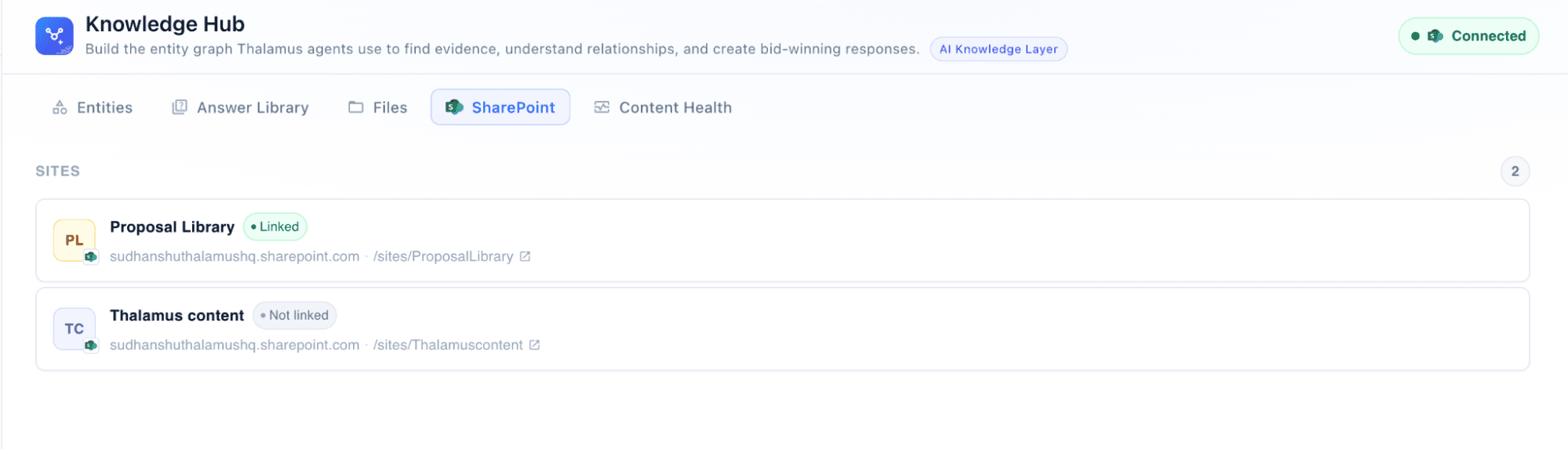
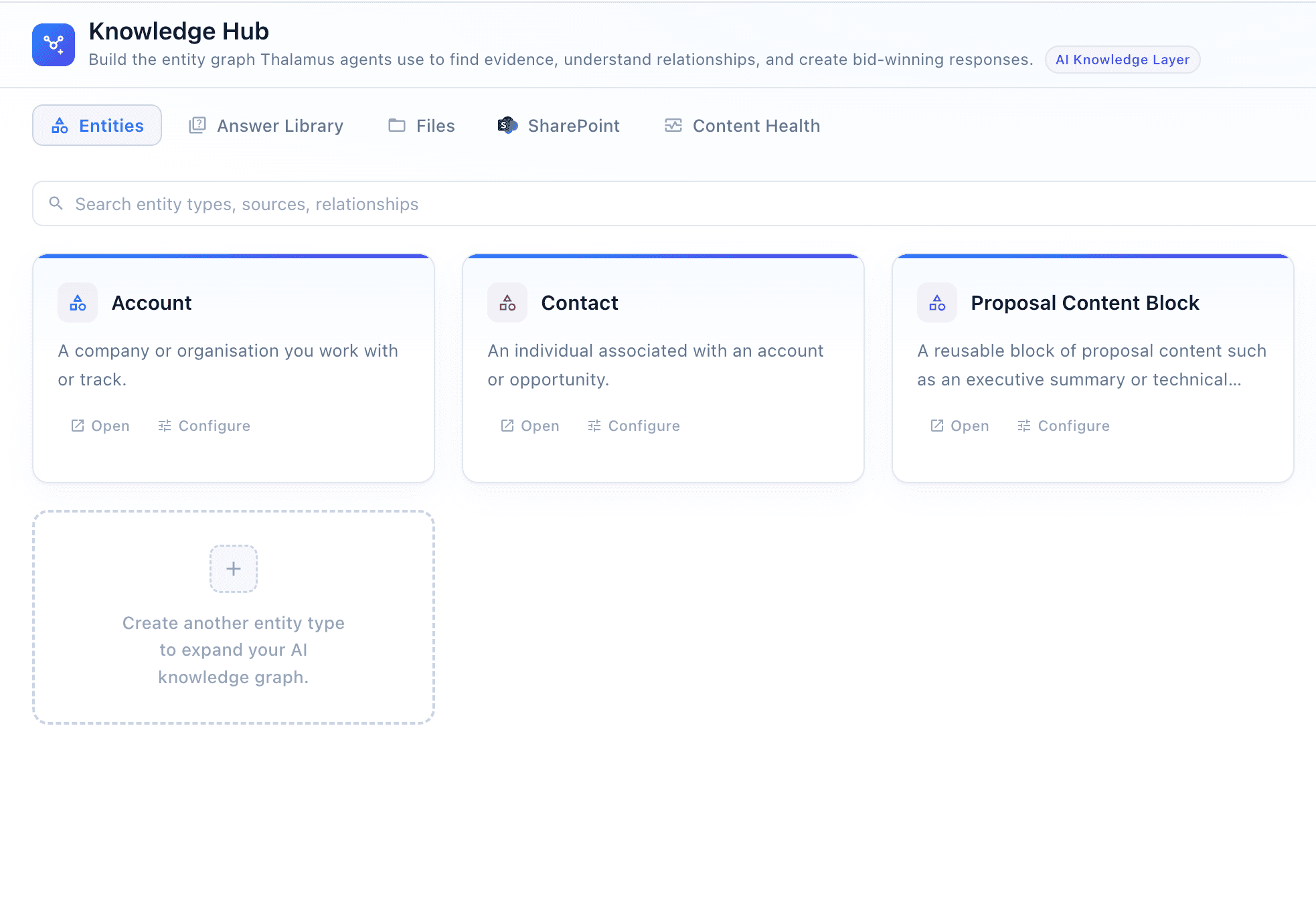
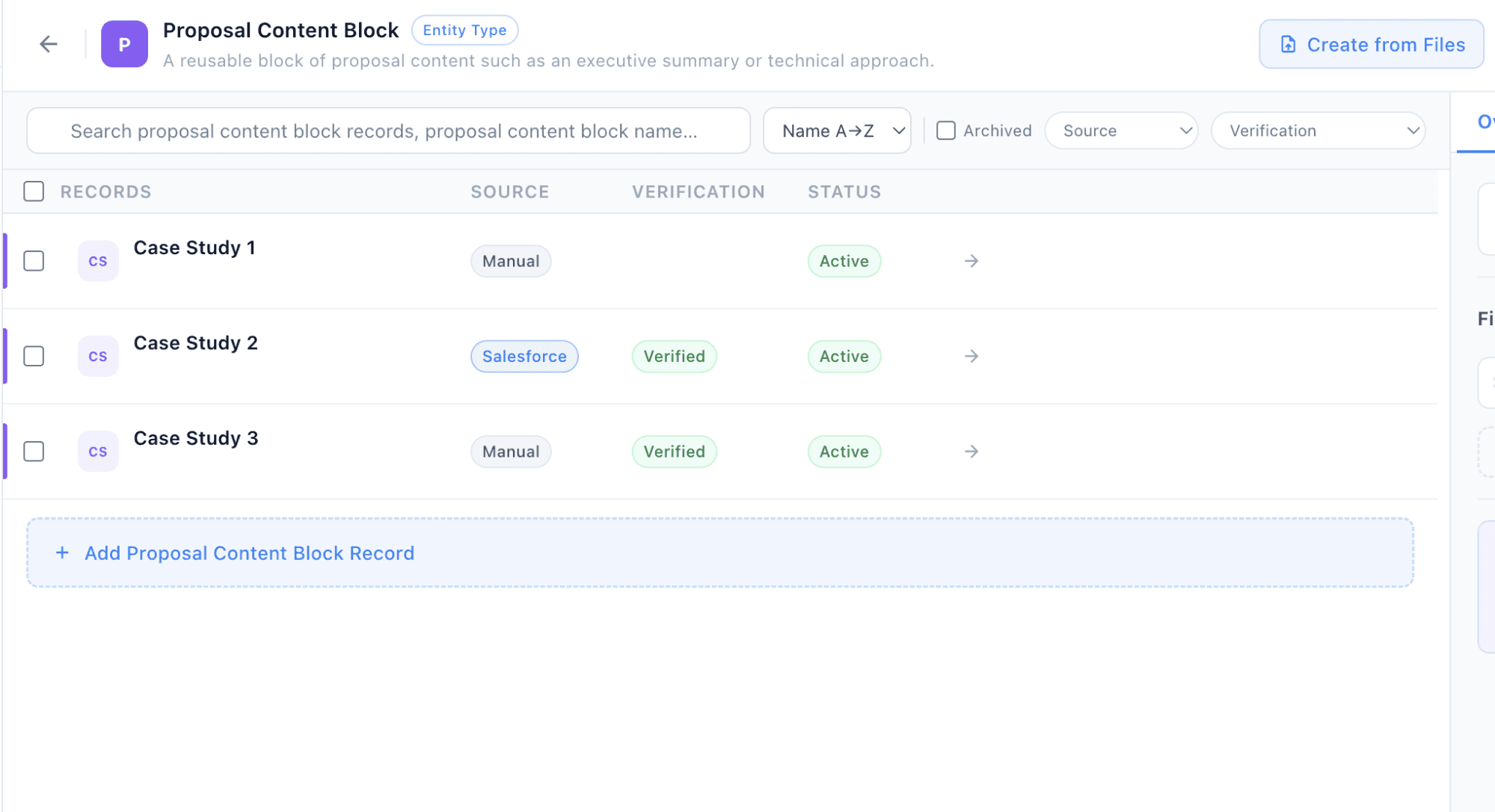
Thalamus AI's Knowledge Hub is the evidence layer underneath everything else the platform does. Instead of a flat Q&A library, Thalamus AI structures company knowledge into Entity Records, case studies, client references, service capabilities, and project experience that teams can open and edit directly, rather than hunting through a folder of old proposals for the current version.


Thalamus AI connects those Entity Records to real CRM data from Salesforce, HubSpot, or other enterprise CRM platforms, pulling in accounts, contacts, opportunities, and buyer relationships. That matters because a strong RFP answer isn't only "do we have this capability?" It's "have we worked with this buyer before, who on our team knows them, do we have a live reference, which similar customer did we solve this exact problem for?" Thalamus AI turns that CRM context into a working part of the bid, not a fact someone has to remember and mention in a Slack thread.

Thalamus AI also lets teams attach AI instructions directly to a knowledge record, so a case study doesn't get pulled into every answer just because a keyword matched. A Thalamus AI agent reads those instructions to understand when a record is relevant, what claims it supports, and what it shouldn't be used to imply, before it ever reaches a draft.

Thalamus AI's Knowledge Hub is the evidence layer underneath everything else the platform does. Instead of a flat Q&A library, Thalamus AI structures company knowledge into Entity Records, case studies, client references, service capabilities, and project experience that teams can open and edit directly, rather than hunting through a folder of old proposals for the current version.


Thalamus AI connects those Entity Records to real CRM data from Salesforce, HubSpot, or other enterprise CRM platforms, pulling in accounts, contacts, opportunities, and buyer relationships. That matters because a strong RFP answer isn't only "do we have this capability?" It's "have we worked with this buyer before, who on our team knows them, do we have a live reference, which similar customer did we solve this exact problem for?" Thalamus AI turns that CRM context into a working part of the bid, not a fact someone has to remember and mention in a Slack thread.

Thalamus AI also lets teams attach AI instructions directly to a knowledge record, so a case study doesn't get pulled into every answer just because a keyword matched. A Thalamus AI agent reads those instructions to understand when a record is relevant, what claims it supports, and what it shouldn't be used to imply, before it ever reaches a draft.

Thalamus AI Relationship Graphs: Mapping How Your Proposal Knowledge Connects

This is the piece most bid management software skips entirely. Thalamus AI builds Entity Relationship Graphs that map how proposal knowledge actually connects: service capability to case study, case study to client account, account to contact, contact to reference, reference to technology.

In practice, that means opening a single knowledge record inside Thalamus AI, say, a HIPAA compliance and data-security capability, and seeing every related record and referenced entity in one place: the compliance record it's linked to, the technology capability it depends on, the certifications that back it up. Thalamus AI's Bid/No-Bid Matrix draws directly on this graph to assess capability coverage, proof, and existing buyer relationships, which is what makes a bid/no-bid score defensible instead of a hunch dressed up as a number.

This is also the piece that answers the sequencing question directly: Thalamus AI qualifies a bid using the relationship graph first, and only moves to drafting once that qualification is done. Knowledge and relationships inform the decision to bid. The decision to bid comes before the writing starts.

Ask us to map one real account's relationship graph inside Thalamus AI.

Thalamus AI Content Health: Governance That Runs Itself

Import three years of historical RFP responses into any platform, and you'll get duplicate case studies, conflicting certification dates, and stale content within weeks. The usual fix is a manual audit nobody has time to run.
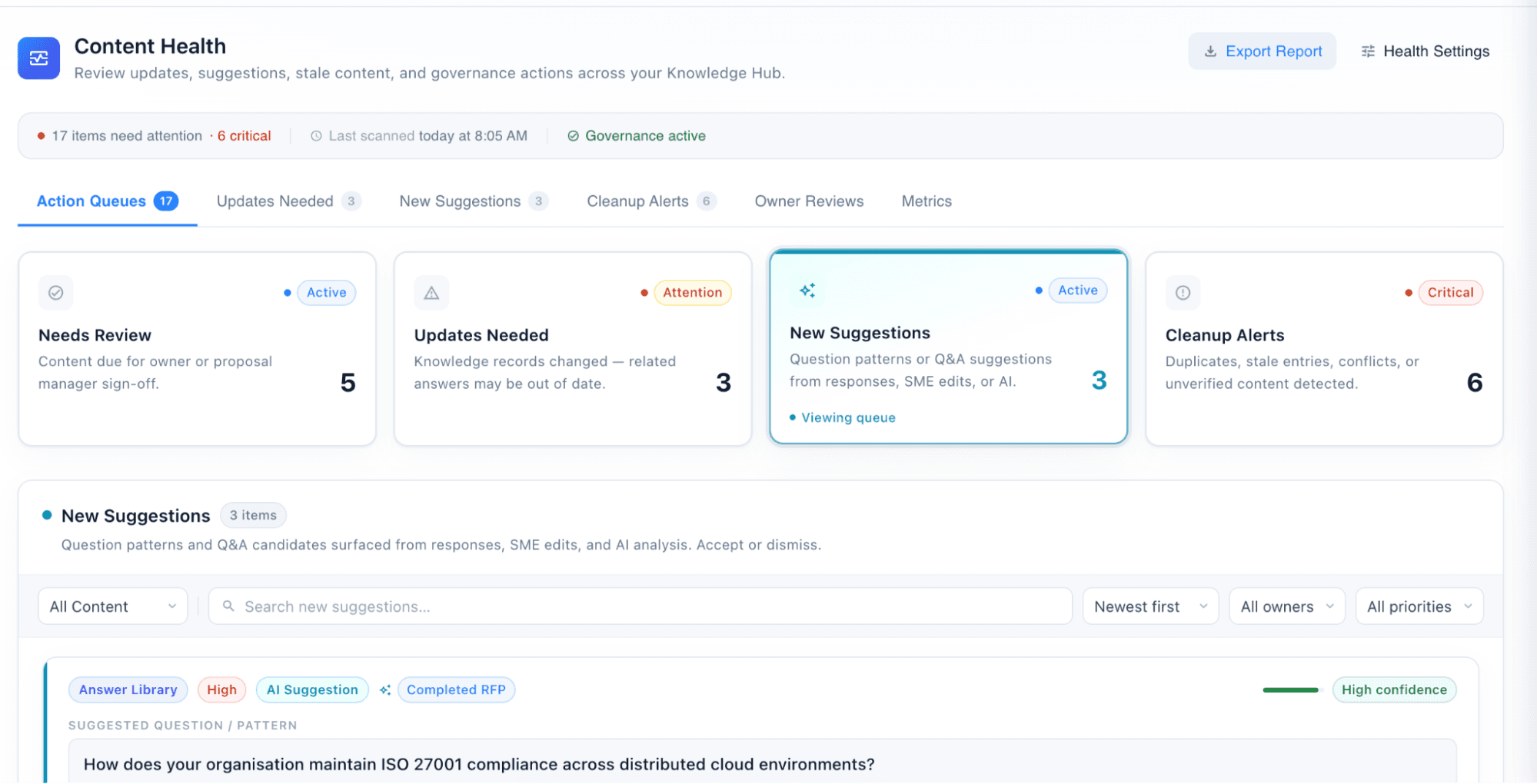
Thalamus AI's Content Health layer is built around exception management instead: it doesn't ask a proposal manager to review the entire library; it surfaces exactly what needs a human look this week, sorted into Needs Review, Updates Needed, New Suggestions, and Cleanup Alerts. Thalamus AI flags duplicates, stale entries, and conflicts automatically; a person still makes the call on what's genuinely outdated versus intentionally different. Thalamus AI is designed to keep humans in control of the decision while removing the burden of finding what needs a decision in the first place.

AI RFP Answer Library: Maintain Approved Knowledge, Not Duplicate Q&A

Traditional RFP libraries create their own maintenance problem: twenty phrasings of the same buyer question become twenty separate Q&A records to keep in sync. Thalamus AI organizes the Answer Library around knowledge areas instead, so SMEs maintain the underlying approved information once, and Thalamus AI manages the question variants and guidance around it.

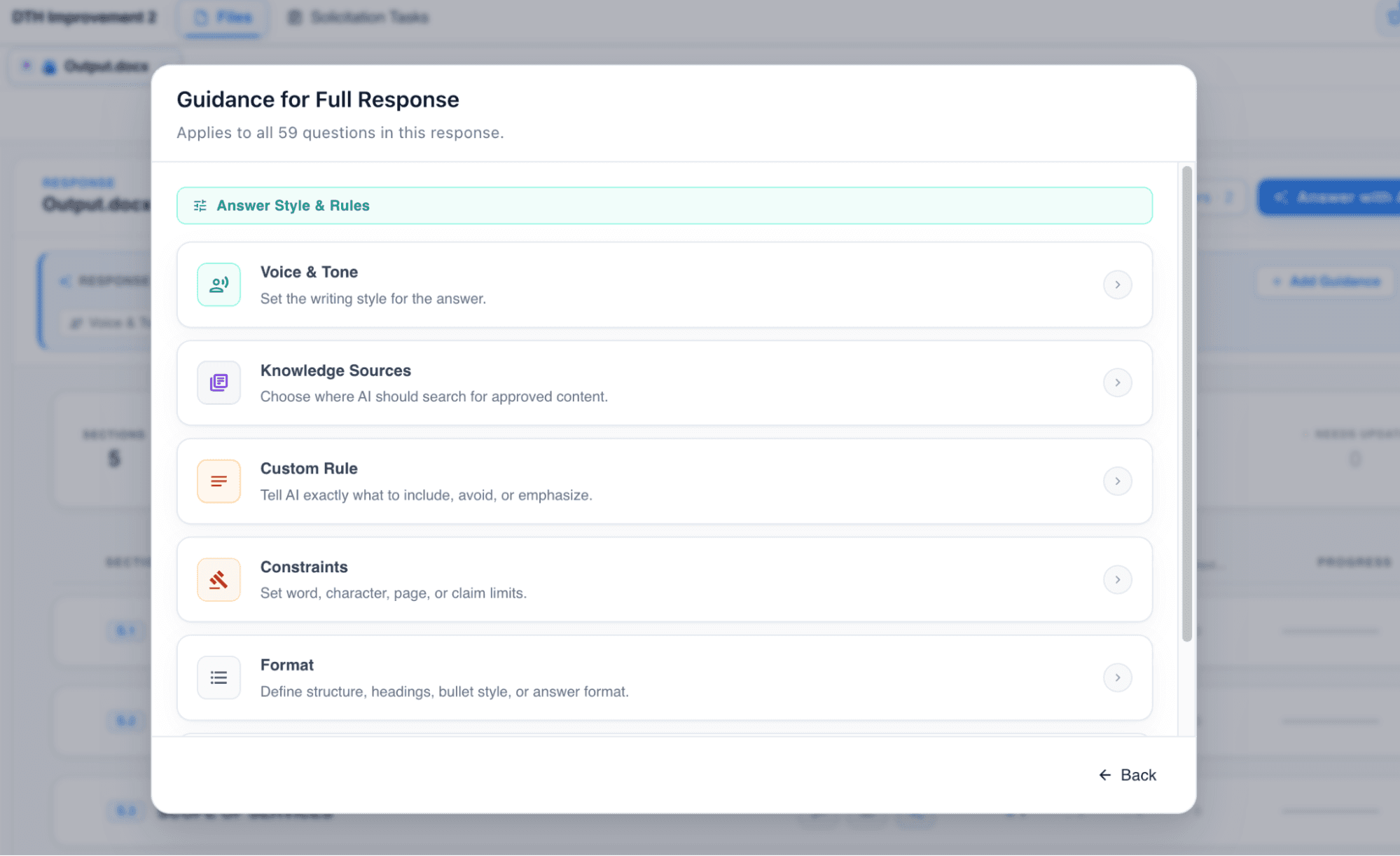
Thalamus AI also runs closed-loop learning on top of this: reviewed and corrected responses feed back into the Answer Library automatically, so the library improves through live RFP work instead of relying on a periodic cleanup project. In Thalamus AI's own internal workflow data across enterprise deployments, this design is built to cut answer-library maintenance by up to roughly two-thirds, by shifting the unit of maintenance from individual Q&A pairs to the approved information underneath them.

Book time to see Thalamus AI's Answer Library against your current content.

Thalamus AI Bid/No-Bid Matrix: Qualify Before You Write

Most teams run bid/no-bid as a conversation, not a system: sales wants to bid because the account is strategic, delivery isn't sure about capacity, and nobody has actually checked whether the company has a real relationship with this specific buyer.
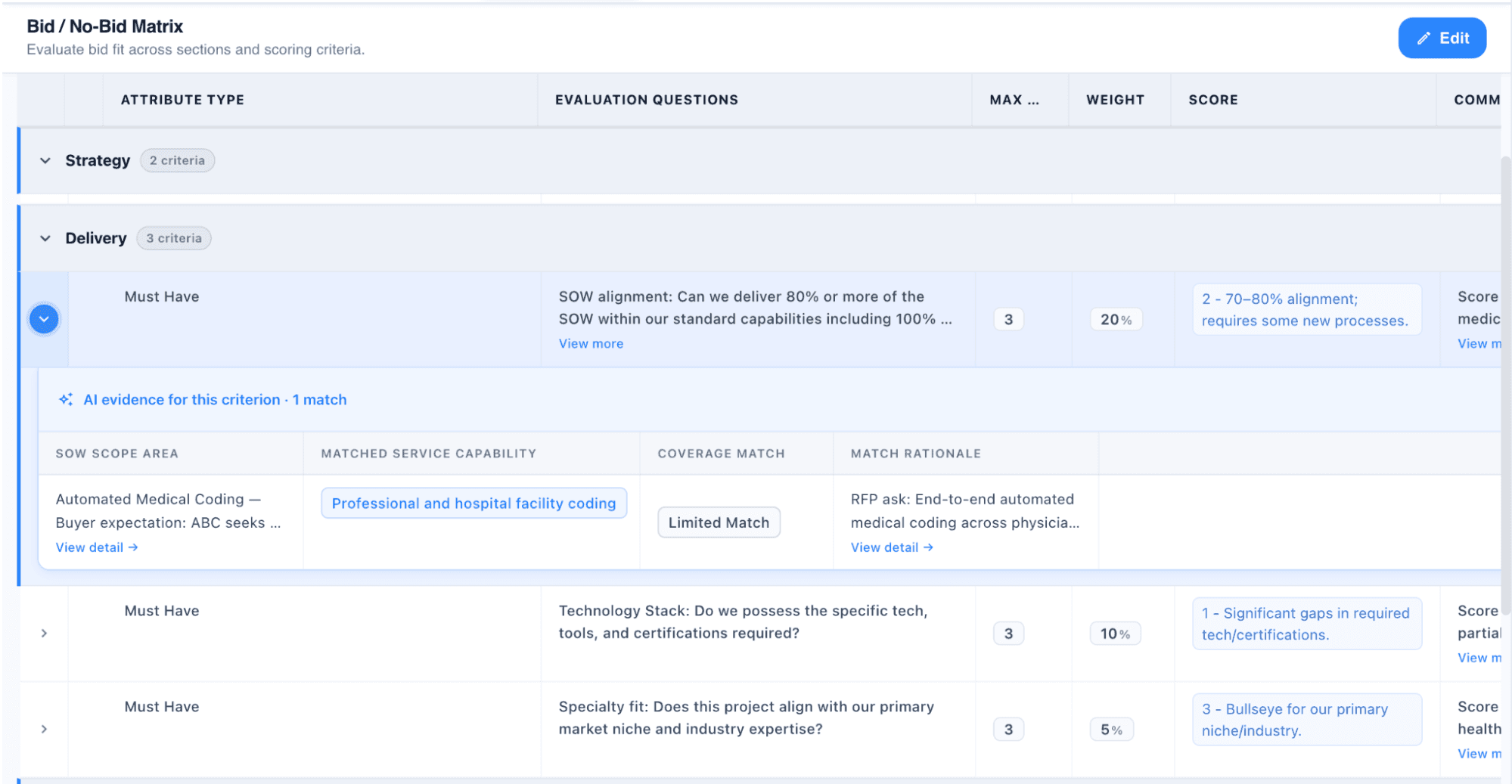
Thalamus AI's Bid/No-Bid Matrix is configurable around the weighted criteria your company already uses: existing relationship, delivery capability, technology fit, target-market alignment, booking value, and scores each one against the entity and relationship graph described above. 

A Thalamus AI score of "70 to 80 percent capability alignment, requires some new processes" isn't a gut call; it's traceable to the exact SOW line item that didn't match an existing capability record. 

Thalamus AI lets teams apply this selectively too: some bids are obvious, and Thalamus AI supports lighter scoring for those so qualification effort goes where it actually changes the decision.

Thalamus AI Ownership Matrix and SME Routing: Get the Right People In Before Kickoff

The pattern I've watched repeat across proposal teams: the kickoff call is the first time Legal sees the liability clause, the first time Security sees the compliance requirement, and two days get lost to a review cycle that could have started a week earlier.
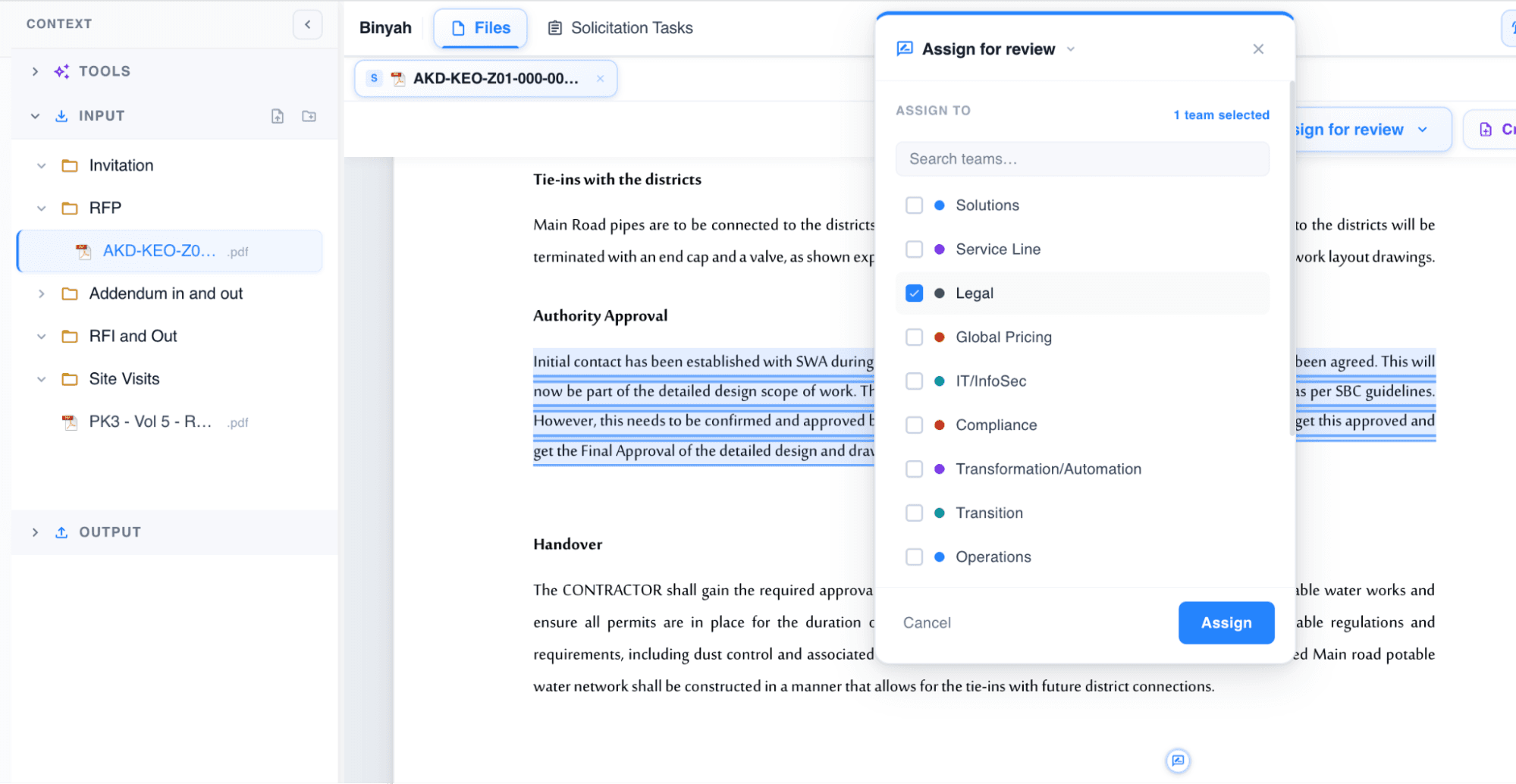
Thalamus AI's Ownership Matrix reads the RFP content and classifies which sections need review from which function- Operations, Security, Legal, Finance- before response writing even starts. Thalamus AI routes only the relevant sections to each SME, so a proposal manager isn't manually parsing a 200-page pack to work out who needs to see what. Comments, annotations, and assignments stay inside the Thalamus AI workspace rather than scattering across email threads and offline Word files. By the time kickoff happens, the risks and constraints are already visible, and Thalamus AI turns that meeting into a decision meeting instead of a document-reading meeting.

Walk through Thalamus AI's Ownership Matrix on a 200-page RFP.

Thalamus AI Journal and Bid Intelligence: Build the Win Strategy Before You Draft

Thalamus AI's Journal turns the RFP into shared bid intelligence before drafting begins: buyer priorities, incumbent context, pain points, evaluation criteria, and win themes, all captured in one place instead of living in one person's head or a kickoff slide that gets forgotten by week two.

Thalamus AI carries that context forward automatically. Win themes defined in the Journal become guidance attached to the relevant sections and questions, so technical, operational, and executive answers reinforce the same strategy without anyone manually repeating the same sentence three times. This is what a real capture brief looks like inside Thalamus AI: what the buyer is asking, what matters most to them, where the company differentiates, and what the response team should emphasize, all connected to the same knowledge and relationship data covered above.

Thalamus AI Clarification Register: Ask Only What Needs Asking

Sending a buyer a clarification question that the RFP already answered on page 40 tells them your team didn't read the package closely, before they've read a single proposal answer.
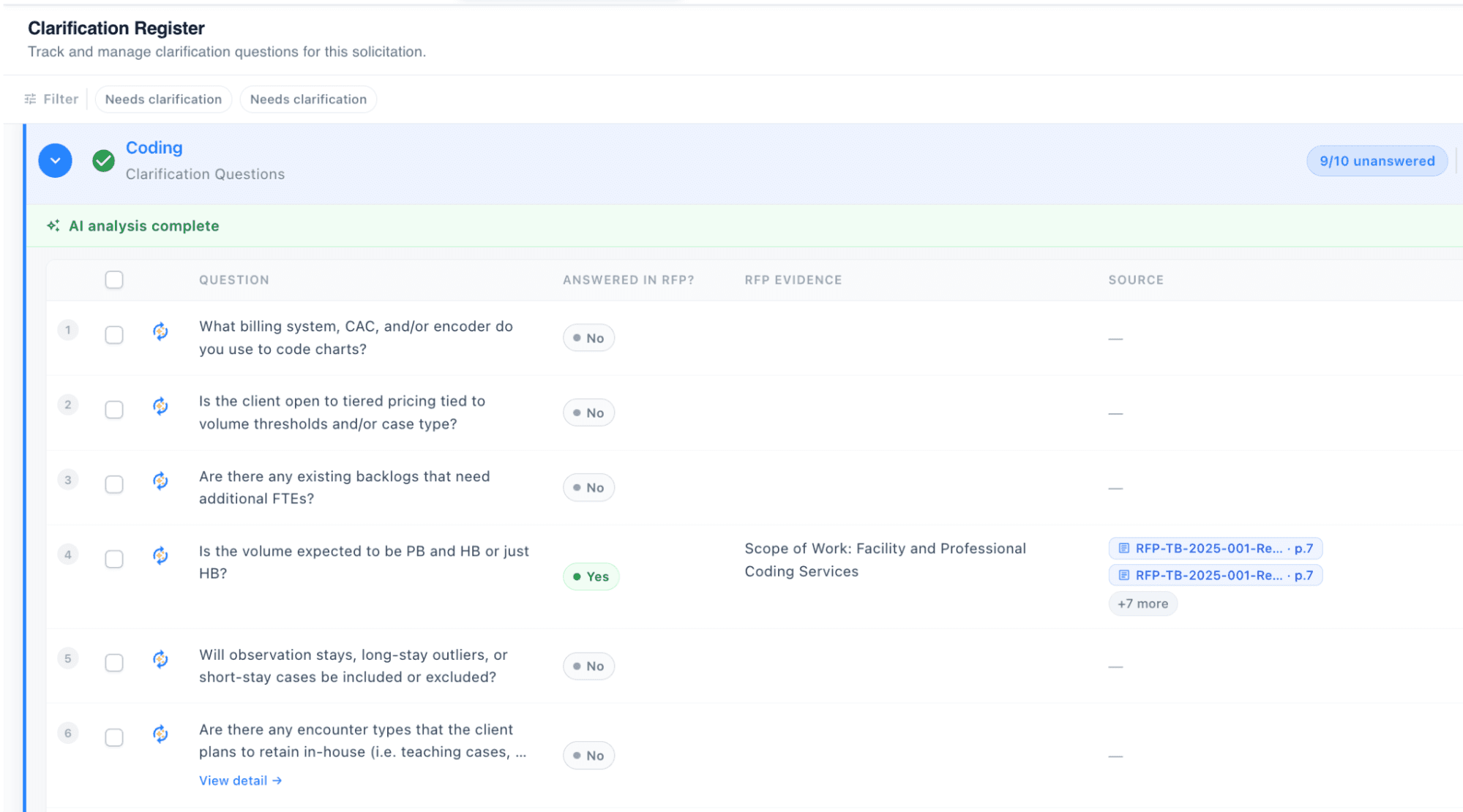
Thalamus AI's Clarification Register reads the entire RFP package and checks every draft clarification question against it before anything goes out, flagging what's already answered and surfacing only genuine gaps. Thalamus AI builds this register before assumptions quietly enter the draft, and the useful questions that come out of a live RFP feed back into a reusable library for future bids.

Thalamus AI Response Generation: Auto-Capture, Evidence, and Control

Thalamus AI identifies sections, questions, and response fields directly from the source RFP document, Word, Excel, or PDF, and builds the response structure automatically, so teams aren't manually rebuilding a buyer's workbook by hand. Everything Thalamus AI auto-captures stays fully editable; the team can restructure, add, or remove anything.

Thalamus AI lets teams steer AI guidance at three levels: the full response, a single section, or one sensitive question, controlling voice, source, required proof, constraints, and format at whichever level actually matters. And every draft Thalamus AI generates shows the evidence behind it and the rationale for why that evidence was used, with reviewer control to swap sources, adjust guidance, or regenerate. Thalamus AI is built so a reviewer can see why an answer says what it says, not just trust that it does.

See Thalamus AI auto-capture a real RFP and show its evidence trail.

Thalamus AI Voice Builder: Write in Your Own Team's Voice

A proposal that reads as five different authors reads like a team that didn't proofread. Thalamus AI's Voice Builder solves this by analyzing writing samples your team already likes, successful proposals, response samples, and learning directness, sentence structure, tone, and level of detail directly from them, then turning those patterns into a reusable team voice.
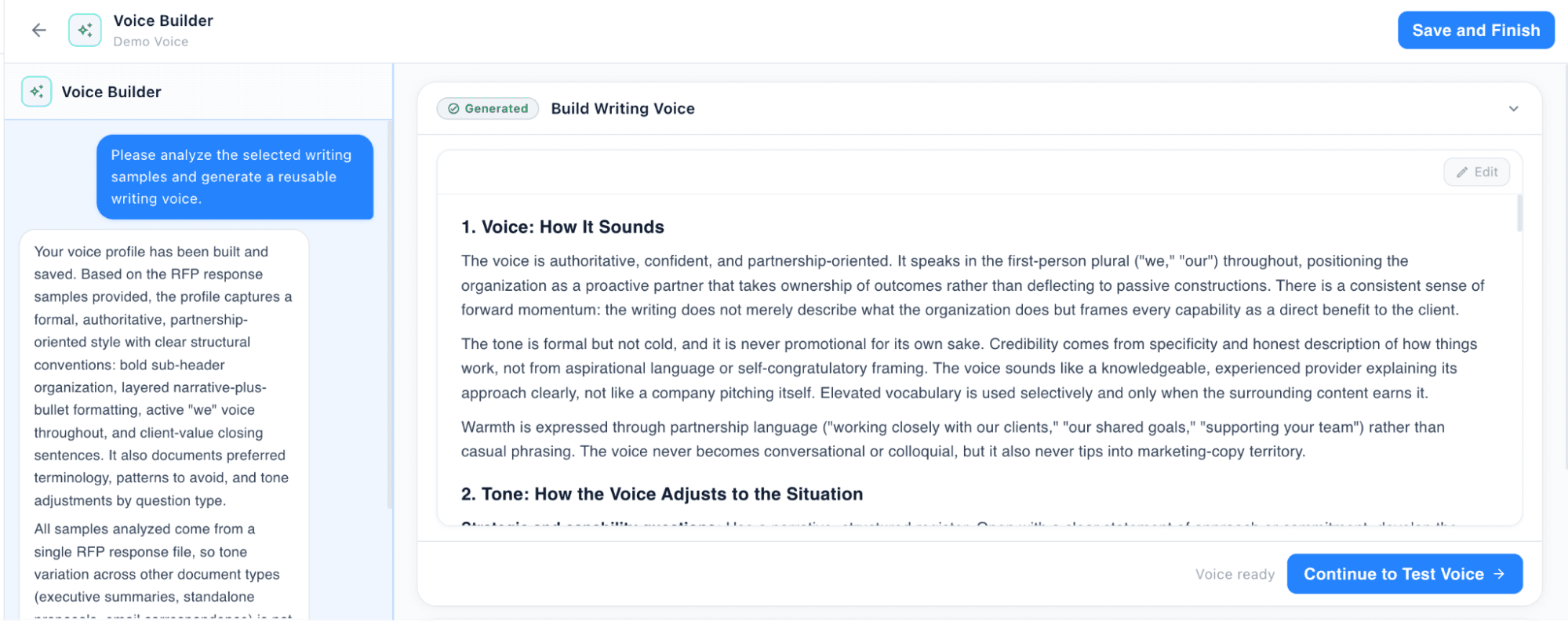
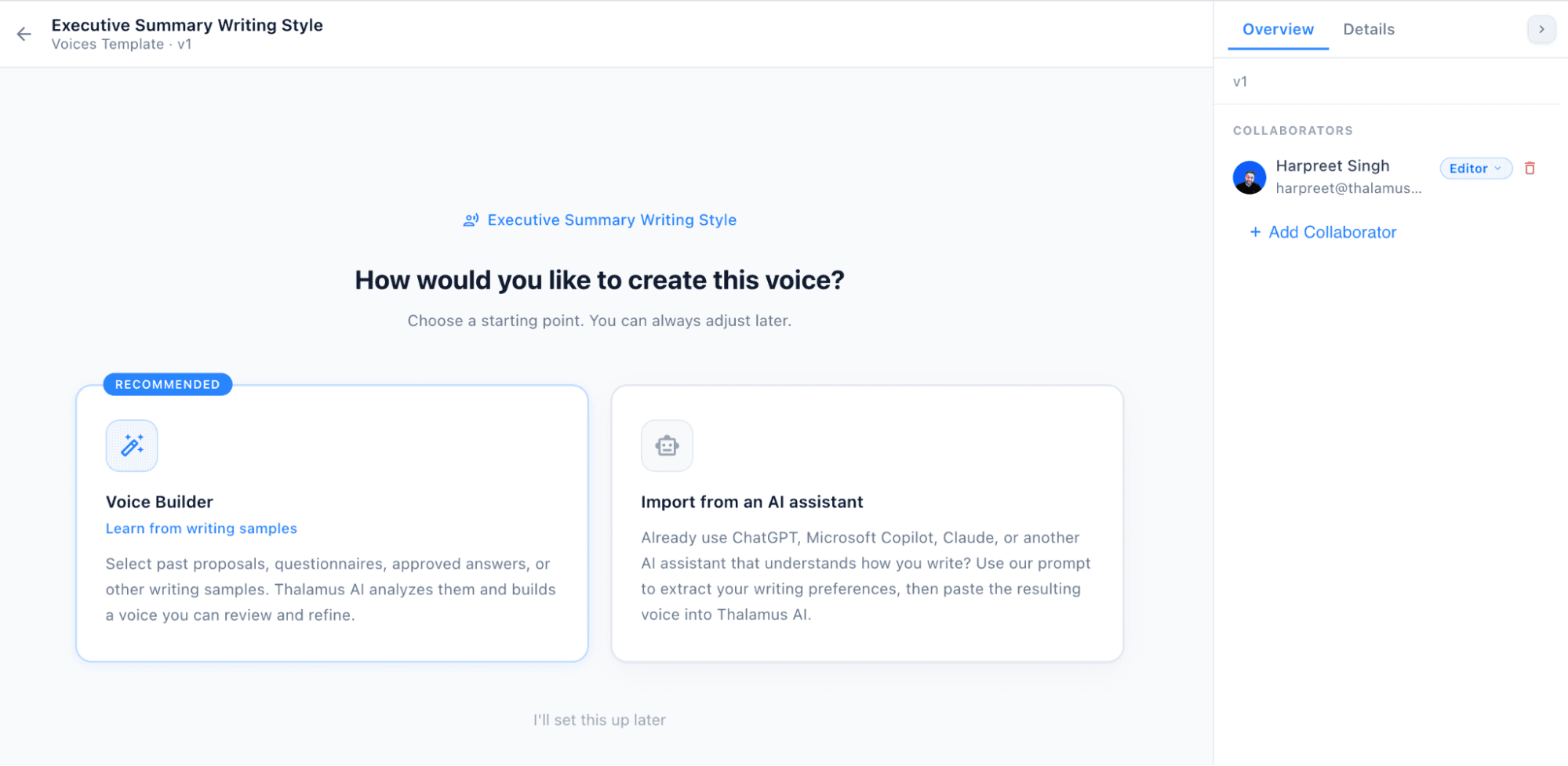
Thalamus AI builds voices at the team level, not writer by writer, so answers stay consistent even when multiple SMEs and contributors touch a single response. Teams can build more than one voice in Thalamus AI too; a technical implementation response reads differently from an executive narrative, and Thalamus AI supports both without forcing a single tone across every document type.

Import Your Writing Style Into Thalamus AI From ChatGPT, Copilot, Claude, or Gemini

If your team has already spent time refining a proposal voice inside ChatGPT, Microsoft Copilot, Claude, or Gemini, Thalamus AI doesn't ask you to start over. Thalamus AI's import flow takes an existing writing-style profile from any of those assistants and converts it into a reusable, team-level voice inside Thalamus AI, ready to apply consistently across every RFP response.
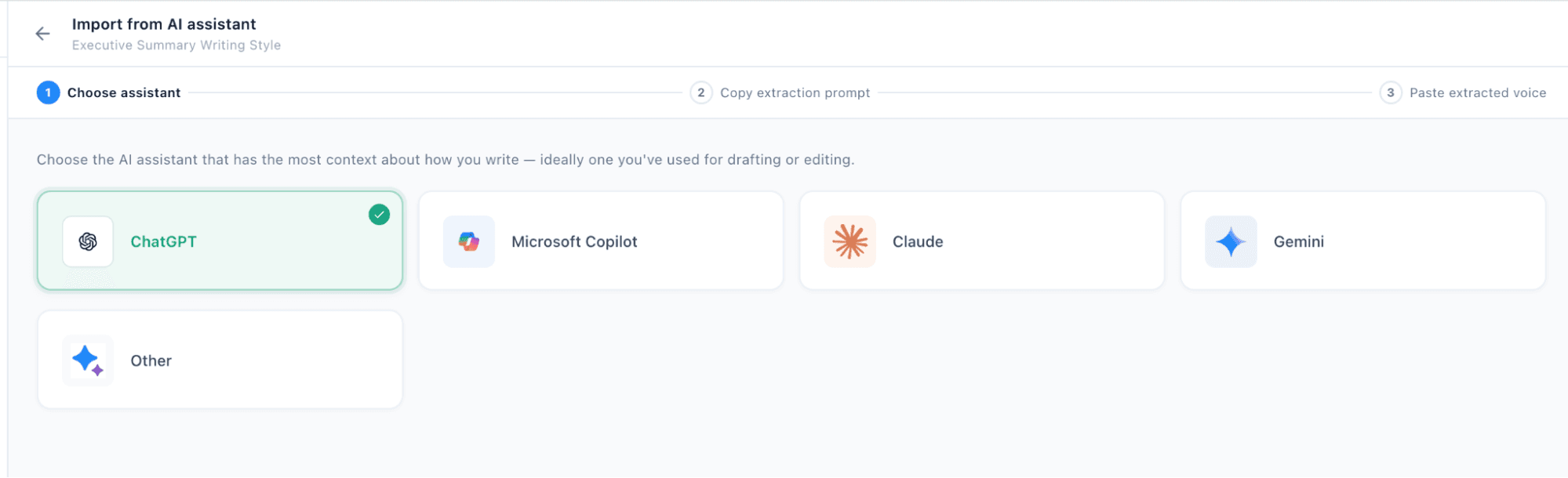
Once imported, that voice can be tested inside Thalamus AI against real RFP questions before it's rolled out, so teams can compare the output to approved samples and refine it until it actually sounds like them. Thalamus AI carries that same voice across every contributor and region, so the final proposal reads as one document, not five people's individual drafts stitched together.

Bring your team's existing ChatGPT or Claude voice into a live Thalamus AI demo.

Thalamus AI Export Studio: Brand, Review, Approve, Export

Thalamus AI keeps final review inside the platform instead of taking the proposal offline. Reviewers comment directly on the final document inside Thalamus AI, working at both the answer level and the full-document level, instead of downloading a copy, marking it up offline, and emailing it back for someone else to reconcile.
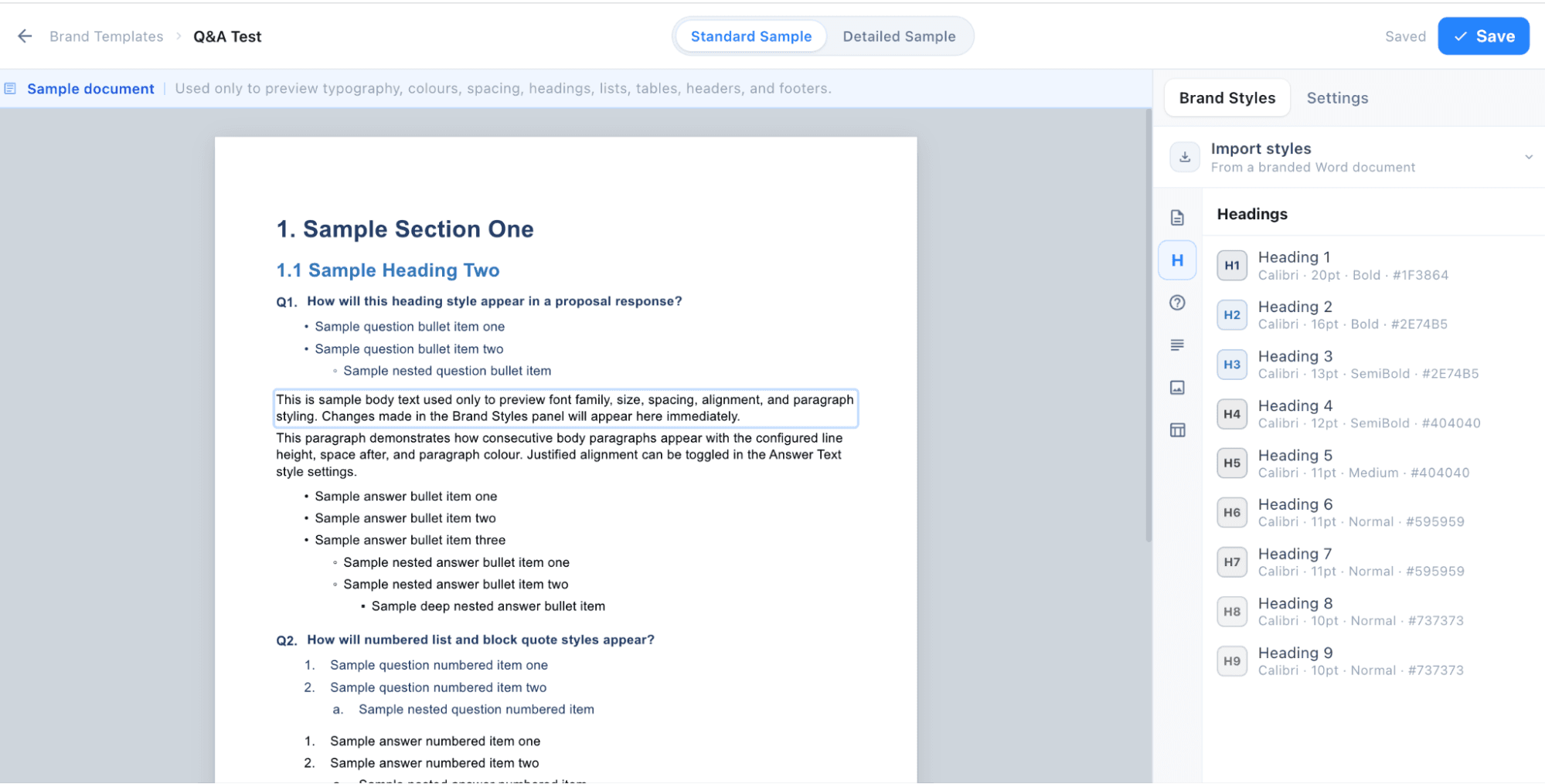
Thalamus AI's Export Studio applies reusable brand templates, typography, colors, headings, and layouts, defined once and reused across every future proposal. Export gates in Thalamus AI mean the document doesn't go out until the right people have signed off, and the final export lands in the format the buyer actually needs. A proposal that never has to leave Thalamus AI to get formatted is a proposal that never reintroduces version-control risk at the finish line.

Thalamus AI Institutional Memory: Every Win and Loss Makes the Next Bid Smarter

This is the piece that closes the loop, and it's the one most bid management software never builds at all. Thalamus AI captures knowledge, decisions, guidance, reviews, and outcomes directly inside the workflow: every approved answer, every qualification decision, every win theme, every reviewer edit, every final output.

Once a bid is won or lost, that outcome updates Thalamus AI's institutional memory. A losing bid's win themes get reassessed. A winning bid's case studies and evidence get reinforced as proof that works. Thalamus AI feeds that outcome back into the same Knowledge Hub, Bid Intelligence, and Bid/No-Bid layers covered earlier in this piece, so the qualification score on your next RFP is informed by what actually happened on the last one, not just what looked promising going in. The tenth bid your team runs on Thalamus AI should be measurably easier to qualify and write than the first one. That compounding effect is the actual point of running the whole lifecycle on one platform instead of six disconnected tools.

Who Is Thalamus AI Built For?

Thalamus AI is probably not the right fit if your team primarily handles short, standardized questionnaires rather than complex multi-section RFPs, if you need a lightweight tool for a small team with low submission volume, or if your main use case is answering ad-hoc buyer questions in Slack rather than coordinating a full proposal across Legal, Delivery, Security, and Sales.

Thalamus AI is built for enterprise proposal teams running complex, multi-stakeholder bids, healthcare, RCM, AEC, government contracting, and professional services in particular, where an RFP touches four or five internal functions before a single answer gets written, and where a wrong bid/no-bid call costs the team more than a slow draft ever would.

What Changes When You Run the Full Bid Lifecycle on Thalamus AI?

In Thalamus AI's internal workflow analysis across enterprise customers in 2025 to 2026, teams running the full lifecycle on Thalamus AI saw roughly two-thirds less time spent on answer-library maintenance, about twice the SME turnaround speed, three times the shortlist rate, and a 1.5x lift in win rate. These are Thalamus AI's own study and numbers based on current client results, and results vary by team size, bid volume, workflow complexity, and content maturity going in.

The pattern underneath those numbers holds regardless of the exact figure your team sees: less time spent operating the bid on Thalamus AI, more time spent shaping whether it's actually winnable.

Bring one live RFP to a 20-minute Thalamus AI walkthrough, intake through export.

Frequently Asked Questions

What is Thalamus AI? 

Thalamus AI is AI-native bid management software built for the full bid lifecycle rather than answer generation alone. It covers capture, knowledge management, bid/no-bid qualification, SME coordination, clarification management, response generation, review, export, and win/loss learning, all inside one connected platform.

What makes Thalamus AI different from RFP response software? 

RFP response software typically starts at the question and ends at the answer. Thalamus AI starts earlier, at whether to bid at all, using CRM-connected knowledge and relationship graphs, and continues past the draft into SME review, export, and institutional memory that carries into the next bid.

Does Thalamus AI work with our existing CRM and content storage? 

Yes. Thalamus AI connects natively to Salesforce, HubSpot, SharePoint, and Google Drive rather than requiring a migration first. Entity Records inside Thalamus AI pull CRM context directly, and SharePoint folder structures and permissions carry over as they already exist.

Can Thalamus AI match my team's existing writing style? 

Yes, in two ways. Thalamus AI's Voice Builder can learn your team's voice directly from past proposals and response samples, or import a writing-style profile you've already built in ChatGPT, Microsoft Copilot, Claude, or Gemini and turn it into a reusable Thalamus AI voice.

How does Thalamus AI learn from wins and losses? 

Every outcome feeds back into Thalamus AI's Institutional Memory layer. Win themes, evidence, and qualification decisions all update based on what actually happened, so Thalamus AI's Bid/No-Bid scoring and Answer Library get more accurate with every bid your team runs.

Table of Content