
Harpreet Singh, MBA
Founder, Thalamus AI

With 12+ years in AI and enterprise software, including GenAI product work at Travelers, Harpreet writes about AI RFP software, AI bid tools, proposal operations, RFP response automation, and the future of enterprise bid management.

Thalamus AI vs General LLMs: The Hidden Cost That Never Appears on the Invoice
Here's what I've consistently seen teams miss when they decide that ChatGPT is "good enough" for RFPs: the comparison they make is between the cost of a general LLM subscription and the cost of a purpose-built platform.
That is the wrong comparison. The right comparison is between the total cost of using each approach, including the time your team spends re-uploading documents, rebuilding context, correcting hallucinations, manually reviewing addenda, chasing SMEs without routing infrastructure, and losing bids that should have been won.
Research across real-world RFP workflows consistently shows that specialist RFP platforms achieve approximately 95% accuracy on domain-specific questions, compared to approximately 65% for general-purpose models applying their training knowledge to your specific bids (ContraVault AI, 2026).
That 30-point accuracy gap does not appear in a feature comparison. It appears in the number of answers your team has to rewrite before submission, the compliance requirements that get missed, and the proposals that go out with contradictory claims because two team members prompted the same LLM differently.
Even the best general LLMs hallucinate company-specific facts when the context is absent or incomplete. An independent 2026 test of ChatGPT, Claude, Gemini, and Perplexity against real RFP question sets found that when a company-specific detail was missing from the uploaded context- a founding year, a project reference, a certification date- models would confidently generate plausible-sounding but fabricated answers rather than flagging the gap.
In a security questionnaire or a government bid, a fabricated compliance claim is not a drafting error. It is a disqualification risk.
Thalamus AI's verified knowledge entity layer is built to close exactly that gap. Before any draft is generated, the underlying knowledge has been structured, attributed, and flagged for currency.
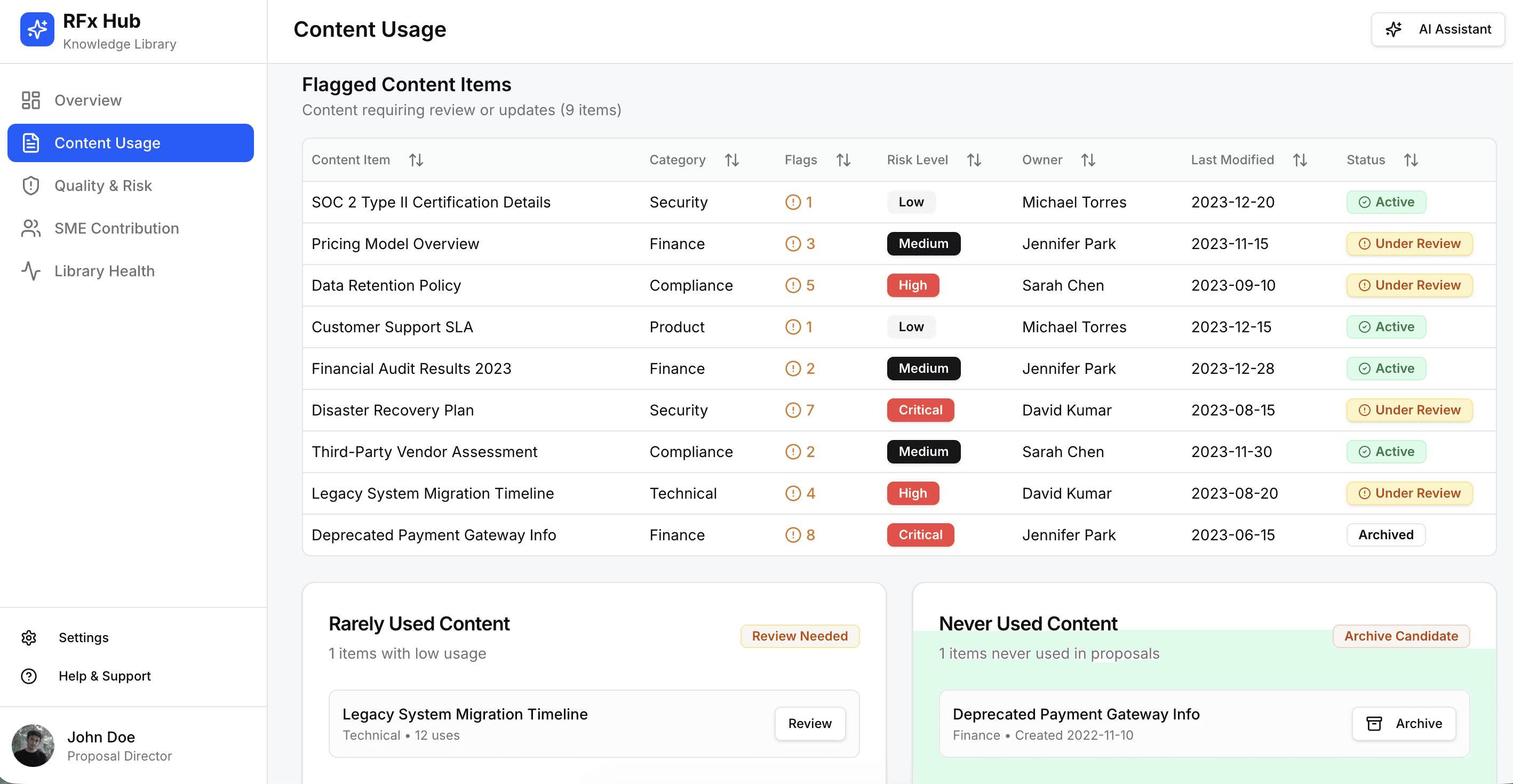
The AI does not guess at your company's project history. It cites it, with a link back to the source document and a verification status that tells your team whether that source has been reviewed recently.
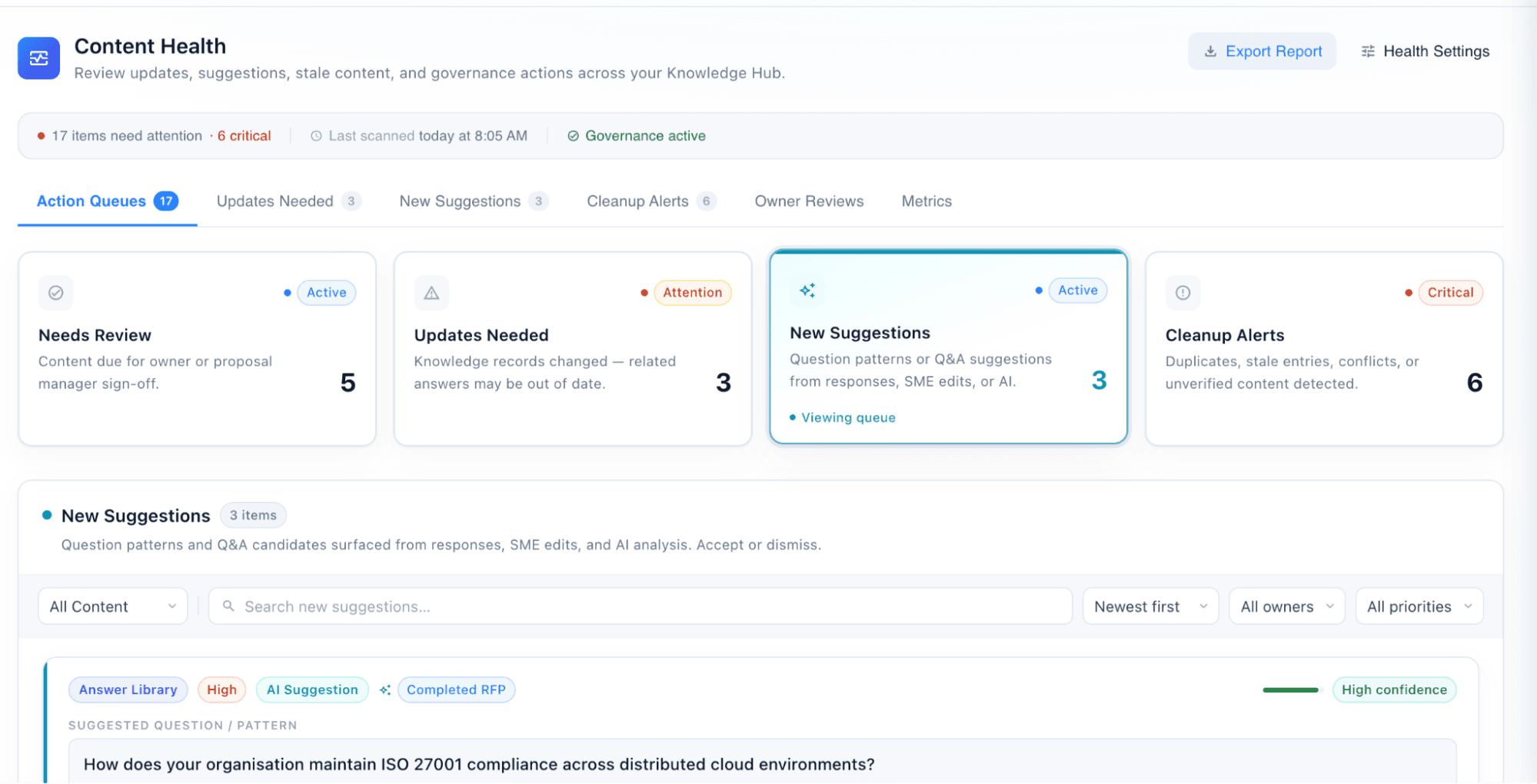
That verification status isn't a one-time check. Content Health continuously scans the knowledge layer for duplicates, stale entries, and conflicting claims, surfacing only what needs a human decision instead of asking your team to re-audit everything, which is the opposite of how a general LLM session works, where accuracy resets every time someone starts a new chat.
Concerned about hallucinations in your current RFP process? See how Thalamus AI's verified knowledge layer prevents ungrounded claims before they reach the draft.
Thalamus AI vs General LLMs on Complex, Multi-Section Proposals
Imagine this: Your team receives a 200-question government infrastructure RFP. Section 4 requires evidence of at least four comparable projects completed within the last five years. Section 7 requires specific team member CVs with certification dates.
The evaluation criteria award points for demonstrating continuity of key personnel across similar contracts. An addendum arrives nine days before the deadline, clarifying that "comparable projects" must now include project value above a defined threshold, changing which of your portfolio projects qualify.
What a general LLM does: Your team pastes the RFP into ChatGPT or Claude, uploads whatever documents they have as context, and prompts for a first draft. If your project database is in SharePoint and your CVs are across various folders, someone spends two to three hours manually gathering and uploading the right documents. The draft lands. It is fluent and coherent.
Now your team needs to verify every project reference, check every CV date, confirm that the cited certifications are current, and manually identify which answers are affected by the addendum. That verification process, which the LLM cannot do, takes as long as the drafting did. And the next time a similar bid arrives, the team starts the document-gathering and context-building process from scratch.
What Thalamus AI does: Your company's projects, CVs, and case studies have already been parsed into structured knowledge entities, editable, auditable, and traceable to source documents. When the RFP arrives, the Analysis Agent shreds it, extracts all requirements, and generates a compliance matrix that maps every requirement to a response section, an owner, and a review gate.
The system identifies which of your verified projects meet the comparability threshold, generates a draft narrative from those entities, and cites each one. When the addendum arrives, Thalamus flags every section where the threshold change affects a project reference and routes the update to the right SME. The team does not need to sweep the document manually. The compliance matrix reflects the updated status within minutes.
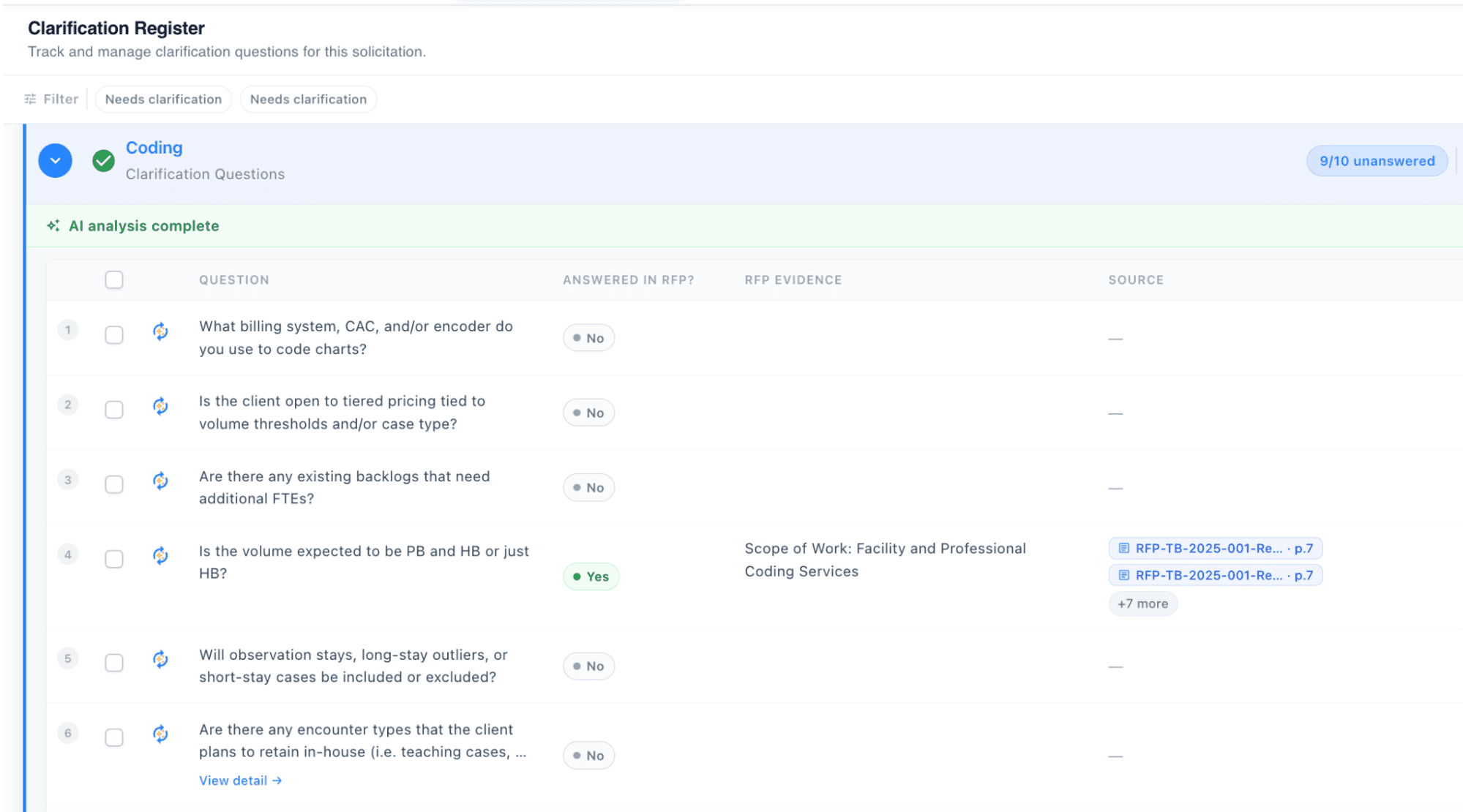
Before the response is finalized, the Clarification Register also checks whether any open question the team has, like the exact project value threshold that now applies, is already answered somewhere in the RFP package, so nobody wastes a clarification request on something buried in an appendix.
The gap between those two workflows is not a feature gap. It is an architecture gap. A language model generates text. A bid management platform manages the bid.
Does your team handle government or complex multi-section proposals? See how Thalamus AI manages from RFP upload to final export, all in one connected workflow.
Where General LLMs Genuinely Win?
I want to be direct about this, because I think the honest version of this comparison is more useful than the one-sided version.
General LLMs are better than Thalamus AI or any purpose-built RFP platform for a specific set of tasks. They are better for open-ended brainstorming where structure and governance don't matter yet.
They are better for executive summary rewrites where you want a range of stylistic options quickly.
They are better for translating content into languages your team doesn't work in regularly.
They are better for ad-hoc question answering when you just need an idea, not a comprehensive response.
They are dramatically cheaper for teams that submit one or two low-stakes questionnaires per quarter and don't need coordination infrastructure.
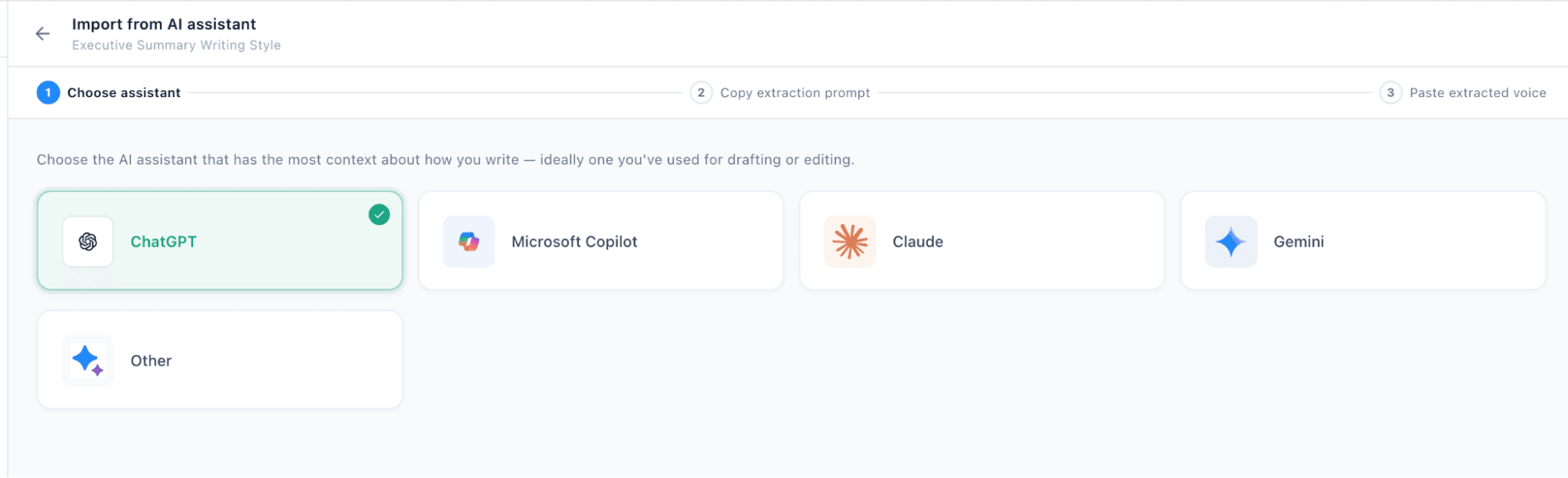
One place this doesn't have to be an either/or: if your team already uses ChatGPT or Copilot for exactly this kind of stylistic flexibility, that voice work can be imported directly into Thalamus AI rather than staying locked in a chat history nobody else on the team can access.
General LLMs are also improving fast. The best models, particularly the latest Claude and GPT-5 releases, have substantially reduced hallucination rates on grounded tasks. Claude's hallucination rate on factual queries in 2026 sits around 3-4% on well-grounded summarisation tasks, with GPT-5.4 close behind at 6–8% (source).
For a team that uploads a well-structured Q&A library and prompts carefully, the draft quality is genuinely good on standard questions.
What general LLMs cannot do, structurally, not because of a version gap, is persist your company's knowledge across bids, route requirements to the right owners, track compliance against a living matrix, flag the impact of a late addendum, or learn from your win/loss history.
Those are not language tasks. They are bid management tasks. And the fact that a language model can produce a convincing paragraph does not mean it can replace the platform that manages the process those paragraphs belong to.
Your team is probably already using LLMs for parts of the RFP process. See how Thalamus AI integrates that capability into a governed, traceable bid workflow.
Thalamus AI vs General LLMs: Who Should Use Each?
Making this decision honestly requires naming the scenario, not just the feature list.
I have seen teams waste months on a general LLM workflow that looked productive and produced bids that lost, not because the writing was poor, but because the process around it had no governance. I have also seen teams use ChatGPT effectively for low-complexity, low-stakes questionnaires and save real money doing it.
The tool is not the problem. The mismatch between the tool and the requirement is.
Stick with a general LLM if:
Your team submits fewer than five proposals per quarter, all of them low-complexity
Your primary use case is rewording and light drafting, not coordination or compliance tracking
You respond to standardised questionnaires where your answers rarely change, and the risk of hallucination is low
Budget is the primary constraint, and your team has the capacity to manually verify every output
You have no need for multi-team coordination, version control, audit trails, or institutional learning
Choose Thalamus AI if:
You manage complex, multi-section proposals where compliance tracking, requirement mapping, and SME coordination are as important as drafting quality
Your knowledge is locked in past proposals, CVs, and case studies that your team has to manually re-gather for every new bid
You submit multiple bids simultaneously and need a platform that tracks progress, ownership, and compliance across all of them
You want every AI-generated response to be traceable, every claim attributed to a source document, and every entity flagged if outdated
You need your bid function to compound: better knowledge, better decisions, and better win rates with every bid cycle
Thalamus AI is probably not the right fit if: your team is small, your bids are simple, and what you actually need is a faster way to draft boilerplate answers to standard questions. A well-prompted general LLM with a clean Q&A upload will do that job at a fraction of the cost, and you should use it.
Ready to see what a purpose-built bid management platform looks like for your team? Start with a 3-month Thalamus AI pilot, unlimited projects, unlimited RFPs.
What Enterprise Customers Report After Moving from General LLMs to Thalamus AI?
Enterprise customers using Thalamus AI across complex proposal environments have reported measurable improvements that go beyond drafting speed, because the problems they were solving were never just drafting problems.
Based on Thalamus AI internal customer performance data (2025–2026), across enterprise teams in healthcare, AEC, government contracting, and professional services:
+34% improvement in response reliability, the result of removing the conditions under which unverified, outdated, or hallucinated content enters a bid. Not faster drafting. Fewer errors.
3x more bid shortlist appearances, across customers managing complex proposals where coordination and compliance had previously been the bottleneck, not content quality
2.5x increase in bid win rates, reported by enterprise teams on the full bid management platform, not just the drafting layer
Proposal teams using agentic AI platforms reported 2.3x higher response accuracy and met procurement deadlines 40% faster compared to teams using generic AI tools like ChatGPT alone (Thalamus AI primary research, 2025).
General LLMs will keep improving. The gap between a well-prompted ChatGPT session and a mediocre RFP response is closing. What is not closing is what cannot close by design - the gap between a language model that generates text and a bid management platform that manages the bid from qualification to submission to institutional learning.
Those are different jobs. And the teams that keep trying to solve a bid management problem with a drafting tool will keep arriving at the same conclusion: the writing was fine. The process wasn't.
Bring one RFP. We'll show you what the full bid lifecycle looks like when the platform is built around it from the start.Book a Thalamus AI demo.
Frequently Asked Questions
Can ChatGPT write RFP responses?
Yes, ChatGPT can write RFP responses if you provide the right context, source material, and instructions. It can help proposal teams summarize an RFP, rewrite draft answers, improve tone, create executive summaries, and produce first-pass responses to standard questions.
But ChatGPT is not an RFP response platform. It does not automatically maintain your approved proposal content, verify company-specific claims, track compliance, route work to SMEs, manage addenda, or learn from past wins and losses. For simple RFPs or low-risk questionnaires, ChatGPT can be useful. For complex bids, enterprise proposal teams still need review workflows, source-linked knowledge, compliance matrices, and human validation before submitting.
What are the best ChatGPT prompts for RFP responses?
Answer: The best ChatGPT prompts for RFP responses are specific, source-aware, and designed to prevent hallucinations. A good prompt should tell ChatGPT what to do, what source material to use, what not to invent, and what to flag for human review. Examples:
RFP summary prompt: “Summarize this RFP into buyer goals, mandatory requirements, evaluation criteria, submission instructions, key risks, and unanswered questions. Do not invent missing information.”
Proposal writing prompt: “Rewrite this bid proposal response to make it clearer, more persuasive, and more buyer-focused. Keep all facts, certifications, metrics, dates, and commitments unchanged.”
Compliance prompt: “Extract all mandatory requirements from this RFP. Group them by legal, technical, pricing, security, delivery, and administrative requirements. Mark uncertain items as ‘Needs review.’”
SME review prompt: “Identify which sections of this response need review from legal, pricing, security, finance, delivery, or technical SMEs.”
These prompts help with early drafting and analysis. They do not replace AI RFP software that manages requirements, owners, review gates, compliance status, source links, and addendum changes across the full RFP lifecycle.
Can Microsoft Copilot help with RFP responses?
Yes, Microsoft Copilot can help with RFP responses, especially when proposal teams work inside Microsoft 365. Copilot can summarize RFP documents, search internal files, rewrite proposal sections, create meeting summaries, draft emails to SMEs, and help organize content from Word, Excel, Outlook, Teams, SharePoint, and OneDrive.
Copilot prompts for RFP work can help with tasks like:
“Summarize this RFP and list all mandatory requirements.”
“Create a review checklist for this proposal response.”
“Draft an email to the security team asking them to validate these questionnaire answers.”
“Rewrite this proposal section in a more executive, client-focused tone.”
Copilot is useful for productivity. But it is not designed as a dedicated RFP software platform. It does not automatically create a live compliance matrix, manage bid/no-bid scoring, maintain a verified RFP content library, track addendum impact, or build institutional memory across every submission.
What is the difference between ChatGPT and AI RFP software?
ChatGPT is a general-purpose language model. It generates, summarizes, rewrites, and reasons over text based on the context you provide in a session. It is useful for proposal writing, brainstorming, editing, and first drafts.
AI RFP software is built specifically for proposal and bid workflows. A purpose-built AI RFP platform helps teams manage the full RFP lifecycle: bid qualification, requirement mapping, compliance matrices, SME collaboration, source-linked proposal drafting, review gates, addendum tracking, portal responses, and post-submission learning.
The simplest difference is this:
ChatGPT helps write answers.
AI RFP software helps manage the bid.
For enterprise proposal teams, the hard part is rarely just writing. The hard part is knowing which requirements matter, who owns each section, whether every answer is compliant, which sources are approved, what changed in an addendum, and what the team should learn for the next bid.
When should proposal teams stop using prompts and use an RFP platform?
Proposal teams should consider moving from prompts to an RFP platform when the RFP process becomes too complex to manage manually.
Signs that prompts are no longer enough:
Your team manages multiple RFPs at the same time.
SMEs from legal, pricing, security, finance, delivery, and technical teams need to contribute.
You need a compliance matrix for every bid.
You spend too much time checking whether AI-generated answers are accurate.
Your content lives across SharePoint, Google Drive, OneDrive, old proposals, PDFs, spreadsheets, and inboxes.
Addenda change requirements mid-cycle, and your team has to manually find impacted sections.
Your team repeats the same mistakes because win/loss learnings are not captured.
ChatGPT prompts can help with writing. An RFP platform helps with governance, compliance, collaboration, source traceability, and institutional learning. Once the workflow involves risk, ownership, and repeatability, prompts alone become fragile.
Can ChatGPT create a compliance matrix?
Yes, ChatGPT can create a draft compliance matrix if you paste or upload the RFP and ask it to extract requirements. It can organize information into columns such as requirement, section reference, owner, response status, risk level, and notes.
But there is an important limitation. ChatGPT can create a table. It cannot manage a live compliance matrix across the full RFP lifecycle.
A real RFP compliance matrix needs persistent requirement tracking, source references, owners, review gates, status updates, risk flags, addendum impact tracking, and audit history. If a buyer releases an addendum, ChatGPT will not automatically know which live proposal sections are now affected unless someone manually provides the new context and asks it to review again.
So ChatGPT can help draft a compliance matrix. AI RFP software is better suited to maintain one.
Is Thalamus AI a ChatGPT alternative for RFPs?
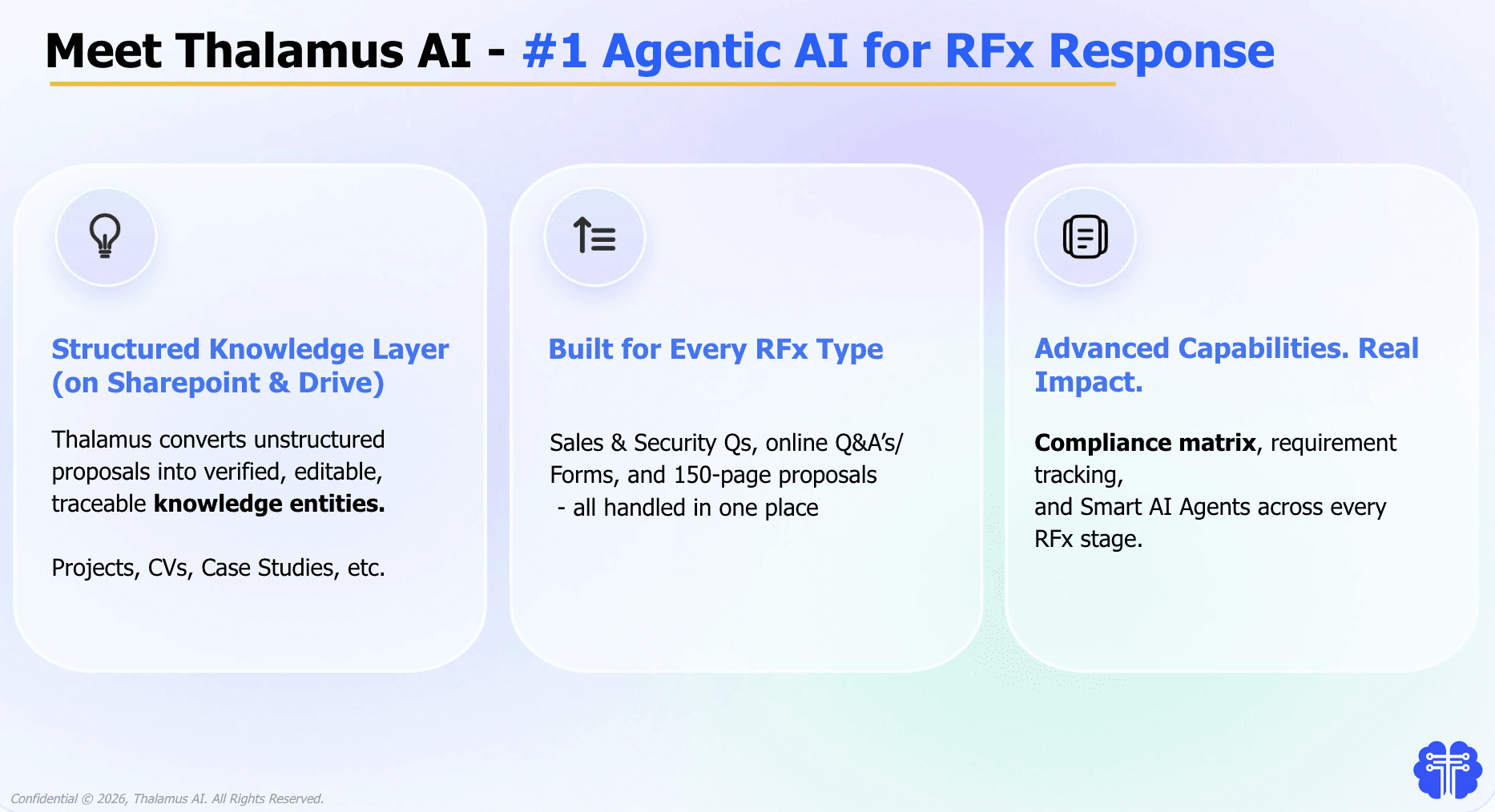
Thalamus AI is not just a ChatGPT alternative for RFPs. It is an AI-native RFP and proposal platform built for enterprise proposal teams that need to manage complex RFx workflows from qualification to submission.
ChatGPT helps teams generate and rewrite text. Thalamus AI helps teams manage the full RFP lifecycle: qualify bids, map requirements, coordinate SMEs, track compliance, monitor addenda, generate source-linked proposal drafts, manage review gates, complete questionnaires and portal responses, and learn from every submission.
Thalamus AI uses AI agents and a verified RFP content library to keep proposal knowledge structured, traceable, and reusable. That makes it better suited for teams that need compliant answers, source-linked knowledge, SME accountability, audit trails, and institutional memory across every bid.
For simple drafting, ChatGPT may be enough. For high-stakes RFPs, security questionnaires, DDQs, complex proposals, and multi-team bid workflows, Thalamus AI is built for the job ChatGPT was not designed to manage.
Can I bring my existing ChatGPT writing style into Thalamus AI?
Yes. Thalamus AI's Voice Builder can import a writing-style profile from ChatGPT, Microsoft Copilot, or Gemini and convert it into a reusable, team-level voice, so work your team already did tuning an LLM's tone doesn't have to be rebuilt from scratch.