
Harpreet Singh, MBA
Founder, Thalamus AI

With 12+ years in AI and enterprise software, including GenAI product work at Travelers Group, Harpreet writes about AI RFP software, AI bid tools, proposal operations, RFP response automation, and the future of enterprise bid management.

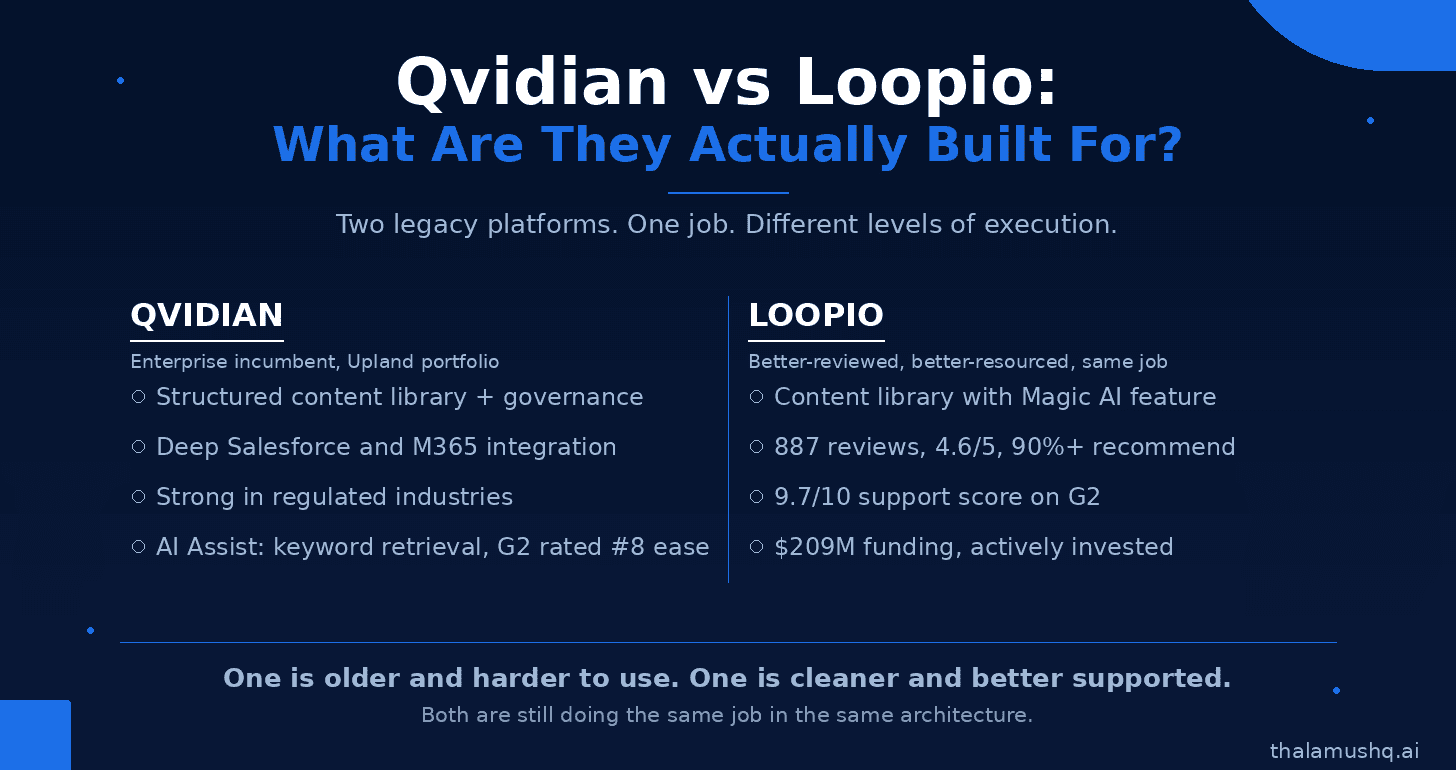
Qvidian vs Loopio: The AI Gap That Actually Matters
The AI comparison between Qvidian and Loopio is the one most teams focus on, and it is worth being precise about what that comparison actually means.
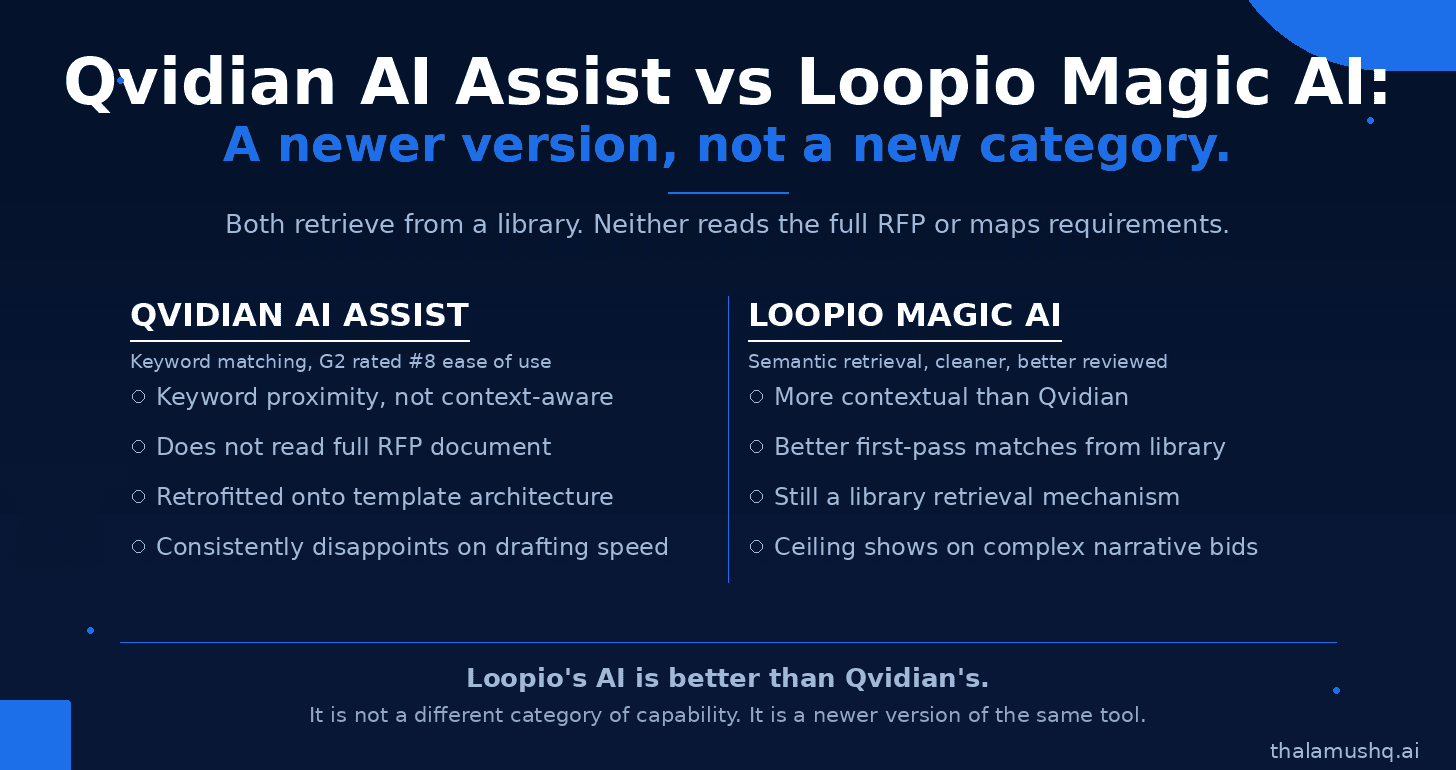
Qvidian's AI Assist uses keyword matching to surface relevant content from the library when a new RFP arrives. Users on G2 describe it consistently as limited, slow, and feeling like a feature retrofitted onto a platform that was not built with AI in mind. One enterprise user on G2 compared it to a paperweight - useful to have around but not something that makes the team faster. The underlying issue is architectural: Qvidian AI Assist does not read the full RFP document, does not understand question context beyond keyword proximity, and cannot pull live deal context from CRM or call intelligence. For a team that expected AI to meaningfully reduce their manual drafting workload, it consistently disappoints.
Loopio's Magic AI is a more modern implementation of the same underlying idea - semantic retrieval from the content library. It analyzes incoming questions more contextually than Qvidian, surfaces better matches, and generates cleaner first-pass suggestions. The improvement over Qvidian is real and consistently reflected in G2 reviews. The ceiling is also real: Magic AI is a library retrieval mechanism. It does not generate responses from the full RFP document context, does not map requirements to response sections, and does not draft narrative content that did not already exist in the library. For a team whose primary workload is standardized questionnaires with repeatable answers, that ceiling may never be reached. For a team drafting section-by-section responses to a 100-page complex bid, it surfaces quickly.
The honest summary: Loopio's AI is better than Qvidian's in the same way that a newer version of the same tool is better. It is not a different category of capability.
Looking for AI that works from the full RFP document, not just your content library? See how Thalamus AI's agentic workflow handles requirement extraction and compliance tracking from upload.
Qvidian vs Loopio: Where Each Platform Genuinely Wins?
Where Qvidian genuinely wins?
Qvidian's strongest case is for large enterprises in regulated industries, financial services, insurance, and banking, where it has a long, proven install base and where the governance structure, Microsoft 365 integration depth, and compliance-ready content lifecycle management have been validated by years of production use. For a team that has already built a mature Qvidian content library and whose bid workflow is primarily standardized proposals and DDQs in a financial services context, the migration cost of switching platforms is real, and the marginal improvement from Loopio may not justify it.
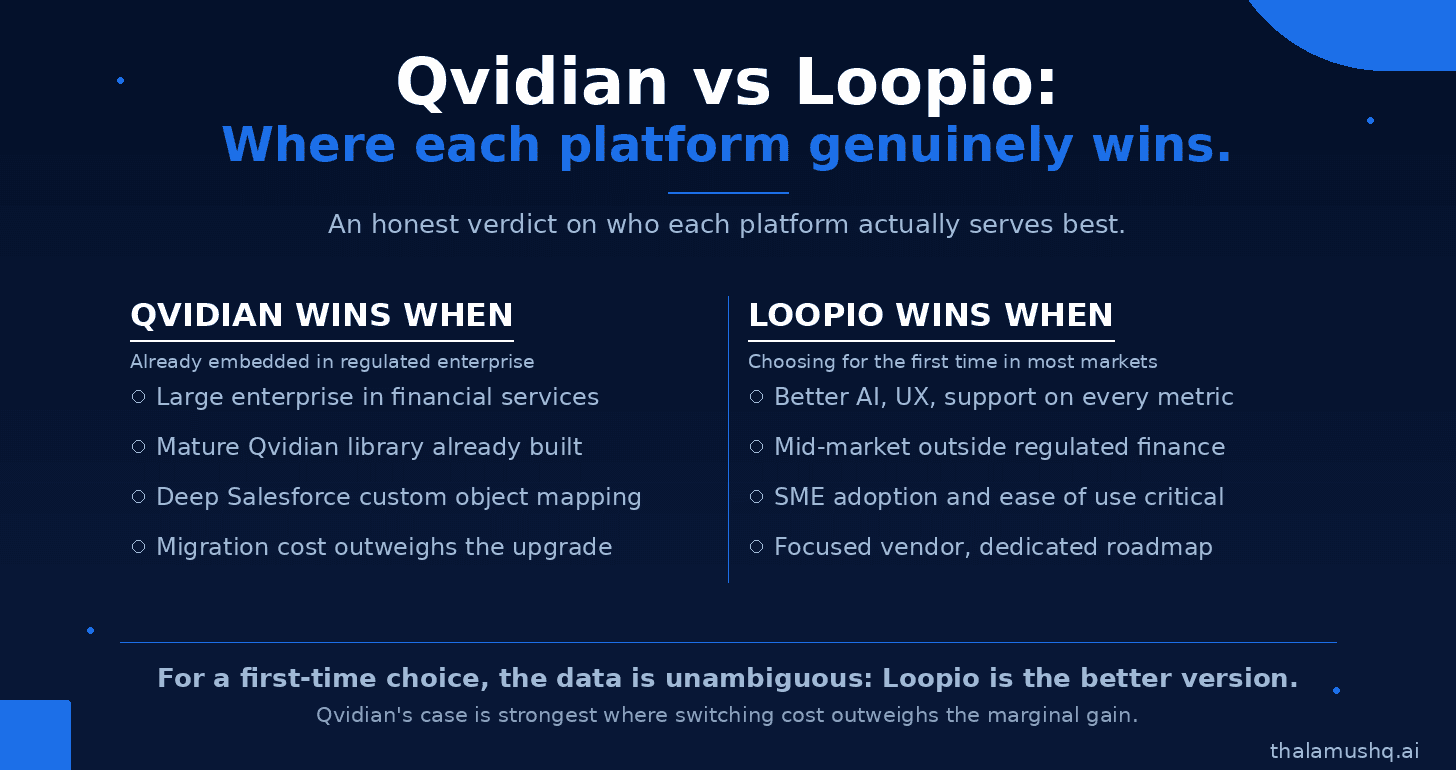
Qvidian also has deeper Salesforce integration than Loopio at the enterprise tier - custom object mapping, opportunity-linked content, and workflow triggers that connect into complex CRM configurations. For a sales operations team that has built sophisticated Salesforce workflows, Qvidian's integration depth is a genuine advantage.
Where Loopio genuinely wins?
Loopio wins on almost every metric a team evaluating a new platform cares about. Better AI, better support, better UX, better recommendation rate, significantly more social proof, and a dedicated product roadmap from a well-funded, focused company rather than one of twenty products in a portfolio. For a team choosing between the two platforms for the first time, the data is unambiguous: Loopio is the better version of this architectural approach for most teams in most markets.
The specific case for Loopio over Qvidian is strongest for mid-market teams without an existing Qvidian investment, teams outside regulated financial services, teams where SME adoption and ease of use are critical, and teams that want a platform vendor whose entire business is this product, not a distracted portfolio owner whose roadmap attention is divided.
Already on Qvidian and wondering whether Loopio or something else is the right move? See how Thalamus AI compares as a migration path that covers what neither platform does.
What Qvidian vs Loopio Gets Wrong as a Question?
I want to name something directly, because I think it serves teams evaluating this comparison better than another feature table does.
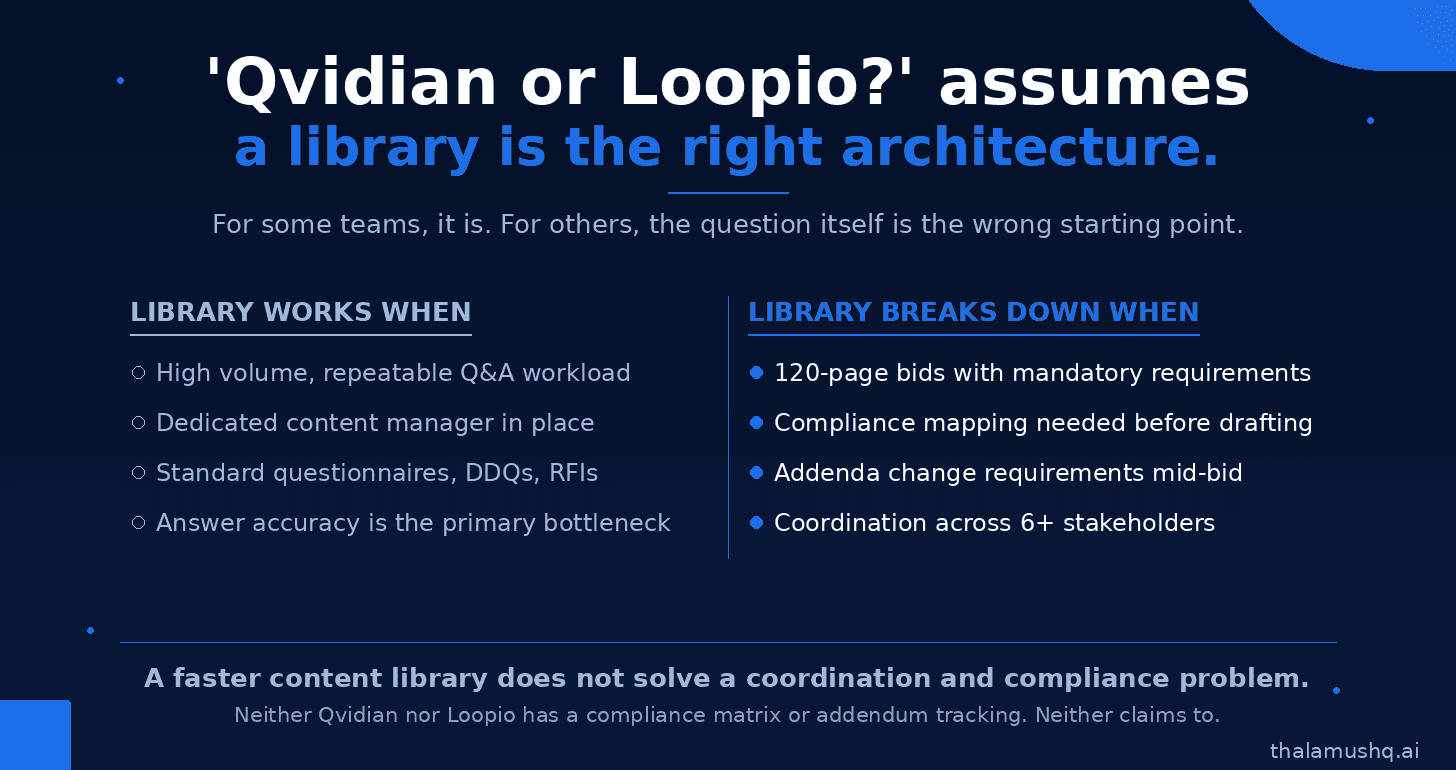
The question "Qvidian or Loopio" presupposes that a content library is the right architecture for your proposal function. For some teams, it is. For teams with high volumes of standardized questionnaires, repeatable answer patterns, and a dedicated content manager who can keep the library current, a well-governed content library does exactly what it promises, makes responses faster, more consistent, and less dependent on individual memory.
The presupposition breaks down when the bid complexity grows beyond what a library can reliably serve. A 120-page government infrastructure bid is not a content retrieval problem. It is a requirement mapping problem, a coordination problem, a compliance tracking problem, and a knowledge verification problem. Surfacing the right answer from a well-maintained library does not map every mandatory requirement to a section and owner before drafting begins. It does not detect that a clarification notice changed a technical requirement and flag every affected section in the live response. It does not route the update to the right SME with version-controlled approval. It does not build a compliance matrix that reflects the current status of every requirement across the full document.
Both Qvidian and Loopio are honest about this; neither markets a compliance matrix or addendum tracking as a core capability, because neither has one. The teams that feel the limit most sharply are the ones whose bids have grown complex enough that a content library's output quality is no longer the primary bottleneck. The bottleneck is coordination, compliance, and institutional memory, and a faster content library does not solve those problems.
Feeling the ceiling of a content library on your most complex bids? See what full bid lifecycle management looks like with Thalamus AI, compliance matrix, addendum tracking, and RACI routing included.
Qvidian vs Loopio: Who Should Choose Each?
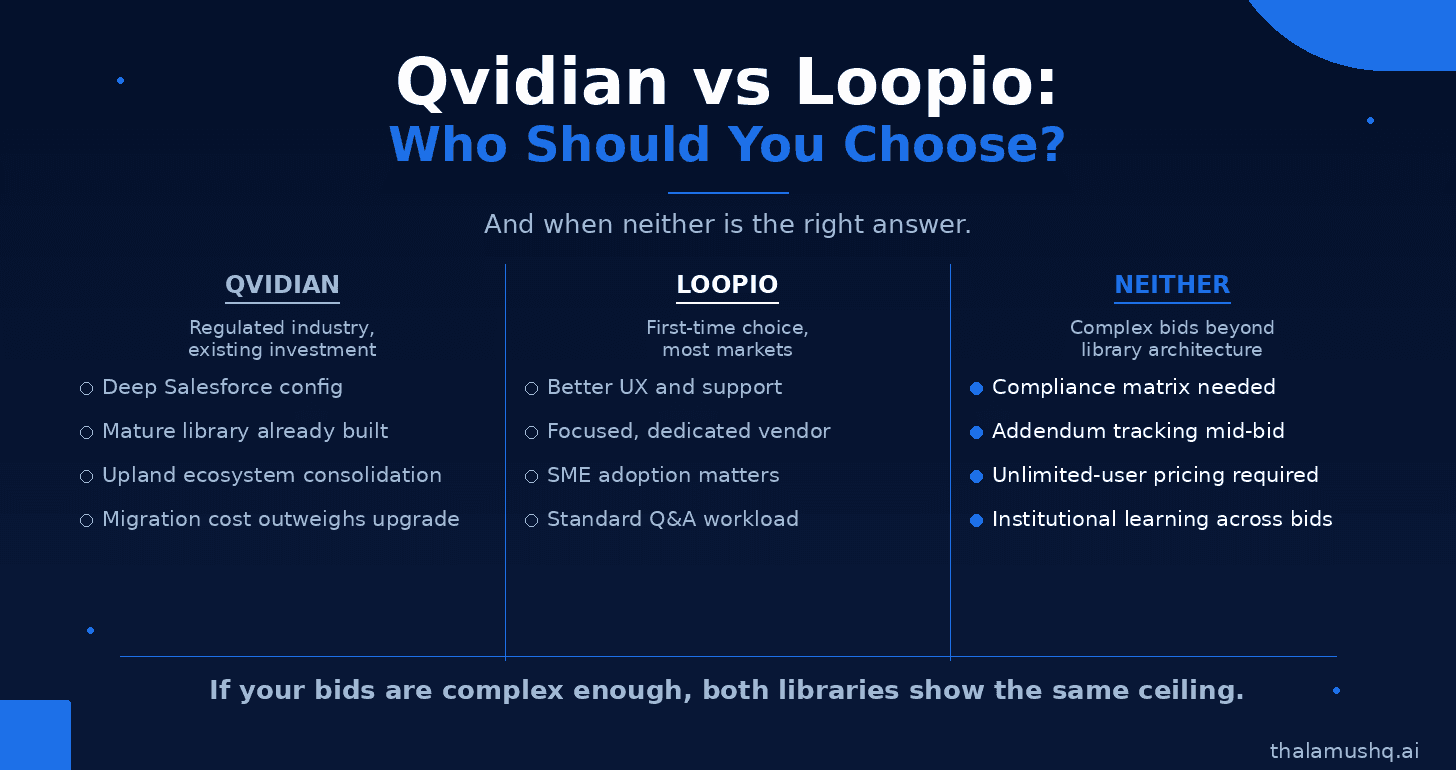
Choose Qvidian if:
Your team is in a regulated industry, financial services, insurance, or banking, where Qvidian's existing governance structure and compliance-ready content lifecycle management align with your proposal function's requirements.
You have a deep Salesforce configuration and need CRM integration depth at the enterprise level that Loopio does not match.
You already have a mature Qvidian content library and the migration cost of switching outweighs the marginal improvement Loopio offers.
Your IT and procurement teams are already part of the Upland ecosystem and consolidating on one vendor is a priority.
Choose Loopio if:
Your team is evaluating RFP software for the first time or replacing an older tool, and you want the better-reviewed, better-supported version of the content library approach.
SME adoption and ease of use matter; Loopio's UX advantage over Qvidian is real and consistently noted by reviewers.
You want a dedicated, focused vendor whose entire product investment is in RFP software rather than one of twenty Upland portfolio priorities.
Your primary workload is standardized questionnaires, DDQs, and structured RFPs where a well-maintained library reliably covers the content
Consider neither if:
Your bids are complex, multi-section proposals where requirement mapping, compliance tracking, addendum management, and multi-stakeholder coordination determine whether you are shortlisted or disqualified.
Your knowledge is locked in unstructured documents like past proposals, CVs, and case studies that need to become verified, reusable assets without a manual library-build effort.
You want institutional learning that compounds across bid cycles, not just content analytics within a single library.
Unlimited-user pricing matters; both Qvidian and Loopio use per-seat models that penalise teams with many occasional SME contributors.
Think your bids have grown beyond what either of these platforms covers? Start with a 3-month Thalamus AI pilot, unlimited projects, unlimited RFPs, one team.
Qvidian vs Loopio vs Thalamus AI
Evaluation area | Qvidian | Loopio | Thalamus AI |
Core model | Content library + templates | Content library + workflows | Full bid lifecycle platform |
Best fit | Regulated enterprise teams | Teams wanting easier RFP response management | Complex enterprise bid teams |
AI approach | Library retrieval | Modern library retrieval | Source-linked agentic workflows |
Compliance matrix | Not publicly positioned as core | Not publicly positioned as core | Core workflow |
Addendum tracking | Not publicly positioned as core | Not publicly positioned as core | Core workflow |
SME routing | Workflow-based | Workflow-based | AI RACI routing |
Institutional learning | Content analytics | Content health monitoring | Cross-bid decision graph |
Clarification management | Not publicly positioned as core. | Not publicly positioned as core. | AI ClarificationRegister |
Thalamus AI: The Alternative Both Comparisons Miss
Qvidian and Loopio are both good answers to a question that was central to proposal management software a decade ago: how do we stop recreating the same responses from scratch on every bid? The content library solved that problem. For the teams it fits, it still does.
The question that matters more in 2026, for teams managing bids of real complexity, is different: how do we ensure that every submission is compliant, coordinated across multiple stakeholders, grounded in verified organizational knowledge, and informed by what we learned from the bids that came before it? A content library does not answer that question. It was not designed to.
Thalamus AI is built for that scope. It converts your unstructured documents into verified, editable knowledge entities, connectable to CRM systems like Salesforce and HubSpot for account context, and governed by an AI-managed Content Health layer, and deploys specialized AI agents across the full bid lifecycle: requirement parsing, compliance matrix generation, bid/no-bid scoring, an AI Clarification Register, RACI routing, SME coordination, addendum tracking, and post-bid institutional learning.
Enterprise customers using Thalamus AI across complex proposal environments have reported measurable improvements based on internal customer performance data (2025–2026):
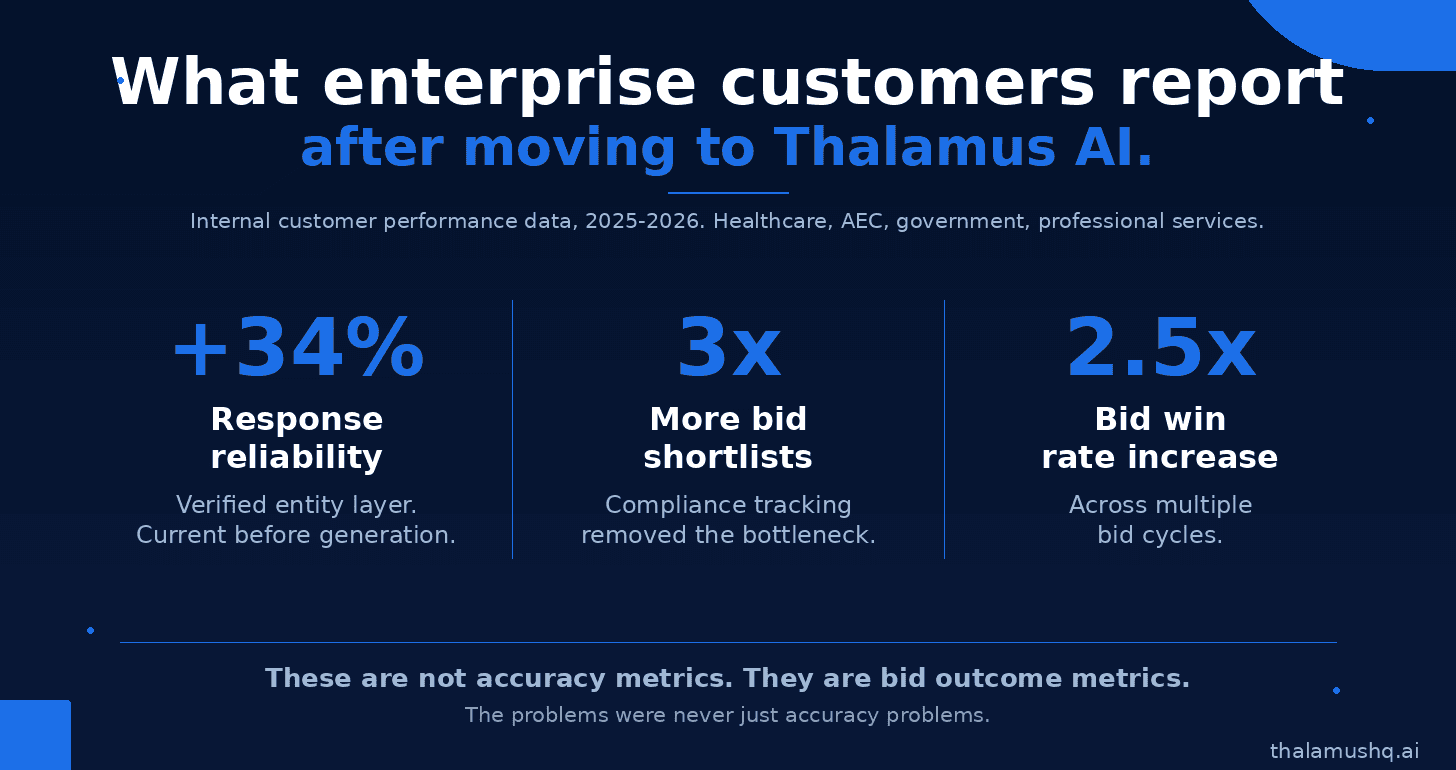
+34% improvement in response reliability - the result of the verified knowledge entity layer and compliance matrix catching gaps before submission.
3x more bid shortlist appearances - across customers where compliance tracking and stakeholder coordination had previously been the bottleneck.
2.5x increase in bid win rates - across enterprise teams using the full bid management platform across multiple bid cycles.
If Qvidian or Loopio solves your problem of the content library, the collaboration, the consistency, then use it. Both are proven platforms that do what they were designed to do.
If your problem is bigger than a content library, the comparison to run is a different one.
Bring one RFP. We'll show you what full bid lifecycle management looks like — compliance matrix, addendum tracking, and institutional learning included — in 20 minutes. Book a Thalamus AI demo.
Qvidian Vs Loopio FAQs
Is Qvidian being discontinued?
Qvidian has not announced a discontinuation. It remains an active Upland Software product with an existing enterprise customer base. However, Upland manages 20+ software products across its portfolio, and multiple G2 reviewers note that roadmap development feels slow, with enhancement requests sitting for extended periods without visible progress. Teams evaluating Qvidian long-term should ask directly about the product investment roadmap and recent feature release cadence.
Can I migrate from Qvidian to Loopio without losing my content library?
Loopio supports content migration from legacy platforms via CSV import and manual transfer processes. There is no automated one-click migration from Qvidian to Loopio. Teams should expect a structured content audit during migration, reviewing, re-tagging, and reorganizing existing Q&A pairs into Loopio's library structure. The migration itself is manageable but requires dedicated time from a content owner.
Does Qvidian or Loopio support HIPAA or healthcare compliance requirements?
Neither Qvidian nor Loopio specifically markets HIPAA compliance as a core certification. Both are SOC 2 compliant. Healthcare teams with specific HIPAA or data residency requirements should confirm compliance scope directly with each vendor during the sales process before making a platform decision.
Which platform has better Microsoft Teams and Outlook integration?
Qvidian has deeper Microsoft 365 integration overall, including Word and SharePoint workflows that are particularly mature for teams whose proposal process lives inside the Microsoft ecosystem. Loopio's Microsoft integration covers Teams collaboration but is less comprehensive at the document-level Microsoft 365 layer. Teams for whom Microsoft 365 is the primary working environment should weigh this in Qvidian's favor.
Is there a free trial for Qvidian or Loopio?
Neither Qvidian nor Loopio offers a self-serve free trial. Both require a sales engagement and demo before evaluation access. This makes hands-on evaluation before contract signing difficult, a risk worth accounting for when shortlisting either platform.
Qvidian vs Loopio: which is better for enterprise RFP teams?
Loopio is better for most enterprise RFP teams choosing a new content-library-based RFP platform in 2026 because it has stronger user reviews, better ease of use, stronger support, and a more focused RFP software roadmap. Qvidian is better for teams already invested in Upland, Microsoft 365, Salesforce-heavy workflows, or regulated industries where existing governance processes matter more than ease of use.