
Harpreet Singh, MBA
Founder, Thalamus AI

With 12+ years in AI and enterprise software, including GenAI product work at Travelers, Harpreet writes about AI RFP software, AI bid tools, proposal operations, RFP response automation, and the future of enterprise bid management.

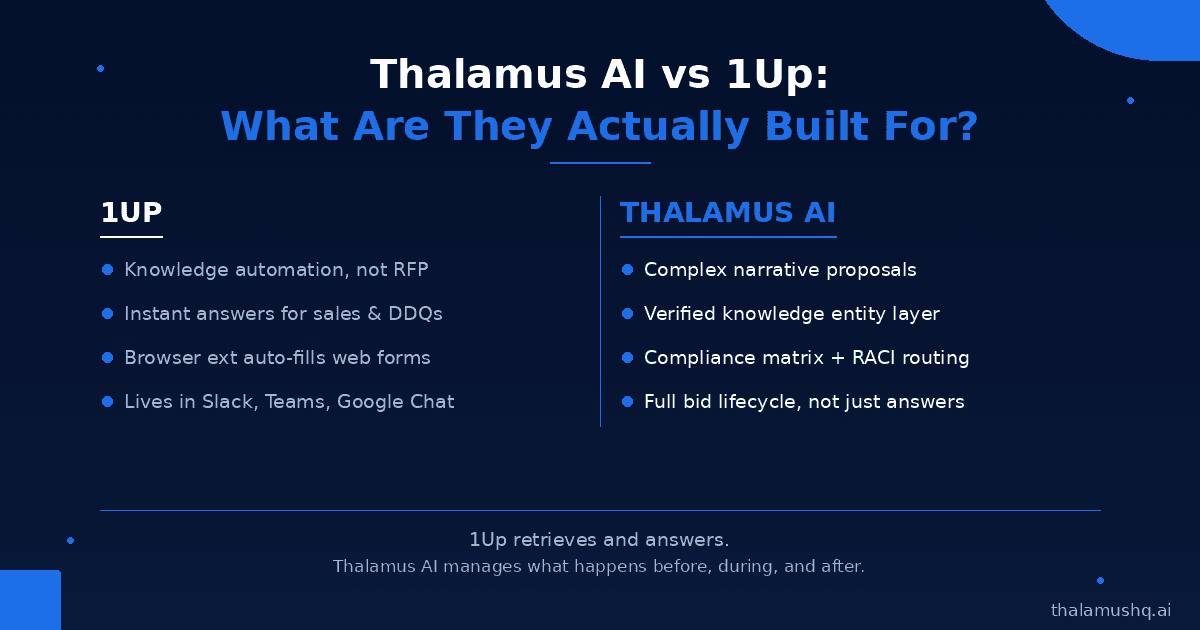
Thalamus AI vs 1Up on Complex, Multi-Section Proposals
Imagine this. Your team receives a 110-page enterprise infrastructure RFP. It includes a mandatory compliance statement, 70+ evaluation criteria split across technical, commercial, and delivery sections, CVs and certifications required for eight key personnel, and an addendum that lands nine days before the deadline, changing the technical scoring weight.
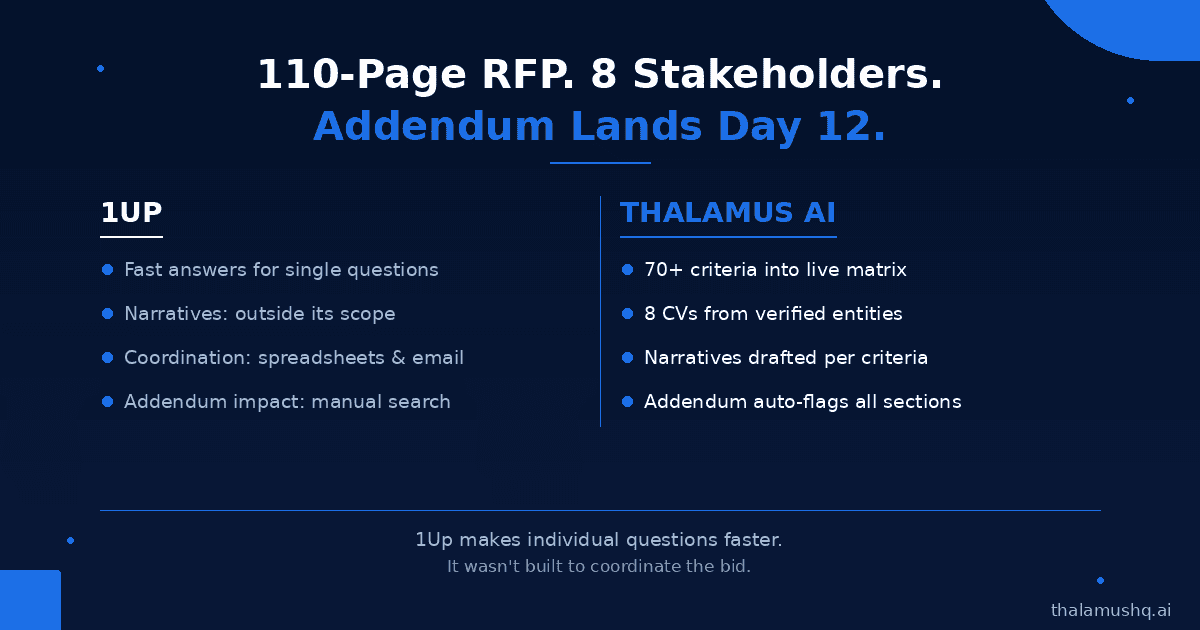
What 1Up does: 1Up's retrieval engine is fast at surfacing the right source content for individual questions, pulling a data retention policy, confirming a certification, answering a security control question, all in seconds. For a narrative technical approach section requiring synthesis across multiple sources and a persuasive argument tailored to this specific evaluator, that retrieval model is not what 1Up was built to do, and its own users have said as much. The compliance statement, the cross-section dependency tracking, and the coordination across eight stakeholders happen outside the platform, typically in spreadsheets, email, and ad hoc Slack threads. When the addendum lands, identifying which sections are affected is a manual exercise.
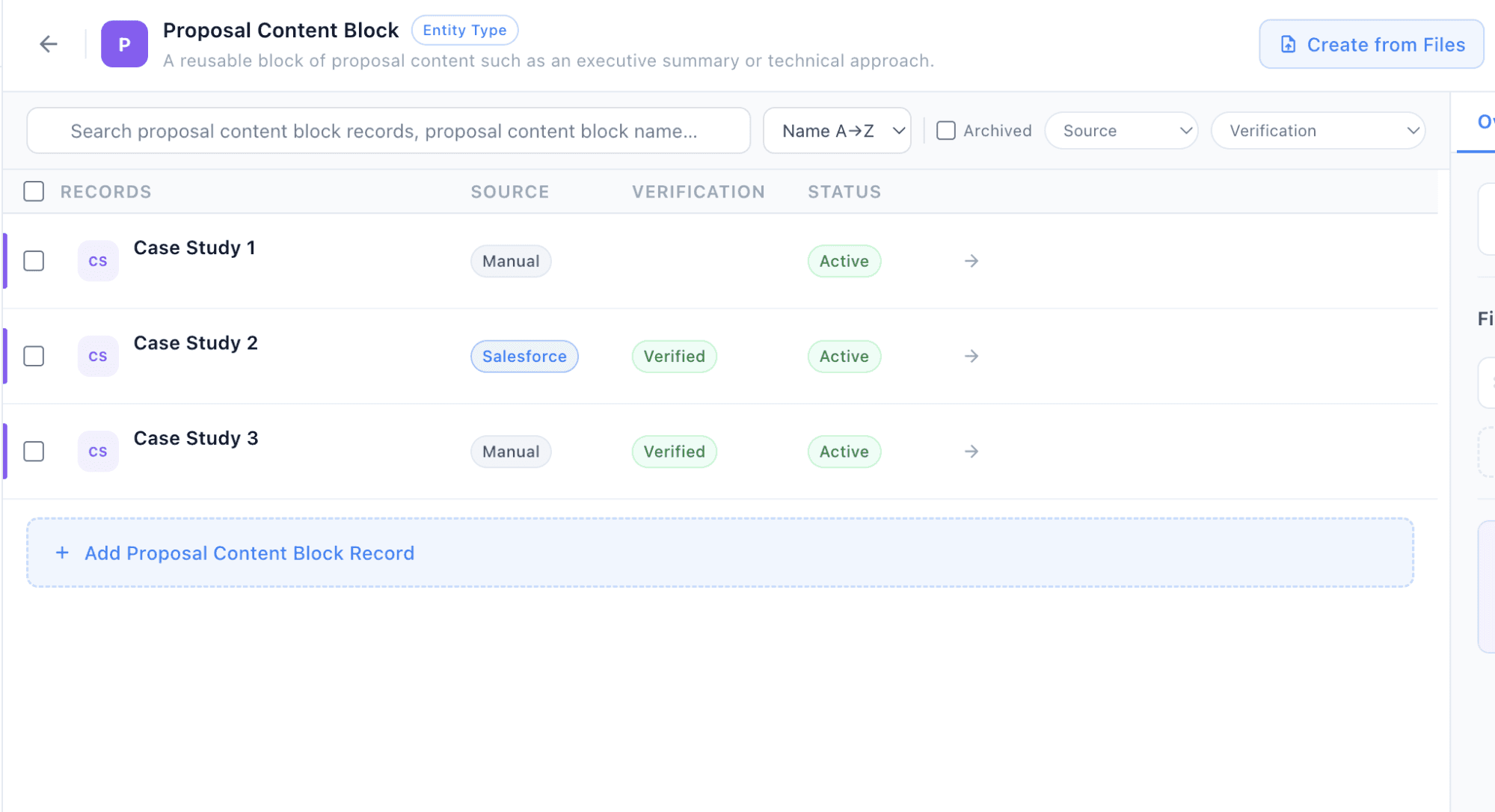
What Thalamus AI does: The RFx Analysis Agent shreds the RFP on upload, extracting all 70+ evaluation criteria into a living compliance matrix mapped to section, owner, and status. The eight personnel CVs are drawn from verified knowledge entities, confirmed current, and cited to source. Narrative sections are drafted with the full context of the evaluation criteria they're answering. When the addendum arrives, Thalamus AI automatically detects the scoring change and flags every affected section, routing the update to the right SME for re-approval.
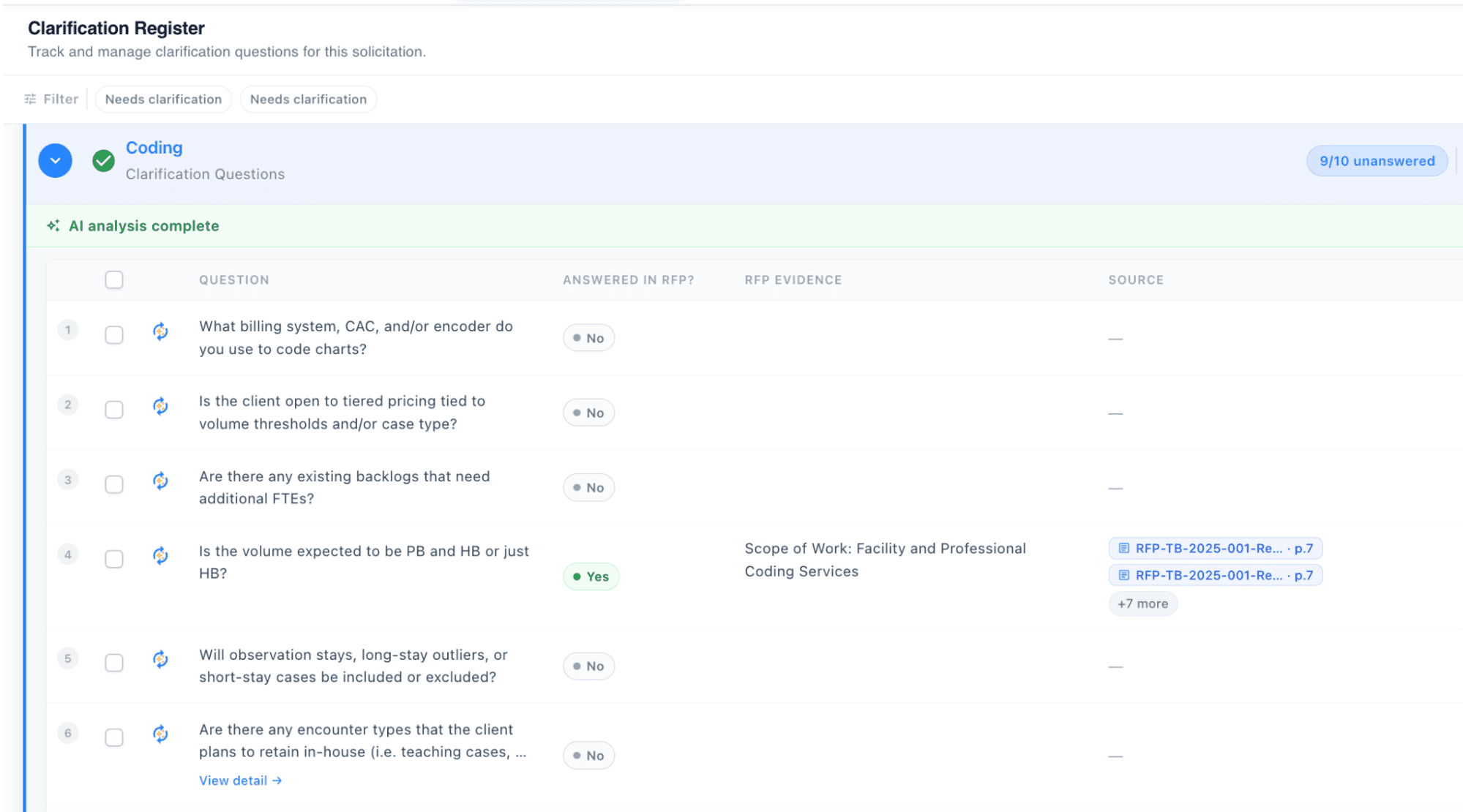
And, before the response is finalized, the Clarification Register also checks whether any open question the team has about the RFP, like the exact scope of the revised technical criteria, is already answered somewhere in the 110-page package, so a clarification request doesn't go out for something buried in an appendix. And because the eight SMEs were assigned to their sections before kickoff through the Ownership Matrix, they're reviewing content they've already seen once, not encountering it cold when the addendum lands.
This isn't a case of one platform doing the same job better. It's two different jobs. 1Up would make individual questions in this RFP faster to answer. It would not coordinate the bid.
Managing complex, multi-stakeholder proposals where coordination is the bottleneck? See how Thalamus AI handles RFP shredding through final export in one connected workflow.
Thalamus AI vs 1Up: What Should You Choose
The decision here is less about which platform is better and more about which problem you actually have. Both are good answers to different questions.
Choose 1Up if:
Your primary workload is short-form, high-volume Q&A - security questionnaires, DDQs, sales RFPs, answered quickly and accurately from a knowledge base
Your team is sales engineering or presales, not a dedicated proposal function
You want transparent, published pricing and the option to self-serve without a sales call
Your bids rarely involve more than a handful of stakeholders or complex cross-section dependencies
Fast time-to-value matters more than depth of workflow
Choose Thalamus AI if:
You manage complex, multi-section proposals with mandatory compliance requirements and a real risk of disqualification for missed items
Your bids involve six or more stakeholders across legal, technical, security, and delivery who need coordinated, tracked sign-off
Addenda routinely arrive mid-bid and change requirements that affect sections already drafted
Your knowledge, past proposals, CVs, and case studies need to persist and stay verified across every future bid
Narrative writing quality, tailored to the specific evaluation criteria of each bid, is a core requirement
Honestly, many teams need both. 1Up for the fast, recurring security questionnaires your SMEs answer weekly. Thalamus AI for the complex, high-stakes proposals where a missed requirement costs the contract. Treating this as an either/or decision is often the wrong frame.
Think your bids have outgrown a Q&A-only tool? Start with a 3-month Thalamus AI pilot, unlimited projects, unlimited RFPs, and one team.
What Enterprise Customers Report After Moving to Thalamus AI?
Enterprise customers using Thalamus AI across complex proposal environments have reported measurable improvements at every stage of the bid cycle, not just faster answers to individual questions, but fewer missed requirements, stronger shortlists, and higher win rates on the bids that matter most.
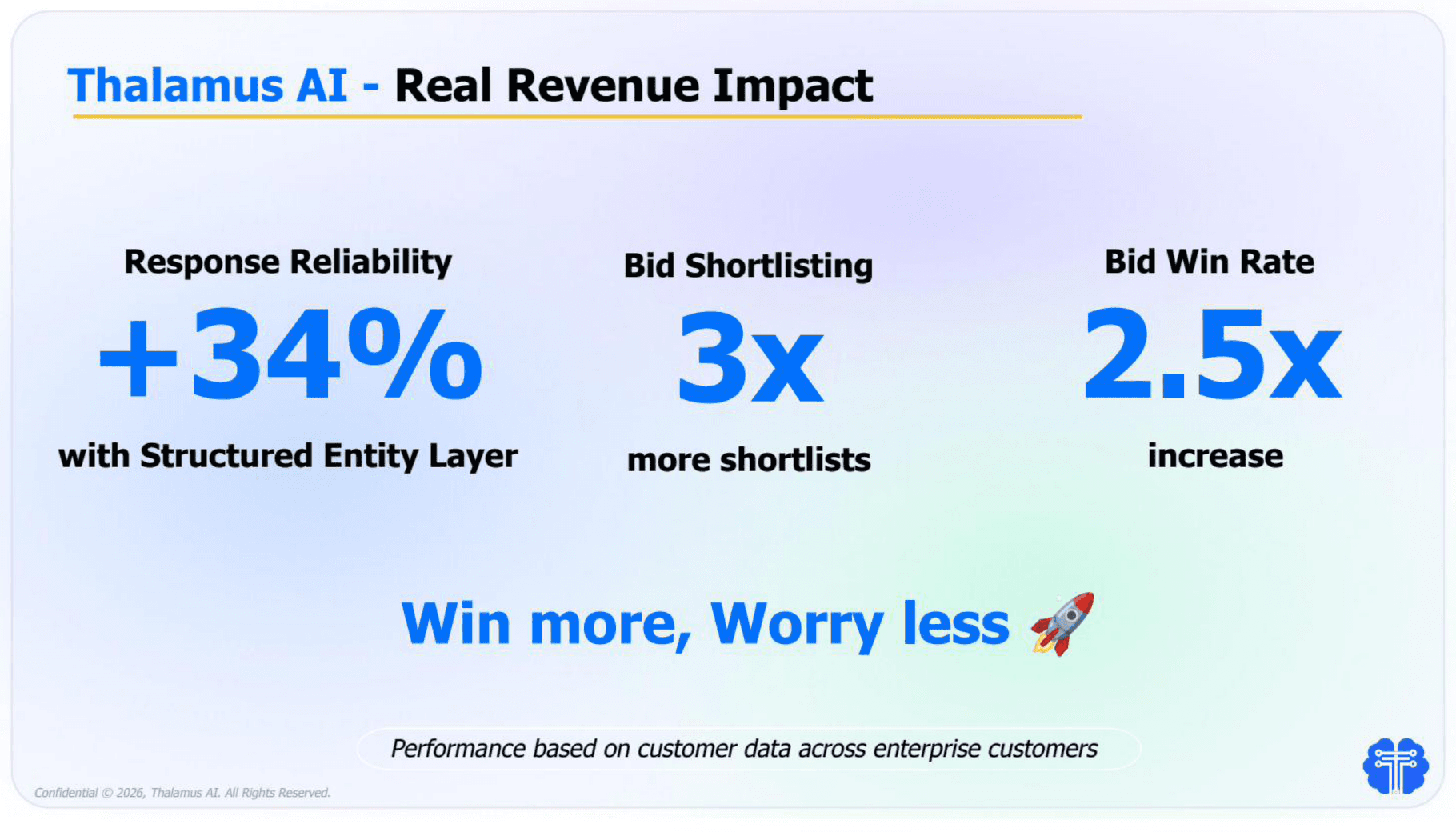
Based on Thalamus AI internal customer performance data (2025–2026), across enterprise teams in healthcare, AEC, government contracting, and professional services:
+34% improvement in response reliability - attributed to the verified knowledge entity layer catching outdated or inconsistent content before it reaches a draft
3x more bid shortlist appearances - across customers managing complex, multi-section proposals where compliance tracking and stakeholder coordination had previously been manual
2.5x increase in bid win rates - reported by enterprise teams using the full bid management platform across multiple bid cycles
1Up is a genuinely well-built platform, and the teams who love it are right to. It solves the speed problem for short-form questions better than almost anything else in this category, at a price point and onboarding speed Thalamus AI doesn't try to compete with. What it was never built to solve, and doesn't claim to, is the coordination, compliance, and institutional learning problem that defines complex, high-stakes proposals.
If your hardest bids look like a fast questionnaire, 1Up is a strong, honest choice. If your hardest bids look like the 110-page infrastructure RFP above, the comparison runs the other way.
Bring one RFP. We'll show you what coordinated, compliance-tracked bid management looks like in 20 minutes. Book a Thalamus AI demo.
Thalamus AI Vs 1Up: FAQs
Which is better for small teams - 1Up or Thalamus AI?
1Up is the stronger fit for small teams (under 10 people) handling a low-to-moderate volume of questionnaires and short RFPs. Its free plan and Starter tier at $300 per month make it accessible without an enterprise procurement process, and its Slack-native experience requires no training.
Thalamus AI is built for enterprise proposal operations where bid complexity, compliance requirements, and multi-stakeholder coordination are the bottlenecks. Small teams that primarily answer repeatable questions will find Thalamus AI more powerful than their current situation requires.
Is Thalamus AI more expensive than 1Up?
Yes, at the entry level. 1Up offers a free plan and a Starter tier at $300 per month with transparent published pricing. Thalamus AI is custom-priced based on team size and workflow configuration, with no public pricing, and is positioned for enterprise teams running complex bids. However, for larger teams and higher RFP complexity, the total cost of ownership comparison shifts: 1Up’s public pricing is transparent and accessible, but its plans are structured around usage, questionnaire automation volume, admin limits, and enterprise packaging. Thalamus AI is priced for broader enterprise bid workflows, with unlimited users and projects under one subscription.
Does 1Up handle complex enterprise RFPs well?
1Up can support RFP automation, especially for repeatable questionnaires and structured forms. It is less suited for complex, multi-section enterprise RFPs that require live compliance matrices, addendum impact tracking, bid/no-bid scoring, subsection-level RACI routing, and long-form narrative strategy. Verified G2 review data for 1Up shows "limited features" and "inaccurate responses" as recurring complaints precisely in the context of complex or novel questions outside its existing knowledge coverage.
What does Thalamus AI have that 1Up does not?
Thalamus AI includes compliance matrix generation and real-time addendum tracking, subsection-level RACI routing where SMEs can be assigned to individual bid sections with version-controlled review gates, bid/no-bid qualification scoring, capture planning, post-bid institutional learning that tracks which content correlates with wins, and a verified entity knowledge layer where every AI answer is traceable to a source document. None of these capabilities is part of 1Up's current positioning. Both platforms avoid a manually curated Q&A library, but the mechanism differs: 1Up retrieves live from connected sources, so answers are only as current as those sources. Thalamus AI's knowledge entities are additionally governed by an AI-managed Content Health layer that actively flags duplicate, stale, or conflicting entries as exceptions for review, and can connect to CRM systems for account context, capabilities that sit outside 1Up's current positioning.
Can 1Up generate compliance matrices like Thalamus AI?
No. Compliance matrix generation, mapping every explicit and implicit RFP requirement to a response section, an owner, a compliance status, and a risk level, is not a capability 1Up currently offers. Thalamus AI's compliance matrix is a live working document that also auto-detects when addenda change requirements mid-bid and flags every impacted section. For proposal teams where missed requirements create disqualification risk, this is the most specific functional gap between the two platforms.
Which platform is better for a growing proposal team that started on 1Up?
Teams that start on 1Up typically outgrow it when two things happen simultaneously: RFP volume increases, and RFP complexity increases. The first is a workload problem that most platforms solve. The second is a capability problem that only full-lifecycle platforms solve. If a growing team is hitting accuracy issues on complex questions, coordination problems across more than five or six contributors, or compliance gaps on formal government or enterprise bids, Thalamus AI is the natural next platform. If the team is simply handling more of the same questionnaires they were already doing, scaling within 1Up or moving to AutoRFP.ai is a more proportionate step.
Data source
Thalamus AI internal customer performance data, 2025–2026, based on enterprise customer outcomes across healthcare, AEC, government contracting, and professional services. 1Up data sourced from G2 and Gartner Peer Insights reviews, 1Up's published product and pricing materials, as of June 2026.