
Harpreet Singh, MBA
Founder, Thalamus AI

With 12+ years in AI and enterprise software, including GenAI product work at Travelers Group, Harpreet writes about AI RFP software, AI bid tools, proposal operations, RFP response automation, and the future of enterprise bid management.

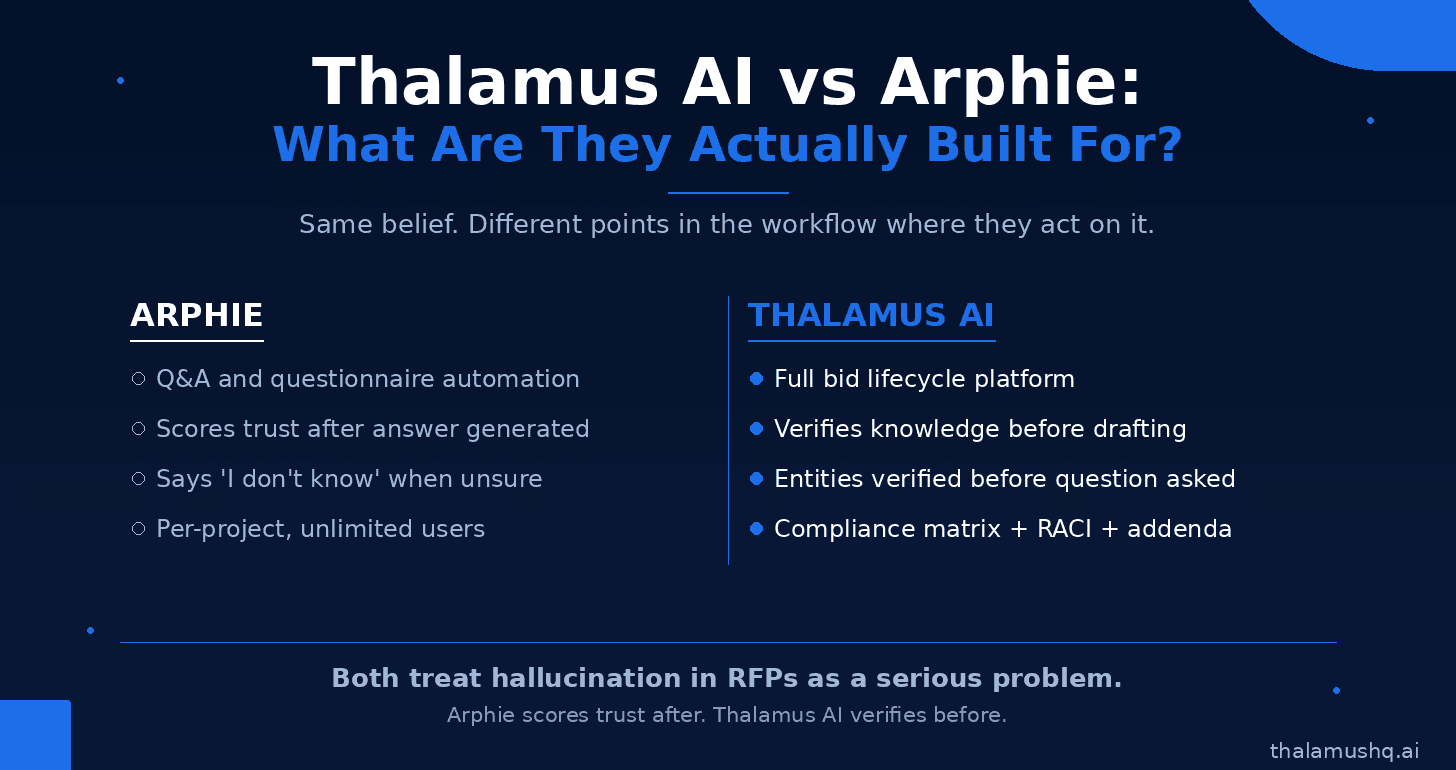
Thalamus AI vs Arphie: Trust at the Output vs Trust at the Knowledge Stage
This is the distinction worth spending real time on, because it determines where each platform's reliability ceiling sits.
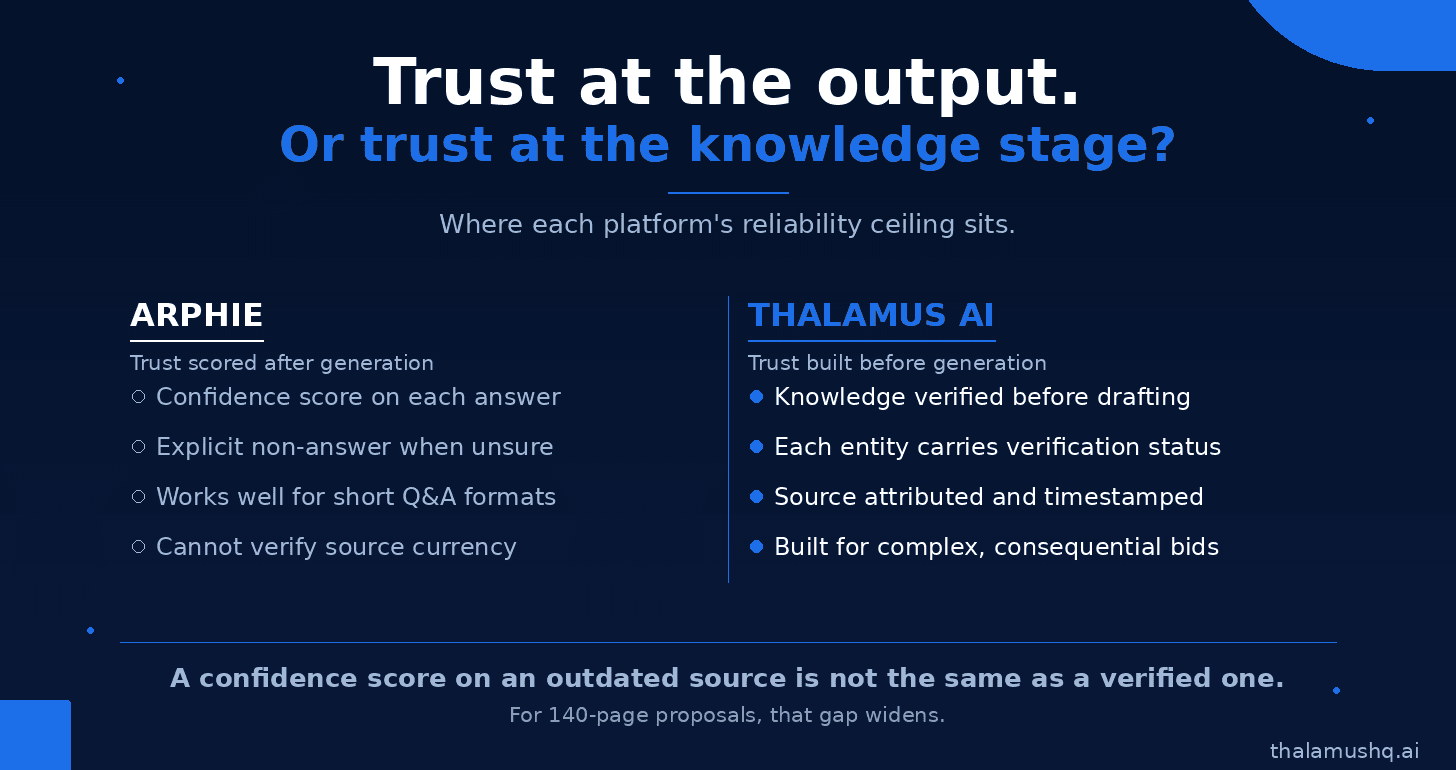
Arphie's approach is to score the answer. When the AI generates a response, it attaches a confidence score telling the reviewer how much to trust it, and an explicit non-answer when the knowledge base isn't sufficient. This is genuinely useful; it concentrates human review effort where it is most needed, and it removes the dangerous scenario where an AI confidently generates a plausible but fabricated answer. For a presales or security team handling hundreds of short, structured questions, confidence scoring is a practical, lightweight trust mechanism that works well at that scale.
What confidence scoring cannot do is verify the underlying source before the answer is generated. The AI draws from connected sources, scores its confidence in the output, and flags when it cannot find a sufficient answer. What it does not do is tell you whether the CV it is about to cite was updated six months ago or three years ago. Whether the project reference it is about to use meets the threshold the evaluator specified. Whether the certification it is about to claim expired last quarter.
Thalamus AI's approach is to verify the knowledge before the answer is generated. Past proposals, CVs, case studies, and Q&A content are converted into structured entities, each one editable, each one attributed to a source document, each one carrying a verification status that reflects the last time a human reviewed it, and continuously monitored by an AI-managed Content Health layer that flags an entity as an exception the moment it goes stale or conflicts with newer knowledge, rather than waiting for the next scheduled review to catch it.
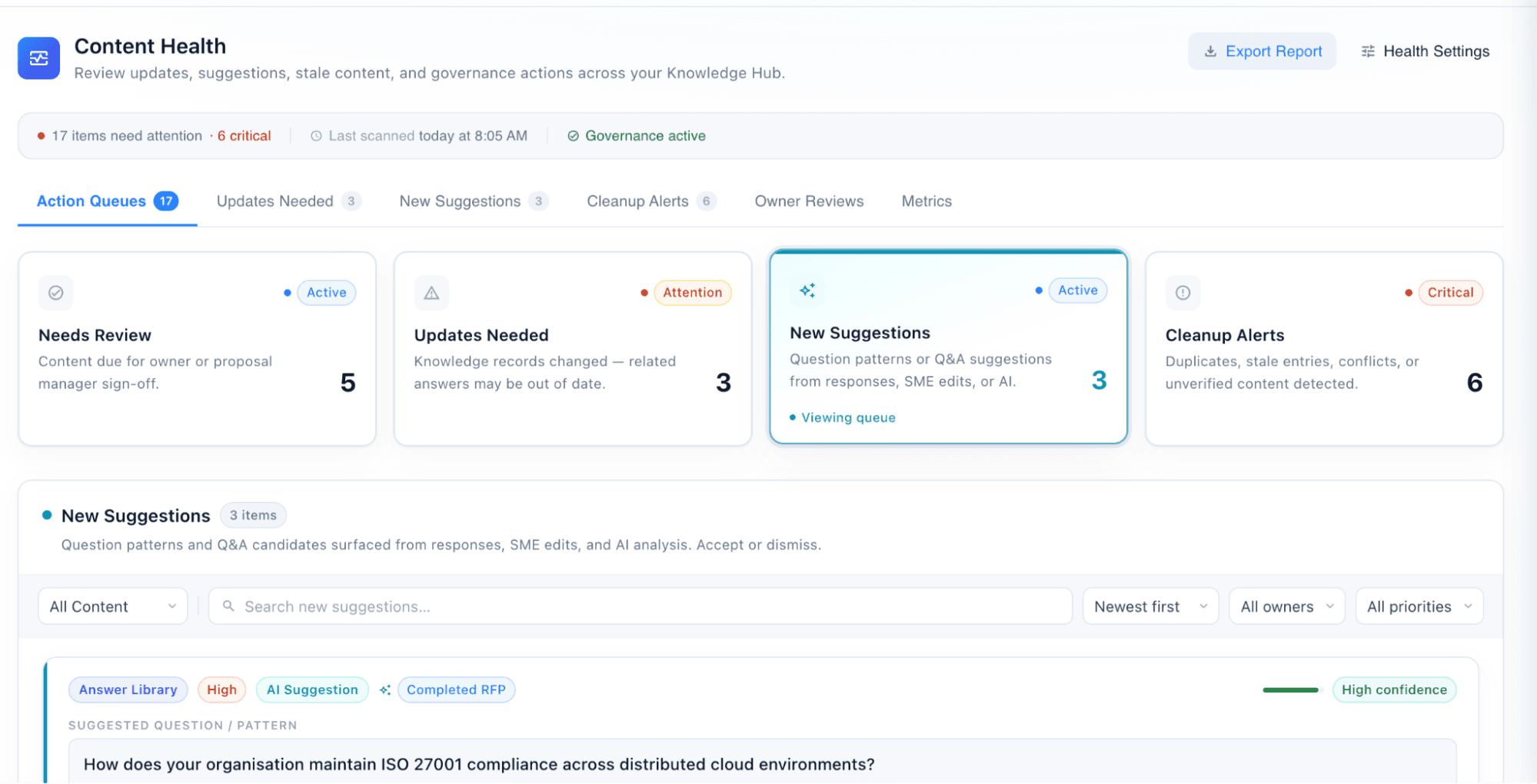
When the AI drafts a response, it draws from that verified layer. The output can be trusted not because it was scored after generation, but because what it drew from was verified before generation started. A confidence score on a potentially outdated source is a different thing from a confidence score on a verified one.
For short, frequently repeated questions, security controls, data retention policies, standard compliance boilerplate, the gap between these two approaches is small. For a 140-page proposal where the project references, personnel CVs, and organizational claims are specific, current, and consequential, that gap widens.
Curious how verified knowledge entities prevent ungrounded answers before they reach the draft? See Thalamus AI's knowledge layer live, applied to a real past proposal.
Thalamus AI vs Arphie on Complex, Multi-Section Proposals
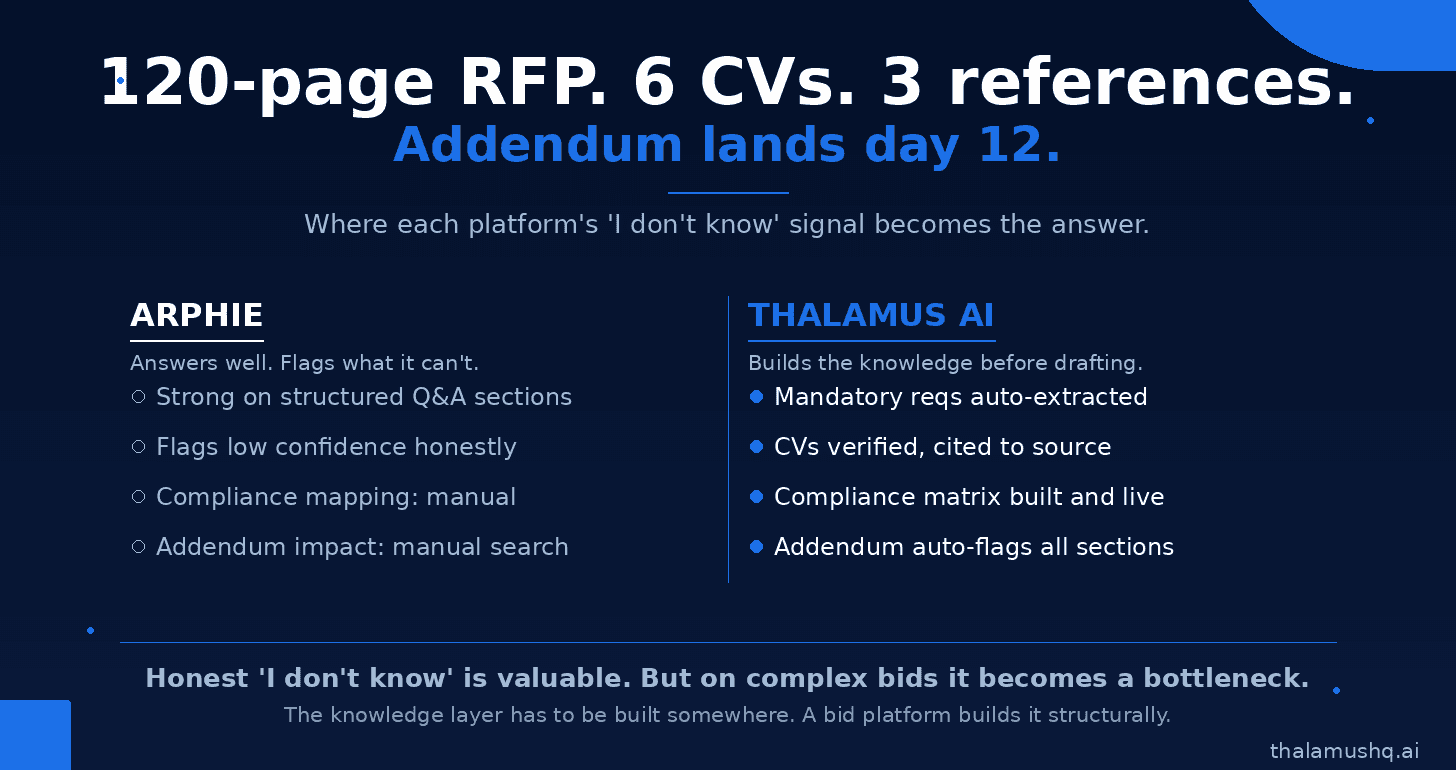
Imagine this. Your team receives a 120-page professional services RFP. It requires a technical methodology section tailored to the client's specific infrastructure context, CVs for six named personnel with current certification dates, at least three comparable project references completed within the last four years, a compliance statement mapping every mandatory requirement to a response section, and a pricing narrative with supporting rationale. An addendum arrives eight days before the deadline, adding a mandatory sub-requirement to the technical methodology section.
What does Arphie do?
Arphie answers individual questions accurately and transparently for the structured Q&A portions of this RFP, security controls, standard compliance questions, and boilerplate organizational information. For the technical methodology section requiring synthesis across multiple sources and tailored argumentation, the confidence scoring mechanism will flag low confidence or return "I don't know" on questions where the knowledge base doesn't contain sufficient narrative source material. The compliance statement, the cross-section requirement mapping, and the addendum impact identification all sit outside the platform and fall to your team to manage manually.
What does Thalamus AI do?
The RFx Analysis Agent shreds the RFP on upload, extracts all mandatory requirements, and generates a living compliance matrix mapping each one to a section, an owner, and a review status. The six personnel CVs are drawn from verified knowledge entities, confirmed as current, and cited to their source documents. The three project references are validated against the four-year threshold and the comparability criteria before they are included in the draft. The technical methodology is drafted with full context of the evaluation criteria it is answering. When the addendum lands, Thalamus AI automatically detects the new sub-requirement and flags the technical methodology section for update, routing it to the right SME via Slack for re-approval by the lead author.
Before the response is finalized, the Clarification Register also checks whether any open question the team has about the RFP itself is already answered somewhere in the 120-page package, a distinct check from Arphie's per-answer confidence scoring, since it's about the completeness of the team's understanding of the RFP, not the confidence in any single generated answer.
Arphie's "I don't know" signal is honest and valuable. But when a complex proposal produces too many "I don't know" signals on the sections that matter most, that honesty becomes a bottleneck. The knowledge layer has to be built somewhere, and a bid management platform builds it structurally, not question by question.
Do your most important bids regularly produce questions your Q&A tool can't answer? See how Thalamus AI's verified knowledge layer and compliance matrix handle a real complex bid.
Where Arphie Genuinely Wins?
I want to give this real weight, because Arphie's anti-hallucination architecture is among the most thoughtfully designed in this category for what it is built to do.
The combination of exact source citations, confidence scoring, and explicit "I don't know" signaling addresses the trust problem in RFP AI at a level most platforms don't attempt. Loopio's Magic feature doesn't score confidence. Many RFP AI tools focus on generating an answer. Arphie deserves credit for making uncertainty visible instead of hiding it behind fluent output. Teams using Arphie consistently report that the review step becomes faster and more focused, because the system tells them which answers need attention rather than making them guess.
Arphie's per-project unlimited-user pricing model also deserves credit. In a category where seat-based pricing penalizes cross-functional collaboration, Arphie's structure lets legal, security, and sales engineering contribute without adding license costs, and for mid-market teams that don't want to restrict access, that is a meaningful financial distinction.
The onboarding story is strong too. Teams are up and running within a week, and Arphie offers a free trial for qualified buyers, a rare thing in this category that allows genuine hands-on evaluation before a commitment. For a team comparing multiple platforms, that reduces risk meaningfully.
Where Arphie is still evolving: mobile support, export formatting depth, and reporting breadth have all been flagged by reviewers as areas where the platform is newer and less mature than established competitors. And the platform's own confidence scoring architecture is the honest signal of where its current scope ends: when the knowledge base can't answer a complex, multi-source synthesis question, Arphie says so. That honesty is admirable. It is also a reliable indicator that narrative proposal support, compliance matrix generation, and cross-bid institutional learning are genuinely outside the current product.
Already using Arphie for questionnaires but finding the scope ceiling on complex bids? Book a Thalamus AI demo and see what the next layer of the bid management stack looks like.
Thalamus AI vs Arphie: Who Should You Choose?
The clearest signal for this comparison is the one Arphie's own architecture provides: if the platform regularly returns "I don't know" on the sections your most important bids require, the right response is not a different Q&A tool. It is a different architecture.
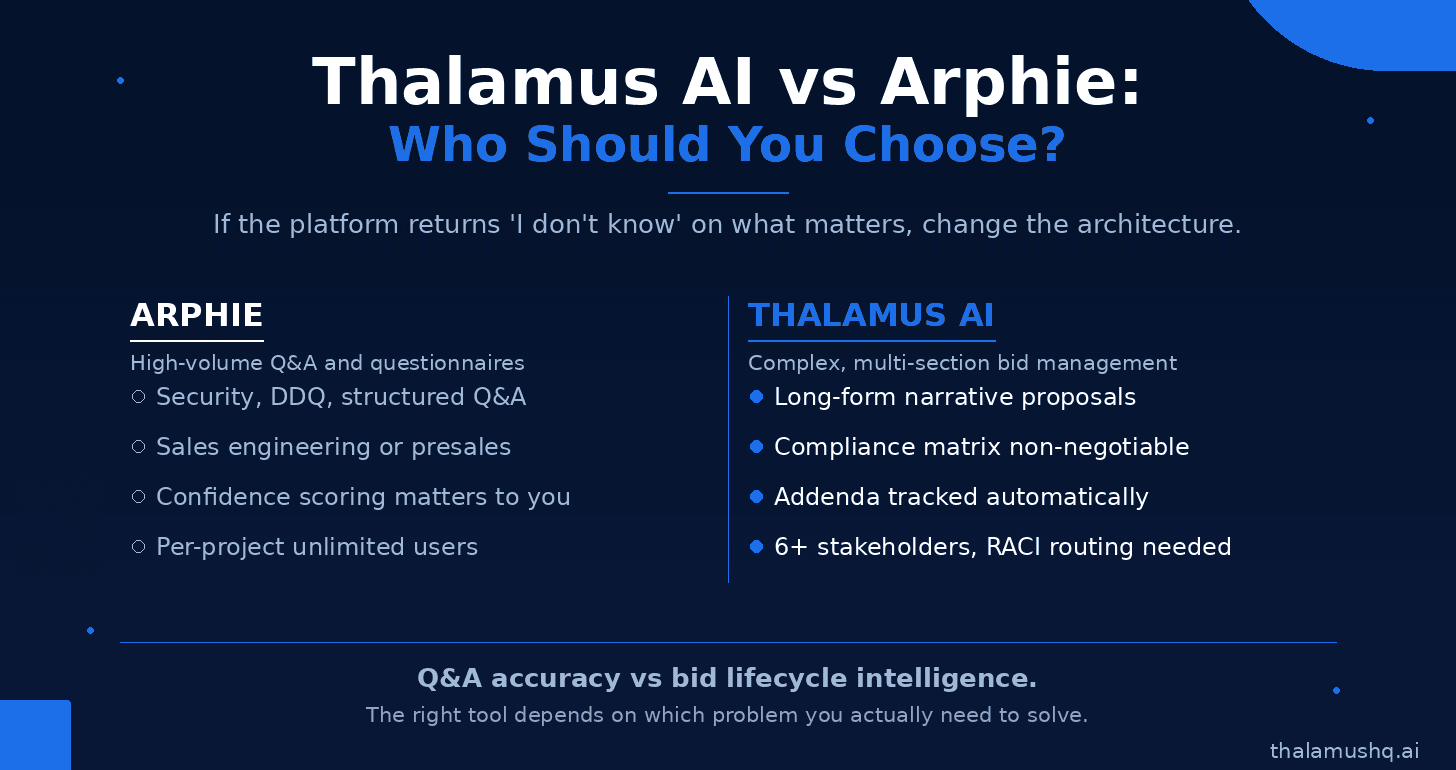
Choose Arphie if:
Your primary workload is high-volume, Q&A-driven questionnaires like security assessments, DDQs, and structured RFPs, where answer accuracy, source citation, and confidence transparency matter more than narrative depth.
Your team is in sales engineering or presales, answering structured questions quickly and accurately to keep deals moving.
You want transparent confidence scoring that concentrates human review effort where it is most needed.
Per-project unlimited-user pricing fits your contribution model better than a seat-based structure.
Fast onboarding and a genuine free trial matter for your evaluation process.
Choose Thalamus AI if:
Your bids require long-form narrative content like technical methodologies, organizational capabilities, and tailored solution approaches that can't be answered from a Q&A retrieval model.
A missed mandatory requirement in a compliance statement risks automatic disqualification, not just a weak answer.
Addenda routinely arrive mid-bid and require automatic detection of which sections are affected.
You need RACI routing that coordinates six or more stakeholders across legal, technical, security, and delivery with tracked, version-controlled approvals.
You want the platform to compound across bids with institutional memory that makes the next proposal smarter than the last.
Honestly, for some teams, both are in the stack. Arphie for fast, accurate, confidence-scored security questionnaires. Thalamus AI for the complex, high-stakes narrative proposals where the scope ceiling on a Q&A tool becomes real. These are not competing for the same workflow in every team.
Think your bids are hitting the ceiling of a Q&A tool? Start with a 3-month Thalamus AI pilot, unlimited projects, unlimited RFPs, one team.
What Enterprise Customers Report After Moving to Thalamus AI?
Enterprise customers using Thalamus AI across complex proposal environments have reported measurable improvements that go beyond answer accuracy because the problems they were solving were never just accuracy problems.
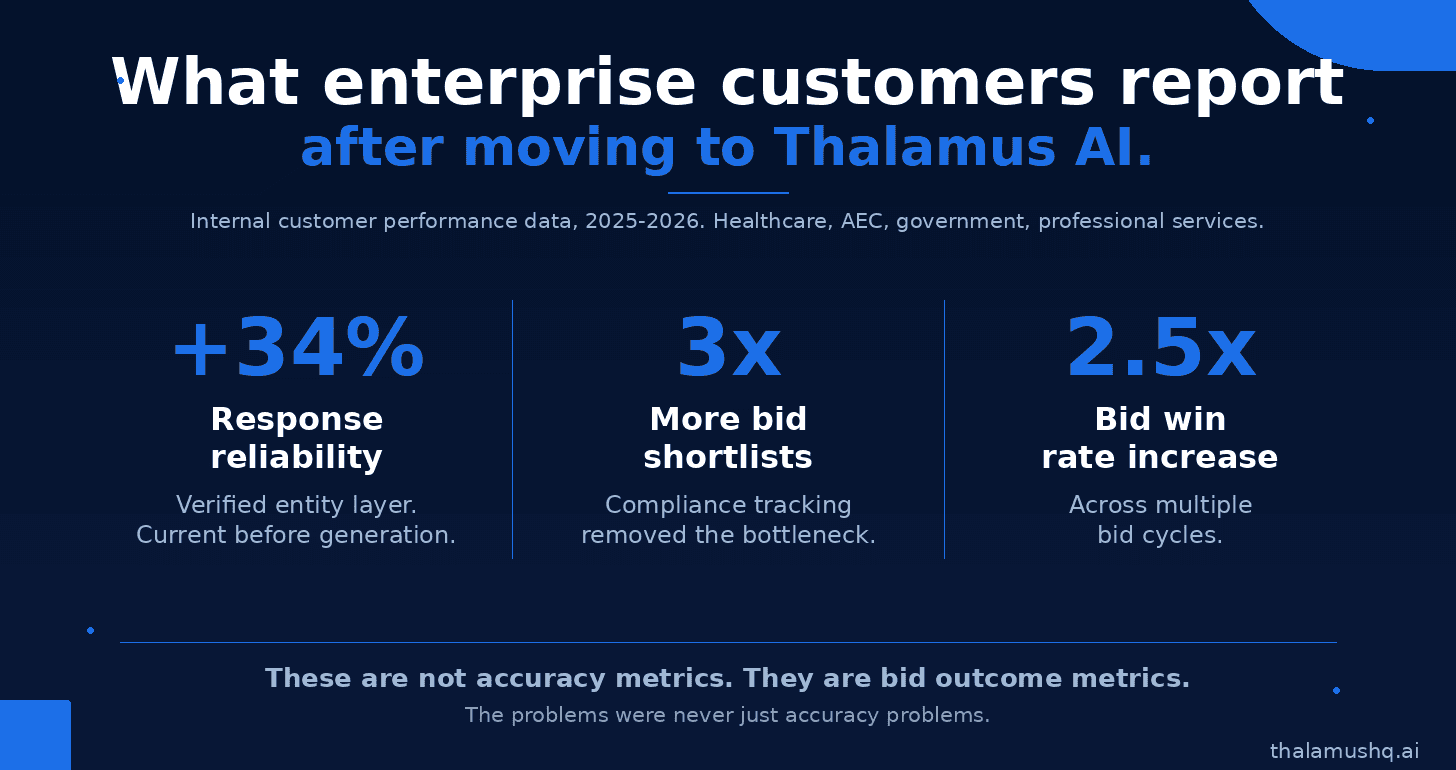
Based on Thalamus AI internal customer performance data from 2025–2026. Results vary by proposal volume, workflow complexity, content maturity, implementation quality, and adoption depth. Results are collected across enterprise teams in healthcare, AEC, government contracting, and professional services:
+34% improvement in response reliability - attributed to the verified knowledge entity layer ensuring that what the AI draws from is current and attributed before the answer is generated, not scored for confidence after.
3x more bid shortlist appearances across customers managing complex, multi-section proposals where compliance tracking and RACI coordination had previously been the bottleneck.
2.5x increase in bid win rates, reported by enterprise teams using the full bid management platform across multiple bid cycles, not a single submission
Arphie is a genuinely well-designed platform, and the teams using it for high-volume questionnaire workflows are right to value its confidence scoring, source transparency, and honest "I don't know" architecture. For that workload, it is among the most trustworthy tools in the category.
What it was built to solve is the trust problem at the output stage of a Q&A workflow. What Thalamus AI is built to solve is the coordination, compliance, and institutional knowledge problem of a full bid lifecycle, and the trust problem at the knowledge stage, before the first draft begins.
If the most important bids your team submits look like long-form, compliance-tracked, multi-stakeholder proposals, those are not the same problem.
Bring one RFP. We'll show you what verified knowledge, live compliance tracking, and full bid lifecycle management look like, in 20 minutes. Book a Thalamus AI demo.
Thalamus AI vs Arphie - FAQs
Does Arphie support long-form narrative RFP sections, or only Q&A questionnaires?
Arphie is built primarily for Q&A-driven workflows like structured questionnaires, DDQs, and security reviews. For long-form narrative sections requiring synthesis across multiple sources and tailored argumentation, Arphie's own confidence architecture will typically flag low confidence or insufficient knowledge, which is a reliable indicator that narrative proposal support sits outside its current core scope.
Does Arphie integrate with Salesforce?
Arphie connects to Google Drive, SharePoint, and Confluence for knowledge ingestion, but Salesforce is not a prominently stated native integration. Teams needing CRM-native proposal workflows should confirm integration availability directly with Arphie during the sales process.
How does Arphie's per-project pricing work in practice?
Arphie prices per project with unlimited users included per project, meaning you are not charged per seat, only per active RFP or questionnaire project. This avoids the cost penalty that hits teams on Responsive or Loopio when occasional SME contributors need access. The exact per-project cost requires a custom quote and is not publicly listed.
Is Arphie suitable for government or public sector proposals?
Arphie may be suitable for many enterprise contexts, but teams with federal, defense, FedRAMP, CMMC, DoD IL5, or other government-specific security mandates should confirm certification scope directly with Arphie and evaluate vendors against those exact procurement requirements.
Does Thalamus AI integrate with Salesforce?
Yes. Entity Records can connect to Salesforce and HubSpot, so proposal knowledge carries account and relationship context alongside the content itself, distinct from Arphie's source connectors, which cover document repositories (Google Drive, SharePoint, Confluence) rather than CRM systems.