
Harpreet Singh, MBA
Founder, Thalamus AI

With 12+ years in AI and enterprise software, including GenAI product work at Travelers, Harpreet writes about AI RFP software, AI bid tools, proposal operations, RFP response automation, and the future of enterprise bid management.
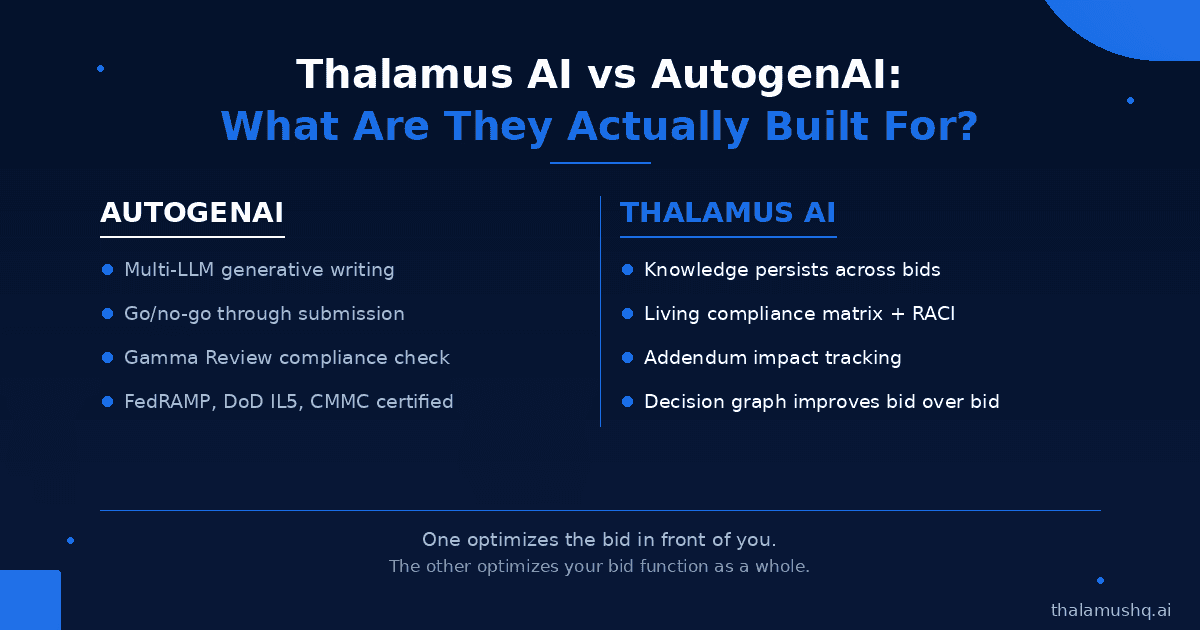
Thalamus AI vs AutogenAI on What "Full Lifecycle" Actually Means?
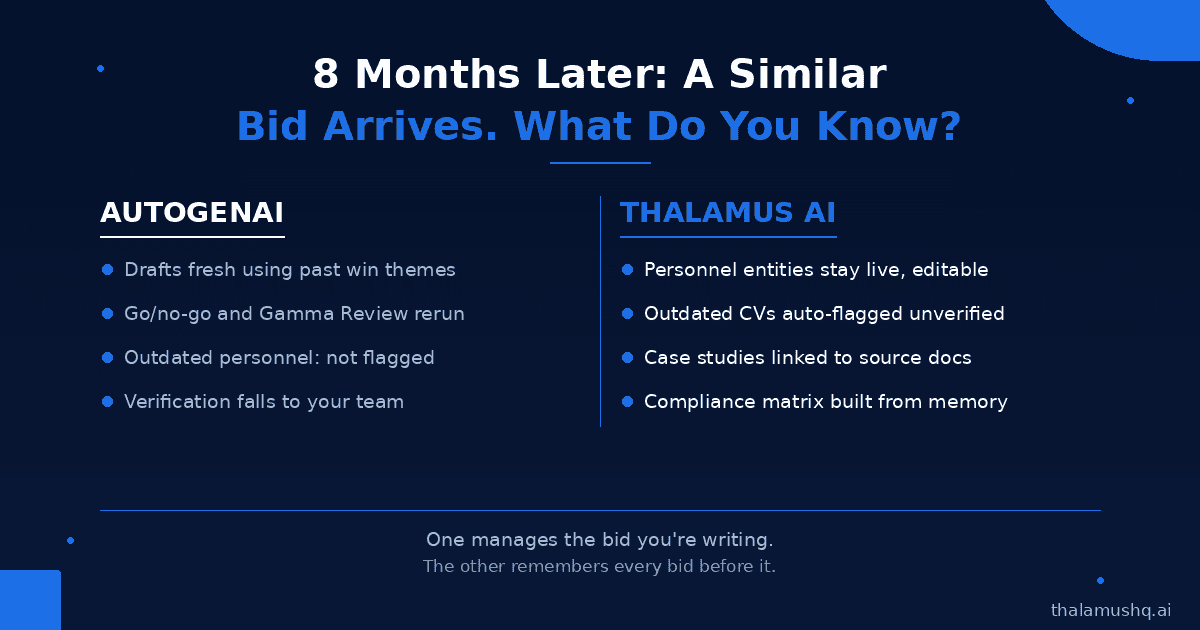
Imagine this. Your team wins a federal infrastructure contract using AutogenAI - strong narrative, Gamma Review caught two compliance gaps before submission, and the bid went out clean. Eight months later, a similar opportunity comes in from a different agency. The technical approach is 70% reusable. The project references need updating. Two of the key personnel from the winning bid have since left the company, and nobody is sure which CVs in the shared drive are current.
What does AutogenAI do?
Library AI draws on your past proposals and win themes to inform the new draft's language and positioning. The platform's lifecycle tools, like go/no-go scoring, requirement shredding, and Gamma Review, run fresh for this new opportunity, just as before. What the platform does not do is flag that two referenced personnel have left, or that a case study cited eight months ago has since been updated with a different outcome figure. That verification still falls to your team.
What does Thalamus AI do?
The personnel entities tied to the original bid are still live, structured, and editable. If a CV is outdated, the entity has already been flagged by whoever last touched it, or it surfaces automatically as unverified. The case study entity carries a status and a link to its source document.
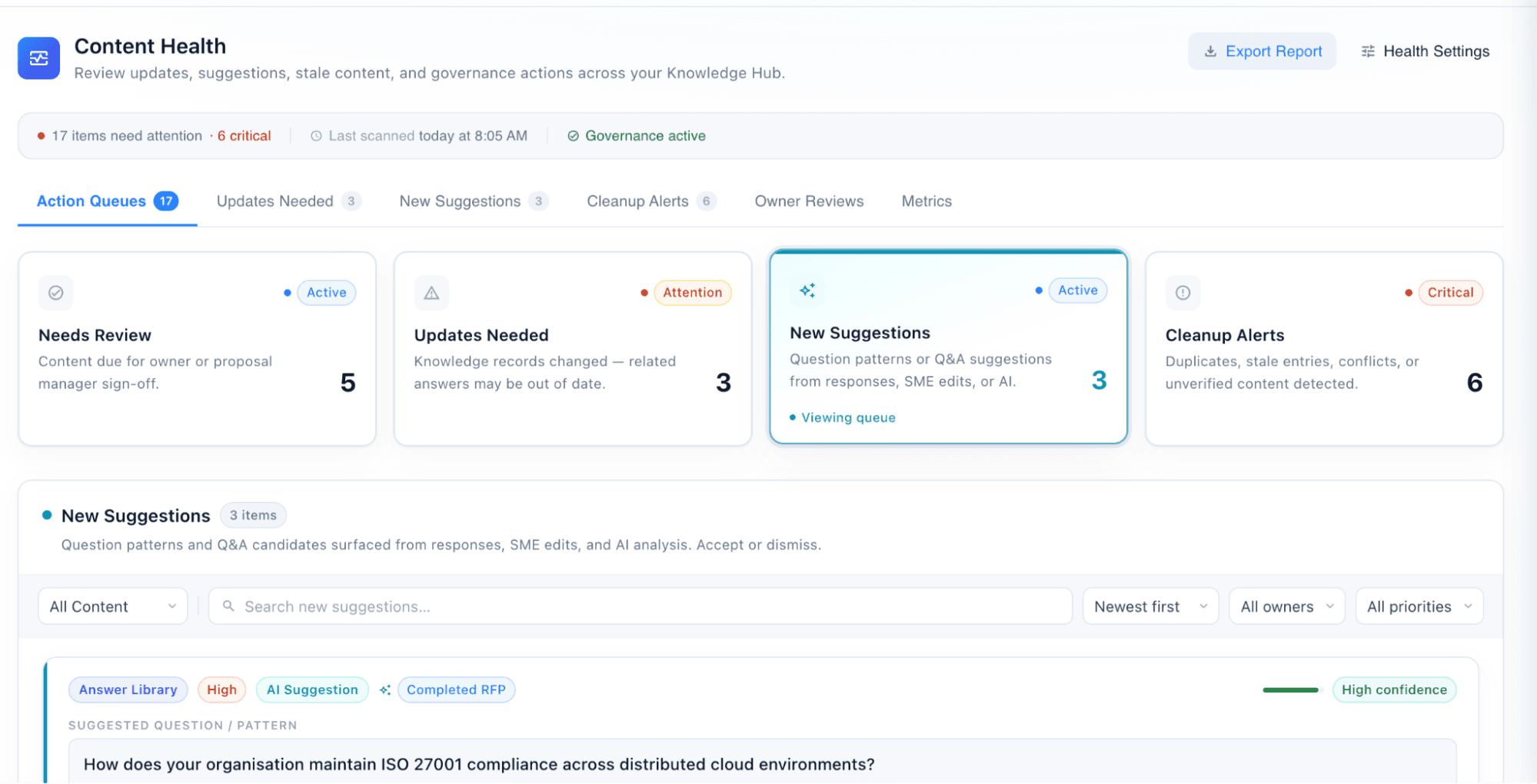
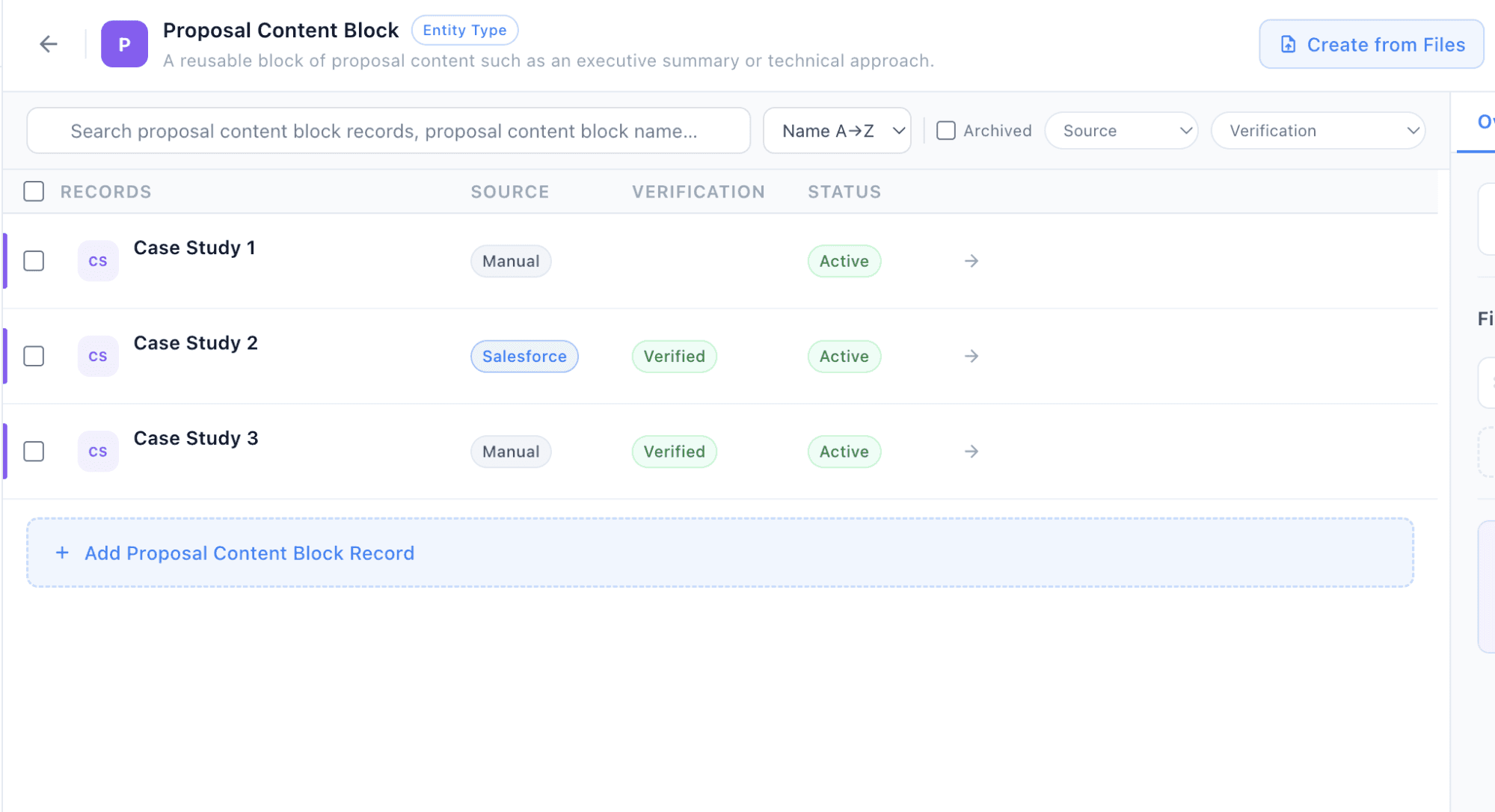
An AI-managed Content Health layer runs that check continuously in the background, flagging stale or conflicting entities as exceptions before they ever reach a new draft, rather than waiting for someone to notice eight months later. And because entities can connect to CRM systems like Salesforce for account context, the system also reflects whether the client relationship itself has changed since the last bid - a new primary contact, an updated account status - without anyone cross-referencing manually.
When the new RFP arrives, the same RFx Analysis Agent shreds it, builds a fresh compliance matrix, and routes sections to SMEs, but it does so against a knowledge base that already knows what changed since the last bid, not one that starts from a search through a shared drive.
That is the practical shape of the cross-bid lifecycle difference. AutogenAI manages the bid you're writing exceptionally well. Thalamus AI manages that, and the institutional memory of every bid that came before it.
Curious how Thalamus AI's knowledge entities stay current across bids without manual upkeep? See it live in a Thalamus AI demo, applied to a real past proposal.
Thalamus AI vs AutogenAI on Compliance: Gamma Review vs the Living Compliance Matrix
Both platforms take compliance seriously, and it's worth being precise about how each one actually does it, because the two approaches solve different moments in the bid.
Gamma Review runs as an automated check against your draft, identifying gaps, missing requirements, and unsupported claims before submission. It is a quality gate, positioned late in the process, and by every account in G2 reviews, it does that job well, catching issues teams would otherwise miss on a final read-through.
Thalamus AI's compliance matrix is built at a different point in the workflow and stays live throughout. The RFx Analysis Agent extracts every requirement the moment the RFP is uploaded, before a single word is drafted, and maps each one to a response section, an owner, and a status. It is not a final check. It is the document that governs the bid from day one. When a clarification notice or addendum arrives mid-bid and changes a requirement, Thalamus AI automatically detects the change and flags every section it affects - narrative already drafted, sections already marked complete, all of it. AutogenAI's public materials do not describe an equivalent mid-bid change detection capability.
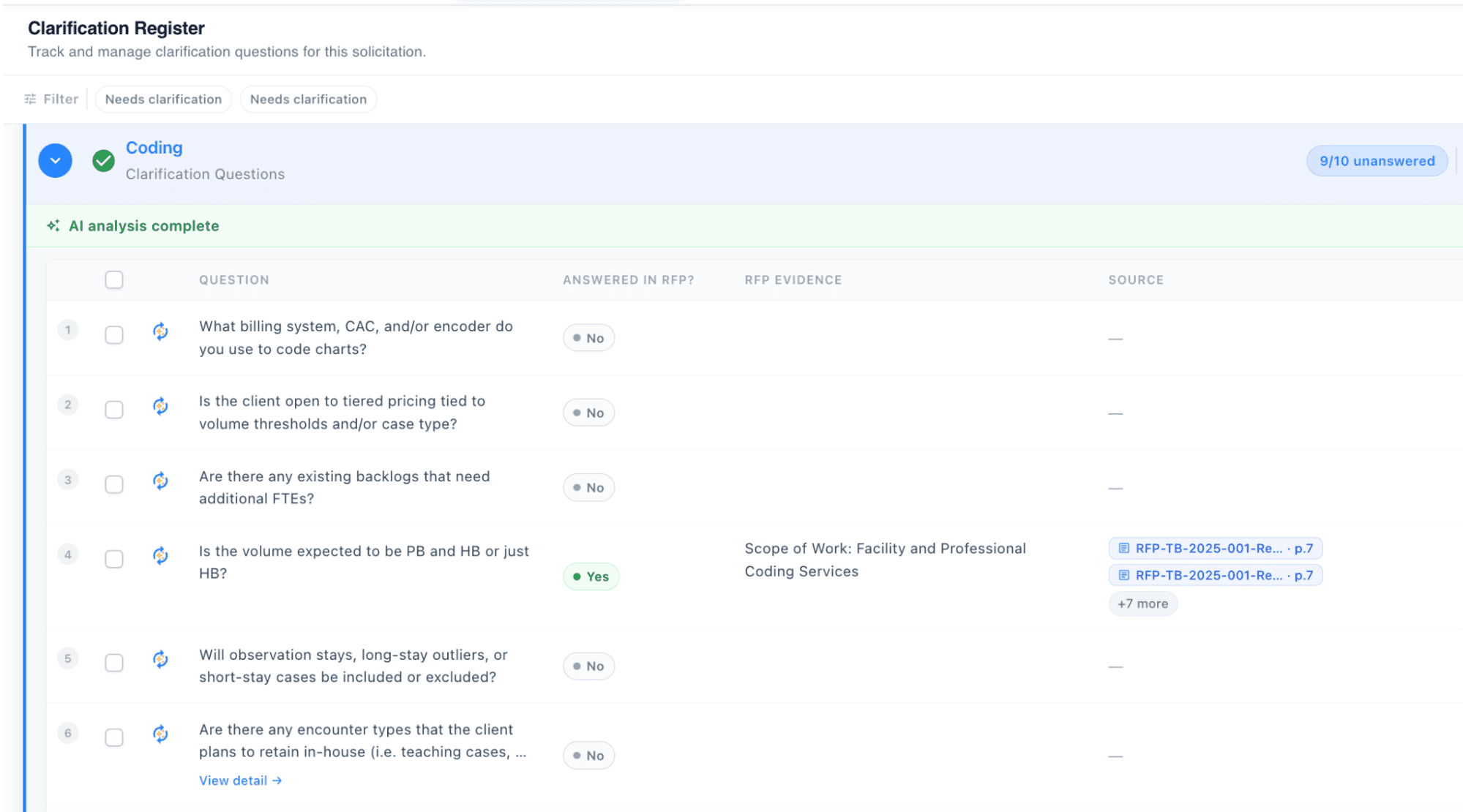
One adjacent gap worth naming precisely is that Gamma Review catches compliance issues in the draft stage. Thalamus AI's Clarification Register operates a step earlier, checking whether each open question the team has about the RFP is already answered somewhere in the package the buyer issued, separating genuinely unresolved items from ones simply buried in an appendix. AutogenAI's public materials don't describe an equivalent pre-submission check for open questions specifically.
For a bid with a stable, unchanging requirement set, a strong pre-submission review may be sufficient. For a complex RFP where addenda routinely arrive in the final two weeks, the difference between catching a gap at the end and catching a change the moment it happens is the difference between a clean resubmission and a scramble.
Managing bids where addenda regularly change requirements mid-process? See how Thalamus AI's living compliance matrix and addendum tracking work on a real RFP.
Thalamus AI vs AutogenAI: Who Should You Choose?
This comparison comes down to a question most teams don't articulate clearly enough before they buy: do you need the strongest possible draft for the bid in front of you, or do you need a system that gets smarter every time you bid? Both are legitimate priorities. They are not always on the same platform.
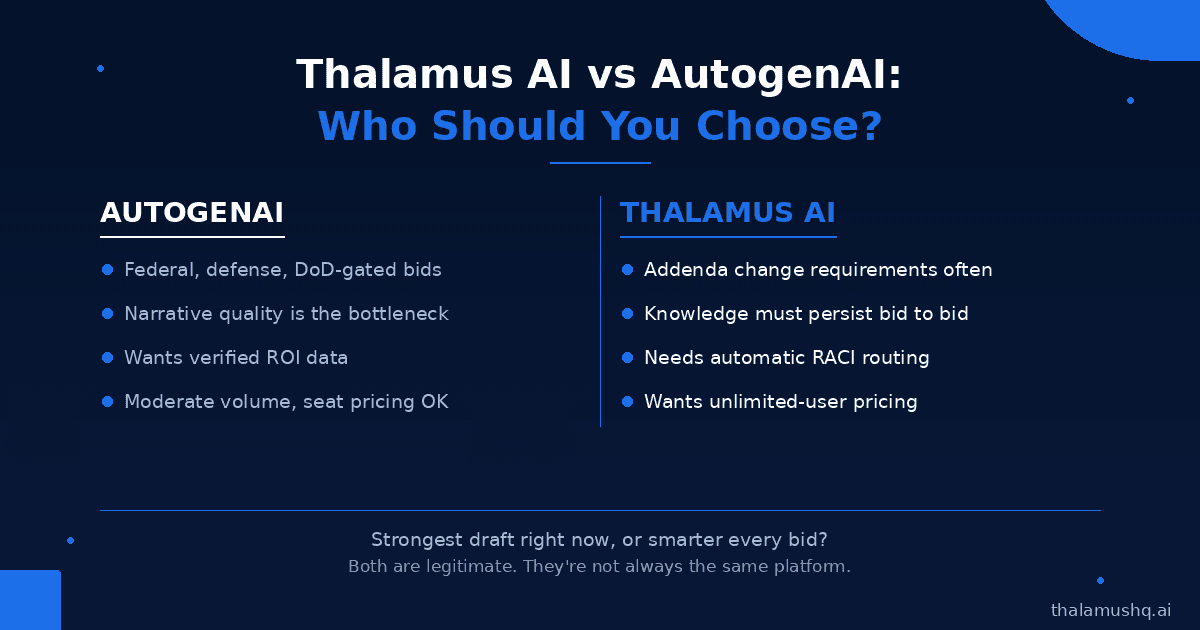
Choose AutogenAI if:
Your bids are federal, defense, or DoD-adjacent and require FedRAMP High, DoD IL5, or CMMC 2.0 certification as a gating requirement
Narrative writing quality is your single biggest bottleneck, and you want a bespoke language engine trained on your organization's voice
You want independently verified ROI data to support a budget case internally
Your proposal volume is moderate, and your team can absorb seat-based pricing with minimum commitments
Choose Thalamus AI if:
You manage complex, multi-section proposals where addenda routinely change requirements mid-bid, and automatic impact detection matters
Your knowledge - past proposals, CVs, case studies - needs to persist and stay verified across every future bid, not just the current one
You need RACI routing at the subsection level so SMEs across legal, technical, and delivery are assigned automatically, not manually
You want unlimited-user pricing so your full bid team can contribute without seat-based cost anxiety
Your bids are predominantly commercial, healthcare, AEC, or enterprise rather than federal/defense-gated
Your knowledge, past proposals, CVs, and case studies need to persist and stay verified across every future bid, with CRM-connected account context, not just the current one
Thalamus AI is probably not the right fit if: your bids require FedRAMP High, DoD IL5, or CMMC 2.0 certification today, or your primary need is the single strongest narrative draft for a one-off bid rather than a system that compounds knowledge across many.
Think Thalamus AI might be the right fit for your team? Start with a 3-month pilot, unlimited projects, unlimited RFPs, one team.
What Enterprise Customers Report After Moving to Thalamus AI?
Enterprise customers using Thalamus AI across complex proposal environments have reported measurable improvements that compound across bids, not just within a single submission.
Based on Thalamus AI internal customer performance data (2025–2026), across enterprise teams in healthcare, AEC, government contracting, and professional services:
+34% improvement in response reliability - attributed to the verified knowledge entity layer catching outdated or inconsistent content before it reaches a draft
3x more bid shortlist appearances - across customers managing complex, multi-section proposals where addendum changes had previously been a manual, error-prone process
2.5x increase in bid win rates - reported by enterprise teams using the full bid management platform across multiple bid cycles, not a single submission
AutogenAI's own evidence is genuinely strong - the MH&A study's 12.4% revenue growth figure is a higher evidentiary bar than most of this category clears, and it deserves to be taken at face value.
Where the two platforms diverge is not in the credibility of their data, but in what the data is measuring: AutogenAI's numbers reflect what happens when a single bid is written exceptionally well. Thalamus AI's numbers reflect what happens when an entire bid function compounds its knowledge over time.
If your hardest problem is the bid in front of you, AutogenAI is a genuinely strong choice, and we'd say so to your face. If your hardest problem is what happens to everything your team has ever learned once that bid closes, the comparison runs the other way.
Bring one RFP. We'll show you what cross-bid institutional memory and live addendum tracking look like in 20 minutes. Book a Thalamus AI demo.
Thalamus AI vs AutogenAI - FAQs
Does Thalamus AI use multi-LLM routing like AutogenAI?
Thalamus AI does not position multi-LLM routing as its main differentiator. Its core architecture is built around a verified knowledge entity layer, source-linked proposal data, and agentic workflows for requirement mapping, compliance matrices, RACI routing, SME collaboration, and post-bid learning. AutogenAI’s multi-model routing across GPT, Claude, Gemini, Cohere, and Mistral is a distinct architectural choice focused heavily on task-specific writing quality.
Is AutogenAI only for government and defense teams?
No. While AutogenAI holds FedRAMP High, DoD IL5, and CMMC 2.0 certifications that make it a strong fit for federal and defense procurement, its customer base also includes commercial clients like Careium and construction firms, alongside government-adjacent customers like Serco and Seetec.
What is the MH&A study AutogenAI cites?
The MH&A study is an independent academic report published in May 2025 comparing revenue outcomes between AutogenAI users and comparable non-users between FY23 and FY24. It found a 12.4% revenue increase for users against a 7.1% decline for non-users, a near 20-percentage-point gap, conducted externally rather than commissioned as vendor-reported data.
Does Thalamus AI offer a free trial?
No. Like AutogenAI, Thalamus AI does not offer a self-serve free trial. Both platforms require a guided demo before evaluation, though Thalamus AI's 3-month pilot pack gives teams a longer hands-on evaluation window than a typical trial would.
Can Thalamus AI or AutogenAI generate visuals or graphics in proposals?
Neither platform publicly positions native visual, chart, or graphic generation as a core capability. Both are primarily focused on proposal writing, RFP analysis, compliance review, and document workflow. Teams typically still use separate design tools for complex visual proposal elements.
How long does AutogenAI implementation typically take?
AutogenAI has held G2's Fastest Implementation award for RFP software since entering the category in 2025, with onboarding generally measured in days rather than weeks. Thalamus AI's typical onboarding runs through a structured 3-month pilot pack designed for deeper workflow configuration.
Is there a more affordable alternative to AutogenAI for commercial, non-government bid teams?
For teams without a federal or defense security requirement, Thalamus AI's unlimited-user pricing model removes the seat-based cost structure and minimum commitments that AutogenAI's enterprise pricing involves, which can make it a more predictable cost for commercial teams scaling SME access.
Why do people search for “Thalamus AI vs Autogen AI”?
Many buyers write AutogenAI as “Autogen AI” because the brand name is visually close to a two-word phrase. This page compares Thalamus AI with AutogenAI, the proposal writing platform, not Microsoft AutoGen.
Does Thalamus AI's knowledge stay current between bids without manual review?
Yes. An AI-managed Content Health layer continuously scans entities for duplicates, staleness, and conflicts, flagging only what needs a human decision. This differs from AutogenAI's Library AI, which is trained on an organization's proposals at onboarding rather than actively monitored afterward.
Data source
Thalamus AI internal customer performance data, 2025–2026, based on enterprise customer outcomes across healthcare, AEC, government contracting, and professional services. AutogenAI data sourced from G2 (130 reviews, 4.4/5), AutogenAI's published product and security materials, and the MH&A independent academic revenue study (May 2025), as of June 2026.