Compare

Compare

10 mins

10 mins

Thalamus AI vs HeyIris: RFP Platform Comparison 2026

Thalamus AI vs HeyIris: RFP Platform Comparison 2026

Thalamus AI vs HeyIris: RFP Platform Comparison 2026

Thalamus AI vs HeyIris: RFP Platform Comparison 2026

Harpreet Singh, MBA

Founder, Thalamus AI

With 12+ years in AI and enterprise software, including GenAI product work at Travelers Group, Harpreet writes about AI RFP software, AI bid tools, proposal operations, RFP response automation, and the future of enterprise bid management.

Summarize with ChatGPT

Summarize with ChatGPT

Key Takeaways

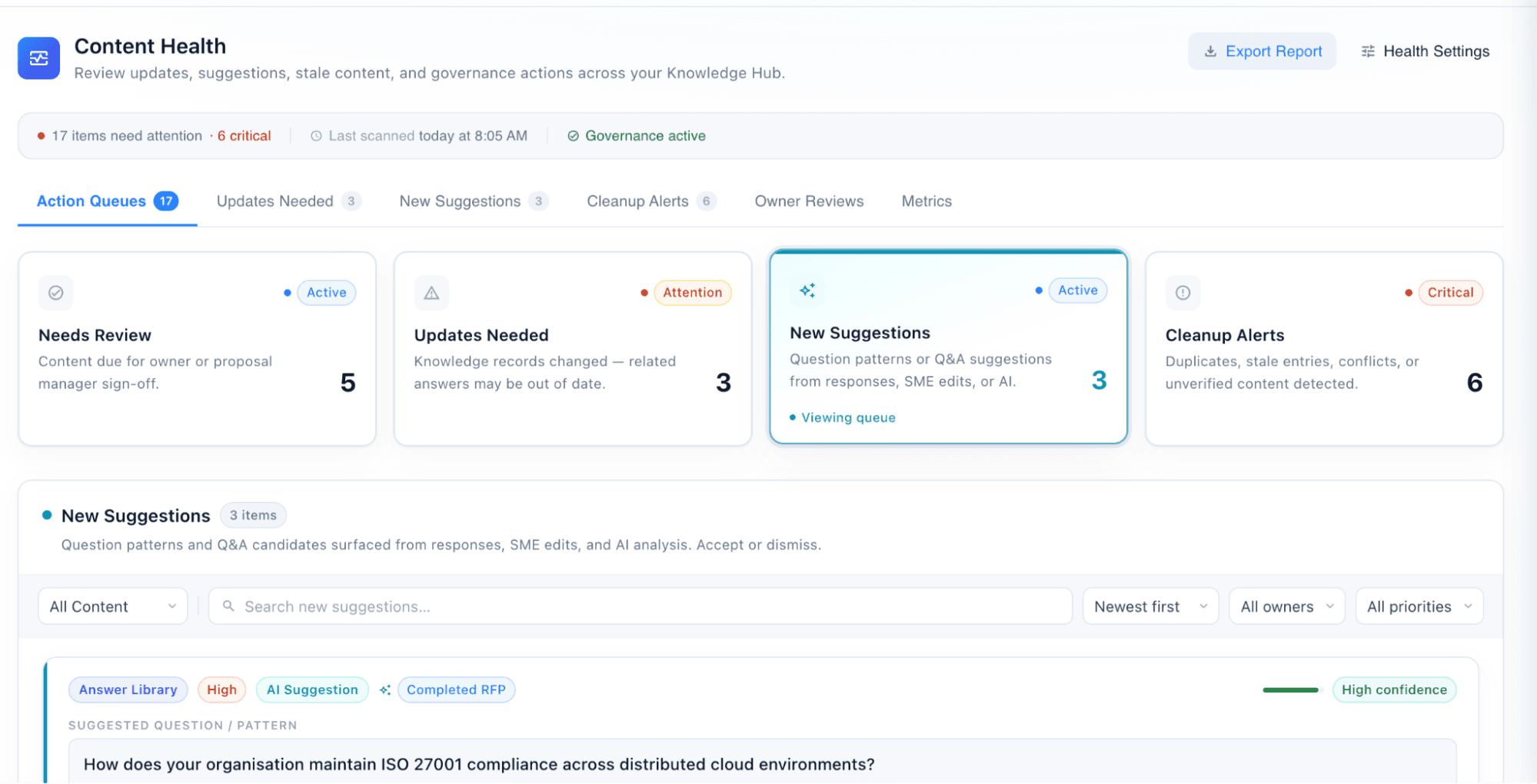
  • HeyIris positions itself as an AI-native Deal Desk for sales engineers, presales teams, and proposal writers that need faster RFP response automation, DDQs, security questionnaires, Salesforce-connected workflows, and deal velocity. Thalamus AI is built for proposal and bid teams that need deeper bid lifecycle control across requirements, compliance, SMEs, addenda, and post-bid learning.

  • HeyIris's Knowledge Ledger is a genuinely well-designed centralized knowledge system that learns from every RFP, but its output quality depends entirely on ledger depth, and returns "not enough info" when that depth is insufficient.

  • Thalamus AI is built for proposal and bid management teams managing complex, multi-section proposals where compliance matrices, addendum tracking, RACI routing, and post-bid institutional learning are as critical as drafting speed.

  • Enterprise customers using Thalamus AI across complex proposal environments have reported a +34% improvement in response reliability, 3x more shortlist appearances, and a 2.5x increase in bid win rates.

There is a question that surfaces in almost every evaluation conversation where HeyIris appears on a shortlist: "Is this for our sales team or for our proposal team?" It is a better question than most comparison blogs acknowledge, because the answer often settles the comparison before a feature table is necessary.

HeyIris calls itself a Deal Desk. That is not a label chosen by accident. A Deal Desk is the function inside a sales organization that helps close complex, high-value deals, pricing sign-off, contract terms, technical validation, and knowledge support. HeyIris has taken that concept and built an AI platform around it: a place where the knowledge needed to win deals lives, grows, and gets faster to access with every RFP the team responds to.

That is a different job from managing a bid. And understanding which job your team has is most of what this comparison is actually about.

Summarize with ChatGPT

Key Takeaways

Key Takeaways

Key Takeaways

  • HeyIris positions itself as an AI-native Deal Desk for sales engineers, presales teams, and proposal writers that need faster RFP response automation, DDQs, security questionnaires, Salesforce-connected workflows, and deal velocity. Thalamus AI is built for proposal and bid teams that need deeper bid lifecycle control across requirements, compliance, SMEs, addenda, and post-bid learning.

  • HeyIris's Knowledge Ledger is a genuinely well-designed centralized knowledge system that learns from every RFP, but its output quality depends entirely on ledger depth, and returns "not enough info" when that depth is insufficient.

  • Thalamus AI is built for proposal and bid management teams managing complex, multi-section proposals where compliance matrices, addendum tracking, RACI routing, and post-bid institutional learning are as critical as drafting speed.

  • Enterprise customers using Thalamus AI across complex proposal environments have reported a +34% improvement in response reliability, 3x more shortlist appearances, and a 2.5x increase in bid win rates.

There is a question that surfaces in almost every evaluation conversation where HeyIris appears on a shortlist: "Is this for our sales team or for our proposal team?" It is a better question than most comparison blogs acknowledge, because the answer often settles the comparison before a feature table is necessary.

HeyIris calls itself a Deal Desk. That is not a label chosen by accident. A Deal Desk is the function inside a sales organization that helps close complex, high-value deals, pricing sign-off, contract terms, technical validation, and knowledge support. HeyIris has taken that concept and built an AI platform around it: a place where the knowledge needed to win deals lives, grows, and gets faster to access with every RFP the team responds to.

That is a different job from managing a bid. And understanding which job your team has is most of what this comparison is actually about.

  • HeyIris positions itself as an AI-native Deal Desk for sales engineers, presales teams, and proposal writers that need faster RFP response automation, DDQs, security questionnaires, Salesforce-connected workflows, and deal velocity. Thalamus AI is built for proposal and bid teams that need deeper bid lifecycle control across requirements, compliance, SMEs, addenda, and post-bid learning.

  • HeyIris's Knowledge Ledger is a genuinely well-designed centralized knowledge system that learns from every RFP, but its output quality depends entirely on ledger depth, and returns "not enough info" when that depth is insufficient.

  • Thalamus AI is built for proposal and bid management teams managing complex, multi-section proposals where compliance matrices, addendum tracking, RACI routing, and post-bid institutional learning are as critical as drafting speed.

  • Enterprise customers using Thalamus AI across complex proposal environments have reported a +34% improvement in response reliability, 3x more shortlist appearances, and a 2.5x increase in bid win rates.

There is a question that surfaces in almost every evaluation conversation where HeyIris appears on a shortlist: "Is this for our sales team or for our proposal team?" It is a better question than most comparison blogs acknowledge, because the answer often settles the comparison before a feature table is necessary.

HeyIris calls itself a Deal Desk. That is not a label chosen by accident. A Deal Desk is the function inside a sales organization that helps close complex, high-value deals, pricing sign-off, contract terms, technical validation, and knowledge support. HeyIris has taken that concept and built an AI platform around it: a place where the knowledge needed to win deals lives, grows, and gets faster to access with every RFP the team responds to.

That is a different job from managing a bid. And understanding which job your team has is most of what this comparison is actually about.

Quick Answer: Thalamus AI vs HeyIris - Which Platform Is Better?

Quick Answer: Thalamus AI vs HeyIris - Which Platform Is Better?

HeyIris is better for sales, presales, and sales engineering teams that need fast RFP response automation, security questionnaire support, DDQ responses, Salesforce-connected workflows, Portal AutoFill, and a self-updating Knowledge Ledger.

Thalamus AI is better for enterprise proposal and bid teams managing complex, multi-section RFPs where drafting is only one part of the workflow. Thalamus AI is built for full bid lifecycle management: bid/no-bid, requirement extraction, compliance matrices, addendum tracking, AI RACI routing, SME collaboration, source-linked drafting, portal responses, and post-bid learning.

The short version: choose HeyIris if your main goal is accelerating sales-led response work. Choose Thalamus AI if your main goal is running complex bids from intake to submission without losing requirements, owners, evidence, or institutional learning.

HeyIris is better for sales, presales, and sales engineering teams that need fast RFP response automation, security questionnaire support, DDQ responses, Salesforce-connected workflows, Portal AutoFill, and a self-updating Knowledge Ledger.

Thalamus AI is better for enterprise proposal and bid teams managing complex, multi-section RFPs where drafting is only one part of the workflow. Thalamus AI is built for full bid lifecycle management: bid/no-bid, requirement extraction, compliance matrices, addendum tracking, AI RACI routing, SME collaboration, source-linked drafting, portal responses, and post-bid learning.

The short version: choose HeyIris if your main goal is accelerating sales-led response work. Choose Thalamus AI if your main goal is running complex bids from intake to submission without losing requirements, owners, evidence, or institutional learning.

Thalamus AI vs HeyIris: What Each Platform Is Actually Built For?

Thalamus AI vs HeyIris: What Each Platform Is Actually Built For?

In most conversations where HeyIris and Thalamus AI both appear in an evaluation, I find the same pattern: HeyIris was surfaced by the sales or presales team, and Thalamus AI was surfaced by the proposal manager or bid director. That is not a coincidence. Both platforms handle RFPs. They were built for different people managing them.

HeyIris, marketed simply as Iris, is an AI-native Deal Desk founded in 2023. It is built for sales engineers, presales teams, and proposal writers at B2B companies who need to respond to RFPs, security questionnaires, DDQs, and RFIs faster and more consistently than their current manual process allows. Its core is the Knowledge Ledger, a structured, self-updating knowledge system that centralises your company's documentation and past Q&A pairs, learns from every RFP your team submits, and uses that accumulated knowledge to generate first drafts for incoming requests. With a 4.9/5 G2 rating across 67 reviews and 95% five-star ratings since launching in 2023, its users consistently report dramatically faster turnaround times, some noting 10x efficiency gains, and strong hands-on support from the Iris team throughout onboarding.

Thalamus AI is built for a different function. Where HeyIris accelerates deal velocity for a sales-adjacent team handling buyer-facing documentation, Thalamus AI manages the full lifecycle of a bid: from the moment an opportunity is identified, through requirement parsing, compliance matrix generation, bid/no-bid scoring, RACI routing, SME coordination, addendum tracking, and post-bid institutional learning. It converts your unstructured documents, past proposals, CVs, and case studies into verified, editable knowledge entities and deploys 20+ specialized AI agents across every stage. The output is not just a faster draft. It is a coordinated, compliance-tracked, institutionally informed bid.

Two platforms. Both call their knowledge system a core differentiator. Very different definitions of what the knowledge needs to do.

Evaluating HeyIris for your presales team but also managing complex multi-section proposals? Bring one live RFP to a Thalamus AI demo, 20 minutes, to see the full bid lifecycle in action.

In most conversations where HeyIris and Thalamus AI both appear in an evaluation, I find the same pattern: HeyIris was surfaced by the sales or presales team, and Thalamus AI was surfaced by the proposal manager or bid director. That is not a coincidence. Both platforms handle RFPs. They were built for different people managing them.

HeyIris, marketed simply as Iris, is an AI-native Deal Desk founded in 2023. It is built for sales engineers, presales teams, and proposal writers at B2B companies who need to respond to RFPs, security questionnaires, DDQs, and RFIs faster and more consistently than their current manual process allows. Its core is the Knowledge Ledger, a structured, self-updating knowledge system that centralises your company's documentation and past Q&A pairs, learns from every RFP your team submits, and uses that accumulated knowledge to generate first drafts for incoming requests. With a 4.9/5 G2 rating across 67 reviews and 95% five-star ratings since launching in 2023, its users consistently report dramatically faster turnaround times, some noting 10x efficiency gains, and strong hands-on support from the Iris team throughout onboarding.

Thalamus AI is built for a different function. Where HeyIris accelerates deal velocity for a sales-adjacent team handling buyer-facing documentation, Thalamus AI manages the full lifecycle of a bid: from the moment an opportunity is identified, through requirement parsing, compliance matrix generation, bid/no-bid scoring, RACI routing, SME coordination, addendum tracking, and post-bid institutional learning. It converts your unstructured documents, past proposals, CVs, and case studies into verified, editable knowledge entities and deploys 20+ specialized AI agents across every stage. The output is not just a faster draft. It is a coordinated, compliance-tracked, institutionally informed bid.

Two platforms. Both call their knowledge system a core differentiator. Very different definitions of what the knowledge needs to do.

Evaluating HeyIris for your presales team but also managing complex multi-section proposals? Bring one live RFP to a Thalamus AI demo, 20 minutes, to see the full bid lifecycle in action.

Thalamus AI vs HeyIris: Side-by-Side Feature Comparison

Thalamus AI vs HeyIris: Side-by-Side Feature Comparison

Thalamus AI vs HeyIris: Side-by-Side Feature Comparison

What You're Actually Evaluating

Thalamus AI

HeyIris (Iris)

Core positioning

Full bid lifecycle platform for proposal and bid management teams

AI-native Deal Desk for sales engineers, presales teams, and proposal writers

Knowledge architecture

Verified, editable, auditable knowledge entities (CVs, projects, case studies, Q&A), attributed to source, traceable, with verification status

Knowledge Ledger, centralized, self-updating system that learns from every RFP and ingests past Q&A pairs and documents

When knowledge is insufficient

Answers grounded in verified entities; flags unverified or stale content proactively

Returns "not enough info" - explicit and honest, but requires well-maintained ledger depth to avoid

Full bid lifecycle coverage

✓ Capture → Qualify → Plan → Coordinate → Respond → Learn

RFP response, questionnaire automation, and deal knowledge management; not a full lifecycle platform

Narrative proposal support

✓ 150-page multi-document proposals with structured assembly

Not a stated core capability

Compliance matrix & requirement mapping

✓ Auto-generated living compliance index with requirement-level traceability

Not a core capability

Addendum & change impact tracking

✓ Automatically flags impacted sections when requirements change

Not a core capability

Bid / No-Bid scoring

✓ AI-generated with win/loss outcome data

Not a core capability

RACI & multi-stakeholder routing

✓ Auto-classifies and routes to proposal, legal, security, SME teams at subsection level

Task assignment, deadline tracking, collaborative workspace; no automated RACI generation

Conflict identification

✓ Compliance matrix catches requirement gaps; entity verification flags contradictions

✓ Built-in checks flag inconsistencies between drafts and Knowledge Ledger content

Institutional memory

✓ Win/loss outcomes, reviewer corrections, and entity updates compound across every bid

Knowledge Ledger learns from every submitted RFP; no win/loss outcome learning loop

Portal AutoFill

✓ Native part of the RFx workflow

✓ Portal AutoFill available, fills vendor portals directly

Salesforce integration

✓ CRM integration layer

✓ Native Salesforce integration, consistently praised by reviewers

Visual/graphic handling in proposals

Not a core capability

Flagged by reviewers as a gap, limited handling of graphical elements

AI approach

Agentic, grounded in verified internal entities only

Deterministic, internal-only, does not generate from public web data

Processing speed

Standard enterprise processing

Reviewers note occasional slowness during high-load processing

Pricing structure

Unlimited users and RFPs under one subscription; custom quote

Per-user seats with unlimited collaborators; custom pricing by team size and RFP volume

Founded

2024

2023

Total funding

Not publicly disclosed

$4.07M

G2 rating

5.0/5 (growing review base)

4.9/5 (67 reviews, 95% five-star)

Want this comparison applied to your team's specific RFx mix? Book a 20-minute Thalamus AI session, bring your next RFP, and we'll run it through the platform live.

What You're Actually Evaluating

Thalamus AI

HeyIris (Iris)

Core positioning

Full bid lifecycle platform for proposal and bid management teams

AI-native Deal Desk for sales engineers, presales teams, and proposal writers

Knowledge architecture

Verified, editable, auditable knowledge entities (CVs, projects, case studies, Q&A), attributed to source, traceable, with verification status

Knowledge Ledger, centralized, self-updating system that learns from every RFP and ingests past Q&A pairs and documents

When knowledge is insufficient

Answers grounded in verified entities; flags unverified or stale content proactively

Returns "not enough info" - explicit and honest, but requires well-maintained ledger depth to avoid

Full bid lifecycle coverage

✓ Capture → Qualify → Plan → Coordinate → Respond → Learn

RFP response, questionnaire automation, and deal knowledge management; not a full lifecycle platform

Narrative proposal support

✓ 150-page multi-document proposals with structured assembly

Not a stated core capability

Compliance matrix & requirement mapping

✓ Auto-generated living compliance index with requirement-level traceability

Not a core capability

Addendum & change impact tracking

✓ Automatically flags impacted sections when requirements change

Not a core capability

Bid / No-Bid scoring

✓ AI-generated with win/loss outcome data

Not a core capability

RACI & multi-stakeholder routing

✓ Auto-classifies and routes to proposal, legal, security, SME teams at subsection level

Task assignment, deadline tracking, collaborative workspace; no automated RACI generation

Conflict identification

✓ Compliance matrix catches requirement gaps; entity verification flags contradictions

✓ Built-in checks flag inconsistencies between drafts and Knowledge Ledger content

Institutional memory

✓ Win/loss outcomes, reviewer corrections, and entity updates compound across every bid

Knowledge Ledger learns from every submitted RFP; no win/loss outcome learning loop

Portal AutoFill

✓ Native part of the RFx workflow

✓ Portal AutoFill available, fills vendor portals directly

Salesforce integration

✓ CRM integration layer

✓ Native Salesforce integration, consistently praised by reviewers

Visual/graphic handling in proposals

Not a core capability

Flagged by reviewers as a gap, limited handling of graphical elements

AI approach

Agentic, grounded in verified internal entities only

Deterministic, internal-only, does not generate from public web data

Processing speed

Standard enterprise processing

Reviewers note occasional slowness during high-load processing

Pricing structure

Unlimited users and RFPs under one subscription; custom quote

Per-user seats with unlimited collaborators; custom pricing by team size and RFP volume

Founded

2024

2023

Total funding

Not publicly disclosed

$4.07M

G2 rating

5.0/5 (growing review base)

4.9/5 (67 reviews, 95% five-star)

Want this comparison applied to your team's specific RFx mix? Book a 20-minute Thalamus AI session, bring your next RFP, and we'll run it through the platform live.

Thalamus AI vs HeyIris on the Knowledge Architecture That Matters Most

Thalamus AI vs HeyIris on the Knowledge Architecture That Matters Most

Thalamus AI vs HeyIris on the Knowledge Architecture That Matters Most

Both platforms identify centralized knowledge as their core differentiator. Both are right to. Where they differ is in what the knowledge needs to do before a word is drafted.

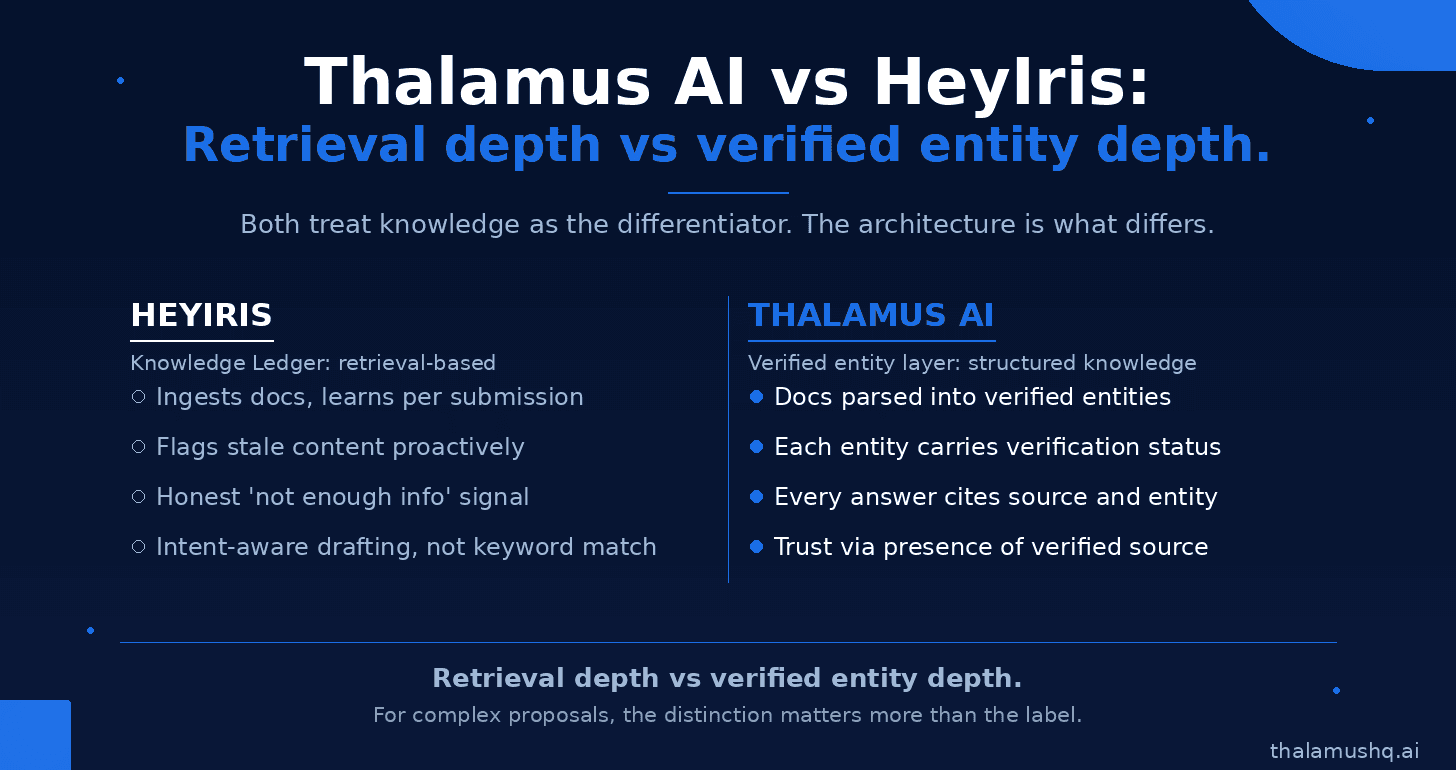
HeyIris's Knowledge Ledger is a genuinely well-designed system. It ingests your documents, past Q&A pairs, and RFP responses, learns from every submission, flags content that may have gone stale, and propagates updates across related content. The Ledger gets smarter with every RFP your team submits, which, over time, means the draft quality improves as a function of how many responses your team has made and how well the Ledger has been maintained. Reviewers consistently describe the drafting as understanding the intent behind questions, not just matching keywords, which reflects a knowledge system doing what it was designed to do.

The honest signal from HeyIris's own architecture is what happens when the Ledger doesn't know. The system returns "not enough info", an honest acknowledgement that it will not fabricate an answer from public data or incomplete context. One G2 reviewer named this as their only complaint: "I don't like that Iris can't invent answers on its own and will say 'not enough info' when trying to build an answer." That complaint is actually a feature, not a bug, as it prevents hallucination. But it also tells you that the knowledge architecture is retrieval-dependent. If your Ledger lacks depth on a topic, the platform tells you rather than guesses.

Thalamus AI's approach builds the knowledge layer differently. Your unstructured documents are not just ingested and indexed; they are parsed into structured, verified entities: a project record with verifiable outcomes, a CV with role history and certification dates, a case study with source-attributed results. Each entity carries a verification status. When the AI generates an answer, it draws from that verified layer and cites the specific entity and source document it drew from. The trust signal comes not from the absence of a fabricated answer, but from the presence of a verified one.

For a sales engineer answering fifty security questionnaires per quarter from a well-maintained Ledger, these two approaches produce similar output quality. For a bid manager drafting a technical methodology section for a 120-page proposal where the project reference needs to meet a specific threshold the evaluator specified, verified entity depth matters differently than retrieval depth.

Curious how Thalamus AI's verified entity layer compares to a Knowledge Ledger at the point where a complex bid requires it? See it live in a 20-minute demo, applied to a real proposal.

Both platforms identify centralized knowledge as their core differentiator. Both are right to. Where they differ is in what the knowledge needs to do before a word is drafted.

HeyIris's Knowledge Ledger is a genuinely well-designed system. It ingests your documents, past Q&A pairs, and RFP responses, learns from every submission, flags content that may have gone stale, and propagates updates across related content. The Ledger gets smarter with every RFP your team submits, which, over time, means the draft quality improves as a function of how many responses your team has made and how well the Ledger has been maintained. Reviewers consistently describe the drafting as understanding the intent behind questions, not just matching keywords, which reflects a knowledge system doing what it was designed to do.

The honest signal from HeyIris's own architecture is what happens when the Ledger doesn't know. The system returns "not enough info", an honest acknowledgement that it will not fabricate an answer from public data or incomplete context. One G2 reviewer named this as their only complaint: "I don't like that Iris can't invent answers on its own and will say 'not enough info' when trying to build an answer." That complaint is actually a feature, not a bug, as it prevents hallucination. But it also tells you that the knowledge architecture is retrieval-dependent. If your Ledger lacks depth on a topic, the platform tells you rather than guesses.

Thalamus AI's approach builds the knowledge layer differently. Your unstructured documents are not just ingested and indexed; they are parsed into structured, verified entities: a project record with verifiable outcomes, a CV with role history and certification dates, a case study with source-attributed results. Each entity carries a verification status. When the AI generates an answer, it draws from that verified layer and cites the specific entity and source document it drew from. The trust signal comes not from the absence of a fabricated answer, but from the presence of a verified one.

For a sales engineer answering fifty security questionnaires per quarter from a well-maintained Ledger, these two approaches produce similar output quality. For a bid manager drafting a technical methodology section for a 120-page proposal where the project reference needs to meet a specific threshold the evaluator specified, verified entity depth matters differently than retrieval depth.

Curious how Thalamus AI's verified entity layer compares to a Knowledge Ledger at the point where a complex bid requires it? See it live in a 20-minute demo, applied to a real proposal.

Both platforms identify centralized knowledge as their core differentiator. Both are right to. Where they differ is in what the knowledge needs to do before a word is drafted.

HeyIris's Knowledge Ledger is a genuinely well-designed system. It ingests your documents, past Q&A pairs, and RFP responses, learns from every submission, flags content that may have gone stale, and propagates updates across related content. The Ledger gets smarter with every RFP your team submits, which, over time, means the draft quality improves as a function of how many responses your team has made and how well the Ledger has been maintained. Reviewers consistently describe the drafting as understanding the intent behind questions, not just matching keywords, which reflects a knowledge system doing what it was designed to do.

The honest signal from HeyIris's own architecture is what happens when the Ledger doesn't know. The system returns "not enough info", an honest acknowledgement that it will not fabricate an answer from public data or incomplete context. One G2 reviewer named this as their only complaint: "I don't like that Iris can't invent answers on its own and will say 'not enough info' when trying to build an answer." That complaint is actually a feature, not a bug, as it prevents hallucination. But it also tells you that the knowledge architecture is retrieval-dependent. If your Ledger lacks depth on a topic, the platform tells you rather than guesses.

Thalamus AI's approach builds the knowledge layer differently. Your unstructured documents are not just ingested and indexed; they are parsed into structured, verified entities: a project record with verifiable outcomes, a CV with role history and certification dates, a case study with source-attributed results. Each entity carries a verification status. When the AI generates an answer, it draws from that verified layer and cites the specific entity and source document it drew from. The trust signal comes not from the absence of a fabricated answer, but from the presence of a verified one.

For a sales engineer answering fifty security questionnaires per quarter from a well-maintained Ledger, these two approaches produce similar output quality. For a bid manager drafting a technical methodology section for a 120-page proposal where the project reference needs to meet a specific threshold the evaluator specified, verified entity depth matters differently than retrieval depth.

Curious how Thalamus AI's verified entity layer compares to a Knowledge Ledger at the point where a complex bid requires it? See it live in a 20-minute demo, applied to a real proposal.

Thalamus AI vs HeyIris on Complex, Multi-Section Proposals

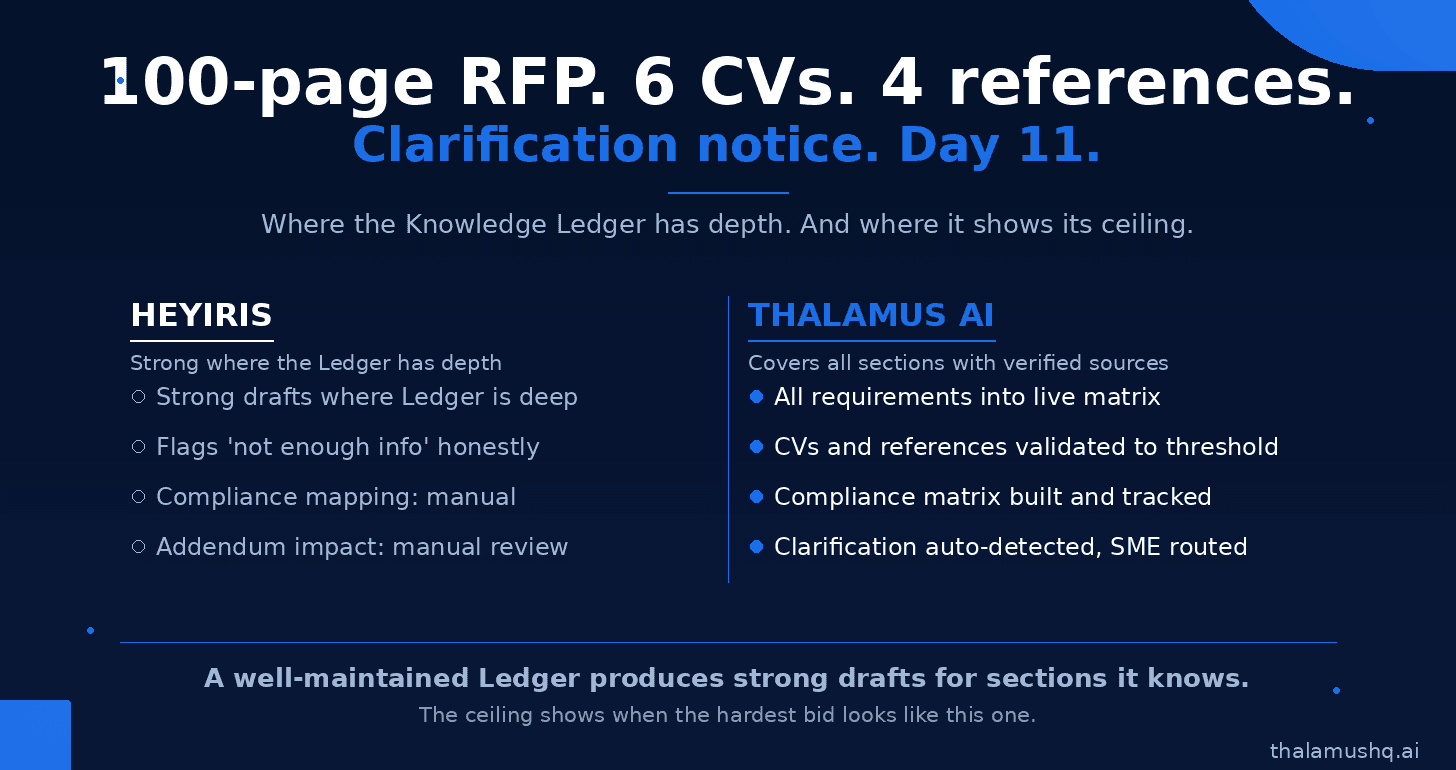
Imagine this. Your team is responding to a 100-page professional services RFP. It requires a tailored technical approach, six named personnel CVs with current certifications, four comparable project references meeting a specific revenue threshold, a compliance statement mapping every mandatory requirement, and a pricing narrative. A clarification notice arrives eleven days before the deadline, changing one of the mandatory technical requirements.
What does HeyIris do? 

Iris generates strong first drafts for the sections where your Knowledge Ledger has depth, past responses, standard methodology language, and approved boilerplate. Where the Ledger is thinner, a tailored argument for this specific buyer's context, a project reference that meets the exact threshold just specified, a CV that was updated last month, the system flags "not enough info" or draws from older content, requiring human review and supplementation. The compliance statement is built manually. The addendum impact is identified manually. Task assignment and deadline tracking happen in the platform's collaborative workspace.

What does Thalamus AI do? 

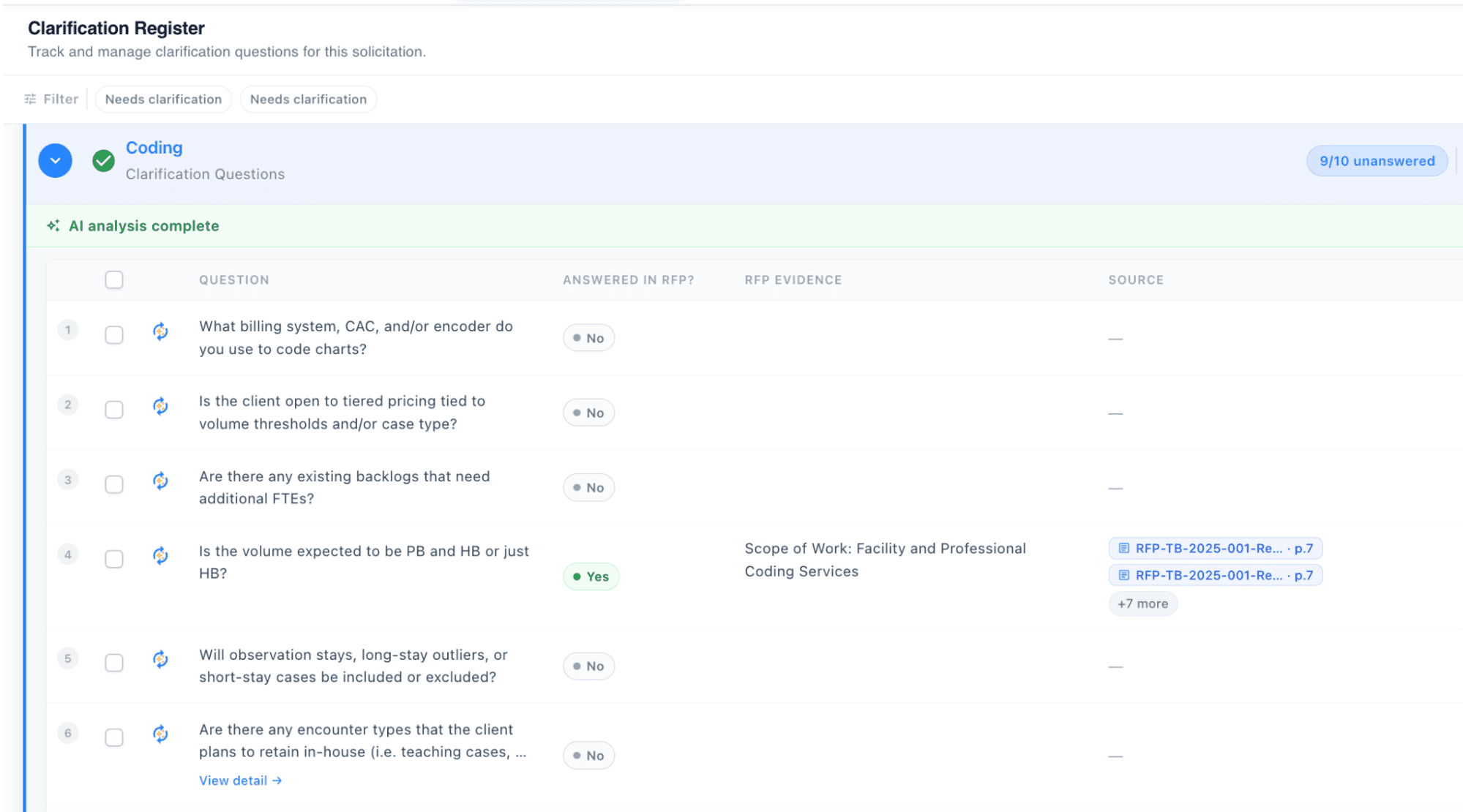
The RFx Analysis Agent shreds the RFP on upload, extracts all mandatory requirements into a living compliance matrix mapped to section, owner, and status. The six personnel CVs are drawn from verified knowledge entities which are current, attributed to source, and verified. The four project references are validated against the threshold before inclusion. The technical approach is drafted with full context of the evaluation criteria it is answering. When the clarification notice arrives, Thalamus AI automatically detects which section is affected, updates the compliance matrix status, and routes the change to the right SME for re-approval via Slack.
HeyIris's Ledger, maintained well, produces strong drafts for the sections it knows. Thalamus AI's verified entity layer produces sourced, traceable drafts for all sections and manages the coordination and compliance layer above them. For a presales team whose hardest bids look like the 50-question security questionnaire, HeyIris's scope fits the job. For a proposal manager whose hardest bid looks like the 100-page RFP above, the scope ceiling shows.

Managing multi-section proposals where the compliance statement and addendum tracking matter as much as the draft? See how Thalamus AI covers the full scope in one connected workflow.

Where HeyIris Genuinely Wins?

HeyIris has earned its 4.9/5 G2 rating from 67 reviewers honestly, and I want to name exactly where that comes from.

For sales engineering and presales teams whose primary bottleneck is turnaround time on high-volume, repeatable questionnaires, HeyIris's combination of Knowledge Ledger depth, Portal AutoFill, and Salesforce integration is a genuinely strong fit. The Salesforce integration in particular is consistently highlighted by reviewers as a workflow accelerator; creating new projects directly from CRM data removes a manual step that compounds across dozens of responses per month. The Portal AutoFill capability means web-based vendor assessments are completed directly without export/import cycles. And the hands-on onboarding support HeyIris provides, described by multiple reviewers as exceptional, means the Ledger gets populated correctly from day one rather than requiring months of self-directed setup.

For a sales-led organization where the proposal team sits inside the sales function, and deal velocity is the primary KPI, HeyIris's Deal Desk framing is the right one. It is a tool that makes the sales team faster at the knowledge-intensive parts of closing deals.

Where the limits show: visual handling in proposals is flagged by reviewers as a gap. Processing can be slow under load. Tone control needs more granularity than the current configuration allows. And as a 2023-founded company with $4.07M in funding, HeyIris is earlier stage than most platforms in this comparison series, which means a smaller integration surface, a narrower feature roadmap, and a team that compensates with hands-on support rather than breadth of self-serve capability.

Thalamus AI vs HeyIris: Who Should You Choose?

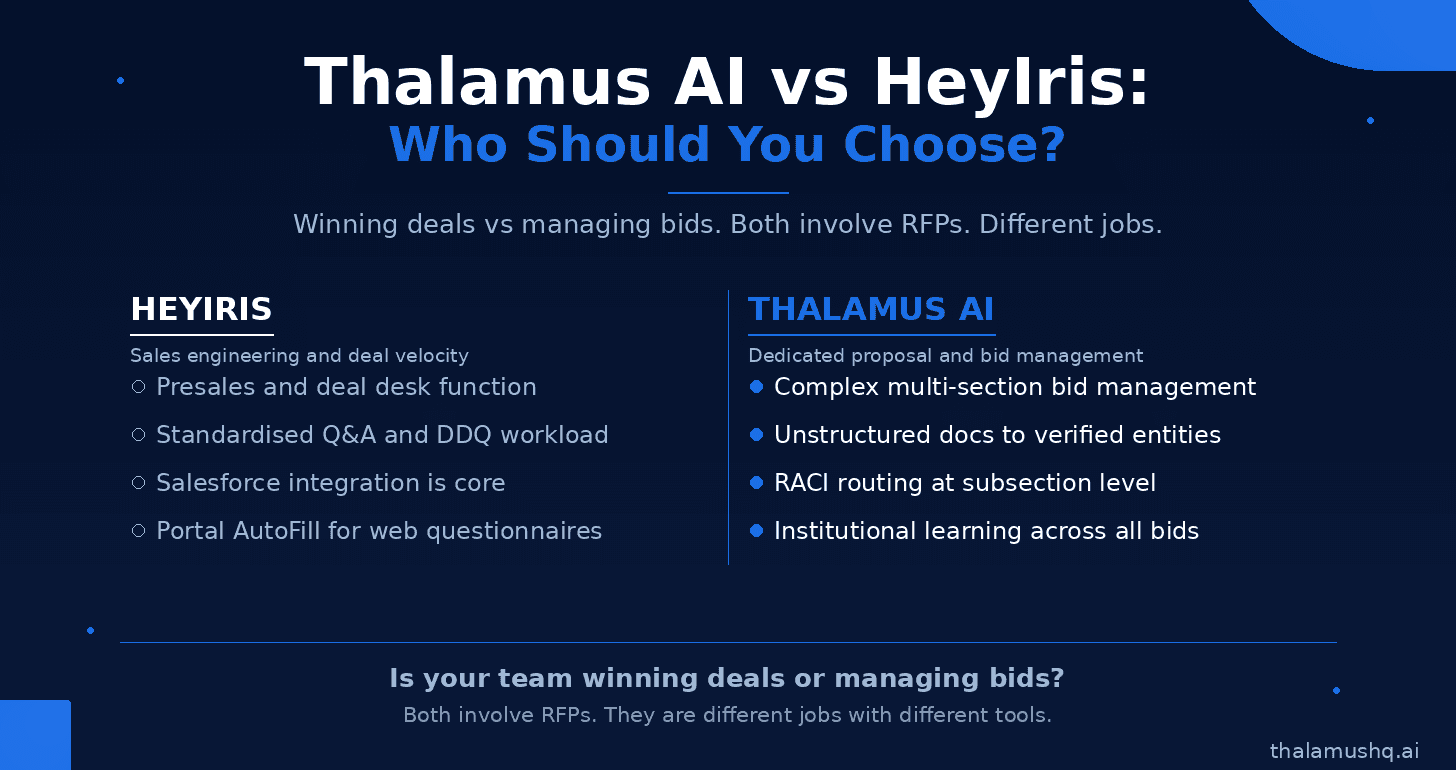
The clearest frame for this decision: is your team's primary job winning deals, or managing bids? Both involve RFPs. They are different organizational functions with different definitions of success.
Choose HeyIris if:

  • Your team is in sales engineering, presales, or a deal desk function where accelerating individual deal velocity is the primary goal

  • Your RFP workload is primarily standardized questionnaires, security reviews, DDQs, RFIs, where a well-maintained Knowledge Ledger handles the majority of questions reliably

  • Salesforce integration is important for creating response workflows directly from your CRM

  • Portal AutoFill for web-based vendor questionnaires is a daily workflow requirement

  • You want a well-supported, fast-onboarding platform with hands-on implementation help

Choose Thalamus AI if:

  • Your team is a dedicated proposal or bid management function responsible for complex, multi-section bids where compliance tracking, addendum management, and multi-stakeholder coordination determine outcomes

  • Your knowledge sits in unstructured documents like past proposals, CVs, and case studies that need to become verified, source-attributed entities rather than a searchable Ledger

  • You need RACI-level routing so legal, technical, security, and delivery SMEs are assigned and tracked at the subsection level with version-controlled approvals

  • Institutional learning across bids, not just content learning within a Ledger, matters for building a proposal function that improves over time

  • Unlimited users and projects under one subscription remove the per-seat and credit constraints that come with scaling

Thalamus AI is probably not the right fit if: your team is primarily a sales engineering function, your bids are short and standardized, and what you need is a tool that plugs into Salesforce and reduces the turnaround time on incoming vendor questionnaires without the depth of a full bid management platform.

Think your bid complexity has outgrown what a Deal Desk tool covers? Start with a 3-month Thalamus AI pilot, unlimited projects, unlimited RFPs, one team.

What Enterprise Customers Report After Moving to Thalamus AI?

Enterprise customers using Thalamus AI across complex proposal environments have reported improvements that compound across the bid function, not just within individual deals.
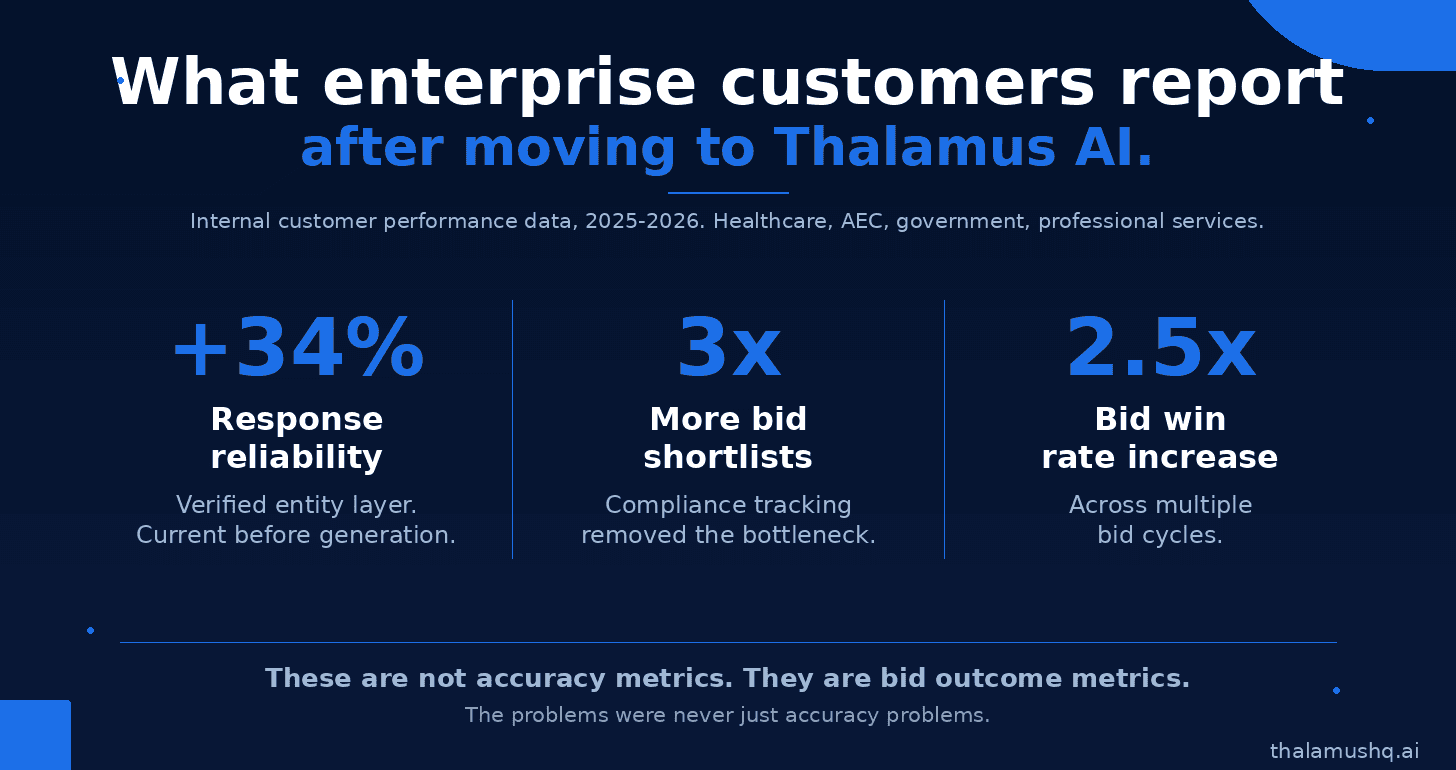
Based on Thalamus AI internal customer performance data (2025–2026), across enterprise teams in healthcare, AEC, government contracting, and professional services:

  • +34% improvement in response reliability - attributed to the verified knowledge entity layer ensuring that what the AI draws from is current, attributed, and traceable before the draft is generated

  • 3x more bid shortlist appearances - across customers managing complex, multi-section proposals where compliance tracking and stakeholder coordination had previously been the bottleneck

  • 2.5x increase in bid win rates - reported by enterprise teams using the full bid management platform across multiple bid cycles, not single submissions

HeyIris's user reviews reflect a different but genuine kind of success: teams reporting 10x efficiency gains on questionnaire turnaround, dramatically reduced manual effort, and strong adoption from sales engineers who previously dreaded the RFP queue. Both sets of outcomes are real. They reflect different teams with different definitions of what winning looks like.

If winning means faster deal closure with fewer hours on security questionnaires, HeyIris is a well-built platform earning its G2 rating for good reason. If winning means more shortlists, more contract awards, and a bid function that gets smarter with every submission, the comparison points the other way.

Bring one RFP. We'll show you what full bid lifecycle management looks like, compliance matrix, addendum tracking, and all- in 20 minutes. Book a Thalamus AI demo.

Thalamus AI vs HeyIris FAQs

What does "AI-native Deal Desk" mean in HeyIris?

HeyIris uses "Deal Desk" to describe the AI-powered knowledge and response function that supports a sales team in closing complex, knowledge-intensive deals. Traditional deal desks handle pricing approvals, contract terms, and technical validation. HeyIris's version automates the documentation and knowledge layer, RFP responses, security questionnaires, and DDQs, so sales and presales teams can handle more deals faster without expanding headcount.

Does HeyIris have a free trial?

HeyIris does not publicly advertise a self-serve free trial. Evaluation typically begins with a guided demo, with pricing quoted based on team size and RFP volume. The onboarding experience is consistently praised by reviewers as hands-on and well-supported.

Is Thalamus AI a replacement for HeyIris for sales engineering teams?

Not necessarily. For sales engineering teams whose primary job is answering fast, repeatable questionnaires with Salesforce-native workflows, HeyIris's Deal Desk positioning and CRM integration are a closer fit than Thalamus AI's full bid lifecycle architecture. Thalamus AI is the stronger choice when the team managing the bid is a dedicated proposal function, not a sales-adjacent one.

What integrations does HeyIris support?

HeyIris's most prominently praised integration is Salesforce, which allows teams to create response projects directly from CRM records. It also connects to Google Drive, SharePoint, and Confluence for knowledge ingestion. Slack integration for question routing is part of its questionnaire workflow.

Does HeyIris support complex spreadsheet-based RFP formats?

One G2 reviewer specifically requested better handling of complex spreadsheet-based RFP templates as a feature improvement. While HeyIris handles standard Excel and Word formats, advanced spreadsheet complexity is flagged as an area still in development.

How does HeyIris's pricing work?

HeyIris uses per-user seat pricing with unlimited collaborators included, and RFx credits tied to volume. Pricing is custom-quoted by team size and RFP volume; it is not publicly listed. This differs from Thalamus AI's unlimited-user, unlimited-project subscription model.