
Harpreet Singh, MBA
Founder, Thalamus AI

With 12+ years in AI and enterprise software, including GenAI product work at Travelers Group, Harpreet writes about AI RFP software, AI bid tools, proposal operations, RFP response automation, and the future of enterprise bid management.


Thalamus AI vs Tribble on Complex, Multi-Section Proposals
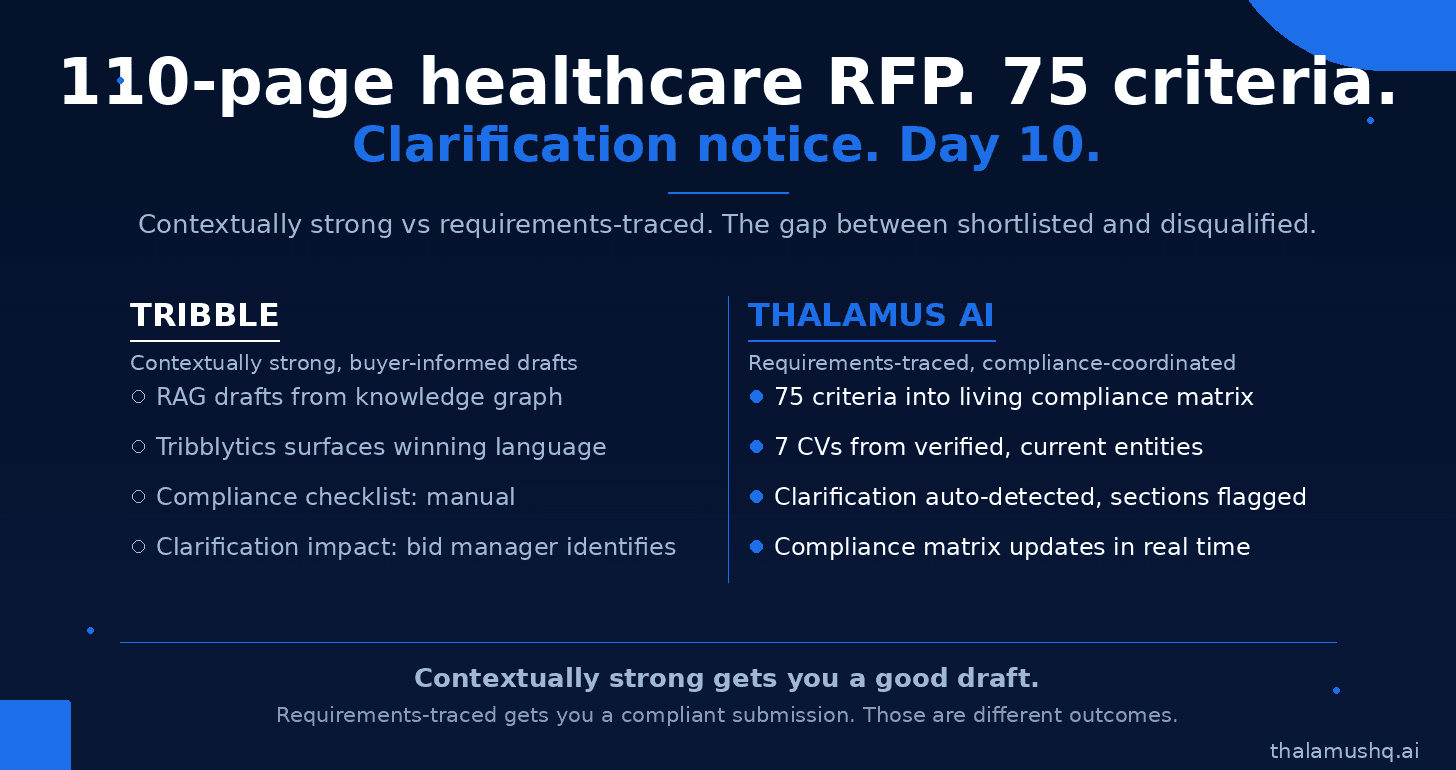
Imagine this. Your team is responding to a 110-page healthcare technology RFP. It has a mandatory compliance checklist, 75 evaluation criteria spanning technical, security, implementation, and commercial sections, required CVs for seven named personnel, and a clarification notice that arrives ten days before the deadline, changing the data residency requirement.
What does Tribble do?
Tribble's RAG-based engine drafts responses grounded in your organizational knowledge graph; past proposals, documents, Gong call context, and Slack conversations inform each section. If your team has been winning healthcare technology deals, Tribblytics has likely identified which language performs well in that context, and the platform surfaces it. The SME workflow routes questions to subject matter experts via Slack through Loop in an Expert. The compliance checklist and requirement mapping are manual processes. When the clarification notice arrives, identifying which sections are affected falls to the bid manager.
What does Thalamus AI do?
The RFx Analysis Agent shreds the RFP on upload, extracts all 75 evaluation criteria, and generates a living compliance matrix mapping each requirement to a section, an owner, and a review status. The seven personnel CVs are drawn from verified knowledge entities, confirmed to be current. The technical and security sections are drafted with full context of the specific evaluation criteria they must satisfy. When the clarification notice arrives, Thalamus AI automatically detects the data residency change and flags every affected section, routing updates to the right SME for re-approval via Slack. The compliance matrix status updates in real time.
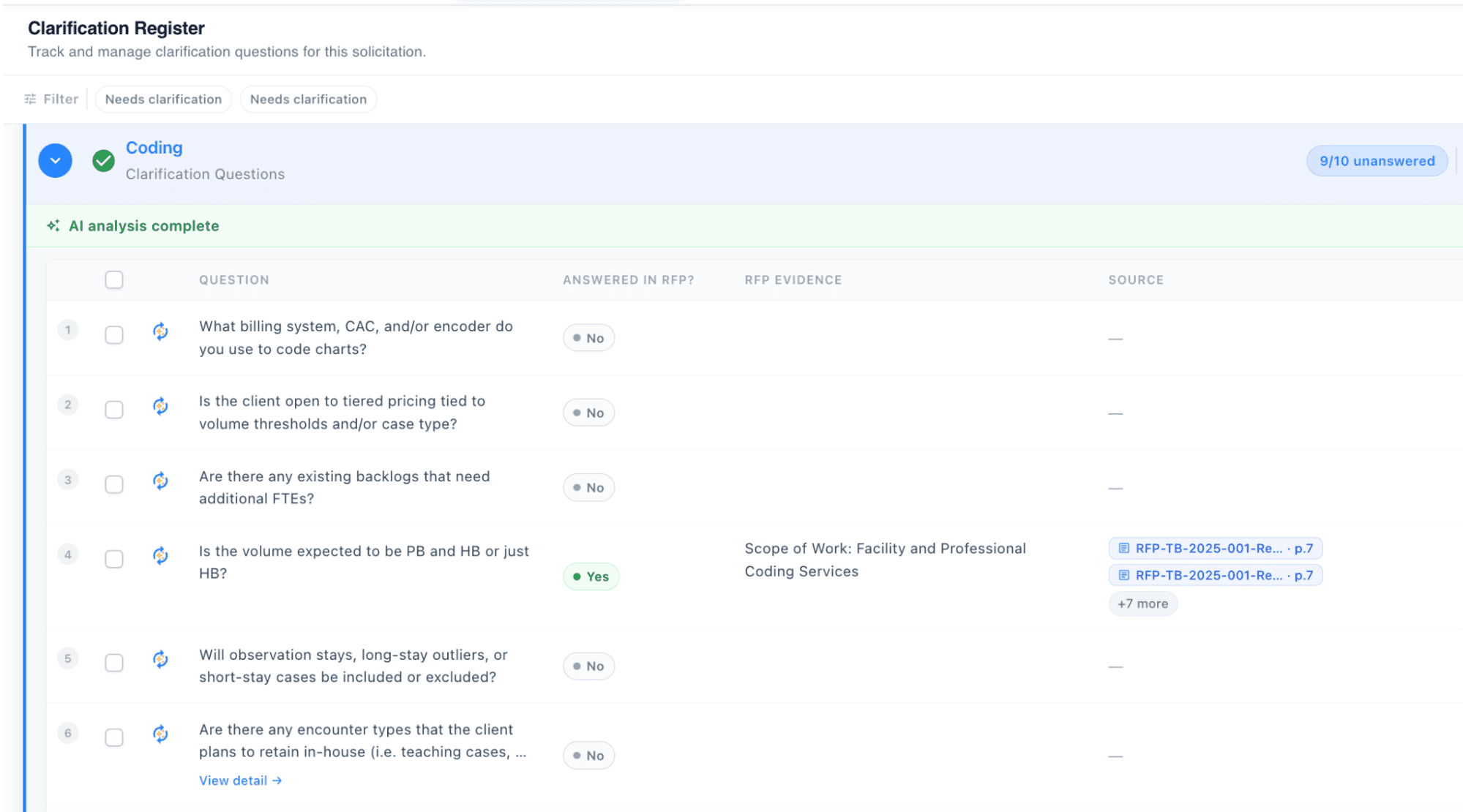
Beyond the specific data residency clarification, the Clarification Register also checks whether any other open question the team has about the RFP is already answered somewhere in the 110-page package, catching gaps in the team's own understanding before they turn into unnecessary clarification requests to the buyer.
Tribble's output for this RFP will be contextually strong and buyer-informed. Thalamus AI's output will be requirements-traced and compliance-coordinated. For a 110-page RFP where automatic disqualification for a missed mandatory item is a real risk, the difference between "contextually big" and "requirements-traced" is the gap between being shortlisted and not submitting a compliant bid at all.
Managing complex bids where a missed compliance requirement costs the contract? See how Thalamus AI's compliance matrix and addendum tracking protect your submission.
Where Tribble Genuinely Wins?
Tribble has earned its position, and I want to be specific about exactly what it does better than most platforms in this category.
Tribblytics is the most commercially useful outcome intelligence capability I have seen from any platform in this comparison series. Most RFP software tracks which content was used most often. Tribble tracks which content correlates with won deals, a fundamentally different thing. Knowing that a specific technical framing outperforms an alternative in mid-market financial services deals against a named competitor is the kind of institutional intelligence that traditionally lived only in the heads of your best proposal writers. Tribble extracts it systematically and makes it available to every future bid.
The Gong integration deepens that advantage. Discovery call context - what the buyer emphasized, what objections surfaced, which competitors they mentioned - flowing directly into proposal drafts means Tribble's responses are contextualized to the specific buyer's stated priorities, not just your standard approved answer. For sales engineering teams that live in Gong, that integration changes the quality ceiling on personalized proposals meaningfully.
The deployment speed is also genuinely impressive - 48-hour sandbox and 70% automation within 14 days requires no library pre-build and no weeks of configuration. For a mid-market team that needs value fast without a dedicated implementation project, that timeline is competitive.
Where the limits show: the governance architecture is lighter than enterprise bid management platforms. There are no formal approval gates, no RACI routing with version-controlled approvals, and no automated compliance matrix. Teams managing 100+ concurrent RFPs start to hit portfolio orchestration gaps. Teams without Gong lose the personalization advantage that most differentiates Tribble from other AI-native platforms. And the credit-based pricing model, while unlimited on users, can escalate in cost for teams with high questionnaire throughput at scale.
Thalamus AI vs Tribble: Who Should You Choose?
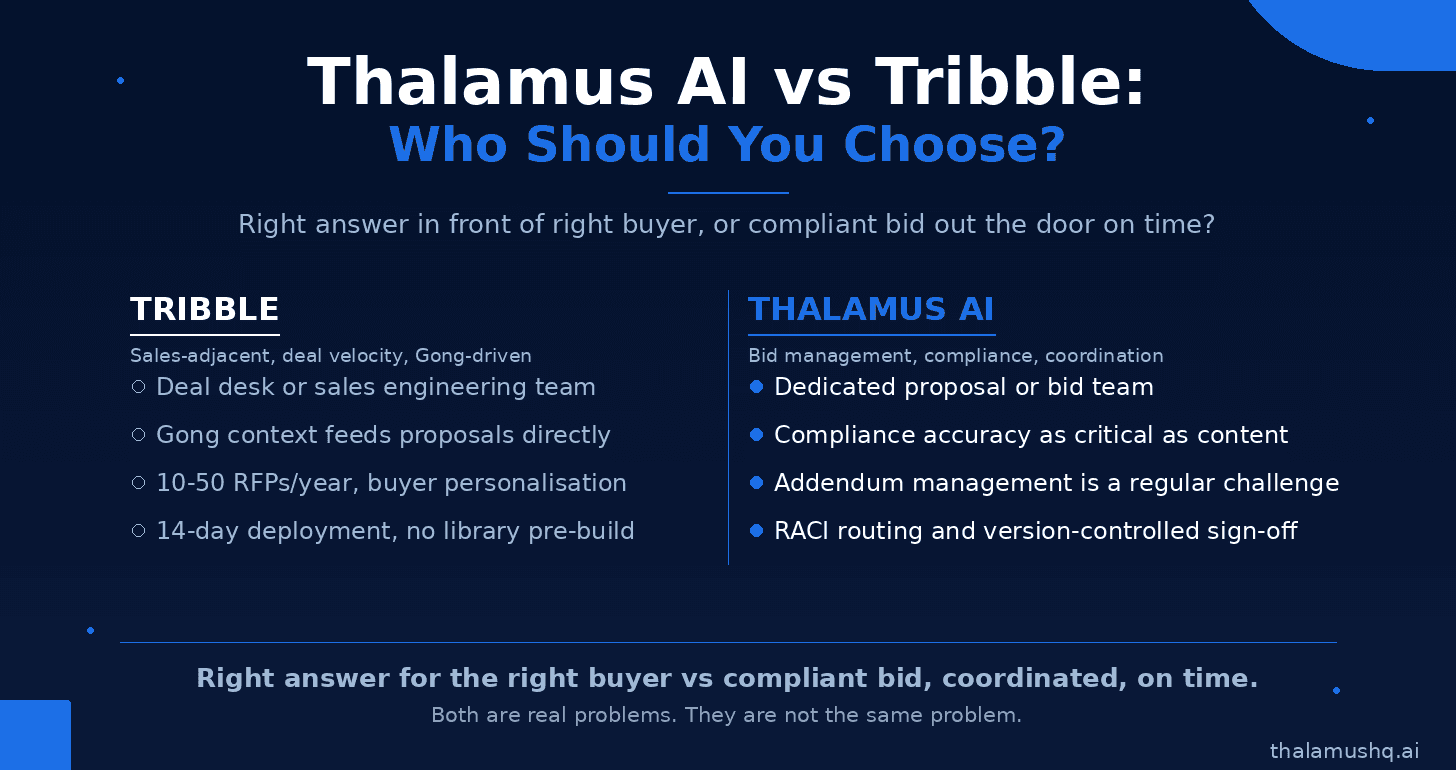
The clearest frame: is your biggest challenge getting the right answer in front of the right buyer, or getting a compliant, coordinated bid out the door accurately and on time? Both are real proposal problems. They point to different platforms.
Choose Tribble if:
Your team is sales-adjacent - deal desk, sales engineering, presales, and deal velocity and win rate improvement are the primary KPIs.
Your organization uses Gong, and buyer context from discovery calls feeding directly into proposals is a meaningful competitive advantage in your market.
You handle 10–50 RFPs annually, and response quality, buyer personalization, and outcome learning are the primary bottlenecks.
You want fast deployment, 14-day automation without a library pre-build or heavy implementation.
Unlimited-user pricing that doesn't penalise occasional SME contributors matters commercially.
Choose Thalamus AI if:
You are a dedicated proposal or bid management team where compliance accuracy and coordination are as critical as content quality.
Your bids require formal approval workflows, version-controlled sign-off, and RACI-level routing across legal, technical, security, and delivery.
Addendum and clarification management mid-bid is a regular operational challenge, not an occasional one.
You need a compliance matrix that maps every requirement to a section, owner, and status before drafting begins.
Your institutional learning needs to compound around bid management accuracy, verified entity currency, compliance gap patterns, requirement coverage, not just commercial language optimization.
Thalamus AI is probably not the right fit if: your team is primarily sales-adjacent, your bids are primarily short questionnaires and standard RFPs without strict compliance requirements, and Gong-driven buyer personalization is the capability that would most improve your win rate.
Think your bid complexity calls for more than outcome intelligence and buyer personalization? Start with a 3-month Thalamus AI pilot - unlimited projects, unlimited RFPs, one team.
What Enterprise Customers Report After Moving to Thalamus AI?
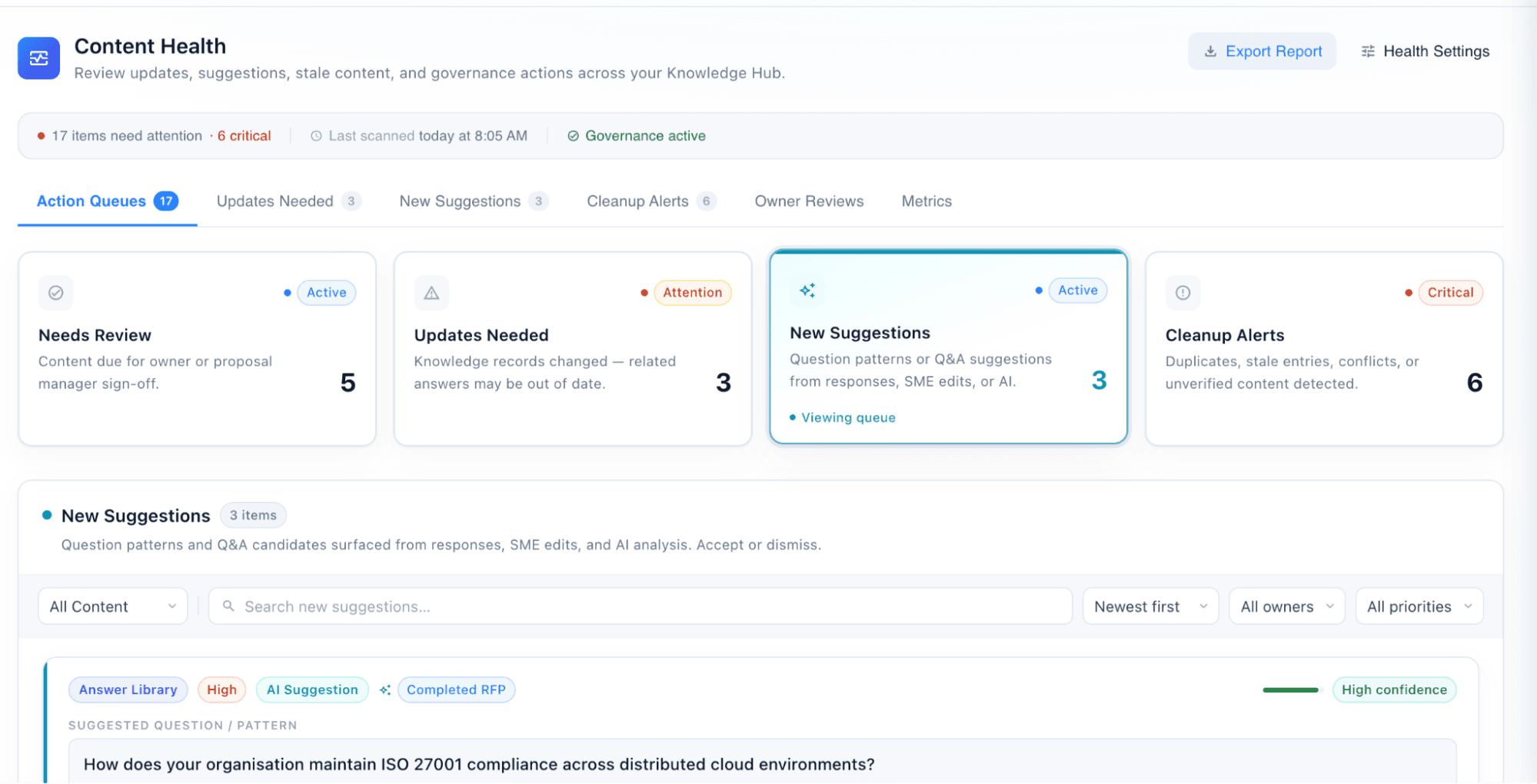
Enterprise customers using Thalamus AI across complex proposal environments have reported improvements that compound across the full bid function, in compliance accuracy, shortlist rates, and win rates, not just in response speed on individual submissions.
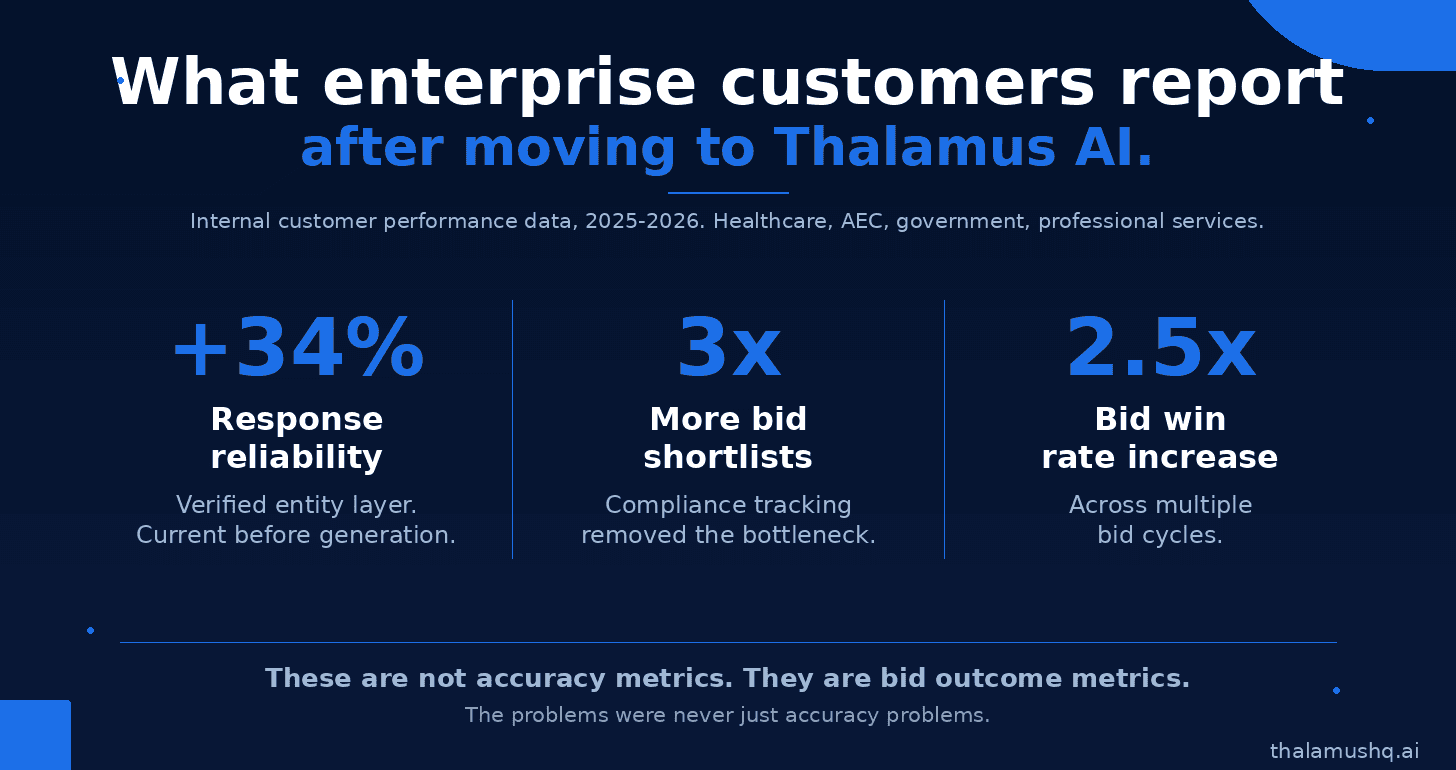
Based on Thalamus AI internal customer performance data (2025–2026), across enterprise teams in healthcare, AEC, government contracting, and professional services:
+34% improvement in response reliability - attributed to the verified knowledge entity layer and living compliance matrix catching accuracy gaps before they reach submission.
3x more bid shortlist appearances - across customers managing complex, multi-section proposals where compliance tracking and stakeholder coordination had previously been the bottleneck.
2.5x increase in bid win rates - reported by enterprise teams using the full bid management platform across multiple bid cycles.
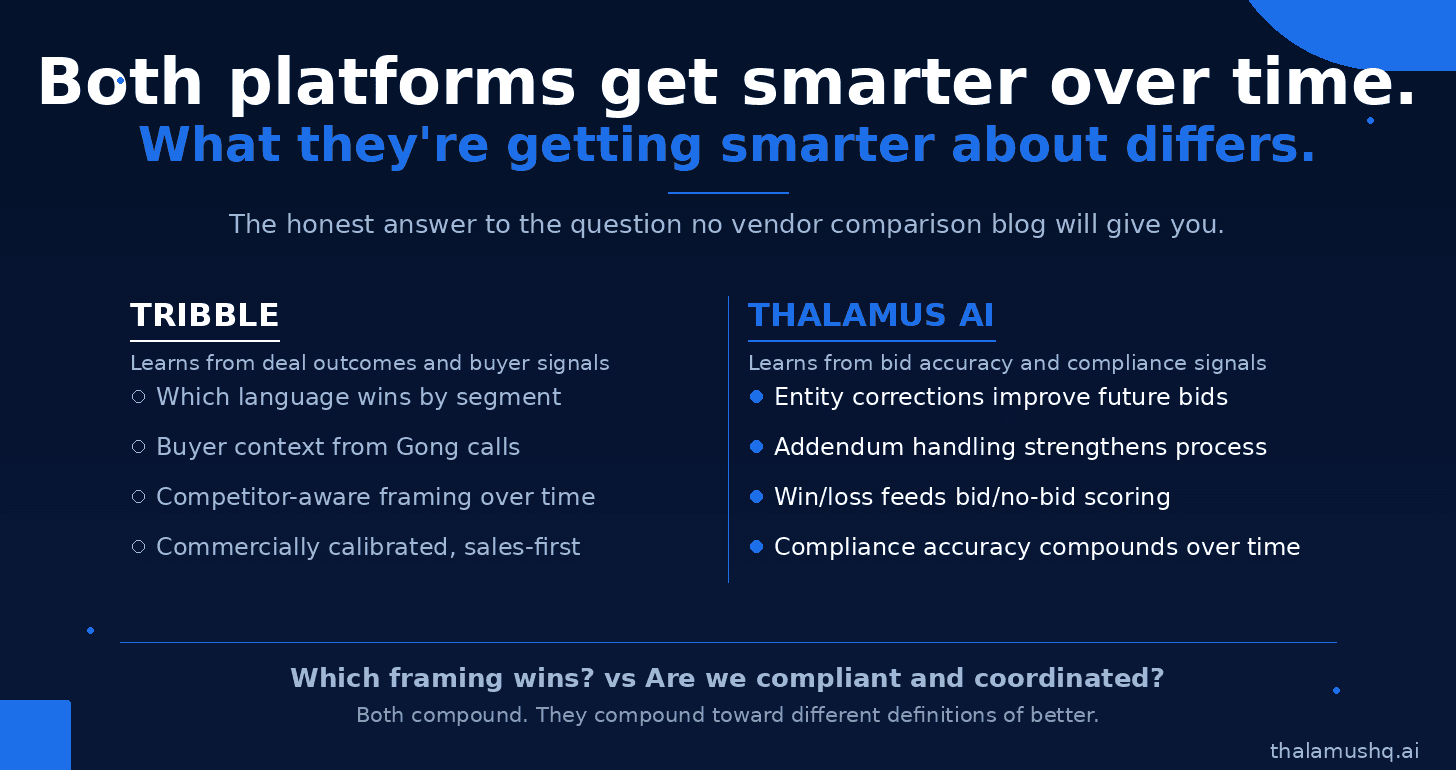
Tribble's outcome intelligence and Thalamus AI's bid management approach are both real and both compound. Tribble is one of the most sophisticated platforms in this category for the problem it was built to solve; commercial language optimization grounded in actual deal outcomes is a genuine capability gap in most RFP software, and Tribblytics fills it well.
What Tribble does not solve, and does not claim to solve, is the coordination, compliance, and governance problem of a full bid function. The team that tracks which framing wins against a competitor in a specific segment is a sales team with a strong proposal function behind it. The platform that manages the proposal function, requirements tracking, addendum detection, RACI routing, and verified knowledge is what Thalamus AI is built to be.
Bring one RFP. We'll show you what compliant, coordinated, full-lifecycle bid management looks like, in 20 minutes. Book a Thalamus AI demo.
Thalamus AI vs Tribble FAQs
What is Tribblytics and how is it different from standard RFP analytics?
Tribblytics is Tribble's outcome intelligence layer; it connects submitted proposal content to deal results, identifying which language, framing, and positioning correlates with won deals by segment, deal size, and competitor. Standard RFP analytics track usage and completion rates. Tribblytics tracks commercial outcomes, which is a meaningfully different capability that most platforms in this category do not offer.
Does Tribble work without Gong?
Yes, but its most differentiating capability, buyer-context personalization from discovery call recordings, is only available to teams using Gong or a compatible call intelligence platform. Tribble's own documentation acknowledges that teams without call recording lose the buyer-personalization advantage. The platform still performs for standard RAG-based drafting without Gong, but at that point it competes more directly with other AI-native questionnaire tools.
How does Tribble's credit-based pricing work in practice?
Tribble uses a usage-based credit model where credits are consumed based on the type and length of work completed, with unlimited users included. This avoids per-seat cost penalties for occasional contributors, but teams with high questionnaire throughput can find credit consumption escalates at scale. Pricing requires a custom quote; no self-serve pricing is publicly listed.
Is Tribble suitable for government or public sector bids?
Tribble's RAG architecture, Gong integration, and Tribblytics outcome learning are optimized for commercial enterprise deals. It does not hold FedRAMP, CMMC, or DoD IL5 certifications, and its governance layer, without formal approval gates or compliance matrix generation, is lighter than what most government contracting environments require. Teams in public sector procurement should evaluate AutogenAI or Thalamus AI for those contexts.
Does Tribble integrate with CRM systems other than Salesforce?
Tribble's knowledge graph ingests CRM data as a source for generating and personalizing responses, with Salesforce being the most prominently referenced integration. HubSpot and other CRMs are supported at the data ingestion level, though the depth of integration varies. Confirming your specific CRM compatibility during a Tribble demo is recommended.
Does Thalamus AI integrate with CRM systems other than Salesforce?
Yes. Entity Records connect to both Salesforce and HubSpot, so proposal knowledge carries account and relationship context alongside the content itself. This is a narrower claim than Tribble's Gong integration, which brings buyer conversation context into drafts; the CRM connection provides account history and contacts, not call transcripts.