Alternatives
Alternatives
•
•
8 mins
8 mins
10 Best Loopio Alternatives in 2026: Ranked for Enterprise RFP Teams
10 Best Loopio Alternatives in 2026: Ranked for Enterprise RFP Teams
10 Best Loopio Alternatives in 2026: Ranked for Enterprise RFP Teams
10 Best Loopio Alternatives in 2026: Ranked for Enterprise RFP Teams

Harpreet Singh, MBA
Founder, Thalamus AI

With 12+ years in AI and enterprise software, including GenAI product work at Travelers, Harpreet writes about AI RFP software, AI bid tools, proposal operations, RFP response automation, and the future of enterprise bid management.
Summarize with ChatGPT
Summarize with ChatGPT
Key Takeaways
Teams look for Loopio alternatives for three consistent reasons: library maintenance fatigue, AI that underperforms on complex questions, and a platform ceiling when bids get bigger than questionnaires.
This list evaluates 10 alternatives on AI architecture, full lifecycle depth, pricing model, and genuine weaknesses, not just feature checklists.
Most Loopio alternatives solve one of the three problems. Very few solve all three.
Thalamus AI - an AI RFP solution and full Bid Management Ecosystem is the strongest alternative to Loopio for enterprise teams running complex, multi-document bids where CRM-connected knowledge, AI-managed content governance, compliance tracking, clarification management, RACI routing, and post-bid learning are as important as drafting speed.
The right alternative depends entirely on why Loopio stopped working - matching pain point to platform is the only decision framework that holds up at renewal.
If you are still mapping out the broader RFP software landscape before narrowing down to Loopio, our blog about the 12 Best AI RFP Software Tools in 2026 covers all the leading tools in one place.
Summarize with ChatGPT
Key Takeaways
Key Takeaways
Key Takeaways
Teams look for Loopio alternatives for three consistent reasons: library maintenance fatigue, AI that underperforms on complex questions, and a platform ceiling when bids get bigger than questionnaires.
This list evaluates 10 alternatives on AI architecture, full lifecycle depth, pricing model, and genuine weaknesses, not just feature checklists.
Most Loopio alternatives solve one of the three problems. Very few solve all three.
Thalamus AI - an AI RFP solution and full Bid Management Ecosystem is the strongest alternative to Loopio for enterprise teams running complex, multi-document bids where CRM-connected knowledge, AI-managed content governance, compliance tracking, clarification management, RACI routing, and post-bid learning are as important as drafting speed.
The right alternative depends entirely on why Loopio stopped working - matching pain point to platform is the only decision framework that holds up at renewal.
If you are still mapping out the broader RFP software landscape before narrowing down to Loopio, our blog about the 12 Best AI RFP Software Tools in 2026 covers all the leading tools in one place.
Teams look for Loopio alternatives for three consistent reasons: library maintenance fatigue, AI that underperforms on complex questions, and a platform ceiling when bids get bigger than questionnaires.
This list evaluates 10 alternatives on AI architecture, full lifecycle depth, pricing model, and genuine weaknesses, not just feature checklists.
Most Loopio alternatives solve one of the three problems. Very few solve all three.
Thalamus AI - an AI RFP solution and full Bid Management Ecosystem is the strongest alternative to Loopio for enterprise teams running complex, multi-document bids where CRM-connected knowledge, AI-managed content governance, compliance tracking, clarification management, RACI routing, and post-bid learning are as important as drafting speed.
The right alternative depends entirely on why Loopio stopped working - matching pain point to platform is the only decision framework that holds up at renewal.
If you are still mapping out the broader RFP software landscape before narrowing down to Loopio, our blog about the 12 Best AI RFP Software Tools in 2026 covers all the leading tools in one place.
Teams look for Loopio alternatives for three consistent reasons: library maintenance fatigue, AI that underperforms on complex questions, and a platform ceiling when bids get bigger than questionnaires.
This list evaluates 10 alternatives on AI architecture, full lifecycle depth, pricing model, and genuine weaknesses, not just feature checklists.
Most Loopio alternatives solve one of the three problems. Very few solve all three.
Thalamus AI - an AI RFP solution and full Bid Management Ecosystem is the strongest alternative to Loopio for enterprise teams running complex, multi-document bids where CRM-connected knowledge, AI-managed content governance, compliance tracking, clarification management, RACI routing, and post-bid learning are as important as drafting speed.
The right alternative depends entirely on why Loopio stopped working - matching pain point to platform is the only decision framework that holds up at renewal.
If you are still mapping out the broader RFP software landscape before narrowing down to Loopio, our blog about the 12 Best AI RFP Software Tools in 2026 covers all the leading tools in one place.
How We Evaluated the Best Loopio Alternatives for Enterprise RFP Teams?
How We Evaluated the Best Loopio Alternatives for Enterprise RFP Teams?
We assessed each platform across ten criteria. Every tool was evaluated by the same standard, no exceptions for any platform, including Thalamus AI.
AI architecture - retrieval from a Q&A library, generative from live source documents, or multi-agent agentic reasoning. The architecture determines what happens when the question is novel or complex.
Full bid lifecycle depth - whether the platform covers capture planning, bid/no-bid, compliance mapping, requirement tagging, response generation, SME coordination, review gates, submission, and post-bid learning, or only the drafting step.
Knowledge model - Q&A pair libraries, verified entity layers, living knowledge graphs, or bespoke language engines, and whether the platform actively governs content health or leaves maintenance entirely to the team. The knowledge model determines output quality and ongoing maintenance cost.
Compliance and requirement tracking - whether the tool maps requirements to response sections, tracks compliance status, and catches changes in real time when addenda are issued.
Workflow configurability - multi-stakeholder workflows with RACI routing, SME assignment, version control, review gates, and approval chains.
Pricing model and transparency - whether pricing is publicly listed, seat-based, or usage-based, and whether the cost model is predictable when RFP volume or contributor count varies.
Integration depth - native connections to SharePoint, Google Drive, Salesforce, HubSpot, Slack, Microsoft Teams, and document management systems teams already use.
G2 rating and review volume - sourced from G2's RFP Software category, Spring 2026.
Security and compliance certifications - SOC 2 Type II, ISO 27001, GDPR, FedRAMP status relevant for enterprise procurement.
Best-fit use case - a specific buyer profile, not a generic positioning claim. Specific enough to exclude the wrong buyer.
We assessed each platform across ten criteria. Every tool was evaluated by the same standard, no exceptions for any platform, including Thalamus AI.
AI architecture - retrieval from a Q&A library, generative from live source documents, or multi-agent agentic reasoning. The architecture determines what happens when the question is novel or complex.
Full bid lifecycle depth - whether the platform covers capture planning, bid/no-bid, compliance mapping, requirement tagging, response generation, SME coordination, review gates, submission, and post-bid learning, or only the drafting step.
Knowledge model - Q&A pair libraries, verified entity layers, living knowledge graphs, or bespoke language engines, and whether the platform actively governs content health or leaves maintenance entirely to the team. The knowledge model determines output quality and ongoing maintenance cost.
Compliance and requirement tracking - whether the tool maps requirements to response sections, tracks compliance status, and catches changes in real time when addenda are issued.
Workflow configurability - multi-stakeholder workflows with RACI routing, SME assignment, version control, review gates, and approval chains.
Pricing model and transparency - whether pricing is publicly listed, seat-based, or usage-based, and whether the cost model is predictable when RFP volume or contributor count varies.
Integration depth - native connections to SharePoint, Google Drive, Salesforce, HubSpot, Slack, Microsoft Teams, and document management systems teams already use.
G2 rating and review volume - sourced from G2's RFP Software category, Spring 2026.
Security and compliance certifications - SOC 2 Type II, ISO 27001, GDPR, FedRAMP status relevant for enterprise procurement.
Best-fit use case - a specific buyer profile, not a generic positioning claim. Specific enough to exclude the wrong buyer.
Best Loopio Alternatives 2026: Quick Comparison Table
Best Loopio Alternatives 2026: Quick Comparison Table
Tool | Best for | G2 rating | Pricing model | Solves Loopio's library problem? |
Thalamus AI | Enterprise teams running complex, multi-document RFPs needing compliance tracking, RACI routing, and post-bid learning | Unlimited users/projects, one subscription | ✓ Verified entity layer + AI-managed Content Health, no manual Q&A curation | |
Responsive (RFPIO) | Mid-to-enterprise teams needing deep CRM integrations and high-volume questionnaire management | Seat-based; ~$20K+/yr (Foundations) | ✗ Q&A library - same maintenance model | |
Arphie | Presales teams wanting AI answers from live source systems without any Q&A library | Custom enterprise; no public pricing | ✓ Live source integrations — no static library | |
Tribble | Enterprise B2B software and financial services teams where win-pattern learning compounds over time | Consumption-based; no public pricing | ✓ Living knowledge graph - auto-updates | |
AutogenAI | Government and defence teams needing FedRAMP High security and best-in-class narrative proposal writing | Custom enterprise; minimum seat commitments | ✓ Bespoke language engine - no library upkeep | |
HeyIris (Iris AI) | B2B SaaS presales teams wanting citeable answers with inline confidence scores and portal AutoFill | Per-user; unlimited collaborators | ⚡ Document-based retrieval - reduces but doesn't eliminate upkeep | |
Inventive AI | Fast-moving teams wanting AI-first questionnaire automation with claimed 0% hallucination and conflict detection | No public pricing; contact sales | ✓ Live source connections - proactive stale content alerts | |
AutoRFP ai | Mid-market presales teams wanting transparent, unlimited-user pricing with no seat-based cost anxiety | Scale $899/mo; Accelerate $1,299/mo; unlimited users | ⚡ Semantic search library - lower maintenance than Loopio | |
1Up | Small-to-mid-market sales and RevOps teams wanting fast questionnaire answers via Slack and Teams | Free plan; Starter $300/mo; Plus $900/mo | ✓ Live connectors - no library curation required | |
Qvidian (Upland) | Enterprise financial services teams needing established content governance and IBM WatsonX AI | Custom enterprise; part of the Upland suite | ✗ Q&A library - same maintenance model as Loopio |
Tool | Best for | G2 rating | Pricing model | Solves Loopio's library problem? |
Thalamus AI | Enterprise teams running complex, multi-document RFPs needing compliance tracking, RACI routing, and post-bid learning | Unlimited users/projects, one subscription | ✓ Verified entity layer + AI-managed Content Health, no manual Q&A curation | |
Responsive (RFPIO) | Mid-to-enterprise teams needing deep CRM integrations and high-volume questionnaire management | Seat-based; ~$20K+/yr (Foundations) | ✗ Q&A library - same maintenance model | |
Arphie | Presales teams wanting AI answers from live source systems without any Q&A library | Custom enterprise; no public pricing | ✓ Live source integrations — no static library | |
Tribble | Enterprise B2B software and financial services teams where win-pattern learning compounds over time | Consumption-based; no public pricing | ✓ Living knowledge graph - auto-updates | |
AutogenAI | Government and defence teams needing FedRAMP High security and best-in-class narrative proposal writing | Custom enterprise; minimum seat commitments | ✓ Bespoke language engine - no library upkeep | |
HeyIris (Iris AI) | B2B SaaS presales teams wanting citeable answers with inline confidence scores and portal AutoFill | Per-user; unlimited collaborators | ⚡ Document-based retrieval - reduces but doesn't eliminate upkeep | |
Inventive AI | Fast-moving teams wanting AI-first questionnaire automation with claimed 0% hallucination and conflict detection | No public pricing; contact sales | ✓ Live source connections - proactive stale content alerts | |
AutoRFP ai | Mid-market presales teams wanting transparent, unlimited-user pricing with no seat-based cost anxiety | Scale $899/mo; Accelerate $1,299/mo; unlimited users | ⚡ Semantic search library - lower maintenance than Loopio | |
1Up | Small-to-mid-market sales and RevOps teams wanting fast questionnaire answers via Slack and Teams | Free plan; Starter $300/mo; Plus $900/mo | ✓ Live connectors - no library curation required | |
Qvidian (Upland) | Enterprise financial services teams needing established content governance and IBM WatsonX AI | Custom enterprise; part of the Upland suite | ✗ Q&A library - same maintenance model as Loopio |
10 Top Loopio Alternatives in 2026: Full User Reviews
10 Top Loopio Alternatives in 2026: Full User Reviews
10 Top Loopio Alternatives in 2026: Full User Reviews
This list evaluates 10 alternatives on the dimensions that actually matter when you are making that switch. Every tool card names real weaknesses. No tool paid to appear here. And Thalamus AI is evaluated by the same standard as every other platform on the list.
1. Thalamus AI - Best Loopio Alternative for Enterprise Bid Lifecycle Management
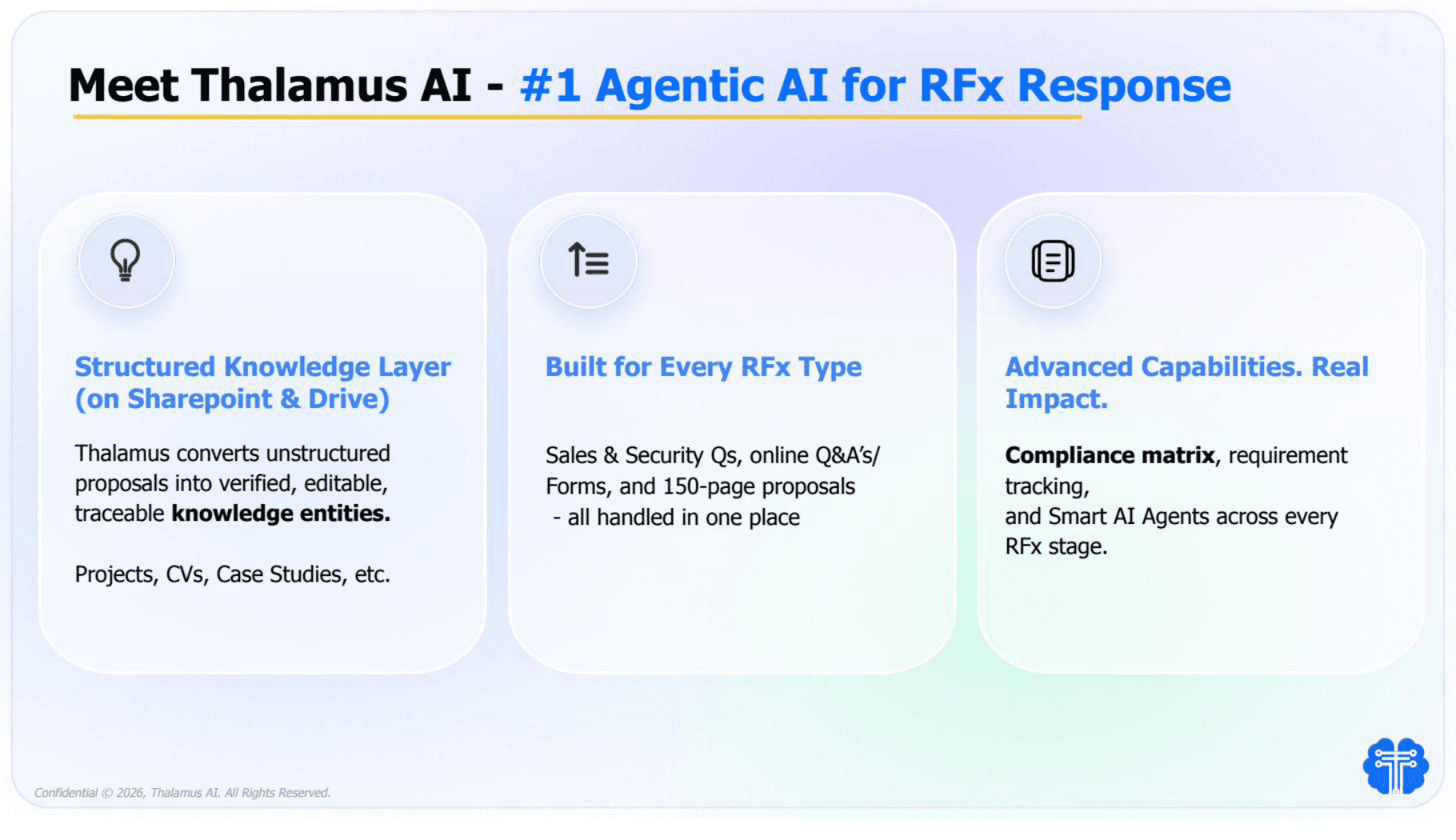
Best for: Enterprise proposal teams in healthcare, AEC, government contracting, and professional services handling complex, multi-document RFPs, where library maintenance, compliance tracking, and post-bid learning are as important as drafting speed.
G2 rating: 5.0 / 5 ↗ G2
Pricing: Unlimited projects, unlimited users, unlimited RFPs - one subscription. Three-month pilot pack available. Contact for enterprise pricing.
AI approach: Multi-agent agentic AI with a verified entity knowledge layer, decision graph, and closed-loop institutional learning.
Solves Loopio's core problems: All three - library maintenance burden, AI ceiling on complex proposals, and the full lifecycle gap.
What Thalamus AI Does Better Than Loopio for RFP Response Management?
No Q&A library to maintain ever
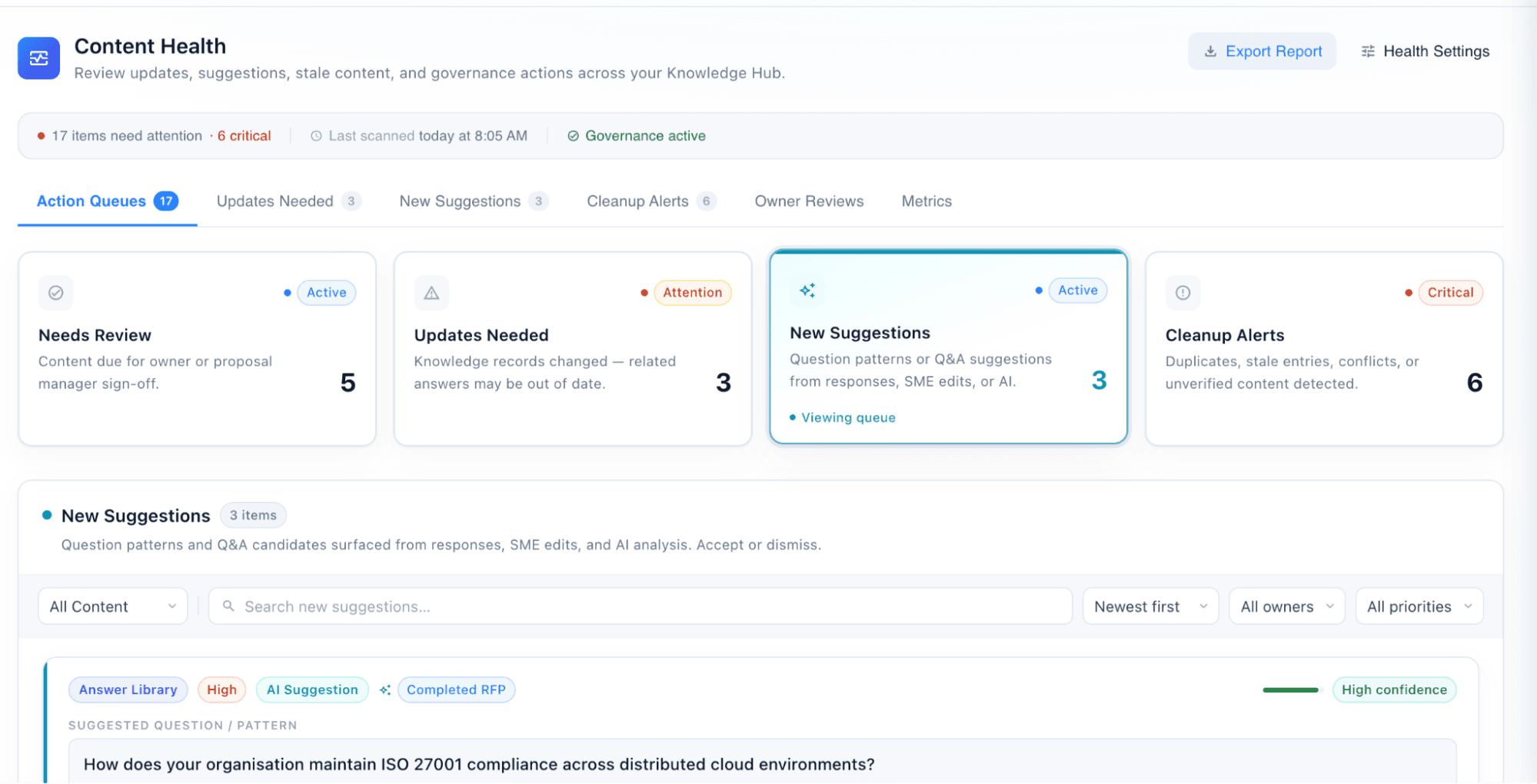
Instead of storing content as Q&A pairs that age, duplicate, and require constant curation, Thalamus AI converts unstructured proposals, CVs, case studies, project histories, and certifications into verified, editable, auditable knowledge entities that can connect to CRM systems like Salesforce and HubSpot for account context.
Each entity is traceable to its source document with a completeness score and last-verified timestamp. An AI-managed Content Health layer continuously scans for duplicates, stale entries, and conflicting claims and surfaces only what needs a human decision, so the library maintenance problem this whole list exists to solve doesn't just move to a different architecture; it's actively watched.
Full bid lifecycle, not just the response step.
Thalamus AI covers capture planning, bid/no-bid qualification, requirement mapping, RACI routing, SME coordination, response generation, compliance review, submission, and post-bid institutional learning in one platform. Loopio covers the response step. The gap matters when bids get complex.
Compliance matrix as a live working document -
Every requirement is mapped to a response section, an owner, a compliance status, and a risk level. When an addendum is issued mid-bid, which happens routinely on government and public-sector RFPs, Thalamus AI automatically detects changed requirements, flags every impacted section, and prompts the responsible author to update. This level of addendum impact tracking is rare across the RFP software category and is not a core public differentiator for most tools on this list. This addendum tracking capability is absent across the rest of this list.
Subsection-level RACI routing -
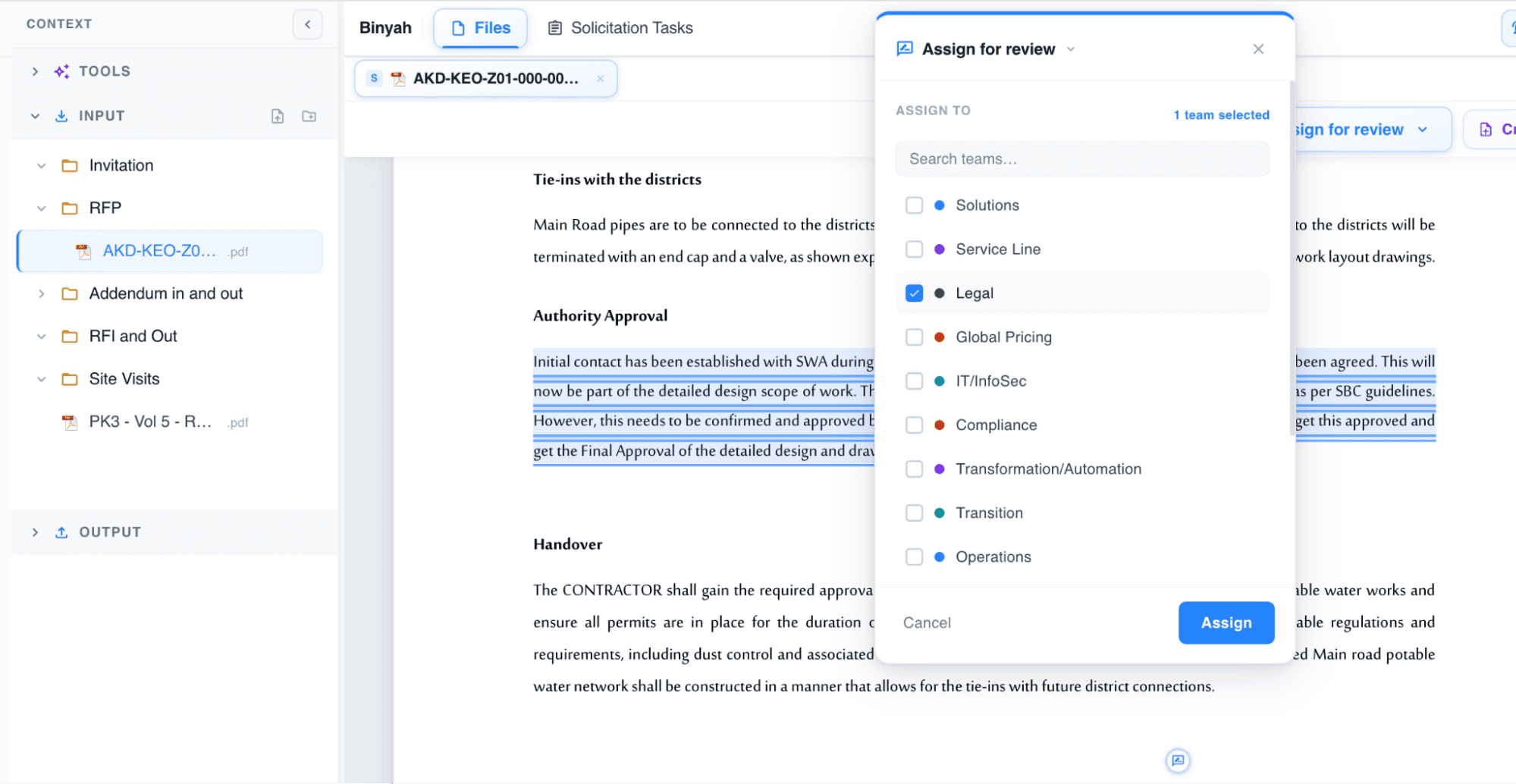
Proposal leads can assign SMEs to individual sections before kickoff through the Ownership Matrix, not just during drafting, set version-controlled review gates, require lead-author approval before content advances, and route documents to legal, finance, security, or pricing teams based on requirement type, all without leaving the platform.
Catches open questions before submission, not after.
The AI Clarification Register checks each unanswered question the team has against the RFP package itself, separating genuinely open items from ones simply buried in an appendix. Loopio has no equivalent workflow.
Institutional memory that compounds with every bid -
Every correction, decision, win, loss, reviewer comment, and content choice strengthens the knowledge graph. Unlike Loopio, which stores content but does not learn from outcomes, Thalamus AI gets measurably better at predicting winning content over time.
Unlimited users, no seat tax -
Every SME, legal reviewer, finance contributor, and delivery lead can be looped in without triggering an invoice. Loopio's seat-based pricing creates the opposite incentive; teams shrink the contributor circle to control cost, which degrades proposal quality.
45+ language support and browser extension for portal questionnaires -
all under the same subscription with no add-on fees.
Where Thalamus AI Falls Short as a Loopio Alternative?
Not suited for simple, high-volume security questionnaire workflows -
Teams whose entire RFP programme is structured around DDQs and vendor assessments will find the platform more powerful than they need, and lighter tools like 1Up or Arphie will get them to value faster.
Initial setup investment is real -
Bid-stage workflows, RACI configuration, compliance matrices, and entity ingestion require upfront time before the platform runs at full efficiency. Teams expecting same-day self-serve value from a tool they can click through immediately should calibrate expectations.
Lower G2 review volume than legacy platforms -
Few reviews at the time of writing mean third-party social proof is still building. Teams relying heavily on review volume for procurement decisions may want to request customer references directly.
Occasional early-stage bugs flagged on G2 -
Freezing screens and task tracker loading issues appear in recent reviews, alongside consistent praise for support response times.
What Real Users Say About Thalamus AI on G2?
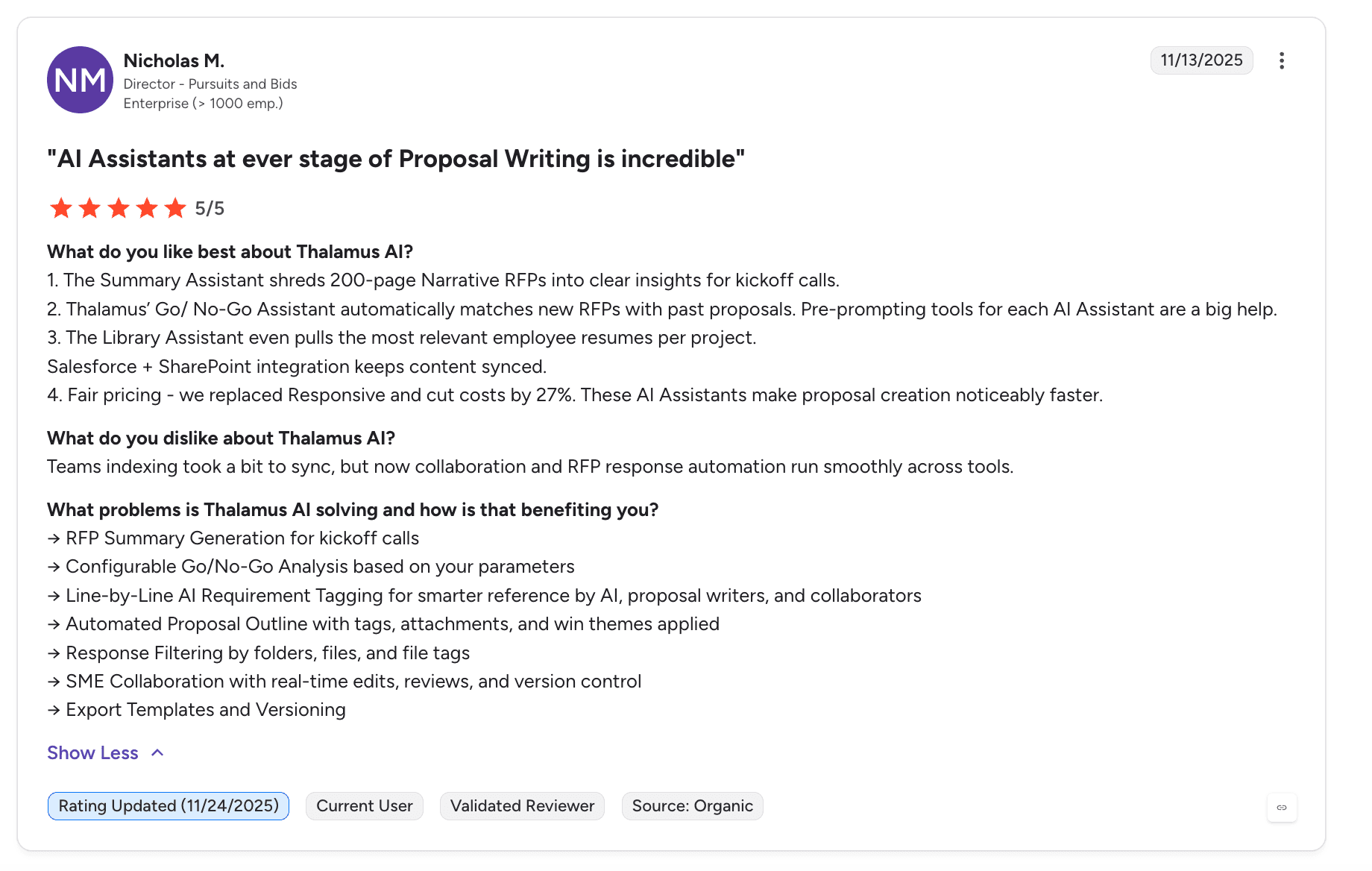
Customer data shared publicly by Thalamus AI reports a 2.5x increase in bid win rates, 3x more bid shortlistings, and a 34% improvement in response reliability attributable to the structured entity layer. Enterprise customer outcomes; individual results vary by team size, RFP volume, and workflow configuration.
Who Should Consider Thalamus AI Over Loopio?
Enterprise proposal teams that have hit Loopio's ceiling - not because Loopio failed at what it was designed to do, but because the team's bids have grown more complex than a Q&A library can support.
The strongest fit is when the bottleneck is coordination, compliance, and knowledge governance across the full bid lifecycle, not just the speed of generating a first draft.
Bring one live RFP. We'll show you what verifiable, compliance-tracked AI looks like on your actual content — not our demo data. → Start Your 3-Month Pilot
2. Responsive (RFPIO) - Loopio Alternative for Integration-Heavy Enterprise Questionnaire Teams
Best for: Mid-to-enterprise teams managing high volumes of structured RFPs, questionnaires, and assessments who need deep CRM integration and a mature analytics layer.
G2 rating: 4.5 / 5 ↗ G2 G2 #1 in RFP Software category for 4 consecutive years
Pricing: Foundations plan approximately $20K+/year; seat-based. No transparent public pricing for higher tiers.
AI approach: Legacy response management platform with AI drafting and content retrieval layered on top.
Solves Loopio's core problems: Partially. Deeper integrations and stronger analytics, but the same Q&A library maintenance model.
What Responsive (RFPIO) Does Well as a Loopio Alternative?
Deepest integration ecosystem in the category - Native connections to Salesforce, HubSpot, major cloud storage systems, Slack, Microsoft Teams, and a wide range of procurement portals. For enterprise organisations with proposal workflows embedded across multiple business systems, this breadth reduces coordination overhead that Loopio cannot match.
Mature analytics and reporting - Response completion rates, answer quality scores, SME contribution volumes, and RFP submission timelines, a level of operational visibility Loopio users regularly cite as a reason to switch.
G2 #1 in the RFP Software category for four consecutive years - The review volume and sustained ranking signal broad market trust that newer AI-native tools have not yet had time to accumulate.
SOC 2 Type 2 and ISO 27001:2022 certifications. Enterprise-procurement-safe across most regulated industries.
Where Responsive (RFPIO) Falls Short as a Loopio Alternative?
Same core architecture problem as Loopio - Responsive was built as a response management platform before the current wave of agentic AI. The AI drafting layer retrieves and assembles content from the existing library; it does not reason across documents or generate net-new content from real-time company knowledge. Teams switching from Loopio because of library maintenance fatigue will find the same root cause waiting for them.
Seat-based pricing creates the same "seat anxiety" as Loopio - The ~$20K/year Foundations plan introduces cost friction when teams need to loop in SMEs, legal reviewers, or technical contributors on a per-bid basis.
Steep learning curve - G2 reviewers consistently flag navigation complexity and a steep onboarding curve - a meaningful friction point for occasional contributors and SMEs.
No capture planning, bid/no-bid scoring, RACI auto-generation, addendum tracking, or institutional win/loss learning - Teams switching from Loopio because the platform does not cover the full bid lifecycle will find the same ceiling here.
What Real Users Say About Responsive (RFPIO) on G2?
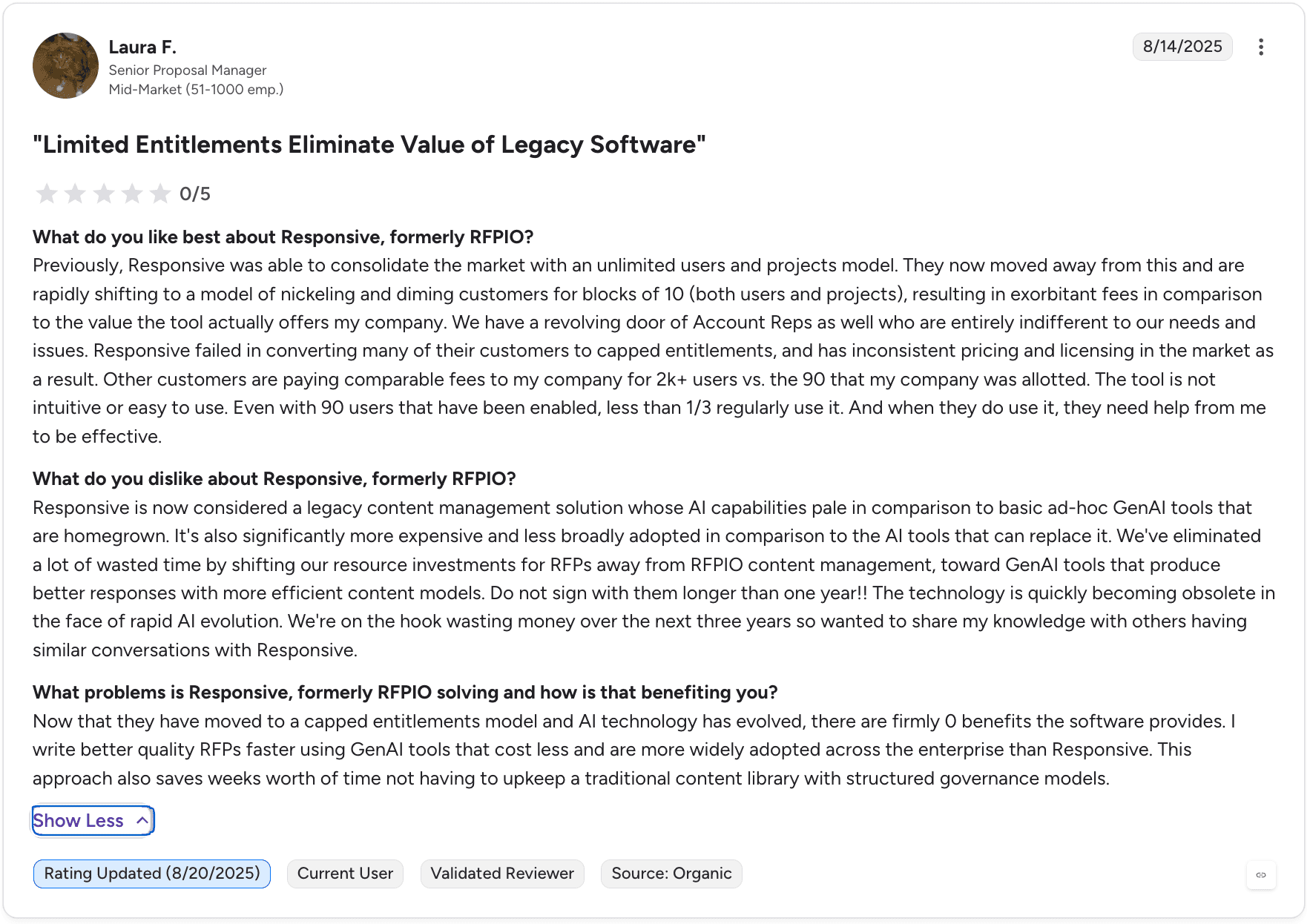
Who Should Consider Responsive (RFPIO) Over Loopio?
Teams switching from Loopio because of Salesforce integration depth, reporting maturity, or RFP volume capacity, not because of the AI or the library maintenance model. If your switch is motivated by content governance or AI quality, Responsive solves a different problem.
3. Arphie - Loopio Alternative for Teams Who Never Want to Maintain a Content Library Again
Best for: Mid-to-enterprise presales, sales engineering, and proposal teams who want strong AI-generated answers without maintaining any static Q&A library, relying instead on live connections to source systems.
G2 rating: 4.9 / 5 ↗ G2
Pricing: Custom enterprise pricing; zero data retention policy. No public pricing.
AI approach: AI agents with live integrations to Google Drive, SharePoint, Confluence, Notion, Seismic, Highspot, and web URLs. No static Q&A library required.
Solves Loopio's core problems? The library maintenance problem, directly. The lifecycle ceiling, it does not.
What Arphie Does Well as a Loopio Alternative?
No Q&A library bottleneck, at all - Arphie connects AI agents directly to live source systems, Google Drive, SharePoint, Confluence, Notion, Seismic, Highspot, and web URLs, and retrieves current content at generation time. For teams who have spent months maintaining Loopio's library and watching it degrade anyway, this is a structurally different model.
Answers are only as stale as the source documents - The AI cannot surface content that was last updated in 2022 because the source document it pulls from has since been revised. Loopio's library does not self-update when the underlying documents change.
Proactive content update suggestions - AI agents flag when source documents have changed, prompting authors to review and update affected answers before they cause problems in a live bid.
Confidence scores and source citations on every answer - Every answer shows where it came from and how confident the system is, giving reviewers a clear path to verification without manually cross-referencing original documents.
Zero data retention policy and SOC 2 Type 2 certification - Strong security positioning for regulated industries.
Where Arphie Falls Short as a Loopio Alternative?
"No library required" does not mean "no knowledge governance required." Answer quality depends on the quality, organisation, and findability of content across connected source systems. If SharePoint or Confluence is disorganised, Arphie will surface disorganised answers. The maintenance burden shifts; it does not disappear.
No capture planning, bid/no-bid scoring, RACI auto-generation, addendum tracking, or compliance matrix generation - Teams switching from Loopio because of the full lifecycle gap will find the same ceiling here.
No closed-loop win/loss learning - Corrections and edits improve the current cycle, but the platform does not track which content correlates with wins and use that signal to strengthen future recommendations.
Custom enterprise pricing with no public transparency - Requires a full sales process before any cost-benefit analysis is possible.
What Real Users Say About Arphie on G2?
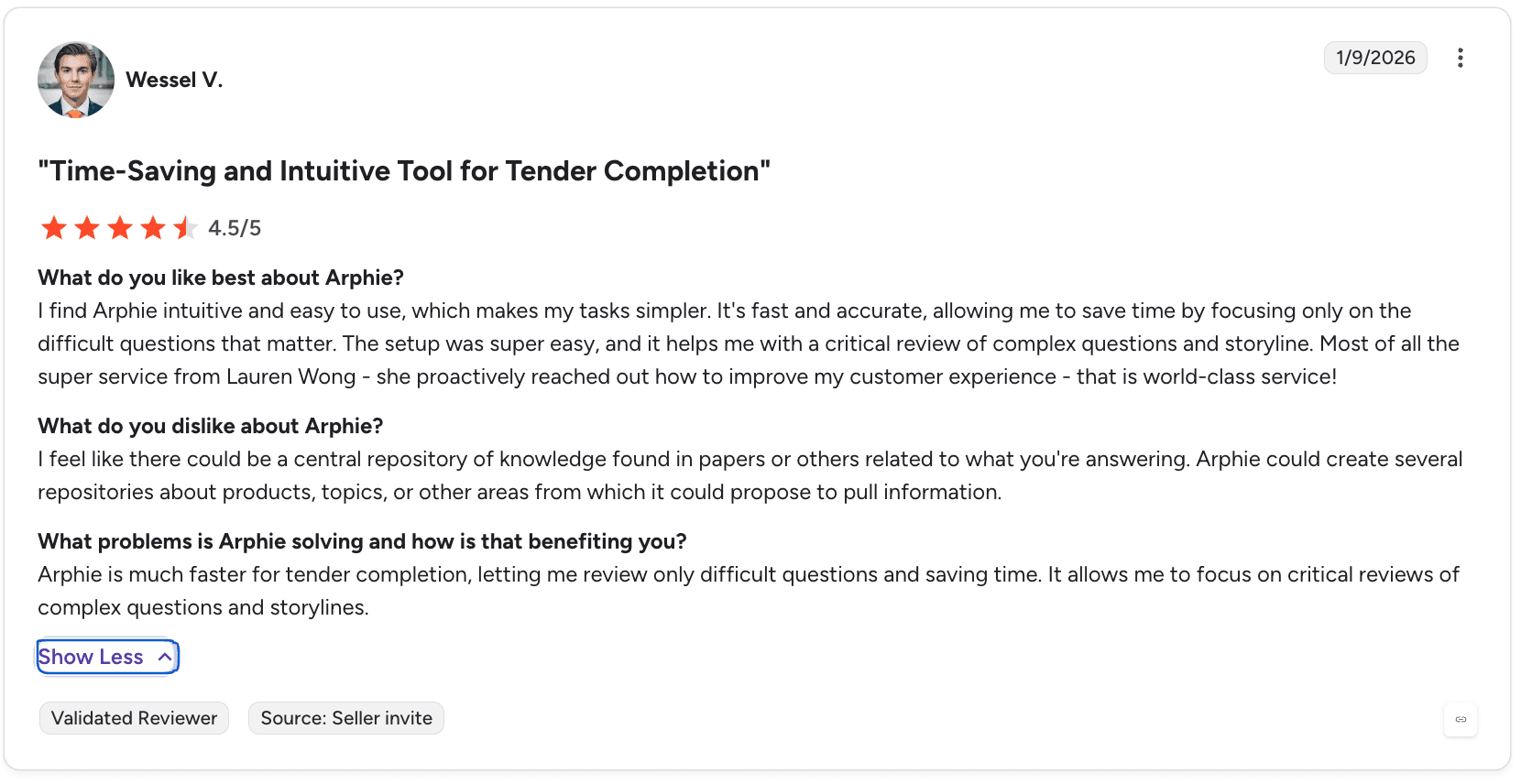
Community and analyst commentary consistently describes Arphie as the "honest, careful choice" for teams in regulated industries where source attribution is non-negotiable, and where the answer being sourced matters as much as the answer being fast.
Who Should Consider Arphie Over Loopio?
Teams switching from Loopio specifically because of library maintenance fatigue, whose content already lives in well-organised SharePoint, Confluence, or Notion repositories, and who want AI answers grounded in current documents without curating a parallel Q&A database.
Not suited for teams that also need the full bid lifecycle, compliance tracking, or institutional learning.
4. Tribble - Loopio Alternative for Win-Pattern Learning and Deal Intelligence
Best for: Enterprise B2B software, financial services, and consulting teams running high-volume RFPs and DDQs where win-pattern learning is expected to compound over 12+ months.
G2 rating: 4.8 / 5 ↗ G2
Pricing: Consumption-based; no public pricing. Requires sales engagement. Cost unpredictable at variable RFP volumes.
AI approach: AI-native; positronic living knowledge graph ingesting documents, call recordings, emails, CRM data, proposals, and win/loss outcomes.
Solves Loopio's core problems: The library maintenance problem and the AI gap on complex questions. Not the full lifecycle ceiling.
What Tribble Does Well as a Loopio Alternative?
Living knowledge graph that self-updates - Unlike Loopio's Q&A library, which requires someone to manually tag, update, and deduplicate entries, Tribble's positronic knowledge graph continuously ingests documents, call recordings, emails, CRM data, past proposals, compliance documents, and win/loss outcomes. Every answer is sourced and cited with confidence scores.
Win-pattern learning that genuinely compounds - Content that wins deals rises in priority; content that correlates with losses is flagged or deprecated. The knowledge graph improves automatically as outcomes are fed back in, not just as the library grows. This is the opposite of how Loopio works.
Tribblytics analytics surfaces content gaps costing deals - Rather than just tracking response completion rates, Tribble tells teams which parts of their knowledge base are weak relative to what evaluators are actually asking. Loopio has no equivalent capability.
SEC/FINRA compliance support - The strongest option in this evaluation for financial services teams with regulatory documentation requirements on top of standard RFP responses.
Where Tribble Falls Short as a Loopio Alternative?
Not a full bid-lifecycle platform - No capture planning, pre-RFP strategy, RACI auto-generation, addendum tracking, or portal response support. Teams switching from Loopio because of the full lifecycle gap will find the same ceiling.
Narrative proposal support is limited - G2 reviewers note the platform is less suited to freeform, design-led, or structurally complex proposals, the kind common in government, AEC, or professional services.
Consumption-based pricing is unpredictable - Teams with variable RFP volumes may find it hard to forecast invoices. No public pricing is available before a sales process.
Better positioned for presales questionnaire workflows than for orchestrated multi-stakeholder bid packages.
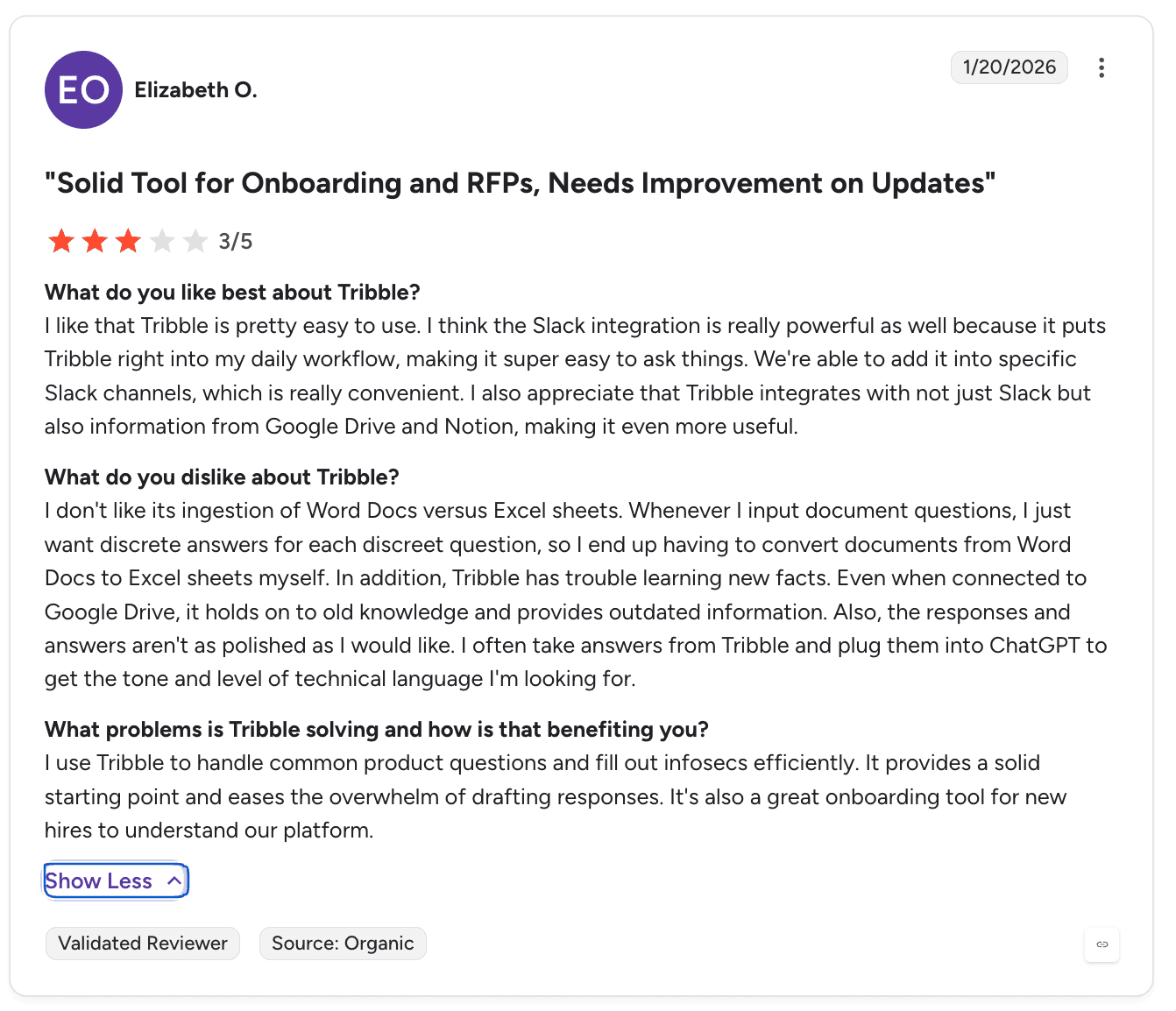
What Real Users Say About Tribble on G2?
Who Should Consider Tribble Over Loopio?
Enterprise B2B software, security, and financial services teams managing a high and consistent volume of RFPs and DDQs where the platform's win-pattern learning is expected to compound meaningfully. Not suited for teams that need a full bid-lifecycle platform, complex narrative proposals, government RFP workflows, or predictable per-unit pricing.
Still comparing tools? Most teams identify the right Loopio alternative within one live walkthrough on their actual content. → See It on Your Next RFP
5. AutogenAI - Loopio Alternative for Government, Defence, and Long-Form Narrative Proposals
Best for: Enterprise proposal teams in government contracting, defence, professional services, and AEC who need best-in-class narrative writing quality and FedRAMP High security certification.
G2 rating: 4.4 / 5 ↗ G2
Pricing: Custom enterprise pricing; minimum seat commitments; onboarding fees apply. No public pricing.
AI approach: Bespoke language engines, a custom language model trained per customer on their own documents, past proposals, win themes, and organisational voice.
Solves Loopio's core problems: The library maintenance problem and the AI gap on complex narratives. Adds full lifecycle coverage, writing-led.
What AutogenAI Does Well as a Loopio Alternative?
Best narrative writing quality in the RFP category - AutogenAI's output quality is the most consistently acknowledged strength in the space, cited even by competitors in their own comparative content. Drafts generated from day one sound like the organisation's own writing, not a generic AI approximation that needs heavy editing.
Bespoke language engines, not shared models - A custom language model is trained per customer on the organisation's own proposals, win themes, and brand voice. Win themes and competitive ghosting carry forward automatically from bid to bid, no manual re-input, no Loopio-style library curation.
FedRAMP High - the only platform in this evaluation with that certification. For US federal government bids handling controlled unclassified information or DoD IL5 data, this is not a preference but a requirement. CMMC 2.0 compliance is also supported. No other Loopio alternative in this list comes close.
Full bid lifecycle from capture to submission - Qualification, capture planning, go/no-bid, requirement shredding, outline generation, collaborative drafting, and the Gamma Review, an automated compliance-checking module that catches requirement gaps before submission.
Where AutogenAI Falls Short as a Loopio Alternative?
Not designed for security questionnaire or DDQ workflows - Teams that split their time between complex proposals and high-volume vendor questionnaires will find that AutogenAI solves only part of the problem and need a separate tool for questionnaire automation.
No portal response support - A common RFx format is excluded from its coverage.
Premium pricing with opaque structure - Minimum seat commitments, onboarding fees, and no self-serve trial. Not a day-one replacement for a team that needs to move quickly.
Primarily English-language focus - Limits utility for multinational teams working across markets.
Limited integration breadth - Fewer native connectors to CRM, cloud storage, and project management tools than platforms like Responsive or Thalamus AI.
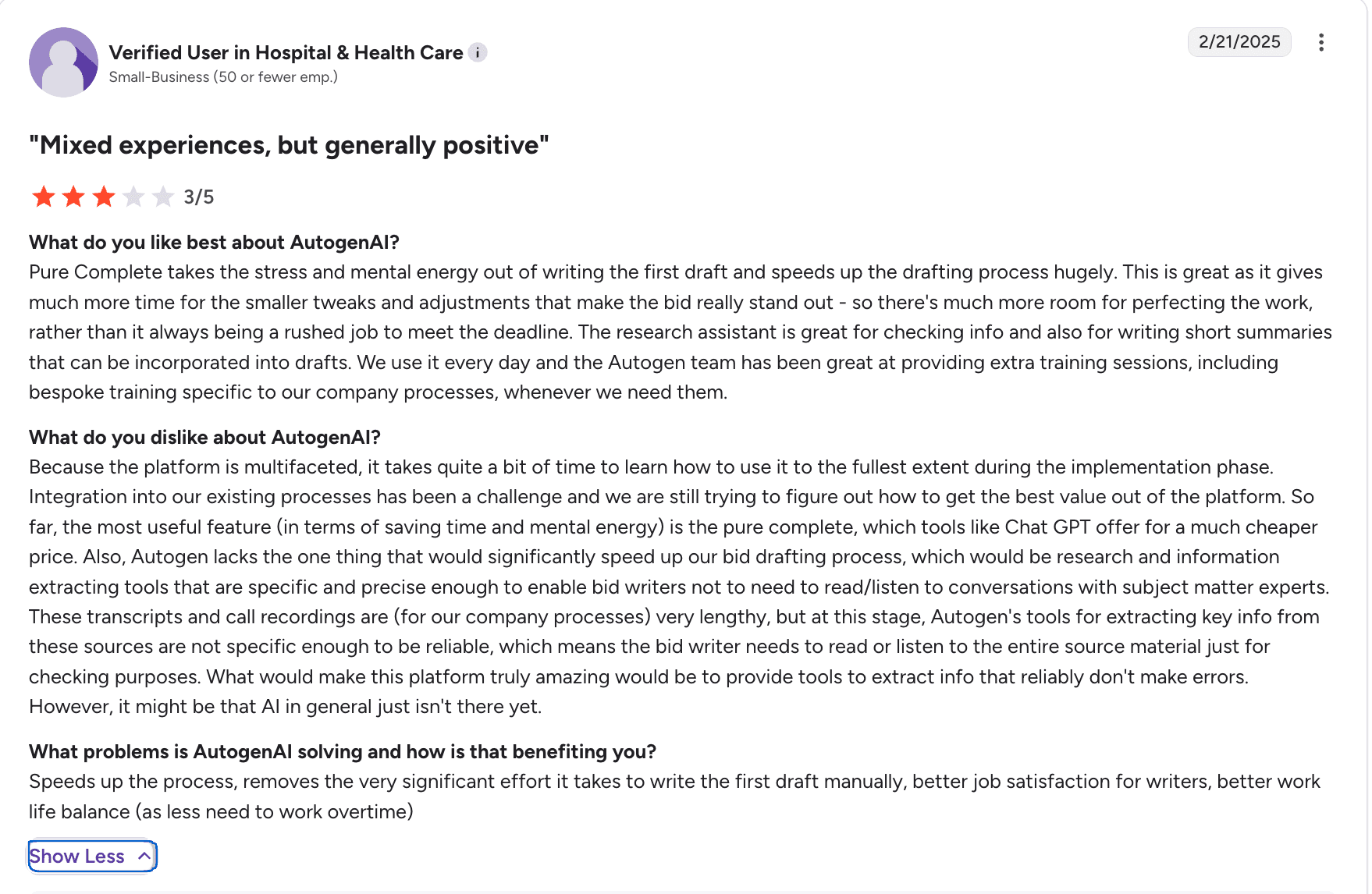
What Real Users Say About AutogenAI on G2?
Who Should Consider AutogenAI Over Loopio?
Enterprise proposal teams in government contracting, defence, professional services, and AEC, where narrative quality is the primary differentiator and FedRAMP High or CMMC 2.0 is non-negotiable.
Not suited for teams whose volume is primarily questionnaires, or who need transparent self-serve pricing and a fast onboarding timeline.
6. HeyIris (Iris AI) - Loopio Alternative for Citeable Answers with Confidence Scoring
Best for: B2B SaaS sales engineering and presales teams wanting sourced, citeable answers with inline confidence scores, portal AutoFill capability, and go/no-go scoring in the same platform.
G2 rating: 4.9 / 5 ↗ G2
Pricing: Per-user pricing with unlimited collaborators. No public pricing.
AI approach: AI-native; document-based retrieval with inline citations and confidence scores on every generated answer.
Solves Loopio's core problems: Reduces library maintenance through document-based retrieval. Does not solve the full lifecycle ceiling.
What HeyIris (Iris AI) Does Well as a Loopio Alternative?
Inline citation and confidence score on every answer - Every AI-generated response includes a source reference and a confidence percentage, so reviewers know instantly whether to approve, edit, or escalate. Loopio's "Magic" tool suggests content, but does not show how confident it is in that suggestion.
Single knowledge base for RFPs and security questionnaires - One platform handles both, reducing the tool sprawl that Loopio teams often end up with when their security team adopts a separate DDQ tool.
Go/no-go scoring with deal fit and win-rate data - Incorporates deal context to help teams make qualification decisions with an objective signal. Loopio has no qualification layer.
Portal AutoFill for Whistic and BitSight - Native browser extension handles portal-based questionnaires directly without manual copy-paste.
Deepest integration breadth in the presales segment - Salesforce, HubSpot, Slack, Google Drive, SharePoint, Confluence, Notion, Vanta, and more.
Where HeyIris (Iris AI) Falls Short as a Loopio Alternative?
Will not generate answers when the knowledge base coverage is incomplete - G2 reviewers note the platform responds "not enough info" rather than generating a plausible answer - honest, but creates friction when the knowledge base has gaps that need filling mid-bid.
No capture planning, pre-RFP strategy, RACI auto-generation, or addendum tracking.
No institutional decision graph or closed-loop win/loss learning - Answers improve as the knowledge base grows, but the platform does not track which content wins deals and feed that signal back into future responses.
No public pricing. Requires a full sales process before any cost comparison is possible.
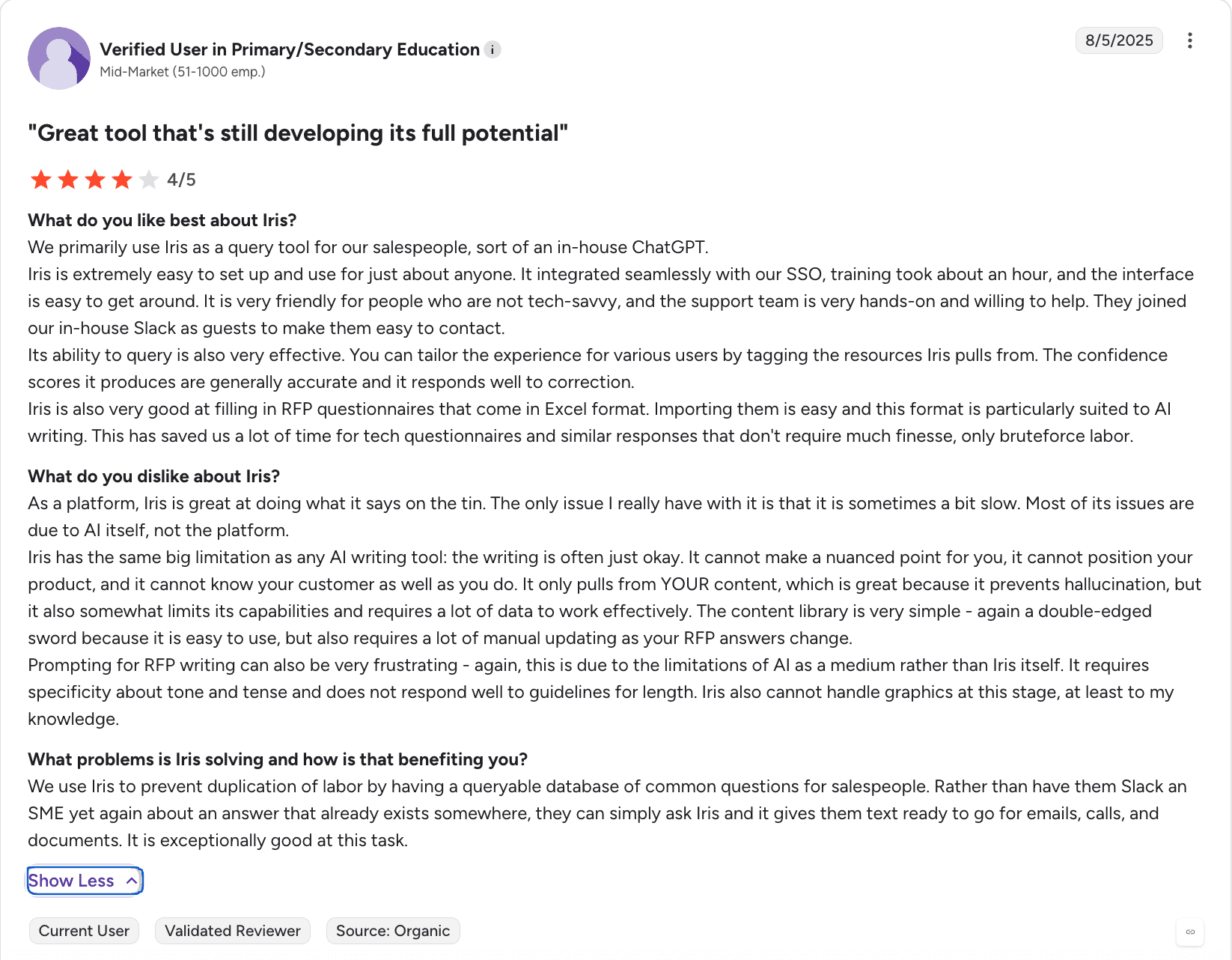
What Real Users Say About HeyIris (Iris AI) on G2?
Who Should Consider HeyIris (Iris AI) Over Loopio?
B2B SaaS presales and sales engineering teams switching from Loopio because of AI accuracy and citation transparency - who handle a mix of portal-based questionnaires and structured RFPs and need auditable answers with confidence scores.
Not suited for teams that need a full bid-lifecycle platform, complex narrative proposals, or institutional learning from deal outcomes.
7. Inventive AI - Loopio Alternative for Accuracy-First Questionnaire Automation
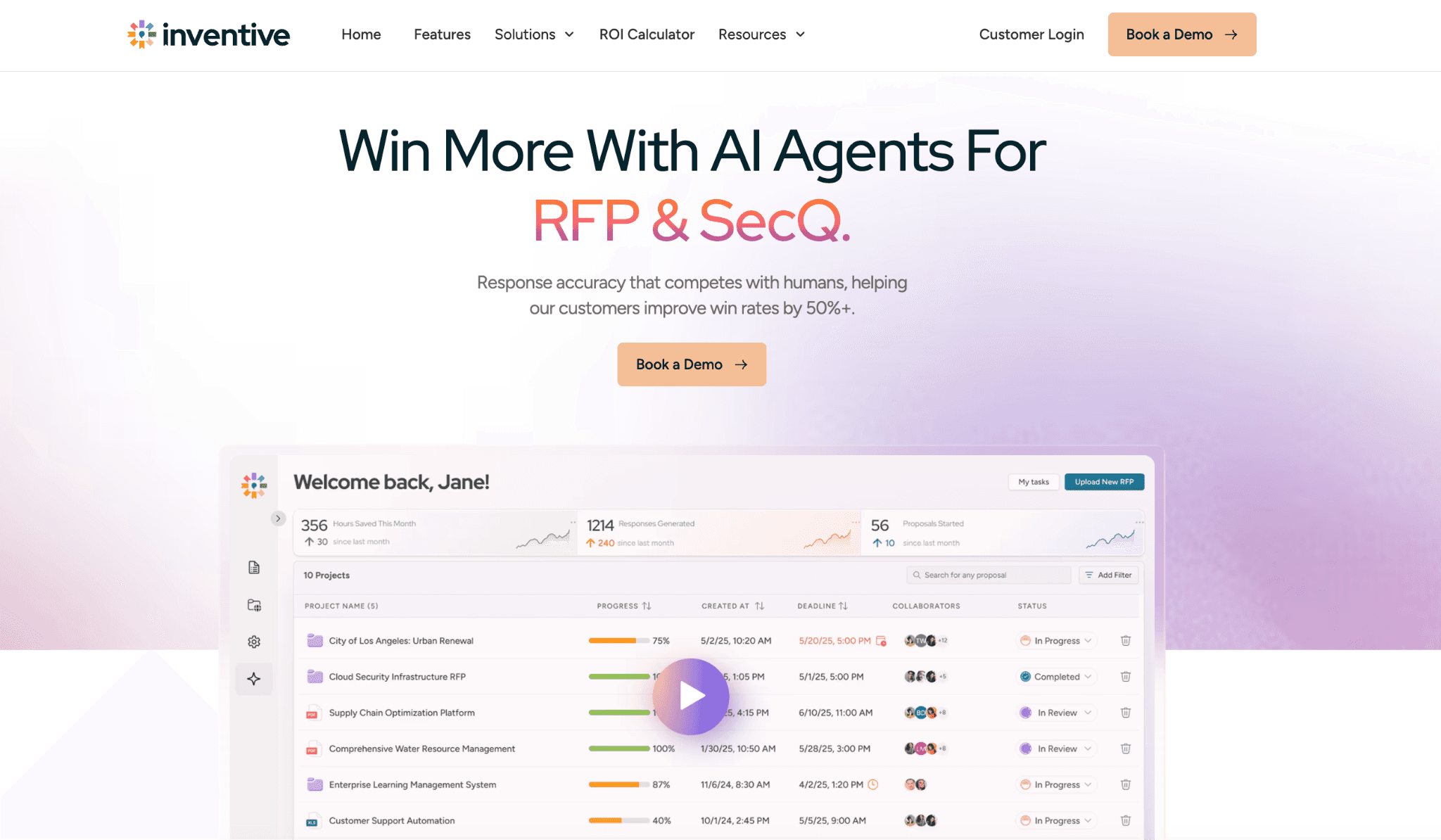
Best for: Fast-moving teams wanting AI-first questionnaire and RFP response automation with claimed 0% hallucination, real-time conflict detection across documents, and high adoption rates across non-technical users.
G2 rating: 5/ 5 ↗ G2
Pricing: No public pricing; requires sales engagement.
AI approach: AI-first; RAG with semantic search. Claims 0% hallucination and 95%+ first-pass accuracy.
Solves Loopio's core problems: The library maintenance problem through live source connections. Does not solve the full lifecycle ceiling.
What Inventive AI Does Well as a Loopio Alternative?
0% hallucination claim grounded in document-level RAG - Answers are generated from a centralised knowledge hub connected to SharePoint, Google Drive, Confluence, and Notion, not from model training data. This directly addresses one of Loopio's most cited limitations: AI answers that are plausible but wrong when library content is stale.
Real-time conflict detection across documents - Identifies when two source documents contain contradictory information before the AI uses them to generate an answer. For teams managing a large, multi-source knowledge base where version control is imperfect, this is a meaningful safeguard.
Proactive staleness detection - The AI Content Manager automatically identifies outdated content and prevents it from being reused in responses, addressing the root cause of Loopio's library decay problem.
Modern AI-first architecture that avoids the legacy-platform constraints burdening Loopio and Responsive.
Where Inventive AI Falls Short as a Loopio Alternative?
Primarily a response automation tool, not a full bid-lifecycle platform - No capture planning, bid/no-bid scoring, RACI auto-generation, addendum tracking, compliance matrix generation, or institutional decision graphs. The full lifecycle gap that drives many teams away from Loopio remains.
Long-form narrative proposal support is limited - Less suited for 100-page multi-document bid packages requiring section-level coherence, SME routing, and review gates.
No public pricing - Requires sales engagement before any cost visibility, which makes pre-shortlist evaluation harder.
If Inventive AI caught your eye and you want a direct head-to-head against Thalamus AI, we have done that comparison in full. Read Thalamus AI vs Inventive AI.
What Real Users Say About Inventive AI on G2?
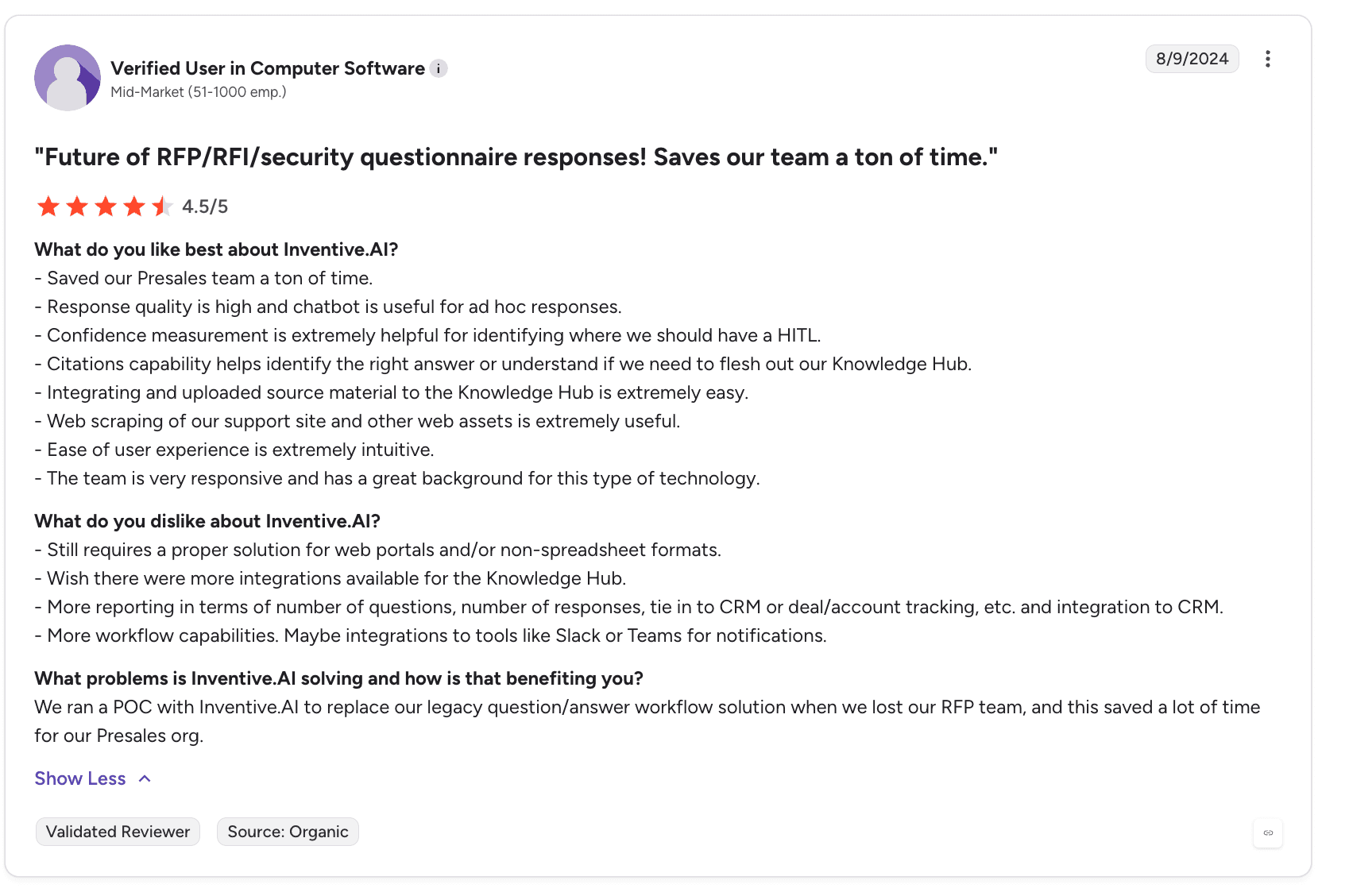
Who Should Consider Inventive AI Over Loopio?
Fast-moving sales, presales, and proposal teams switching from Loopio because of AI accuracy and ease-of-adoption concerns, who primarily handle structured questionnaires and shorter RFPs, and who want a modern AI-first tool with proactive stale content alerts. Not suited for teams that need a full bid-lifecycle platform, complex narrative proposals, or institutional learning from deal outcomes.
If your answers point toward a full bid-lifecycle platform, let's talk. No pressure, no generic pitch. → Get a Personalised Recommendation
8. AutoRFP AI - Loopio Alternative for Transparent, Unlimited-User Pricing
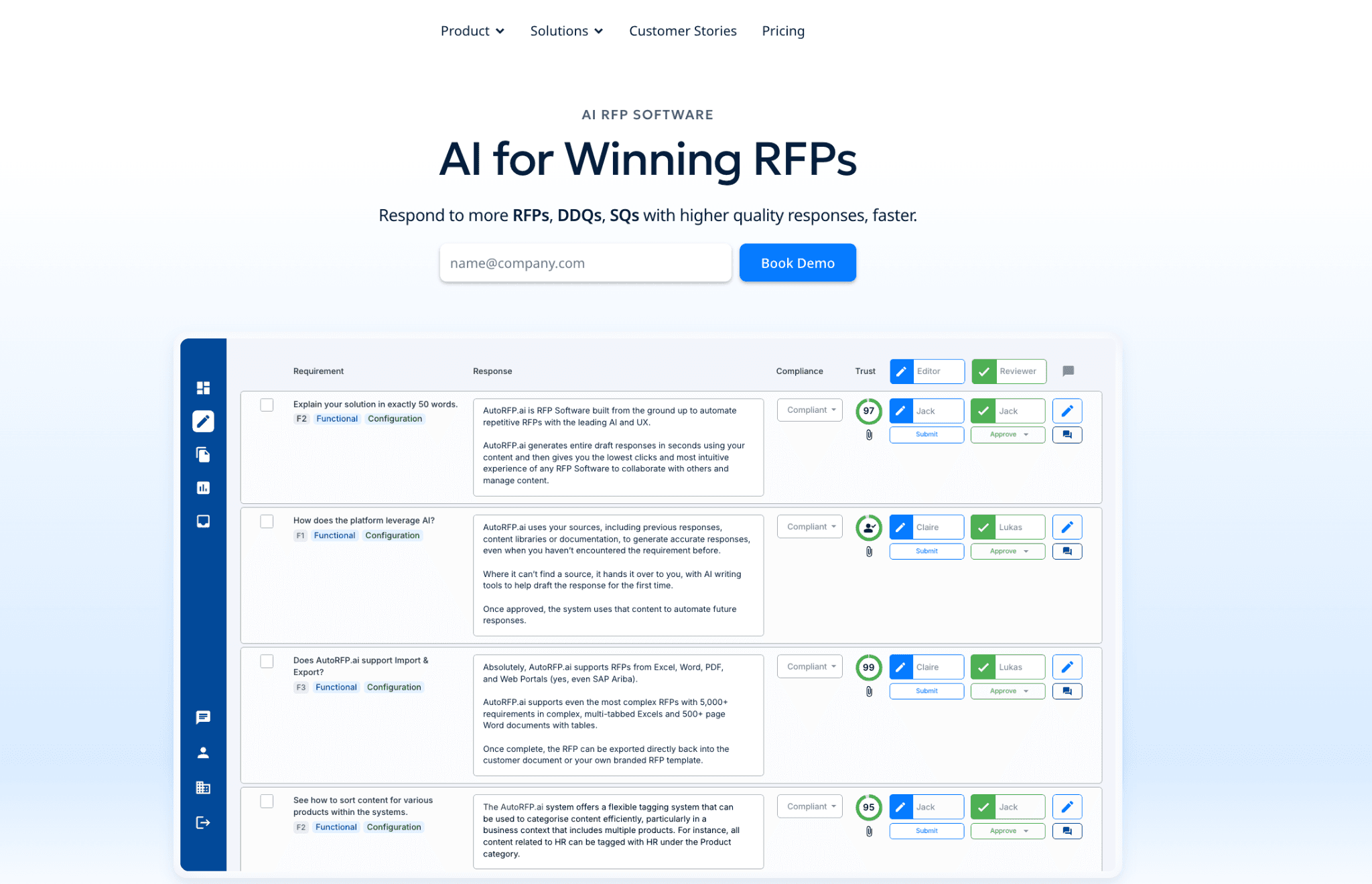
Best for: Mid-market presales, sales engineering, and solutions teams wanting a modern AI-native RFP tool with publicly listed, unlimited-user pricing and no seat-based cost anxiety.
G2 rating: 4.8 / 5 ↗ G2
Pricing: Scale $899/mo (unlimited users), Accelerate $1,299/mo (unlimited users), Enterprise custom. 30-day money-back guarantee. Transparent public pricing.
AI approach: AI-native; RAG + semantic search.
Solves Loopio's core problems: Reduces library maintenance through semantic search. Removes seat-based pricing anxiety. Does not solve the full lifecycle ceiling.
What AutoRFP AI Does Well as a Loopio Alternative?
Transparent public pricing with unlimited users - The Scale tier at $899/month removes the seat-anxiety problem that makes Loopio's pricing model difficult to justify when RFP teams need to loop in SMEs, legal reviewers, or technical contributors on a per-bid basis. This is the sharpest direct pricing differentiator versus Loopio on this list.
30-day money-back guarantee - Allows teams to pilot genuinely rather than committing through a lengthy enterprise sales process - a direct contrast to Loopio's 15 to 60-day onboarding requirement before full value.
40+ language auto-detection - Among the better multilingual coverage in the mid-market AI-native segment. Loopio supports approximately 12 languages.
Contradiction detection across response sections - Helps teams catch inconsistencies before submission without manual cross-checking.
SOC 2, ISO 27001, and GDPR certifications cover the compliance baseline for most mid-market enterprise requirements.
Where AutoRFP AI Falls Short as a Loopio Alternative?
Response acceleration tool, not a full bid-lifecycle platform - No capture planning, bid/no-bid scoring, RACI auto-generation, addendum tracking, compliance matrix generation, or win/loss institutional learning. Teams switching from Loopio because of the lifecycle ceiling will find the same ceiling at a lower price point.
Not suited for long-form narrative proposals - Where section-level coherence, requirement mapping, and structured assembly across 100+ pages are required, AutoRFP AI is outside its primary positioning.
Younger ecosystem - Less established than Loopio or Responsive in terms of partner network and long-term roadmap visibility.
What Real Users Say About AutoRFP AI on G2?
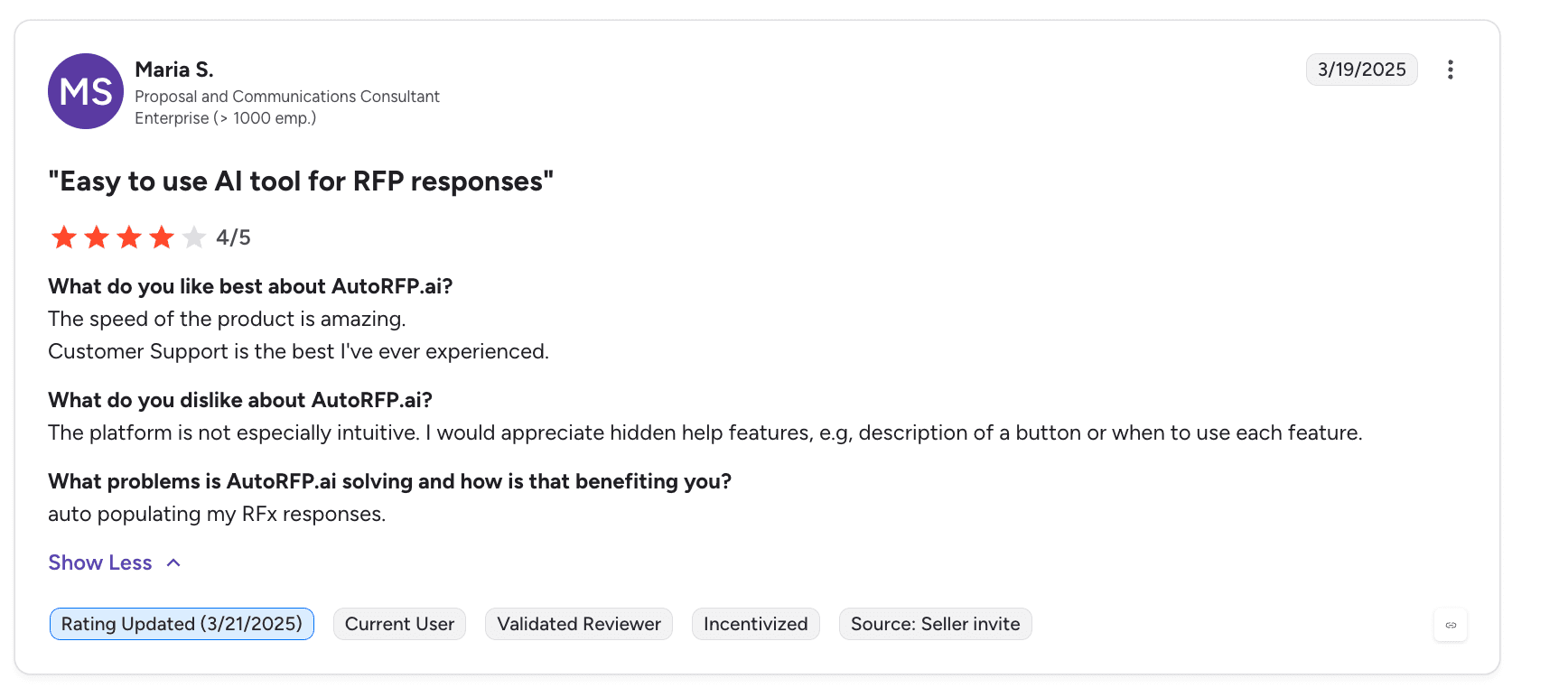
Who Should Consider AutoRFP AI Over Loopio?
Mid-market presales and sales engineering teams switching from Loopio primarily because of seat-based pricing friction, multilingual gaps, and slow onboarding, who handle primarily structured questionnaires and shorter RFPs and want a modern AI-native tool with transparent, unlimited-user pricing.
Not suited for teams that need full bid-lifecycle orchestration, complex narrative proposals, or institutional learning.
9. 1Up - Loopio Alternative for Sales Teams Living in Slack and Teams
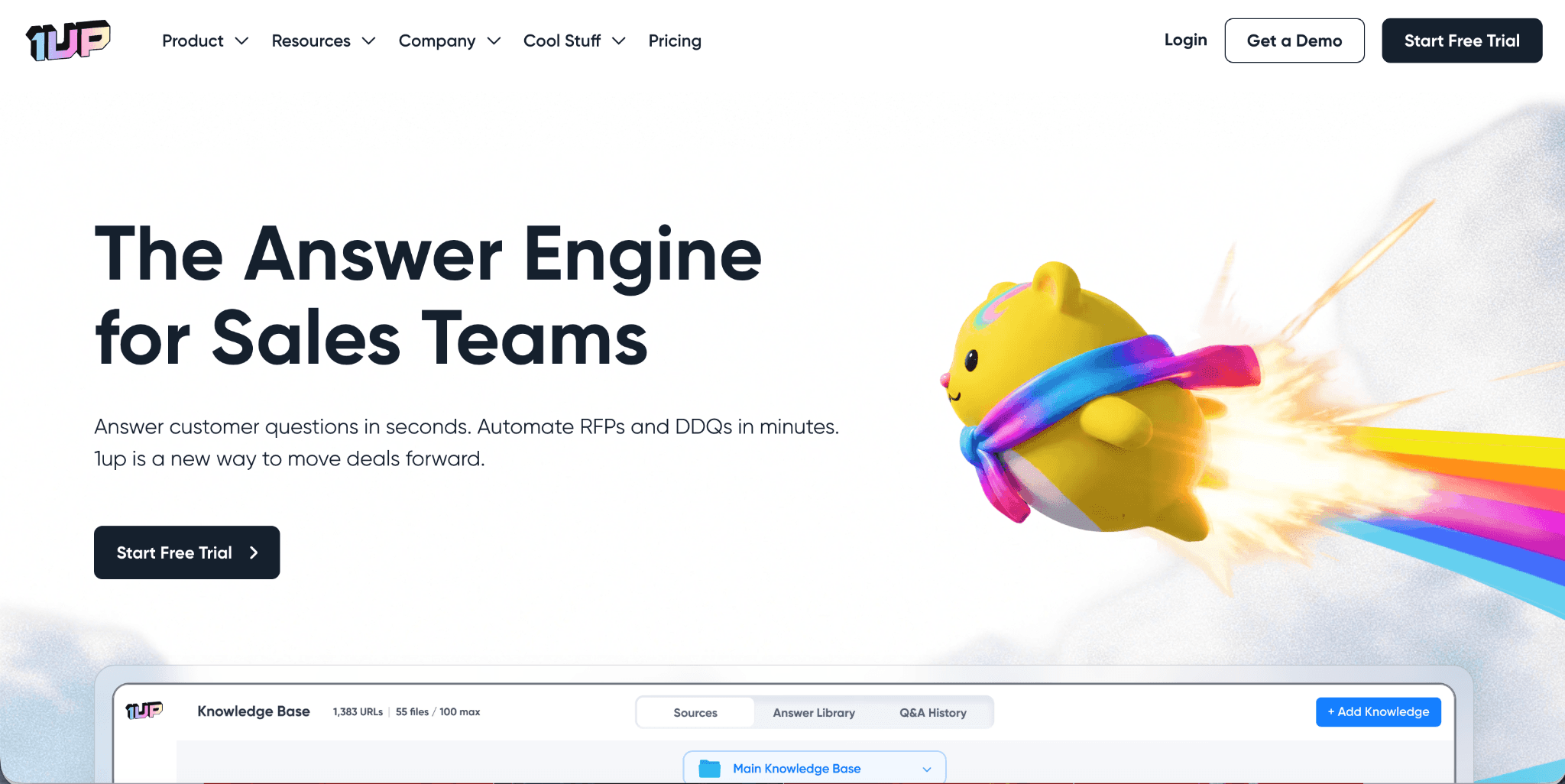
Best for: Small-to-mid-market B2B sales, presales, and RevOps teams wanting fast, automated questionnaire and RFP answers via Slack, Teams, or Google Chat - without switching to a dedicated proposal platform.
G2 rating: 4.9 / 5 ↗ G2
Pricing: Free plan available. Starter $300/mo. Plus $900/mo. Enterprise custom. Transparent public pricing.
AI approach: AI-first knowledge automation; live connectors to approved sources; answers surfaced via Slack, Teams, and web interface.
Solves Loopio's core problems - Library maintenance, through live connectors instead of a curated Q&A database. Does not solve the lifecycle ceiling.
What 1Up Does Well as a Loopio Alternative?
Lowest entry price for a purpose-built non-generic AI RFP tool - Free plan with no credit card required; Starter at $300/month. Teams can evaluate without a sales process - the opposite of Loopio's enterprise procurement model.
Native Slack, Teams, and Google Chat integration - Team members get sourced answers without leaving the communication tool they use all day - the lowest adoption friction of any tool in this evaluation. For sales teams who resist switching to a dedicated proposal platform, this removes the most common objection.
Self-learning knowledge base - 1Up captures edits and feedback from multiple connected sources in real-time. Unlike Loopio's library, which ages unless someone manually maintains it, 1Up's knowledge layer improves as the team uses it.
Live connectors to website, Google Drive, past RFPs, and internal knowledge bases. No Q&A library curation required.
SOC 2 Type II certified; data not used to train AI models. SSO support for enterprise identity management.
Where 1Up Falls Short as a Loopio Alternative?
Not designed for complex, multi-document proposal workflows - No compliance mapping, RACI routing, addendum tracking, bid/no-bid scoring, capture planning, or institutional win/loss learning. If the reason for switching from Loopio is that bids have become too complex for a response management platform, 1Up will not solve that problem.
Scales poorly for large enterprise bid teams - The Slack-first interaction model and basic review/edit workflow create coordination gaps when multiple sections, stakeholders, and review gates are involved.
Narrative proposal writing is outside its positioning - Teams that start here for questionnaire automation typically discover they need a second tool for more complex proposal work, recreating the tool sprawl they were trying to escape.
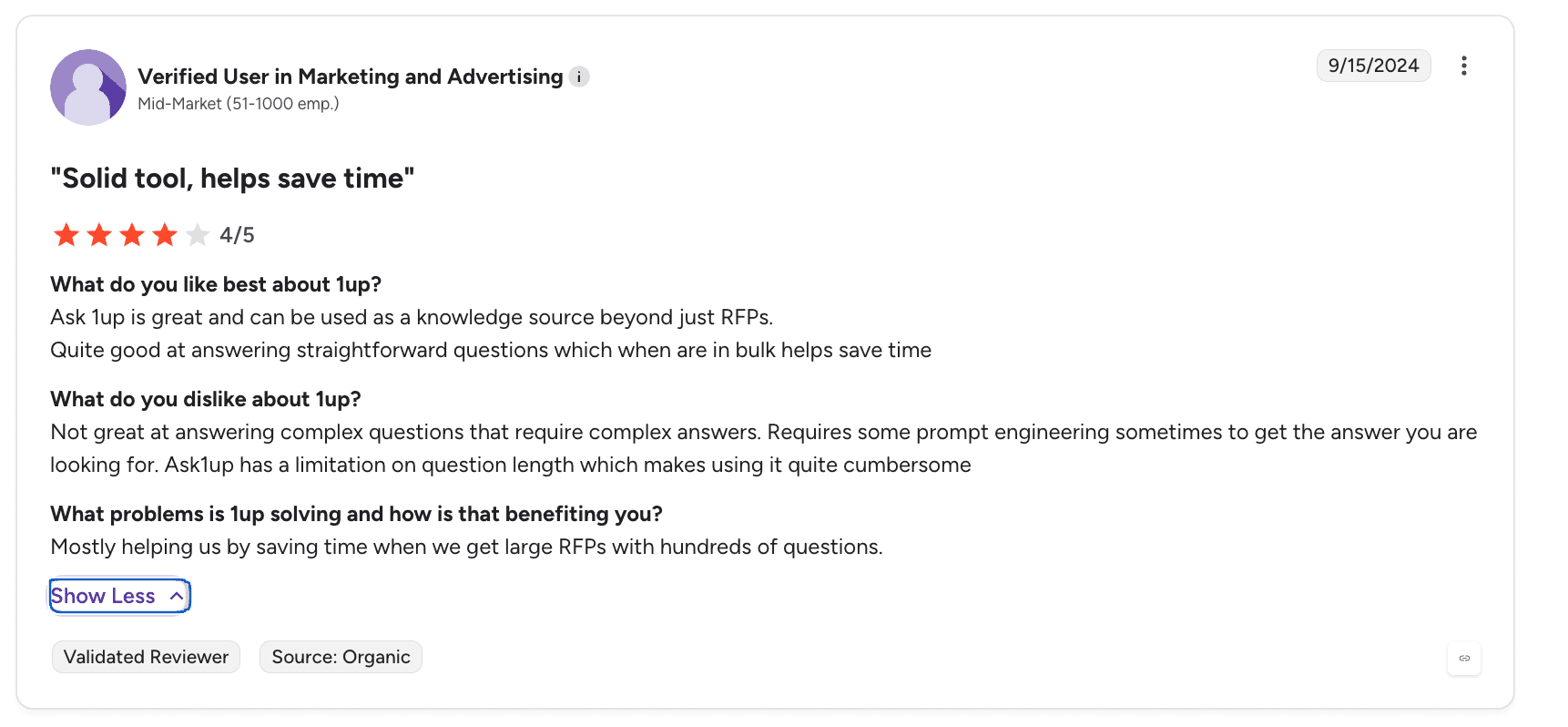
What Real Users Say About 1Up on G2?
Who Should Consider 1Up Over Loopio?
Small-to-mid-market B2B sales, presales, and RevOps teams whose primary use case is answering questionnaires and short RFPs quickly via Slack or Teams, and who want to move fast without an enterprise procurement process.
Not suited for enterprise teams running complex, multi-section RFPs, long-form narrative proposals, or any workflow requiring compliance matrices, RACI routing, or post-bid institutional learning.
10. Qvidian (Upland) - Loopio Alternative for Regulated Financial Services Teams Needing Content Governance
Best for: Enterprise teams in financial services, professional services, and education who need a mature content governance platform with strong audit trails, proven industry credentials, and an IBM watsonx AI integration.
G2 rating: 4.3 / 5 ↗ G2
Pricing: Custom enterprise pricing; part of the Upland Software suite. No public pricing.
AI approach: Legacy proposal automation platform with AI Assist (generative AI) bolted on; not built AI-native.
Solves Loopio's core problems: Partially, deeper content governance and audit trails. Same Q&A library maintenance model.
What Qvidian (Upland) Does Well as a Loopio Alternative?
Serves 8 of the 10 largest US banks and 6 of the 10 largest European banks - A distribution of clients that signals procurement-safe positioning and regulatory readiness at the scale of the world's most scrutinised financial institutions.
IBM watsonx AI partnership - A branded, auditable AI layer that resonates in regulated industries where AI provenance and explainability are evaluated as part of procurement - a consideration Loopio's "Magic" feature does not address.
Mature audit trails, role-based permissions, and content governance features built over 40+ years of enterprise proposal industry experience.
Broader RFx coverage than Loopio - including SOWs and complex proposals; stronger in financial services, professional services, and education.
Office Online collaboration with multi-step assignment workflows and approval chains.
Where Qvidian (Upland) Falls Short as a Loopio Alternative
Rated #8 easiest-to-use in the G2 RFP Software category - Qvidian's G2 ease-of-use score is meaningfully lower than Loopio's; teams switching from Loopio for a simpler experience will not find it here.
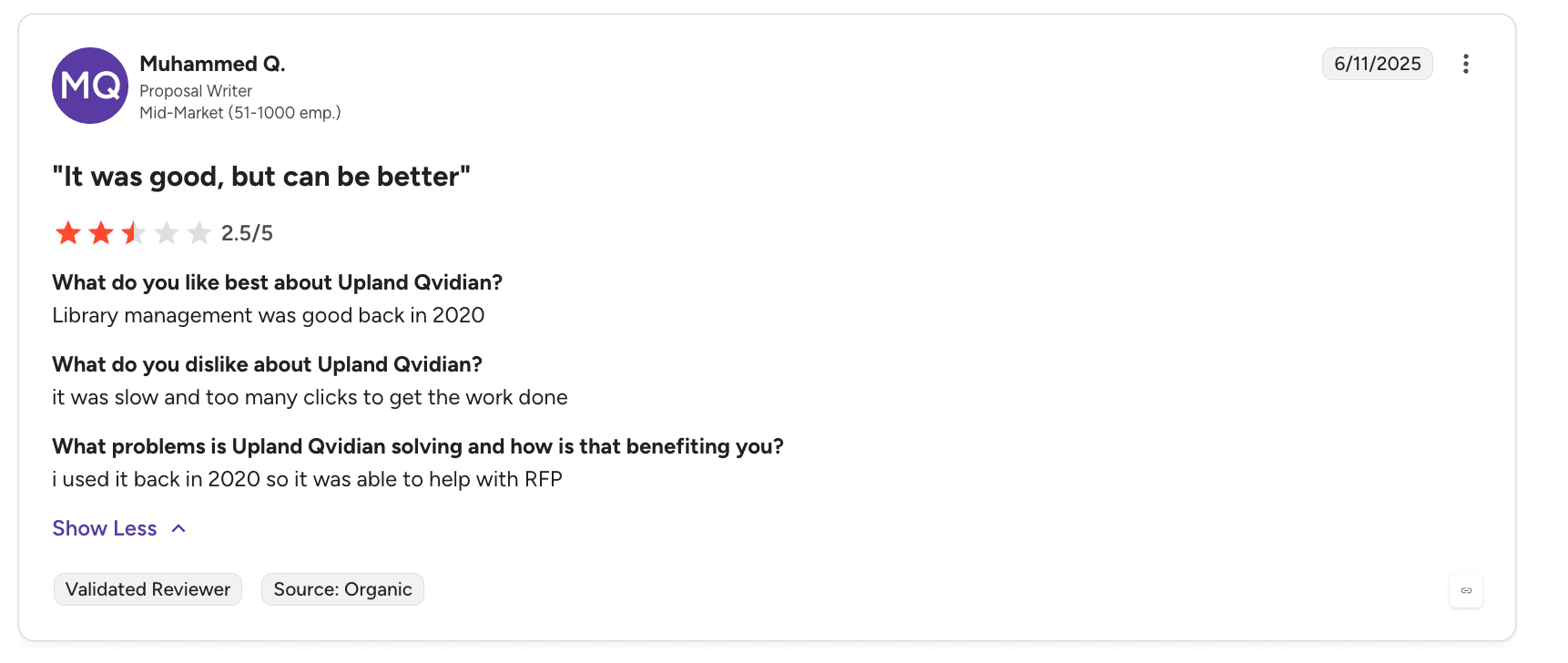
Legacy architecture with AI Assist bolted on - The same root problem as Loopio: AI generation anchored to a content library that requires ongoing manual maintenance. Switching from Loopio to Qvidian does not solve the library maintenance problem.
Custom enterprise pricing with no public transparency - Requires a full procurement cycle before any cost comparison, and is typically more expensive than Loopio.
No capture planning, bid/no-bid scoring, RACI auto-generation, addendum tracking, or institutional win/loss learning in its core public positioning.
What Real Users Say About Qvidian on G2
Who Should Consider Qvidian (Upland) Over Loopio?
Enterprise teams in financial services, professional services, and education that prioritise institutional credibility, IBM WatsonX AI provenance, and mature content governance, and where navigating a legacy UX is an acceptable trade-off.
Not suited for teams that want modern ease-of-use, transparent pricing, or advanced features like RACI routing, addendum tracking, or institutional learning.
This list evaluates 10 alternatives on the dimensions that actually matter when you are making that switch. Every tool card names real weaknesses. No tool paid to appear here. And Thalamus AI is evaluated by the same standard as every other platform on the list.
1. Thalamus AI - Best Loopio Alternative for Enterprise Bid Lifecycle Management
Best for: Enterprise proposal teams in healthcare, AEC, government contracting, and professional services handling complex, multi-document RFPs, where library maintenance, compliance tracking, and post-bid learning are as important as drafting speed.
G2 rating: 5.0 / 5 ↗ G2
Pricing: Unlimited projects, unlimited users, unlimited RFPs - one subscription. Three-month pilot pack available. Contact for enterprise pricing.
AI approach: Multi-agent agentic AI with a verified entity knowledge layer, decision graph, and closed-loop institutional learning.
Solves Loopio's core problems: All three - library maintenance burden, AI ceiling on complex proposals, and the full lifecycle gap.
What Thalamus AI Does Better Than Loopio for RFP Response Management?
No Q&A library to maintain ever
Instead of storing content as Q&A pairs that age, duplicate, and require constant curation, Thalamus AI converts unstructured proposals, CVs, case studies, project histories, and certifications into verified, editable, auditable knowledge entities that can connect to CRM systems like Salesforce and HubSpot for account context.
Each entity is traceable to its source document with a completeness score and last-verified timestamp. An AI-managed Content Health layer continuously scans for duplicates, stale entries, and conflicting claims and surfaces only what needs a human decision, so the library maintenance problem this whole list exists to solve doesn't just move to a different architecture; it's actively watched.
Full bid lifecycle, not just the response step.
Thalamus AI covers capture planning, bid/no-bid qualification, requirement mapping, RACI routing, SME coordination, response generation, compliance review, submission, and post-bid institutional learning in one platform. Loopio covers the response step. The gap matters when bids get complex.
Compliance matrix as a live working document -
Every requirement is mapped to a response section, an owner, a compliance status, and a risk level. When an addendum is issued mid-bid, which happens routinely on government and public-sector RFPs, Thalamus AI automatically detects changed requirements, flags every impacted section, and prompts the responsible author to update. This level of addendum impact tracking is rare across the RFP software category and is not a core public differentiator for most tools on this list. This addendum tracking capability is absent across the rest of this list.
Subsection-level RACI routing -
Proposal leads can assign SMEs to individual sections before kickoff through the Ownership Matrix, not just during drafting, set version-controlled review gates, require lead-author approval before content advances, and route documents to legal, finance, security, or pricing teams based on requirement type, all without leaving the platform.
Catches open questions before submission, not after.
The AI Clarification Register checks each unanswered question the team has against the RFP package itself, separating genuinely open items from ones simply buried in an appendix. Loopio has no equivalent workflow.
Institutional memory that compounds with every bid -
Every correction, decision, win, loss, reviewer comment, and content choice strengthens the knowledge graph. Unlike Loopio, which stores content but does not learn from outcomes, Thalamus AI gets measurably better at predicting winning content over time.
Unlimited users, no seat tax -
Every SME, legal reviewer, finance contributor, and delivery lead can be looped in without triggering an invoice. Loopio's seat-based pricing creates the opposite incentive; teams shrink the contributor circle to control cost, which degrades proposal quality.
45+ language support and browser extension for portal questionnaires -
all under the same subscription with no add-on fees.
Where Thalamus AI Falls Short as a Loopio Alternative?
Not suited for simple, high-volume security questionnaire workflows -
Teams whose entire RFP programme is structured around DDQs and vendor assessments will find the platform more powerful than they need, and lighter tools like 1Up or Arphie will get them to value faster.
Initial setup investment is real -
Bid-stage workflows, RACI configuration, compliance matrices, and entity ingestion require upfront time before the platform runs at full efficiency. Teams expecting same-day self-serve value from a tool they can click through immediately should calibrate expectations.
Lower G2 review volume than legacy platforms -
Few reviews at the time of writing mean third-party social proof is still building. Teams relying heavily on review volume for procurement decisions may want to request customer references directly.
Occasional early-stage bugs flagged on G2 -
Freezing screens and task tracker loading issues appear in recent reviews, alongside consistent praise for support response times.
What Real Users Say About Thalamus AI on G2?
Customer data shared publicly by Thalamus AI reports a 2.5x increase in bid win rates, 3x more bid shortlistings, and a 34% improvement in response reliability attributable to the structured entity layer. Enterprise customer outcomes; individual results vary by team size, RFP volume, and workflow configuration.
Who Should Consider Thalamus AI Over Loopio?
Enterprise proposal teams that have hit Loopio's ceiling - not because Loopio failed at what it was designed to do, but because the team's bids have grown more complex than a Q&A library can support.
The strongest fit is when the bottleneck is coordination, compliance, and knowledge governance across the full bid lifecycle, not just the speed of generating a first draft.
Bring one live RFP. We'll show you what verifiable, compliance-tracked AI looks like on your actual content — not our demo data. → Start Your 3-Month Pilot
2. Responsive (RFPIO) - Loopio Alternative for Integration-Heavy Enterprise Questionnaire Teams
Best for: Mid-to-enterprise teams managing high volumes of structured RFPs, questionnaires, and assessments who need deep CRM integration and a mature analytics layer.
G2 rating: 4.5 / 5 ↗ G2 G2 #1 in RFP Software category for 4 consecutive years
Pricing: Foundations plan approximately $20K+/year; seat-based. No transparent public pricing for higher tiers.
AI approach: Legacy response management platform with AI drafting and content retrieval layered on top.
Solves Loopio's core problems: Partially. Deeper integrations and stronger analytics, but the same Q&A library maintenance model.
What Responsive (RFPIO) Does Well as a Loopio Alternative?
Deepest integration ecosystem in the category - Native connections to Salesforce, HubSpot, major cloud storage systems, Slack, Microsoft Teams, and a wide range of procurement portals. For enterprise organisations with proposal workflows embedded across multiple business systems, this breadth reduces coordination overhead that Loopio cannot match.
Mature analytics and reporting - Response completion rates, answer quality scores, SME contribution volumes, and RFP submission timelines, a level of operational visibility Loopio users regularly cite as a reason to switch.
G2 #1 in the RFP Software category for four consecutive years - The review volume and sustained ranking signal broad market trust that newer AI-native tools have not yet had time to accumulate.
SOC 2 Type 2 and ISO 27001:2022 certifications. Enterprise-procurement-safe across most regulated industries.
Where Responsive (RFPIO) Falls Short as a Loopio Alternative?
Same core architecture problem as Loopio - Responsive was built as a response management platform before the current wave of agentic AI. The AI drafting layer retrieves and assembles content from the existing library; it does not reason across documents or generate net-new content from real-time company knowledge. Teams switching from Loopio because of library maintenance fatigue will find the same root cause waiting for them.
Seat-based pricing creates the same "seat anxiety" as Loopio - The ~$20K/year Foundations plan introduces cost friction when teams need to loop in SMEs, legal reviewers, or technical contributors on a per-bid basis.
Steep learning curve - G2 reviewers consistently flag navigation complexity and a steep onboarding curve - a meaningful friction point for occasional contributors and SMEs.
No capture planning, bid/no-bid scoring, RACI auto-generation, addendum tracking, or institutional win/loss learning - Teams switching from Loopio because the platform does not cover the full bid lifecycle will find the same ceiling here.
What Real Users Say About Responsive (RFPIO) on G2?
Who Should Consider Responsive (RFPIO) Over Loopio?
Teams switching from Loopio because of Salesforce integration depth, reporting maturity, or RFP volume capacity, not because of the AI or the library maintenance model. If your switch is motivated by content governance or AI quality, Responsive solves a different problem.
3. Arphie - Loopio Alternative for Teams Who Never Want to Maintain a Content Library Again
Best for: Mid-to-enterprise presales, sales engineering, and proposal teams who want strong AI-generated answers without maintaining any static Q&A library, relying instead on live connections to source systems.
G2 rating: 4.9 / 5 ↗ G2
Pricing: Custom enterprise pricing; zero data retention policy. No public pricing.
AI approach: AI agents with live integrations to Google Drive, SharePoint, Confluence, Notion, Seismic, Highspot, and web URLs. No static Q&A library required.
Solves Loopio's core problems? The library maintenance problem, directly. The lifecycle ceiling, it does not.
What Arphie Does Well as a Loopio Alternative?
No Q&A library bottleneck, at all - Arphie connects AI agents directly to live source systems, Google Drive, SharePoint, Confluence, Notion, Seismic, Highspot, and web URLs, and retrieves current content at generation time. For teams who have spent months maintaining Loopio's library and watching it degrade anyway, this is a structurally different model.
Answers are only as stale as the source documents - The AI cannot surface content that was last updated in 2022 because the source document it pulls from has since been revised. Loopio's library does not self-update when the underlying documents change.
Proactive content update suggestions - AI agents flag when source documents have changed, prompting authors to review and update affected answers before they cause problems in a live bid.
Confidence scores and source citations on every answer - Every answer shows where it came from and how confident the system is, giving reviewers a clear path to verification without manually cross-referencing original documents.
Zero data retention policy and SOC 2 Type 2 certification - Strong security positioning for regulated industries.
Where Arphie Falls Short as a Loopio Alternative?
"No library required" does not mean "no knowledge governance required." Answer quality depends on the quality, organisation, and findability of content across connected source systems. If SharePoint or Confluence is disorganised, Arphie will surface disorganised answers. The maintenance burden shifts; it does not disappear.
No capture planning, bid/no-bid scoring, RACI auto-generation, addendum tracking, or compliance matrix generation - Teams switching from Loopio because of the full lifecycle gap will find the same ceiling here.
No closed-loop win/loss learning - Corrections and edits improve the current cycle, but the platform does not track which content correlates with wins and use that signal to strengthen future recommendations.
Custom enterprise pricing with no public transparency - Requires a full sales process before any cost-benefit analysis is possible.
What Real Users Say About Arphie on G2?
Community and analyst commentary consistently describes Arphie as the "honest, careful choice" for teams in regulated industries where source attribution is non-negotiable, and where the answer being sourced matters as much as the answer being fast.
Who Should Consider Arphie Over Loopio?
Teams switching from Loopio specifically because of library maintenance fatigue, whose content already lives in well-organised SharePoint, Confluence, or Notion repositories, and who want AI answers grounded in current documents without curating a parallel Q&A database.
Not suited for teams that also need the full bid lifecycle, compliance tracking, or institutional learning.
4. Tribble - Loopio Alternative for Win-Pattern Learning and Deal Intelligence
Best for: Enterprise B2B software, financial services, and consulting teams running high-volume RFPs and DDQs where win-pattern learning is expected to compound over 12+ months.
G2 rating: 4.8 / 5 ↗ G2
Pricing: Consumption-based; no public pricing. Requires sales engagement. Cost unpredictable at variable RFP volumes.
AI approach: AI-native; positronic living knowledge graph ingesting documents, call recordings, emails, CRM data, proposals, and win/loss outcomes.
Solves Loopio's core problems: The library maintenance problem and the AI gap on complex questions. Not the full lifecycle ceiling.
What Tribble Does Well as a Loopio Alternative?
Living knowledge graph that self-updates - Unlike Loopio's Q&A library, which requires someone to manually tag, update, and deduplicate entries, Tribble's positronic knowledge graph continuously ingests documents, call recordings, emails, CRM data, past proposals, compliance documents, and win/loss outcomes. Every answer is sourced and cited with confidence scores.
Win-pattern learning that genuinely compounds - Content that wins deals rises in priority; content that correlates with losses is flagged or deprecated. The knowledge graph improves automatically as outcomes are fed back in, not just as the library grows. This is the opposite of how Loopio works.
Tribblytics analytics surfaces content gaps costing deals - Rather than just tracking response completion rates, Tribble tells teams which parts of their knowledge base are weak relative to what evaluators are actually asking. Loopio has no equivalent capability.
SEC/FINRA compliance support - The strongest option in this evaluation for financial services teams with regulatory documentation requirements on top of standard RFP responses.
Where Tribble Falls Short as a Loopio Alternative?
Not a full bid-lifecycle platform - No capture planning, pre-RFP strategy, RACI auto-generation, addendum tracking, or portal response support. Teams switching from Loopio because of the full lifecycle gap will find the same ceiling.
Narrative proposal support is limited - G2 reviewers note the platform is less suited to freeform, design-led, or structurally complex proposals, the kind common in government, AEC, or professional services.
Consumption-based pricing is unpredictable - Teams with variable RFP volumes may find it hard to forecast invoices. No public pricing is available before a sales process.
Better positioned for presales questionnaire workflows than for orchestrated multi-stakeholder bid packages.
What Real Users Say About Tribble on G2?
Who Should Consider Tribble Over Loopio?
Enterprise B2B software, security, and financial services teams managing a high and consistent volume of RFPs and DDQs where the platform's win-pattern learning is expected to compound meaningfully. Not suited for teams that need a full bid-lifecycle platform, complex narrative proposals, government RFP workflows, or predictable per-unit pricing.
Still comparing tools? Most teams identify the right Loopio alternative within one live walkthrough on their actual content. → See It on Your Next RFP
5. AutogenAI - Loopio Alternative for Government, Defence, and Long-Form Narrative Proposals
Best for: Enterprise proposal teams in government contracting, defence, professional services, and AEC who need best-in-class narrative writing quality and FedRAMP High security certification.
G2 rating: 4.4 / 5 ↗ G2
Pricing: Custom enterprise pricing; minimum seat commitments; onboarding fees apply. No public pricing.
AI approach: Bespoke language engines, a custom language model trained per customer on their own documents, past proposals, win themes, and organisational voice.
Solves Loopio's core problems: The library maintenance problem and the AI gap on complex narratives. Adds full lifecycle coverage, writing-led.
What AutogenAI Does Well as a Loopio Alternative?
Best narrative writing quality in the RFP category - AutogenAI's output quality is the most consistently acknowledged strength in the space, cited even by competitors in their own comparative content. Drafts generated from day one sound like the organisation's own writing, not a generic AI approximation that needs heavy editing.
Bespoke language engines, not shared models - A custom language model is trained per customer on the organisation's own proposals, win themes, and brand voice. Win themes and competitive ghosting carry forward automatically from bid to bid, no manual re-input, no Loopio-style library curation.
FedRAMP High - the only platform in this evaluation with that certification. For US federal government bids handling controlled unclassified information or DoD IL5 data, this is not a preference but a requirement. CMMC 2.0 compliance is also supported. No other Loopio alternative in this list comes close.
Full bid lifecycle from capture to submission - Qualification, capture planning, go/no-bid, requirement shredding, outline generation, collaborative drafting, and the Gamma Review, an automated compliance-checking module that catches requirement gaps before submission.
Where AutogenAI Falls Short as a Loopio Alternative?
Not designed for security questionnaire or DDQ workflows - Teams that split their time between complex proposals and high-volume vendor questionnaires will find that AutogenAI solves only part of the problem and need a separate tool for questionnaire automation.
No portal response support - A common RFx format is excluded from its coverage.
Premium pricing with opaque structure - Minimum seat commitments, onboarding fees, and no self-serve trial. Not a day-one replacement for a team that needs to move quickly.
Primarily English-language focus - Limits utility for multinational teams working across markets.
Limited integration breadth - Fewer native connectors to CRM, cloud storage, and project management tools than platforms like Responsive or Thalamus AI.
What Real Users Say About AutogenAI on G2?
Who Should Consider AutogenAI Over Loopio?
Enterprise proposal teams in government contracting, defence, professional services, and AEC, where narrative quality is the primary differentiator and FedRAMP High or CMMC 2.0 is non-negotiable.
Not suited for teams whose volume is primarily questionnaires, or who need transparent self-serve pricing and a fast onboarding timeline.
6. HeyIris (Iris AI) - Loopio Alternative for Citeable Answers with Confidence Scoring
Best for: B2B SaaS sales engineering and presales teams wanting sourced, citeable answers with inline confidence scores, portal AutoFill capability, and go/no-go scoring in the same platform.
G2 rating: 4.9 / 5 ↗ G2
Pricing: Per-user pricing with unlimited collaborators. No public pricing.
AI approach: AI-native; document-based retrieval with inline citations and confidence scores on every generated answer.
Solves Loopio's core problems: Reduces library maintenance through document-based retrieval. Does not solve the full lifecycle ceiling.
What HeyIris (Iris AI) Does Well as a Loopio Alternative?
Inline citation and confidence score on every answer - Every AI-generated response includes a source reference and a confidence percentage, so reviewers know instantly whether to approve, edit, or escalate. Loopio's "Magic" tool suggests content, but does not show how confident it is in that suggestion.
Single knowledge base for RFPs and security questionnaires - One platform handles both, reducing the tool sprawl that Loopio teams often end up with when their security team adopts a separate DDQ tool.
Go/no-go scoring with deal fit and win-rate data - Incorporates deal context to help teams make qualification decisions with an objective signal. Loopio has no qualification layer.
Portal AutoFill for Whistic and BitSight - Native browser extension handles portal-based questionnaires directly without manual copy-paste.
Deepest integration breadth in the presales segment - Salesforce, HubSpot, Slack, Google Drive, SharePoint, Confluence, Notion, Vanta, and more.
Where HeyIris (Iris AI) Falls Short as a Loopio Alternative?
Will not generate answers when the knowledge base coverage is incomplete - G2 reviewers note the platform responds "not enough info" rather than generating a plausible answer - honest, but creates friction when the knowledge base has gaps that need filling mid-bid.
No capture planning, pre-RFP strategy, RACI auto-generation, or addendum tracking.
No institutional decision graph or closed-loop win/loss learning - Answers improve as the knowledge base grows, but the platform does not track which content wins deals and feed that signal back into future responses.
No public pricing. Requires a full sales process before any cost comparison is possible.
What Real Users Say About HeyIris (Iris AI) on G2?
Who Should Consider HeyIris (Iris AI) Over Loopio?
B2B SaaS presales and sales engineering teams switching from Loopio because of AI accuracy and citation transparency - who handle a mix of portal-based questionnaires and structured RFPs and need auditable answers with confidence scores.
Not suited for teams that need a full bid-lifecycle platform, complex narrative proposals, or institutional learning from deal outcomes.
7. Inventive AI - Loopio Alternative for Accuracy-First Questionnaire Automation
Best for: Fast-moving teams wanting AI-first questionnaire and RFP response automation with claimed 0% hallucination, real-time conflict detection across documents, and high adoption rates across non-technical users.
G2 rating: 5/ 5 ↗ G2
Pricing: No public pricing; requires sales engagement.
AI approach: AI-first; RAG with semantic search. Claims 0% hallucination and 95%+ first-pass accuracy.
Solves Loopio's core problems: The library maintenance problem through live source connections. Does not solve the full lifecycle ceiling.
What Inventive AI Does Well as a Loopio Alternative?
0% hallucination claim grounded in document-level RAG - Answers are generated from a centralised knowledge hub connected to SharePoint, Google Drive, Confluence, and Notion, not from model training data. This directly addresses one of Loopio's most cited limitations: AI answers that are plausible but wrong when library content is stale.
Real-time conflict detection across documents - Identifies when two source documents contain contradictory information before the AI uses them to generate an answer. For teams managing a large, multi-source knowledge base where version control is imperfect, this is a meaningful safeguard.
Proactive staleness detection - The AI Content Manager automatically identifies outdated content and prevents it from being reused in responses, addressing the root cause of Loopio's library decay problem.
Modern AI-first architecture that avoids the legacy-platform constraints burdening Loopio and Responsive.
Where Inventive AI Falls Short as a Loopio Alternative?
Primarily a response automation tool, not a full bid-lifecycle platform - No capture planning, bid/no-bid scoring, RACI auto-generation, addendum tracking, compliance matrix generation, or institutional decision graphs. The full lifecycle gap that drives many teams away from Loopio remains.
Long-form narrative proposal support is limited - Less suited for 100-page multi-document bid packages requiring section-level coherence, SME routing, and review gates.
No public pricing - Requires sales engagement before any cost visibility, which makes pre-shortlist evaluation harder.
If Inventive AI caught your eye and you want a direct head-to-head against Thalamus AI, we have done that comparison in full. Read Thalamus AI vs Inventive AI.
What Real Users Say About Inventive AI on G2?
Who Should Consider Inventive AI Over Loopio?
Fast-moving sales, presales, and proposal teams switching from Loopio because of AI accuracy and ease-of-adoption concerns, who primarily handle structured questionnaires and shorter RFPs, and who want a modern AI-first tool with proactive stale content alerts. Not suited for teams that need a full bid-lifecycle platform, complex narrative proposals, or institutional learning from deal outcomes.
If your answers point toward a full bid-lifecycle platform, let's talk. No pressure, no generic pitch. → Get a Personalised Recommendation
8. AutoRFP AI - Loopio Alternative for Transparent, Unlimited-User Pricing
Best for: Mid-market presales, sales engineering, and solutions teams wanting a modern AI-native RFP tool with publicly listed, unlimited-user pricing and no seat-based cost anxiety.
G2 rating: 4.8 / 5 ↗ G2
Pricing: Scale $899/mo (unlimited users), Accelerate $1,299/mo (unlimited users), Enterprise custom. 30-day money-back guarantee. Transparent public pricing.
AI approach: AI-native; RAG + semantic search.
Solves Loopio's core problems: Reduces library maintenance through semantic search. Removes seat-based pricing anxiety. Does not solve the full lifecycle ceiling.
What AutoRFP AI Does Well as a Loopio Alternative?
Transparent public pricing with unlimited users - The Scale tier at $899/month removes the seat-anxiety problem that makes Loopio's pricing model difficult to justify when RFP teams need to loop in SMEs, legal reviewers, or technical contributors on a per-bid basis. This is the sharpest direct pricing differentiator versus Loopio on this list.
30-day money-back guarantee - Allows teams to pilot genuinely rather than committing through a lengthy enterprise sales process - a direct contrast to Loopio's 15 to 60-day onboarding requirement before full value.
40+ language auto-detection - Among the better multilingual coverage in the mid-market AI-native segment. Loopio supports approximately 12 languages.
Contradiction detection across response sections - Helps teams catch inconsistencies before submission without manual cross-checking.
SOC 2, ISO 27001, and GDPR certifications cover the compliance baseline for most mid-market enterprise requirements.
Where AutoRFP AI Falls Short as a Loopio Alternative?
Response acceleration tool, not a full bid-lifecycle platform - No capture planning, bid/no-bid scoring, RACI auto-generation, addendum tracking, compliance matrix generation, or win/loss institutional learning. Teams switching from Loopio because of the lifecycle ceiling will find the same ceiling at a lower price point.
Not suited for long-form narrative proposals - Where section-level coherence, requirement mapping, and structured assembly across 100+ pages are required, AutoRFP AI is outside its primary positioning.
Younger ecosystem - Less established than Loopio or Responsive in terms of partner network and long-term roadmap visibility.
What Real Users Say About AutoRFP AI on G2?
Who Should Consider AutoRFP AI Over Loopio?
Mid-market presales and sales engineering teams switching from Loopio primarily because of seat-based pricing friction, multilingual gaps, and slow onboarding, who handle primarily structured questionnaires and shorter RFPs and want a modern AI-native tool with transparent, unlimited-user pricing.
Not suited for teams that need full bid-lifecycle orchestration, complex narrative proposals, or institutional learning.
9. 1Up - Loopio Alternative for Sales Teams Living in Slack and Teams
Best for: Small-to-mid-market B2B sales, presales, and RevOps teams wanting fast, automated questionnaire and RFP answers via Slack, Teams, or Google Chat - without switching to a dedicated proposal platform.
G2 rating: 4.9 / 5 ↗ G2
Pricing: Free plan available. Starter $300/mo. Plus $900/mo. Enterprise custom. Transparent public pricing.
AI approach: AI-first knowledge automation; live connectors to approved sources; answers surfaced via Slack, Teams, and web interface.
Solves Loopio's core problems - Library maintenance, through live connectors instead of a curated Q&A database. Does not solve the lifecycle ceiling.
What 1Up Does Well as a Loopio Alternative?
Lowest entry price for a purpose-built non-generic AI RFP tool - Free plan with no credit card required; Starter at $300/month. Teams can evaluate without a sales process - the opposite of Loopio's enterprise procurement model.
Native Slack, Teams, and Google Chat integration - Team members get sourced answers without leaving the communication tool they use all day - the lowest adoption friction of any tool in this evaluation. For sales teams who resist switching to a dedicated proposal platform, this removes the most common objection.
Self-learning knowledge base - 1Up captures edits and feedback from multiple connected sources in real-time. Unlike Loopio's library, which ages unless someone manually maintains it, 1Up's knowledge layer improves as the team uses it.
Live connectors to website, Google Drive, past RFPs, and internal knowledge bases. No Q&A library curation required.
SOC 2 Type II certified; data not used to train AI models. SSO support for enterprise identity management.
Where 1Up Falls Short as a Loopio Alternative?
Not designed for complex, multi-document proposal workflows - No compliance mapping, RACI routing, addendum tracking, bid/no-bid scoring, capture planning, or institutional win/loss learning. If the reason for switching from Loopio is that bids have become too complex for a response management platform, 1Up will not solve that problem.
Scales poorly for large enterprise bid teams - The Slack-first interaction model and basic review/edit workflow create coordination gaps when multiple sections, stakeholders, and review gates are involved.
Narrative proposal writing is outside its positioning - Teams that start here for questionnaire automation typically discover they need a second tool for more complex proposal work, recreating the tool sprawl they were trying to escape.
What Real Users Say About 1Up on G2?
Who Should Consider 1Up Over Loopio?
Small-to-mid-market B2B sales, presales, and RevOps teams whose primary use case is answering questionnaires and short RFPs quickly via Slack or Teams, and who want to move fast without an enterprise procurement process.
Not suited for enterprise teams running complex, multi-section RFPs, long-form narrative proposals, or any workflow requiring compliance matrices, RACI routing, or post-bid institutional learning.
10. Qvidian (Upland) - Loopio Alternative for Regulated Financial Services Teams Needing Content Governance
Best for: Enterprise teams in financial services, professional services, and education who need a mature content governance platform with strong audit trails, proven industry credentials, and an IBM watsonx AI integration.
G2 rating: 4.3 / 5 ↗ G2
Pricing: Custom enterprise pricing; part of the Upland Software suite. No public pricing.
AI approach: Legacy proposal automation platform with AI Assist (generative AI) bolted on; not built AI-native.
Solves Loopio's core problems: Partially, deeper content governance and audit trails. Same Q&A library maintenance model.
What Qvidian (Upland) Does Well as a Loopio Alternative?
Serves 8 of the 10 largest US banks and 6 of the 10 largest European banks - A distribution of clients that signals procurement-safe positioning and regulatory readiness at the scale of the world's most scrutinised financial institutions.
IBM watsonx AI partnership - A branded, auditable AI layer that resonates in regulated industries where AI provenance and explainability are evaluated as part of procurement - a consideration Loopio's "Magic" feature does not address.
Mature audit trails, role-based permissions, and content governance features built over 40+ years of enterprise proposal industry experience.
Broader RFx coverage than Loopio - including SOWs and complex proposals; stronger in financial services, professional services, and education.
Office Online collaboration with multi-step assignment workflows and approval chains.
Where Qvidian (Upland) Falls Short as a Loopio Alternative
Rated #8 easiest-to-use in the G2 RFP Software category - Qvidian's G2 ease-of-use score is meaningfully lower than Loopio's; teams switching from Loopio for a simpler experience will not find it here.
Legacy architecture with AI Assist bolted on - The same root problem as Loopio: AI generation anchored to a content library that requires ongoing manual maintenance. Switching from Loopio to Qvidian does not solve the library maintenance problem.
Custom enterprise pricing with no public transparency - Requires a full procurement cycle before any cost comparison, and is typically more expensive than Loopio.
No capture planning, bid/no-bid scoring, RACI auto-generation, addendum tracking, or institutional win/loss learning in its core public positioning.
What Real Users Say About Qvidian on G2
Who Should Consider Qvidian (Upland) Over Loopio?
Enterprise teams in financial services, professional services, and education that prioritise institutional credibility, IBM WatsonX AI provenance, and mature content governance, and where navigating a legacy UX is an acceptable trade-off.
Not suited for teams that want modern ease-of-use, transparent pricing, or advanced features like RACI routing, addendum tracking, or institutional learning.
How to Choose the Right Loopio Alternative for Your Team?
How to Choose the Right Loopio Alternative for Your Team?
How to Choose the Right Loopio Alternative for Your Team?
The most useful question to ask before evaluating any Loopio alternative is not "which tool has the best AI?" - it is: why did Loopio stop working for your team?
The answer almost always falls into one of three categories, and the right alternative depends entirely on which one describes your situation.
If Loopio's library maintenance is the problem - your team is spending 5+ hours a week reviewing, deduplicating, and updating Q&A pairs, and the library still produces outdated AI answers, look at tools that replace the library model entirely: Arphie (live source integrations), 1Up (knowledge automation from live connectors), Inventive AI (proactive staleness detection), or Thalamus AI (verified entity layer with AI-managed Content Health and no Q&A curation required).
If Loopio's AI is the problem - the "Magic" feature fails on contextually complex questions, and your team is spending as much time editing AI suggestions as they would drafting from scratch, look at tools built on agentic or document-grounded AI: Thalamus AI, AutogenAI, Tribble, HeyIris (Iris AI), or Arphie. The architectural difference matters more than the feature list.
If Loopio's scope is the problem - your team's bids have grown beyond what a response management platform can handle, and you are manually managing compliance tracking, RACI coordination, and addendum changes in spreadsheets alongside Loopio - there are only two tools in this evaluation built for the full bid lifecycle: Thalamus AI and AutogenAI. Every other platform on this list covers the response step. If the scope gap is the core issue, be honest about it before shortlisting.
If your situation points toward a simpler tool, because your bids are short, your team is small, and the only problem is library maintenance, trust that signal. The most expensive tool is the one that is too powerful for the workflow it is dropped into.
Have a question that this guide didn't answer? Our proposal experts respond within one business day. → Ask Us Directly
The most useful question to ask before evaluating any Loopio alternative is not "which tool has the best AI?" - it is: why did Loopio stop working for your team?
The answer almost always falls into one of three categories, and the right alternative depends entirely on which one describes your situation.
If Loopio's library maintenance is the problem - your team is spending 5+ hours a week reviewing, deduplicating, and updating Q&A pairs, and the library still produces outdated AI answers, look at tools that replace the library model entirely: Arphie (live source integrations), 1Up (knowledge automation from live connectors), Inventive AI (proactive staleness detection), or Thalamus AI (verified entity layer with AI-managed Content Health and no Q&A curation required).
If Loopio's AI is the problem - the "Magic" feature fails on contextually complex questions, and your team is spending as much time editing AI suggestions as they would drafting from scratch, look at tools built on agentic or document-grounded AI: Thalamus AI, AutogenAI, Tribble, HeyIris (Iris AI), or Arphie. The architectural difference matters more than the feature list.
If Loopio's scope is the problem - your team's bids have grown beyond what a response management platform can handle, and you are manually managing compliance tracking, RACI coordination, and addendum changes in spreadsheets alongside Loopio - there are only two tools in this evaluation built for the full bid lifecycle: Thalamus AI and AutogenAI. Every other platform on this list covers the response step. If the scope gap is the core issue, be honest about it before shortlisting.
If your situation points toward a simpler tool, because your bids are short, your team is small, and the only problem is library maintenance, trust that signal. The most expensive tool is the one that is too powerful for the workflow it is dropped into.
Have a question that this guide didn't answer? Our proposal experts respond within one business day. → Ask Us Directly
The most useful question to ask before evaluating any Loopio alternative is not "which tool has the best AI?" - it is: why did Loopio stop working for your team?
The answer almost always falls into one of three categories, and the right alternative depends entirely on which one describes your situation.
If Loopio's library maintenance is the problem - your team is spending 5+ hours a week reviewing, deduplicating, and updating Q&A pairs, and the library still produces outdated AI answers, look at tools that replace the library model entirely: Arphie (live source integrations), 1Up (knowledge automation from live connectors), Inventive AI (proactive staleness detection), or Thalamus AI (verified entity layer with AI-managed Content Health and no Q&A curation required).
If Loopio's AI is the problem - the "Magic" feature fails on contextually complex questions, and your team is spending as much time editing AI suggestions as they would drafting from scratch, look at tools built on agentic or document-grounded AI: Thalamus AI, AutogenAI, Tribble, HeyIris (Iris AI), or Arphie. The architectural difference matters more than the feature list.
If Loopio's scope is the problem - your team's bids have grown beyond what a response management platform can handle, and you are manually managing compliance tracking, RACI coordination, and addendum changes in spreadsheets alongside Loopio - there are only two tools in this evaluation built for the full bid lifecycle: Thalamus AI and AutogenAI. Every other platform on this list covers the response step. If the scope gap is the core issue, be honest about it before shortlisting.
If your situation points toward a simpler tool, because your bids are short, your team is small, and the only problem is library maintenance, trust that signal. The most expensive tool is the one that is too powerful for the workflow it is dropped into.
Have a question that this guide didn't answer? Our proposal experts respond within one business day. → Ask Us Directly
Why Teams Look for Loopio Alternatives in 2026?
Loopio built its reputation doing one thing well: organizing past RFP answers so teams can find and reuse them faster. For most of its first decade, that was enough. In 2026, it is no longer enough for a growing number of enterprise teams - and the reasons are consistent across every competitor audit, G2 review thread, and buyer conversation.
The first is library maintenance fatigue. After 6 to 12 months, the content library grows unwieldy. Outdated answers sit alongside current ones. Duplicates multiply. Someone needs to constantly review, update, and tag entries - and that someone is usually a senior team member whose time costs the most. Loopio's "Magic" AI feature promises to surface the best answer automatically, but G2 reviewers consistently report that it underperforms on nuanced, contextually complex questions. It works for repetitive, standardized queries. It struggles with the questions that actually decide bids.
The second is the full lifecycle ceiling. Loopio is a response management platform, it was built for the drafting step. Teams that have grown into multi-document bids with compliance requirements, RACI coordination across five or more stakeholders, and real disqualification risk when an addendum is missed hit a ceiling that Loopio was never designed to handle. There is no compliance matrix, no addendum tracking, no bid/no-bid scoring, and no post-bid learning that tells you what content correlates with wins and what correlates with losses.
Still running bids with Loopio's library? See how Thalamus AI takes you from RFP upload to first draft in under 15 minutes — no library maintenance required. → Book a Free Demo
Loopio Alternatives FAQ: What Buyers Ask Most in 2026?
The most consistent reasons across G2 reviews and buyer conversations are library maintenance fatigue, AI that underperforms on complex or novel questions, and a platform ceiling when bids grow beyond structured questionnaires into multi-document proposals with compliance requirements. Loopio was built for the response step, and it does that step reliably. The frustration surfaces when teams need a platform that covers everything before and after the response step as well.
What is the best Loopio alternative for enterprise RFP teams in 2026?
For enterprise teams handling complex, multi-document bids with compliance requirements and multi-stakeholder coordination, Thalamus AI is the strongest overall alternative - the only tool in this evaluation that natively covers the full bid lifecycle, including addendum tracking, RACI routing, and institutional learning. For teams in government contracting or defence where FedRAMP High is a requirement, AutogenAI is the right fit. For teams primarily answering structured security questionnaires without needing a full lifecycle platform, Arphie, 1Up, or AutoRFP AI are faster to adopt and lower cost.
How is Thalamus AI different from Loopio?
The structural difference is the knowledge architecture. Loopio stores content as Q&A pairs in a library that requires ongoing manual curation, tagging, and deduplication. Thalamus AI converts unstructured proposals, CVs, case studies, and certifications into verified, editable, auditable knowledge entities grounded in source documents - no Q&A maintenance required. The second structural difference is lifecycle coverage: Loopio is strongest in response management and content library workflows, but is less designed for pre-bid strategy, compliance-matrix orchestration, addendum impact tracking, and post-bid institutional learning. Loopio covers the response step; Thalamus AI covers the full bid lifecycle from capture planning through post-bid institutional learning.
Thalamus AI also actively governs that knowledge layer: an AI-managed Content Health system flags duplicate, stale, or conflicting entries as exceptions for review, and entities can connect to CRM systems for account context, rather than leaving maintenance entirely to whoever remembers to check.
Is Loopio worth switching from for a small team?
For small teams primarily handling structured questionnaires and short RFPs, Loopio is often a workable solution, and the switching cost may exceed the benefit. The tools worth evaluating for small teams are 1Up (Slack/Teams-native, free plan), AutoRFP AI (transparent pricing, unlimited users at $899/month), or Arphie (no library maintenance). The switching decision should be based on a specific pain point, not a general sense that there might be something better.
Does Loopio have an AI that actually works?
Loopio's "Magic" AI feature works reliably for repetitive, standardised questions where the answer in the library is current and well-tagged. G2 reviewers consistently report it falls short on contextually complex questions that require nuanced understanding, suggesting relevant but incorrect content, or surfacing stale library entries. The limitation is architectural: the AI is bound by the quality of the library it retrieves from. If the library is outdated or incomplete, the AI output is too.
How long does it take to switch from Loopio to a new RFP platform?
It depends significantly on the platform and the size of the existing Loopio library. For AI-native tools like Arphie or 1Up, onboarding can take days, because they connect to live source systems rather than requiring a library migration.
For platforms like Thalamus AI, the three-month pilot pack is structured specifically to allow a parallel run with Loopio before committing to a full migration.
For platforms like AutogenAI, vendor-assisted onboarding with a bespoke language engine takes longer but delivers a higher baseline quality from day one.
The practical guidance: start by identifying your top 200 most-used Loopio responses, pilot your three most recent complex RFPs on the new platform, and compare end-to-end time and rework before committing.
Can I migrate my Loopio content library to another platform?
Usually, but with caveats. Most platforms accept exports from Loopio in CSV or Excel format. The more important question is whether you should migrate everything.
A library migration that brings stale, duplicated, or poorly tagged content into a new system reproduces the problem in a new location. Most implementations teams recommend a cleanup pass, removing duplicates, retiring outdated answers, and keeping only the 20% of library content that generates 80% of reuse - before migrating or connecting to a new platform.
What is the difference between Loopio and Responsive (RFPIO) as Loopio alternatives to each other?
Both are legacy response management platforms with AI layered on top - the same core architectural model. Responsive has deeper CRM integrations (Salesforce, HubSpot), more mature analytics, and a broader integration ecosystem.
Loopio has a more intuitive UI (per G2 ease-of-use scores) and stronger customer support ratings. If you are evaluating both as Loopio alternatives to each other, the decision usually comes down to integration breadth versus ease of use, not AI capability, which is similar in architecture across both platforms.
Is there a Loopio alternative with no seat-based pricing?
Yes - Thalamus AI (unlimited users, unlimited projects, one subscription), AutoRFP AI (Scale $899/month), and 1Up (Starter $300/month, no per-seat model) all remove the seat-based pricing anxiety that Loopio's model creates when SMEs, legal reviewers, and executive approvers need to be looped in per bid.
See What a Full Bid Lifecycle Platform Looks Like with Thalamus AI Compared to Loopio
If your team has hit Loopio's ceiling, not because Loopio failed at what it was designed to do, but because your bids have grown more complex than a Q&A library can support, the next step is a 30-minute walkthrough on your actual content.
Bring one live RFP. Thalamus AI will show you what a verifiable, compliance-tracked, agentic AI response looks like against your actual requirements, in your actual proposal workflow — with every requirement tracked, every section owned, and every answer verified.
Your next RFP doesn't have to start with a library cleanup. → Book Your Demo Now!