
Harpreet Singh, MBA
Founder, Thalamus AI

With 12+ years in AI and enterprise software, including GenAI product work at Travelers, Harpreet writes about AI RFP software, AI bid tools, proposal operations, RFP response automation, and the future of enterprise bid management.
Thalamus AI vs Inventive AI on Complex, Multi-Section Proposals
Imagine this: Your team receives a 175-page government infrastructure RFP. It has a mandatory submission checklist, six appendices, 90+ evaluation criteria, and technical response sections requiring sign-off from legal, engineering, delivery, and pricing. Ten days before the deadline, an addendum arrives and changes the scoring weighting for the technical approach section, the section your team has already drafted.
What Inventive AI does: Inventive generates high-quality first drafts from your centralised knowledge hub. Its AI Conflict Manager flags contradictions between your source documents. Your team collaborates on the response, and the conflict detection helps ensure content accuracy. The addendum needs to be reviewed manually, and your team identifies which sections are affected, which, at ten days out with multiple live bids running, competes directly with other deadlines for attention.
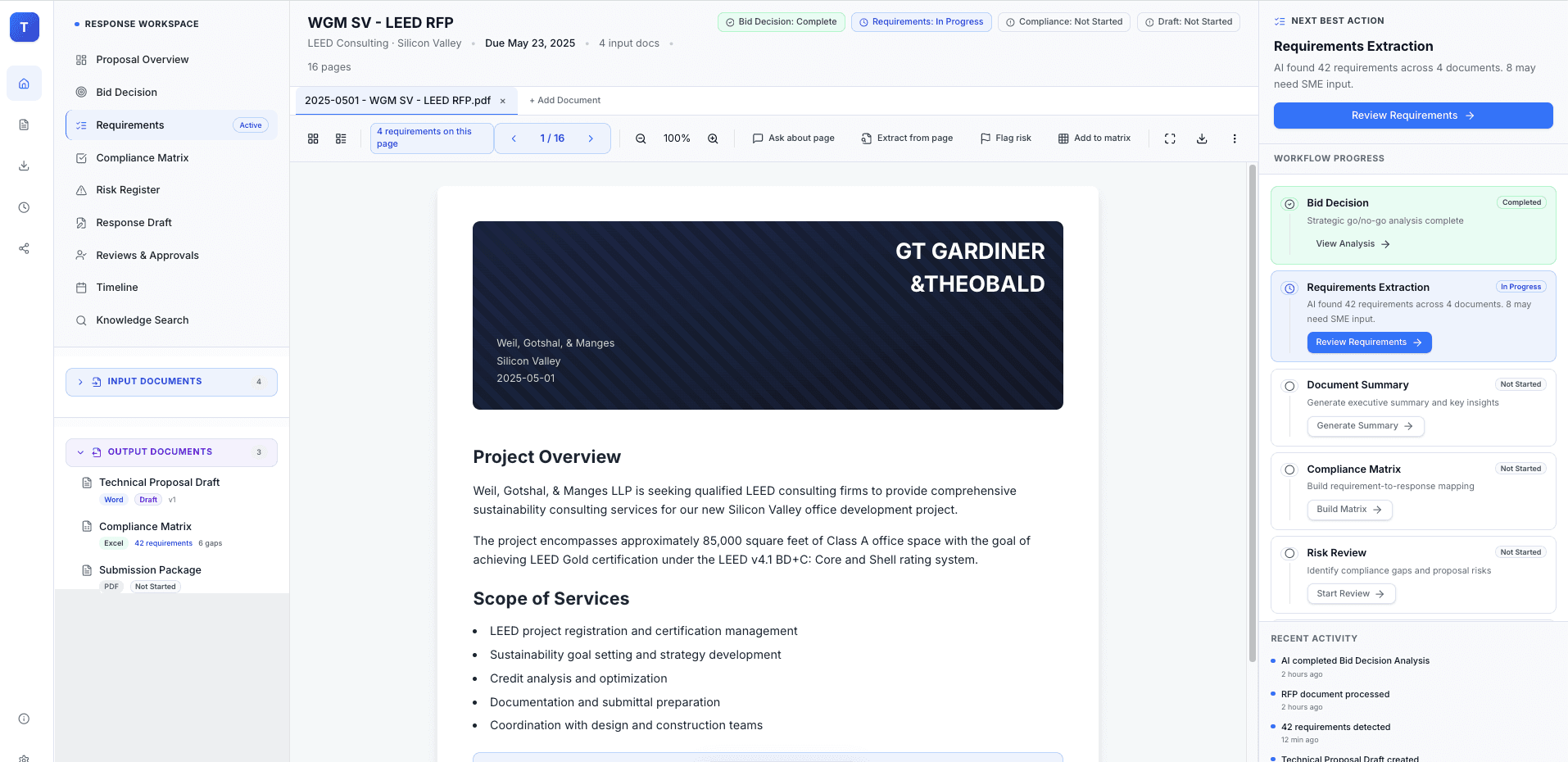
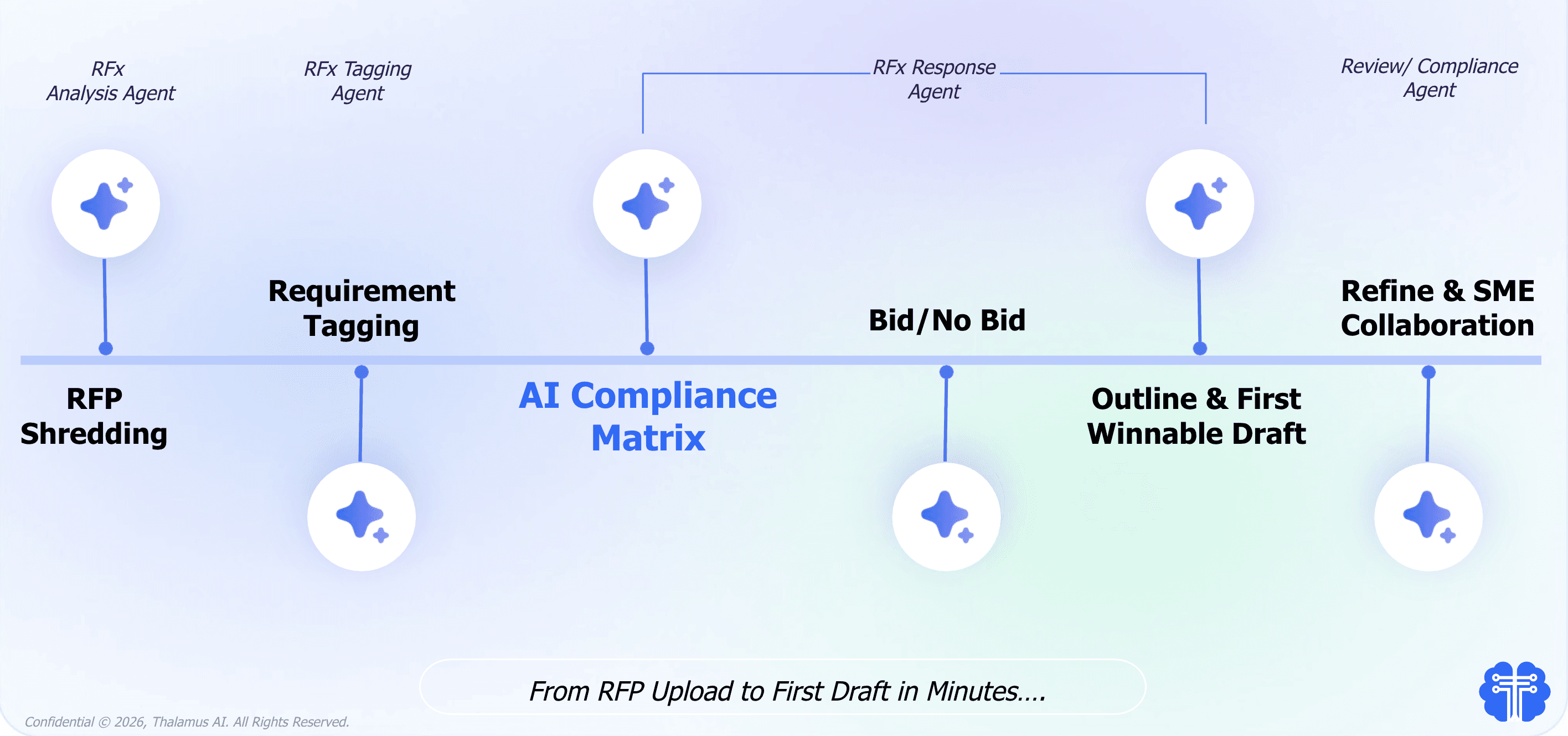
What Thalamus AI does: The RFx Analysis Agent parses the RFP on upload, extracting requirements, tagging evaluation criteria, flagging compliance risks, and generating a living compliance matrix that maps every requirement to a response section, an owner, and a review gate. When the addendum lands, Thalamus automatically detects what changed and flags every impacted section across the live response, including the technical approach section that has already been drafted. The system routes the change to the right SME via Slack or Teams, the lead author approves the update, and the compliance matrix reflects the new status. Over time, Thalamus AI helps the bid function become more structured, traceable, and consistent.
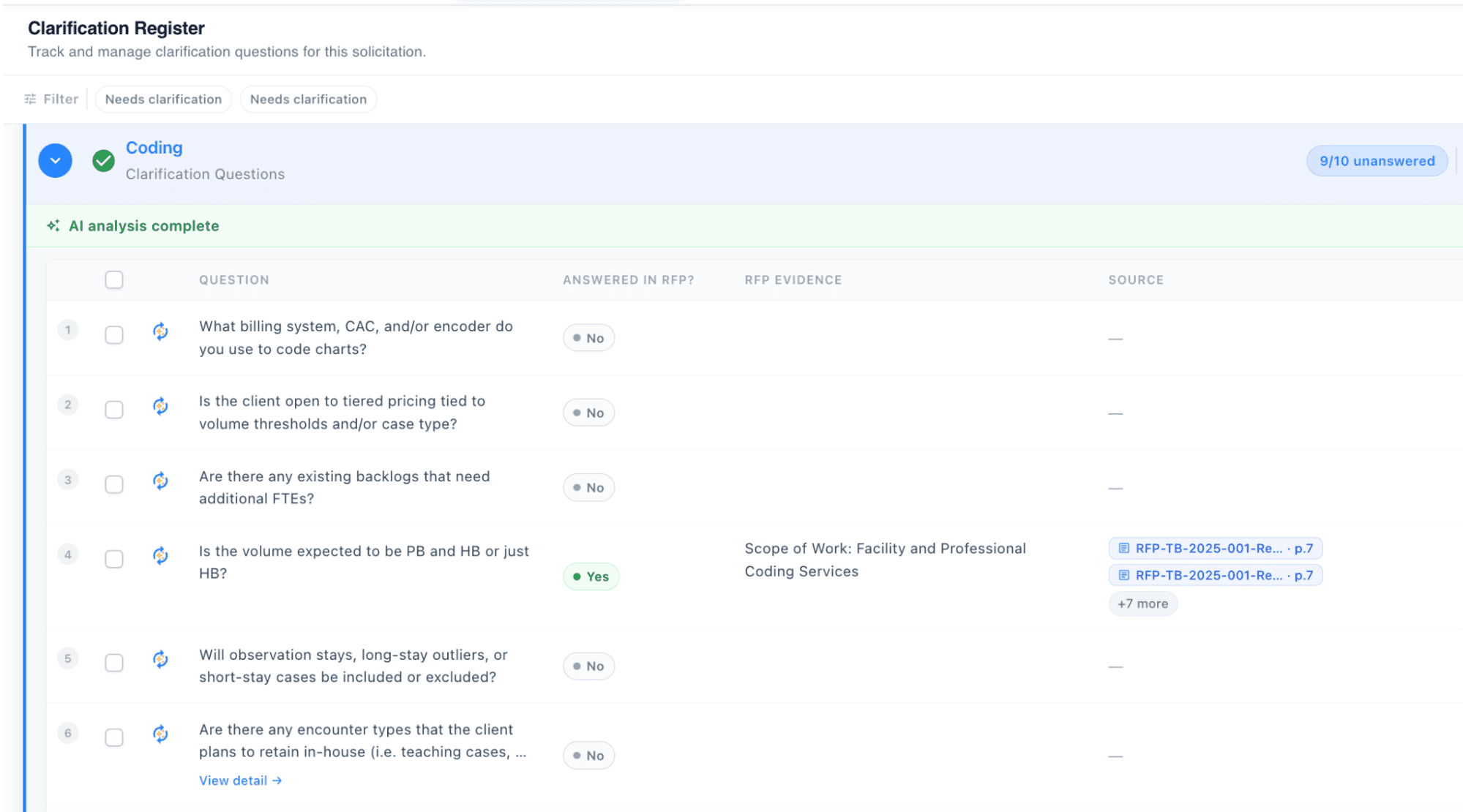
So, before the response is locked, the Clarification Register checks whether each open question is already answered somewhere in the RFP package, separating genuinely open items from ones simply buried in an appendix. And because SMEs were assigned to their sections before kickoff through the Ownership Matrix, legal and delivery are reviewing content they've already seen once, not encountering it cold at the addendum stage.
That gap, between "we'll review the addendum when someone has time" and "the system flagged it immediately and routed it to the right person," is where proposals are lost. Not because the content was bad. Because the coordination around a critical change was invisible.
Does your team handle government bids or complex multi-section proposals? See how Thalamus manages from RFP shredding to final export in one connected workflow.
Thalamus AI vs Inventive AI: Where Inventive AI Genuinely Wins?
I want to be direct about this because I think it matters for the people reading this comparison.
Inventive AI is a stronger choice than Thalamus AI in specific, well-defined scenarios. If your team's primary workload is high-volume, standardised questionnaires like security reviews, vendor due diligence questionnaires, RFIs with repeatable answer patterns, and your biggest bottleneck is the time it takes to generate a quality first draft, Inventive's AI Context Engine and Conflict Manager are purpose-built for that job.
Inventive also has a cleaner onboarding story for teams that want fast time-to-value on questionnaire automation without the configuration depth that a full bid management platform requires.
If the scope of your problem is drafting, Inventive's scope matches it well. Its AI architecture, particularly the proprietary conflict detection between knowledge sources, is genuinely differentiated in that segment.
Inventive AI is not publicly positioned as a full bid lifecycle management platform. And for teams where managing the bid is the job, where the proposal manager is responsible not just for the draft but for compliance, coordination, addendum handling, SME routing, and what the team learns from the outcome, the scope mismatch becomes consequential quickly.
Still deciding between the two platforms? Talk to the Thalamus team, we'll help you map the right fit honestly.
Thalamus AI vs Inventive AI on What "AI-Native" Actually Means at Scale
Inventive AI's comparison blog positions Thalamus AI as requiring "significant manual intervention" and delivering "generic" responses. In my experience, working with enterprise teams on complex bids, that framing reflects a clear misunderstanding of how Thalamus AI's knowledge architecture works.
Thalamus AI does not generate responses from raw, unstructured documents. It converts your documents into structured, verified knowledge entities first: project records with verifiable outcomes, CVs with role histories and certifications, case studies with quantified results, Q&A pairs with source traceability.
Every AI-generated response cites the entity it drew from, with a direct link back to the original source document. A reviewer sees not just what the AI wrote, but where the claim came from and whether that source has been marked current or flagged for review. Those entities also carry relationship context: a case study connects to the client account, the reference contact, and the certification it depends on, so the AI understands not just what a piece of content says but how it relates to everything else in the knowledge base.
The difference between that and a centralised knowledge hub is not semantic. A centralised hub stores content. A verified entity layer structures it, traces it, and flags it when it goes stale without requiring your team to remember what needs updating.
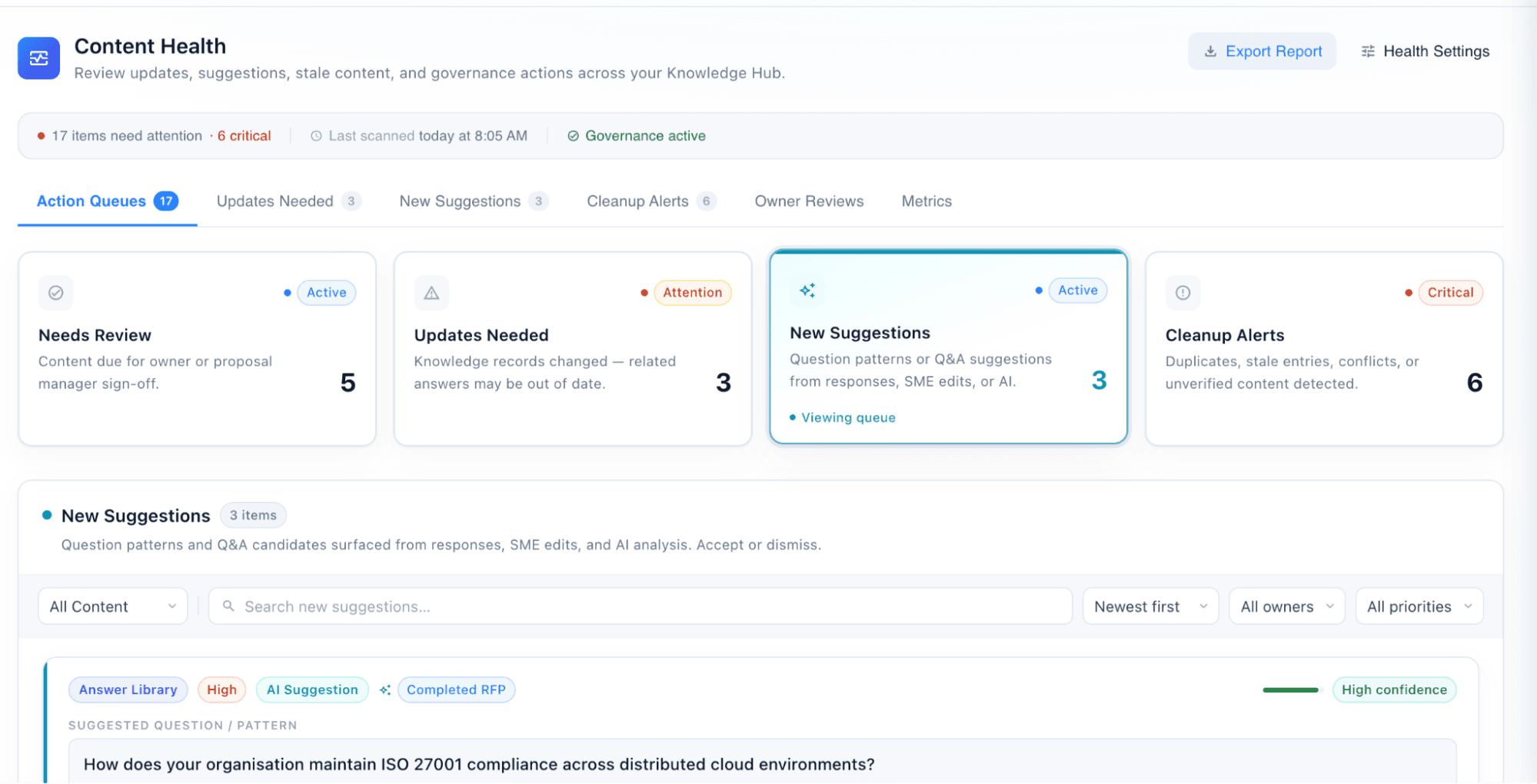
At the scale of an enterprise bid team managing dozens of complex proposals across multiple sectors and jurisdictions, that distinction compounds. The teams that consistently deliver credible, verifiable proposals are not the ones with the most accurate drafting AI. They are the ones whose knowledge layer doesn't let bad content through.
Want to understand how Thalamus's verified knowledge entity layer works in practice? Request a live walkthrough, bring a past proposal, and watch it become structured, reusable bid assets.
Thalamus AI vs Inventive AI: Who Should You Choose?
Most teams I speak with approach this comparison from the wrong direction. They start with the feature list and look for the longer one. The more useful question is: in 18 months, what does your proposal function look like, and which platform architecture gets you there?
Choose Inventive AI if:
Your primary workload is standardised questionnaires like security reviews, DDQs, RFIs, where high-volume, accurate first-draft generation is the core problem
Your team wants fast time-to-value with minimal workflow configuration
Conflict detection between knowledge sources is a critical pain point for your team
You don't need compliance matrices, RACI routing, addendum tracking, or bid/no-bid logic
Your bids are primarily response-stage problems, not lifecycle management problems
If you are coming from Loopio rather than Inventive AI, the platform comparison below covers the same decision from that angle. Read Thalamus AI vs Loopio.
Choose Thalamus AI if:
You manage the full bid lifecycle, starting from qualification, coordination, compliance tracking, SME routing, and post-bid learning, and not just the drafting stage
Your knowledge is trapped in unstructured documents that need to become verified, reusable bid assets without a manual conversion effort
You respond to complex, multi-section proposals, government RFPs, healthcare bids, and AEC tenders, where a compliance matrix and addendum tracking are critical
You want the platform to compound: smarter bids, better win rates, and institutional memory that survives staff turnover
You need one platform for every RFx type, like narrative proposals, Excel and Word questionnaires, and online portal responses
Thalamus AI is probably not the right fit if: your team handles primarily short, standardised questionnaires with low complexity; you are a small team with low submission volume wanting lightweight draft assistance; or you need a fast plug-in for questionnaire automation without the workflow depth of a full bid management platform.
Think Thalamus AI might be the right fit? Start with a 3-month pilot, unlimited projects, unlimited RFPs, one team.
What Enterprise Customers Report After Moving to Thalamus AI?
Enterprise customers using Thalamus AI across complex proposal environments have reported, in internal customer workflow analysis, measurable improvements at every stage of the bid cycle, not just in drafting speed, but in the reliability of what goes out the door and the outcomes that follow.
Based on Thalamus AI internal customer performance data (2025–2026), across enterprise teams in healthcare, AEC, government contracting, and professional services:
+34% improvement in response reliability - attributed to the verified knowledge entity layer, which removes the conditions under which outdated or contradictory content enters a bid. These results are based on Thalamus AI internal customer workflow analysis from 2025-2026. Outcomes vary by proposal volume, team size, content maturity, workflow complexity, industry, and adoption depth.
3x more bid shortlist appearances - across customers managing complex, multi-section proposals where coordination and compliance tracking had previously been the bottleneck.
2.5x increase in bid win rates - reported by enterprise teams using the full bid management platform, not just the drafting layer.
Inventive AI's own published case study Insider, achieving 50%+ higher win rates and 90% faster RFPs, is a strong result for a team where questionnaire automation was the primary problem. That is the scenario Inventive is built for, and that case study reflects it honestly.
The teams I see choosing Thalamus AI are not choosing it because it drafts differently. They are choosing it because the proposal manager's job is not just to produce content, it is to coordinate a bid, track compliance, manage SMEs across legal and engineering and delivery, and build a function that gets better at winning over time. A drafting platform cannot do that. A bid management ecosystem can.
If you are currently using ChatGPT or a general AI tool for RFP drafting and wondering where it breaks down, we have covered the specific failure points in detail. Read: ChatGPT for RFP Responses -- When It Works and When It Does Not.
Frequently Asked Questions
Is Thalamus AI an Inventive AI alternative?
Yes. Thalamus AI is an Inventive AI alternative for enterprise proposal teams that need AI RFP software covering bid qualification, requirement mapping, compliance matrices, SME collaboration, addendum tracking, source-linked proposal drafting, and post-bid learning.
What is the main difference between Thalamus AI and Inventive AI?
Inventive AI is primarily positioned around AI response automation, first-draft generation, and questionnaire accuracy. Thalamus AI is built for the full bid lifecycle, including pre-RFP planning, bid/no-bid scoring, AI RACI routing, compliance tracking, addendum impact management, and institutional memory.
Which platform is better for security questionnaires and DDQs?
Inventive AI may be a strong fit for teams focused mainly on high-volume security questionnaires, DDQs, RFIs, and repeatable first-draft generation. Thalamus AI is better suited for teams that need questionnaire support plus broader RFx lifecycle management across complex proposals, portals, and multi-document RFPs.
Which platform is better for complex RFPs and narrative proposals?
Thalamus AI is designed for complex RFPs and long-form narrative proposals where proposal teams need requirement mapping, compliance matrices, SME routing, addendum tracking, review gates, and source-linked proposal knowledge.
Does Thalamus AI support portal responses?
Yes. Thalamus AI supports portal responses as part of the broader RFx workflow across RFPs, RFIs, DDQs, security questionnaires, Q&A forms, and complex narrative proposals.
Does Thalamus AI use a content library?
Yes. Thalamus AI uses a verified RFP content library that turns past proposals, case studies, project experience, certifications, compliance proofs, Q&A pairs, and approved content into source-linked proposal knowledge.
Does Thalamus AI connect to my CRM?
Yes. Entity Records can connect to Salesforce, HubSpot, and other CRM platforms, so proposal knowledge carries account history, contacts, and relationship context alongside the content itself.
Bring one RFP. We'll show you the full lifecycle, from upload and requirement parsing to first compliant, source-linked draft, in 20 minutes. Book a Thalamus AI demo.