Compare
Compare
•
•
5 mins
5 mins
Thalamus AI vs Loopio: RFP Software Comparison
Thalamus AI vs Loopio: RFP Software Comparison
Thalamus AI vs Loopio: RFP Software Comparison
Thalamus AI vs Loopio: RFP Software Comparison

Harpreet Singh, MBA
Founder, Thalamus AI

With 12+ years in AI and enterprise software, including GenAI product work at Travelers, Harpreet writes about AI RFP software, AI bid tools, proposal operations, RFP response automation, and the future of enterprise bid management.
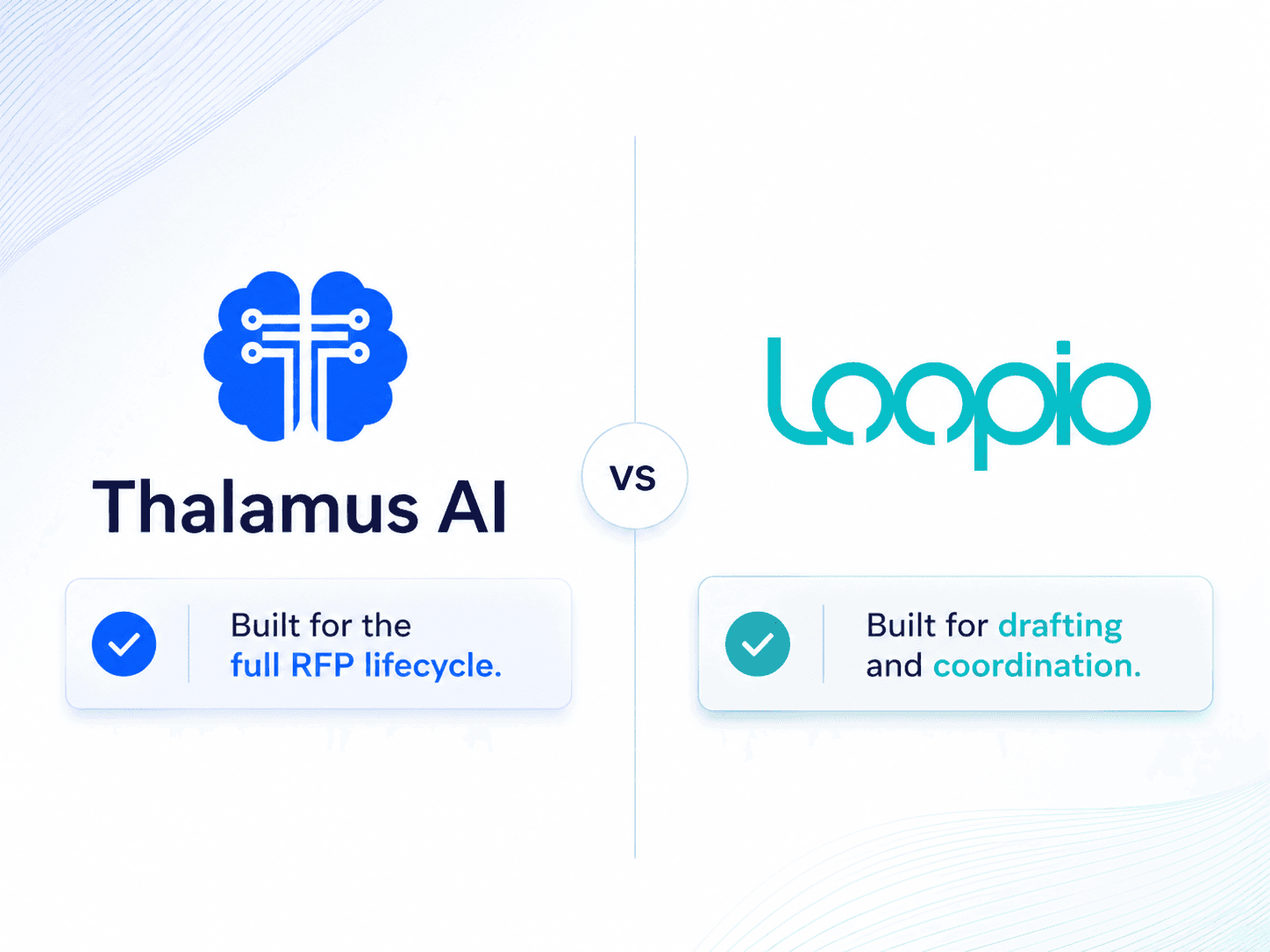
Summarize with ChatGPT
Summarize with ChatGPT
Quick Answer & Key Takeaways
Quick Answer
Loopio is a strong response-management platform for teams that rely on governed content libraries and repeatable RFP, RFI, DDQ, and security questionnaire workflows. Thalamus AI is an AI-native RFP and proposal platform for teams that need to manage the full bid lifecycle - qualification, requirement mapping, compliance matrices, SME routing, drafting, review, addenda, and post-bid learning.
Key Takeaways
Thalamus AI is built for the full bid lifecycle, from opportunity qualification and compliance tracking to multi-team coordination, narrative drafting, and post-bid institutional learning.
Thalamus AI's Content Health system flags only what needs a look, like duplicate knowledge, stale answers, and unresolved conflicts, instead of asking your team to audit the whole library. It's designed to reduce RFP answer-library maintenance by up to 65% (based on Thalamus AI internal customer workflow analysis).
For complex, multi-section proposals, government RFPs, and large enterprise bids, Thalamus AI's compliance matrix, addendum tracking, and AI agents address problems that a content library alone cannot solve.
Institutional memory is what separates a response tool from a bid management ecosystem. Every win, loss, and reviewer correction in Thalamus AI strengthens the next bid, not just the current one.
Enterprise customers using Thalamus AI across complex proposal environments have reported a +34% improvement in response reliability, 3x more shortlist appearances, and a 2.5x increase in bid win rates (Based on Thalamus AI internal customer workflow analysis from 2025–2026. Results vary by proposal volume, team size, content maturity, workflow complexity, and adoption).
Summarize with ChatGPT
Quick Answer & Key Takeaways
Quick Answer & Key Takeaways
Quick Answer & Key Takeaways
Quick Answer
Loopio is a strong response-management platform for teams that rely on governed content libraries and repeatable RFP, RFI, DDQ, and security questionnaire workflows. Thalamus AI is an AI-native RFP and proposal platform for teams that need to manage the full bid lifecycle - qualification, requirement mapping, compliance matrices, SME routing, drafting, review, addenda, and post-bid learning.
Key Takeaways
Thalamus AI is built for the full bid lifecycle, from opportunity qualification and compliance tracking to multi-team coordination, narrative drafting, and post-bid institutional learning.
Thalamus AI's Content Health system flags only what needs a look, like duplicate knowledge, stale answers, and unresolved conflicts, instead of asking your team to audit the whole library. It's designed to reduce RFP answer-library maintenance by up to 65% (based on Thalamus AI internal customer workflow analysis).
For complex, multi-section proposals, government RFPs, and large enterprise bids, Thalamus AI's compliance matrix, addendum tracking, and AI agents address problems that a content library alone cannot solve.
Institutional memory is what separates a response tool from a bid management ecosystem. Every win, loss, and reviewer correction in Thalamus AI strengthens the next bid, not just the current one.
Enterprise customers using Thalamus AI across complex proposal environments have reported a +34% improvement in response reliability, 3x more shortlist appearances, and a 2.5x increase in bid win rates (Based on Thalamus AI internal customer workflow analysis from 2025–2026. Results vary by proposal volume, team size, content maturity, workflow complexity, and adoption).
Quick Answer
Loopio is a strong response-management platform for teams that rely on governed content libraries and repeatable RFP, RFI, DDQ, and security questionnaire workflows. Thalamus AI is an AI-native RFP and proposal platform for teams that need to manage the full bid lifecycle - qualification, requirement mapping, compliance matrices, SME routing, drafting, review, addenda, and post-bid learning.
Key Takeaways
Thalamus AI is built for the full bid lifecycle, from opportunity qualification and compliance tracking to multi-team coordination, narrative drafting, and post-bid institutional learning.
Thalamus AI's Content Health system flags only what needs a look, like duplicate knowledge, stale answers, and unresolved conflicts, instead of asking your team to audit the whole library. It's designed to reduce RFP answer-library maintenance by up to 65% (based on Thalamus AI internal customer workflow analysis).
For complex, multi-section proposals, government RFPs, and large enterprise bids, Thalamus AI's compliance matrix, addendum tracking, and AI agents address problems that a content library alone cannot solve.
Institutional memory is what separates a response tool from a bid management ecosystem. Every win, loss, and reviewer correction in Thalamus AI strengthens the next bid, not just the current one.
Enterprise customers using Thalamus AI across complex proposal environments have reported a +34% improvement in response reliability, 3x more shortlist appearances, and a 2.5x increase in bid win rates (Based on Thalamus AI internal customer workflow analysis from 2025–2026. Results vary by proposal volume, team size, content maturity, workflow complexity, and adoption).
Thalamus AI vs Loopio: What Each Platform Is Actually Built For?
Thalamus AI vs Loopio: What Each Platform Is Actually Built For?
In nearly every evaluation conversation I have with proposal teams, the same question surfaces within the first ten minutes: "We're already looking at Loopio; what's actually different about Thalamus AI?"
The answer is less about individual features and more about what problem each platform was designed to solve at its core.
Loopio is a response management platform built around a curated Q&A content library. Its strength is giving teams a governed repository of approved answers, structured project workflows, and clear ownership over who can update what.
For teams that run high volumes of standardized questionnaires like security reviews, DDQs, RFIs, and need that content tightly controlled, Loopio does that job reliably. It has been doing it since 2014, and companies trust it for good reason.
However, Thalamus AI is built for a different scope. It is an AI-native platform designed to be the operating system for your entire bid function - from the moment an opportunity is identified to what your team learns after the contract is awarded or lost.
If you are still in the research phase and want to see how both platforms rank against the wider market, this overview gives you the full picture. See the 12 Best AI RFP Software Tools in 2026.
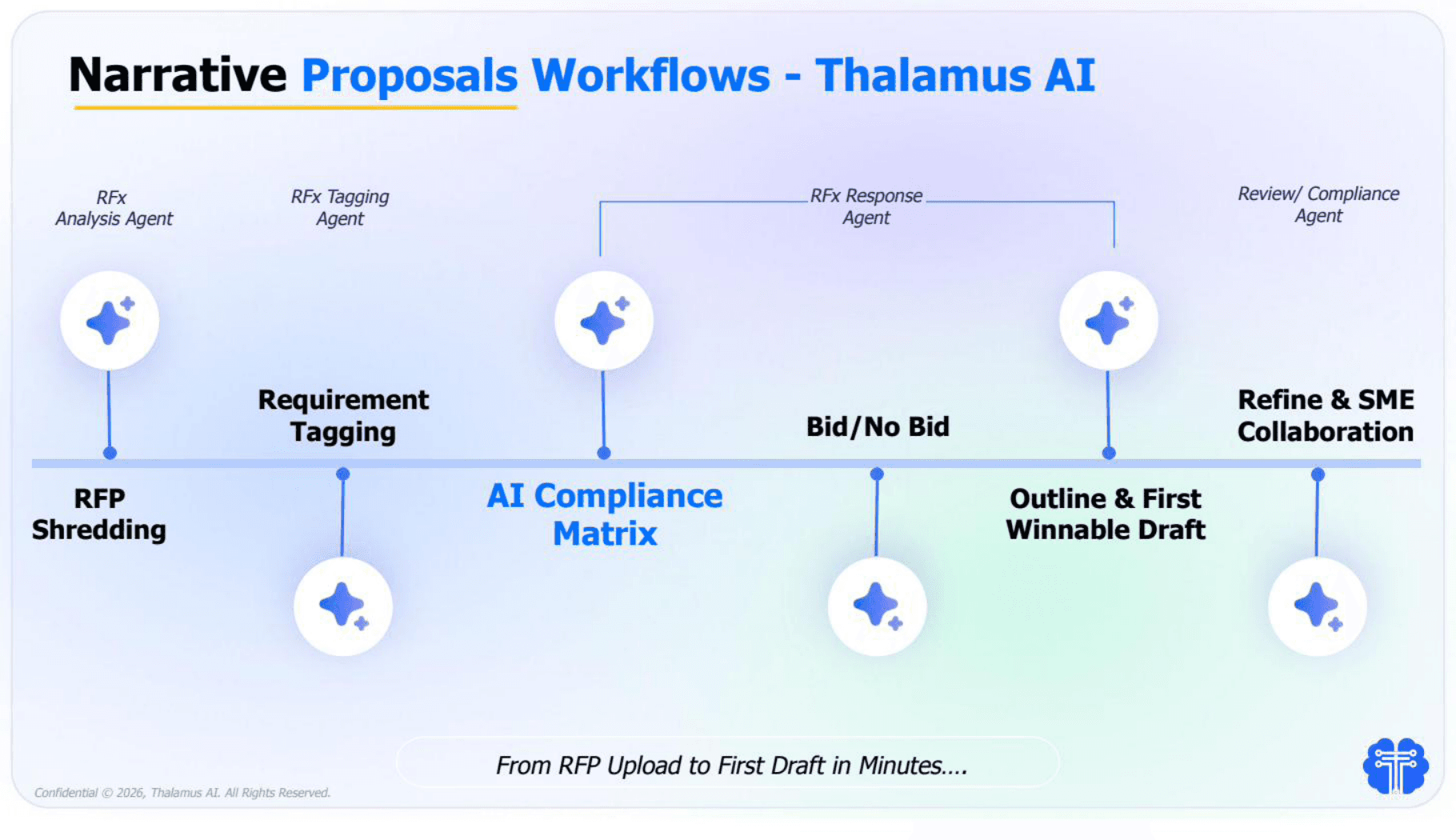
Where Loopio organizes your existing answers, Thalamus AI converts your unstructured documents (past proposals, CVs, case studies, old bids) into verified, editable knowledge entities and deploys specialized AI agents at every stage of the bid lifecycle: requirement parsing, compliance matrix generation, bid/no-bid scoring, RACI routing, narrative drafting, SME coordination, and post-bid institutional learning. Entity Records also connect to CRM systems like Salesforce and HubSpot, so proposal knowledge carries the account and relationship context that Loopio's content library doesn't touch: has this buyer bought from us before, who owns the relationship, which reference applies.
One platform manages responses. The other manages the full bid.
Thinking about switching from Loopio or evaluating both platforms? Talk to the Thalamus AI team, bring one live RFP, and we'll show you the full workflow end to end.
In nearly every evaluation conversation I have with proposal teams, the same question surfaces within the first ten minutes: "We're already looking at Loopio; what's actually different about Thalamus AI?"
The answer is less about individual features and more about what problem each platform was designed to solve at its core.
Loopio is a response management platform built around a curated Q&A content library. Its strength is giving teams a governed repository of approved answers, structured project workflows, and clear ownership over who can update what.
For teams that run high volumes of standardized questionnaires like security reviews, DDQs, RFIs, and need that content tightly controlled, Loopio does that job reliably. It has been doing it since 2014, and companies trust it for good reason.
However, Thalamus AI is built for a different scope. It is an AI-native platform designed to be the operating system for your entire bid function - from the moment an opportunity is identified to what your team learns after the contract is awarded or lost.
If you are still in the research phase and want to see how both platforms rank against the wider market, this overview gives you the full picture. See the 12 Best AI RFP Software Tools in 2026.
Where Loopio organizes your existing answers, Thalamus AI converts your unstructured documents (past proposals, CVs, case studies, old bids) into verified, editable knowledge entities and deploys specialized AI agents at every stage of the bid lifecycle: requirement parsing, compliance matrix generation, bid/no-bid scoring, RACI routing, narrative drafting, SME coordination, and post-bid institutional learning. Entity Records also connect to CRM systems like Salesforce and HubSpot, so proposal knowledge carries the account and relationship context that Loopio's content library doesn't touch: has this buyer bought from us before, who owns the relationship, which reference applies.
One platform manages responses. The other manages the full bid.
Thinking about switching from Loopio or evaluating both platforms? Talk to the Thalamus AI team, bring one live RFP, and we'll show you the full workflow end to end.
Thalamus AI vs Loopio: Side-by-Side Feature Comparison
Thalamus AI vs Loopio: Side-by-Side Feature Comparison
What You're Actually Evaluating | Thalamus AI | Loopio |
AI architecture | AI-native, built from the ground up with agentic workflows | Established response-management platform with AI added to a content-library workflow |
Full bid lifecycle coverage | Capture → Qualify → Plan → Coordinate → Respond → Learn | Response and project management only |
Knowledge structure | Verified, editable, auditable knowledge entities (CVs, projects, case studies, Q&A) | Q&A pair content library requiring manual upkeep |
Narrative proposal support | 150-page multi-document proposals, structured assembly | Strongest for questionnaires; limited long-form narrative |
Compliance matrix & requirement mapping | Auto-generated living compliance index with traceability | Partial; content matching, less centered on requirement-level compliance matrices and addendum impact tracking |
Addendum & change impact tracking | Flags impacted sections in real time | Not a core capability |
Bid / No-Bid scoring | Configurable weighted scorecard (delivery fit, technology fit, market alignment) with AI evidence matched against RFP scope. | Partial; less central to workflow |
AI RACI & document routing | Auto-classifies and routes to proposal, legal, security, SME teams | Collaboration workflows; no auto-RACI |
Institutional memory & decision graph | Every win, loss, correction, and reviewer comment improves future bids | Not a core public positioning |
Online portal response | Native part of the RFx workflow | Not positioned as the core operating model for full bid lifecycle management |
RFx types covered | RFPs, RFIs, DDQs, security questionnaires, portal Q&As, 150-page proposals | Strong for RFPs, RFIs, DDQs, security questionnaires |
Multilingual support | 45+ languages | Partial multilingual support |
Onboarding timeline | 3-month pilot pack; live in days | 15–60 days before full value realised |
Pricing structure | Unlimited projects, users, and RFPs under one subscription | Seat-based enterprise pricing |
Security certifications | SOC 2 Type II + ISO/IEC 27001:2022 + VAPT | SOC 2 Type II |
CRM integration | Native Salesforce and HubSpot connections bring account and contact context into knowledge entities | Not positioned as a core capability |
Clarification management | AI Clarification Register checks each open question against the RFP package before it goes to the buyer | No dedicated clarification workflow |
Content governance model | AI-managed Content Health, exception-based flags for duplicates, stale content, conflicts | Manual content audits to keep the library current |
Want to see these differences on your actual workflow? Book a 20-minute Thalamus demo, bring your next RFP and we'll run it live.
What You're Actually Evaluating | Thalamus AI | Loopio |
AI architecture | AI-native, built from the ground up with agentic workflows | Established response-management platform with AI added to a content-library workflow |
Full bid lifecycle coverage | Capture → Qualify → Plan → Coordinate → Respond → Learn | Response and project management only |
Knowledge structure | Verified, editable, auditable knowledge entities (CVs, projects, case studies, Q&A) | Q&A pair content library requiring manual upkeep |
Narrative proposal support | 150-page multi-document proposals, structured assembly | Strongest for questionnaires; limited long-form narrative |
Compliance matrix & requirement mapping | Auto-generated living compliance index with traceability | Partial; content matching, less centered on requirement-level compliance matrices and addendum impact tracking |
Addendum & change impact tracking | Flags impacted sections in real time | Not a core capability |
Bid / No-Bid scoring | Configurable weighted scorecard (delivery fit, technology fit, market alignment) with AI evidence matched against RFP scope. | Partial; less central to workflow |
AI RACI & document routing | Auto-classifies and routes to proposal, legal, security, SME teams | Collaboration workflows; no auto-RACI |
Institutional memory & decision graph | Every win, loss, correction, and reviewer comment improves future bids | Not a core public positioning |
Online portal response | Native part of the RFx workflow | Not positioned as the core operating model for full bid lifecycle management |
RFx types covered | RFPs, RFIs, DDQs, security questionnaires, portal Q&As, 150-page proposals | Strong for RFPs, RFIs, DDQs, security questionnaires |
Multilingual support | 45+ languages | Partial multilingual support |
Onboarding timeline | 3-month pilot pack; live in days | 15–60 days before full value realised |
Pricing structure | Unlimited projects, users, and RFPs under one subscription | Seat-based enterprise pricing |
Security certifications | SOC 2 Type II + ISO/IEC 27001:2022 + VAPT | SOC 2 Type II |
CRM integration | Native Salesforce and HubSpot connections bring account and contact context into knowledge entities | Not positioned as a core capability |
Clarification management | AI Clarification Register checks each open question against the RFP package before it goes to the buyer | No dedicated clarification workflow |
Content governance model | AI-managed Content Health, exception-based flags for duplicates, stale content, conflicts | Manual content audits to keep the library current |
Want to see these differences on your actual workflow? Book a 20-minute Thalamus demo, bring your next RFP and we'll run it live.
Thalamus AI vs Loopio: Cost and Implementation Considerations
Thalamus AI vs Loopio: Cost and Implementation Considerations
Thalamus AI vs Loopio: Cost and Implementation Considerations
Every team I speak with during an RFP software evaluation focuses on the same two things: does the AI draft accurately, and is it easy to use? Those are the right questions for day one. What they miss is the question that determines whether the platform still works for you in year two, and who pays the ongoing cost of keeping it that way.
Loopio's own documentation acknowledges 15 to 60 days before teams realize full value. That is the upfront cost. The ongoing cost is what compounds. Every answer in a Loopio content library requires human maintenance to stay accurate.
Someone has to review it, flag it when it is stale, update it when your product or service changes, and ensure it reflects the right version of your story. For a team managing a few hundred Q&A pairs, that is manageable.
But for an enterprise team with thousands of answers across security, legal, product, and delivery, it becomes a full-time job that nobody was hired to do. That cost never appears in a software comparison. It appears in your team's calendar.
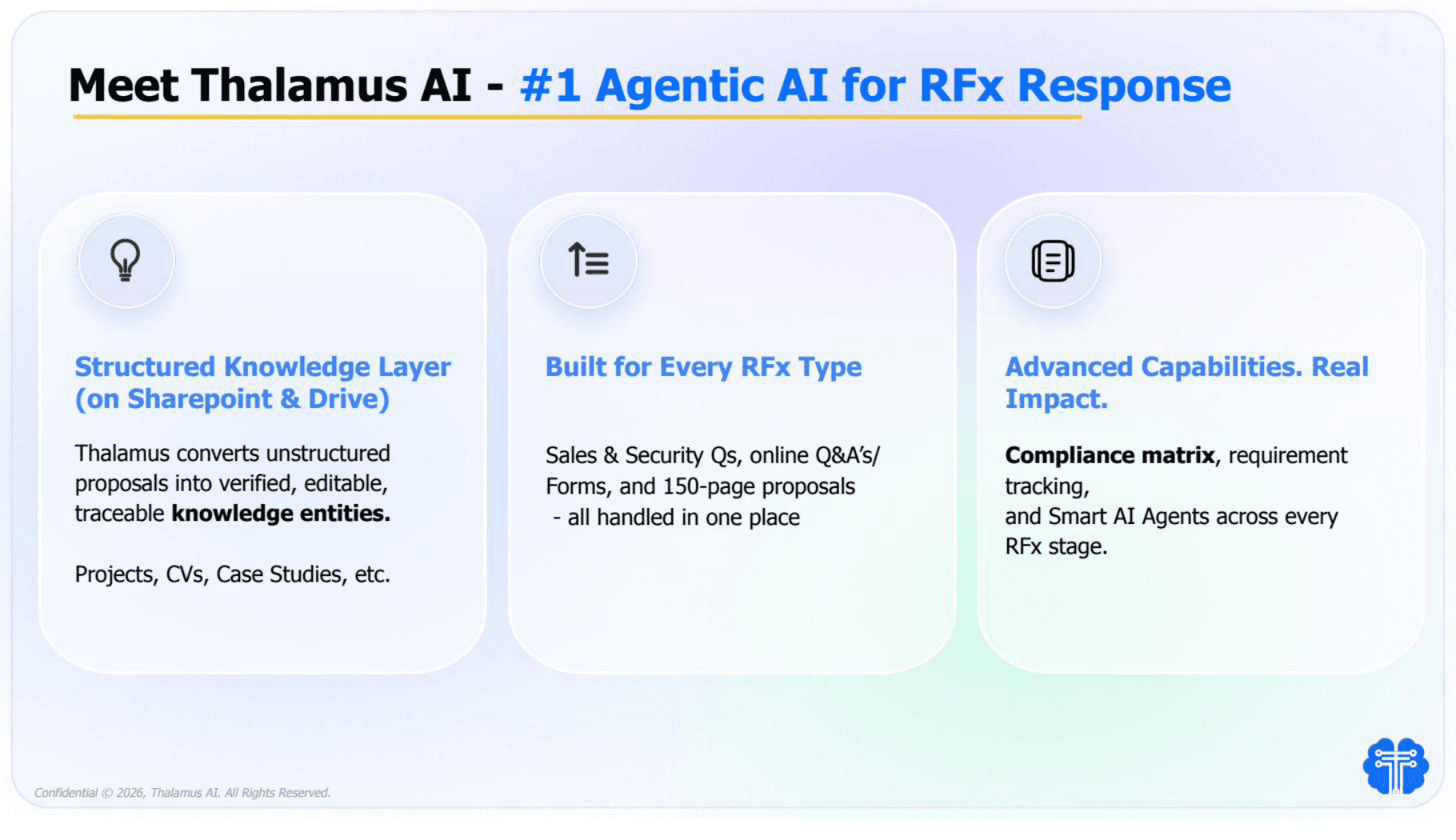
However, Thalamus AI approaches this differently. When you connect your SharePoint, Google Drive, or upload past proposals, Thalamus AI parses those documents into structured entities: verified project records, staff credentials with role history, case study results with outcomes, and section-level content organized by proposal type.

These entities are editable, auditable, and traceable back to their source documents. If a CV is outdated, any team member can flag it. If a project detail changes, the entity updates. The knowledge layer stays current because the structure makes maintenance visible, rather than relying on a team to remember what needs updating.
Moreover, Thalamus AI's Content Health layer is built around exception management. It surfaces the records that need a human look: duplicates imported from years of SharePoint history, answers that drifted out of sync, conflicting claims, and leaves healthy content alone. Proposal managers and SMEs still make the call on what's outdated versus intentionally different. AI's job is making sure the right person doesn't miss it, not deciding for them.
That is not faster AI generation from raw documents. It is a fundamentally different knowledge architecture, one that builds governance into the structure rather than managing a static library that decays the moment someone stops tending it.
Curious how the knowledge entity layer works in practice? Watch the Thalamus AI walkthrough to see how past proposals become structured, reusable bid assets.
Every team I speak with during an RFP software evaluation focuses on the same two things: does the AI draft accurately, and is it easy to use? Those are the right questions for day one. What they miss is the question that determines whether the platform still works for you in year two, and who pays the ongoing cost of keeping it that way.
Loopio's own documentation acknowledges 15 to 60 days before teams realize full value. That is the upfront cost. The ongoing cost is what compounds. Every answer in a Loopio content library requires human maintenance to stay accurate.
Someone has to review it, flag it when it is stale, update it when your product or service changes, and ensure it reflects the right version of your story. For a team managing a few hundred Q&A pairs, that is manageable.
But for an enterprise team with thousands of answers across security, legal, product, and delivery, it becomes a full-time job that nobody was hired to do. That cost never appears in a software comparison. It appears in your team's calendar.
However, Thalamus AI approaches this differently. When you connect your SharePoint, Google Drive, or upload past proposals, Thalamus AI parses those documents into structured entities: verified project records, staff credentials with role history, case study results with outcomes, and section-level content organized by proposal type.
These entities are editable, auditable, and traceable back to their source documents. If a CV is outdated, any team member can flag it. If a project detail changes, the entity updates. The knowledge layer stays current because the structure makes maintenance visible, rather than relying on a team to remember what needs updating.
Moreover, Thalamus AI's Content Health layer is built around exception management. It surfaces the records that need a human look: duplicates imported from years of SharePoint history, answers that drifted out of sync, conflicting claims, and leaves healthy content alone. Proposal managers and SMEs still make the call on what's outdated versus intentionally different. AI's job is making sure the right person doesn't miss it, not deciding for them.
That is not faster AI generation from raw documents. It is a fundamentally different knowledge architecture, one that builds governance into the structure rather than managing a static library that decays the moment someone stops tending it.
Curious how the knowledge entity layer works in practice? Watch the Thalamus AI walkthrough to see how past proposals become structured, reusable bid assets.
Complex RFPs: Where the Difference Shows Up
Complex RFPs: Where the Difference Shows Up
Complex RFPs: Where the Difference Shows Up
Imagine this: Your team receives a 150-page government or enterprise RFP. It has a mandatory submission checklist, 80+ evaluation criteria, technical sections requiring input from engineering, legal, and delivery, and an addendum that arrives 10 days before the deadline and changes 12 requirements.
What Loopio does: Loopio retrieves content from your approved library and generates a first draft. Your team collaborates using project management workflows and task assignment. The addendum requires your team to manually review every section to identify what has been affected and update it accordingly. That review falls on whoever has bandwidth, which, at 10 days out, is nobody.
What Thalamus AI does:
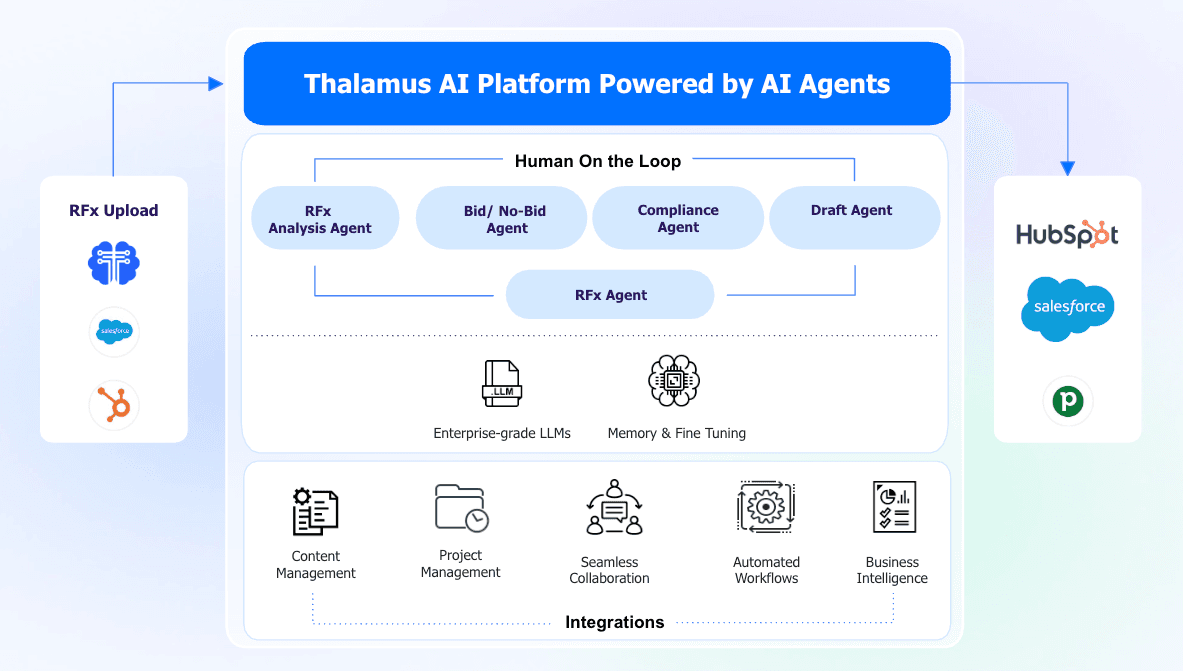
The RFx Analysis Agent shreds the RFP on upload, extracting requirements, tagging evaluation criteria, flagging compliance risks, and generating an AI compliance matrix that maps every requirement to a response section and an owner.
When the addendum arrives, Thalamus AI automatically detects what changed and flags every impacted section across the live response. Narrative sections are drafted from verified knowledge entities, project credentials traced to source documents, CVs confirmed current, and case studies with verifiable outcomes.
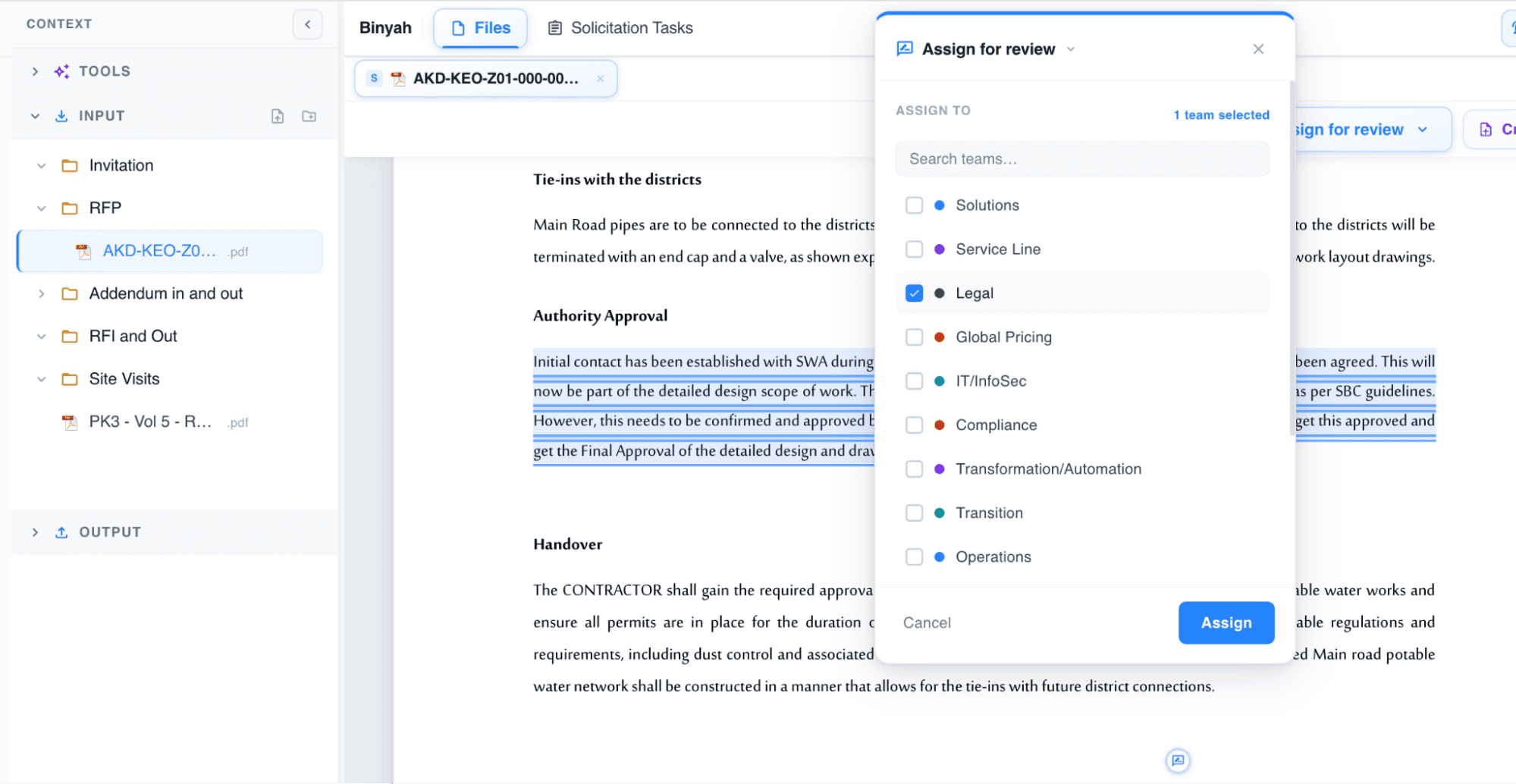
SMEs receive routed questions via Slack, Teams, or email without leaving their tools. The lead author retains approval on every change. Additionally, SMEs can be assigned to relevant sections before kickoff, not just during drafting, so operations, legal, and security walk into the kickoff call having already seen the part that concerns them.
A 150-page proposal is not a content retrieval problem. It is a coordination, compliance, and institutional knowledge problem. The team that loses is usually the one that missed a requirement buried in section 7, submitted a CV with an outdated certification, or didn't catch that the addendum shifted the technical scoring weighting. Thalamus AI is built to close those gaps systematically, not catch them manually.
Before the response is locked, the Clarification Register checks whether each open question the team has is already answered somewhere else in the RFP package, separating genuinely open questions from ones simply buried in an appendix.
If you are wondering how general AI tools like ChatGPT hold up for RFP work before committing to a dedicated platform, we have covered exactly that. Read: ChatGPT for RFP Responses -- When It Works and When It Does Not.
Imagine this: Your team receives a 150-page government or enterprise RFP. It has a mandatory submission checklist, 80+ evaluation criteria, technical sections requiring input from engineering, legal, and delivery, and an addendum that arrives 10 days before the deadline and changes 12 requirements.
What Loopio does: Loopio retrieves content from your approved library and generates a first draft. Your team collaborates using project management workflows and task assignment. The addendum requires your team to manually review every section to identify what has been affected and update it accordingly. That review falls on whoever has bandwidth, which, at 10 days out, is nobody.
What Thalamus AI does:
The RFx Analysis Agent shreds the RFP on upload, extracting requirements, tagging evaluation criteria, flagging compliance risks, and generating an AI compliance matrix that maps every requirement to a response section and an owner.
When the addendum arrives, Thalamus AI automatically detects what changed and flags every impacted section across the live response. Narrative sections are drafted from verified knowledge entities, project credentials traced to source documents, CVs confirmed current, and case studies with verifiable outcomes.
SMEs receive routed questions via Slack, Teams, or email without leaving their tools. The lead author retains approval on every change. Additionally, SMEs can be assigned to relevant sections before kickoff, not just during drafting, so operations, legal, and security walk into the kickoff call having already seen the part that concerns them.
A 150-page proposal is not a content retrieval problem. It is a coordination, compliance, and institutional knowledge problem. The team that loses is usually the one that missed a requirement buried in section 7, submitted a CV with an outdated certification, or didn't catch that the addendum shifted the technical scoring weighting. Thalamus AI is built to close those gaps systematically, not catch them manually.
Before the response is locked, the Clarification Register checks whether each open question the team has is already answered somewhere else in the RFP package, separating genuinely open questions from ones simply buried in an appendix.
If you are wondering how general AI tools like ChatGPT hold up for RFP work before committing to a dedicated platform, we have covered exactly that. Read: ChatGPT for RFP Responses -- When It Works and When It Does Not.
Imagine this: Your team receives a 150-page government or enterprise RFP. It has a mandatory submission checklist, 80+ evaluation criteria, technical sections requiring input from engineering, legal, and delivery, and an addendum that arrives 10 days before the deadline and changes 12 requirements.
What Loopio does: Loopio retrieves content from your approved library and generates a first draft. Your team collaborates using project management workflows and task assignment. The addendum requires your team to manually review every section to identify what has been affected and update it accordingly. That review falls on whoever has bandwidth, which, at 10 days out, is nobody.
What Thalamus AI does:
The RFx Analysis Agent shreds the RFP on upload, extracting requirements, tagging evaluation criteria, flagging compliance risks, and generating an AI compliance matrix that maps every requirement to a response section and an owner.
When the addendum arrives, Thalamus AI automatically detects what changed and flags every impacted section across the live response. Narrative sections are drafted from verified knowledge entities, project credentials traced to source documents, CVs confirmed current, and case studies with verifiable outcomes.
SMEs receive routed questions via Slack, Teams, or email without leaving their tools. The lead author retains approval on every change. Additionally, SMEs can be assigned to relevant sections before kickoff, not just during drafting, so operations, legal, and security walk into the kickoff call having already seen the part that concerns them.
A 150-page proposal is not a content retrieval problem. It is a coordination, compliance, and institutional knowledge problem. The team that loses is usually the one that missed a requirement buried in section 7, submitted a CV with an outdated certification, or didn't catch that the addendum shifted the technical scoring weighting. Thalamus AI is built to close those gaps systematically, not catch them manually.
Before the response is locked, the Clarification Register checks whether each open question the team has is already answered somewhere else in the RFP package, separating genuinely open questions from ones simply buried in an appendix.
If you are wondering how general AI tools like ChatGPT hold up for RFP work before committing to a dedicated platform, we have covered exactly that. Read: ChatGPT for RFP Responses -- When It Works and When It Does Not.
Where Loopio May Be the Better Fit
Loopio may be a strong fit for teams that primarily manage high-volume standardized questionnaires, already have a mature approved-answer library, and want a governed response-management platform for repeatable RFPs, RFIs, DDQs, and security questionnaires. Loopio may be a strong fit for SaaS revenue teams managing repeatable questionnaires and governed answer libraries.
If you are leaning toward Loopio but want to keep your options open, here is a full list of alternatives worth considering before you decide. See the 10 Best Loopio Alternatives in 2026.
Where Thalamus AI Is Stronger
Thalamus AI is a stronger fit for teams managing complex RFPs, long narrative proposals, cross-functional bid workflows, compliance matrices, addenda, SME routing, and institutional learning across the full bid lifecycle.
Thalamus AI is a stronger fit for healthcare, AEC, construction, professional services, and enterprise teams managing complex, cross-functional RFPs.
To see the full capability set, including how Thalamus AI handles compliance tracking and structured knowledge across the RFP lifecycle, the solution page has the detail. Explore the Thalamus AI RFP Solution.
FAQs
Is Thalamus AI a Loopio alternative?
Yes. Thalamus AI is a Loopio alternative for proposal teams that need AI-native RFP software covering bid qualification, requirement mapping, compliance tracking, SME routing, draft generation, and post-bid learning.
What is the main difference between Thalamus AI and Loopio?
Loopio focuses on response management and governed content-library workflows. Thalamus AI focuses on the full RFP lifecycle, including bid/no-bid scoring, AI RACI routing, compliance matrices, addendum tracking, and institutional memory.
Which platform is better for complex narrative proposals?
Thalamus AI is designed for complex multi-document RFPs and long narrative proposals where requirement mapping, SME coordination, compliance tracking, and source-linked knowledge matter.
Which platform is better for standardized questionnaires?
Loopio may be a strong fit for teams that mainly complete standardized RFPs, RFIs, DDQs, and security questionnaires using an established, approved-answer library.
Does Thalamus AI support portal responses?
Yes. Thalamus AI supports portal responses as part of the broader RFx workflow.
See Thalamus AI on a Live RFP
Does your team handle complex, multi-section proposals? See how Thalamus manages the full lifecycle, from RFP shredding to final export, in one connected workflow.