Blogs

Blogs

10 mins

10 mins

Qvidian Pricing in 2026: What It Actually Costs (And What Nobody Tells You)

Qvidian Pricing in 2026: What It Actually Costs (And What Nobody Tells You)

Qvidian Pricing in 2026: What It Actually Costs (And What Nobody Tells You)

Qvidian Pricing in 2026: What It Actually Costs (And What Nobody Tells You)

Harpreet Singh, MBA

Founder, Thalamus AI

With 12+ years in AI and enterprise software, including GenAI product work at Travelers, Harpreet writes about AI RFP software, AI bid tools, proposal operations, RFP response automation, and the future of enterprise bid management.

Summarize with ChatGpt

Summarize with ChatGpt

Key Takeaways

  • Qvidian does not publish its pricing publicly. Every cost figure requires a direct conversation with Upland Software's sales team.

  • Based on industry analyst estimates and verified user community reports on G2, Capterra, and Gartner Peer Insights, Qvidian's base license starts at approximately $15,000-$25,000 per year, before implementation, onboarding, seat scaling, and AI add-on costs are factored in.

  • Three variables drive Qvidian's total cost: user count, feature tier (including AI Assist), and integration complexity.

  • The real total cost of ownership at enterprise scale is significantly higher than the base license figure - often 2x to 3x when professional services, content migration, and ongoing admin overhead are included.

  • Qvidian pricing is genuinely worth it for financial services and professional services enterprises with a dedicated proposal team and an existing content library. It is harder to justify for mid-market teams, smaller proposal operations, or teams without a dedicated content owner.

  • Because Qvidian does not publish pricing plans or subscription tiers, buyers usually have to evaluate the platform through custom enterprise quotes.

Summarize with ChatGPT

Key Takeaways

Key Takeaways

Key Takeaways

  • Qvidian does not publish its pricing publicly. Every cost figure requires a direct conversation with Upland Software's sales team.

  • Based on industry analyst estimates and verified user community reports on G2, Capterra, and Gartner Peer Insights, Qvidian's base license starts at approximately $15,000-$25,000 per year, before implementation, onboarding, seat scaling, and AI add-on costs are factored in.

  • Three variables drive Qvidian's total cost: user count, feature tier (including AI Assist), and integration complexity.

  • The real total cost of ownership at enterprise scale is significantly higher than the base license figure - often 2x to 3x when professional services, content migration, and ongoing admin overhead are included.

  • Qvidian pricing is genuinely worth it for financial services and professional services enterprises with a dedicated proposal team and an existing content library. It is harder to justify for mid-market teams, smaller proposal operations, or teams without a dedicated content owner.

  • Because Qvidian does not publish pricing plans or subscription tiers, buyers usually have to evaluate the platform through custom enterprise quotes.

  • Qvidian does not publish its pricing publicly. Every cost figure requires a direct conversation with Upland Software's sales team.

  • Based on industry analyst estimates and verified user community reports on G2, Capterra, and Gartner Peer Insights, Qvidian's base license starts at approximately $15,000-$25,000 per year, before implementation, onboarding, seat scaling, and AI add-on costs are factored in.

  • Three variables drive Qvidian's total cost: user count, feature tier (including AI Assist), and integration complexity.

  • The real total cost of ownership at enterprise scale is significantly higher than the base license figure - often 2x to 3x when professional services, content migration, and ongoing admin overhead are included.

  • Qvidian pricing is genuinely worth it for financial services and professional services enterprises with a dedicated proposal team and an existing content library. It is harder to justify for mid-market teams, smaller proposal operations, or teams without a dedicated content owner.

  • Because Qvidian does not publish pricing plans or subscription tiers, buyers usually have to evaluate the platform through custom enterprise quotes.

Quick Answer: How Much Does Qvidian Cost in 2026?

Quick Answer: How Much Does Qvidian Cost in 2026?

Quick Answer: How Much Does Qvidian Cost in 2026?

Qvidian does not publish pricing publicly. Public third-party estimates and user-review commentary suggest Qvidian commonly starts around $15,000–$25,000 per year for a base enterprise deployment, but the actual cost can rise significantly once AI Assist, implementation, onboarding, content migration, integrations, and additional users are included. For mid-size and enterprise proposal teams, the first-year total cost of ownership can be materially higher than the base license. Teams should request a direct quote from Upland Software and compare the all-in cost against AI-native RFP platforms with unlimited-user pricing.

Qvidian does not publish pricing publicly. Public third-party estimates and user-review commentary suggest Qvidian commonly starts around $15,000–$25,000 per year for a base enterprise deployment, but the actual cost can rise significantly once AI Assist, implementation, onboarding, content migration, integrations, and additional users are included. For mid-size and enterprise proposal teams, the first-year total cost of ownership can be materially higher than the base license. Teams should request a direct quote from Upland Software and compare the all-in cost against AI-native RFP platforms with unlimited-user pricing.

Why Qvidian Pricing Is so difficult to research?

Why Qvidian Pricing Is so difficult to research?

If you searched "Qvidian pricing" expecting a clear answer on what the platform costs, you already know the problem: Qvidian does not publish its pricing on its website. No tiers. No per-user rates. No base package cost. Every number is locked behind "contact sales" - a deliberate strategy that is common among legacy enterprise software vendors, but genuinely frustrating when you are trying to build a business case, compare options, or get budget approval.

The opacity is compounded by the fact that Qvidian is part of the Upland Software suite - a portfolio of enterprise software products. Pricing conversations often happen in the context of broader Upland negotiations, which introduces additional variables around bundling, contract terms, and multi-product discounts that make independent cost comparison even harder.

This page pulls together what is publicly known - from verified user community reports on G2, Capterra, TrustRadius, and Gartner Peer Insights to give you the clearest available picture of what Qvidian actually costs before you get on a call with their team.

Still evaluating Qvidian? Compare your current cost model against an unlimited-user RFP workflow. → See how Thalamus AI compares

If you searched "Qvidian pricing" expecting a clear answer on what the platform costs, you already know the problem: Qvidian does not publish its pricing on its website. No tiers. No per-user rates. No base package cost. Every number is locked behind "contact sales" - a deliberate strategy that is common among legacy enterprise software vendors, but genuinely frustrating when you are trying to build a business case, compare options, or get budget approval.

The opacity is compounded by the fact that Qvidian is part of the Upland Software suite - a portfolio of enterprise software products. Pricing conversations often happen in the context of broader Upland negotiations, which introduces additional variables around bundling, contract terms, and multi-product discounts that make independent cost comparison even harder.

This page pulls together what is publicly known - from verified user community reports on G2, Capterra, TrustRadius, and Gartner Peer Insights to give you the clearest available picture of what Qvidian actually costs before you get on a call with their team.

Still evaluating Qvidian? Compare your current cost model against an unlimited-user RFP workflow. → See how Thalamus AI compares

How Much Does Qvidian Cost in 2026?

How Much Does Qvidian Cost in 2026?

How Much Does Qvidian Cost in 2026?

The Base Qvidian Cost: What the Range Actually Looks Like

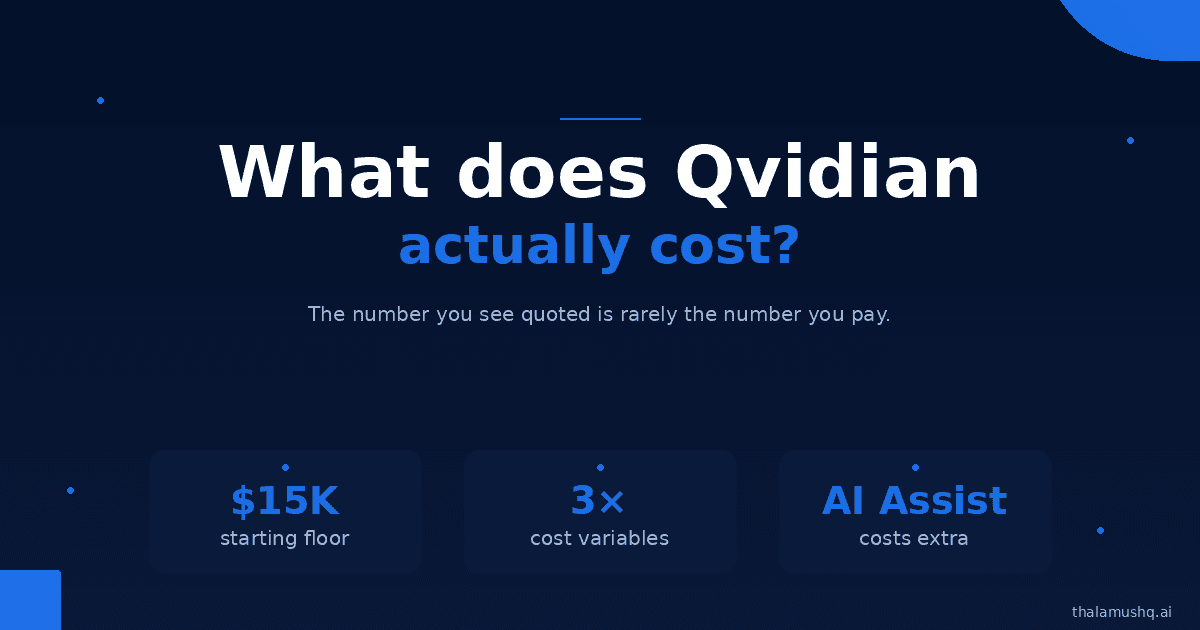
Public third-party estimates and user-review commentary suggest that Qvidian's base license starts at approximately $15,000–$25,000 per year for a standard enterprise deployment. 

This figure represents the entry point for a proposal team gaining access to the platform's core content library, RFP response automation, and collaboration features.

That number is a floor, not a ceiling. Several verified reviewers on TrustRadius describe the platform as "costly" for smaller teams or organizations with lower RFP volumes, a signal that the real cost scales meaningfully beyond the base.

Because Upland does not publish Qvidian pricing publicly, this article uses public marketplace listings, third-party pricing estimates, verified user-review commentary, and pricing-model analysis. These figures are directional estimates only. Actual pricing can vary based on user count, feature tier, AI Assist access, implementation scope, integrations, contract term, and Upland Software negotiations.

Qvidian Pricing Per User: The Three Variables That Drive Cost Up

Qvidian's pricing is not a flat rate. It is determined by three primary variables, each of which can push the total cost significantly above the base license estimate.

User count: 

Qvidian charges based on the number of team members who need access to the platform. This creates the classic "seat anxiety" problem: every SME, legal reviewer, finance contributor, or executive approver who needs to touch a bid section adds to the license cost. For teams that run multi-stakeholder proposals, where 10 to 20 people might contribute to a single bid, the per-seat model quickly becomes a constraint on how broadly the tool can be deployed.

Feature tier (including AI Assist): 

Qvidian's AI Assist, the platform's generative AI capability for content generation and suggestion, is not included in the base tier. It is an additional cost layer on top of the standard content library and workflow features. Organizations that need the AI functionality (which, in 2026, is almost every team evaluating a modern RFP platform) will pay more than the base $15K–$25K estimate.

Integration complexity: 

Qvidian integrates with Salesforce, Microsoft Office 365, SharePoint, Teams, and other enterprise systems. Implementations that require custom integrations, data migration from a legacy platform, or connections to bespoke CRM configurations carry additional setup and professional services fees.

The Base Qvidian Cost: What the Range Actually Looks Like

Public third-party estimates and user-review commentary suggest that Qvidian's base license starts at approximately $15,000–$25,000 per year for a standard enterprise deployment. 

This figure represents the entry point for a proposal team gaining access to the platform's core content library, RFP response automation, and collaboration features.

That number is a floor, not a ceiling. Several verified reviewers on TrustRadius describe the platform as "costly" for smaller teams or organizations with lower RFP volumes, a signal that the real cost scales meaningfully beyond the base.

Because Upland does not publish Qvidian pricing publicly, this article uses public marketplace listings, third-party pricing estimates, verified user-review commentary, and pricing-model analysis. These figures are directional estimates only. Actual pricing can vary based on user count, feature tier, AI Assist access, implementation scope, integrations, contract term, and Upland Software negotiations.

Qvidian Pricing Per User: The Three Variables That Drive Cost Up

Qvidian's pricing is not a flat rate. It is determined by three primary variables, each of which can push the total cost significantly above the base license estimate.

User count: 

Qvidian charges based on the number of team members who need access to the platform. This creates the classic "seat anxiety" problem: every SME, legal reviewer, finance contributor, or executive approver who needs to touch a bid section adds to the license cost. For teams that run multi-stakeholder proposals, where 10 to 20 people might contribute to a single bid, the per-seat model quickly becomes a constraint on how broadly the tool can be deployed.

Feature tier (including AI Assist): 

Qvidian's AI Assist, the platform's generative AI capability for content generation and suggestion, is not included in the base tier. It is an additional cost layer on top of the standard content library and workflow features. Organizations that need the AI functionality (which, in 2026, is almost every team evaluating a modern RFP platform) will pay more than the base $15K–$25K estimate.

Integration complexity: 

Qvidian integrates with Salesforce, Microsoft Office 365, SharePoint, Teams, and other enterprise systems. Implementations that require custom integrations, data migration from a legacy platform, or connections to bespoke CRM configurations carry additional setup and professional services fees.

What Upland Qvidian Pricing Does Not Include?

What Upland Qvidian Pricing Does Not Include?

What Upland Qvidian Pricing Does Not Include?

This is the section that matters most for total cost of ownership modeling, and it is the section that most Qvidian pricing discussions skip.

Implementation and Onboarding Fees

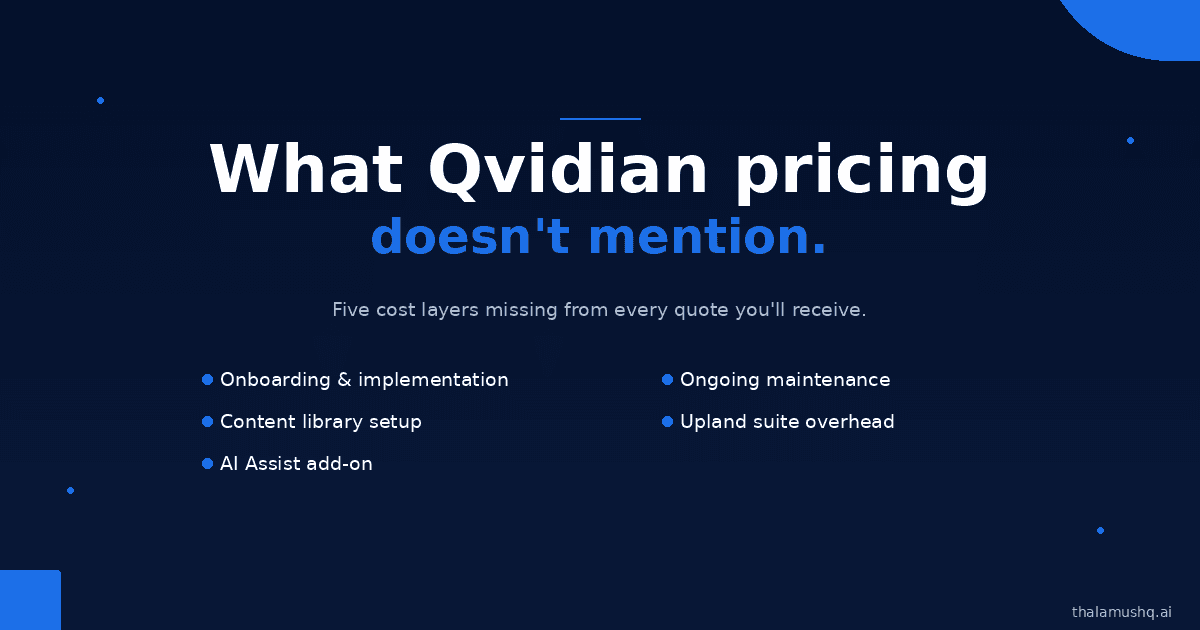
Qvidian is not a self-serve platform. Enterprise deployments typically require vendor-assisted onboarding, which includes platform configuration, user training, content migration, and workflow setup. 

These professional services are not included in the base licence and represent a meaningful additional cost, particularly for organizations migrating a large existing content library from a previous platform or from SharePoint.

Verified user reviews on Capterra and TrustRadius consistently flag implementation timelines as longer than expected. "Slow implementation timelines" and "heavy admin overhead" appear as recurring themes in G2 community reviews.

Content Library Setup and Ongoing Maintenance

Qvidian's content library, the foundation that its AI drafting layer draws from, does not arrive pre-populated. Building, tagging, organizing, and deduplicating a content library to the point where the AI can use it reliably requires significant upfront investment of staff time. 

This is not a one-time cost: the library requires continuous maintenance by a designated content owner to remain current and accurate. If that role falls to a senior proposal professional, the labor cost of library maintenance should be factored into the total cost of ownership.

G2 reviewers rate Qvidian #8 easiest-to-use in the RFP Software category - a signal that the platform requires dedicated, trained users to operate effectively. Teams without proposal professionals on staff will carry higher training and adoption overhead.

AI Assist as a Premium Add-On

As noted above, Qvidian's AI Assist is not a core feature - it is priced as a premium capability. For teams who specifically need AI-powered content generation, the all-in cost, including AI Assist, is higher than the base license estimate suggests.

Upland Qvidian Pricing: The Suite Overhead Factor

Because Qvidian operates inside the Upland Software portfolio, pricing negotiations may involve commercial considerations around other Upland products. Teams that do not need the broader Upland suite may find they are being priced relative to a bundle, making a standalone Qvidian evaluation harder to disentangle.

This is the section that matters most for total cost of ownership modeling, and it is the section that most Qvidian pricing discussions skip.

Implementation and Onboarding Fees

Qvidian is not a self-serve platform. Enterprise deployments typically require vendor-assisted onboarding, which includes platform configuration, user training, content migration, and workflow setup. 

These professional services are not included in the base licence and represent a meaningful additional cost, particularly for organizations migrating a large existing content library from a previous platform or from SharePoint.

Verified user reviews on Capterra and TrustRadius consistently flag implementation timelines as longer than expected. "Slow implementation timelines" and "heavy admin overhead" appear as recurring themes in G2 community reviews.

Content Library Setup and Ongoing Maintenance

Qvidian's content library, the foundation that its AI drafting layer draws from, does not arrive pre-populated. Building, tagging, organizing, and deduplicating a content library to the point where the AI can use it reliably requires significant upfront investment of staff time. 

This is not a one-time cost: the library requires continuous maintenance by a designated content owner to remain current and accurate. If that role falls to a senior proposal professional, the labor cost of library maintenance should be factored into the total cost of ownership.

G2 reviewers rate Qvidian #8 easiest-to-use in the RFP Software category - a signal that the platform requires dedicated, trained users to operate effectively. Teams without proposal professionals on staff will carry higher training and adoption overhead.

AI Assist as a Premium Add-On

As noted above, Qvidian's AI Assist is not a core feature - it is priced as a premium capability. For teams who specifically need AI-powered content generation, the all-in cost, including AI Assist, is higher than the base license estimate suggests.

Upland Qvidian Pricing: The Suite Overhead Factor

Because Qvidian operates inside the Upland Software portfolio, pricing negotiations may involve commercial considerations around other Upland products. Teams that do not need the broader Upland suite may find they are being priced relative to a bundle, making a standalone Qvidian evaluation harder to disentangle.

Qvidian Cost in 2026: Total Cost of Ownership by Team Size

The table below represents estimated total annual cost ranges based on user community reports, analyst estimates, and the three pricing variables described above. These are not figures sourced from Qvidian directly.

Team profile

Users

Estimated base licence

Add: AI Assist

Add: Implementation

Estimated Year 1 TCO

Small proposal team

5–10 users

$15K–$20K

+$5K–$8K

+$5K–$10K

~$25K–$38K

Mid-size proposal operation

10–20 users

$20K–$35K

+$8K–$15K

+$10K–$20K

~$38K–$70K

Large enterprise bid team

20–50 users

$35K–$60K+

+$15K–$25K

+$15K–$30K

~$65K–$115K+

Estimates based on industry analyst data and verified user community reports. Actual costs will vary based on contract negotiation, Upland suite bundling, and implementation scope. Contact Upland Software for accurate pricing for your specific situation.

Is Qvidian Worth It in 2026? Who Gets Real Value from the Qvidian RFP Platform

Qvidian is not a bad investment for every organization. There is a specific buyer profile for whom the total cost of ownership is justifiable, and it is worth naming it clearly, because buying the wrong platform is more expensive than the platform itself.
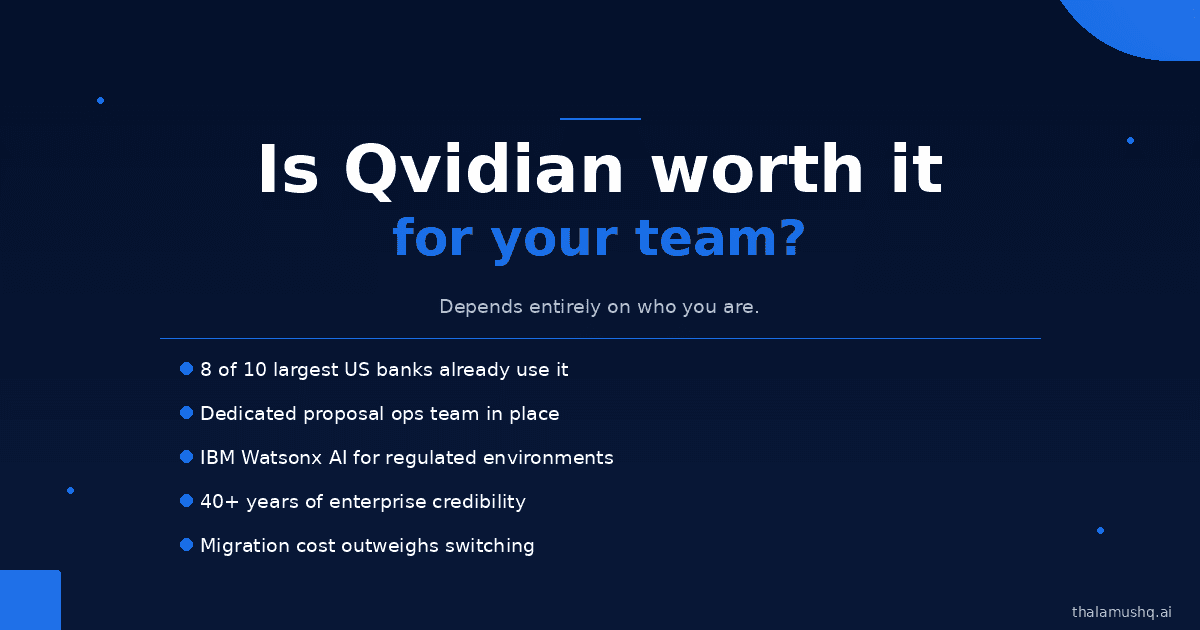
Qvidian pricing makes sense when all of the following are true:

  • You are a large financial services, professional services, or insurance enterprise with mature proposal operations, strict governance needs, and a large distributed user base (Qvidian has historically been strong in large regulated enterprises, especially financial services, insurance, and professional services.)

  • You have a dedicated proposal operations function with at least one full-time content owner whose role includes ongoing library maintenance. 

  • You have existing workflows built around Qvidian's library model, and the switching cost of migration outweighs the cost of staying. 

  • You specifically value the IBM Watsonx AI partnership for AI provenance and auditability in a regulated environment. 

  • Your procurement process requires a platform with 40+ years of enterprise proposal industry credibility and mature audit trails

If those conditions describe your organization, Qvidian's pricing is defensible, and the investment is likely already built into your proposal operations budget.

Who Is Likely Overpaying for Qvidian?

Qvidian pricing is harder to justify when:

  • Your team is under 15 people, and the seat-based model means you are paying for access that non-daily users do not fully utilize. 

  • You do not have a dedicated content owner - meaning library maintenance falls to proposal managers, whose time costs more per hour than the maintenance itself. 

  • Your RFP volume is variable - high in some quarters, low in others - and a flat enterprise licence creates cost inefficiency during low-volume periods. 

  • You are evaluating Qvidian for the first time in 2026, without an existing content library to migrate, and the platform's AI capabilities need to be built from scratch. 

  • You need every SME, legal reviewer, and executive approver to actively participate in bid coordination, but the per-seat model limits how broadly you can deploy the licence. 
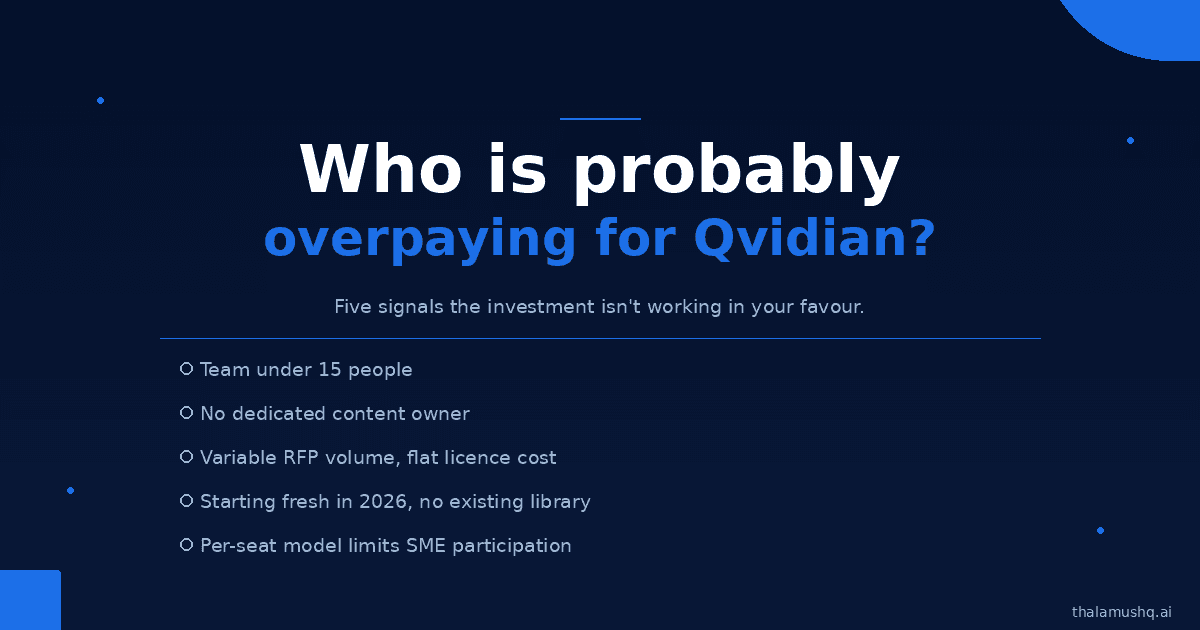
Teams in this second group are typically the ones who find Qvidian's real TCO exceeds the value delivered, and who are actively looking at Qvidian alternatives in 2026.

If your answers point toward a full bid-lifecycle platform with unlimited users and no seat tax, let's talk. → Get a Personalized Recommendation

Qvidian Pricing vs Alternatives: A Quick Model Comparison

Rather than naming specific competitor prices - which fluctuate and require vendor confirmation - the more useful comparison is the pricing model, because the model determines how your cost scales as your team and RFP volume grow.

Platform type

Pricing model

How does cost scale with team growth

Transparency

Qvidian (Upland)

Custom enterprise; seat-based; AI as add-on

Cost increases significantly with user count

No public pricing

Legacy Q&A library platforms

Seat-based enterprise; content library required

Same seat-scaling problem; library maintenance adds labor cost

No public pricing

AI-native questionnaire tools

Per-user or usage-based

Scales with user count or volume

Some public pricing available

Unlimited-user platforms

Flat subscription; unlimited users and projects

Does not scale with team size or RFP volume

Varies

The structural advantage of an unlimited-user, unlimited-project model, like Thalamus AI's, is that the cost of looping in every SME, every legal reviewer, and every executive approver is zero. The Qvidian model creates a financial disincentive to do exactly what produces better proposals: broader stakeholder involvement.

For a full side-by-side comparison of tools across pricing models, AI architecture, and lifecycle coverage, see our 12 Best AI RFP Software Tools in 2026.

Qvidian Pricing FAQ: What Buyers Ask Most in 2026?

How much does Qvidian cost in 2026? 

Qvidian does not publish its pricing publicly. Based on industry analyst estimates and verified user community reports on G2, Capterra, and Gartner Peer Insights, the base licence starts at approximately $15,000–$25,000 per year for a standard enterprise deployment. The real total cost of ownership is significantly higher once AI Assist, implementation fees, seat scaling, and ongoing content maintenance overhead are factored in. Contact Upland Software directly for a quote specific to your organization's size and requirements.

Does Qvidian charge per user? 

Yes. Qvidian's pricing is driven in part by the number of users who need platform access. This means cost scales with team size - a meaningful consideration for proposal operations that need to loop in SMEs, legal reviewers, finance contributors, and executive approvers on a per-bid basis. Per-seat models create a financial incentive to restrict platform access, which can negatively impact proposal quality on complex bids.

Does Qvidian have a free trial? 

No. Qvidian does not offer a free trial or a self-serve entry point. All evaluations require a demo request and direct engagement with Upland Software's sales team before any platform access is granted.

What is included in Qvidian's base licence? 

The base Qvidian licence typically includes access to the core content library, RFP response automation, collaboration and workflow features, and integrations with Salesforce and Microsoft Office. AI Assist, the platform's generative AI capability, is a premium add-on and is not included in the base tier. Implementation, onboarding, and content migration services are also separate costs.

Is Qvidian worth it in 2026? 

For large financial services and professional services enterprises with a dedicated proposal team, a maintained content library, and a procurement environment that requires IBM WatsonX AI provenance and mature audit trails, yes. For mid-market teams, newer proposal operations without an existing library, or teams that need every stakeholder to actively contribute without a seat tax, the total cost of ownership is harder to justify relative to more modern alternatives.

What are the hidden costs of Qvidian? 

The most commonly cited hidden costs in user reviews on G2, Capterra, and TrustRadius are: implementation and onboarding professional services fees; content library setup and ongoing maintenance overhead (typically a dedicated staff role); AI Assist as a premium add-on; and seat-based scaling costs when the proposal team expands or when SMEs and reviewers are added to bids.

How does Qvidian pricing compare to Loopio and Responsive? 

All three are custom enterprise platforms with no publicly listed pricing. Responsive (RFPIO) is estimated at approximately $20,000+/year at the Foundations tier. Loopio is similarly priced as a premium enterprise platform. Qvidian is generally positioned at a comparable or higher price point, particularly with AI Assist included. The meaningful pricing model difference is that newer AI-native alternatives offer unlimited-user subscriptions where cost does not scale with team size. For a full comparison, see our 10 Best Loopio Alternatives in 2026 and 12 Best AI RFP Software Tools in 2026.

Is there a cheaper alternative to Qvidian? 

Yes, depending on what "cheaper" means in your context. On a base subscription cost basis, several AI-native platforms offer lower or more predictable pricing. More importantly, on a total cost of ownership basis, factoring in the staff time required to maintain Qvidian's content library, the seat-scaling cost, and the AI Assist add-on, unlimited-user platforms with no library maintenance requirement can represent a significant total cost reduction even at a comparable or higher subscription price. See our full evaluation of Qvidian alternatives in 2026.

Who owns Qvidian? 

Qvidian is owned by Upland Software, an enterprise software company that acquired Qvidian as part of its portfolio of sales and marketing productivity tools. The platform operates as Upland Qvidian within the Upland Software suite. Several user community reports on G2 and Gartner Peer Insights note that development velocity on the platform has been slower since the Upland acquisition relative to the pace of innovation in the AI-native segment of the RFP software market.

What happens to Qvidian's cost as our team grows? 

Because Qvidian is seat-based, the cost scales with user count. Adding proposal team members, SMEs, legal contributors, finance reviewers, or executive approvers increases the licence cost. This is the structural difference between seat-based legacy platforms and unlimited-user models: on Qvidian, growing your contributor base is a budget conversation. On platforms with unlimited-user pricing, it is not.

What is the estimated Qvidian implementation cost?

Qvidian implementation costs vary based on onboarding, content migration, workflow setup, integrations, and user training. Public estimates suggest implementation can add several thousand to tens of thousands of dollars to first-year cost, depending on team size and complexity. Buyers should ask Upland Software to separate software license cost from implementation and professional services in the quote.

Is Qvidian AI Assist included in the base price?

Qvidian positions AI Assist as its generative AI capability, but pricing is not publicly itemized. Buyers should confirm whether AI Assist is included in their quoted package or priced as an add-on, because AI access can materially change the total cost of ownership.

The Bottom Line on Qvidian Pricing

Qvidian's pricing reflects the platform's positioning: it is an enterprise-grade proposal management platform built for large organizations that already have established proposal operations, a dedicated content team, and a procurement environment where IBM WatsonX AI credibility and legacy platform stability matter more than modern AI architecture or onboarding speed.

If that describes your organization, the pricing, while opaque, is in line with what large enterprises have historically paid for proposal automation at scale.

If your organization needs a full bid lifecycle platform that covers the entire workflow from capture planning through institutional learning, deploys without a professional services engagement, and prices every stakeholder's access into a single flat subscription, Qvidian's model is worth comparing directly to what's available in 2026.

our next RFP should not start with a library cleanup or a seat-count conversation. See what unlimited-user, AI-native bid infrastructure looks like in practice. → Book Your Demo with our team today!