
Harpreet Singh, MBA
Founder, Thalamus AI

With 12+ years in AI and enterprise software, including GenAI product work at Travelers, Harpreet writes about AI RFP software, AI bid tools, proposal operations, RFP response automation, and the future of enterprise bid management.

How We Evaluated Every Responsive RFP Software Alternative in 2026?
Every tool in this list was evaluated against the same ten criteria. No tool paid to appear. Thalamus AI is assessed by the same standard as every other platform.
AI architecture - retrieval from a Q&A library, generative from live documents, or multi-agent agentic reasoning. The architecture determines performance when questions are novel or complex.
Library maintenance model - whether the platform requires ongoing Q&A curation to maintain AI output quality, or whether it eliminates that requirement through live source connections or verified entity layers, and whether the platform actively governs content health once that requirement is reduced.
Full bid lifecycle depth - whether the platform covers the complete workflow from capture planning through post-bid learning, or only the response generation step.
Compliance and requirement tracking - compliance matrix generation, requirement tagging, and real-time addendum detection.
Workflow configurability - RACI routing, SME assignment, version control, review gates, and approval chains.
Pricing model - seat-based, unlimited-user, usage-based, or custom enterprise; and whether total cost scales with team growth.
Integration depth - native connections to SharePoint, Google Drive, Salesforce, HubSpot, Slack, Teams.
Format coverage - RFPs, DDQs, security questionnaires, online portals, Excel/Word formats.
G2 rating and review volume - sourced from G2's RFP Software category, Spring 2026.
Best-fit switch reason - the specific Responsive pain point each tool was best designed to address.
RFPIO Competitors 2026: Quick Comparison Table
Tool | Best for switching from Responsive when... | G2 rating | Pricing model | Solves library problem? | Full lifecycle? |
Thalamus AI | Bids have grown complex; need compliance tracking, RACI routing, and post-bid learning | Unlimited users + projects; one subscription | ✓ Verified entity layer + AI-managed Content Health, minimal Q&A maintenance | ✓ Full lifecycle | |
Loopio | UX friction is the primary pain point, and the team size is under 25 | Enterprise; contact for a quote | ✗ Same Q&A library model — maintenance burden remains | ✗ Response step only | |
AutogenAI | Government or defense bids requiring FedRAMP High and best-in-class narrative writing | Custom enterprise; minimum seat commitments | ✓ Bespoke language engine — no library curation | ✓ Full lifecycle (writing-led) | |
Tribble | Financial services or B2B SaaS teams wanting win-pattern learning that compounds over time | Consumption-based; no public pricing | ✓ Living knowledge graph — self-updating | ✗ Response step only | |
HeyIris (Iris AI) | Presales and sales engineering teams wanting confidence-scored, citeable answers | Per-user; unlimited collaborators | ⚡ Document-based — reduces but does not eliminate upkeep | ✗ Response step only | |
Arphie | Library maintenance is the primary pain, and content lives in a well-organized SharePoint/Confluence | Custom enterprise; no public pricing | ✓ Live source connections, no static library | ✗ Response step only | |
Inventive AI | Accuracy and conflict detection are priorities; the team wants the fastest possible adoption | No public pricing; contact sales | ✓ Live source connections, proactive stale alerts | ✗ Response step only | |
AutoRFP | Per-seat pricing is the primary pain; the team needs an unlimited-user model | Scale $899/mo; Accelerate $1,299/mo; unlimited users | ⚡ Semantic search - lower maintenance than Responsive | ✗ Response step only | |
1Up | Small team (under 10); Responsive is overkill; want Slack/Teams-native answers | Free plan; $300/mo; $900/mo; Enterprise | ✓ Live connectors - no library curation | ✗ Response step only | |
Conveyor | Security questionnaires and vendor portals (Whistic, BitSight) are a primary use case | Always-free tier; credit-based pro plans | ✓ Document-sourced - minimal library overhead | ✗ Security questionnaires only |
10 Best Responsive RFPIO Alternatives in 2026: Full Reviews
1. Thalamus AI - Best Responsive Alternative
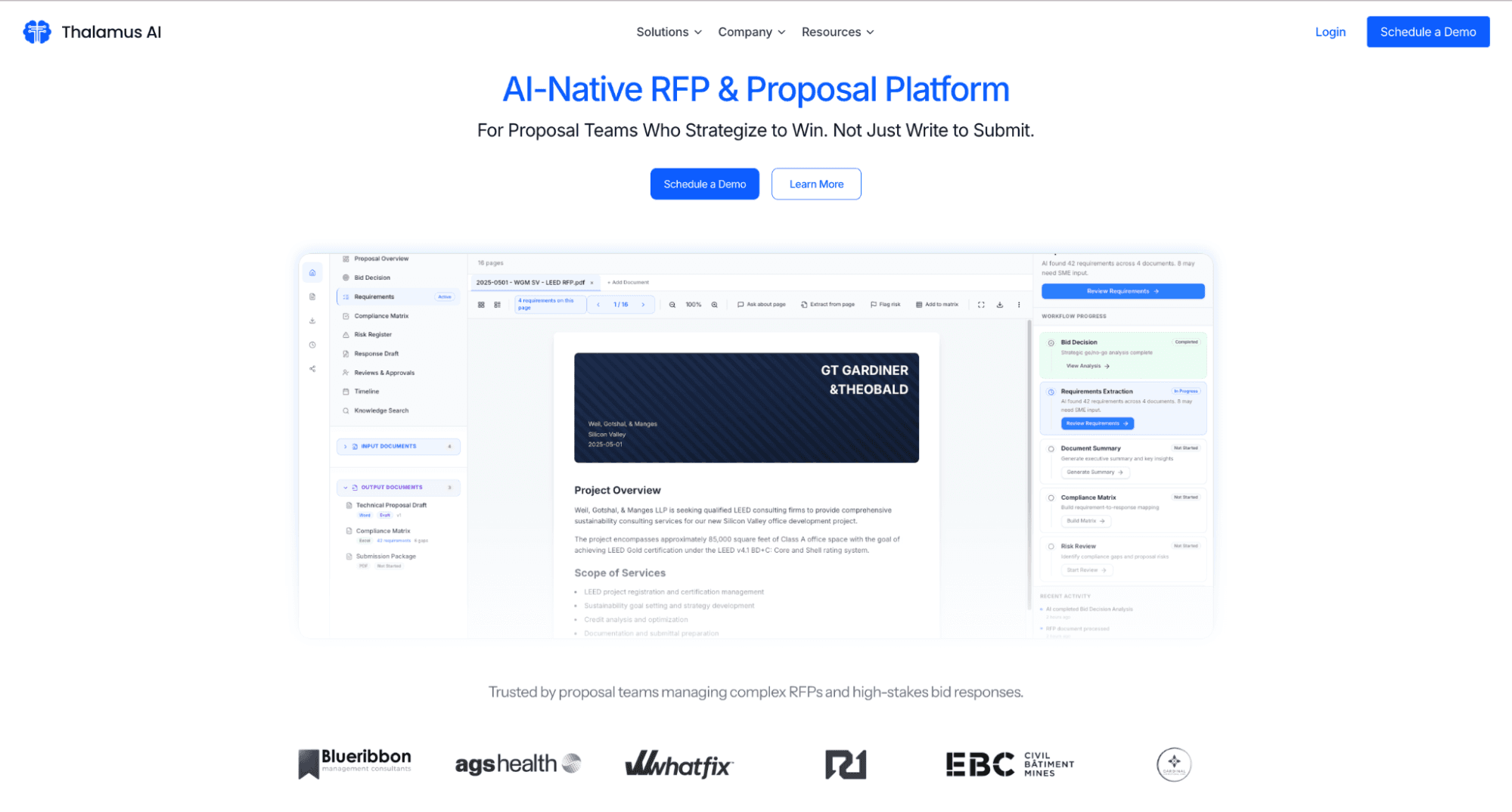
Switch from Responsive when: Your bids have grown complex enough to expose the gaps in what a response management platform covers, compliance matrices, addendum tracking, RACI routing at the subsection level, and post-bid institutional learning are being managed in spreadsheets alongside Responsive.
G2 rating: 5.0 / 5 ↗ G2
Pricing: Unlimited users, unlimited projects, unlimited RFPs - one subscription. Three-month pilot pack available.
AI approach: Multi-agent agentic AI with a verified entity knowledge layer, decision graph, and closed-loop institutional learning.
Why Thalamus AI Is a Different Category of Responsive Alternative?
Most tools in this evaluation compete with Responsive in response management. Thalamus AI is different: it is built for teams that have outgrown response management and need bid lifecycle infrastructure.
No Q&A library to maintain.
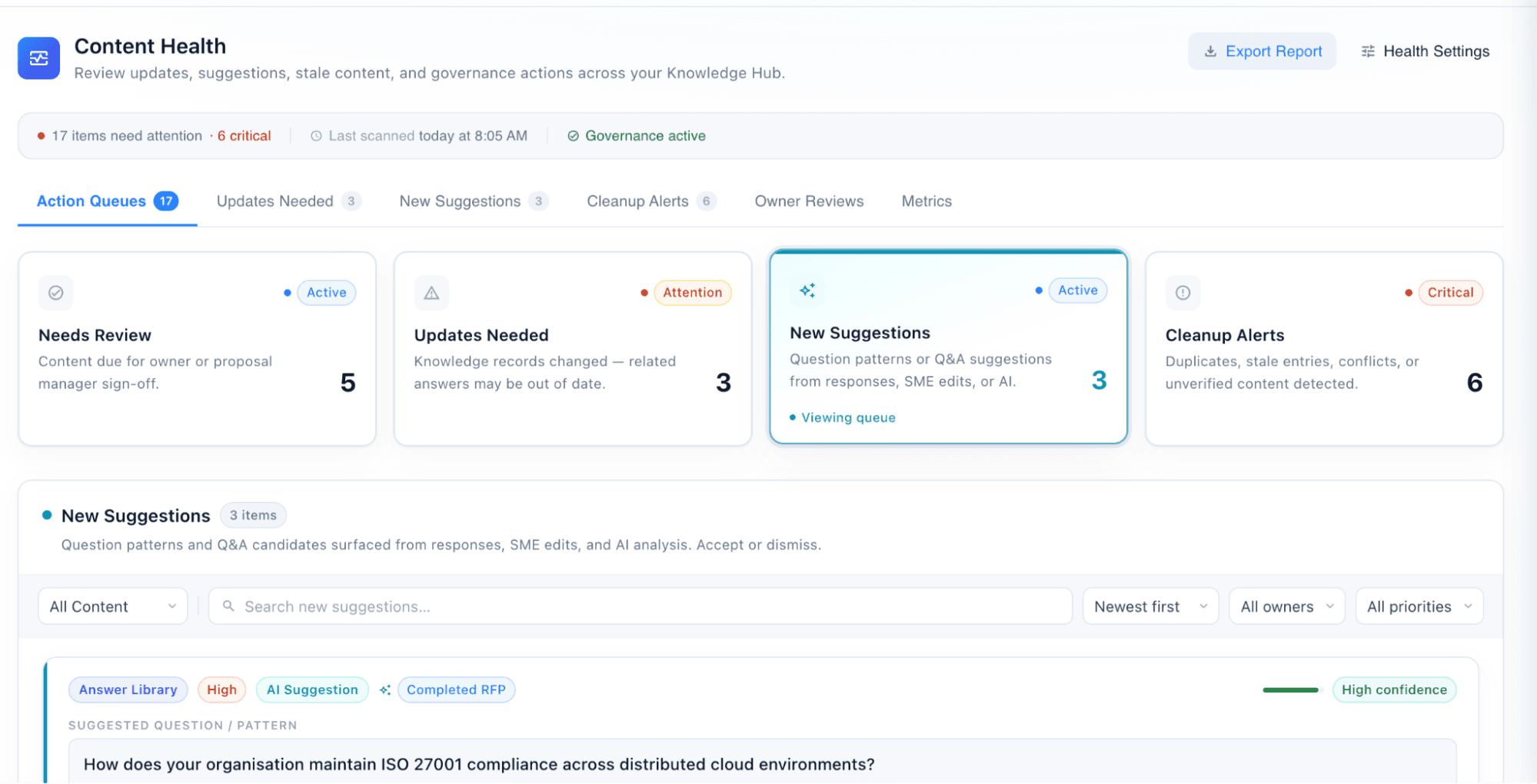
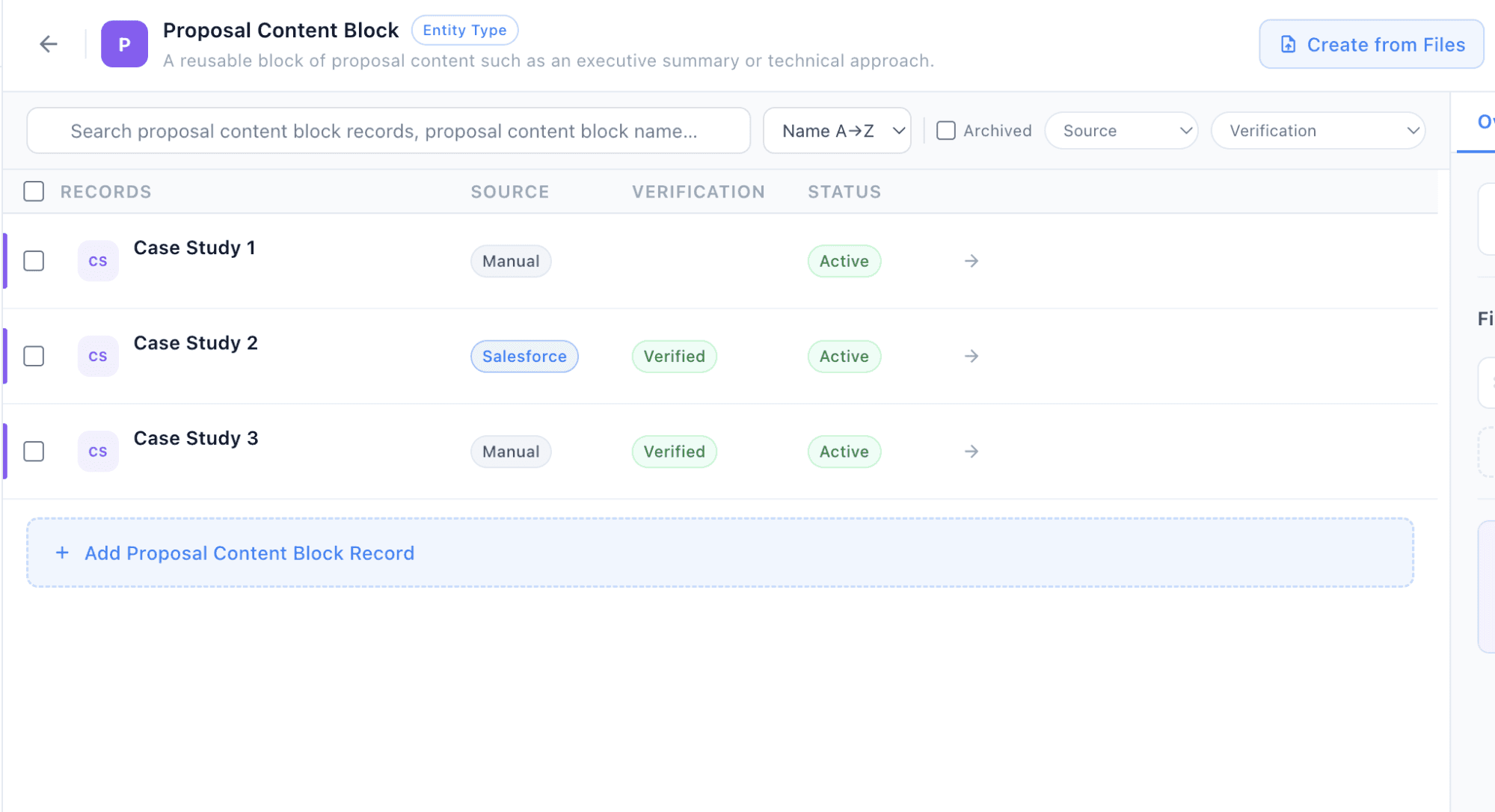
Thalamus converts unstructured proposals, CVs, case studies, and project histories into verified, editable, auditable knowledge entities, each traceable to its source document with a completeness score and last-verified timestamp, and connectable to CRM systems like Salesforce and HubSpot for account context. An AI-managed Content Health layer continuously flags duplicate, stale, or conflicting entries as exceptions for review, so the quarterly cleanup problem Responsive teams describe doesn't just move to a new platform.
Full bid lifecycle in one platform - Capture planning, bid/no-bid qualification, requirement mapping, RACI routing, SME coordination, response generation, compliance review, submission, and post-bid institutional learning. Responsive covers the response step. Thalamus AI covers everything that happens before and after it.
Compliance matrix as a live working document - Every requirement is mapped to a section, an owner, a status, and a risk level. When an addendum is issued mid-bid, Thalamus automatically detects changed requirements and flags every impacted section. Responsive does not have this capability in its current core positioning.
Subsection-level RACI routing - Assign SMEs to individual sections before kickoff through the Ownership Matrix, not just during drafting; set version-controlled review gates, require lead-author approval before content advances, all within the platform, not alongside it in email.
Unlimited users, no seat penalty - Every SME, every legal reviewer, every pricing specialist, every executive approver, included under one subscription. Responsive's per-seat model creates a financial incentive to keep the contributor circle small. Thalamus AI removes that incentive entirely.
Institutional memory that compounds - Every correction, decision, win, loss, and reviewer comment strengthens the knowledge graph. The platform improves automatically as the organization uses it, the opposite of Responsive's library, which degrades when not actively maintained.
AI Clarification Register catches open questions before submission
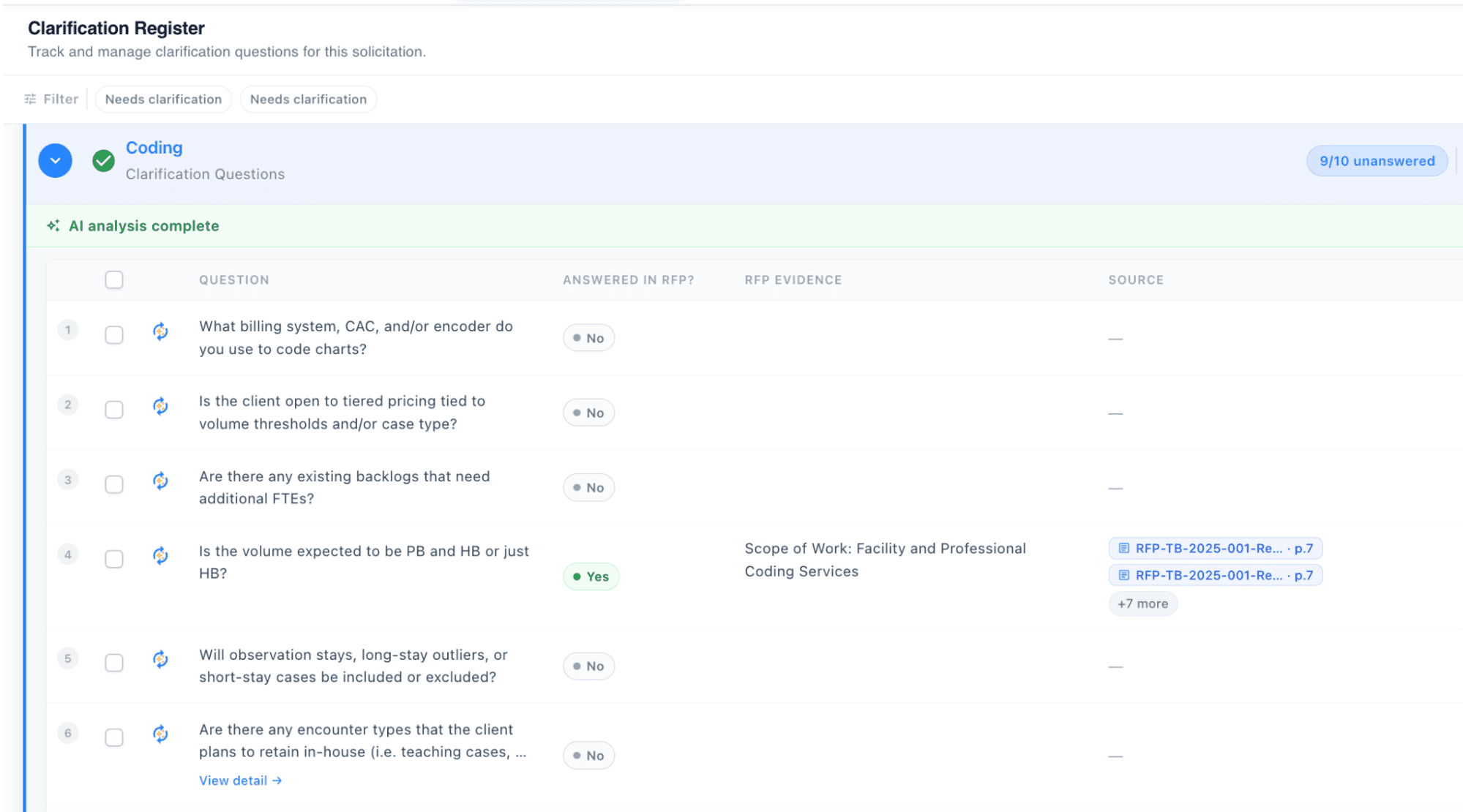
Before a response is locked, Thalamus checks each unanswered question the team has against the RFP package itself, flagging what's genuinely open versus buried in an appendix. Responsive has no equivalent workflow.
Where Thalamus AI Falls Short as a Responsive Alternative?
Not suited for simple, high-volume security questionnaire workflows - Teams whose entire program is structured around DDQs will find lighter tools like Conveyor or 1Up faster to onboard and more cost-effective.
Initial setup investment is real - Bid-stage workflows, entity ingestion, and compliance matrix configuration require upfront time. Same-day value from a self-serve click-through experience is not the right expectation.
Lower public G2 review volume than Responsive - Ten reviews versus Responsive's 1,263 - the peer review depth difference is significant for procurement decisions that rely heavily on review volume. Request customer references directly. Review volume matters. Responsive has a far deeper public review volume than newer AI-native platforms. Thalamus AI has fewer public reviews, but is included here because its architecture directly addresses full bid lifecycle gaps that response-management platforms do not cover.
What Real Users Say About Thalamus AI on G2
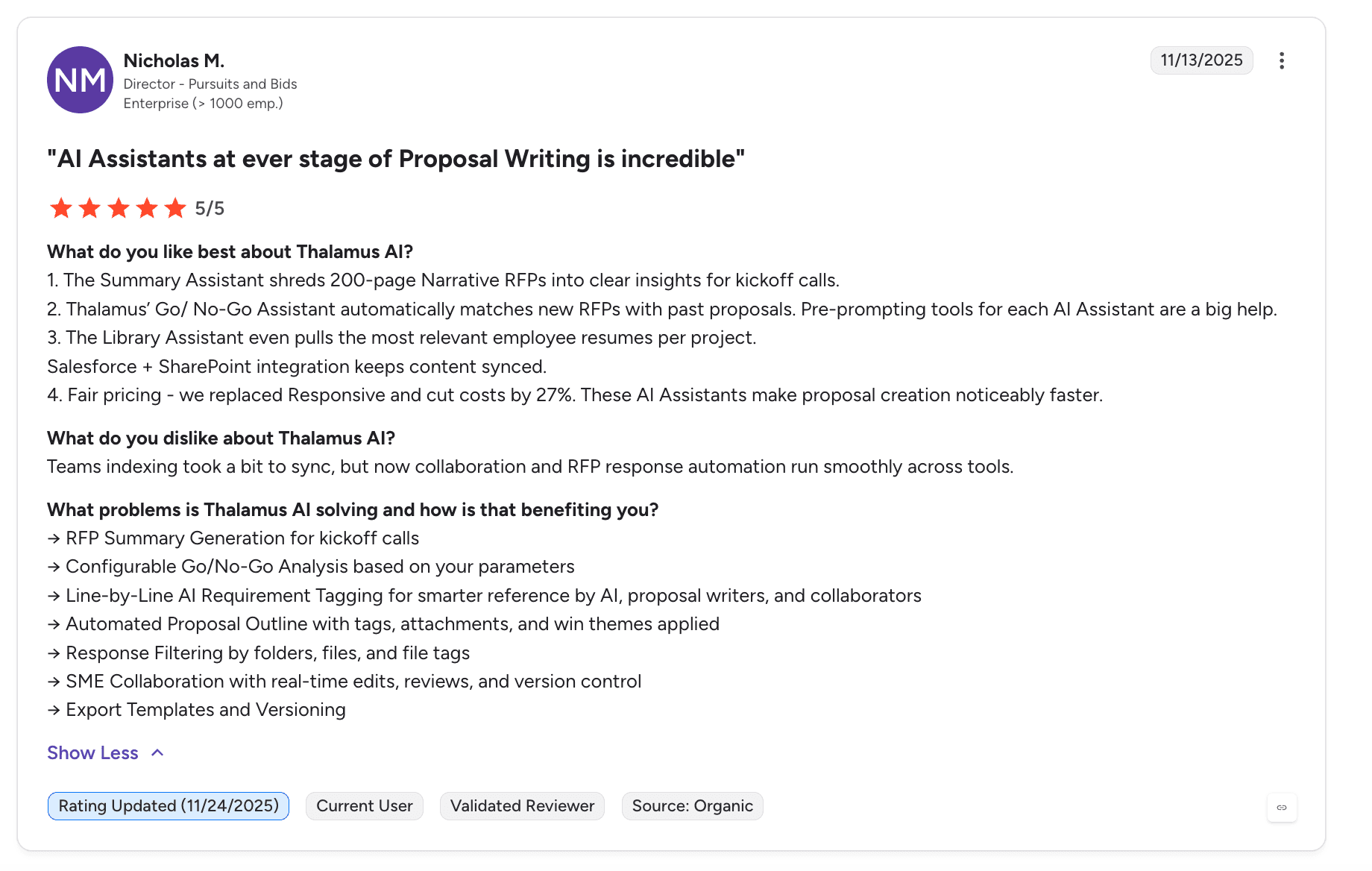
Thalamus AI reports a 2.5x increase in bid win rates, 3x more bid shortlistings, and a 34% improvement in response reliability across enterprise customers. Based on internal customer data, individual results vary.
Who Should Switch from Responsive to Thalamus AI?
Enterprise proposal teams in healthcare, AEC, government contracting, and professional services are running complex, multi-document bids where the bottleneck is not just drafting speed but coordination, compliance, and institutional knowledge governance across the full bid lifecycle.
Bring one live RFP. We will show you what the switch from Responsive actually looks like on your content, not a manufactured demo. → Start Your 3-Month Pilot
2. Loopio - Most Common First Stop After Responsive (With an Honest Caveat)
Switch from Responsive when: The primary pain is UX complexity and SME adoption friction, Responsive feels too heavy for your team size, and you want a cleaner, better-supported experience. Not the right switch if the primary pain is library maintenance or AI quality.
G2 rating: 4.7 / 5 ↗ G2 - 9.7/10 G2 customer support score; G2 ease of use 9.1/10 (vs Responsive's 8.7/10)
Pricing: Enterprise; contact for quote.
AI approach: Pre-LLM platform with AI drafting layered on; not built AI-native.
What Loopio Does Better Than Responsive
Cleaner UX and lower adoption friction - G2 scores Loopio 9.1/10 on ease of use versus Responsive's 8.7/10. For teams where SME adoption has been a persistent problem on Responsive, Loopio typically requires less training before contributors reach a functional level. One verified G2 community member who switched from Loopio to Responsive describes Loopio as "proposal management for dummies - much easier, but much less powerful."
Outstanding customer support - 9.7/10 on G2 - The highest customer support score in the RFP Software category. Teams frustrated by Responsive's slow bug resolution timelines and limited proactive account communication will notice the difference.
Automated library maintenance signals - Loopio flags duplicate or stale content during scheduled review cycles, a step above Responsive's passive library model.
Role-based governance with transparent citations and full version history.
The Honest Caveat About Switching from Responsive to Loopio
Loopio shares the same core library maintenance model as Responsive -
This is the most important sentence in this section, and the one no other Responsive alternatives blog will say clearly enough for you to act on. If the reason you are leaving Responsive is that the Q&A library requires more curation than your team has capacity for, switching to Loopio moves the problem to a new address without solving it.
Loopio's "Magic" AI feature retrieves from the same kind of Q&A library that Responsive's AI does. The maintenance burden is structurally identical.
Switch to Loopio for the UX and support. Do not switch to Loopio for the library problem. If the library is the problem, look at Arphie, 1Up, or Thalamus AI.
What Real Users Say About Loopio on G2
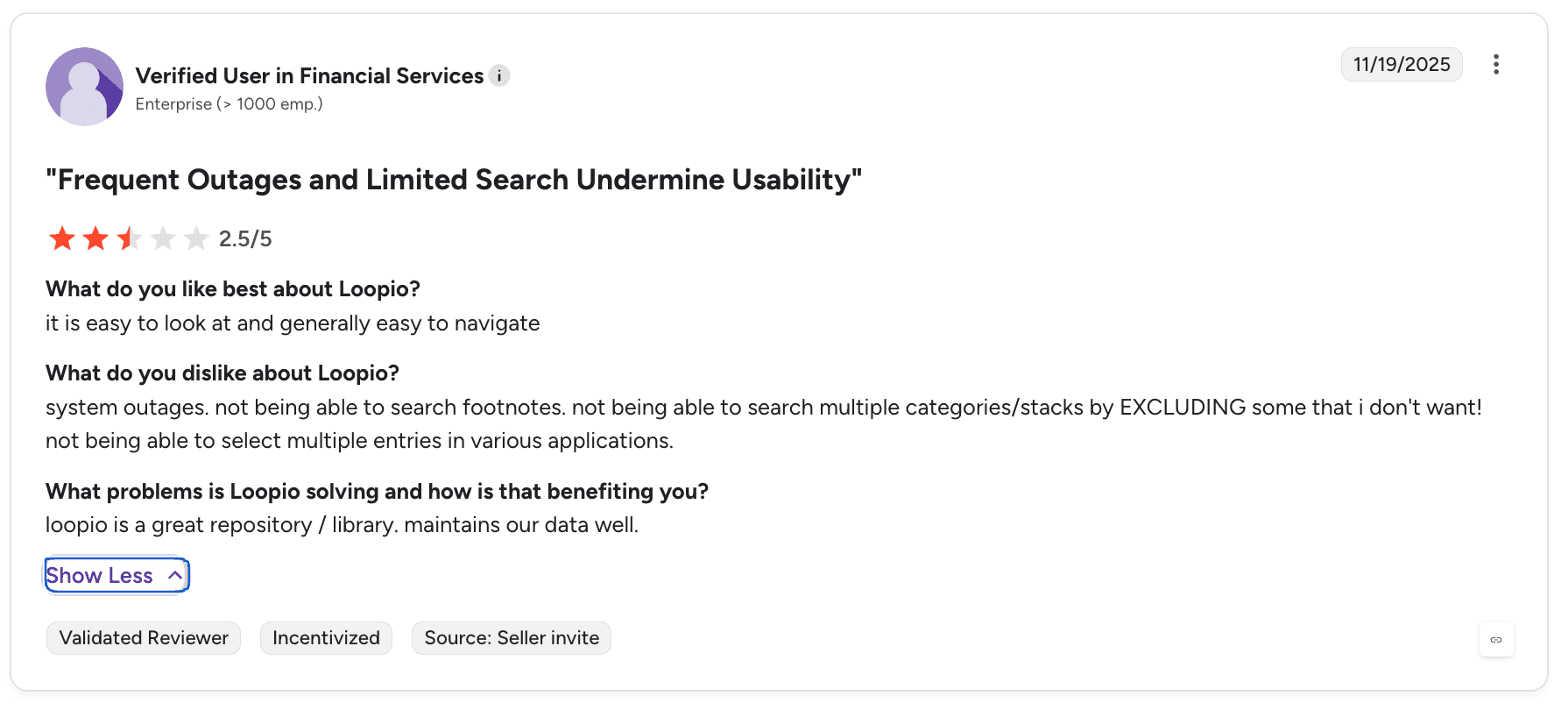
For a full evaluation of what comes after Loopio, see our 10 Best Loopio Alternatives in 2026.
Who Should Switch from Responsive to Loopio?
Teams whose primary frustration with Responsive is UX complexity, SME adoption friction, and support quality, and whose RFP program is primarily structured questionnaires and defined-format RFPs where a well-maintained library genuinely serves the workflow. Not the right switch for library maintenance fatigue or full lifecycle scope gaps.
3. AutogenAI - Best Responsive Alternative for Government, defense, and Narrative Proposals

Switch from Responsive when: Your team bids on US government contracts or defense work requiring FedRAMP High security, which Responsive does not hold, or when narrative proposal quality is the primary competitive differentiator and Responsive's AI is producing generic output that requires heavy rewriting.
G2 rating: 4.4 / 5 ↗ G2 - G2 Best ROI 2025 & 2026; G2 Fastest Implementation 2026
Pricing: Custom enterprise; minimum seat commitments; onboarding fees apply. No public pricing.
AI approach: Bespoke language engine - a custom model trained per customer on their own proposals, win themes, and organizational voice.
What AutogenAI Does Better Than Responsive?
Best narrative writing quality in the category - AutogenAI builds a bespoke language engine per customer, trained on the organization's own proposals and win themes. Drafts sound like the organization from day one, not a generic AI approximation requiring heavy editing. This directly addresses one of the most consistent Responsive complaints: AI output that needs significant manual refinement before submission.
FedRAMP High certification - no other tool in this evaluation has it: For US federal government bids handling controlled unclassified information, this is a procurement requirement, not a feature preference. Responsive does not hold FedRAMP High certification.
Win themes carry forward automatically - Competitive ghosting and win-theme threading carry from bid to bid without manual re-input - the opposite of maintaining a Responsive library where win themes must be tagged and curated.
Gamma Review - automated compliance checking - Catches requirement gaps before submission. Responsive does not have an equivalent automated compliance checking module.
Where AutogenAI Falls Short as a Responsive Alternative?
Not designed for security questionnaire or DDQ workflows - Teams handling both complex proposals and high-volume vendor questionnaires need a second tool alongside AutogenAI - potentially recreating the tool sprawl they were trying to reduce.
No portal response support - A common format that Responsive at least partially covers.
Premium pricing with no transparency - Minimum seat commitments and onboarding fees make this a significant procurement commitment without self-serve evaluation.
Primarily English-language focus - Limits utility for multinational teams.
What Real Users Say About AutogenAI on G2?
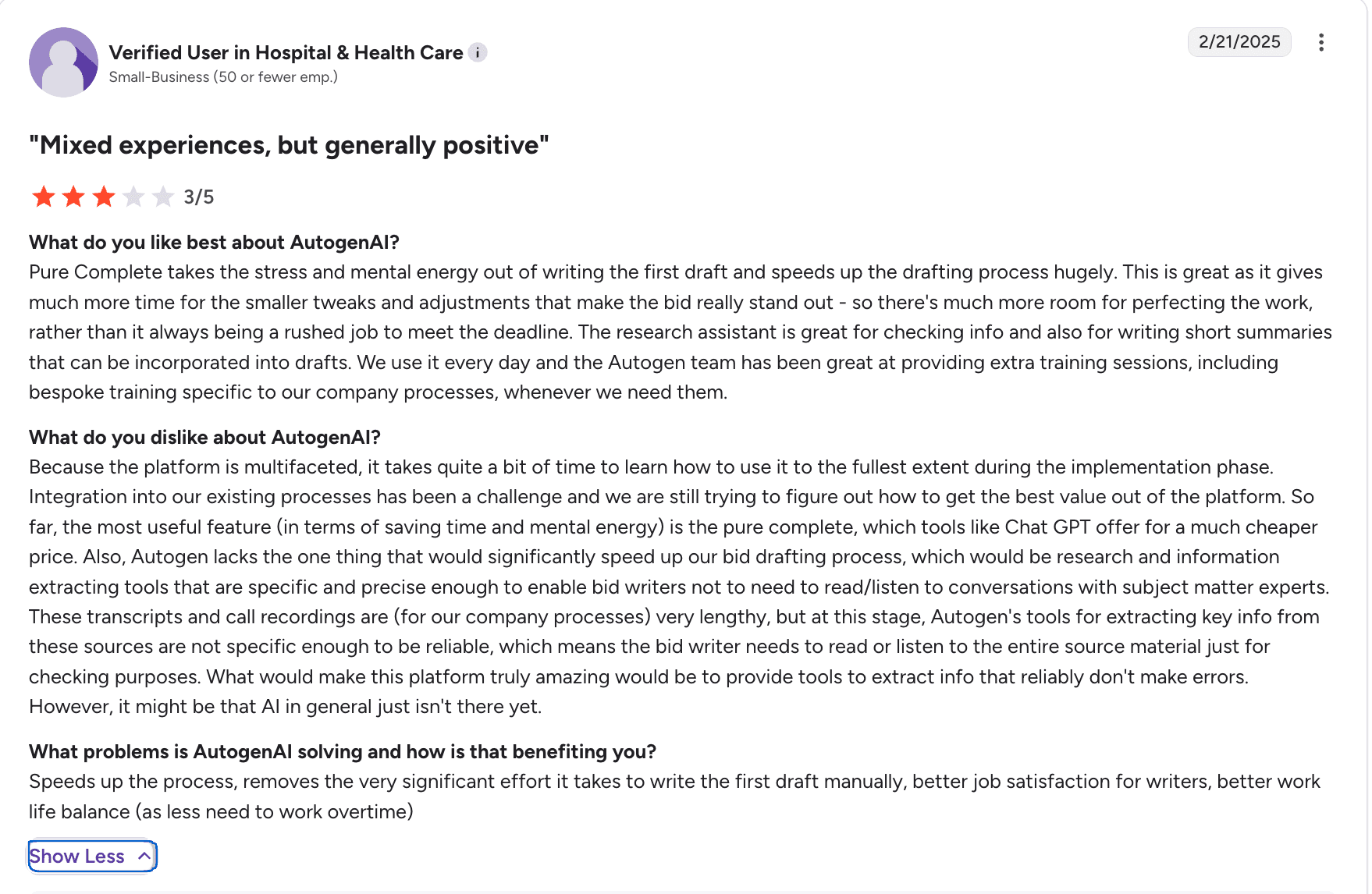
Who Should Switch from Responsive to AutogenAI?
Enterprise proposal teams in government contracting, defense, professional services, and AEC, where FedRAMP High certification is a procurement requirement and narrative proposal quality is the primary differentiator in competitive evaluations.
5. Tribble - Best Responsive Alternative for Win-Pattern Learning and Knowledge Intelligence
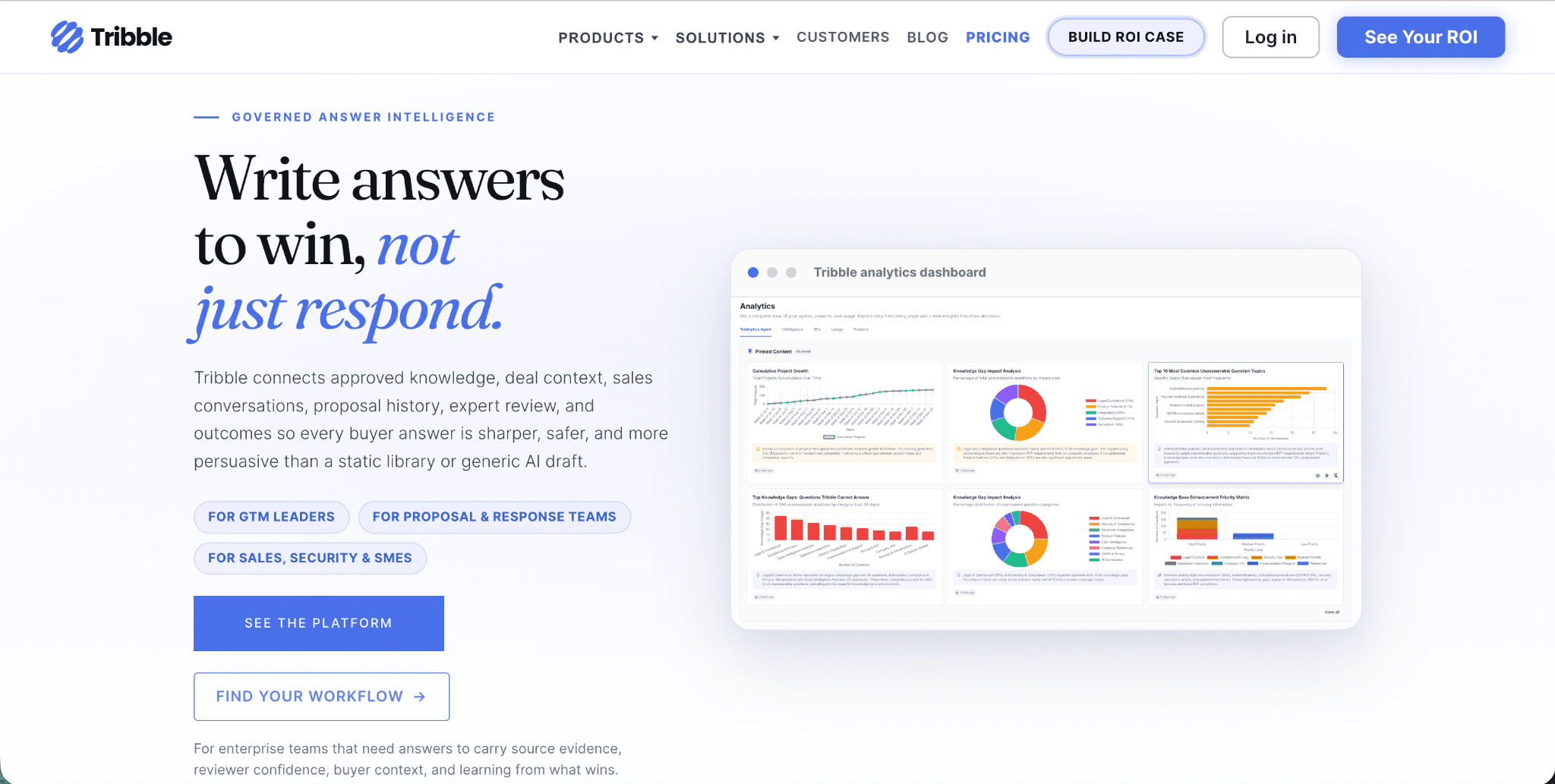
Switch from Responsive when: Your team runs a high and consistent volume of RFPs and DDQs in B2B software or financial services, and you want a platform whose knowledge base gets measurably smarter as you win and lose deals, rather than a library that stores answers without learning which ones work.
G2 rating: 4.8 / 5 ↗ G2
Pricing: Consumption-based; no public pricing. Cost can be unpredictable at variable volumes.
AI approach: AI-native; positronic living knowledge graph ingesting documents, call recordings, emails, CRM data, and win/loss outcomes.
What Tribble Does Better Than Responsive?
Win-pattern learning that compounds automatically - Responsive's content library stores past answers but has no mechanism to track which answers correlate with wins and which with losses. Tribble's positronic knowledge graph continuously ingests CRM data and outcomes - content that wins deals rises in priority, content that correlates with losses is flagged. The knowledge base gets better as you use it.
No manual library curation required - The knowledge graph self-updates as source documents change and outcomes accumulate. The maintenance burden that defines Responsive's hidden cost does not exist in Tribble's model.
Tribblytics analytics surfaces content gaps costing deals. Not just response completion rates - Tribble tells teams which parts of their knowledge base are weak relative to what evaluators are actually asking.
SEC/FINRA compliance support. The strongest option for financial services teams with regulatory documentation requirements on top of standard RFP responses - a segment where Responsive is commonly used.
4.8/5 G2 rating across 19 Spring 2026 badges — the highest verified G2 score in the AI-native RFP segment at the time of writing.
Where Tribble Falls Short as a Responsive Alternative?
Not a full bid-lifecycle platform - No capture planning, compliance matrix generation, addendum tracking, or RACI auto-generation.
Consumption-based pricing is unpredictable - Teams with variable RFP volumes may find invoices hard to forecast quarter to quarter.
Narrative proposal support is limited for freeform, design-led, or structurally complex proposals common in AEC or government bidding.
What Real Users Say About Tribble on G2?
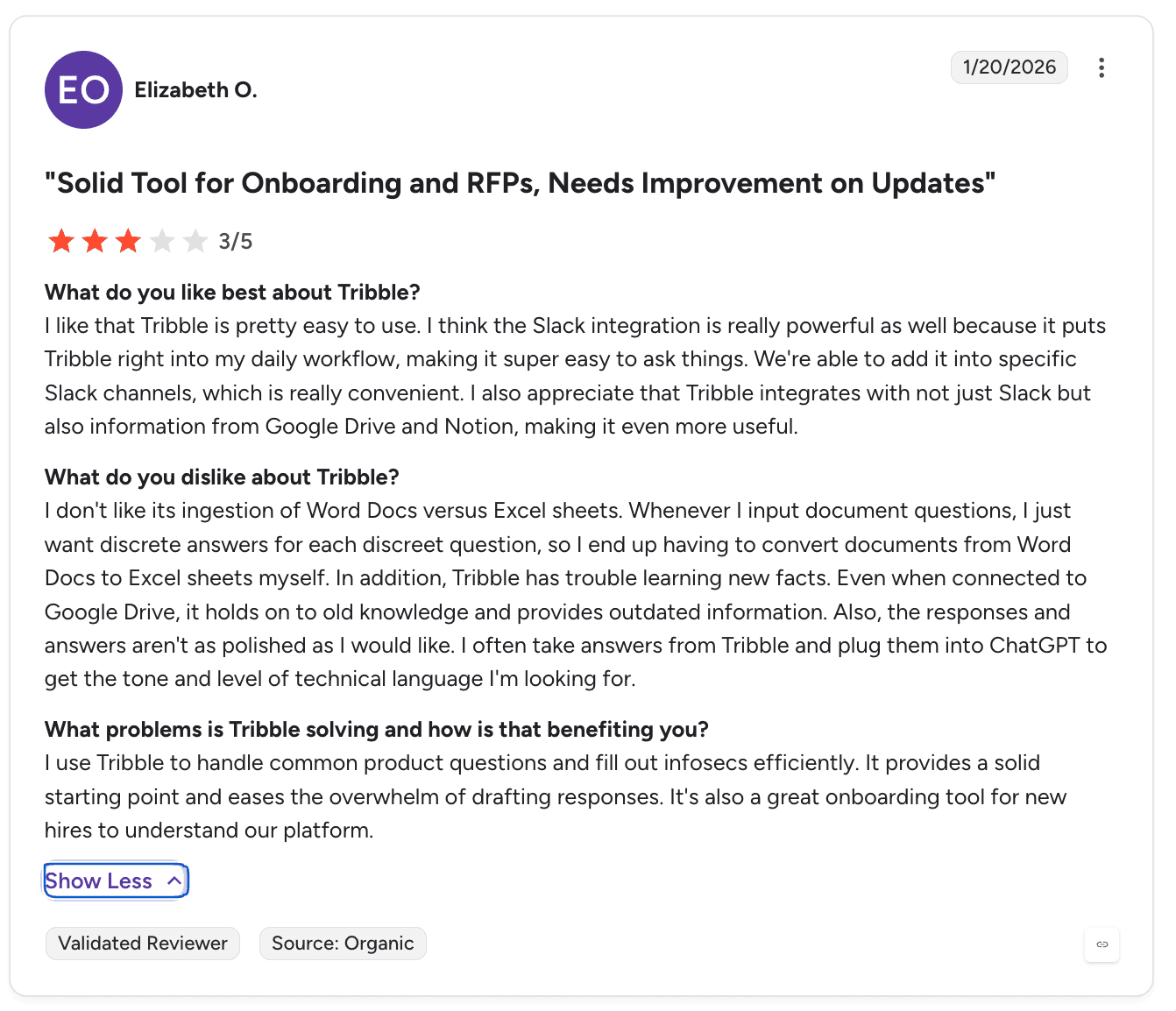
Who Should Switch from Responsive to Tribble?
Enterprise B2B software, security, and financial services teams managing a high and consistent volume of RFPs and DDQs where win-pattern learning is expected to compound meaningfully over 12+ months of use.
Still comparing tools? Most teams identify the right Responsive alternative within one live walkthrough on their actual content. → See Thalamus AI on Your Next RFP
5. HeyIris (Iris AI) - Best Responsive Alternative for Confidence-Scored, Citeable Answers
Switch from Responsive when: Your team's primary frustration is that Responsive's AI suggestions are not citeable or confidence-scored, and presales or sales engineering contributors need auditable answers they can defend, not drafts they have to verify manually.
G2 rating: 4.9 / 5 ↗ G2 (66+ reviews - strongest G2 rating among AI-native tools with meaningful review volume)
Pricing: Per-user; unlimited collaborators. No public pricing.
AI approach: AI-native; document-based retrieval with inline citations and confidence scores on every generated answer.
What HeyIris Does Better Than Responsive?
Inline citation and confidence score on every answer - Every AI-generated response includes a source reference and confidence percentage. For presales teams accountable for accuracy on security questionnaires or technical RFPs, this eliminates a significant manual verification step. Responsive's AI suggests content from the library, but does not tell you how confident it is in that suggestion.
Go/no-go scoring with deal fit and win-rate data - A qualification layer, Responsive does not have, incorporates deal context to help teams make objective bid decisions.
Portal AutoFill for Whistic and BitSight - Native browser extension handles portal-based questionnaires directly. Responsive's strength is Excel and Word format RFPs; portal-native questionnaires are better served by purpose-built tools.
Unlimited collaborators on per-user plans - Reduces the contributor cost friction that Responsive's seat model creates.
4.9/5 G2 rating across 66+ reviews - the most credible, verifiable user satisfaction signal for a modern AI-native tool in this evaluation.
Where HeyIris Falls Short as a Responsive Alternative?
Will not generate answers when the knowledge base coverage is incomplete - Returns "not enough info" rather than generating a plausible answer, honest, but creates mid-bid friction when coverage gaps exist.
No capture planning, RACI routing, addendum tracking, or compliance matrix generation.
No institutional win/loss learning - Answers improve as the knowledge base grows; the platform does not track which content correlates with deal outcomes.
What Real Users Say About HeyIris on G2?
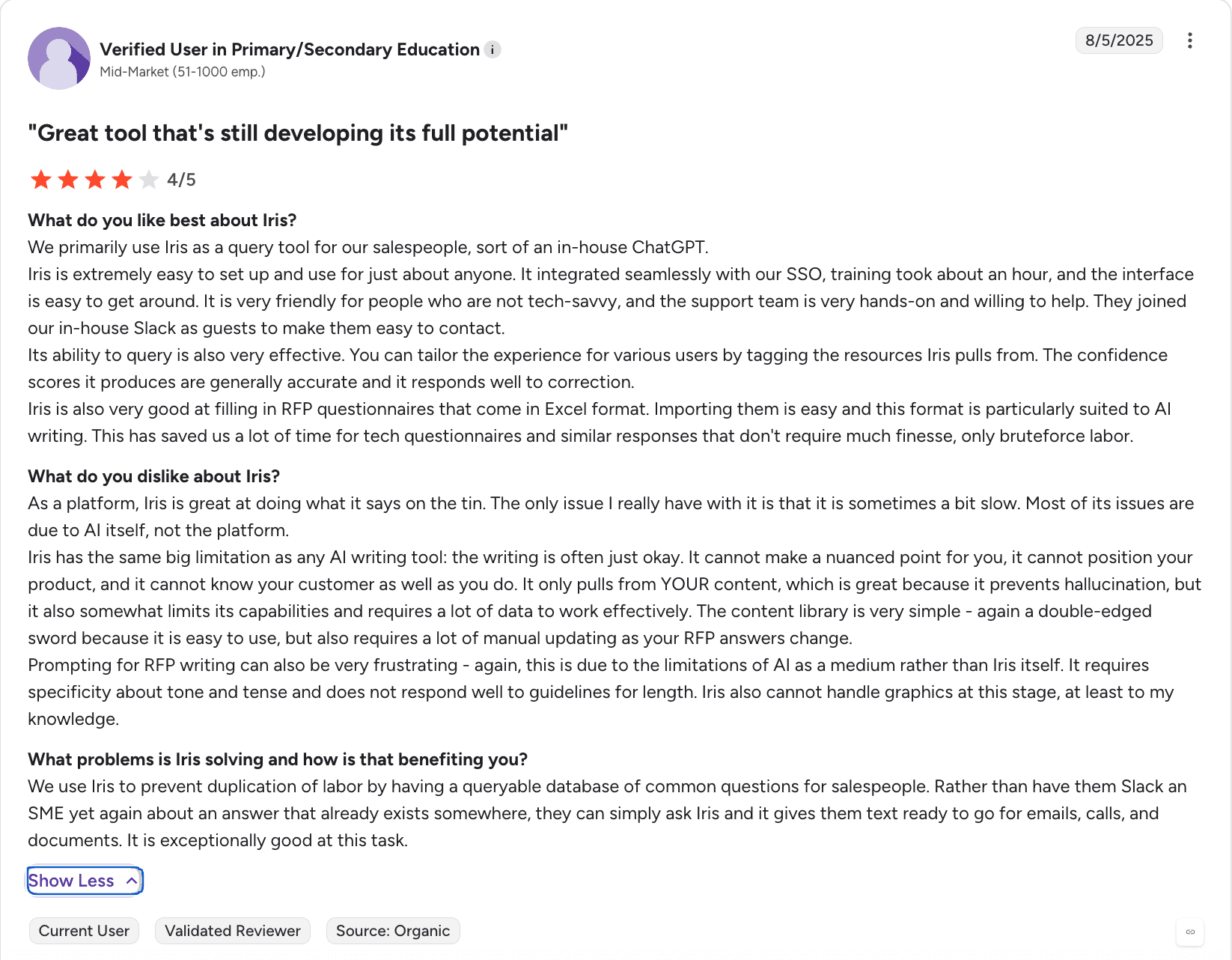
Who Should Switch from Responsive to HeyIris (Iris AI)?
B2B SaaS presales and sales engineering teams switching from Responsive because of AI transparency and citation confidence, who handle a mix of portal-based questionnaires and structured RFPs and need auditable answers with source attribution on every response.
6. Arphie - Best Responsive Alternative for Teams Who Never Want a Content Library Again
Switch from Responsive when: Library maintenance is the primary reason for leaving, and your existing content already lives in well-organized SharePoint, Confluence, Notion, or Seismic rather than in a Responsive Q&A database.
G2 rating: 5 / 5 ↗ G2
Pricing: Custom enterprise; zero data retention policy. No public pricing.
AI approach: AI agents with live integrations to Google Drive, SharePoint, Confluence, Notion, Seismic, Highspot, and web URLs. No Q&A library required.
What Arphie Does Better Than Responsive?
No Q&A library at all - Arphie's AI agents connect directly to live source systems like Google Drive, SharePoint, Confluence, Notion, Seismic, Highspot and retrieve current content at generation time. Answers are only as stale as the source documents, not as stale as the last library maintenance cycle.
Proactive content update suggestions - When connected source documents change, Arphie flags affected answers before they appear in a live bid, addressing the root cause of Responsive library degradation.
Confidence scores and source citations on every answer - Full provenance on every generated response.
Zero data retention policy and SOC 2 Type 2 certification - Strong security positioning for regulated industries.
Where Arphie Falls Short as a Responsive Alternative?
"No library required" does not mean "no knowledge governance required." Answer quality depends on the quality and organization of connected source systems. Poorly structured SharePoint or Confluence produces poorly structured answers.
Narrower workflow configurability than Responsive - No compliance mapping, RACI routing, addendum tracking, or multi-step approval chains comparable to Responsive's workflow depth.
No closed-loop win/loss learning - The knowledge base improves as content is updated, but does not track which answers correlate with deal outcomes.
Custom enterprise pricing - No public pricing; requires a full sales process before cost visibility.
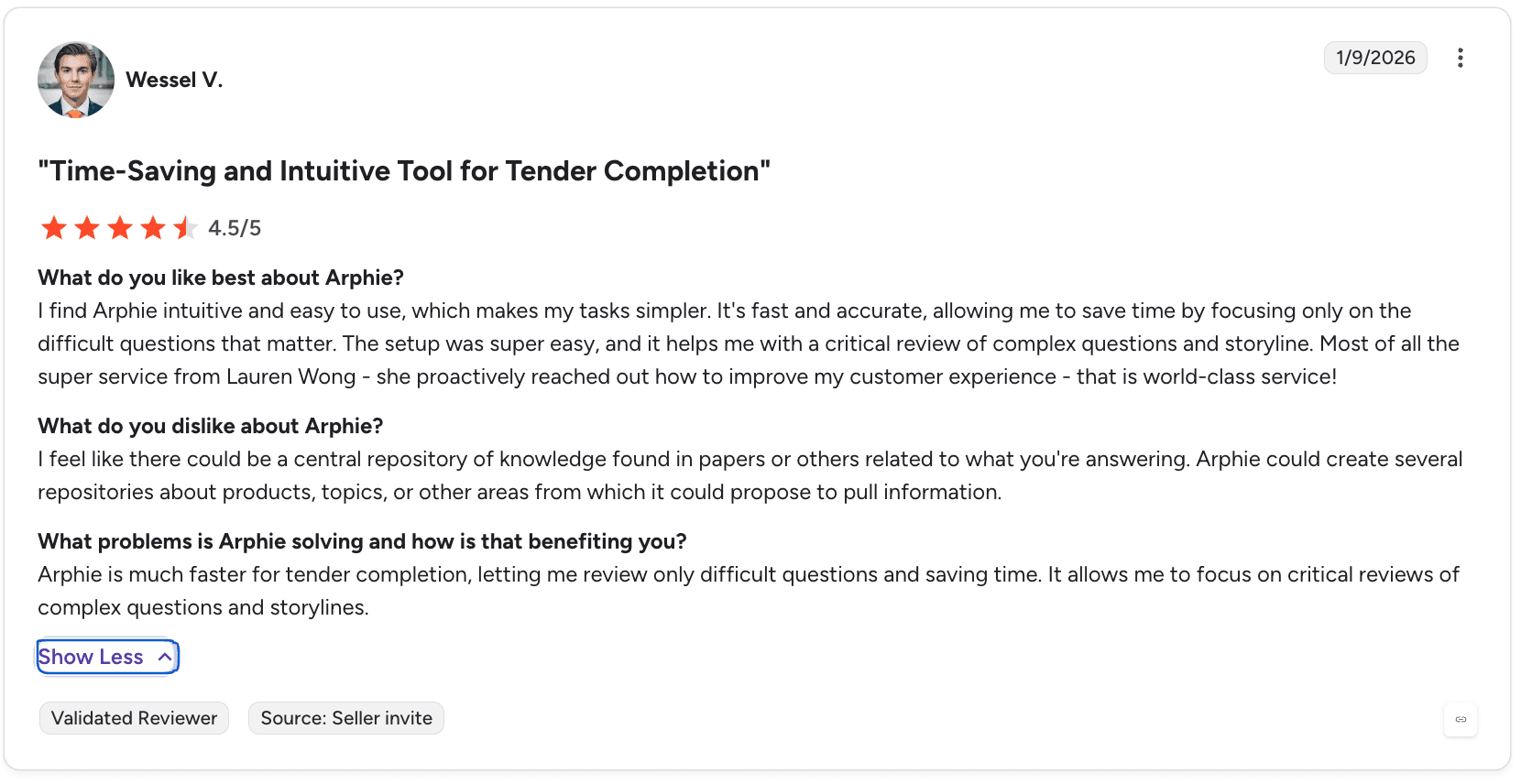
What Real Users Say About Arphie on G2?
Who Should Switch from Responsive to Arphie?
Mid-to-enterprise sales engineering and presales teams switching from Responsive specifically because of library maintenance fatigue, whose content already lives in well-organized live source systems and who want AI answers grounded in current documents without building or migrating a parallel Q&A database.
7. Inventive AI - Best Responsive Alternative for Accuracy-First Teams Prioritising Adoption Speed
Switch from Responsive when: AI accuracy and ease of adoption are the primary pain points, Responsive's AI suggestions require too much manual correction, and non-proposal-professional contributors find the platform too complex to use without training.
G2 rating: 5 / 5 ↗ G2 — claimed #1 easiest-to-use RFP software on G2; 100% customer adoption rate reported
Pricing: No public pricing; contact sales.
AI approach: AI-first; RAG with semantic search. Claims 0% hallucination and 95%+ first-pass accuracy.
What Inventive AI Does Better Than Responsive?
0% hallucination claim, grounded in document-level RAG - Answers generated from a knowledge hub connected to SharePoint, Google Drive, Confluence, and Notion, not from model training data. Directly addresses Responsive's AI limitation: suggestions that are plausible but incorrect when library content is stale.
Real-time conflict detection across documents - Identifies contradictory information across source documents before the AI uses it to generate an answer. Responsive has no equivalent capability.
Claimed #1 easiest-to-use RFP software on G2 with 100% adoption rate - For teams frustrated by Responsive's adoption friction among non-daily users, a 100% adoption claim is the most direct competitive answer.
Proactive staleness detection - The AI Content Manager identifies outdated content and prevents it from appearing in responses without a refresh.
Where Inventive AI Falls Short as a Responsive Alternative?
Response automation tool, not a full lifecycle platform - No capture planning, compliance matrices, RACI routing, addendum tracking, or win/loss institutional learning.
No public pricing. No self-serve evaluation path before engaging sales.
Long-form narrative proposal support is limited for complex multi-document bids requiring structured assembly.
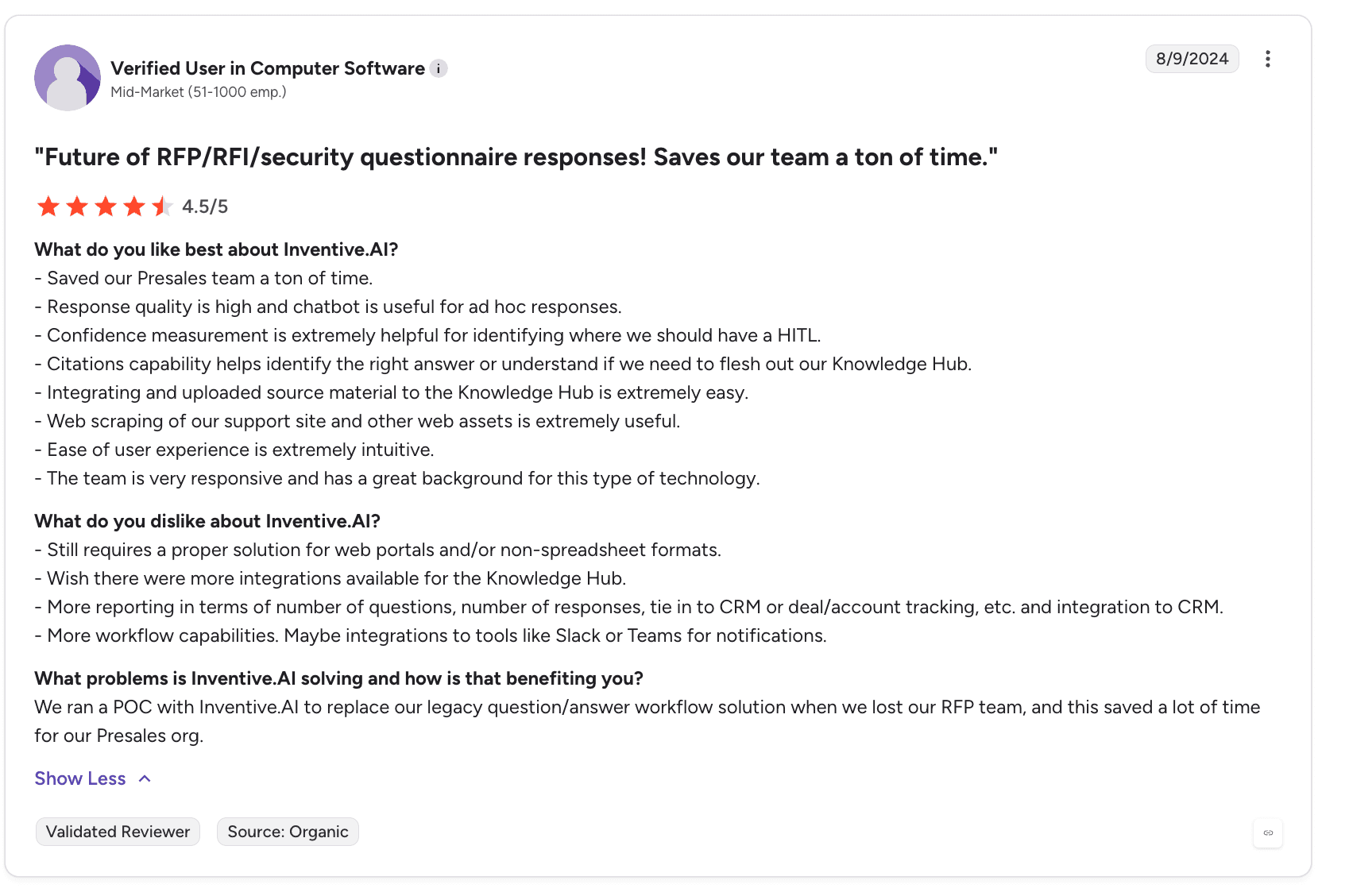
What Real Users Say About Inventive AI on G2?
Who Should Switch from Responsive to Inventive AI?
Fast-moving sales, presales, and proposal teams switching from Responsive because of AI accuracy and adoption friction, who primarily handle structured questionnaires and shorter RFPs and want a modern tool with proactive stale content alerts and the lowest possible onboarding time.
8. AutoRFP AI - Best Responsive Alternative for Transparent, Unlimited-User Pricing
Switch from Responsive when: Per-seat pricing is the primary pain - the bill grows every time a reviewer, SME, or approver needs platform access, and the team is restricting the contributor circle to control cost rather than to improve proposal quality.
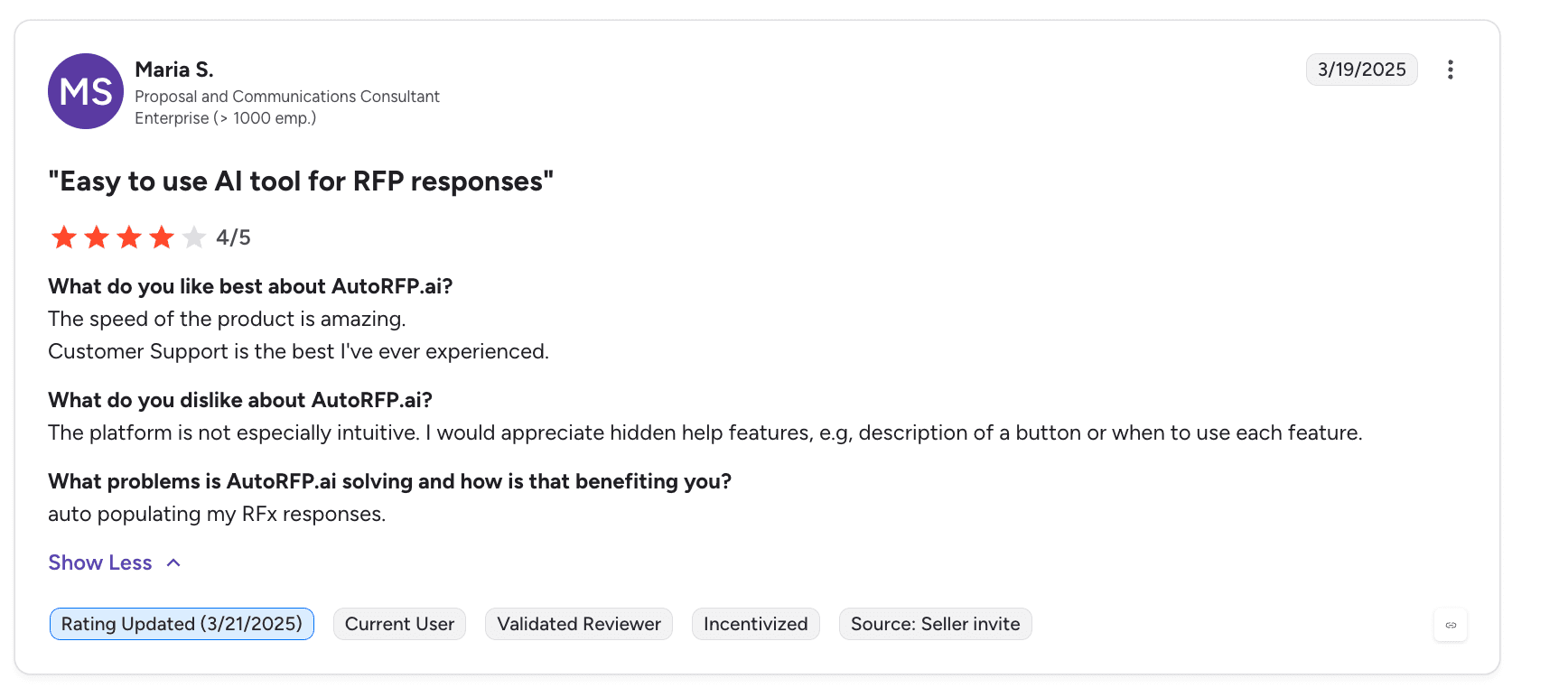
G2 rating: 4.8 / 5 ↗ G2
Pricing: Scale $899/mo (unlimited users), Accelerate $1,299/mo (unlimited users), Enterprise custom. 30-day money-back guarantee.
AI approach: AI-native; RAG + semantic search.
What AutoRFP AI Does Better Than Responsive?
Transparent public pricing with unlimited users - The Scale tier at $899/month for unlimited users is the direct structural alternative to Responsive's seat-based model. The cost does not grow when the contributor circle expands, which removes the disincentive to involve everyone who should be involved in a bid.
30-day money-back guarantee - A genuine pilot option that Responsive does not offer, teams can evaluate on real content without a procurement commitment.
40+ language auto-detection - Broader multilingual coverage than Responsive in the mid-market tier.
Contradiction detection across response sections - Flags inconsistencies before submission, a capability Responsive does not prominently feature.
SOC 2, ISO 27001, and GDPR certifications.
Where AutoRFP AI Falls Short as a Responsive Alternative?
Response acceleration tool, not a full lifecycle platform - No capture planning, compliance matrices, RACI routing, addendum tracking, or institutional learning.
Younger ecosystem - Less established integration footprint and partner network than Responsive.
Not suited for complex long-form narrative proposals.
What Real Users Say About AutoRFP AI on G2?
Who Should Switch from Responsive to AutoRFP AI?
Mid-market presales and sales engineering teams are switching from Responsive primarily because per-seat pricing limits contributor access, who handle primarily structured questionnaires and shorter RFPs, and want a transparent, unlimited-user pricing model with a genuine pilot option.
9. 1Up - Best Responsive Alternative for Small Teams and Slack-Native Workflows
Switch from Responsive when: The team is small (under 10 people), Responsive feels like enterprise infrastructure for a team that does not have enterprise proposal operations, and the path of least resistance is getting answers in Slack or Teams without switching context.
G2 rating: 4.9 / 5 ↗ G2
Pricing: Free plan; Starter $300/mo; Plus $900/mo; Enterprise custom.
AI approach: AI-first knowledge automation; live connectors to approved sources; answers via Slack, Teams, and web interface.
What 1Up Does Better Than Responsive?
Zero learning curve for non-proposal-professional users - 1Up surfaces answers in Slack, Teams, and Google Chat - tools contributors already use daily. For small teams where the proposal function sits inside a sales or business development role rather than a dedicated proposal operations team, this removes the adoption overhead that makes Responsive hard to justify.
Lowest entry price for a purpose-built AI RFP tool - Free plan available; Starter at $300/month. The contrast with Responsive's ~$20K+/year enterprise pricing could not be more direct.
Live connectors - no Q&A library required - 1Up connects to existing knowledge sources in real time. No library to build, no library to maintain.
Self-learning from edits and feedback - The knowledge base improves as the team uses it, without requiring manual curation sprints.
SOC 2 Type II certified; data not used to train AI models.
Where 1Up Falls Short as a Responsive Alternative?
Not designed for complex, multi-stakeholder proposal workflows - No compliance mapping, RACI routing, addendum tracking, bid/no-bid scoring, or institutional learning.
Scales poorly for large enterprise bid teams - The Slack-first interaction model creates coordination gaps at enterprise bid complexity.
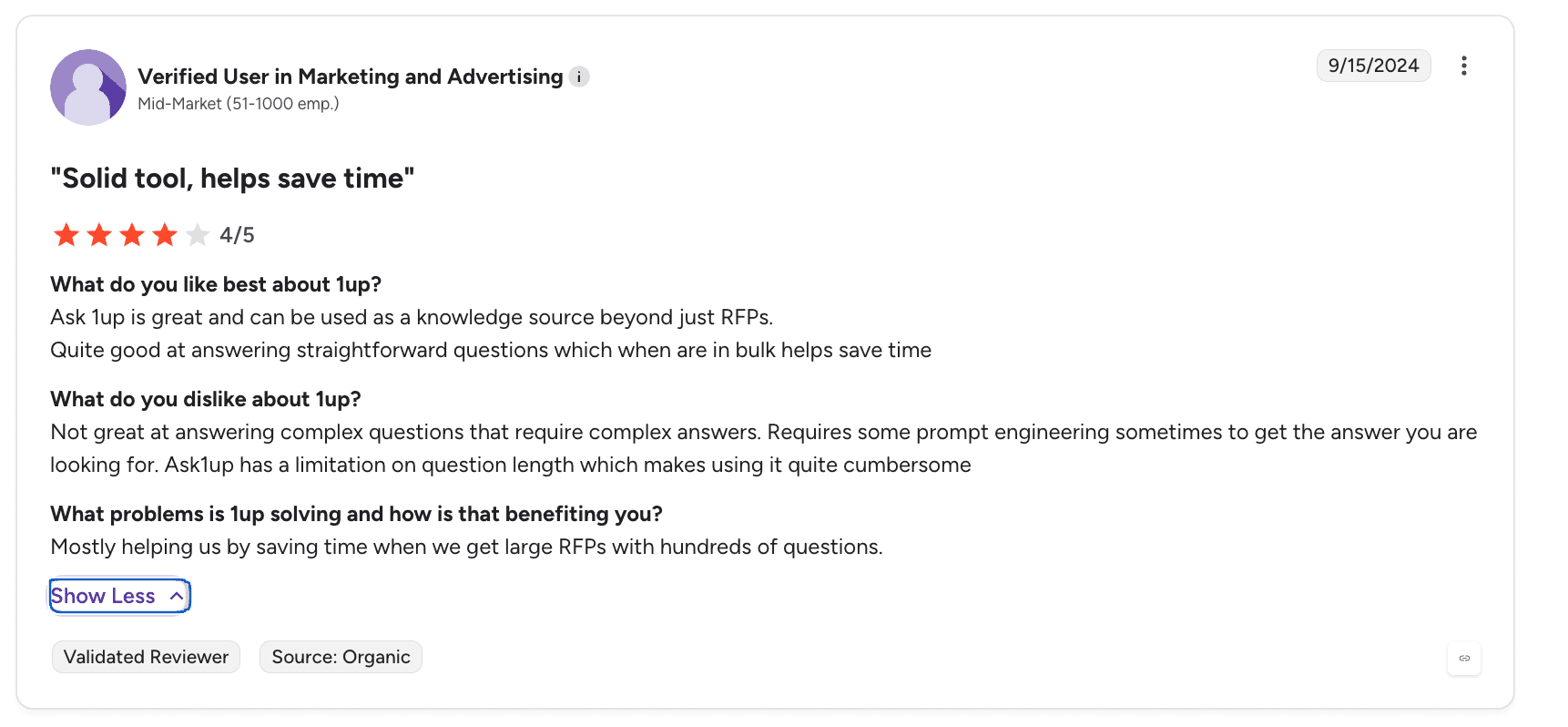
What Real Users Say About 1Up on G2?
Who Should Switch from Responsive to 1Up?
Small-to-mid-market B2B sales, presales, and RevOps teams (under 10 people) for whom Responsive is expensive enterprise infrastructure - who primarily answer questionnaires and short RFPs and want Slack or Teams-native answers without any library to build or maintain.
10. Conveyor - Best Responsive Alternative for Security Questionnaire Automation
Switch from Responsive when: Security questionnaires and vendor portal submissions (Whistic, BitSight) are a primary workflow, and Responsive's Excel/Word-first architecture is not designed for the portal-native security questionnaire format that vendor security reviews increasingly use.
G2 rating: 4.6 / 5 ↗ G2
Pricing: Always-free tier; credit-based professional plans. No seat-based pricing.
AI approach: AI-native for security questionnaire automation; GPT-powered with cited sources and one-click portal auto-complete.
What Conveyor Does Better Than Responsive for Security Questionnaires?
Portal AutoFill for Whistic and BitSight, one click - Conveyor's browser extension handles portal-based security questionnaires directly in the portal interface without copy-paste. Responsive's strength is Excel and Word; portal-native formats are a different workflow that Responsive does not support.
Trust Center that reduces inbound questionnaire volume - A self-serve portal where vendors publish security documentation and pre-answered questionnaires, letting prospects answer their own questions before submitting a formal request. Responsive has no equivalent capability for reducing inbound volume proactively.
Claims 95%+ first-pass accuracy on security DDQs - Validated by 150+ G2 reviews, the highest review volume among AI-native tools in this evaluation.
Always-free tier - Teams can start immediately without a procurement process.
Document-sourced answers, minimal library maintenance - Answers sourced from cited documents rather than a manually curated library.
Where Conveyor Falls Short as a Responsive Alternative?
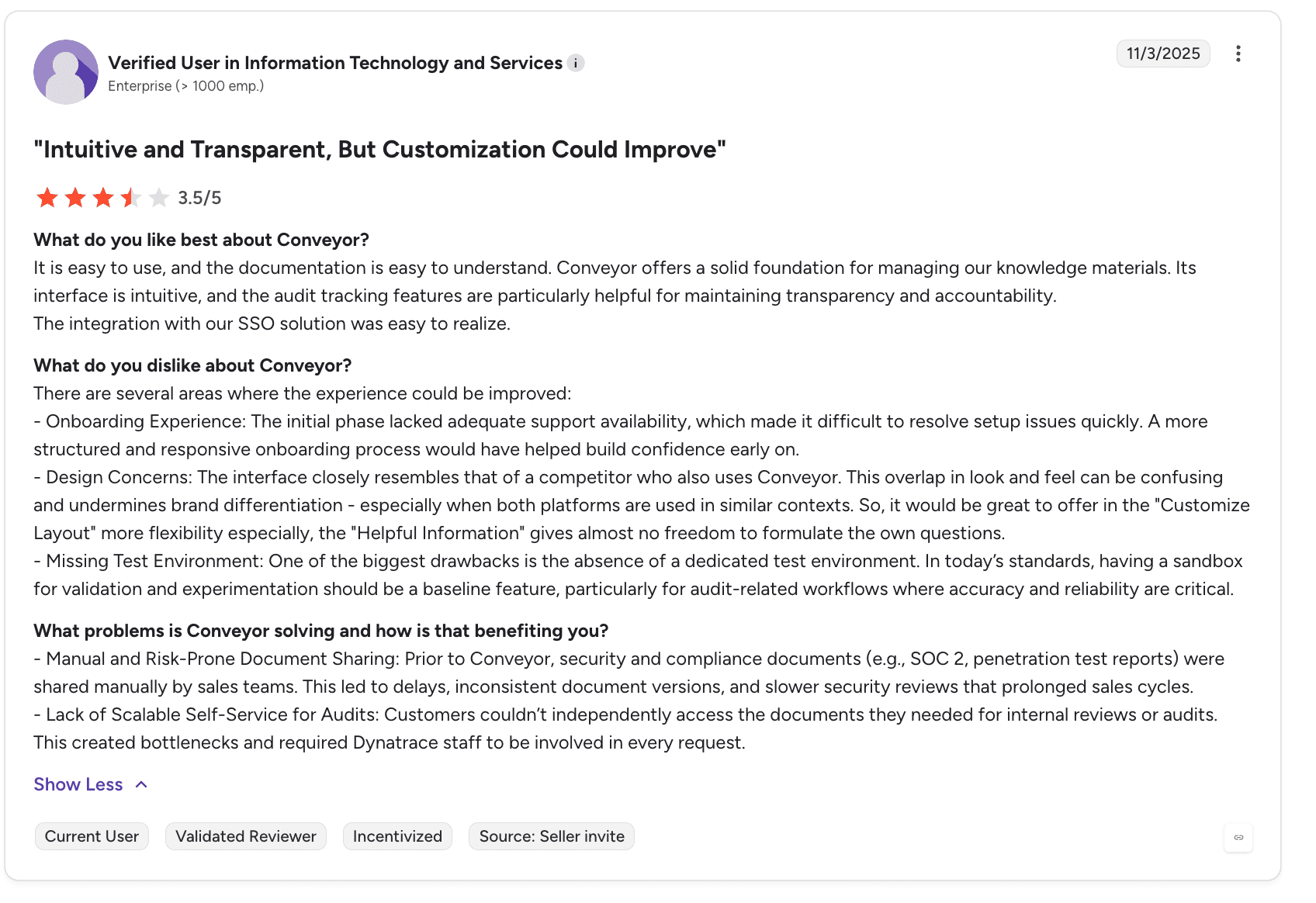
Not an RFP platform - Full RFP response, narrative proposals, complex bid packages, RACI routing, compliance matrices, all outside Conveyor's scope. This is not a full replacement for Responsive; it is a purpose-built tool for the security questionnaire subset of what Responsive covers.
Loading speed issues under peak deadline pressure - G2 reviewers note slow loading times when working against tight submission deadlines.
What Real Users Say About Conveyor on G2?
Who Should Switch from Responsive to Conveyor?
B2B SaaS vendors, startups, and scale-ups for whom security questionnaires and vendor portal submissions are a primary or growing workflow, and who want a purpose-built tool that automates portal responses and reduces inbound questionnaire volume via a Trust Center. Not a full Responsive replacement; a purpose-built complement or replacement for the security questionnaire use case specifically.
How to Choose the Right AI RFP Software Alternative to Responsive?
Map your switch reason to your alternative. Everything else in this guide follows from that one step.
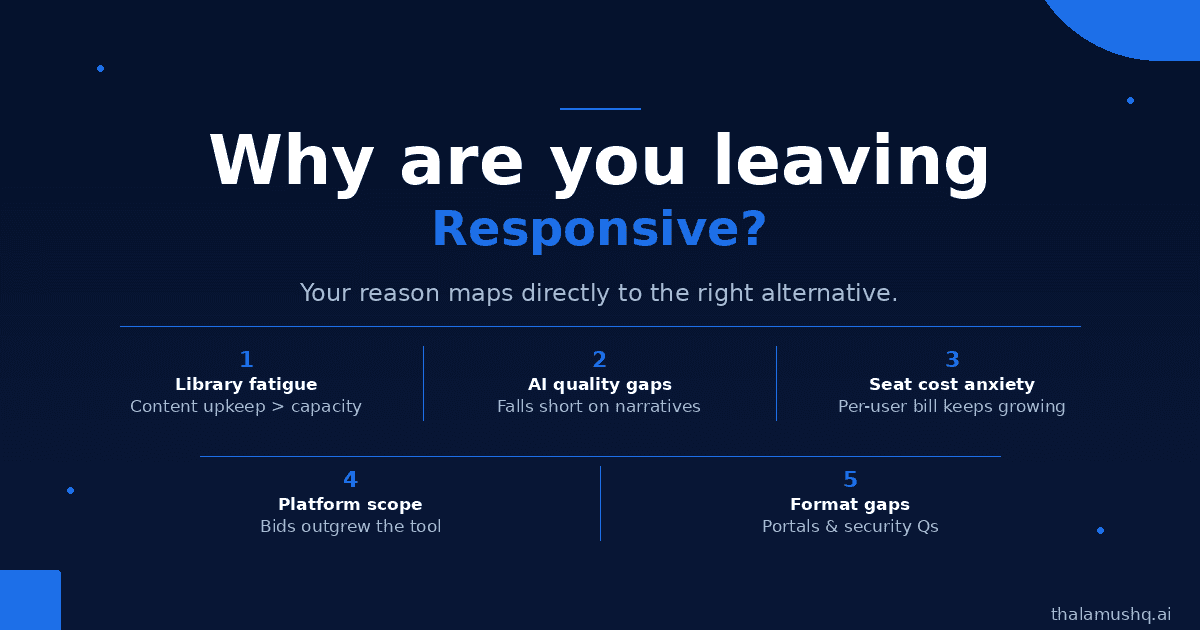
If your reason is library maintenance fatigue → Arphie, 1Up, or Thalamus AI.
If your reason is AI quality on complex proposals → Thalamus AI, AutogenAI, or Tribble.
If your reason is per-seat pricing anxiety → AutoRFP AI, 1Up, or Thalamus AI.
If your reason is lifecycle scope - bids have outgrown response management → Thalamus AI or AutogenAI only.
If your reason is security questionnaire format gaps → Conveyor or HeyIris.
If your reason is UX complexity and SME adoption → Loopio (with the honest caveat above), Inventive AI, or 1Up.
If your reason is more than one of the above, which is common, because the problems compound, prioritise the one that is costing you the most in missed bids or wasted staff time, and choose the alternative that solves that one first.
How to Migrate from Responsive RFPIO? The Practical Guide
This section covers the question that no other Responsive alternatives page answers, and that real teams ask every week in community discussions.
What You Can Export from Responsive?
Responsive allows content library export in structured formats, typically Excel or CSV, containing your Q&A pairs, tags, review status, and metadata. This export is the foundation of any migration. Most alternative platforms accept this format for import.
What Gets Lost in Migration?
Workflow history and project records - Completed RFP projects, assignment history, and approval trails do not transfer to a new platform. These are Responsive-native records.
Custom integration configurations - Salesforce field mappings, Slack workflow automations, and custom API connections are platform-specific and need to be rebuilt in the destination system.
Library quality - This is the most important migration consideration. Exporting a Responsive library that contains stale, duplicated, or poorly tagged content and importing it into a new platform reproduces the problem at a new address. Every migration team that has done this reports the same outcome: the new platform underperforms expectations because the content it was given was already underperforming in Responsive.
The Right Migration Approach from Responsive
Do not migrate everything - Run a library audit before migrating. Identify the 20% of library content that generates 80% of reuse, verified by Responsive's own usage analytics. Retire the remaining 80% rather than carrying it forward. Import only current, verified, high-usage content.
Run parallel on one real bid - Before fully committing to a new platform, run one live RFP end-to-end on the alternative tool while completing it normally on Responsive. Compare time-to-first-draft, edit time, and final output quality. The comparison of real content is more informative than any product demo.
Time the switch around your RFP calendar - The worst time to migrate is in the middle of a high-volume bid quarter. If your program has quieter periods, typically Q1 for many industries, use that window for migration and validation before the next heavy cycle.
For platforms that replace the library model entirely (Arphie, 1Up, Thalamus AI), the migration question is different. These tools connect to live source systems rather than importing a Q&A database. For Thalamus AI specifically, that configuration can also include connecting CRM systems for account context, which isn't something a Q&A export carries over from Responsive in the first place.
The migration is not content; it is a source system connection. If your content is already in SharePoint, Google Drive, or Confluence, the "migration" is a configuration exercise, not a data transfer.
If your answers point toward a full bid lifecycle platform, let's talk through what the switch actually looks like for your team. → Get a Personalised Recommendation
Responsive RFPIO Alternatives FAQ: Real Questions from the Community
What is the best alternative to Responsive RFPIO in 2026?
The best alternative depends on why you are leaving. For teams whose bids have grown complex enough to need compliance matrices, addendum tracking, RACI routing, and post-bid learning: Thalamus AI.
For government contracting and defense teams requiring FedRAMP High security: AutogenAI. For teams switching because of library maintenance fatigue: Arphie or 1Up. For teams switching because of per-seat pricing: AutoRFP.ai. For small teams (under 10 people) for whom Responsive is an enterprise infrastructure, they cannot fully use: 1Up. For security questionnaire automation: Conveyor.
Is Loopio a good alternative to Responsive?
Loopio is a good alternative to Responsive if the primary pain is UX complexity and SME adoption friction as Loopio scores higher on G2 ease of use (9.1/10 vs Responsive's 8.7/10) and has the highest customer support rating in the category (9.7/10).
Loopio is not a good alternative if the primary pain is library maintenance fatigue because Loopio uses the same Q&A library model as Responsive, so the maintenance burden is structurally identical. Teams switching from Responsive to Loopio for the wrong reason will find themselves evaluating alternatives again in 18 months.
Why are teams switching from Responsive RFPIO in 2026?
The five most consistent switch reasons across G2, Capterra, Gartner Peer Insights, and community discussions are: library maintenance overhead that requires more staff time than the team has available; AI quality limitations on complex or novel questions outside the library's coverage; per-seat pricing that limits how broadly the platform can be deployed across contributors; UI inconsistency between the old and new interfaces; and bid complexity growth that has exceeded what a response management platform was designed to cover.
What is the difference between RFPIO and Responsive?
RFPIO rebranded to Responsive in 2022. It is the same company and the same platform with a new name and a broader positioning, from "RFP automation" to "Strategic Response Management." The rebrand accompanied a significant interface overhaul (which G2 reviewers note created UI inconsistency) and the addition of GenAI response generation capabilities.
The core architecture, a governed Q&A content library with workflow automation and AI drafting on top, is the same. If you searched for either "RFPIO alternative" or "Responsive alternative," you are evaluating the same product.
How do I migrate from Responsive RFPIO to another tool?
Export your Responsive content library in Excel or CSV format, the platform supports this natively. Before importing to a new tool, audit the export: identify the 20% of content that generates 80% of reuse, retire the rest. Importing stale or duplicated content into a new platform reproduces the problem at a new address.
For platforms that replace the library model entirely (Arphie, 1Up, Thalamus AI), migration means connecting to live source systems rather than transferring a Q&A database, which is a configuration exercise, not a data migration. Time to switch to a quieter bid period and run at least one live RFP in parallel across both platforms before cutting over.
Is there a free alternative to Responsive RFPIO?
Yes. 1Up offers a genuine free plan with no credit card required, connecting to live knowledge sources and surfacing answers via Slack and Teams. Conveyor has an always-free tier for security questionnaire automation. General-purpose AI tools (ChatGPT, Claude, Gemini) are available at $20–25/month Pro tiers. For teams whose primary need is simple questionnaire volume at low cost, 1Up's free plan is the most capable purpose-built option at zero cost. For enterprise RFP management at the same capability level as Responsive, a free alternative does not currently exist in the market.
Which Responsive alternative is best for small teams?
1Up is the strongest alternative for small teams (under 10 people). It offers a free plan, a Slack-native experience that requires no training, live source connectors that eliminate library maintenance, and a Starter tier at $300/month. For teams of 3–8 people who find Responsive is an enterprise infrastructure they are paying for but not fully using, 1Up delivers the core value - fast answers to questionnaires and short RFPs - without the implementation overhead, content library setup, or per-seat scaling costs.
Does Loopio have the same library maintenance problem as Responsive?
Yes. Loopio uses a Q&A pair content library as its knowledge foundation - the same structural model as Responsive. The maintenance burden (tagging, deduplication, regular review cycles, updating answers when underlying facts change) is structurally identical.
Loopio's automated review signals (flagging stale or duplicate content) reduce the passive degradation somewhat compared to Responsive's more manual model, but the underlying maintenance requirement is the same. Teams switching from Responsive to Loopio for library maintenance reasons will encounter the same root problem.
Is there a Responsive alternative with full bid lifecycle management?
Two tools in this evaluation cover the full bid lifecycle rather than just the response step: Thalamus AI and AutogenAI. Every other tool in this list, including Loopio, Arphie, Tribble, HeyIris, Inventive AI, AutoRFP AI, 1Up, and Conveyor, covers the response management step.
For teams whose primary frustration with Responsive is that it does not cover capture planning, bid/no-bid scoring, compliance matrix generation, addendum tracking, and post-bid institutional learning, the choice is between those two platforms. See our 12 Best AI RFP Software Tools in 2026 for a full comparison.
We like Responsive's workflow, but want better AI. Do we have to switch everything?
Not necessarily. The question is whether the AI limitation is architectural (retrieval from a static library that cannot reason across documents or learn from outcomes) or configurational (the library is outdated and the AI is surfacing stale content). If the library is the problem, a library cleanup and governance improvement may fix the AI output quality without switching platforms.
If the architecture is the problem, you need cross-document reasoning, compliance tracking, or win-pattern learning, then the AI improvement requires a platform change, because those capabilities require a different knowledge architecture underneath. The Thalamus AI vs Loopio comparison maps this distinction in detail.
What is the best Responsive alternative for enterprise proposal teams?
For enterprise proposal teams that need full bid lifecycle management, Thalamus AI is one of the strongest Responsive alternatives. It supports bid/no-bid qualification, requirement mapping, compliance matrices, addendum tracking, RACI routing, SME collaboration, portal responses, and post-bid learning. For teams focused only on structured questionnaire response, Loopio, AutoRFP, 1Up, or Conveyor may be a better fit.
What is the best Responsive alternative with no seat-based pricing?
Responsive uses a seat-based model, which can become expensive as more SMEs, reviewers, and approvers join the bid process. Alternatives with more scalable pricing models include Thalamus AI, AutoRFP, and 1Up, depending on team size, workflow complexity, and whether the team needs full bid lifecycle coverage or only response automation.
What is the best Responsive alternative for compliance matrices and addendum tracking?
Thalamus AI is a strong fit for teams that need compliance matrix generation, requirement mapping, addendum impact tracking, an AI Clarification Register for open questions, and subsection-level RACI routing. These capabilities are important when bids involve changing requirements, multiple documents, and many SMEs.
The Bottom Line on Responsive RFPIO Alternatives in 2026
Responsive is the most established, most reviewed platform in the RFP software category. The teams that outgrow it are not teams for whom Responsive failed, they are teams whose bids have grown more complex than a response management platform was designed to handle, or teams for whom the economics of a library-first, seat-based model no longer add up at their current scale.
The right alternative is not the one with the best feature list on paper. It is the one that was built to solve the specific problem that Responsive is no longer solving for your team.
If that problem is bid complexity, if your team is managing compliance, addenda, and stakeholder coordination in spreadsheets alongside Responsive, the next step is not another response management tool. It is a 30-minute walkthrough on your actual content, against your actual requirements, in your actual bid workflow.
Your next complex bid deserves more than a smarter library. → Book Your Demo