Informational

Informational

12 mins

12 mins

Bid No Bid Decision Process: Complete Checklist and Template (2026)

Bid No Bid Decision Process: Complete Checklist and Template (2026)

Bid No Bid Decision Process: Complete Checklist and Template (2026)

Bid No Bid Decision Process: Complete Checklist and Template (2026)

Harpreet Singh, MBA

Founder, Thalamus AI

With 12+ years in AI and enterprise software, including GenAI product work at Travelers Group, Harpreet writes about AI RFP software, AI bid tools, proposal operations, RFP response automation, and the future of enterprise bid management.

Summarize with ChatGPT

Summarize with ChatGPT

Key Takeaways

  • The bid no-bid decision process is a structured evaluation that determines whether to invest resources in responding to a specific RFP or bid. Teams that apply it consistently achieve win rates of 40-60%, compared with the 10-20% average for teams that chase every opportunity without a framework.

  • The bid/no-bid checklist is the practical tool that makes the process repeatable with a set of scored questions across strategic fit, competitive position, technical capability, resource capacity, financial viability, and risk that converts a gut-feel judgment into a documented, defensible recommendation.

  • A complete bid-no-bid process takes one to two hours for a standard opportunity. For complex, high-value bids, it can take a day. That investment prevents 20 to 100 hours of proposal writing on an opportunity the team should never have bid on.

  • The result of the bid/no-bid process is one of three outcomes: bid (full resources committed), no bid (decline formally with a no-bid letter), or conditional bid (pursue only if specific conditions are met).

  • This guide includes a 30-question inline checklist, a decision matrix template, and a no-bid letter template, all embedded on this page, with no download required.

  • People searching for “bid no bid,” “bid no bid decision,” “bid no bid checklist,” or “go no go decision” are usually trying to answer the same question: should this opportunity receive full proposal resources, conditional pursuit, or a formal no-bid response?

  • Thalamus AI makes the bid/no-bid decision process more repeatable by letting teams configure their own bid/no-bid matrix, weighted scoring criteria, and no-go conditions. AI agents then extract RFP requirements, search approved knowledge sources for supporting evidence, and create a traceable qualification view that helps teams decide whether to bid, no-bid, or pursue a conditional bid.

Summarize with ChatGPT

Key Takeaways

Key Takeaways

Key Takeaways

  • The bid no-bid decision process is a structured evaluation that determines whether to invest resources in responding to a specific RFP or bid. Teams that apply it consistently achieve win rates of 40-60%, compared with the 10-20% average for teams that chase every opportunity without a framework.

  • The bid/no-bid checklist is the practical tool that makes the process repeatable with a set of scored questions across strategic fit, competitive position, technical capability, resource capacity, financial viability, and risk that converts a gut-feel judgment into a documented, defensible recommendation.

  • A complete bid-no-bid process takes one to two hours for a standard opportunity. For complex, high-value bids, it can take a day. That investment prevents 20 to 100 hours of proposal writing on an opportunity the team should never have bid on.

  • The result of the bid/no-bid process is one of three outcomes: bid (full resources committed), no bid (decline formally with a no-bid letter), or conditional bid (pursue only if specific conditions are met).

  • This guide includes a 30-question inline checklist, a decision matrix template, and a no-bid letter template, all embedded on this page, with no download required.

  • People searching for “bid no bid,” “bid no bid decision,” “bid no bid checklist,” or “go no go decision” are usually trying to answer the same question: should this opportunity receive full proposal resources, conditional pursuit, or a formal no-bid response?

  • Thalamus AI makes the bid/no-bid decision process more repeatable by letting teams configure their own bid/no-bid matrix, weighted scoring criteria, and no-go conditions. AI agents then extract RFP requirements, search approved knowledge sources for supporting evidence, and create a traceable qualification view that helps teams decide whether to bid, no-bid, or pursue a conditional bid.

  • The bid no-bid decision process is a structured evaluation that determines whether to invest resources in responding to a specific RFP or bid. Teams that apply it consistently achieve win rates of 40-60%, compared with the 10-20% average for teams that chase every opportunity without a framework.

  • The bid/no-bid checklist is the practical tool that makes the process repeatable with a set of scored questions across strategic fit, competitive position, technical capability, resource capacity, financial viability, and risk that converts a gut-feel judgment into a documented, defensible recommendation.

  • A complete bid-no-bid process takes one to two hours for a standard opportunity. For complex, high-value bids, it can take a day. That investment prevents 20 to 100 hours of proposal writing on an opportunity the team should never have bid on.

  • The result of the bid/no-bid process is one of three outcomes: bid (full resources committed), no bid (decline formally with a no-bid letter), or conditional bid (pursue only if specific conditions are met).

  • This guide includes a 30-question inline checklist, a decision matrix template, and a no-bid letter template, all embedded on this page, with no download required.

  • People searching for “bid no bid,” “bid no bid decision,” “bid no bid checklist,” or “go no go decision” are usually trying to answer the same question: should this opportunity receive full proposal resources, conditional pursuit, or a formal no-bid response?

  • Thalamus AI makes the bid/no-bid decision process more repeatable by letting teams configure their own bid/no-bid matrix, weighted scoring criteria, and no-go conditions. AI agents then extract RFP requirements, search approved knowledge sources for supporting evidence, and create a traceable qualification view that helps teams decide whether to bid, no-bid, or pursue a conditional bid.

Quick Answer: What Is a Bid No-Bid Decision?

Quick Answer: What Is a Bid No-Bid Decision?

A bid no-bid decision is the structured process a proposal, sales, or bid team uses to decide whether an RFP is worth pursuing. Instead of relying on gut feel, teams score the opportunity across strategic fit, competitive position, technical capability, resource capacity, financial viability, and risk.

A strong bid no-bid checklist helps teams decide whether to bid, no-bid, or pursue a conditional bid. The goal is not to reduce ambition. The goal is to focus proposal resources on opportunities the team can realistically win.

The best bid no-bid decision process includes a scored checklist, a decision matrix, documented reasoning, stakeholder sign-off, and a professional no-bid letter when the team decides not to respond.

Thalamus AI supports the bid/no-bid decision by turning the RFP into a scored, evidence-backed qualification workflow. Teams can configure their own bid/no-bid matrix, define weighted criteria, set no-go conditions, and use AI agents to extract RFP requirements, find supporting evidence, assess fit, and produce a traceable recommendation before drafting begins.

A bid no-bid decision is the structured process a proposal, sales, or bid team uses to decide whether an RFP is worth pursuing. Instead of relying on gut feel, teams score the opportunity across strategic fit, competitive position, technical capability, resource capacity, financial viability, and risk.

A strong bid no-bid checklist helps teams decide whether to bid, no-bid, or pursue a conditional bid. The goal is not to reduce ambition. The goal is to focus proposal resources on opportunities the team can realistically win.

The best bid no-bid decision process includes a scored checklist, a decision matrix, documented reasoning, stakeholder sign-off, and a professional no-bid letter when the team decides not to respond.

Thalamus AI supports the bid/no-bid decision by turning the RFP into a scored, evidence-backed qualification workflow. Teams can configure their own bid/no-bid matrix, define weighted criteria, set no-go conditions, and use AI agents to extract RFP requirements, find supporting evidence, assess fit, and produce a traceable recommendation before drafting begins.

What Is the Bid No Bid Decision Process?

What Is the Bid No Bid Decision Process?

The bid no bid decision (also written as bid/no-bid, go/no-go, or bid or no bid) is the structured evaluation process that organizations use before committing resources to an RFP response. 

It answers one question: given everything we know about this opportunity, our competitive position, and our current capacity - should we invest the time and money required to prepare a competitive bid?

That question matters more than most proposal teams acknowledge. Responding to a competitive RFP typically costs between $5,000 and $50,000 or more in staff time, depending on complexity. 

A 150-page government proposal can consume 400 to 600 hours across writers, subject matter experts, reviewers, and coordinators. For teams managing five to ten concurrent bids, every commitment is simultaneously a decision not to pursue something else.

Teams that bid on every opportunity they receive without a systematic evaluation typically win 10 to 20 percent of what they submit. Teams that apply a consistent bid-no-bid framework, focusing resources on opportunities they have a genuine chance of winning, achieve win rates of 40 to 60 percent. The difference is not the quality of their writing. It is the quality of their selection.

The bid/no-bid decision process is how high-performing bid teams protect their most limited resource, their people's time, and focus it on opportunities that are actually worth winning.

The bid no bid decision (also written as bid/no-bid, go/no-go, or bid or no bid) is the structured evaluation process that organizations use before committing resources to an RFP response. 

It answers one question: given everything we know about this opportunity, our competitive position, and our current capacity - should we invest the time and money required to prepare a competitive bid?

That question matters more than most proposal teams acknowledge. Responding to a competitive RFP typically costs between $5,000 and $50,000 or more in staff time, depending on complexity. 

A 150-page government proposal can consume 400 to 600 hours across writers, subject matter experts, reviewers, and coordinators. For teams managing five to ten concurrent bids, every commitment is simultaneously a decision not to pursue something else.

Teams that bid on every opportunity they receive without a systematic evaluation typically win 10 to 20 percent of what they submit. Teams that apply a consistent bid-no-bid framework, focusing resources on opportunities they have a genuine chance of winning, achieve win rates of 40 to 60 percent. The difference is not the quality of their writing. It is the quality of their selection.

The bid/no-bid decision process is how high-performing bid teams protect their most limited resource, their people's time, and focus it on opportunities that are actually worth winning.

Why the Bid/No-Bid Decision Matters More Than Most Teams Think?

Why the Bid/No-Bid Decision Matters More Than Most Teams Think?

Why the Bid/No-Bid Decision Matters More Than Most Teams Think?

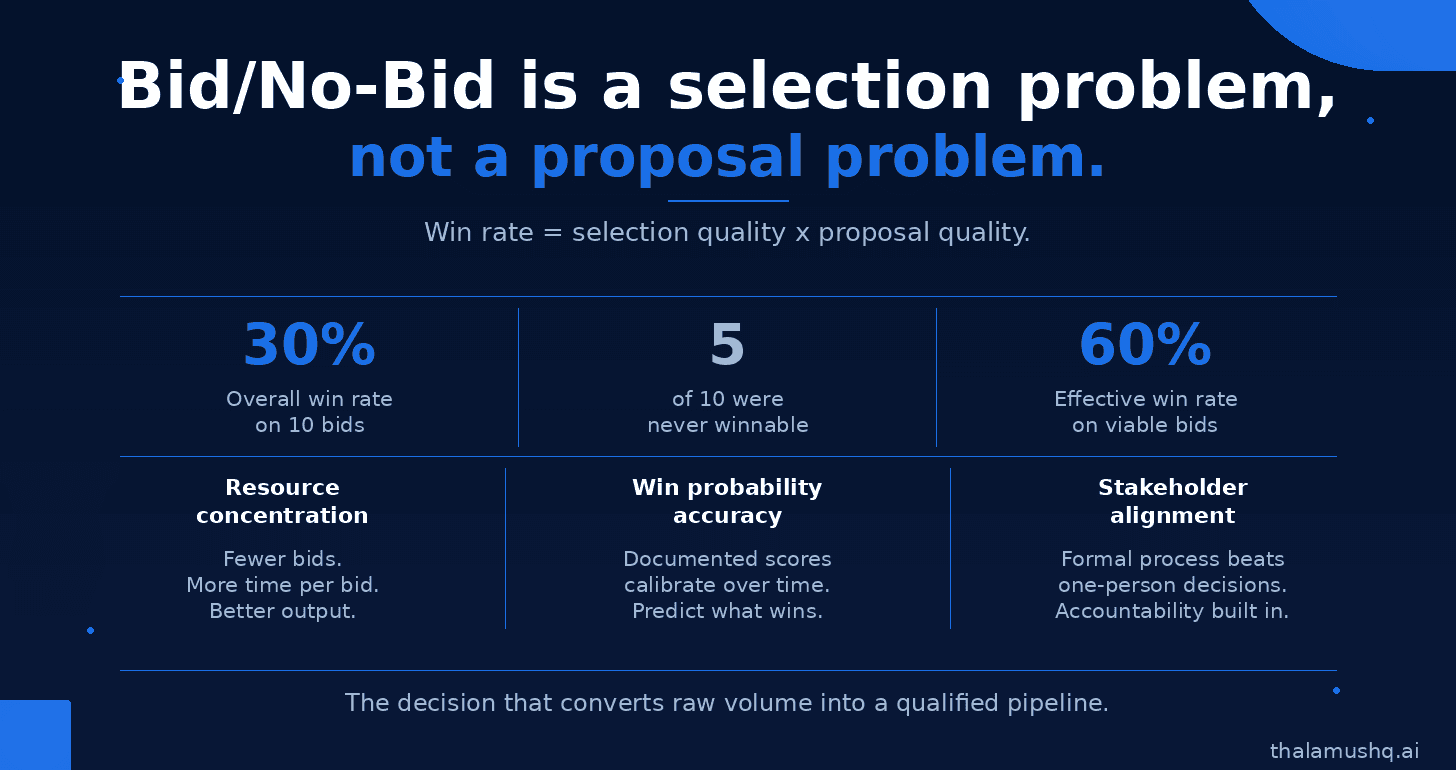
Most proposal teams think of their win rate as a product of proposal quality. In reality, it is a product of selection quality multiplied by proposal quality.

A team that bids on ten opportunities and wins three has a 30% win rate. If five of those ten opportunities were ones they had no realistic chance of winning due to incumbent relationships, pricing position, missing past performance, or misaligned capabilities, then their effective win rate on viable opportunities is actually three out of five, or 60%. The same team is simultaneously underperforming (30% overall) and overperforming (60% on viable opportunities) depending on how you measure.

The bid no-bid decision converts raw volume into a qualified pipeline. It does not reduce the number of bids; it reduces the number of bids that were never winnable in the first place.

Three specific benefits apply consistently across industries and team sizes:

Bid resource concentration - When the proposal team pursues fewer, better-qualified opportunities, each bid receives more time, more research, more stakeholder input, and higher-quality output. The proposal is better because the team was not simultaneously writing four others that never had a chance.

Win probability accuracy - A documented bid-no-bid evaluation creates a record of why each opportunity was pursued. Over time, teams can calibrate their scoring models against actual outcomes, understanding which criteria were most predictive of wins and which were leading indicators of losses.

Stakeholder alignment - The bid/no-bid decision that is made by one person in their head and the one that is documented, scored, and signed off by a proposal manager, a business development lead, and a delivery principal are fundamentally different in terms of accountability. A formal process prevents the "we should just do it" culture that bypasses rational evaluation.

Start responding to the right RFPs from the moment they land, with automated bid/no-bid analysis built into the workflow. → See How Thalamus AI Qualifies Bids

Most proposal teams think of their win rate as a product of proposal quality. In reality, it is a product of selection quality multiplied by proposal quality.

A team that bids on ten opportunities and wins three has a 30% win rate. If five of those ten opportunities were ones they had no realistic chance of winning due to incumbent relationships, pricing position, missing past performance, or misaligned capabilities, then their effective win rate on viable opportunities is actually three out of five, or 60%. The same team is simultaneously underperforming (30% overall) and overperforming (60% on viable opportunities) depending on how you measure.

The bid no-bid decision converts raw volume into a qualified pipeline. It does not reduce the number of bids; it reduces the number of bids that were never winnable in the first place.

Three specific benefits apply consistently across industries and team sizes:

Bid resource concentration - When the proposal team pursues fewer, better-qualified opportunities, each bid receives more time, more research, more stakeholder input, and higher-quality output. The proposal is better because the team was not simultaneously writing four others that never had a chance.

Win probability accuracy - A documented bid-no-bid evaluation creates a record of why each opportunity was pursued. Over time, teams can calibrate their scoring models against actual outcomes, understanding which criteria were most predictive of wins and which were leading indicators of losses.

Stakeholder alignment - The bid/no-bid decision that is made by one person in their head and the one that is documented, scored, and signed off by a proposal manager, a business development lead, and a delivery principal are fundamentally different in terms of accountability. A formal process prevents the "we should just do it" culture that bypasses rational evaluation.

Start responding to the right RFPs from the moment they land, with automated bid/no-bid analysis built into the workflow. → See How Thalamus AI Qualifies Bids

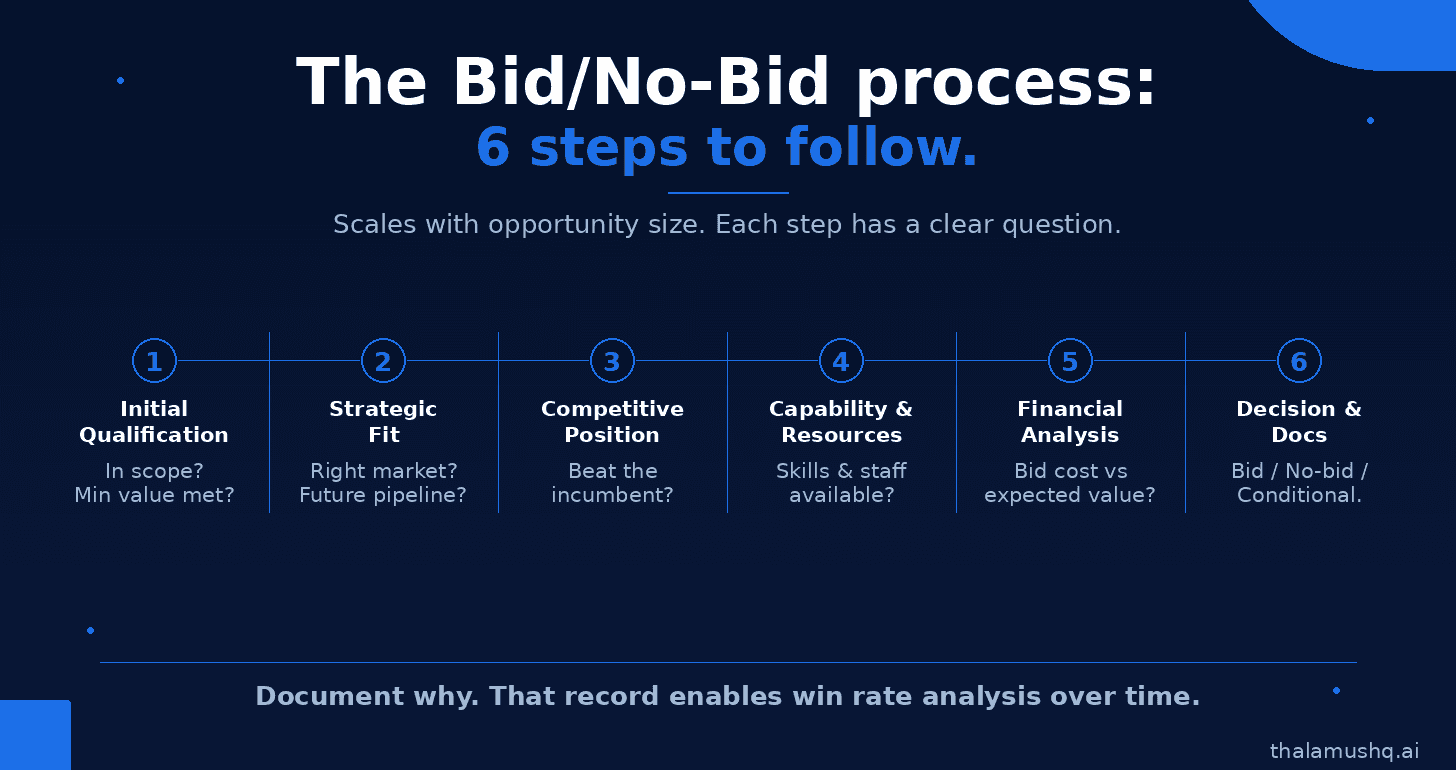
The Bid/No-Bid Decision Process: 6 Steps to Follow

The Bid/No-Bid Decision Process: 6 Steps to Follow

The Bid/No-Bid Decision Process: 6 Steps to Follow

A consistent bid/no-bid process covers six sequential steps. The time each step takes scales with opportunity size and complexity; a $50,000 professional services engagement requires a lighter pass than a $10M government contract.

Step 1 - Initial Opportunity Qualification

Before investing any analysis time, apply three disqualifying filters. If any is a hard no, stop here.

  • Does this opportunity fall within our stated capability and service scope?

  • Is the anticipated contract value above our minimum threshold?

  • Can we meet the submission deadline given current workload?

These three questions take five minutes and eliminate a meaningful share of opportunities before any deeper analysis begins. For teams receiving a high volume of RFP notifications, this triage step prevents the evaluation backlog that buries bid teams.

Step 2 - Strategic Fit Assessment

Does this opportunity advance the organization's stated strategic priorities? Not every winnable opportunity is worth winning. An opportunity that draws resources away from higher-margin work, opens a market the organization does not want to develop, or creates a strategically misaligned client relationship should score low on strategic fit even if it passes the technical qualification filter.

Evaluate: buyer relationship history, sector alignment, contract type compatibility, geographic fit, and whether winning this opportunity positions the organization for future work it actually wants.

Step 3 - Competitive Position Analysis

The most important question in bid or no-bid is not "can we do this?" but "can we beat the likely alternatives?" A team that can technically deliver the work but is competing against an incumbent with a 10-year relationship and deep client knowledge should score their competitive position honestly, and frequently; that honest score should yield a no-bid recommendation.

Evaluate: incumbent status (who has the work now and why might it change), known competitor strengths and weaknesses, client relationship access, prior work with this buyer, and whether the organization has a genuinely differentiated offer for this specific evaluation.

Step 4 - Technical Capability and Resource Check

Can the team actually do this work, with the people it has available, to the standard required? Two distinct questions are hidden inside this step. Technical capability - do we have the expertise, past performance, certifications, and methodology the RFP requires? Resource capacity: do we have the staff time to write the bid and deliver the contract, simultaneously, without compromising either?

Evaluate: mandatory requirements compliance, past performance evidence quality, key personnel availability, proposal team bandwidth against the submission timeline, and delivery capacity against the contract start date.

Step 5 - Financial Analysis and Risk Assessment

Every bid represents a financial bet: bid preparation cost invested against the expected value of winning (contract value × probability of win). If the expected value does not exceed the bid cost by a comfortable margin, the economics argue against pursuing the opportunity, regardless of how winnable it appears.

Evaluate: estimated bid preparation cost, contract value and duration, anticipated margin, payment terms and cash flow compatibility, and the risk-adjusted expected value calculation. Separately, assess the risks of winning: scope creep exposure, delivery risk, reputational risk if the engagement goes poorly.

Step 6 - Decision, Documentation, and Communication

The outcome of the process is one of three recommendations:

Bid - resources committed, proposal plan initiated, owner assigned, and calendar blocked.

No bid - decision documented, reasons recorded, and a no bid letter sent to the buyer within 48 hours of the decision.

Conditional bid - pursue only if specific conditions are met (e.g., a teaming partner is confirmed, a pricing concession is obtained, or the timeline is extended). The conditions should be specific, named, and assigned to an owner with a deadline.

The decision documentation, why the team bid or did not bid, is as important as the decision itself. Over time, this record enables win rate analysis, scoring model calibration, and evidence-based pipeline management that most teams currently cannot do because the reasoning behind historical decisions was never captured.

A consistent bid/no-bid process covers six sequential steps. The time each step takes scales with opportunity size and complexity; a $50,000 professional services engagement requires a lighter pass than a $10M government contract.

Step 1 - Initial Opportunity Qualification

Before investing any analysis time, apply three disqualifying filters. If any is a hard no, stop here.

  • Does this opportunity fall within our stated capability and service scope?

  • Is the anticipated contract value above our minimum threshold?

  • Can we meet the submission deadline given current workload?

These three questions take five minutes and eliminate a meaningful share of opportunities before any deeper analysis begins. For teams receiving a high volume of RFP notifications, this triage step prevents the evaluation backlog that buries bid teams.

Step 2 - Strategic Fit Assessment

Does this opportunity advance the organization's stated strategic priorities? Not every winnable opportunity is worth winning. An opportunity that draws resources away from higher-margin work, opens a market the organization does not want to develop, or creates a strategically misaligned client relationship should score low on strategic fit even if it passes the technical qualification filter.

Evaluate: buyer relationship history, sector alignment, contract type compatibility, geographic fit, and whether winning this opportunity positions the organization for future work it actually wants.

Step 3 - Competitive Position Analysis

The most important question in bid or no-bid is not "can we do this?" but "can we beat the likely alternatives?" A team that can technically deliver the work but is competing against an incumbent with a 10-year relationship and deep client knowledge should score their competitive position honestly, and frequently; that honest score should yield a no-bid recommendation.

Evaluate: incumbent status (who has the work now and why might it change), known competitor strengths and weaknesses, client relationship access, prior work with this buyer, and whether the organization has a genuinely differentiated offer for this specific evaluation.

Step 4 - Technical Capability and Resource Check

Can the team actually do this work, with the people it has available, to the standard required? Two distinct questions are hidden inside this step. Technical capability - do we have the expertise, past performance, certifications, and methodology the RFP requires? Resource capacity: do we have the staff time to write the bid and deliver the contract, simultaneously, without compromising either?

Evaluate: mandatory requirements compliance, past performance evidence quality, key personnel availability, proposal team bandwidth against the submission timeline, and delivery capacity against the contract start date.

Step 5 - Financial Analysis and Risk Assessment

Every bid represents a financial bet: bid preparation cost invested against the expected value of winning (contract value × probability of win). If the expected value does not exceed the bid cost by a comfortable margin, the economics argue against pursuing the opportunity, regardless of how winnable it appears.

Evaluate: estimated bid preparation cost, contract value and duration, anticipated margin, payment terms and cash flow compatibility, and the risk-adjusted expected value calculation. Separately, assess the risks of winning: scope creep exposure, delivery risk, reputational risk if the engagement goes poorly.

Step 6 - Decision, Documentation, and Communication

The outcome of the process is one of three recommendations:

Bid - resources committed, proposal plan initiated, owner assigned, and calendar blocked.

No bid - decision documented, reasons recorded, and a no bid letter sent to the buyer within 48 hours of the decision.

Conditional bid - pursue only if specific conditions are met (e.g., a teaming partner is confirmed, a pricing concession is obtained, or the timeline is extended). The conditions should be specific, named, and assigned to an owner with a deadline.

The decision documentation, why the team bid or did not bid, is as important as the decision itself. Over time, this record enables win rate analysis, scoring model calibration, and evidence-based pipeline management that most teams currently cannot do because the reasoning behind historical decisions was never captured.

Bid No Bid Checklist: 30 Questions Across Six Categories

This checklist is designed to be completed in 60 to 90 minutes for a standard opportunity. Each question is scored 0 (no), 1 (partially or with conditions), or 2 (yes / strong yes). Maximum score: 60. Minimum recommended score to bid: 36 (60%).

Bid No Bid Checklist Template

Opportunity: [RFP title and reference number] 

Buyer: [organization name] 

Estimated contract value: [£/$ value] 

Submission deadline: [Date] 

Evaluator: [Name and date of assessment]

Section 1 - Strategic Fit (Maximum 10 points)

#

Question

Score (0/1/2)

1

Does this opportunity align with our stated strategic growth markets or sectors?


2

Does the buyer match our ideal client profile in terms of size, sector, and relationship potential?


3

Will winning this opportunity position us for future work with this buyer or in this market?


4

Does the contract type, duration, and scope fit within our preferred engagement model?


5

Is there a reason to pursue this opportunity beyond the immediate revenue (e.g., reference client, market entry, capability demonstration)?


Section 1 Total

/10

Section 2 - Competitive Position (Maximum 10 points)

#

Question

Score (0/1/2)

6

Do we have a pre-existing relationship with the buyer or key evaluators?


7

Do we have a meaningful competitive differentiator directly relevant to this evaluation's stated criteria?


8

Is the incumbent positioned to lose this contract, or are we bidding against a strong incumbent with no clear reason for change?


9

Do we know who our primary competitors are, and do we believe we can beat them on the most heavily weighted evaluation criteria?


10

Is our pricing likely to be competitive without compromising our required margin?


Section 2 Total

/10

Section 3 - Technical Capability (Maximum 10 points)

#

Question

Score (0/1/2)

11

Do we meet all mandatory technical requirements, qualifications, and accreditations stated in the RFP?


12

Can we provide a minimum of [N] past performance examples of directly comparable work, in the required format?


13

Do we hold all required certifications, licenses, and compliance credentials?


14

Can we staff the proposed team with named personnel who are genuinely available for this contract's start date?


15

Is our proposed technical approach genuinely differentiated from what our likely competitors will submit?


Section 3 Total

/10

Section 4 - Resource Capacity (Maximum 10 points)

#

Question

Score (0/1/2)

16

Does our proposal team have sufficient capacity to prepare a competitive bid by the submission deadline?


17

Do we have the operational and delivery capacity to begin this contract on the stated start date?


18

Will pursuing this bid require us to divert resources from a higher-priority opportunity currently in flight?


19

Is the bid preparation cost within our approved pre-contract investment limit for opportunities at this value?


20

Can we fund the bid preparation and contract mobilization without material impact on other business priorities?


Section 4 Total

/10

Section 5 - Financial Viability (Maximum 10 points)

#

Question

Score (0/1/2)

21

Is the estimated contract value above our minimum opportunity threshold?


22

Does the anticipated margin meet our minimum acceptable return after bid preparation costs are factored in?


23

Are the payment terms, invoicing schedule, and contract duration compatible with healthy cash flow?


24

Is the risk-adjusted expected value (estimated win probability × contract value − bid cost) positive?


25

If we win, is this contract financially resilient against 10–15% scope variation without becoming loss-making?


Section 5 Total

/10

Section 6 - Risk Assessment (Maximum 10 points)

#

Question

Score (0/1/2)

26

Are all compliance, regulatory, and contractual requirements clearly specified and within our ability to meet?


27

Is the RFP specification clear and stable enough that scope creep and change-order risk is manageable?


28

Do we understand the buyer's evaluation methodology and scoring weights well enough to write to them explicitly?


29

Are there any political, reputational, or third-party risks associated with winning this contract that we have assessed and are comfortable with?


30

If this contract under-delivers against the buyer's expectations, is the reputational and financial exposure manageable?


Section 6 Total

/10

Total Score: _____ / 60

Score range

Recommendation

48-60 (80%+)

Strong bid - pursue with full resources

36-47 (60–79%)

Bid, pursue with risks documented and mitigated

24-35 (40–59%)

Conditional bid, pursue only if specific conditions are met

Below 24 (below 40%)

No bid recommended

Decision: ☐ Bid ☐ Conditional bid (conditions: _____) ☐ No bid

Authorized by: _______________ Date: _______________

Bid No Bid Decision Matrix Template

For teams that want a more structured view alongside the checklist, the decision matrix consolidates the evaluation into a single-page summary.

Category

Maximum score

Actual score

Percentage

Weight

Weighted score

Strategic fit

10


15%


Competitive position

10


25%


Technical capability

10


20%


Resource capacity

10


15%


Financial viability

10


15%


Risk assessment

10


10%


Total

60


100%


Opportunity summary:

  • Buyer: _______________ | Contract title: _______________

  • Estimated value: _______________ | Submission deadline: _______________

  • Estimated win probability: % | Bid preparation cost: $____________

  • Risk-adjusted expected value: $_______________ | Risk rating: Low / Medium / High

  • Recommendation: Bid / Conditional bid/No bid

This matrix can be saved as a Google Sheet or Excel file and updated for each opportunity. Over time, comparing completed matrices against actual outcomes- which opportunities that scored 70%+ were actually won, which scored below 40% and were correctly declined- allows teams to calibrate the weighting against their specific market and buyer relationships.

Thalamus AI generates a compliance matrix and bid/no-bid analysis automatically from the uploaded RFP in minutes, feeding the data your team needs to complete this decision before writing a single word. → Book a Demo

How to Write a No Bid Letter?

When the bid/no-bid decision is no bid, communicating that decision professionally to the buyer is not optional; it is a relationship management obligation. A no-bid letter that is specific, courteous, and sent promptly maintains the relationship for future opportunities. A non-response or a last-minute withdrawal after an RFP clarification period causes real operational disruption for the buyer's procurement team and is remembered.

A no-bid letter should be sent within 48 hours of the decision and well before the submission deadline. It should acknowledge the opportunity, confirm the decision not to submit, and, without being specific about competitive or commercial reasons, indicate the general nature of the decision. It should never be dismissive or leave the door closed on future engagement.

No Bid Letter Template

[Date]

[Buyer Name] [organization Name] [Address]

Subject: Notice of Non-Participation - [RFP Reference Number]: [RFP Title]

Dear [Buyer Name / Procurement Team],

Thank you for the opportunity to review [RFP Reference Number], [RFP Title], issued on [Issue Date] with a submission deadline of [Submission Deadline].

After careful consideration, [Your organization Name] has decided not to submit a proposal in response to this solicitation.

[Choose one of the following reason statements; do not use multiple:]

Option A - Capacity: This decision reflects our current capacity commitments rather than any concern about the opportunity itself. We do not believe we would be positioned to give your evaluation the quality of response it deserves given our current resource allocation.

Option B - Strategic fit: Following internal review, we determined that this particular opportunity does not align closely enough with our current strategic priorities to allow us to respond with the quality and commitment your procurement deserves.

Option C - Timing: The submission timeline does not allow us to prepare a proposal that would meet our own standards of quality. We did not want to submit an incomplete or under-resourced response to your process.

We remain interested in supporting [organization Name]'s requirements and would welcome the opportunity to engage on future procurements that align with our capabilities. Please keep us on your supplier notification list.

Thank you again for the opportunity to be considered.

Yours sincerely,

[Signatory Name] [Title] [organization Name] [Contact details]

What not to include in a no bid letter:

  • Specific pricing or competitive reasons

  • Criticism of the RFP specification or evaluation criteria

  • Reference to the organization's competitors or other opportunities

  • Any language that could be read as a complaint or grievance

AI-Powered Bid/No-Bid and Go/No-Go Analysis in Thalamus AI

Thalamus AI turns the bid/no-bid decision process into a configurable, evidence-backed workflow that starts as soon as an RFP is available.
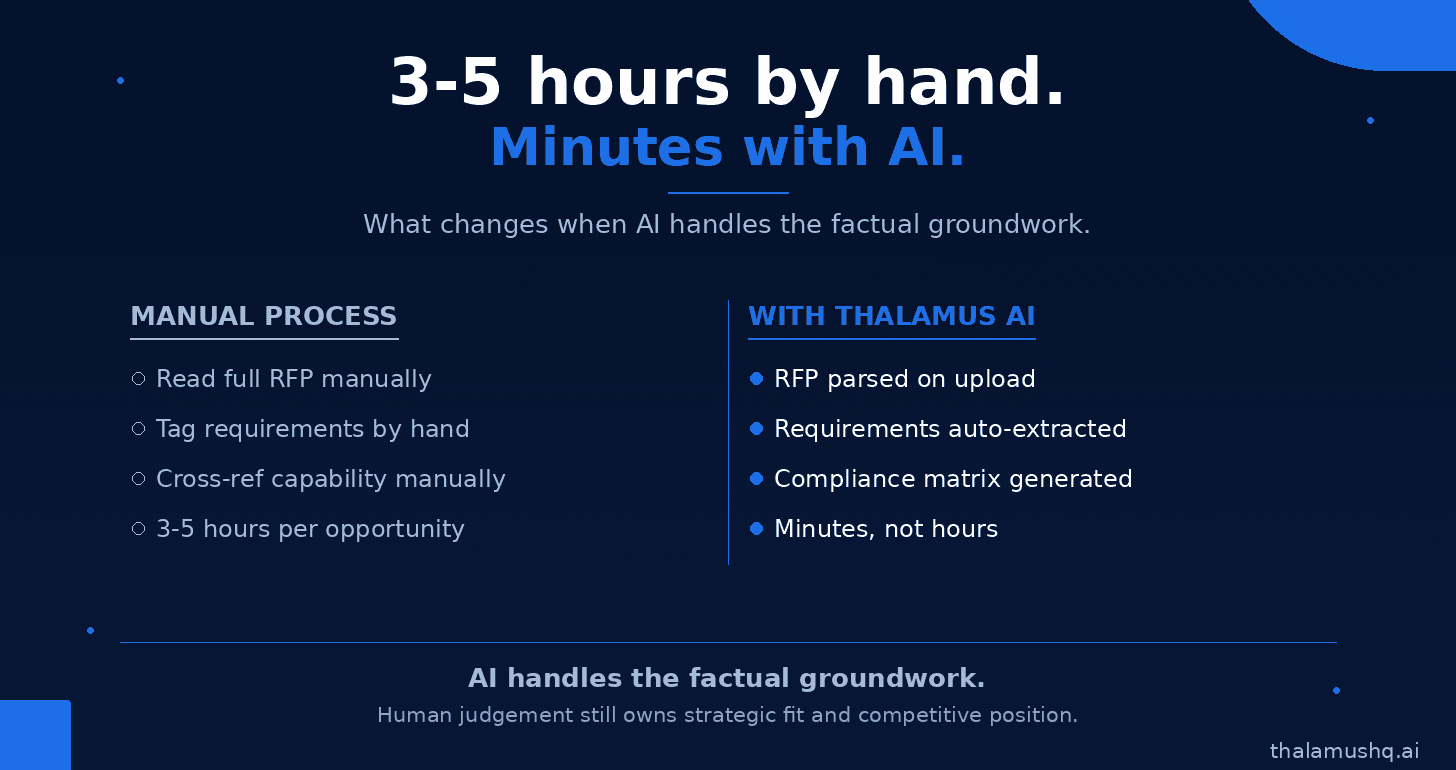

Instead of maintaining a separate bid/no-bid spreadsheet or relying on a meeting driven by gut feel, teams can create their own bid/no-bid matrix, define how each criterion should be evaluated, and use AI agents to gather the evidence needed to score the opportunity.

The final bid, no-bid, or conditional bid decision remains with the team. Thalamus AI provides the factual groundwork, scoring structure, and source-linked evidence that make the recommendation easier to defend.

Configure the Bid/No-Bid Criteria That Matter to Your Business
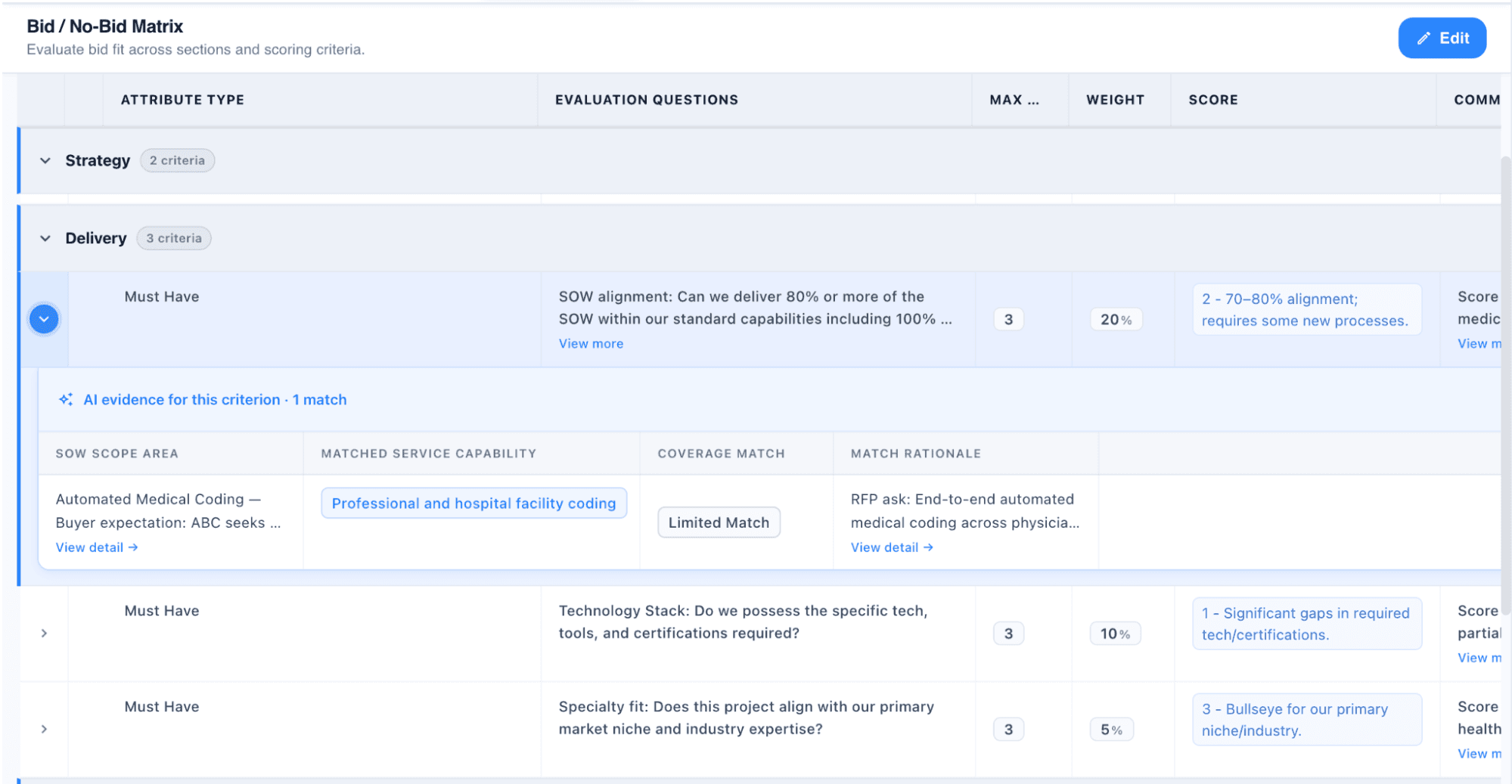
Every organization qualifies opportunities differently. In Thalamus AI, teams can configure their own evaluation sections, questions, scoring rules, and weights.

A bid/no-bid template might evaluate criteria such as buyer relationship, competitive advantage, SOW alignment, technology fit, industry fit, specialty fit, available case studies, client references, certifications, compliance requirements, pricing considerations, resource capacity, and other must-have requirements.

Each criterion can have its own maximum score and weight. A strategic relationship criterion may carry more weight than a secondary capability. A mandatory technical, legal, or compliance requirement can be treated as a hard no-go condition rather than simply another point in the score.

This creates a repeatable go/no-go framework without forcing every organization into the same checklist.

AI Agents Gather the Evidence Behind the Bid Score

The important difference is that the bid/no-bid matrix does not have to be scored from memory.

For each criterion, teams can configure an AI evidence workflow. One agent can read the solicitation documents and extract the buyer’s requirement. Another can search approved internal knowledge for relevant capabilities, technologies, certifications, case studies, references, past performance, pricing inputs, or compliance evidence. Additional agents can assess how strongly the evidence matches the requirement and apply the configured scoring rules.

For example, for a Technology Stack criterion, Thalamus AI can:

  1. Extract the technologies, tools, integrations, or certifications requested in the RFP.

  2. Search the organization’s approved knowledge sources for matching capabilities.

  3. Record the matched evidence and rationale.

  4. Evaluate the strength of the match against the organization’s predefined scoring rules.

The result is not just a score. The matrix can retain the requirement, matched evidence, rationale, score, comments, and supporting sources. That gives proposal, sales, and executive teams a traceable reason for why an opportunity scored the way it did.

Weighted Scoring and No-Go Conditions

Thalamus AI applies the configured weights across the bid/no-bid matrix to calculate an overall opportunity score.

Teams can also define hard no-go conditions. For example, an opportunity can trigger a warning when the total score falls below a minimum threshold, or when any criterion classified as Must Have scores below an acceptable level.

The working view brings criteria, scores, evidence, comments, weighted bid score, and triggered no-go conditions into one place. That gives teams a stronger decision record before proposal writing begins.

This is the core shift: the bid/no-bid decision is no longer an undocumented judgment call. It becomes a repeatable, evidence-backed qualification process that improves with every opportunity.

For a full comparison of AI tools that support the bid and proposal lifecycle, see our 12 Best AI RFP Software Tools in 2026. For more on what a strong RFP response looks like once the bid decision is made, see our Request for Proposal Example guide.

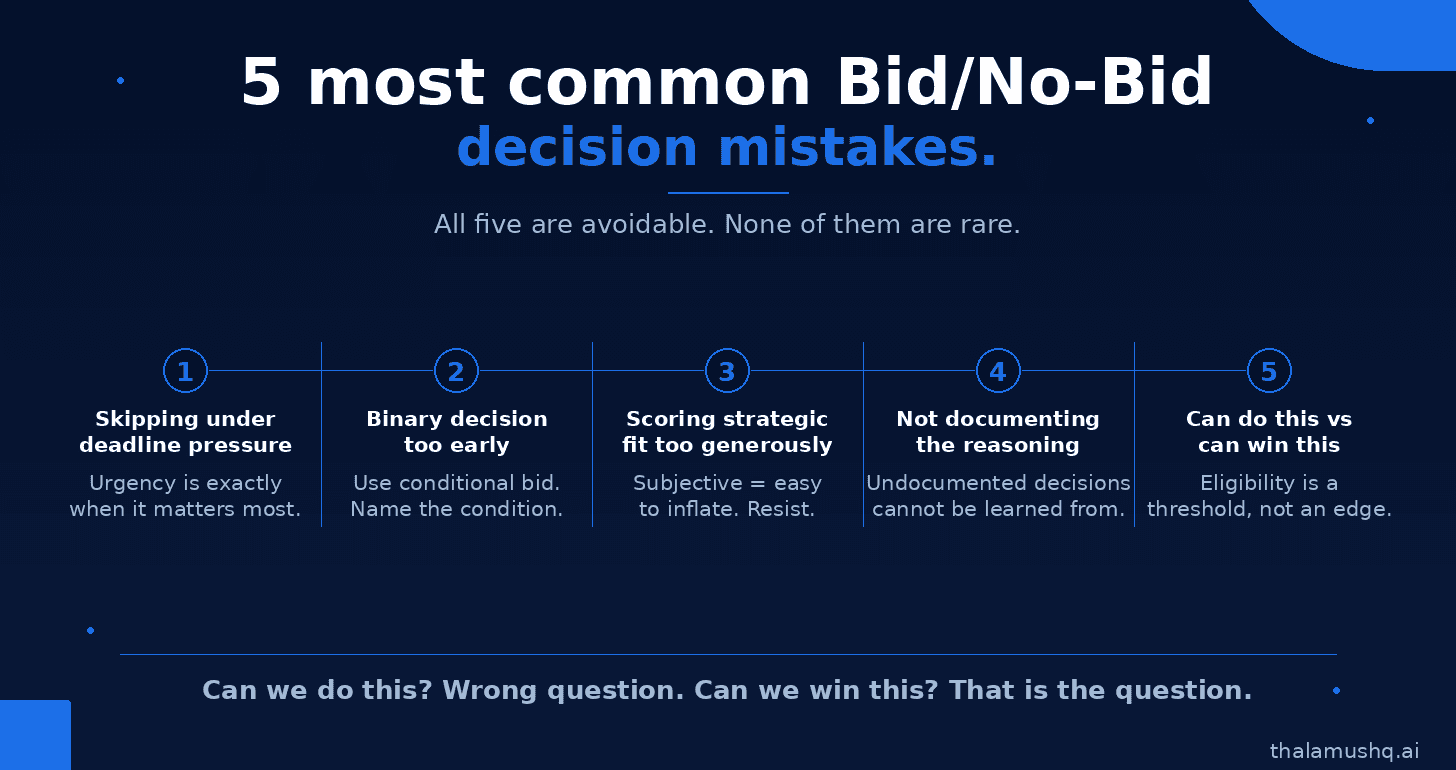
5 Most Common Bid No Bid Decision Mistakes

Skipping the process under deadline pressure - 

The opportunities that feel most urgent, such as short timelines, large contract values, and strong buyer relationships, are precisely the ones where the bid/no-bid process is most valuable. Deadline pressure removes the time available for rational evaluation and creates exactly the conditions where expensive mistakes are made.
  1. Treating the decision as binary too early - 

Most bid/no-bid frameworks produce one of three outputs: bid, no bid, or conditional bid. Teams that skip the conditional bid option, using it as a decision tool that identifies what conditions need to change before committing, miss the most useful output the process can produce. A conditional bid with a named condition ("we will bid if the teaming partner confirms by [date]") is more useful than a premature no bid or an uncommitted bid.

  1. Scoring strategic fit too generously - 

The easiest section to inflate in any bid no bid evaluation is strategic fit, because it is inherently subjective and the people completing the evaluation typically want to bid. A discipline of asking "would the CEO be comfortable with us investing $30,000 in this opportunity?" before confirming a strategic fit score is a useful reality check.

  1. Not documenting the reasoning - 

A bid/no-bid decision that is made but not documented is a decision that cannot be learned from. The most valuable output of a mature bid/no-bid program is the historical record: which opportunities were pursued and why, and how those predictions correlated with actual outcomes.

  1. Confusing "we can do this" with "we can win this." - 

Technical eligibility is a threshold, not a differentiator. The question the bid-no-bid process is answering is not whether the team is capable of delivering the work; it is whether the team can produce a proposal that the buyer will score more highly than the alternatives. Those are different questions, and conflating them is the most common cause of overconfident bid decisions.

Bid No Bid Decision Process FAQ

What is the difference between bid no bid and go no go? 

They are the same process with different names. Bid/no-bid is the standard term in proposal management, government contracting, and professional services. Go/no-go is more common in technology, product development, and project management. The Shipley methodology calls it a "bid/no-bid gate." The framework, criteria, and outcomes are identical regardless of what the team calls it.

Who should be involved in the bid/no-bid decision? 

At minimum: a business development or account lead (buyer relationship and competitive context), a proposal manager (capacity and timeline realism), and a delivery or technical lead (capability verification). For larger opportunities, add a commercial or finance lead to review the financial viability and risk sections. The decision should be Authorized by whoever controls the proposal team's resource allocation.

How long should the bid/no-bid process take? 

For a standard commercial opportunity, 60 to 90 minutes for the evaluator plus a short review meeting with stakeholders. For large or complex government bids, two to four hours, including competitive intelligence review. The time investment should be proportionate to the bid preparation cost; a one-hour evaluation that saves 40 hours of proposal writing on a non-viable opportunity is a straightforward trade.

What is a conditional bid? 

A conditional bid is the outcome when the evaluation score sits between a clear bid and a clear no bid, and the gap can be closed by one specific, achievable action. For example: "We will bid if a teaming partner confirms by [date]." A conditional bid must name the condition, assign an owner, and set a deadline. It is not a way to avoid deciding; it is a structured way of deferring the final call until a material uncertainty is resolved.

What win probability threshold should trigger a no bid? 

Most frameworks use 20–25% as the minimum for smaller, lower-cost opportunities and 30–35% for large or complex proposals where bid preparation investment is significant. Below those thresholds, the expected value calculation, win probability × contract value, minus bid cost, typically produces a marginal or negative result. On the 30-question checklist in this guide, a total score below 40% (under 24 out of 60) is the equivalent signal.

When Should You No-Bid an RFP?

No-bid an RFP when the buyer is a poor strategic fit, the incumbent is strongly positioned, your team lacks required credentials, the timeline is unrealistic, the margin is too low, or the bid would pull resources away from a stronger opportunity. A no-bid decision is not a failure. It is a resource allocation decision that protects the team’s ability to win better-fit bids.

Make Solid Bid/No-Bid Decisions with Thalamus AI in 2026

The bid/no-bid decision process does not win proposals. It creates the conditions in which proposals can be won, by concentrating the team's time, energy, and expertise on the opportunities where it is most likely to matter.

Teams that pursue every opportunity they receive are not more ambitious. They are less strategic. The proposal team that declines three non-viable opportunities to focus fully on one genuinely winnable bid is practicing a discipline that consistently produces better outcomes than the team that spreads itself across all four.

The 30-question checklist, the decision matrix, and the no-bid letter template in this guide are the tools that make that discipline practical and repeatable. The process takes an hour. The habits it builds compound over every bid cycle.

If your team is ready to take the bid-no-bid decision one step further with AI that automatically extracts requirements, maps compliance risk, and feeds your evaluation before your team reads a single page, the next step is a 30-minute walkthrough on a live opportunity.

Your team's capacity is finite. The bids worth writing are not. → Book Your Demo

Related reading: 12 Best AI RFP Software Tools in 2026 | Request for Proposal Example: Real RFPs by Industry | RFP Software Pricing in 2026