Blogs

Blogs

10 mins

10 mins

Request for Proposal Example: 6 Real RFP Samples by Industry

Request for Proposal Example: 6 Real RFP Samples by Industry

Request for Proposal Example: 6 Real RFP Samples by Industry

Request for Proposal Example: 6 Real RFP Samples by Industry

Harpreet Singh, MBA

Founder, Thalamus AI

With 12+ years in AI and enterprise software, including GenAI product work at Travelers Group, Harpreet writes about AI RFP software, AI bid tools, proposal operations, RFP response automation, and the future of enterprise bid management.

Summarize with ChatGPT

Summarize with ChatGPT

Key Takeaways

  • A request for proposal (RFP) is a formal document issued by an organization inviting vendors to submit bids for a specific project or service. Every industry uses RFPs, but the format, length, and requirements differ significantly by sector.

  • This guide serves two audiences: procurement teams who need to write an RFP, and vendor teams who receive one and need to respond to it. Most guides only cover writing. This one covers both.

  • Every strong RFP includes the same core sections: background, scope of work, submission requirements, evaluation criteria, and timeline, regardless of industry.

  • A strong RFP response example includes a tailored executive summary, direct and traceable answers to every stated requirement, quantified evidence, and a clear implementation plan. Generic, template-filled responses rarely win.

  • AI-native platforms like Thalamus AI help vendor teams go from RFP receipt to first draft in under 15 minutes, with every requirement tracked and every response grounded in verified company knowledge.

Summarize with ChatGPT

Key Takeaways

Key Takeaways

Key Takeaways

  • A request for proposal (RFP) is a formal document issued by an organization inviting vendors to submit bids for a specific project or service. Every industry uses RFPs, but the format, length, and requirements differ significantly by sector.

  • This guide serves two audiences: procurement teams who need to write an RFP, and vendor teams who receive one and need to respond to it. Most guides only cover writing. This one covers both.

  • Every strong RFP includes the same core sections: background, scope of work, submission requirements, evaluation criteria, and timeline, regardless of industry.

  • A strong RFP response example includes a tailored executive summary, direct and traceable answers to every stated requirement, quantified evidence, and a clear implementation plan. Generic, template-filled responses rarely win.

  • AI-native platforms like Thalamus AI help vendor teams go from RFP receipt to first draft in under 15 minutes, with every requirement tracked and every response grounded in verified company knowledge.

  • A request for proposal (RFP) is a formal document issued by an organization inviting vendors to submit bids for a specific project or service. Every industry uses RFPs, but the format, length, and requirements differ significantly by sector.

  • This guide serves two audiences: procurement teams who need to write an RFP, and vendor teams who receive one and need to respond to it. Most guides only cover writing. This one covers both.

  • Every strong RFP includes the same core sections: background, scope of work, submission requirements, evaluation criteria, and timeline, regardless of industry.

  • A strong RFP response example includes a tailored executive summary, direct and traceable answers to every stated requirement, quantified evidence, and a clear implementation plan. Generic, template-filled responses rarely win.

  • AI-native platforms like Thalamus AI help vendor teams go from RFP receipt to first draft in under 15 minutes, with every requirement tracked and every response grounded in verified company knowledge.

  • A request for proposal (RFP) is a formal document issued by an organization inviting vendors to submit bids for a specific project or service. Every industry uses RFPs, but the format, length, and requirements differ significantly by sector.

  • This guide serves two audiences: procurement teams who need to write an RFP, and vendor teams who receive one and need to respond to it. Most guides only cover writing. This one covers both.

  • Every strong RFP includes the same core sections: background, scope of work, submission requirements, evaluation criteria, and timeline, regardless of industry.

  • A strong RFP response example includes a tailored executive summary, direct and traceable answers to every stated requirement, quantified evidence, and a clear implementation plan. Generic, template-filled responses rarely win.

  • AI-native platforms like Thalamus AI help vendor teams go from RFP receipt to first draft in under 15 minutes, with every requirement tracked and every response grounded in verified company knowledge.

Quick Answer: What Is a Request for Proposal Example?

Quick Answer: What Is a Request for Proposal Example?

A request for proposal example is a sample RFP document that shows how a buyer asks vendors to submit proposals for a project, service, or product. A strong RFP usually includes organization background, project scope, submission instructions, evaluation criteria, timeline, pricing requirements, and contract terms.

Here is the simplest RFP example structure:

  1. Project background

  2. Scope of work

  3. Vendor qualifications

  4. Proposal submission requirements

  5. Evaluation criteria

  6. Timeline and key dates

  7. Terms and compliance requirements

For vendor teams, a strong RFP response should include a tailored executive summary, direct answers to every requirement, proof from past performance, clear pricing, and a compliance checklist.

A request for proposal example is a sample RFP document that shows how a buyer asks vendors to submit proposals for a project, service, or product. A strong RFP usually includes organization background, project scope, submission instructions, evaluation criteria, timeline, pricing requirements, and contract terms.

Here is the simplest RFP example structure:

  1. Project background

  2. Scope of work

  3. Vendor qualifications

  4. Proposal submission requirements

  5. Evaluation criteria

  6. Timeline and key dates

  7. Terms and compliance requirements

For vendor teams, a strong RFP response should include a tailored executive summary, direct answers to every requirement, proof from past performance, clear pricing, and a compliance checklist.

What Is a Request for Proposal?

What Is a Request for Proposal?

A request for proposal (RFP) is a formal procurement document that an organization issues to invite vendors, contractors, or service providers to submit competitive bids for a specific project, service, or product. It outlines what the issuing organization needs, the criteria by which responses will be evaluated, and the process vendors must follow to submit a compliant proposal.

RFPs are used across virtually every industry and sector: government agencies use them for infrastructure, technology, and services procurement; healthcare organizations use them for software, equipment, and facility management; companies use them to find marketing agencies, IT vendors, construction contractors, and professional service firms. Anywhere a high-stakes purchasing decision involves multiple competing vendors and a structured evaluation process, an RFP is usually the mechanism.

The distinction between an RFP and a request for quotation (RFQ) is worth clarifying upfront. An RFQ is issued when the buyer knows exactly what they want and is primarily comparing price. An RFP is issued when the buyer wants vendors to propose how they would solve the problem, the approach, the methodology, the team, and the price, evaluated together. An RFP requires a proposal; an RFQ requires a quote.

A request for proposal (RFP) is a formal procurement document that an organization issues to invite vendors, contractors, or service providers to submit competitive bids for a specific project, service, or product. It outlines what the issuing organization needs, the criteria by which responses will be evaluated, and the process vendors must follow to submit a compliant proposal.

RFPs are used across virtually every industry and sector: government agencies use them for infrastructure, technology, and services procurement; healthcare organizations use them for software, equipment, and facility management; companies use them to find marketing agencies, IT vendors, construction contractors, and professional service firms. Anywhere a high-stakes purchasing decision involves multiple competing vendors and a structured evaluation process, an RFP is usually the mechanism.

The distinction between an RFP and a request for quotation (RFQ) is worth clarifying upfront. An RFQ is issued when the buyer knows exactly what they want and is primarily comparing price. An RFP is issued when the buyer wants vendors to propose how they would solve the problem, the approach, the methodology, the team, and the price, evaluated together. An RFP requires a proposal; an RFQ requires a quote.

What Request for Proposal Example Includes? 6 Components

What Request for Proposal Example Includes? 6 Components

What Request for Proposal Example Includes? 6 Components

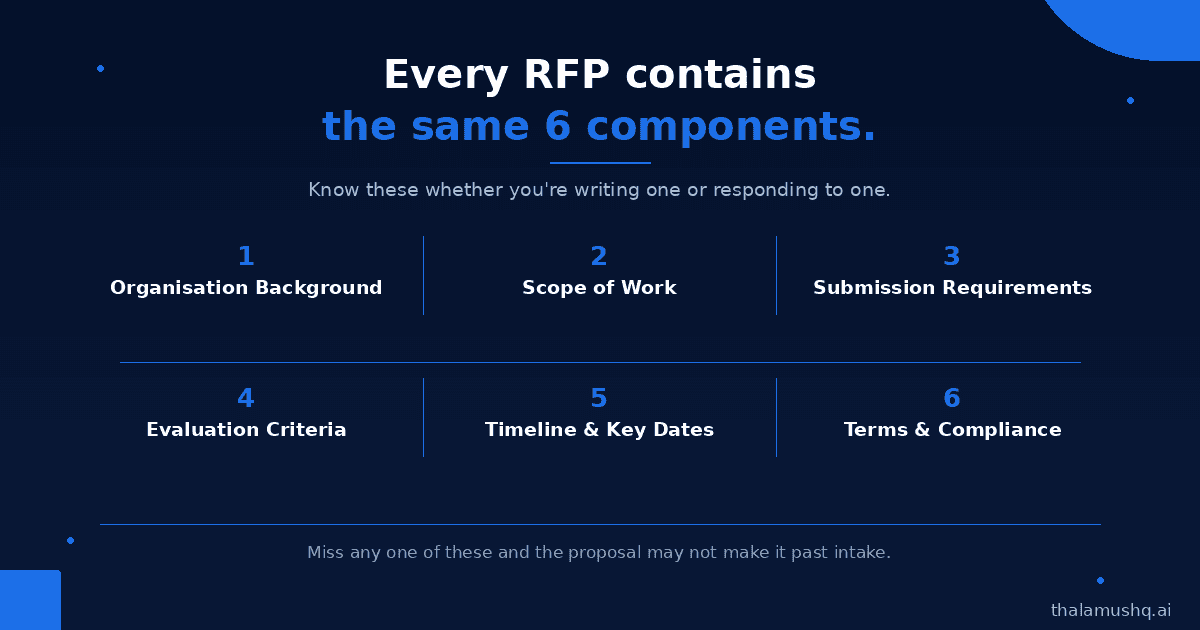
Regardless of industry, a well-structured RFP contains the same core sections. Understanding these sections matters whether you are writing an RFP or responding to one.

Organization Background and Project Context

This section introduces the issuing organization, its mission, size, and relevant history, and establishes the context for the project. Good RFPs give vendors enough context to write genuinely relevant proposals rather than generic responses. The quality of this section predicts the quality of responses: detailed context attracts specific, evidence-backed bids; vague context attracts template proposals.

Scope of Work

The scope of work is the most important section of any RFP. It defines precisely what the vendor is expected to deliver: the tasks, outputs, timelines, and boundaries of the engagement. Specific scopes produce comparable proposals; vague scopes produce incomparable ones. Strong scopes define not just what is required but how success will be measured.

Submission Requirements and Format

This section tells vendors exactly how to respond: the required document structure, page or word limits, file format requirements, the number of copies required (physical or digital), and whether additional forms such as pricing tables or certifications must be included. Many proposals are disqualified not because they are weak but because they fail to follow these instructions precisely.

Evaluation Criteria and Weighting

This is the section most vendors read first, and rightly so. The evaluation criteria define how the issuing organization will score responses: which factors matter, in what proportion, and in what sequence. Common criteria include technical approach (often 30-40% of the score), relevant experience and past performance (20- 30%), management plan and team qualifications (15- 20%), and price or cost (10–25%). Some RFPs weight price more heavily; others weight it minimally for complex professional services engagements.

Timeline and Key Dates

The RFP timeline specifies when questions may be submitted, when clarifications will be issued, the deadline for proposal submission, when the evaluation will occur, and when the award decision will be announced. Government RFPs are particularly rigid about these dates; missing a submission deadline disqualifies a proposal regardless of its quality.

Terms, Conditions, and Compliance Requirements

Certifications, insurance requirements, regulatory compliance standards, non-disclosure agreements, and standard contract terms often appear in the final section of an RFP or as attached appendices. For government and healthcare RFPs, these requirements are often mandatory; failure to include a specific certification can result in automatic disqualification.

Regardless of industry, a well-structured RFP contains the same core sections. Understanding these sections matters whether you are writing an RFP or responding to one.

Organization Background and Project Context

This section introduces the issuing organization, its mission, size, and relevant history, and establishes the context for the project. Good RFPs give vendors enough context to write genuinely relevant proposals rather than generic responses. The quality of this section predicts the quality of responses: detailed context attracts specific, evidence-backed bids; vague context attracts template proposals.

Scope of Work

The scope of work is the most important section of any RFP. It defines precisely what the vendor is expected to deliver: the tasks, outputs, timelines, and boundaries of the engagement. Specific scopes produce comparable proposals; vague scopes produce incomparable ones. Strong scopes define not just what is required but how success will be measured.

Submission Requirements and Format

This section tells vendors exactly how to respond: the required document structure, page or word limits, file format requirements, the number of copies required (physical or digital), and whether additional forms such as pricing tables or certifications must be included. Many proposals are disqualified not because they are weak but because they fail to follow these instructions precisely.

Evaluation Criteria and Weighting

This is the section most vendors read first, and rightly so. The evaluation criteria define how the issuing organization will score responses: which factors matter, in what proportion, and in what sequence. Common criteria include technical approach (often 30-40% of the score), relevant experience and past performance (20- 30%), management plan and team qualifications (15- 20%), and price or cost (10–25%). Some RFPs weight price more heavily; others weight it minimally for complex professional services engagements.

Timeline and Key Dates

The RFP timeline specifies when questions may be submitted, when clarifications will be issued, the deadline for proposal submission, when the evaluation will occur, and when the award decision will be announced. Government RFPs are particularly rigid about these dates; missing a submission deadline disqualifies a proposal regardless of its quality.

Terms, Conditions, and Compliance Requirements

Certifications, insurance requirements, regulatory compliance standards, non-disclosure agreements, and standard contract terms often appear in the final section of an RFP or as attached appendices. For government and healthcare RFPs, these requirements are often mandatory; failure to include a specific certification can result in automatic disqualification.

Example of Request for Proposal: Six Industries Compared

Example of Request for Proposal: Six Industries Compared

Example of Request for Proposal: Six Industries Compared

The following examples illustrate how RFP structure and emphasis shift across industries. Each example shows the tone, typical scope, and key evaluation priorities that vendors should address in their responses.

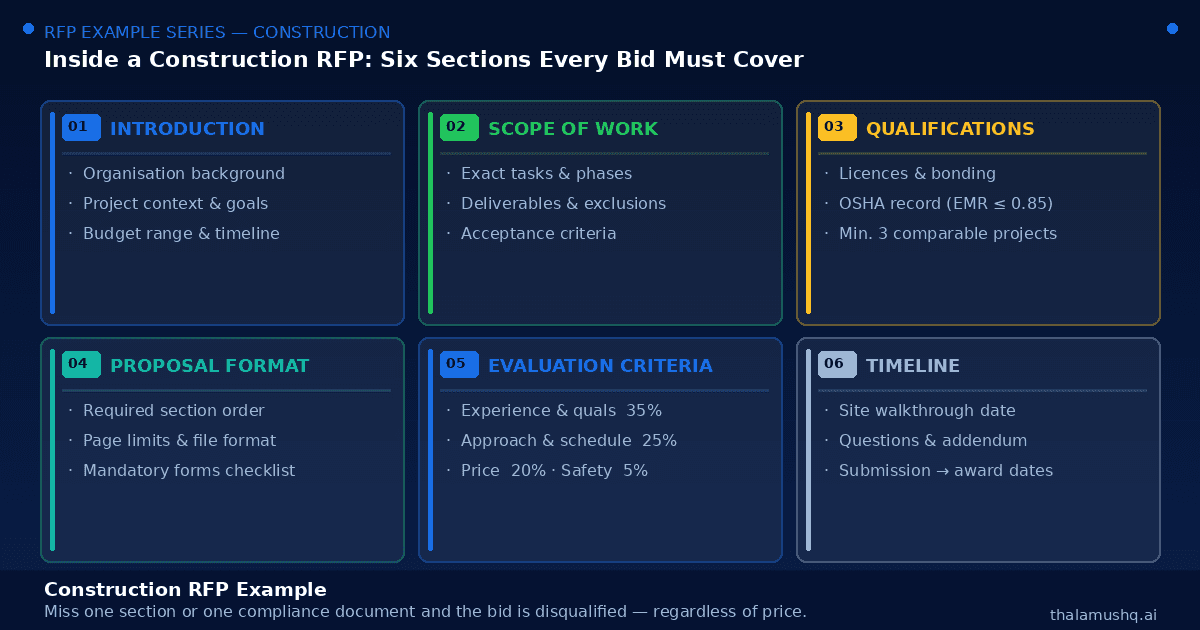
  1. Request for Proposal Example - Construction Industry 

Construction RFPs are among the most detailed and compliance-heavy in any sector. They typically run 20 to 60 pages for major projects and include technical specifications, safety requirements, bonding and insurance mandates, and often specific forms that must be completed and returned with the proposal.

What does a construction RFP look like in practice?

A municipality issuing an RFP for a $4M community recreation center renovation would typically structure the document as follows:

  • Section 1 - Project Overview: Description of the existing facility, the scope of the planned renovation, and the municipality's goals for the project (sustainability certifications, local hiring preferences, accessibility compliance).

  • Section 2 - Scope of Work: Detailed breakdown of construction phases, specific trades required (mechanical, electrical, plumbing, structural), and any design-build or design-bid-build clarifications.

  • Section 3 - Contractor Qualifications: Minimum years of experience in public-sector construction, required licenses and bonding, OSHA compliance history, and references from comparable projects within the past five years.

  • Section 4 - Proposal Requirements: Mandatory forms including the bid form, contractor information sheet, evidence of insurance (general liability minimums typically $2M per occurrence), and a performance bond commitment.

  • Section 5 - Evaluation Criteria: Technical qualifications and experience (40%), project approach and schedule (30%), price (25%), local business preference (5%).

  • Section 6 - Timeline: Pre-bid site walkthrough date, deadline for written questions, addendum issuance date, bid submission deadline, anticipated award date, and anticipated construction start.

What makes construction RFPs distinctive? 

The compliance section is non-negotiable. Any missing form, incomplete certification, or non-compliant insurance coverage disqualifies the bid regardless of price or qualifications. Construction RFP responses must be meticulous on compliance before demonstrating quality.

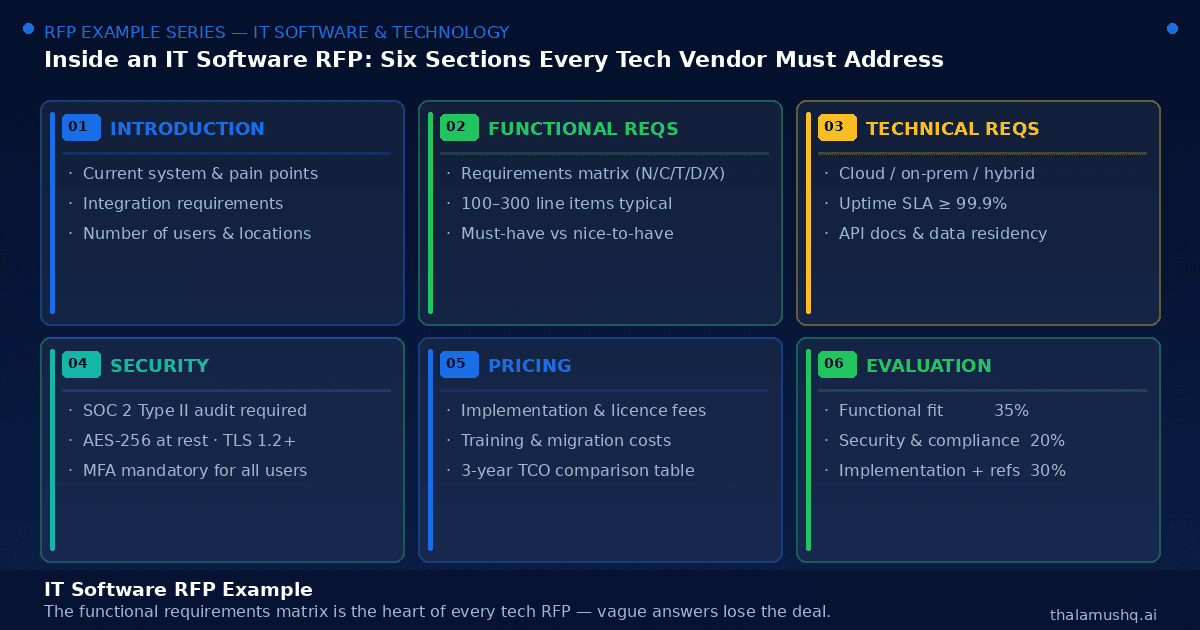
  1. Request for Proposal Example - IT Software and Technology

Technology RFPs are issued by organizations seeking software platforms, managed IT services, cybersecurity assessments, cloud migration support, or custom application development. They tend to be highly technical in their requirements sections and place significant weight on security, integration capability, and vendor financial stability.

What does an IT software RFP look like in practice?

A regional healthcare network issuing an RFP for an electronic health records (EHR) system would typically include:

  • Section 1 - Organization Profile: Description of the network's size (number of facilities, patient volume, current systems), current pain points with existing technology, and integration requirements with existing clinical and administrative systems.

  • Section 2 - Functional Requirements: A detailed matrix of required system capabilities, often 100 to 300 line items, with response columns for each vendor to indicate whether the capability is native, configurable, available via third-party integration, or not available.

  • Section 3 - Technical Requirements: Infrastructure compatibility, data hosting options (cloud/on-premise/hybrid), uptime SLA requirements, disaster recovery and backup protocols, and API documentation requirements.

  • Section 4 - Security and Compliance: HIPAA compliance certification, SOC 2 Type II audit status, penetration testing history, data encryption standards (at rest and in transit), and breach notification procedures.

  • Section 5 - Pricing: Implementation costs, annual licence fees per user or per facility, training and onboarding costs, ongoing support tier options, and estimated five-year total cost of ownership.

  • Section 6 - References: Minimum three comparable implementations at organizations of similar size and complexity, with contact information for reference verification.

What makes technology RFPs distinctive? 

The functional requirements matrix is the heart of a technology RFP response. Vendors who provide vague "Yes" responses without qualification lose evaluator confidence. Strong responses include specific implementation notes, conditions, and references for each capability claimed.

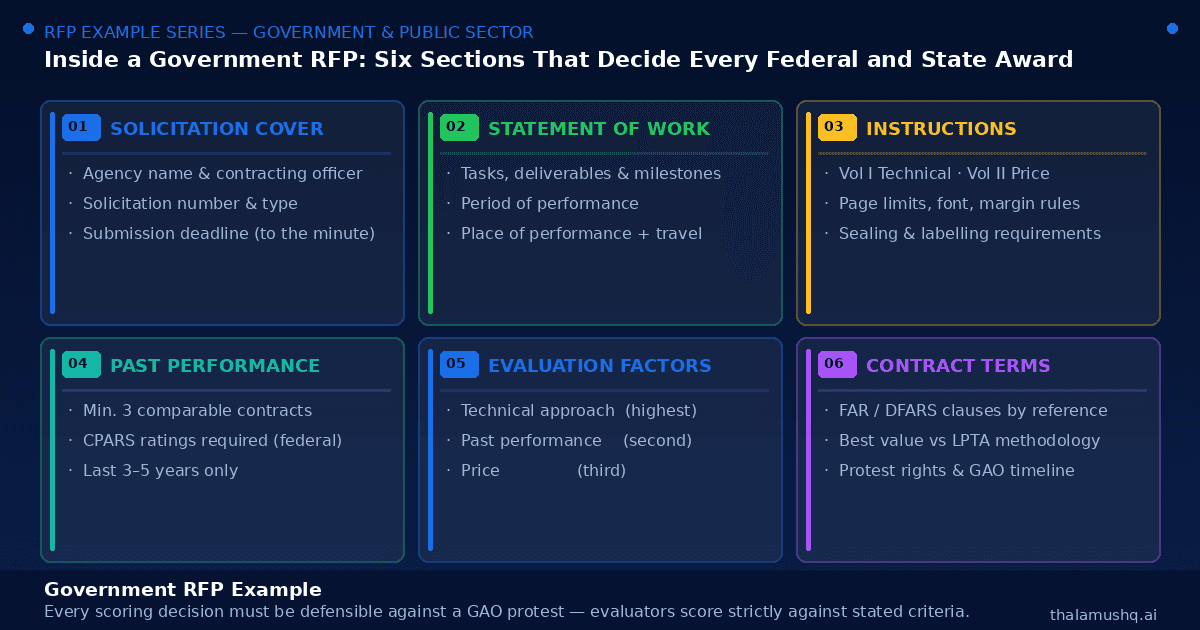
  1. Request for Proposal Example - Government and Public Sector

Government RFPs are the most formally structured of any type. They follow prescribed procurement regulations; at the federal level, the Federal Acquisition Regulation (FAR) in the United States; at state and local levels, individual jurisdiction procurement codes. Non-compliance with these procedural requirements can expose the issuing agency to protest and the responding vendor to disqualification.

What does a government services RFP look like in practice?

A state agency issuing an RFP for professional consulting services to support a major public infrastructure program would typically include:

  • Solicitation Cover Page: Solicitation number, issuing agency name and contracting officer contact, submission deadline (date and time to the minute), and public opening information.

  • Statement of Work (SOW): Detailed description of the consulting services required, deliverables with specific acceptance criteria, performance standards, and the period of performance.

  • Instructions to Offerors: Specific formatting requirements (font size, page limits for each volume), required number of printed and electronic copies, sealing and labeling requirements for physical submissions.

  • Proposal Volumes: Government RFPs typically require separate volumes for technical approach, past performance, and price. These are evaluated independently.

  • Past Performance Requirements: Typically three to five contracts of comparable scope and complexity completed within the past three to five years, with CPARS ratings (Contractor Performance Assessment Reporting System) required for federal contracts.

  • Evaluation Factors: Listed in order of importance. Technical approach is typically most important; past performance second; price third. Some solicitations use best value trade-off rather than lowest-price-technically-acceptable (LPTA) evaluation methodology.

What makes government RFPs distinctive? 

The evaluation is formal, documented, and reviewable. Every scoring decision must be defensible against a Government Accountability Office (GAO) or contract appeals board protest. This means evaluators score strictly against stated criteria, and vendor responses must map directly and explicitly to every stated requirement.

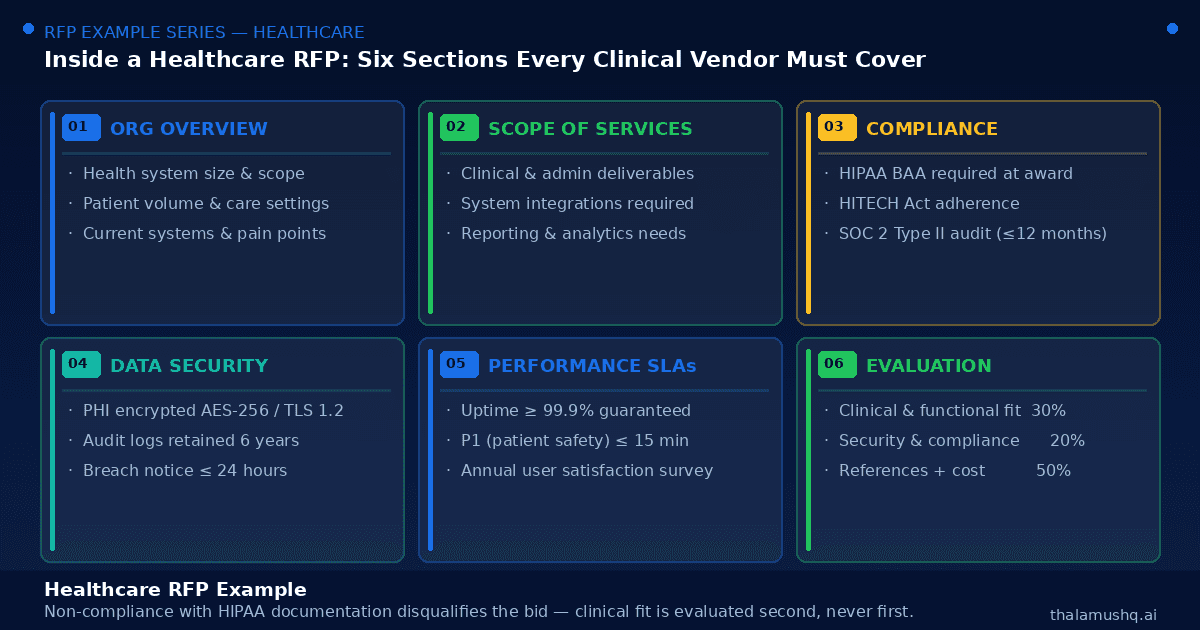
  1. Request for Proposal Example - Healthcare


Healthcare RFPs span a wide range: clinical equipment, patient software, facility management, pharmacy benefits, data analytics, and professional services. They consistently emphasize regulatory compliance (HIPAA, HITECH, Joint Commission standards), patient safety, and vendor financial stability.

What does a healthcare services RFP look like in practice?

A hospital network issuing an RFP for a pharmacy benefits management (PBM) program would include:

  • Executive Summary of Requirements: The network's current pharmaceutical spend, employee population covered, plan design goals, and the specific services being outsourced.

  • Scope of Services: Formulary management, claims processing, mail-order pharmacy, specialty drug management, clinical programs, and member communications, each defined with specific performance expectations.

  • Compliance and Accreditation: HIPAA Business Associate Agreement requirements, URAC accreditation status, state pharmacy licence status in all relevant jurisdictions.

  • Performance Guarantees: Minimum service level agreements, claims processing turnaround, call center response times, error rates, with associated financial penalties for non-performance.

  • Pricing Proposal: Typically a complex spreadsheet model with guaranteed discount percentages, dispensing fees, and administrative fees broken out by drug category and plan type.

  1. Request for Proposal Example - Marketing and Communications

Marketing RFPs are typically shorter than government or construction RFPs but require a different kind of response, one that demonstrates strategic thinking, creative capability, and cultural alignment alongside functional qualifications.

What does a marketing agency RFP look like in practice?

A regional tourism board issuing an RFP for an integrated marketing agency of record would typically include:

  • Organization and Market Context: The board's mission, annual marketing budget range, current brand positioning, target markets and audience demographics, and key competitors in the destination marketing landscape.

  • Scope of Services: Media planning and buying, creative development, social media management, content production, event marketing support, and performance reporting.

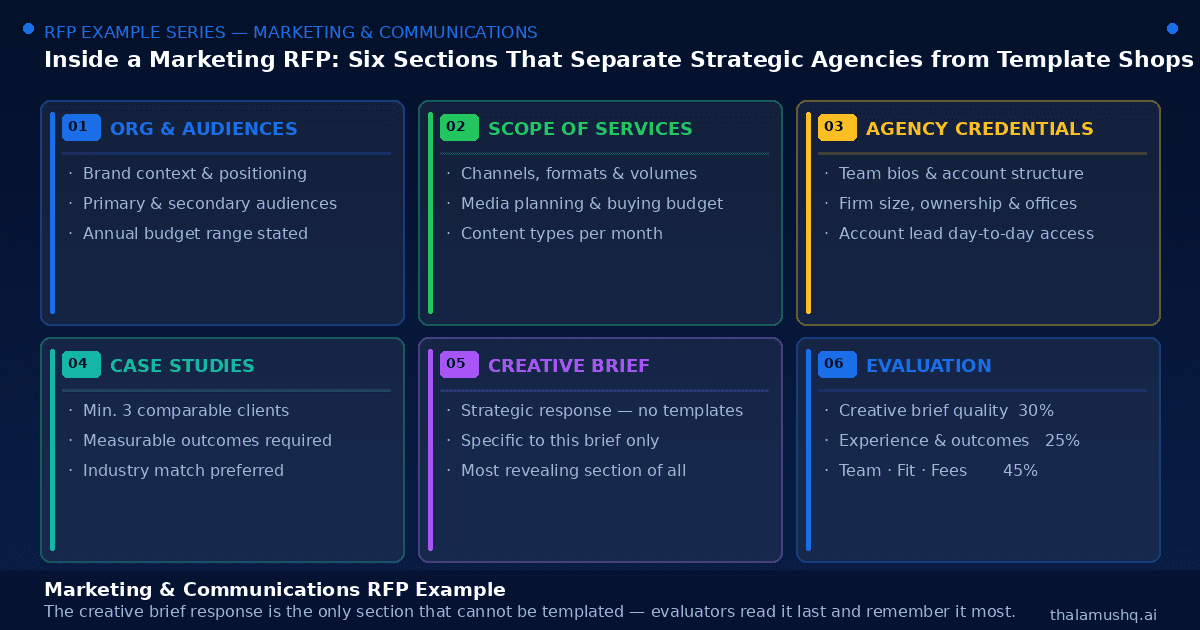
  • Proposal Requirements: Agency overview and credentials, team bios for the proposed account team, three to five case studies from comparable clients (with measurable outcomes), a strategic response to a provided creative brief, and a fee structure proposal.

  • Evaluation Criteria: Strategic thinking and creative quality (30%), relevant experience (25%), proposed team (20%), cultural fit and client relationship approach (15%), fee structure (10%).

What makes marketing RFPs distinctive: The required creative brief response is where agencies differentiate. It is the only section of the proposal that cannot be templated; it has to be written specifically for this client and this brief. Evaluators use it to assess how an agency actually thinks, not how it describes itself.

  1. Request for Proposal Example - Professional Services and Consulting

Professional services RFPs cover accounting, legal, management consulting, engineering, architecture, and similar knowledge-intensive engagements. These RFPs typically weight methodology, team qualifications, and past performance more heavily than price, on the logic that a below-market fee from an underqualified team produces worse outcomes than a premium fee from a qualified one.

What does a professional services RFP look like in practice?

A hospital system issuing an RFP for a strategic management consultancy to support a digital transformation program would include:

  • Background and Objectives: The organization's current state, the transformation goals, the decision-making process for the selection, and the expected engagement timeline.

  • Scope of Services: Project phases, deliverables for each phase, expected engagement model (embedded team vs. advisory), and any specific methodologies the organization prefers or requires.

  • Qualifications Required: Minimum firm revenue (as a stability indicator), years of experience in healthcare digital transformation, reference engagements of comparable size and complexity.

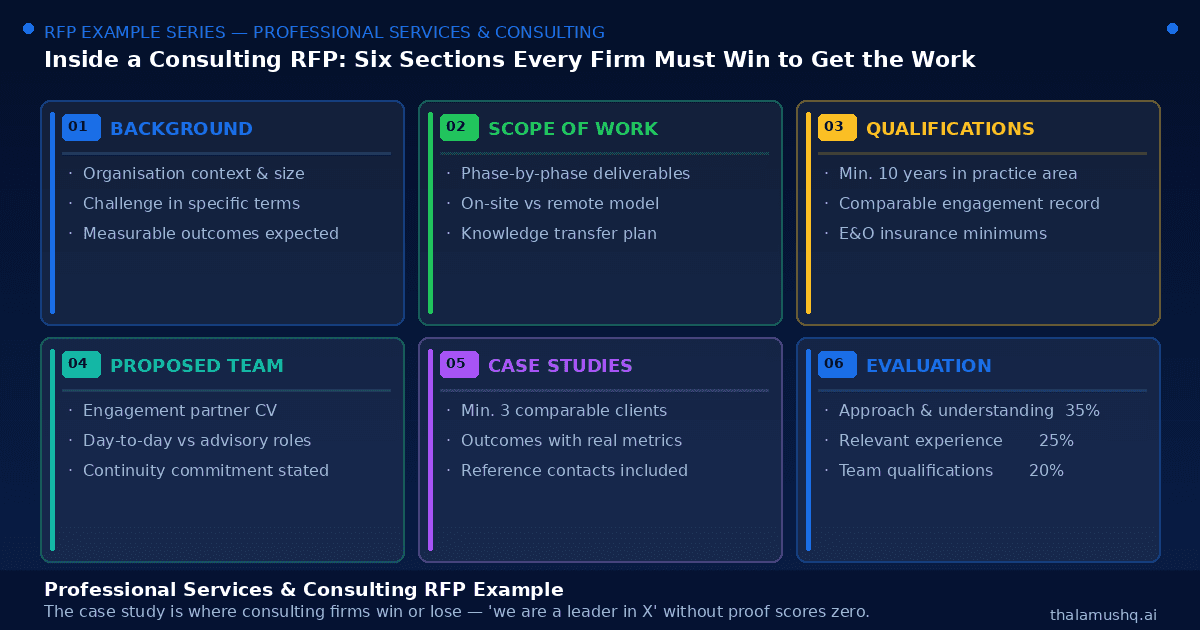
  • Proposal Content Requirements: Firm overview, proposed methodology, proposed team (CVs for all key personnel), relevant case studies with measurable outcomes, and fee proposal with rate card by role level.

  • Evaluation Criteria: Relevant experience (35%), proposed approach and methodology (30%), team qualifications (20%), commercial terms (15%).

The following examples illustrate how RFP structure and emphasis shift across industries. Each example shows the tone, typical scope, and key evaluation priorities that vendors should address in their responses.

  1. Request for Proposal Example - Construction Industry 

Construction RFPs are among the most detailed and compliance-heavy in any sector. They typically run 20 to 60 pages for major projects and include technical specifications, safety requirements, bonding and insurance mandates, and often specific forms that must be completed and returned with the proposal.

What does a construction RFP look like in practice?

A municipality issuing an RFP for a $4M community recreation center renovation would typically structure the document as follows:

  • Section 1 - Project Overview: Description of the existing facility, the scope of the planned renovation, and the municipality's goals for the project (sustainability certifications, local hiring preferences, accessibility compliance).

  • Section 2 - Scope of Work: Detailed breakdown of construction phases, specific trades required (mechanical, electrical, plumbing, structural), and any design-build or design-bid-build clarifications.

  • Section 3 - Contractor Qualifications: Minimum years of experience in public-sector construction, required licenses and bonding, OSHA compliance history, and references from comparable projects within the past five years.

  • Section 4 - Proposal Requirements: Mandatory forms including the bid form, contractor information sheet, evidence of insurance (general liability minimums typically $2M per occurrence), and a performance bond commitment.

  • Section 5 - Evaluation Criteria: Technical qualifications and experience (40%), project approach and schedule (30%), price (25%), local business preference (5%).

  • Section 6 - Timeline: Pre-bid site walkthrough date, deadline for written questions, addendum issuance date, bid submission deadline, anticipated award date, and anticipated construction start.

What makes construction RFPs distinctive? 

The compliance section is non-negotiable. Any missing form, incomplete certification, or non-compliant insurance coverage disqualifies the bid regardless of price or qualifications. Construction RFP responses must be meticulous on compliance before demonstrating quality.

  1. Request for Proposal Example - IT Software and Technology

Technology RFPs are issued by organizations seeking software platforms, managed IT services, cybersecurity assessments, cloud migration support, or custom application development. They tend to be highly technical in their requirements sections and place significant weight on security, integration capability, and vendor financial stability.

What does an IT software RFP look like in practice?

A regional healthcare network issuing an RFP for an electronic health records (EHR) system would typically include:

  • Section 1 - Organization Profile: Description of the network's size (number of facilities, patient volume, current systems), current pain points with existing technology, and integration requirements with existing clinical and administrative systems.

  • Section 2 - Functional Requirements: A detailed matrix of required system capabilities, often 100 to 300 line items, with response columns for each vendor to indicate whether the capability is native, configurable, available via third-party integration, or not available.

  • Section 3 - Technical Requirements: Infrastructure compatibility, data hosting options (cloud/on-premise/hybrid), uptime SLA requirements, disaster recovery and backup protocols, and API documentation requirements.

  • Section 4 - Security and Compliance: HIPAA compliance certification, SOC 2 Type II audit status, penetration testing history, data encryption standards (at rest and in transit), and breach notification procedures.

  • Section 5 - Pricing: Implementation costs, annual licence fees per user or per facility, training and onboarding costs, ongoing support tier options, and estimated five-year total cost of ownership.

  • Section 6 - References: Minimum three comparable implementations at organizations of similar size and complexity, with contact information for reference verification.

What makes technology RFPs distinctive? 

The functional requirements matrix is the heart of a technology RFP response. Vendors who provide vague "Yes" responses without qualification lose evaluator confidence. Strong responses include specific implementation notes, conditions, and references for each capability claimed.

  1. Request for Proposal Example - Government and Public Sector

Government RFPs are the most formally structured of any type. They follow prescribed procurement regulations; at the federal level, the Federal Acquisition Regulation (FAR) in the United States; at state and local levels, individual jurisdiction procurement codes. Non-compliance with these procedural requirements can expose the issuing agency to protest and the responding vendor to disqualification.

What does a government services RFP look like in practice?

A state agency issuing an RFP for professional consulting services to support a major public infrastructure program would typically include:

  • Solicitation Cover Page: Solicitation number, issuing agency name and contracting officer contact, submission deadline (date and time to the minute), and public opening information.

  • Statement of Work (SOW): Detailed description of the consulting services required, deliverables with specific acceptance criteria, performance standards, and the period of performance.

  • Instructions to Offerors: Specific formatting requirements (font size, page limits for each volume), required number of printed and electronic copies, sealing and labeling requirements for physical submissions.

  • Proposal Volumes: Government RFPs typically require separate volumes for technical approach, past performance, and price. These are evaluated independently.

  • Past Performance Requirements: Typically three to five contracts of comparable scope and complexity completed within the past three to five years, with CPARS ratings (Contractor Performance Assessment Reporting System) required for federal contracts.

  • Evaluation Factors: Listed in order of importance. Technical approach is typically most important; past performance second; price third. Some solicitations use best value trade-off rather than lowest-price-technically-acceptable (LPTA) evaluation methodology.

What makes government RFPs distinctive? 

The evaluation is formal, documented, and reviewable. Every scoring decision must be defensible against a Government Accountability Office (GAO) or contract appeals board protest. This means evaluators score strictly against stated criteria, and vendor responses must map directly and explicitly to every stated requirement.

  1. Request for Proposal Example - Healthcare


Healthcare RFPs span a wide range: clinical equipment, patient software, facility management, pharmacy benefits, data analytics, and professional services. They consistently emphasize regulatory compliance (HIPAA, HITECH, Joint Commission standards), patient safety, and vendor financial stability.

What does a healthcare services RFP look like in practice?

A hospital network issuing an RFP for a pharmacy benefits management (PBM) program would include:

  • Executive Summary of Requirements: The network's current pharmaceutical spend, employee population covered, plan design goals, and the specific services being outsourced.

  • Scope of Services: Formulary management, claims processing, mail-order pharmacy, specialty drug management, clinical programs, and member communications, each defined with specific performance expectations.

  • Compliance and Accreditation: HIPAA Business Associate Agreement requirements, URAC accreditation status, state pharmacy licence status in all relevant jurisdictions.

  • Performance Guarantees: Minimum service level agreements, claims processing turnaround, call center response times, error rates, with associated financial penalties for non-performance.

  • Pricing Proposal: Typically a complex spreadsheet model with guaranteed discount percentages, dispensing fees, and administrative fees broken out by drug category and plan type.

  1. Request for Proposal Example - Marketing and Communications

Marketing RFPs are typically shorter than government or construction RFPs but require a different kind of response, one that demonstrates strategic thinking, creative capability, and cultural alignment alongside functional qualifications.

What does a marketing agency RFP look like in practice?

A regional tourism board issuing an RFP for an integrated marketing agency of record would typically include:

  • Organization and Market Context: The board's mission, annual marketing budget range, current brand positioning, target markets and audience demographics, and key competitors in the destination marketing landscape.

  • Scope of Services: Media planning and buying, creative development, social media management, content production, event marketing support, and performance reporting.

  • Proposal Requirements: Agency overview and credentials, team bios for the proposed account team, three to five case studies from comparable clients (with measurable outcomes), a strategic response to a provided creative brief, and a fee structure proposal.

  • Evaluation Criteria: Strategic thinking and creative quality (30%), relevant experience (25%), proposed team (20%), cultural fit and client relationship approach (15%), fee structure (10%).

What makes marketing RFPs distinctive: The required creative brief response is where agencies differentiate. It is the only section of the proposal that cannot be templated; it has to be written specifically for this client and this brief. Evaluators use it to assess how an agency actually thinks, not how it describes itself.

  1. Request for Proposal Example - Professional Services and Consulting

Professional services RFPs cover accounting, legal, management consulting, engineering, architecture, and similar knowledge-intensive engagements. These RFPs typically weight methodology, team qualifications, and past performance more heavily than price, on the logic that a below-market fee from an underqualified team produces worse outcomes than a premium fee from a qualified one.

What does a professional services RFP look like in practice?

A hospital system issuing an RFP for a strategic management consultancy to support a digital transformation program would include:

  • Background and Objectives: The organization's current state, the transformation goals, the decision-making process for the selection, and the expected engagement timeline.

  • Scope of Services: Project phases, deliverables for each phase, expected engagement model (embedded team vs. advisory), and any specific methodologies the organization prefers or requires.

  • Qualifications Required: Minimum firm revenue (as a stability indicator), years of experience in healthcare digital transformation, reference engagements of comparable size and complexity.

  • Proposal Content Requirements: Firm overview, proposed methodology, proposed team (CVs for all key personnel), relevant case studies with measurable outcomes, and fee proposal with rate card by role level.

  • Evaluation Criteria: Relevant experience (35%), proposed approach and methodology (30%), team qualifications (20%), commercial terms (15%).

How to Write a Request for Proposal? A Step-by-Step Example

For procurement teams who need to write an RFP rather than respond to one, the following sequence applies across all industries.
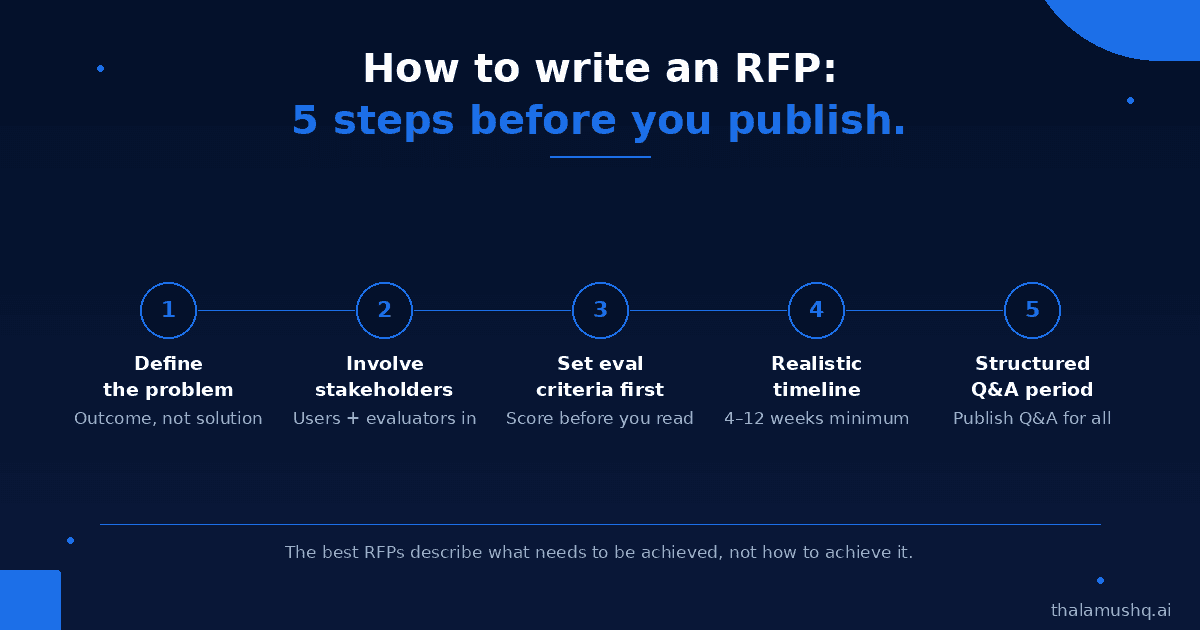
Step 1 - Define the problem clearly before defining the solution - The strongest RFPs describe what the issuing organization needs to achieve, not how they expect the vendor to achieve it. Prescriptive RFPs that specify the solution limit vendor creativity and often exclude better options.

Step 2 - Identify and involve key stakeholders before writing - The people who will evaluate responses, manage the vendor relationship, and use the deliverables should all have input into the requirements section. RFPs written in isolation by procurement without input from users typically produce misaligned responses.

Step 3 - Define evaluation criteria before publishing the RFP - Finalising how responses will be scored before seeing any proposals prevents bias and produces more defensible selection decisions.

Step 4 - Set a realistic timeline - Short timelines discourage qualified vendors from responding and increase the proportion of templated, low-effort bids. For complex engagements, four to six weeks from publication to submission deadline is a minimum; eight to twelve weeks is more appropriate for large or technical procurements.

Step 5 - Allow a structured question period - Publishing written questions and responses (without identifying which vendor asked) before the submission deadline reduces misunderstandings, improves response quality, and treats all vendors fairly.

Request for Proposal Example PDF Format: Most RFPs are distributed as PDF files for reading and Word or Excel templates for responding. Government RFPs often require specific font and margin specifications; private sector RFPs are more flexible. If you want vendors to respond within the document itself, provide an editable Word version alongside the locked PDF. If vendors should submit separate documents, specify the required file format, naming convention, and maximum file size.

Request for Proposal Response Example: What Does a Winning Bid Look Like?

Most guides in this category stop at the RFP example and skip the question that matters most for vendor teams: what does a winning response actually look like?
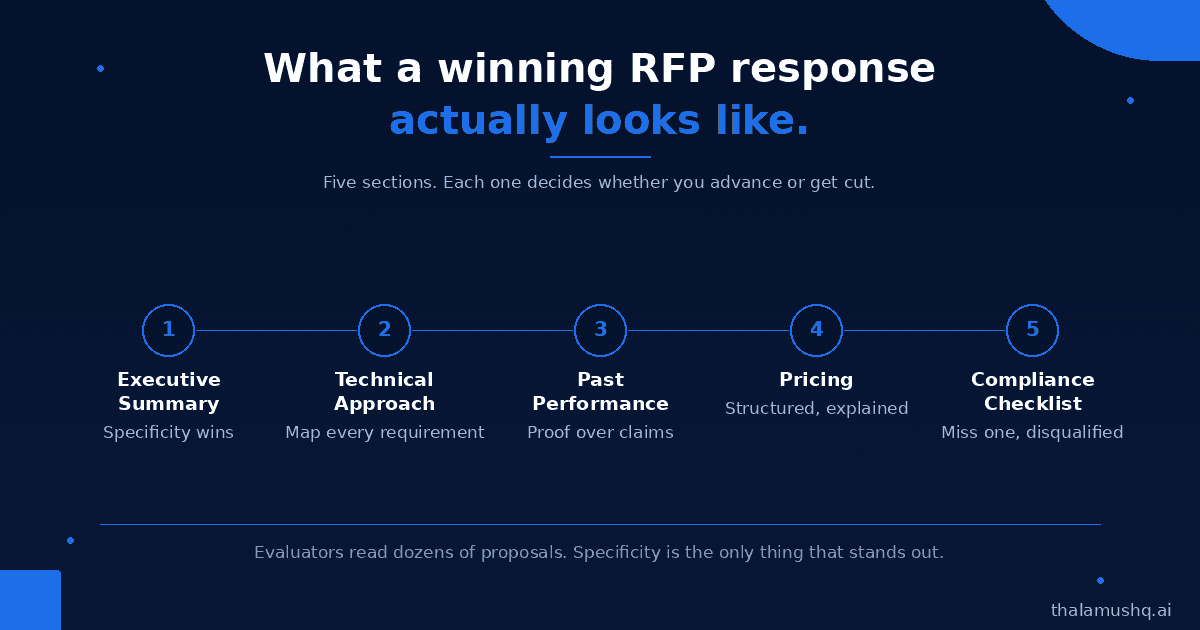
This section covers that. The structure below applies to the response side of an RFP, not to writing the RFP itself.

The Executive Summary: The Section Evaluators Read First and Weigh Heavily

A strong executive summary does three things that most weak ones do not: it names the buyer's problem specifically (not generically), it states the proposed solution in one or two sentences, and it provides one concrete proof point that this specific vendor has solved this specific problem before.

Weak executive summary (what most vendors submit): 

"[Company Name] is pleased to submit this proposal in response to [RFP number]. We have extensive experience in [industry] and are confident we can meet your requirements. Our team is dedicated to delivering high-quality results on time and within budget."

This response communicates nothing. Every vendor submits a version of this sentence.

Strong executive summary (what winning responses contain): 

"The [organization Name]'s [Project Name] faces a specific challenge: [name the challenge from the RFP in the buyer's own language]. [Company Name] has solved this exact problem for [comparable client type]. In [named project], we delivered [specific measurable outcome] within [timeline]. This proposal sets out our approach, team, and pricing to achieve [the buyer's stated goal] for [organization Name]."

The difference is specificity. Evaluators read dozens of proposals. The ones that demonstrate they read the RFP and responded to it, rather than adapted a generic template, stand out immediately.

The Technical Approach: Where Most RFP Responses Are Won or Lost

The technical approach section must map directly and explicitly to every requirement in the RFP's scope of work. Evaluators score this section by checking off stated requirements against the vendor's response. Any requirement not addressed is a gap, and a gap is a scoring deduction.

A strong technical approach does the following:

  • Addresses every explicitly stated requirement by name, not paraphrased, not grouped, but each requirement addressed individually

  • Explains the how in enough detail that an evaluator can envision the vendor executing it, not just "we will conduct a stakeholder review" but "we will conduct a two-week stakeholder review including [specific methodology], producing [specific deliverable] for buyer review and approval"

  • Anticipates likely evaluation concerns and addresses them proactively; if the RFP mentions a tight timeline, the response should address timeline risk mitigation explicitly

  • Uses the buyer's own language and terminology throughout — this is not plagiarism, it is relevance

Past Performance and Case Studies: Proof Over Claims

Evaluators are trained to discount capability claims without evidence. A vendor claiming to be "a leader in [industry]" is providing zero evaluable information. A vendor providing a case study with a named client, a comparable project scope, a specific challenge faced, the approach taken, and a measurable outcome is providing exactly what evaluators need to score confidence.

The structure of a strong RFP case study:

  • Client name (or anonymized descriptor if confidential)

  • Engagement scope and comparability to the current project

  • The specific challenge or problem

  • The approach and what was distinctive about it

  • Measurable outcomes with numbers, not adjectives ("reduced implementation time by 40%" not "significantly improved efficiency")

  • A reference contact willing to be called

Pricing: Transparent, Structured, and Explained

Pricing sections that are unclear, incomplete, or inconsistent with the scope of work described in the technical approach raise immediate red flags. Evaluators see hundreds of proposals where the price appears to have been set independently of the scope described, a sign that the vendor either did not read the RFP carefully or is planning scope adjustments post-award.

A strong pricing section structures cost by deliverable or phase, explains what is and is not included, identifies assumptions that could change the price if they change, and provides context for why the price is what it is. Some RFPs prohibit pricing justification; others require it. Follow the instructions.

Compliance Checklist: The Reason Most Proposals Are Disqualified

The most preventable form of bid loss is disqualification on compliance grounds, submitting a technically strong, competitively priced proposal that is rejected because a mandatory form was missing or a formatting requirement was not followed.

Before submitting any RFP response, verify:

  • Every mandatory form listed in the RFP is included and completed

  • The proposal follows the specified structure and section order exactly

  • Page and word limits are not exceeded in any section

  • Required certifications and insurance documentation are attached

  • The submission method (portal, email, physical mail) and deadline are confirmed

Responding to RFPs manually, tracking requirements in spreadsheets, chasing SMEs by email, verifying compliance section by section, is where most proposal teams spend the majority of their time on work that adds no strategic value. Thalamus AI takes an RFP from upload to first draft in under 15 minutes, with every requirement tracked, every section owned, and every answer grounded in verified company knowledge. → See How It Works on a Live RFP

Copy-Paste Request for Proposal Template

The following template covers the standard sections common to most RFPs. Adapt the language to your organization's style, procurement regulations, and project specifics.

[Organization NAME] REQUEST FOR PROPOSAL [Project or Service Name] RFP Number: [Reference Number] Issue Date: [Date] Submission Deadline: [Date and Time, including timezone]

Section 1 - Introduction and Organization Background

[Organization Name] is seeking proposals from qualified vendors to [brief one-sentence description of what is needed]. This Request for Proposal (RFP) describes the scope of services required, the evaluation process, and the submission requirements.

[Organization background: 1–3 paragraphs describing the organization, its mission, relevant size and context, and why this project is being undertaken now.]

Section 2 - Scope of Work

The selected vendor will be responsible for the following:

2.1 [Primary deliverable or service area] 2.2 [Secondary deliverable or service area] 2.3 [Additional requirements, integrations, or constraints] 2.4 [Deliverables and acceptance criteria]

The following items are explicitly excluded from scope: [list exclusions clearly]

Section 3 - Proposal Requirements

All proposals must include the following components, in the order listed:

3.1 Cover letter (maximum one page) 3.2 Vendor overview and qualifications 3.3 Technical approach and methodology 3.4 Project timeline and milestones 3.5 Team qualifications and key personnel CVs 3.6 Past performance: minimum [N] comparable engagements with references 3.7 Pricing proposal (use attached pricing template) 3.8 Required certifications and compliance documentation

Section 4 - Evaluation Criteria

Proposals will be evaluated on the following criteria and weights:

Criterion

Weight

Technical approach and methodology

[X]%

Relevant experience and past performance

[X]%

Team qualifications

[X]%

Price

[X]%

[Other criterion]

[X]%

Section 5 - Submission Instructions

5.1 Proposals must be submitted by [deadline] to [submission address or portal URL]. 5.2 Late submissions will not be accepted under any circumstances. 5.3 Questions must be submitted in writing to [contact email] by [questions deadline]. 5.4 Responses to all questions will be distributed to all registered vendors by [date].

Section 6 - Timeline

Milestone

Date

RFP issued

[Date]

Pre-proposal conference (if applicable)

[Date]

Questions deadline

[Date]

Answers/addendum issued

[Date]

Proposal submission deadline

[Date]

Evaluation period

[Date range]

Award notification

[Date]

Anticipated project start

[Date]

Section 7 - Terms and Conditions

7.1 [Organization Name] reserves the right to reject any or all proposals, to waive technical irregularities, and to accept the proposal deemed most advantageous to the organization. 7.2 All proposals become the property of [Organization Name] upon submission. 7.3 [organization Name] is not responsible for any costs incurred by vendors in preparing a response to this RFP. 7.4 The selected vendor will be required to sign [organization Name]'s standard services agreement prior to commencement.

AI and the Modern RFP Response Process

The RFP response process as described above, requirement by requirement, section by section, with compliance verification before submission - is where professional proposal teams spend the majority of their time. A single complex RFP can require 40 to 80 hours of coordinated effort across proposal writers, subject matter experts, legal reviewers, pricing specialists, and executive approvers.
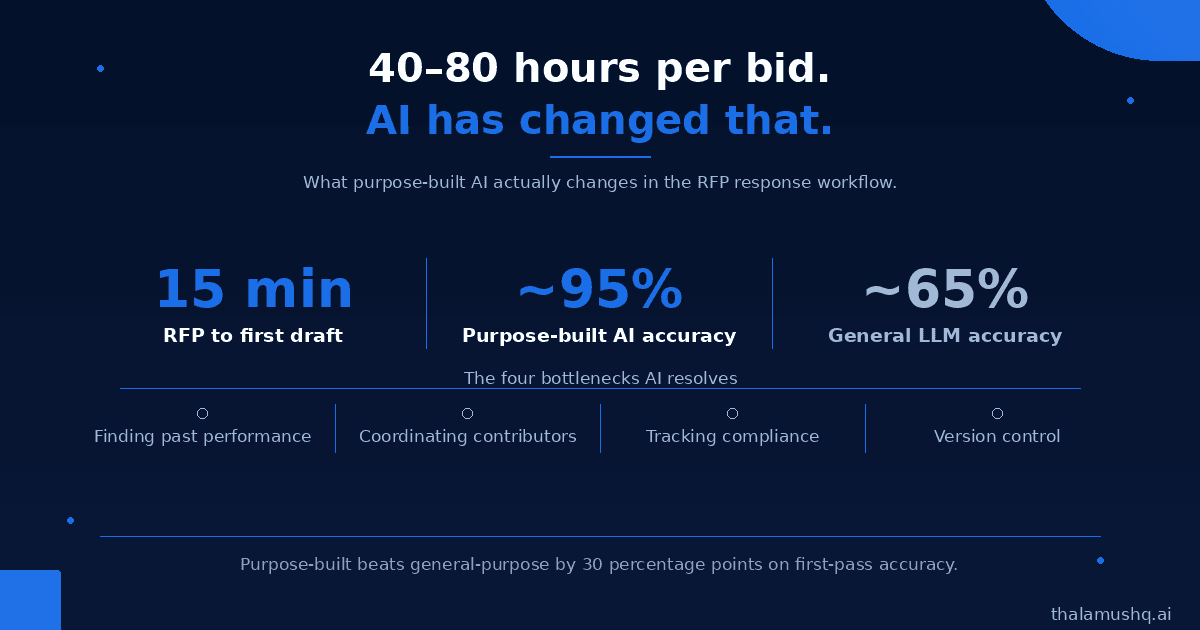
The core bottlenecks are consistent across industries: finding and assembling the right past performance and company knowledge, coordinating contributors across time zones and competing priorities, tracking compliance requirements without missing any, and managing version control across a document that multiple people are editing simultaneously.

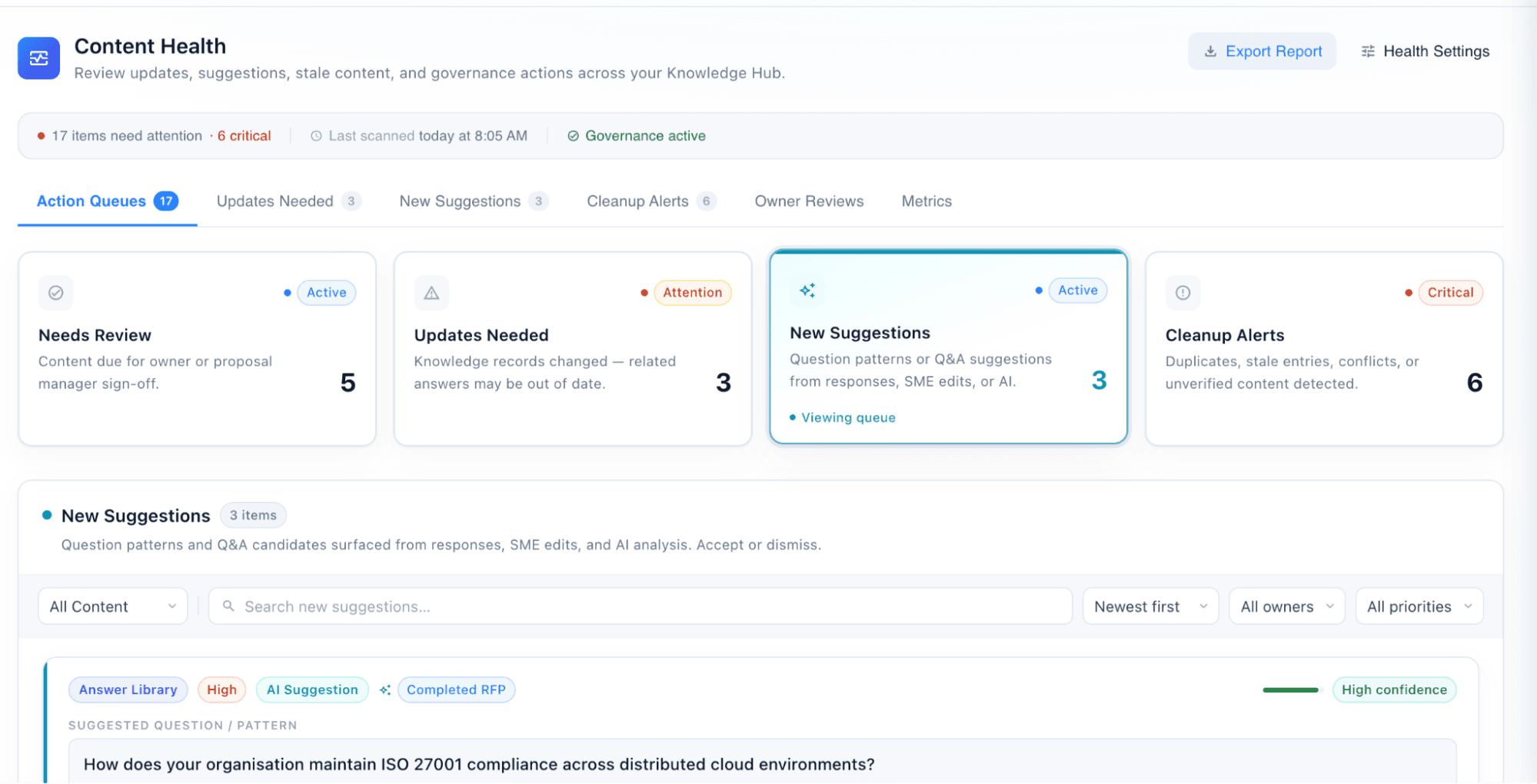
Purpose-built AI RFP platforms have changed this workflow materially in 2026. Thalamus AI, for example, takes an uploaded RFP and produces a compliance matrix mapping every stated and implied requirement to a response section, assigns sections to owners, flags compliance gaps in real time when an addendum changes a requirement, and generates a first draft grounded in verified company knowledge, without requiring a manually maintained content library. Response time from RFP receipt to first reviewable draft: under 15 minutes.
For teams still using general-purpose AI tools like ChatGPT to generate RFP responses, the accuracy gap is meaningful: approximately 65% first-pass accuracy for general LLMs versus approximately 95% for purpose-built platforms, based on the ContraVault AI benchmark study (2026). For a full comparison, see our Thalamus AI vs General LLMs analysis.

For a full evaluation of the best AI tools available for RFP response in 2026, see our 12 Best AI RFP Software Tools in 2026. For a breakdown of how these platforms are priced, see our RFP Software Pricing Guide for 2026.

If your team is spending more than a few hours per RFP on coordination and compliance tracking rather than on the strategic content that actually wins bids, the next step is a 30-minute walkthrough of your actual content. → Book a Demo with Thalamus AI

Request for Proposal FAQ: What Buyers and Vendors Ask Most in 2026?

What should a request for proposal include? 

Every RFP should include: an organization background section providing context about who is issuing the RFP and why; a scope of work defining exactly what the vendor is expected to deliver; submission requirements specifying how and in what format proposals must be submitted; evaluation criteria explaining how responses will be scored and in what proportion; a project timeline with all key dates from questions deadline through award; and terms and conditions covering intellectual property, contract requirements, and the organization's right to reject proposals. Longer or more complex RFPs may also include appendices with mandatory forms, technical specifications, or data to which vendors must respond.

What is the difference between an RFP and an RFQ? 

An RFP (request for proposal) asks vendors to propose how they would solve a problem, covering approach, methodology, team, and price evaluated together. An RFQ (request for quotation) asks vendors to price a defined specification where the buyer already knows exactly what they want and is comparing price alone. RFPs are used for complex, solution-dependent engagements; RFQs are used for commodity or clearly defined purchases.

What is the difference between an RFP and an RFI? 

An RFI (request for information) is issued before a procurement decision has been made to gather market information: what solutions exist, who provides them, and what they cost in general terms. It is a discovery tool, not a procurement mechanism. An RFP follows an RFI once the buyer has defined what they want and is ready to invite competitive bids.

How long should a request for proposal be? 

Length should match the complexity of the engagement. Simple service RFPs (social media management, graphic design, consulting) can be as short as three to seven pages. Complex technology or construction RFPs commonly run 20 to 60 pages. Government RFPs for major programs can run hundreds of pages. The governing principle is clarity, not completeness: every section should help vendors write better proposals or help evaluators evaluate them. Sections that serve neither purpose should be cut.

What is a good RFP response rate? 

Response rates vary by industry and the quality of the RFP itself. Government and public-sector RFPs typically receive three to ten responses for major procurements. Private-sector marketing and professional services RFPs often invite three to five specific vendors rather than publishing broadly. Technology RFPs issued publicly may receive 15 to 30 initial responses, filtered through a shortlisting process. RFPs with very short timelines, unclear scope, or unrealistic budget expectations typically receive fewer and lower-quality responses.

How do I respond to a request for proposal? 

Begin by reading the entire RFP before writing anything. Identify every stated and implied requirement, the evaluation criteria and their weightings, and any mandatory forms or compliance documentation required. Build a compliance checklist before drafting. Structure the response exactly as the RFP specifies; do not reorder sections. Address every stated requirement explicitly, in the order the RFP lists them. Include specific, measurable evidence for every capability claim. Verify compliance with all formatting requirements before submitting. Submit before the deadline, not at the deadline.

What makes an RFP response win? 

Winning RFP responses share five characteristics consistently: they demonstrate the vendor read and understood the specific RFP rather than adapted a generic template; they address every stated requirement explicitly and traceably; they provide specific, quantified evidence from comparable past engagements rather than general capability claims; they propose a realistic, detailed implementation plan that gives evaluators confidence in the vendor's ability to execute; and they contain no compliance errors - missing forms, incorrect formatting, or exceeded page limits - that trigger disqualification before the content is even evaluated.

Can AI help respond to an RFP? 

Yes, meaningfully. Purpose-built AI RFP platforms help vendor teams reduce time-to-first-draft from days to minutes by automatically parsing RFP requirements, generating compliance matrices, surfacing relevant company knowledge and past performance, coordinating SME contributions, and tracking addendum changes in real time. General-purpose AI tools like ChatGPT can accelerate individual section drafting but do not have persistent knowledge bases, compliance tracking, or multi-stakeholder coordination capabilities. 

What is a request for proposal in construction? 

In construction, an RFP is typically issued by a project owner, a municipality, developer, or institution, inviting qualified contractors to bid on a specific construction project. It differs from a simple bid invitation in that it evaluates the contractor's qualifications, approach, and team alongside price, rather than awarding to the lowest bidder on a defined specification. Construction RFPs typically require proof of bonding, insurance certificates meeting specific minimums, OSHA compliance history, references from comparable completed projects, a schedule demonstrating project delivery approach, and completed mandatory forms. Missing any compliance document is typically grounds for disqualification regardless of bid price.

How do I write a request for proposal for software? 

A software RFP should include: a functional requirements matrix (a table listing every required capability with response columns for vendors to indicate native, configurable, or not available); technical requirements covering infrastructure, security, integration APIs, and data hosting; security and compliance requirements (SOC 2 Type II, GDPR, HIPAA as applicable); pricing structure broken out by implementation, annual licence, training, and ongoing support; reference requirements specifying comparable implementations; and a realistic evaluation timeline. The functional requirements matrix is the most important section; it determines which vendors can be objectively compared and which capabilities are genuinely important to the buyer versus aspirational additions.

The Bottom Line on RFP Examples in 2026

An RFP is a formal invitation. The quality of what you receive back depends almost entirely on the quality of what you put in: how clearly you have defined the problem, how specifically you have described the evaluation criteria, and how much context you have given vendors to write genuinely relevant proposals.

On the vendor side, the quality of what you submit depends on how specifically you have addressed what the buyer actually asked, not what you wish they had asked, and how clearly you have evidenced your ability to deliver it.

Both sides of this exchange- writing better RFPs and responding more effectively to them - have been materially accelerated by purpose-built AI in 2026. For vendor teams specifically, the shift from manual RFP response to AI-assisted bid management is the most significant productivity change in the proposal profession in a generation.

Your next RFP does not have to take a week to respond to. → Book Your Demo

Related reading: 10 Best Responsive Alternatives in 2026 | Thalamus AI vs Loopio: RFP Platform Comparison | RFP Software Pricing in 2026