
Harpreet Singh, MBA
Founder, Thalamus AI

With 12+ years in AI and enterprise software, including GenAI product work at Travelers Group, Harpreet writes about AI RFP software, AI bid tools, proposal operations, RFP response automation, and the future of enterprise bid management.

The RFP response process for vendors, stage by stage
Here's the process most RFP-issuer content skips entirely, and most vendor-side content only names without walking through.
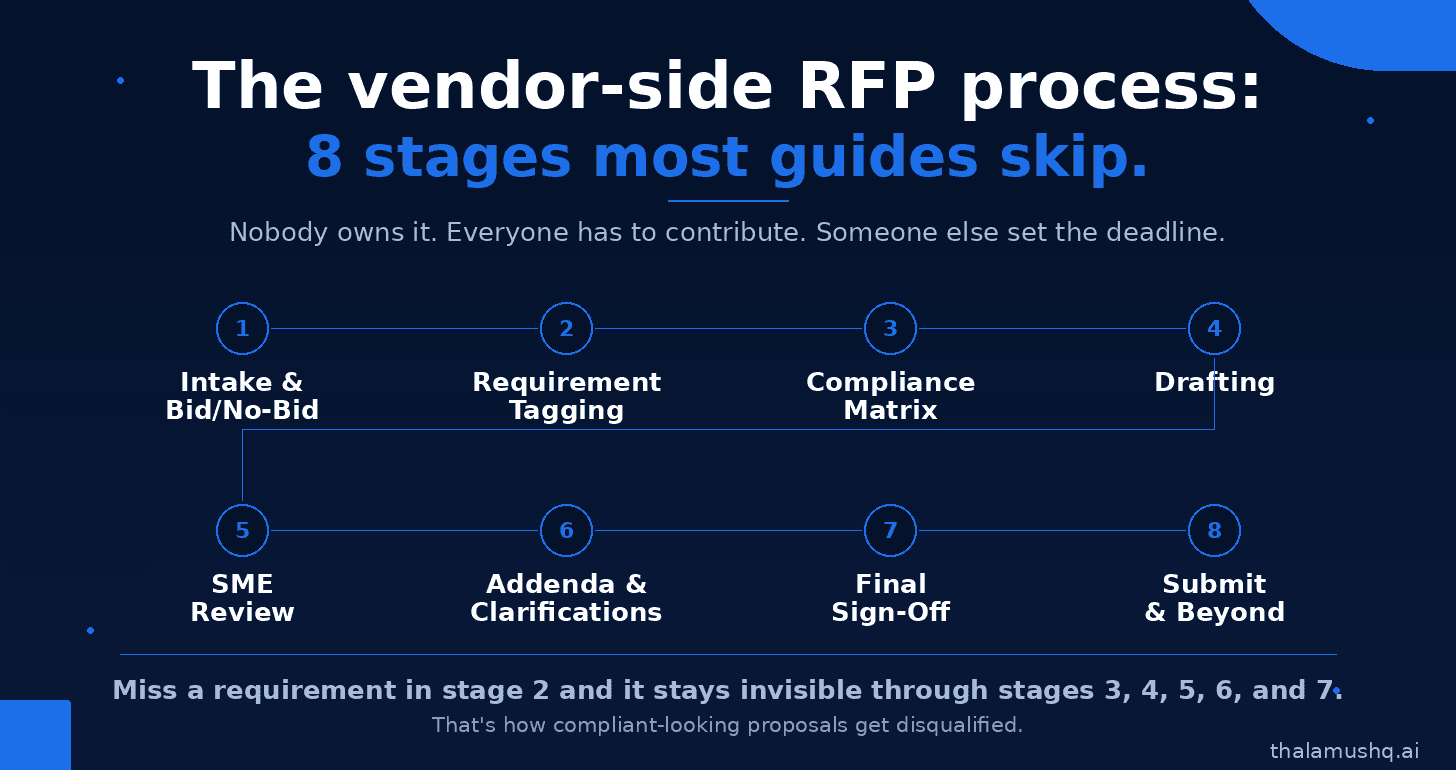
Intake and bid/no-bid
The RFP lands, usually through sales, sometimes through a portal alert. Someone has to decide, fast, whether this is worth the team's time. Skipping this step is how teams end up three weeks deep into a 40-page technical response for a deal they were never going to win. A working go/no-go checklist usually weighs customer fit, existing relationship, realistic win probability, and whether the team actually has the bandwidth this month.
Requirement tagging
The document gets shredded, section by section, and every requirement gets tagged: mandatory, evaluation criteria, instructions, statement of work. This is the step that turns a wall of text into a workable project plan, and it's also the step most teams still do manually, in a spreadsheet, at 11 pm. The tagging quality here sets the ceiling for everything downstream. Miss a mandatory requirement here, and it's invisible for the rest of the process.
Compliance matrix build
Every tagged requirement gets mapped to a response owner, a proposal section, and a status. This matrix becomes the single source of truth for whether the response is actually going to be compliant when it's submitted, not just whether it feels done. A good matrix also tracks risk level per requirement, so the team knows which gaps are minor and which ones are disqualifying.
Drafting from the knowledge base
The actual writing starts, pulling from case studies, resumes, past proposal language, and security documentation that already exists somewhere in the organization. The quality of this stage is a direct function of how well-organized that underlying content actually is, not how good any individual writer is on the team.
SME collaboration and review
Sections get routed to the people who actually know the answer, whether that's a security engineer confirming a compliance certification or a delivery lead confirming a project timeline. This stage runs in parallel with drafting for most complex RFPs, not after it, because waiting for a fully drafted response before looping in SMEs is how deadlines get missed.
Clarification rounds and addenda
This is where most RFP processes quietly go sideways, and it's the stage the next section is entirely about.
Clarification rounds deserve their own attention here, separate from addenda. An addendum changes what's being asked. A clarification round exists because something in the original document was ambiguous enough that multiple vendors had the same question. Teams that don't check whether their own open questions are already answered somewhere in the RFP waste a clarification request, and worse, hand the evaluator a signal that they didn't read the document carefully.
Final review and sign-off
A lead author checks the response for consistency, legal checks the commitments being made, and the whole document gets a final pass against the compliance matrix before it's cleared to go.
Submission and beyond
The proposal goes out, but the process isn't over. Buyers come back with follow-up questions, scoring walkbacks, or a Best and Final Offer request, and the team has to respond again, often on a shorter deadline than the first round.
If you want a broader view of what tools exist to support each of these stages, our roundup of the leading AI RFP software options breaks down which platforms are actually built for this side of the process versus the buyer side.
The RFP Process Stage Most Guides Skip: What Happens When the RFP Changes Mid-Draft
Here's the calculation almost no RFP process guide walks through. Say a compliance matrix has 80 requirements mapped, and the team is six days into a fourteen-day response window. The buyer issues an addendum on day seven that changes a technical specification in section 2.3.
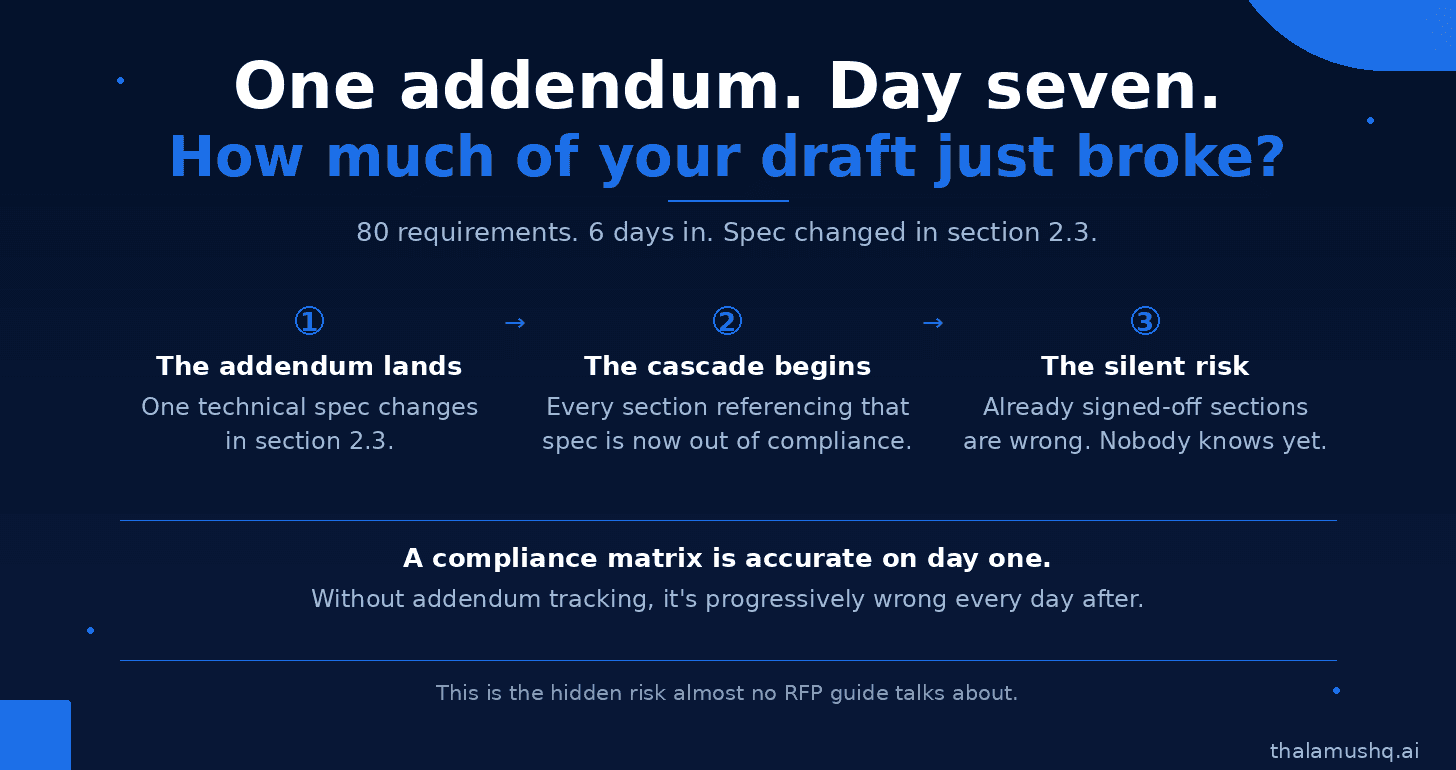
That one addendum doesn't just add a new requirement. It can invalidate the "compliant" status on every section that referenced the original spec, including sections that were already reviewed and signed off by an SME. If nobody is tracking which sections traced back to that requirement, the team finds out during final review, or worse, doesn't find out at all.
I've watched this exact scenario knock a proposal out of contention on a technicality that had nothing to do with the quality of the response. The team answered a question that no longer matched what was being asked, because the compliance matrix was a snapshot from day one, not a living document that moved with the RFP.
Addenda aren't rare. Buyers issue them for the most ordinary reasons: a vendor question exposes an ambiguity, a stakeholder changes their mind about a requirement, a typo needs fixing. Each one is small on its own. What's underestimated is the downstream cost of each one on a response that's already in motion.
This is why treating the RFP response process as a single pass, requirements gathered once at intake and never revisited, is one of the biggest hidden risks in the entire process. It's accurate on day one and progressively less accurate every day after that, right up until submission.
Ready to see how this plays out with a real RFP instead of a hypothetical one? Bring your next RFP to a live walkthrough, and we'll show you exactly where addenda tend to break a response.
Why the compliance matrix is the real backbone of the RFP process
A compliance matrix that's alive tracks three things simultaneously: the requirement, the current status of the response section tied to it, and any addenda that touched that specific requirement since intake. When an addendum lands, the matrix should flag every section it affects immediately, not leave it for someone to catch during a final read-through with two days left on the clock.
A related but distinct problem sits earlier in the process: not what changed, but what was never actually clear in the first place. An AI Clarification Register can check every open question a team has drafted against the RFP package itself before it's sent to the buyer, separating genuinely unanswered items from ones already addressed on page 40. It's a different failure mode from an addendum breaking a compliant section, but it comes from the same root cause: treating the RFP as fully read once, instead of continuously checked.
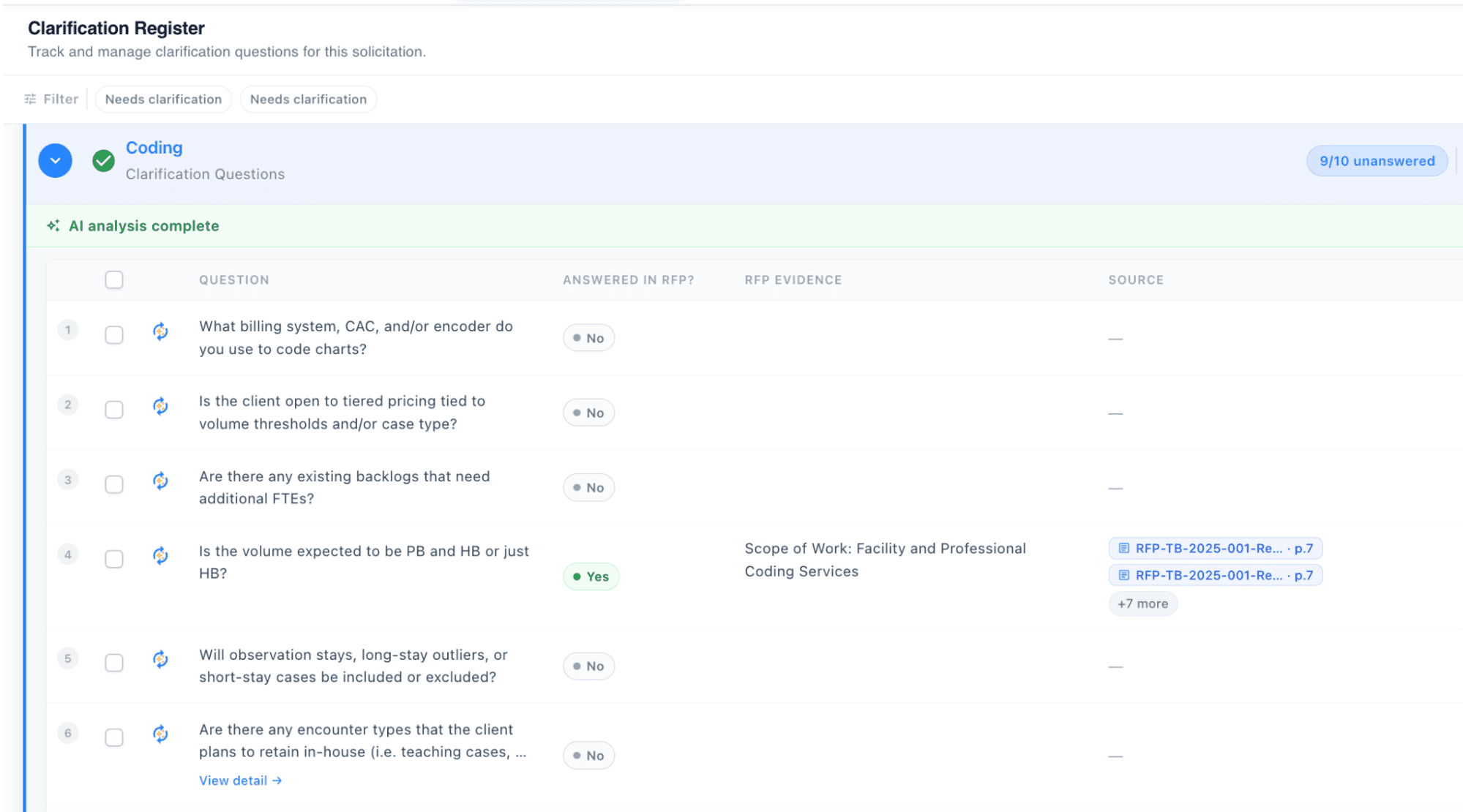
That's the difference between a compliance matrix as a one-time checklist and a compliance matrix as a living index. One reduces disqualification risk for the first draft. The other reduces disqualification risk for the version you actually submit.
If you want to see what a living compliance matrix looks like in practice, walk through Thalamus AI's compliance matrix on your own RFP. It auto-detects addenda changes and flags every impacted section, so the team finds out on day seven, not during final review.
The part of the RFP process that compounds: institutional memory across RFPs
Most companies treat every RFP as an isolated event with a beginning, middle, and end. In practice, the fiftieth RFP a team responds to should be dramatically easier than the first, because the underlying content, the case studies, the resumes, the technical answers, mostly already exists.
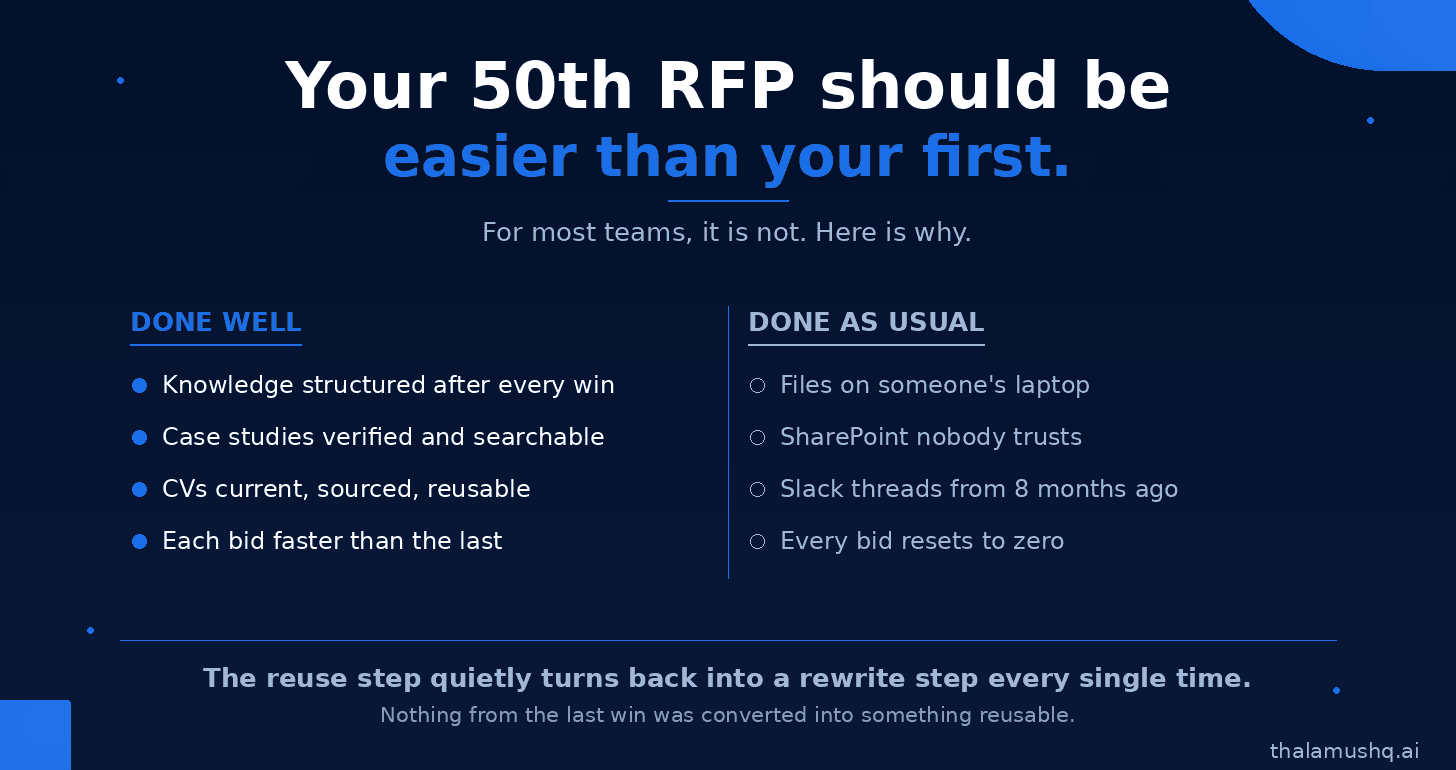
That only holds if the knowledge from every past response is structured, verified, and searchable, rather than scattered across someone's laptop, an old SharePoint folder, and a Slack thread from eight months ago. A large share of teams don't trust their SharePoint or Drive libraries enough to pull answers directly from them, which means the "reuse" step of the process quietly turns back into a rewrite step every single time.
Structured knowledge also benefits from staying connected to where relationship context actually lives. Entities linked to CRM systems like Salesforce carry account history and contact context forward automatically, rather than starting cold on every new opportunity. And a content governance layer that actively flags duplicate, stale, or conflicting entries, rather than waiting for someone to notice during the fiftieth response, is what keeps that "reuse" step from quietly turning back into a rewrite step.
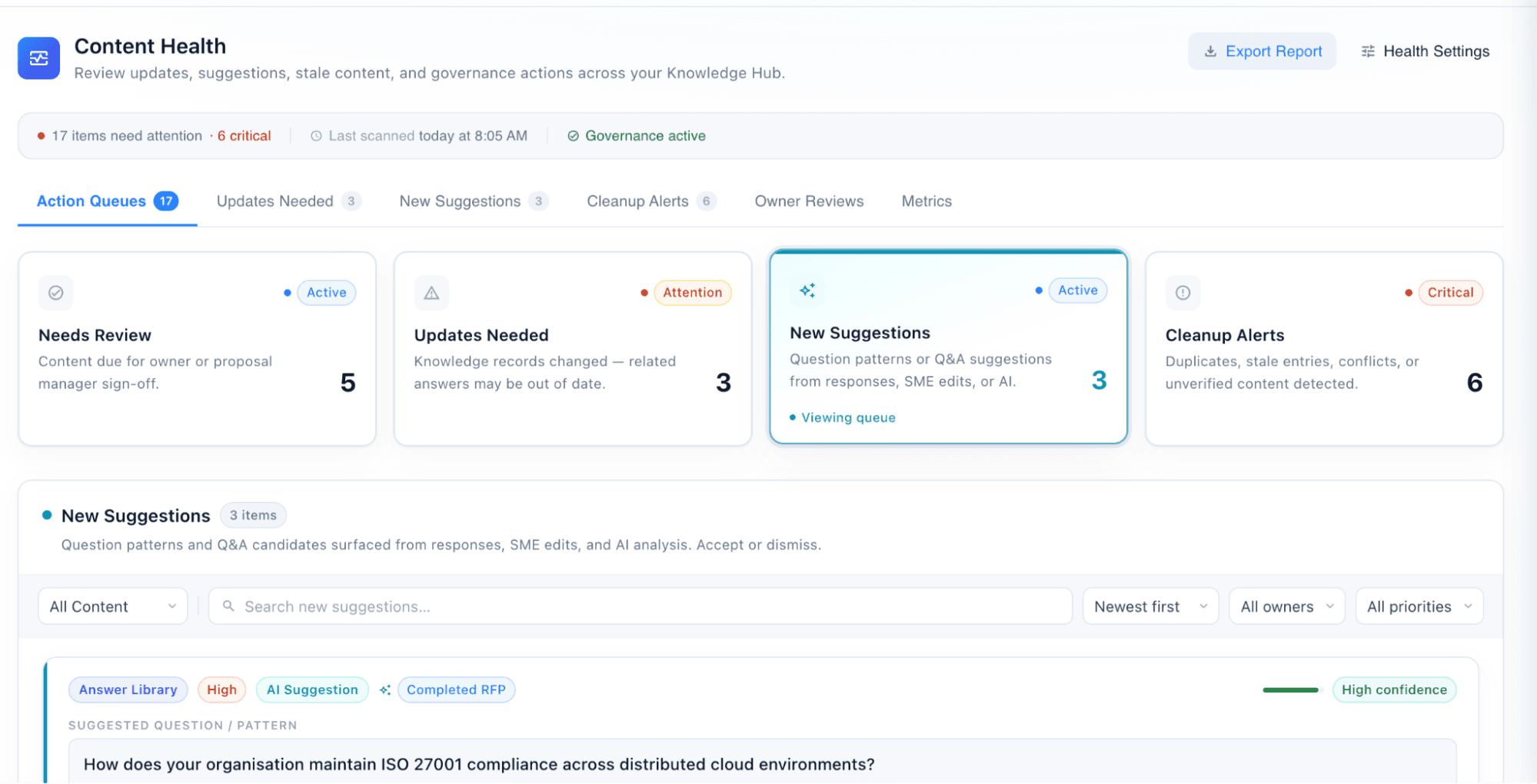
The RFP process, if done well, is supposed to get faster and more reliable with every cycle. The RFP process, done the way most teams still run it, resets to zero on every new document, because nothing from the last win was ever converted into something reusable.
Curious what that looks like structured properly? Show us your current answer library, and we'll map out what a structured version would look like.
Best practices for a smoother RFP process, on both sides of the table
A few habits show up consistently in teams that run a reliable process, whether they're issuing or responding to RFPs.
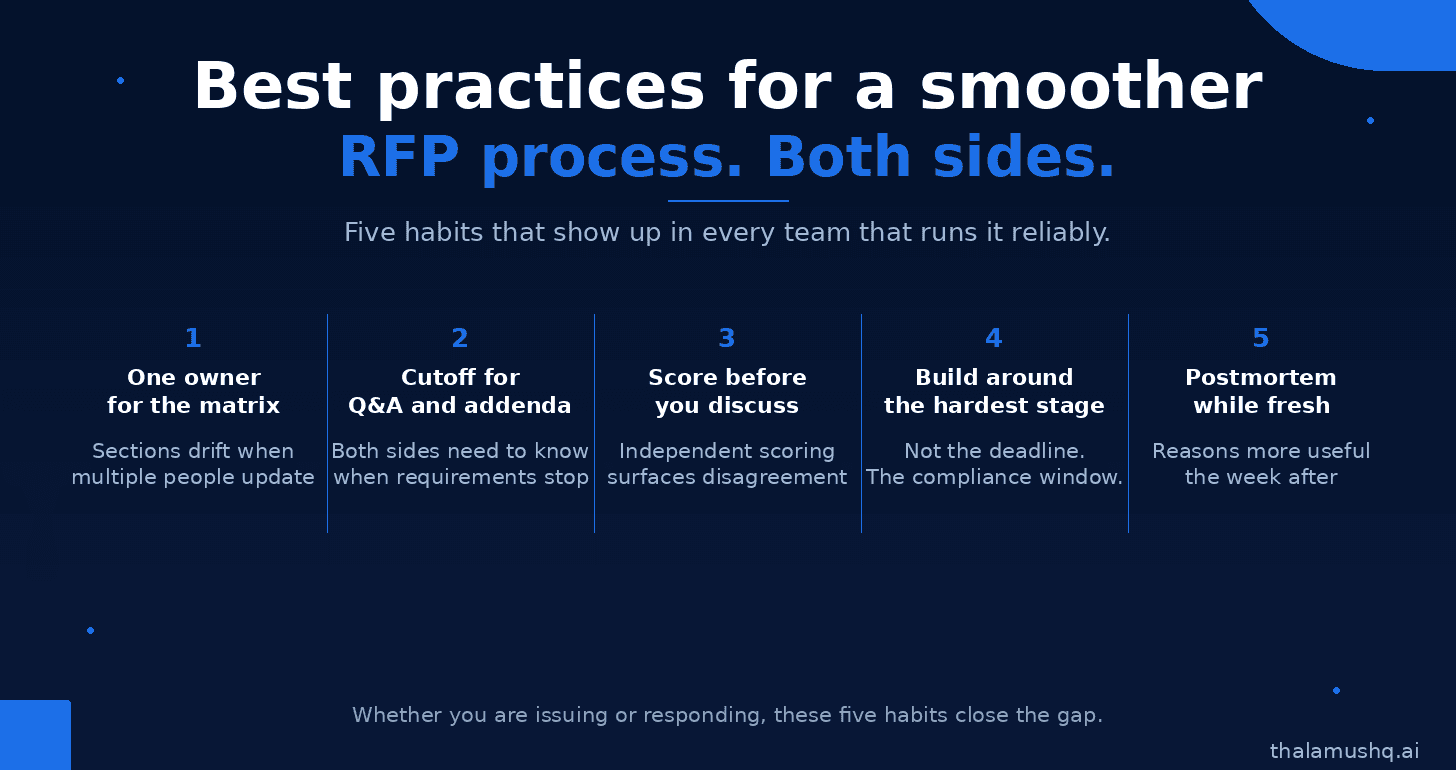
Here are those -
Assign a single owner for the compliance matrix
When multiple people update it independently, sections drift out of sync with each other, and nobody notices until it's too late to fix cleanly.
Set an explicit cutoff for questions and addenda
Both sides benefit from knowing exactly when the requirements stop moving. A defined cutoff, communicated clearly, cuts down on last-minute scrambles for everyone involved.
Score before you discuss, and review before you draft
On the buyer side, independent scoring surfaces real disagreement instead of social convergence. On the response side, an SME reviewing a requirement before drafting starts prevents rework later.
Build the timeline around the hardest stage, not the deadline
For buyers, that's usually evaluation. For response teams, that's usually the compliance matrix staying accurate through the full response window, particularly on RFPs with a long Q&A period.
Capture the postmortem while it's fresh
Whether you won or lost, the reasons are more useful the week after submission than six months later when the next similar RFP shows up.
4 Common challenges in the RFP process
A few friction points show up in nearly every RFP process, on both sides, often enough that it's worth planning around them rather than being surprised by them each time.
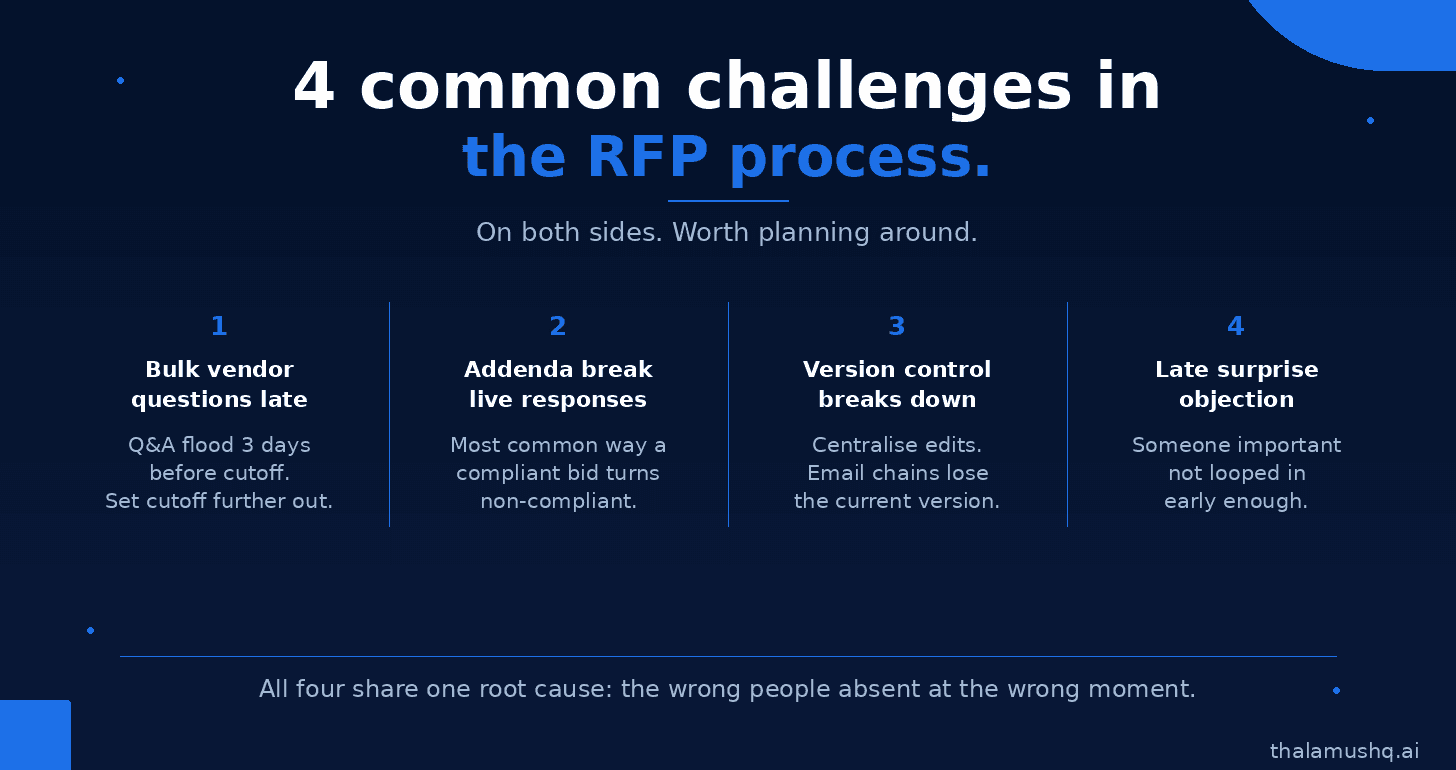
Vendor questions arriving in bulk as the deadline approaches
Buyers often see a flood of clarification questions three days before the Q&A cutoff, leaving little time to respond thoughtfully before proposals are due. Setting the cutoff further out from the submission deadline gives more breathing room on both sides.
Addenda that quietly break an in-progress response
Covered above, and worth repeating here because it's the single most common way a compliant-on-paper response ends up non-compliant on submission day.
Version control across a growing document
Once a proposal is in review with multiple SME contributors, tracking which version is current becomes its own project. Centralizing edits in one place, rather than passing a document through email, removes most of this friction.
A surprise objection late in the process -
On the buyer side, this looks like a senior stakeholder pushing back on a vendor choice they weren't involved in the scoring of. On the response side, it looks like legal flagging a commitment two days before submission that should have been caught during drafting. Both come from the same root cause: someone important wasn't looped in early enough.
RFP Process: For whom this matters most, and for whom it doesn't
If your team handles a handful of short, standardized security questionnaires a year, a spreadsheet and a shared drive will get the job done. The overhead of a structured knowledge layer and a living compliance matrix isn't worth it at that volume.
However, if your team is running multiple complex, multi-section RFPs at once, with SMEs across departments, addenda that actually change requirements mid-cycle, and a compliance matrix that needs to be right on the day of submission, not just the day of intake, that's where the response side of the RFP process stops being a documentation exercise and starts being infrastructure.
That's also roughly the point where teams start comparing dedicated RFP response platforms. If Loopio is on your shortlist, it's worth understanding where a structured knowledge layer changes the equation versus a flatter content library, and our breakdown of Loopio alternatives covers that comparison in more depth.
What structured infrastructure, like Thalamus AI, changes in the RFP process?
Based on Thalamus AI internal customer workflow analysis from 2025–2026, teams using a structured knowledge entity layer saw a 34% improvement in response reliability, 3x more shortlist appearances, and a 2.5x increase in bid win rate. Results vary by proposal volume, workflow complexity, content maturity, and adoption depth.
None of that comes from drafting faster. It comes from the compliance matrix staying accurate through every addendum, the Clarification Register catching what nobody realized was already answered, and from the answer library, kept current by active content governance, actually being trustworthy enough to pull from without a rewrite.
FAQ: the RFP process and the RFP response process, answered
What are the main steps in the RFP process?
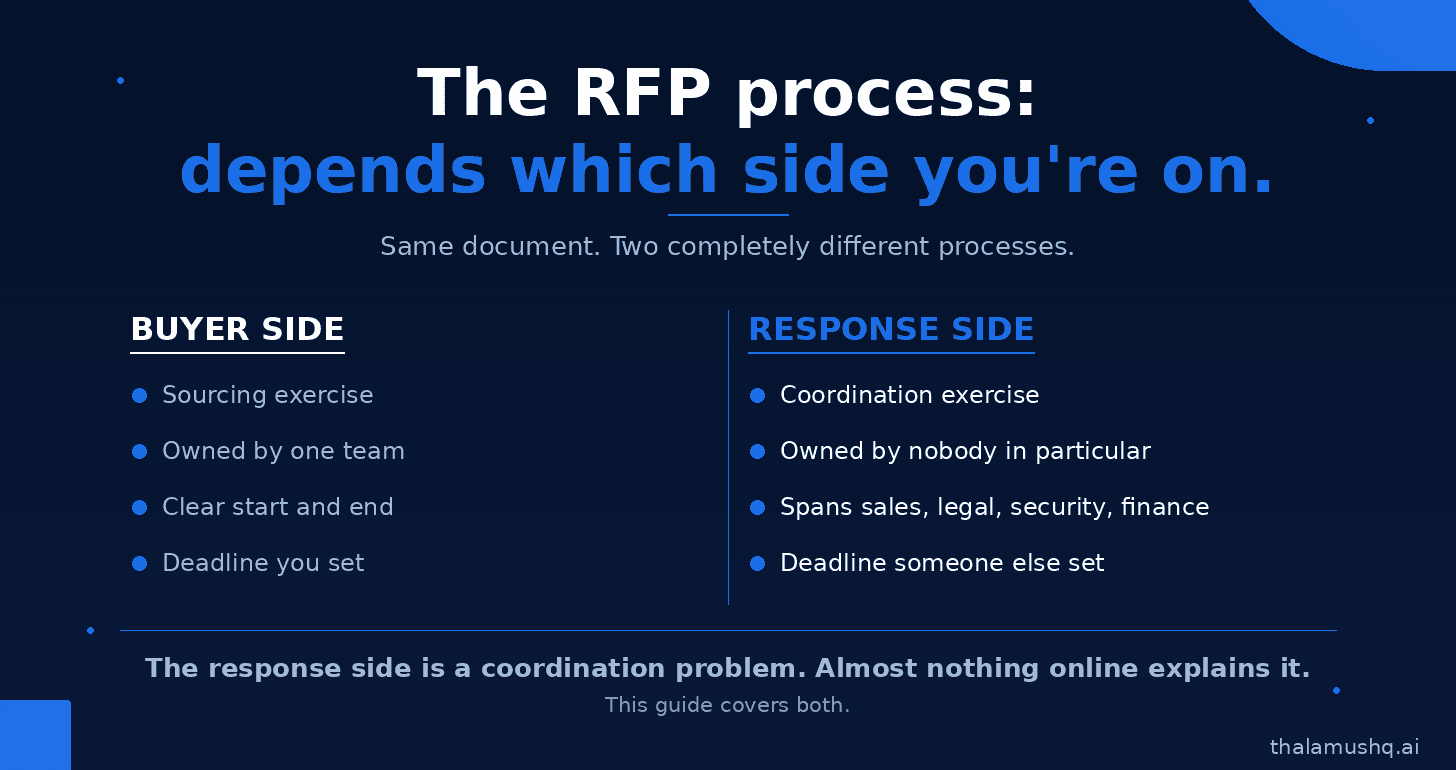
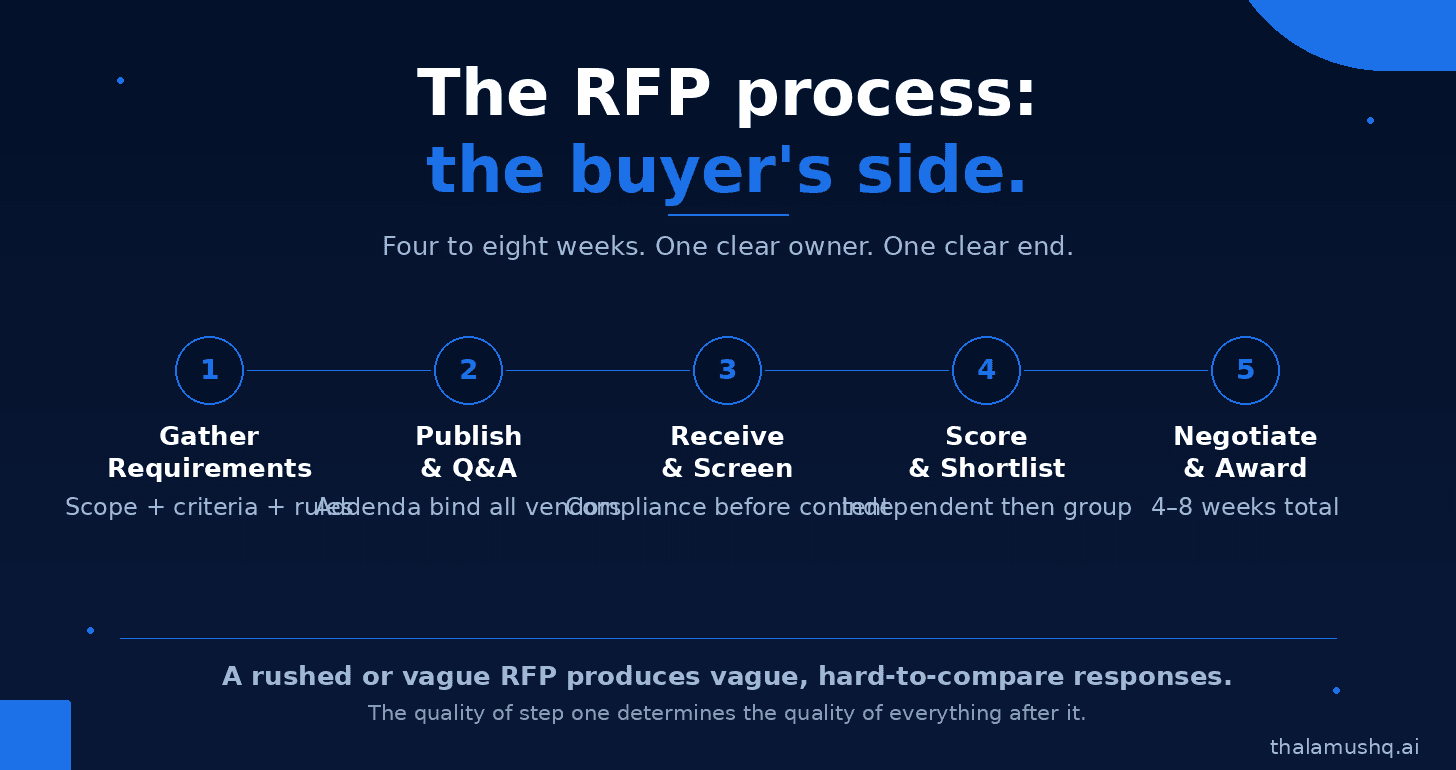
On the buyer side: define requirements, write and publish the RFP, run a Q&A and addenda period, collect and evaluate proposals, negotiate, and award. On the response side: intake and bid/no-bid, requirement tagging, compliance matrix build, drafting, SME collaboration, clarification and addenda tracking, final review, and submission.
What's the difference between the RFP process and the RFP response process?
The RFP process usually refers to the buyer's end-to-end sourcing workflow, from defining a need to awarding a contract. The RFP response process is the vendor's side of the same event: everything a bid team does between receiving the document and submitting a compliant proposal.
How long does the RFP process typically take?
Response windows commonly run two to four weeks depending on complexity, though some RFPs allow as little as a few business days. The full buyer-side process, from requirement gathering through award, often runs four to eight weeks for mid-complexity purchases and longer for enterprise or public sector procurement.
What happens when an RFP addendum is issued mid-process?
An addendum formally changes a requirement, timeline, or scope, and it becomes binding on every vendor in the process. On the response side, any section of the proposal that traced back to the original requirement needs to be re-checked against the new version before submission, not just noted and set aside.
Does the RFP process end at submission?
No. Buyers often come back with clarification questions, scoring walkbacks, or a Best and Final Offer request, all of which reopen sections of the response that the team considered finished.
What's the difference between an RFP, an RFI, and an RFQ?
An RFI, or request for information, is used earlier in the process to gather general information about potential vendors before requirements are fully defined. An RFP is used once requirements are set and the buyer wants a detailed proposal. An RFQ, or request for quotation, is used for standardized purchases where price is the primary deciding factor.
If you're managing the RFP process for vendors on your team and want to see how a living compliance matrix and a structured knowledge layer would handle your next one, Thalamus AI runs a live demo on your actual RFP in about 20 minutes.