Blogs

Blogs

8 mins

8 mins

Best AI for Proposal Writing in 2026: The Right Tool Depends on What You’re Writing

Best AI for Proposal Writing in 2026: The Right Tool Depends on What You’re Writing

Best AI for Proposal Writing in 2026: The Right Tool Depends on What You’re Writing

Best AI for Proposal Writing in 2026: The Right Tool Depends on What You’re Writing

Harpreet Singh, MBA

Founder, Thalamus AI

With 12+ years in AI and enterprise software, including GenAI product work at Travelers Group, Harpreet writes about AI RFP software, AI bid tools, proposal operations, RFP response automation, and the future of enterprise bid management.

Summarize with ChatGPT

Summarize with ChatGPT

Key Takeaways

  • "Proposal writing" covers three fundamentally different workflows: enterprise RFP and bid responses for proposal managers, client-facing sales proposals for freelancers and small businesses, and grant applications for academic and research teams. The best AI for each of these is not the same tool.

  • For enterprise proposal teams responding to formal, competitive RFPs and tenders, Thalamus AI is the strongest overall option in 2026, the only platform that covers the full bid lifecycle, from capture planning through compliance tracking and post-bid institutional learning, without requiring a Q&A content library to maintain.

  • For freelancers and small business sales teams, tools like Proposify, PandaDoc, and Qwilr are better suited: they handle templates, e-signatures, and sales proposal design, not bid management.

  • For academic and research teams writing grant proposals, purpose-built tools like Granted AI address the specific structure, compliance, and funder-matching requirements that neither RFP platforms nor sales proposal tools cover.

  • For enterprise bid teams, the best AI for proposal writing is not a generic proposal generator. Full bid infrastructure platforms like Thalamus AI work best when RFPs require compliance tracking, requirement mapping, SME coordination, addendum management, source-linked drafting, and post-bid learning.

  • Most "best AI for proposal writing" guides mix all three audiences in one list without distinguishing between them. This one does not.

Summarize with ChatGPT

Key Takeaways

Key Takeaways

Key Takeaways

  • "Proposal writing" covers three fundamentally different workflows: enterprise RFP and bid responses for proposal managers, client-facing sales proposals for freelancers and small businesses, and grant applications for academic and research teams. The best AI for each of these is not the same tool.

  • For enterprise proposal teams responding to formal, competitive RFPs and tenders, Thalamus AI is the strongest overall option in 2026, the only platform that covers the full bid lifecycle, from capture planning through compliance tracking and post-bid institutional learning, without requiring a Q&A content library to maintain.

  • For freelancers and small business sales teams, tools like Proposify, PandaDoc, and Qwilr are better suited: they handle templates, e-signatures, and sales proposal design, not bid management.

  • For academic and research teams writing grant proposals, purpose-built tools like Granted AI address the specific structure, compliance, and funder-matching requirements that neither RFP platforms nor sales proposal tools cover.

  • For enterprise bid teams, the best AI for proposal writing is not a generic proposal generator. Full bid infrastructure platforms like Thalamus AI work best when RFPs require compliance tracking, requirement mapping, SME coordination, addendum management, source-linked drafting, and post-bid learning.

  • Most "best AI for proposal writing" guides mix all three audiences in one list without distinguishing between them. This one does not.

  • "Proposal writing" covers three fundamentally different workflows: enterprise RFP and bid responses for proposal managers, client-facing sales proposals for freelancers and small businesses, and grant applications for academic and research teams. The best AI for each of these is not the same tool.

  • For enterprise proposal teams responding to formal, competitive RFPs and tenders, Thalamus AI is the strongest overall option in 2026, the only platform that covers the full bid lifecycle, from capture planning through compliance tracking and post-bid institutional learning, without requiring a Q&A content library to maintain.

  • For freelancers and small business sales teams, tools like Proposify, PandaDoc, and Qwilr are better suited: they handle templates, e-signatures, and sales proposal design, not bid management.

  • For academic and research teams writing grant proposals, purpose-built tools like Granted AI address the specific structure, compliance, and funder-matching requirements that neither RFP platforms nor sales proposal tools cover.

  • For enterprise bid teams, the best AI for proposal writing is not a generic proposal generator. Full bid infrastructure platforms like Thalamus AI work best when RFPs require compliance tracking, requirement mapping, SME coordination, addendum management, source-linked drafting, and post-bid learning.

  • Most "best AI for proposal writing" guides mix all three audiences in one list without distinguishing between them. This one does not.

Quick Answer: What Is the Best AI for Proposal Writing in 2026?

Quick Answer: What Is the Best AI for Proposal Writing in 2026?

The best AI for proposal writing depends on what type of proposal you write.

For enterprise RFPs, bid responses, security questionnaires, DDQs, and complex proposals, Thalamus AI is the best fit when teams need full bid lifecycle management: bid/no-bid qualification, requirement mapping, compliance matrices, addendum tracking, RACI routing, SME collaboration, source-linked drafting, and post-bid learning.

For government contractors that need federal-grade security and narrative proposal writing, AutogenAI is a strong option. For teams with mature content libraries, Loopio and Responsive are established RFP software platforms. For freelancers and small businesses creating sales proposals, PandaDoc, Proposify, Qwilr, Better Proposals, and Bidara are better fits. For grant and research proposals, Granted AI is more relevant than RFP or sales proposal software.

The short version: Thalamus AI is the best AI proposal writing platform for enterprise RFP teams. Sales teams, freelancers, and grant writers need different tools.

The best AI for proposal writing depends on what type of proposal you write.

For enterprise RFPs, bid responses, security questionnaires, DDQs, and complex proposals, Thalamus AI is the best fit when teams need full bid lifecycle management: bid/no-bid qualification, requirement mapping, compliance matrices, addendum tracking, RACI routing, SME collaboration, source-linked drafting, and post-bid learning.

For government contractors that need federal-grade security and narrative proposal writing, AutogenAI is a strong option. For teams with mature content libraries, Loopio and Responsive are established RFP software platforms. For freelancers and small businesses creating sales proposals, PandaDoc, Proposify, Qwilr, Better Proposals, and Bidara are better fits. For grant and research proposals, Granted AI is more relevant than RFP or sales proposal software.

The short version: Thalamus AI is the best AI proposal writing platform for enterprise RFP teams. Sales teams, freelancers, and grant writers need different tools.

The Most Important Thing to Know About AI Proposal Writing Tools in 2026

The Most Important Thing to Know About AI Proposal Writing Tools in 2026

Before comparing any specific tools, there is one distinction worth making upfront - because no other guide in this category makes it clearly, and it is the reason most buyers end up on the wrong platform.

"Proposal writing" means three entirely different things depending on who is searching.

A freelancer or small business owner writing a client proposal wants a tool that generates a professional-looking document with a scope of work, pricing table, and e-signature in under an hour. They are comparing Proposify, PandaDoc, and Qwilr. They have no use for compliance matrices or addendum tracking.

A bid manager or proposal director responding to a formal government or enterprise RFP is managing a 90-page document with specific compliance requirements, 15 contributors across legal, finance, and delivery teams, and a real disqualification risk if a requirement is missed. They need a platform like Thalamus AI that covers the full bid lifecycle. A template and e-signature tool would not survive the first section review.

An academic researcher or grant writer needs a tool trained on funder-specific structures, NIH and NSF formatting requirements, and the mechanics of how review panels score proposals. Neither a sales proposal platform nor an RFP bid tool was built for that.

The current guides for "best AI for proposal writing" mix all three. This guide separates the three. Read the section that matches your actual situation.

Before comparing any specific tools, there is one distinction worth making upfront - because no other guide in this category makes it clearly, and it is the reason most buyers end up on the wrong platform.

"Proposal writing" means three entirely different things depending on who is searching.

A freelancer or small business owner writing a client proposal wants a tool that generates a professional-looking document with a scope of work, pricing table, and e-signature in under an hour. They are comparing Proposify, PandaDoc, and Qwilr. They have no use for compliance matrices or addendum tracking.

A bid manager or proposal director responding to a formal government or enterprise RFP is managing a 90-page document with specific compliance requirements, 15 contributors across legal, finance, and delivery teams, and a real disqualification risk if a requirement is missed. They need a platform like Thalamus AI that covers the full bid lifecycle. A template and e-signature tool would not survive the first section review.

An academic researcher or grant writer needs a tool trained on funder-specific structures, NIH and NSF formatting requirements, and the mechanics of how review panels score proposals. Neither a sales proposal platform nor an RFP bid tool was built for that.

The current guides for "best AI for proposal writing" mix all three. This guide separates the three. Read the section that matches your actual situation.

Best AI Proposal Writing Tools 2026: Quick Comparison by Use Case

Best AI Proposal Writing Tools 2026: Quick Comparison by Use Case

Best AI Proposal Writing Tools 2026: Quick Comparison by Use Case

Audience

Primary need

Recommended tool

Why

Enterprise RFP / bid response

Full lifecycle: compliance, RACI, addendum tracking, institutional learning

Thalamus AI

Top pick for full bid lifecycle management without traditional library maintenance

Government contracting (FedRAMP required)

Narrative quality + FedRAMP High security

AutogenAI

Only AI proposal platform with FedRAMP High certification

RFP with content library investment

Governed library + deep CRM integration

Loopio or Responsive

Proven platforms for high-volume library-based RFP management

Financial services / B2B SaaS questionnaire volume

Win-pattern learning compounding over time

Tribble

Highest G2 score in AI-native RFP segment; closed-loop deal intelligence

Freelancers / small business sales proposals

Templates, e-signatures, design quality

Proposify, PandaDoc, Qwilr

Built specifically for sales proposal creation and deal closing

SMB/mid-market proposal teams

AI-native proposal generation at accessible pricing

Bidara

Transparent pricing, same-day setup, learns from past proposals

Academic / grant researchers

Funder-aware grant proposal structure and compliance

Granted AI

Purpose-built for grant lifecycle including funder matching and review simulation

General use / individual contributor

Fast first draft, any format, low cost

ChatGPT / Claude Pro

Accessible, flexible, but no persistent knowledge base or compliance tracking

Audience

Primary need

Recommended tool

Why

Enterprise RFP / bid response

Full lifecycle: compliance, RACI, addendum tracking, institutional learning

Thalamus AI

Top pick for full bid lifecycle management without traditional library maintenance

Government contracting (FedRAMP required)

Narrative quality + FedRAMP High security

AutogenAI

Only AI proposal platform with FedRAMP High certification

RFP with content library investment

Governed library + deep CRM integration

Loopio or Responsive

Proven platforms for high-volume library-based RFP management

Financial services / B2B SaaS questionnaire volume

Win-pattern learning compounding over time

Tribble

Highest G2 score in AI-native RFP segment; closed-loop deal intelligence

Freelancers / small business sales proposals

Templates, e-signatures, design quality

Proposify, PandaDoc, Qwilr

Built specifically for sales proposal creation and deal closing

SMB/mid-market proposal teams

AI-native proposal generation at accessible pricing

Bidara

Transparent pricing, same-day setup, learns from past proposals

Academic / grant researchers

Funder-aware grant proposal structure and compliance

Granted AI

Purpose-built for grant lifecycle including funder matching and review simulation

General use / individual contributor

Fast first draft, any format, low cost

ChatGPT / Claude Pro

Accessible, flexible, but no persistent knowledge base or compliance tracking

Best AI Tools for Proposal Writing: Enterprise RFP and Bid Response Teams

Best AI Tools for Proposal Writing: Enterprise RFP and Bid Response Teams

Best AI Tools for Proposal Writing: Enterprise RFP and Bid Response Teams

If your team responds to formal, competitive RFPs, tenders, or bid packages, where evaluation criteria, compliance requirements, and multi-stakeholder coordination determine the outcome, this is the section for you.

The tools in this category are not proposal generators. They are bid management platforms. The distinction matters: a proposal generator fills a template. A bid management platform covers the workflow from the moment an RFP lands to the moment the post-bid review informs the next one.

1. Thalamus AI - Best AI Proposal Generator for Enterprise RFP and Bid Response Management

Best for: Enterprise proposal teams in healthcare, AEC, government contracting, and professional services responding to complex, multi-document RFPs where compliance tracking, RACI routing, and institutional learning are as important as drafting speed. 

G2 rating: 5.0 / 5 ↗ G2  

Pricing: Unlimited users, unlimited projects, unlimited RFPs under one subscription. Three-month pilot pack available. 

AI approach: Multi-agent agentic AI with a verified entity knowledge layer, decision graph, and closed-loop institutional learning.

What Thalamus AI Does Well for AI-Assisted Proposal Writing?

  • Covers the full bid lifecycle, not just the drafting step - Capture planning, bid/no-bid qualification, requirement mapping, RACI routing, SME coordination, response generation, compliance review, submission, and post-bid institutional learning, all in one platform without stitching together separate tools.

  • No Q&A content library to build or maintain - Most enterprise RFP platforms require teams to build, tag, and continuously update a content library before AI output reaches useful quality. Thalamus AI converts existing proposals, CVs, case studies, and project histories into verified, auditable knowledge entities, each traceable to its source document.

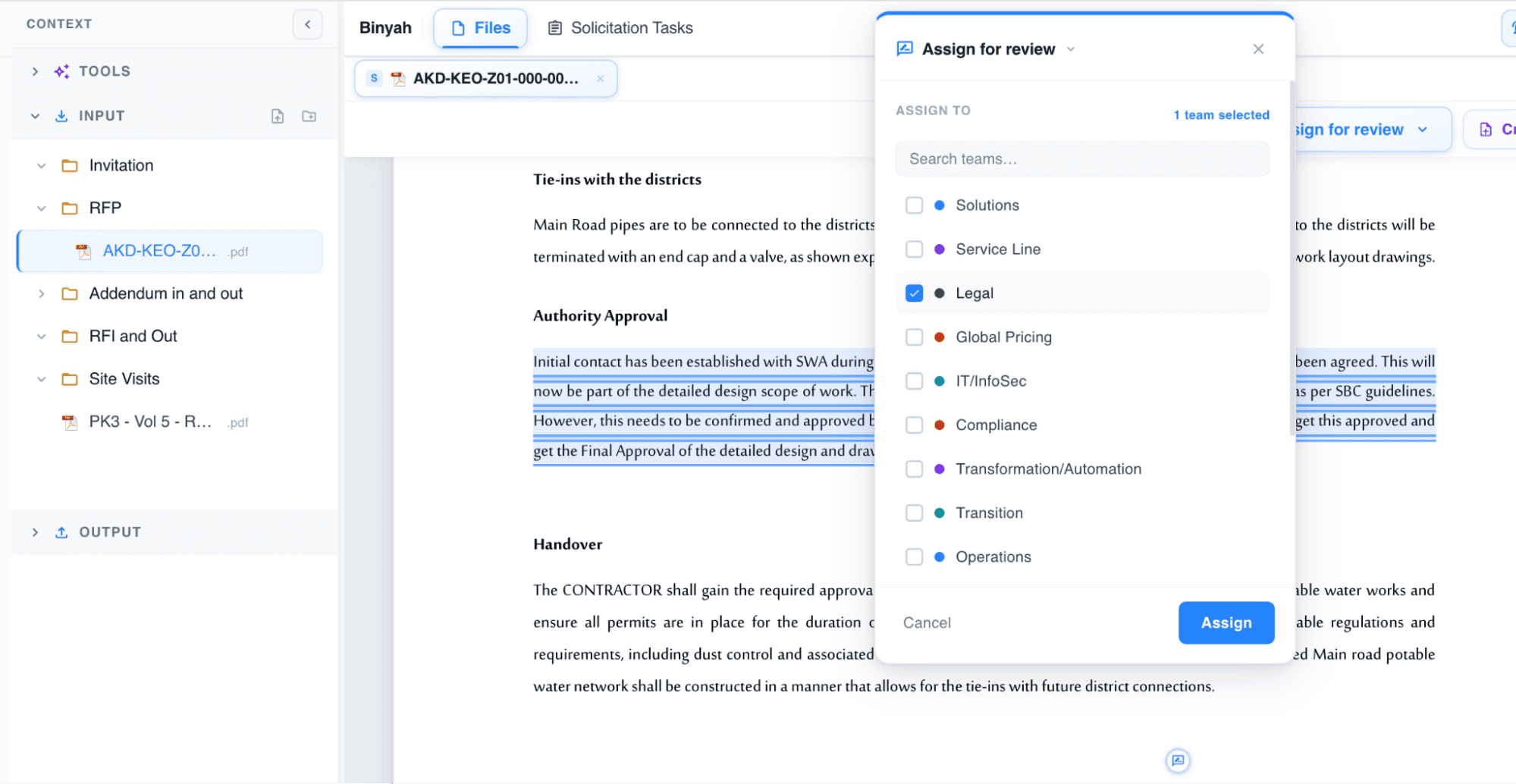
  • Compliance matrix as a live working document - Every requirement is mapped to a response section, an owner, a compliance status, and a risk level. When an addendum changes a requirement mid-bid, Thalamus AI automatically flags every impacted section. This prevents the disqualification events that cost teams bids they were otherwise well-positioned to win.

  • Subsection-level RACI routing - SMEs can be assigned to individual sections with version-controlled review gates and lead-author approval requirements, replacing the email and Slack coordination model that breaks down at 10+ contributors per bid.

  • Unlimited users under one subscription - Every legal reviewer, pricing specialist, technical SME, and executive approver is included without triggering a seat-count conversation.

  • 45+ language support, browser extension for portal questionnaires, and branded export templates, all under the same subscription.

Where Thalamus AI Falls Short?

  • Not suited for simple, high-volume questionnaire workflows - Teams whose entire program is structured DDQs and vendor assessments will find the platform more powerful than the workflow requires, and lighter tools will get them to value faster.

  • Initial setup investment is real - Compliance matrix configuration and RACI workflow setup require upfront time before the platform runs at full efficiency. This is not a same-day self-serve tool.

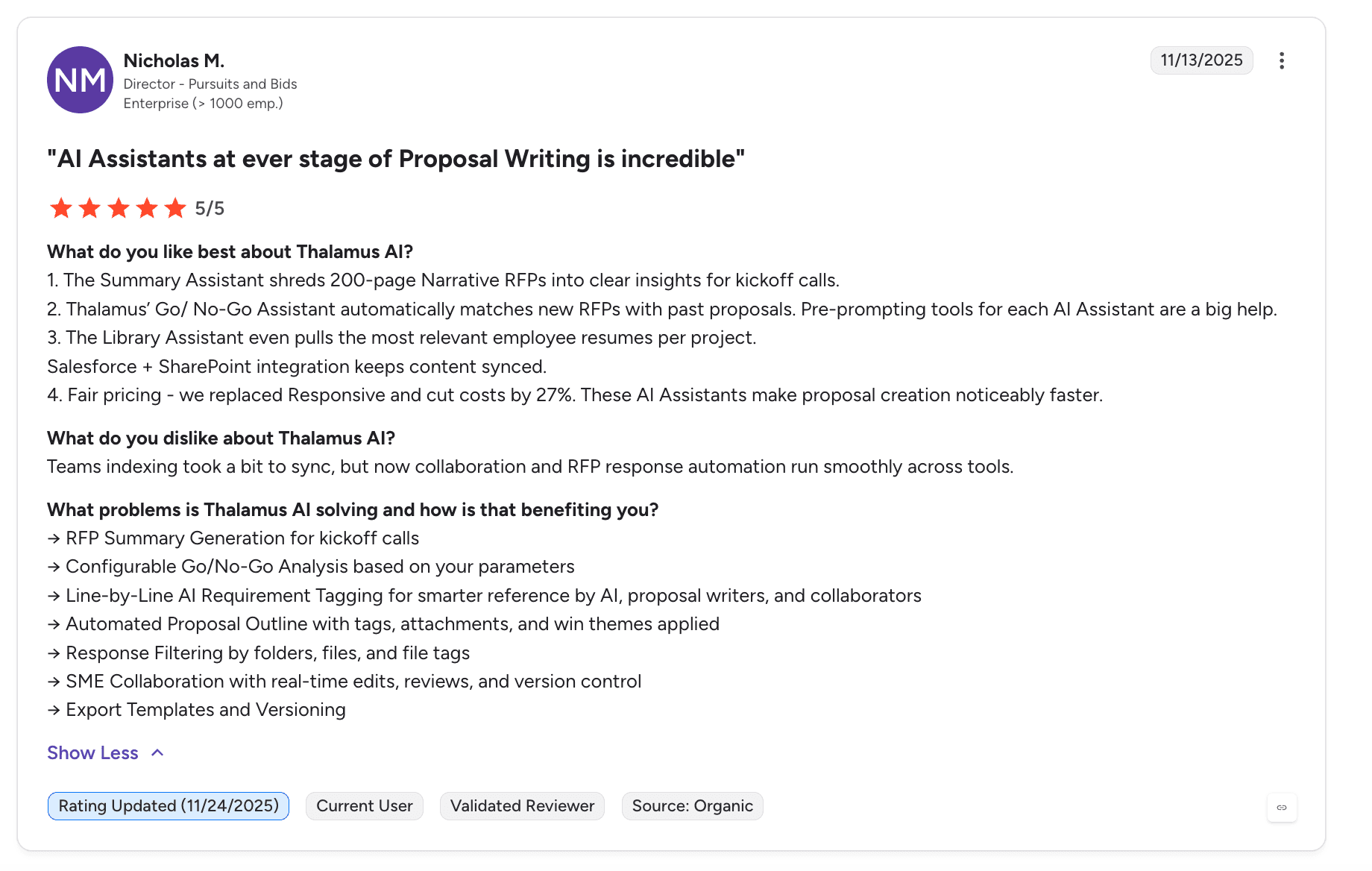
What Real Users Say about Thalamus AI?

Thalamus AI reports a 2.5x increase in bid win rates, 3x more bid shortlistings, and a 34% improvement in response reliability across enterprise customers, based on internal customer data.

Who Should Choose Thalamus AI?

Enterprise proposal teams whose bids span 50 to 200 pages, involve multiple internal stakeholders, and carry real disqualification risk when compliance requirements are missed. The strongest fit is when the bottleneck is not just drafting speed but coordination, compliance, and institutional knowledge governance across the full bid lifecycle.

Bring one live RFP. We will show you what an agentic, compliance-tracked AI proposal workflow looks like on your actual content, not on a manufactured demo. → Book a Free Demo

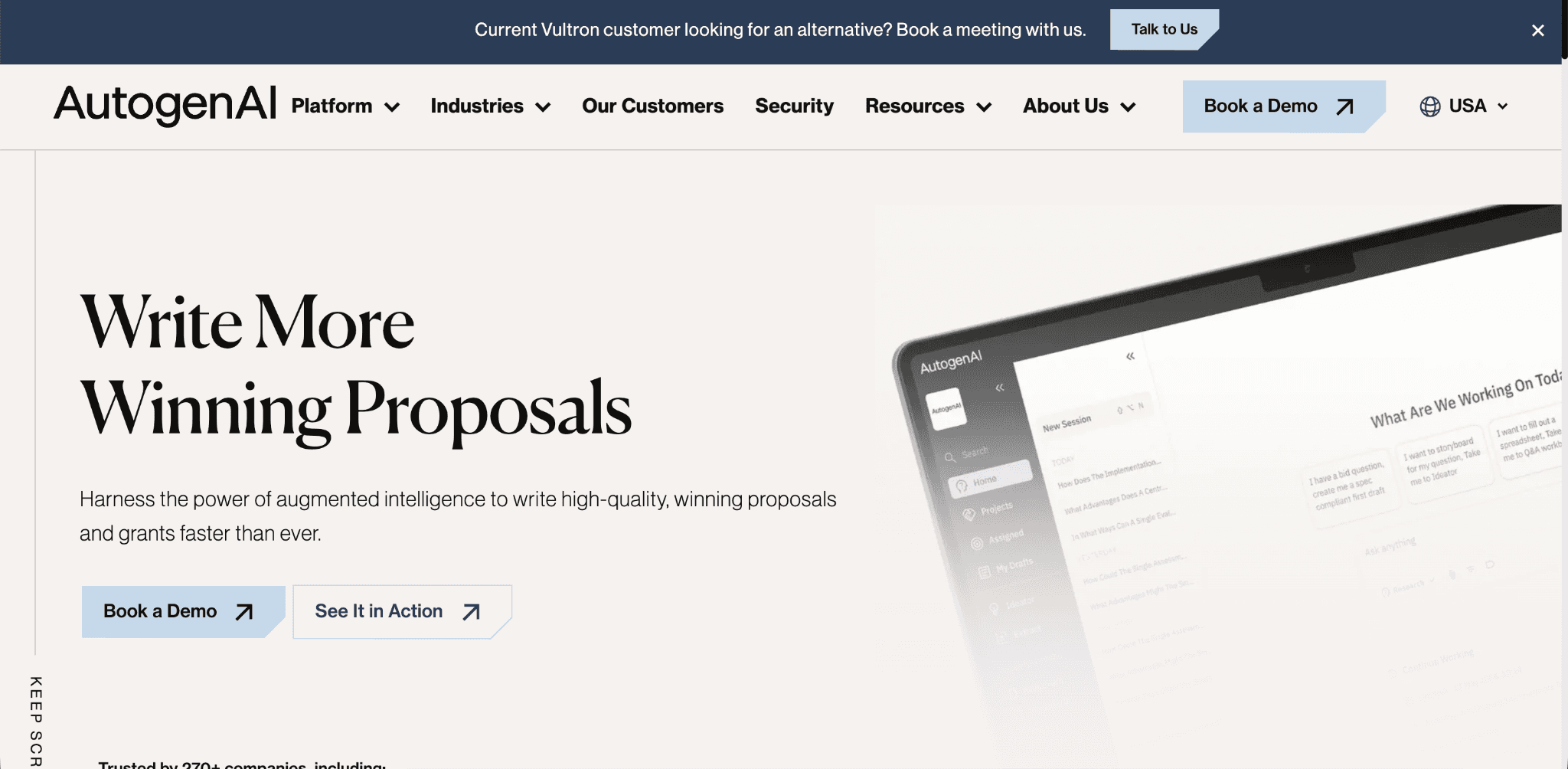
2. AutogenAI - Best AI Proposal Writing Tool for Narrative Quality and Government Contracting

Best for: Government contracting, defense, and professional services teams where long-form narrative writing quality is the primary competitive differentiator and FedRAMP High certification is a procurement requirement. 

G2 rating: 4.4 / 5 ↗ G2 - G2 Best ROI 2025 & 2026 

Pricing: Custom enterprise; approximately $30,000+/year with a 5-seat minimum, based on industry estimates and verified G2 reviewer reports. 

AI approach: Bespoke language engine trained per customer on their own proposals, win themes, and organizational voice.

What AutogenAI Does Well?

  • Best narrative writing quality in the enterprise RFP category - AutogenAI trains a custom language engine on each organization's own proposals and win themes. Drafts produced from day one sound like the organization's own voice rather than a generic AI approximation.

  • FedRAMP High certified - the only platform in the broader AI proposal writing category with this certification. For US federal government bids handling controlled unclassified information, this is a procurement requirement, not a feature preference.

  • Full bid lifecycle from capture to compliance review, including the Gamma Review module that catches requirement gaps before submission.

Where AutogenAI Falls Short?

  • Does not cover security questionnaires, DDQs, or portal questionnaires as primary use cases; teams handling multiple RFx format types need a separate tool.

  • No self-serve trial; vendor-assisted onboarding with a custom-trained language engine means time-to-value is real but not immediate.

  • Premium pricing with a 5-seat minimum makes it hard to justify for teams under 15 people or without an established proposal software budget line.

Who Should Choose AutogenAI?

Enterprise teams in government contracting and defense where FedRAMP High compliance is a non-negotiable requirement and long-form narrative writing quality is the primary win driver. For a full comparison of alternatives, see our 10 Best AutogenAI Alternatives in 2026.

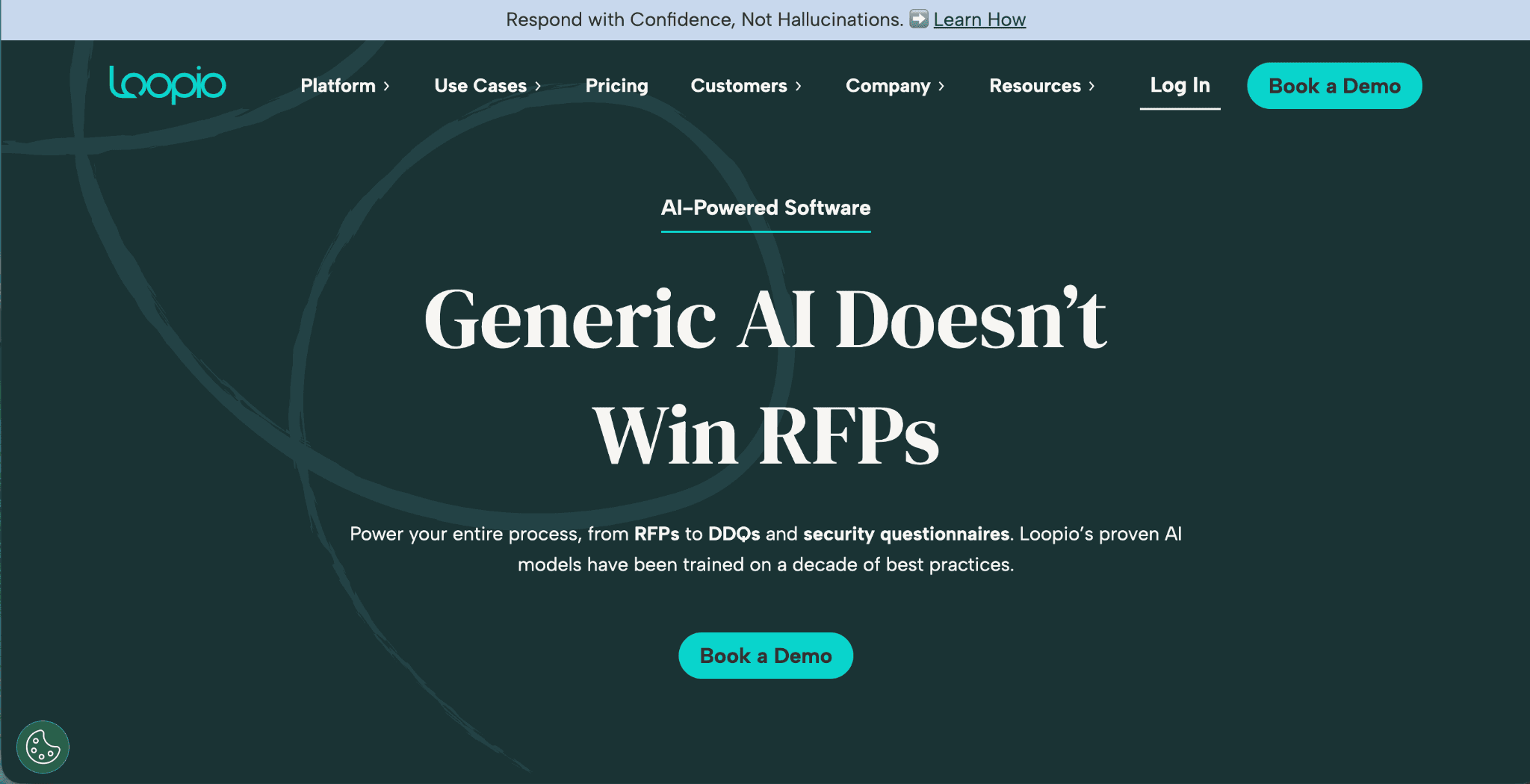
3. Loopio -Best AI Proposal Writing Software for Governed Content Libraries

Best for: Mid-to-enterprise proposal teams wanting a proven, well-supported content library platform with strong customer service and broad RFx type coverage. 

G2 rating: 4.7 / 5 ↗ G2 

Pricing: Enterprise; contact for quote. 

AI approach: Pre-LLM platform with AI drafting capability layered on.

What Loopio Does Well?

  • Well-governed content library with role-based permissions, transparent citations, and full version history for every answer.

  • Outstanding customer support, the highest-rated in the RFP Software category on G2, a meaningful consideration for teams managing live bids where downtime has a direct cost.

  • Handles RFPs, RFIs, DDQs, and security questionnaires across Word, Excel, and online portal formats.

Where Loopio Falls Short?

  • Requires a manually maintained content library - The AI retrieves and assembles from the library, which means output quality is directly capped by how current and well-tagged the library is. Teams without a dedicated content owner find this overhead unsustainable.

  • No compliance matrix generation, addendum tracking, RACI routing, or institutional win/loss learning in its core positioning.

Who Should Choose Loopio?

Teams with an existing, well-maintained content library and a dedicated proposal operations function. For a full evaluation, see our 10 Best Loopio Alternatives in 2026.

4. Responsive (RFPIO) - Best AI Proposal Tool for CRM-Integrated Enterprise Teams

Best for: Mid-to-enterprise teams managing high volumes of structured RFPs and questionnaires who need deep Salesforce or HubSpot integration and mature analytics. 

G2 rating: 4.5 / 5 ↗ G2  

Pricing: Foundations plan approximately $20,000+/year; seat-based 

AI approach: Legacy response management platform with AI drafting layered on.

What Responsive Does Well?

  • Deepest integration ecosystem in the category - Salesforce, HubSpot, SharePoint, Slack, Teams, and a wide range of procurement portals natively connected.

  • 1,263 G2 reviews - the deepest peer review corpus in the enterprise RFP category, a meaningful signal for procurement teams that weight review volume heavily.

  • Broad RFx coverage across structured RFPs, RFIs, DDQs, and security questionnaires.

Where Responsive Falls Short?

  • Library-first AI architecture; output quality is bounded by the currency of the content library, which requires ongoing manual maintenance.

  • Per-seat pricing creates cost friction when the contributor circle expands.

  • No compliance matrix, addendum tracking, or post-bid institutional learning in its current core positioning.

Who Should Choose Responsive?

Teams whose primary need is deep CRM integration and high-volume structured questionnaire management at enterprise scale. For a full breakdown, see our 10 Best Responsive Alternatives in 2026.

5. Tribble - Best AI for Proposal Writing That Learns from Deal Outcomes

Best for: Enterprise B2B software and financial services teams where win-pattern learning that compounds from real deal outcomes is expected to improve proposal quality over time. 

G2 rating: 4.8 / 5 ↗ G2 - highest verified G2 score in the AI-native RFP segment. 

Pricing: Consumption-based; no public pricing. 

AI approach: AI-native; positronic living knowledge graph ingesting documents, CRM data, call recordings, and win/loss outcomes.

What Tribble Does Well?

  • Closed-loop win/loss learning - Content that correlates with wins rises in priority; content that correlates with losses is flagged or deprecated. The knowledge base improves as deals close.

  • No manual library maintenance. The knowledge graph self-updates from connected sources.

  • SEC/FINRA compliance support for financial services teams with regulatory documentation requirements.

Where Tribble Falls Short?

  • Not built for full bid lifecycle coverage, no capture planning, compliance matrices, or addendum tracking.

  • Consumption-based pricing is unpredictable for teams with variable RFP volume.

Who Should Choose Tribble?

B2B SaaS and financial services teams running consistent high-volume RFPs and DDQs where compounding intelligence from deal outcomes is the specific improvement being sought.

If you are evaluating AI proposal writing tools for enterprise bids, the next step is a 30-minute walkthrough on your actual content, not our demo data. → See Thalamus AI on Your Next RFP

If your team responds to formal, competitive RFPs, tenders, or bid packages, where evaluation criteria, compliance requirements, and multi-stakeholder coordination determine the outcome, this is the section for you.

The tools in this category are not proposal generators. They are bid management platforms. The distinction matters: a proposal generator fills a template. A bid management platform covers the workflow from the moment an RFP lands to the moment the post-bid review informs the next one.

1. Thalamus AI - Best AI Proposal Generator for Enterprise RFP and Bid Response Management

Best for: Enterprise proposal teams in healthcare, AEC, government contracting, and professional services responding to complex, multi-document RFPs where compliance tracking, RACI routing, and institutional learning are as important as drafting speed. 

G2 rating: 5.0 / 5 ↗ G2  

Pricing: Unlimited users, unlimited projects, unlimited RFPs under one subscription. Three-month pilot pack available. 

AI approach: Multi-agent agentic AI with a verified entity knowledge layer, decision graph, and closed-loop institutional learning.

What Thalamus AI Does Well for AI-Assisted Proposal Writing?

  • Covers the full bid lifecycle, not just the drafting step - Capture planning, bid/no-bid qualification, requirement mapping, RACI routing, SME coordination, response generation, compliance review, submission, and post-bid institutional learning, all in one platform without stitching together separate tools.

  • No Q&A content library to build or maintain - Most enterprise RFP platforms require teams to build, tag, and continuously update a content library before AI output reaches useful quality. Thalamus AI converts existing proposals, CVs, case studies, and project histories into verified, auditable knowledge entities, each traceable to its source document.

  • Compliance matrix as a live working document - Every requirement is mapped to a response section, an owner, a compliance status, and a risk level. When an addendum changes a requirement mid-bid, Thalamus AI automatically flags every impacted section. This prevents the disqualification events that cost teams bids they were otherwise well-positioned to win.

  • Subsection-level RACI routing - SMEs can be assigned to individual sections with version-controlled review gates and lead-author approval requirements, replacing the email and Slack coordination model that breaks down at 10+ contributors per bid.

  • Unlimited users under one subscription - Every legal reviewer, pricing specialist, technical SME, and executive approver is included without triggering a seat-count conversation.

  • 45+ language support, browser extension for portal questionnaires, and branded export templates, all under the same subscription.

Where Thalamus AI Falls Short?

  • Not suited for simple, high-volume questionnaire workflows - Teams whose entire program is structured DDQs and vendor assessments will find the platform more powerful than the workflow requires, and lighter tools will get them to value faster.

  • Initial setup investment is real - Compliance matrix configuration and RACI workflow setup require upfront time before the platform runs at full efficiency. This is not a same-day self-serve tool.

What Real Users Say about Thalamus AI?

Thalamus AI reports a 2.5x increase in bid win rates, 3x more bid shortlistings, and a 34% improvement in response reliability across enterprise customers, based on internal customer data.

Who Should Choose Thalamus AI?

Enterprise proposal teams whose bids span 50 to 200 pages, involve multiple internal stakeholders, and carry real disqualification risk when compliance requirements are missed. The strongest fit is when the bottleneck is not just drafting speed but coordination, compliance, and institutional knowledge governance across the full bid lifecycle.

Bring one live RFP. We will show you what an agentic, compliance-tracked AI proposal workflow looks like on your actual content, not on a manufactured demo. → Book a Free Demo

2. AutogenAI - Best AI Proposal Writing Tool for Narrative Quality and Government Contracting

Best for: Government contracting, defense, and professional services teams where long-form narrative writing quality is the primary competitive differentiator and FedRAMP High certification is a procurement requirement. 

G2 rating: 4.4 / 5 ↗ G2 - G2 Best ROI 2025 & 2026 

Pricing: Custom enterprise; approximately $30,000+/year with a 5-seat minimum, based on industry estimates and verified G2 reviewer reports. 

AI approach: Bespoke language engine trained per customer on their own proposals, win themes, and organizational voice.

What AutogenAI Does Well?

  • Best narrative writing quality in the enterprise RFP category - AutogenAI trains a custom language engine on each organization's own proposals and win themes. Drafts produced from day one sound like the organization's own voice rather than a generic AI approximation.

  • FedRAMP High certified - the only platform in the broader AI proposal writing category with this certification. For US federal government bids handling controlled unclassified information, this is a procurement requirement, not a feature preference.

  • Full bid lifecycle from capture to compliance review, including the Gamma Review module that catches requirement gaps before submission.

Where AutogenAI Falls Short?

  • Does not cover security questionnaires, DDQs, or portal questionnaires as primary use cases; teams handling multiple RFx format types need a separate tool.

  • No self-serve trial; vendor-assisted onboarding with a custom-trained language engine means time-to-value is real but not immediate.

  • Premium pricing with a 5-seat minimum makes it hard to justify for teams under 15 people or without an established proposal software budget line.

Who Should Choose AutogenAI?

Enterprise teams in government contracting and defense where FedRAMP High compliance is a non-negotiable requirement and long-form narrative writing quality is the primary win driver. For a full comparison of alternatives, see our 10 Best AutogenAI Alternatives in 2026.

3. Loopio -Best AI Proposal Writing Software for Governed Content Libraries

Best for: Mid-to-enterprise proposal teams wanting a proven, well-supported content library platform with strong customer service and broad RFx type coverage. 

G2 rating: 4.7 / 5 ↗ G2 

Pricing: Enterprise; contact for quote. 

AI approach: Pre-LLM platform with AI drafting capability layered on.

What Loopio Does Well?

  • Well-governed content library with role-based permissions, transparent citations, and full version history for every answer.

  • Outstanding customer support, the highest-rated in the RFP Software category on G2, a meaningful consideration for teams managing live bids where downtime has a direct cost.

  • Handles RFPs, RFIs, DDQs, and security questionnaires across Word, Excel, and online portal formats.

Where Loopio Falls Short?

  • Requires a manually maintained content library - The AI retrieves and assembles from the library, which means output quality is directly capped by how current and well-tagged the library is. Teams without a dedicated content owner find this overhead unsustainable.

  • No compliance matrix generation, addendum tracking, RACI routing, or institutional win/loss learning in its core positioning.

Who Should Choose Loopio?

Teams with an existing, well-maintained content library and a dedicated proposal operations function. For a full evaluation, see our 10 Best Loopio Alternatives in 2026.

4. Responsive (RFPIO) - Best AI Proposal Tool for CRM-Integrated Enterprise Teams

Best for: Mid-to-enterprise teams managing high volumes of structured RFPs and questionnaires who need deep Salesforce or HubSpot integration and mature analytics. 

G2 rating: 4.5 / 5 ↗ G2  

Pricing: Foundations plan approximately $20,000+/year; seat-based 

AI approach: Legacy response management platform with AI drafting layered on.

What Responsive Does Well?

  • Deepest integration ecosystem in the category - Salesforce, HubSpot, SharePoint, Slack, Teams, and a wide range of procurement portals natively connected.

  • 1,263 G2 reviews - the deepest peer review corpus in the enterprise RFP category, a meaningful signal for procurement teams that weight review volume heavily.

  • Broad RFx coverage across structured RFPs, RFIs, DDQs, and security questionnaires.

Where Responsive Falls Short?

  • Library-first AI architecture; output quality is bounded by the currency of the content library, which requires ongoing manual maintenance.

  • Per-seat pricing creates cost friction when the contributor circle expands.

  • No compliance matrix, addendum tracking, or post-bid institutional learning in its current core positioning.

Who Should Choose Responsive?

Teams whose primary need is deep CRM integration and high-volume structured questionnaire management at enterprise scale. For a full breakdown, see our 10 Best Responsive Alternatives in 2026.

5. Tribble - Best AI for Proposal Writing That Learns from Deal Outcomes

Best for: Enterprise B2B software and financial services teams where win-pattern learning that compounds from real deal outcomes is expected to improve proposal quality over time. 

G2 rating: 4.8 / 5 ↗ G2 - highest verified G2 score in the AI-native RFP segment. 

Pricing: Consumption-based; no public pricing. 

AI approach: AI-native; positronic living knowledge graph ingesting documents, CRM data, call recordings, and win/loss outcomes.

What Tribble Does Well?

  • Closed-loop win/loss learning - Content that correlates with wins rises in priority; content that correlates with losses is flagged or deprecated. The knowledge base improves as deals close.

  • No manual library maintenance. The knowledge graph self-updates from connected sources.

  • SEC/FINRA compliance support for financial services teams with regulatory documentation requirements.

Where Tribble Falls Short?

  • Not built for full bid lifecycle coverage, no capture planning, compliance matrices, or addendum tracking.

  • Consumption-based pricing is unpredictable for teams with variable RFP volume.

Who Should Choose Tribble?

B2B SaaS and financial services teams running consistent high-volume RFPs and DDQs where compounding intelligence from deal outcomes is the specific improvement being sought.

If you are evaluating AI proposal writing tools for enterprise bids, the next step is a 30-minute walkthrough on your actual content, not our demo data. → See Thalamus AI on Your Next RFP

If your team responds to formal, competitive RFPs, tenders, or bid packages, where evaluation criteria, compliance requirements, and multi-stakeholder coordination determine the outcome, this is the section for you.

The tools in this category are not proposal generators. They are bid management platforms. The distinction matters: a proposal generator fills a template. A bid management platform covers the workflow from the moment an RFP lands to the moment the post-bid review informs the next one.

1. Thalamus AI - Best AI Proposal Generator for Enterprise RFP and Bid Response Management

Best for: Enterprise proposal teams in healthcare, AEC, government contracting, and professional services responding to complex, multi-document RFPs where compliance tracking, RACI routing, and institutional learning are as important as drafting speed. 

G2 rating: 5.0 / 5 ↗ G2  

Pricing: Unlimited users, unlimited projects, unlimited RFPs under one subscription. Three-month pilot pack available. 

AI approach: Multi-agent agentic AI with a verified entity knowledge layer, decision graph, and closed-loop institutional learning.

What Thalamus AI Does Well for AI-Assisted Proposal Writing?

  • Covers the full bid lifecycle, not just the drafting step - Capture planning, bid/no-bid qualification, requirement mapping, RACI routing, SME coordination, response generation, compliance review, submission, and post-bid institutional learning, all in one platform without stitching together separate tools.

  • No Q&A content library to build or maintain - Most enterprise RFP platforms require teams to build, tag, and continuously update a content library before AI output reaches useful quality. Thalamus AI converts existing proposals, CVs, case studies, and project histories into verified, auditable knowledge entities, each traceable to its source document.

  • Compliance matrix as a live working document - Every requirement is mapped to a response section, an owner, a compliance status, and a risk level. When an addendum changes a requirement mid-bid, Thalamus AI automatically flags every impacted section. This prevents the disqualification events that cost teams bids they were otherwise well-positioned to win.

  • Subsection-level RACI routing - SMEs can be assigned to individual sections with version-controlled review gates and lead-author approval requirements, replacing the email and Slack coordination model that breaks down at 10+ contributors per bid.

  • Unlimited users under one subscription - Every legal reviewer, pricing specialist, technical SME, and executive approver is included without triggering a seat-count conversation.

  • 45+ language support, browser extension for portal questionnaires, and branded export templates, all under the same subscription.

Where Thalamus AI Falls Short?

  • Not suited for simple, high-volume questionnaire workflows - Teams whose entire program is structured DDQs and vendor assessments will find the platform more powerful than the workflow requires, and lighter tools will get them to value faster.

  • Initial setup investment is real - Compliance matrix configuration and RACI workflow setup require upfront time before the platform runs at full efficiency. This is not a same-day self-serve tool.

What Real Users Say about Thalamus AI?

Thalamus AI reports a 2.5x increase in bid win rates, 3x more bid shortlistings, and a 34% improvement in response reliability across enterprise customers, based on internal customer data.

Who Should Choose Thalamus AI?

Enterprise proposal teams whose bids span 50 to 200 pages, involve multiple internal stakeholders, and carry real disqualification risk when compliance requirements are missed. The strongest fit is when the bottleneck is not just drafting speed but coordination, compliance, and institutional knowledge governance across the full bid lifecycle.

Bring one live RFP. We will show you what an agentic, compliance-tracked AI proposal workflow looks like on your actual content, not on a manufactured demo. → Book a Free Demo

2. AutogenAI - Best AI Proposal Writing Tool for Narrative Quality and Government Contracting

Best for: Government contracting, defense, and professional services teams where long-form narrative writing quality is the primary competitive differentiator and FedRAMP High certification is a procurement requirement. 

G2 rating: 4.4 / 5 ↗ G2 - G2 Best ROI 2025 & 2026 

Pricing: Custom enterprise; approximately $30,000+/year with a 5-seat minimum, based on industry estimates and verified G2 reviewer reports. 

AI approach: Bespoke language engine trained per customer on their own proposals, win themes, and organizational voice.

What AutogenAI Does Well?

  • Best narrative writing quality in the enterprise RFP category - AutogenAI trains a custom language engine on each organization's own proposals and win themes. Drafts produced from day one sound like the organization's own voice rather than a generic AI approximation.

  • FedRAMP High certified - the only platform in the broader AI proposal writing category with this certification. For US federal government bids handling controlled unclassified information, this is a procurement requirement, not a feature preference.

  • Full bid lifecycle from capture to compliance review, including the Gamma Review module that catches requirement gaps before submission.

Where AutogenAI Falls Short?

  • Does not cover security questionnaires, DDQs, or portal questionnaires as primary use cases; teams handling multiple RFx format types need a separate tool.

  • No self-serve trial; vendor-assisted onboarding with a custom-trained language engine means time-to-value is real but not immediate.

  • Premium pricing with a 5-seat minimum makes it hard to justify for teams under 15 people or without an established proposal software budget line.

Who Should Choose AutogenAI?

Enterprise teams in government contracting and defense where FedRAMP High compliance is a non-negotiable requirement and long-form narrative writing quality is the primary win driver. For a full comparison of alternatives, see our 10 Best AutogenAI Alternatives in 2026.

3. Loopio -Best AI Proposal Writing Software for Governed Content Libraries

Best for: Mid-to-enterprise proposal teams wanting a proven, well-supported content library platform with strong customer service and broad RFx type coverage. 

G2 rating: 4.7 / 5 ↗ G2 

Pricing: Enterprise; contact for quote. 

AI approach: Pre-LLM platform with AI drafting capability layered on.

What Loopio Does Well?

  • Well-governed content library with role-based permissions, transparent citations, and full version history for every answer.

  • Outstanding customer support, the highest-rated in the RFP Software category on G2, a meaningful consideration for teams managing live bids where downtime has a direct cost.

  • Handles RFPs, RFIs, DDQs, and security questionnaires across Word, Excel, and online portal formats.

Where Loopio Falls Short?

  • Requires a manually maintained content library - The AI retrieves and assembles from the library, which means output quality is directly capped by how current and well-tagged the library is. Teams without a dedicated content owner find this overhead unsustainable.

  • No compliance matrix generation, addendum tracking, RACI routing, or institutional win/loss learning in its core positioning.

Who Should Choose Loopio?

Teams with an existing, well-maintained content library and a dedicated proposal operations function. For a full evaluation, see our 10 Best Loopio Alternatives in 2026.

4. Responsive (RFPIO) - Best AI Proposal Tool for CRM-Integrated Enterprise Teams

Best for: Mid-to-enterprise teams managing high volumes of structured RFPs and questionnaires who need deep Salesforce or HubSpot integration and mature analytics. 

G2 rating: 4.5 / 5 ↗ G2  

Pricing: Foundations plan approximately $20,000+/year; seat-based 

AI approach: Legacy response management platform with AI drafting layered on.

What Responsive Does Well?

  • Deepest integration ecosystem in the category - Salesforce, HubSpot, SharePoint, Slack, Teams, and a wide range of procurement portals natively connected.

  • 1,263 G2 reviews - the deepest peer review corpus in the enterprise RFP category, a meaningful signal for procurement teams that weight review volume heavily.

  • Broad RFx coverage across structured RFPs, RFIs, DDQs, and security questionnaires.

Where Responsive Falls Short?

  • Library-first AI architecture; output quality is bounded by the currency of the content library, which requires ongoing manual maintenance.

  • Per-seat pricing creates cost friction when the contributor circle expands.

  • No compliance matrix, addendum tracking, or post-bid institutional learning in its current core positioning.

Who Should Choose Responsive?

Teams whose primary need is deep CRM integration and high-volume structured questionnaire management at enterprise scale. For a full breakdown, see our 10 Best Responsive Alternatives in 2026.

5. Tribble - Best AI for Proposal Writing That Learns from Deal Outcomes

Best for: Enterprise B2B software and financial services teams where win-pattern learning that compounds from real deal outcomes is expected to improve proposal quality over time. 

G2 rating: 4.8 / 5 ↗ G2 - highest verified G2 score in the AI-native RFP segment. 

Pricing: Consumption-based; no public pricing. 

AI approach: AI-native; positronic living knowledge graph ingesting documents, CRM data, call recordings, and win/loss outcomes.

What Tribble Does Well?

  • Closed-loop win/loss learning - Content that correlates with wins rises in priority; content that correlates with losses is flagged or deprecated. The knowledge base improves as deals close.

  • No manual library maintenance. The knowledge graph self-updates from connected sources.

  • SEC/FINRA compliance support for financial services teams with regulatory documentation requirements.

Where Tribble Falls Short?

  • Not built for full bid lifecycle coverage, no capture planning, compliance matrices, or addendum tracking.

  • Consumption-based pricing is unpredictable for teams with variable RFP volume.

Who Should Choose Tribble?

B2B SaaS and financial services teams running consistent high-volume RFPs and DDQs where compounding intelligence from deal outcomes is the specific improvement being sought.

If you are evaluating AI proposal writing tools for enterprise bids, the next step is a 30-minute walkthrough on your actual content, not our demo data. → See Thalamus AI on Your Next RFP

Best AI Proposal Writing Tools for Freelancers and Sales Teams

If you are a freelancer, consultant, or small-to-mid-size business writing client-facing sales proposals, scope of work documents, project proposals, agency pitch decks, or service agreements, the tools in the previous section are built for a different buyer. They are enterprise bid platforms; you need a proposal design and sales workflow tool.
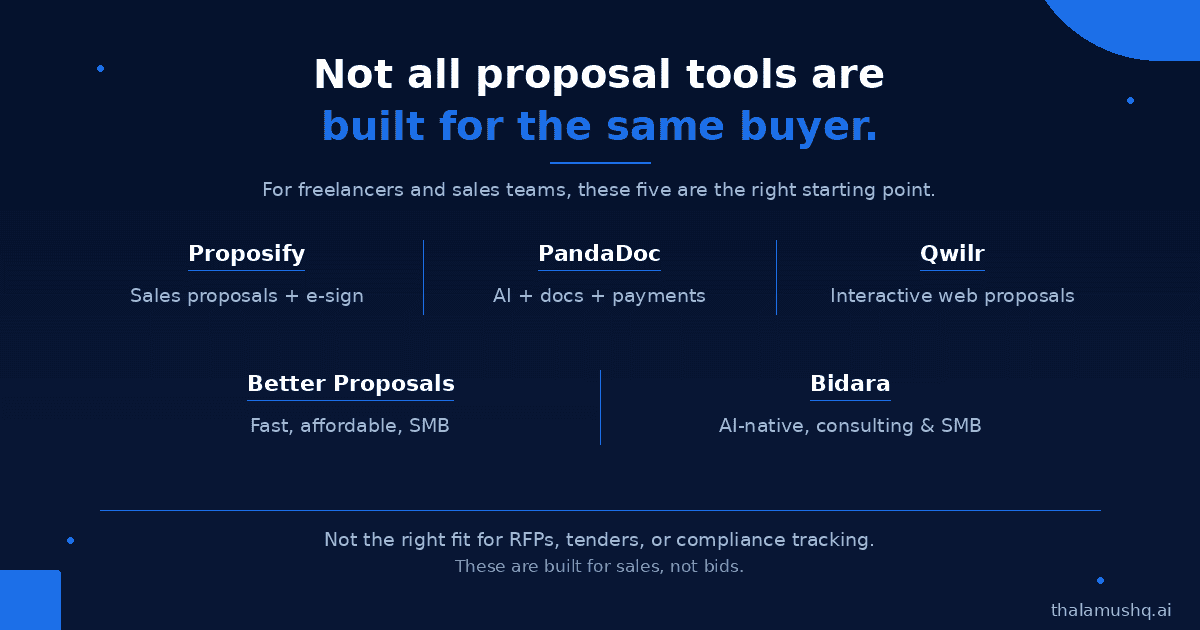
The best options in 2026 for this segment:

Proposify - purpose-built for sales proposals with templates, e-signatures, and engagement analytics that show which sections prospects spend the most time on. Note: as of May 2026, Proposify's AI Proposal Generator is in waitlist mode; the manual editor and template library remain fully functional.

PandaDoc - the strongest all-in-one for teams that want AI content generation, document automation, e-signatures, and payment processing in a single platform. Pricing starts at $19 per user per month, making it accessible for small teams.

Qwilr - turns proposals into interactive web pages rather than PDFs, with embedded videos, dynamic pricing tables, and real-time analytics. The strongest choice when visual presentation and client experience are the primary differentiators.

Better Proposals - affordable, fast, and well-suited for freelancers and SMBs who need professional proposals without enterprise overhead. Includes a template library with AI writing assistance.

Bidara - the strongest AI-native proposal tool for small-to-mid-market teams (1-500 employees) in consulting, engineering, and professional services. Pricing is transparent (Starter $299/month, Growth $599/month) and the platform learns from past proposals to improve output quality over time.

These tools are not the right choice for formal RFP responses, government tenders, or bids where compliance tracking and addendum management matter. For enterprise bid management, see the previous section and our 12 Best AI RFP Software Tools in 2026.

Best AI for Research Proposal Writing: Grant and Academic Teams

Grant proposal writing is its own discipline, different from both sales proposals and formal RFPs. A successful NIH R01 or NSF proposal must respond to specific funder mandates, structure sections in prescribed formats, score against explicit review criteria, and comply with page-limit and formatting rules that vary by agency. General-purpose AI tools produce fluent text; they do not produce compliant, funder-aware grant proposals.
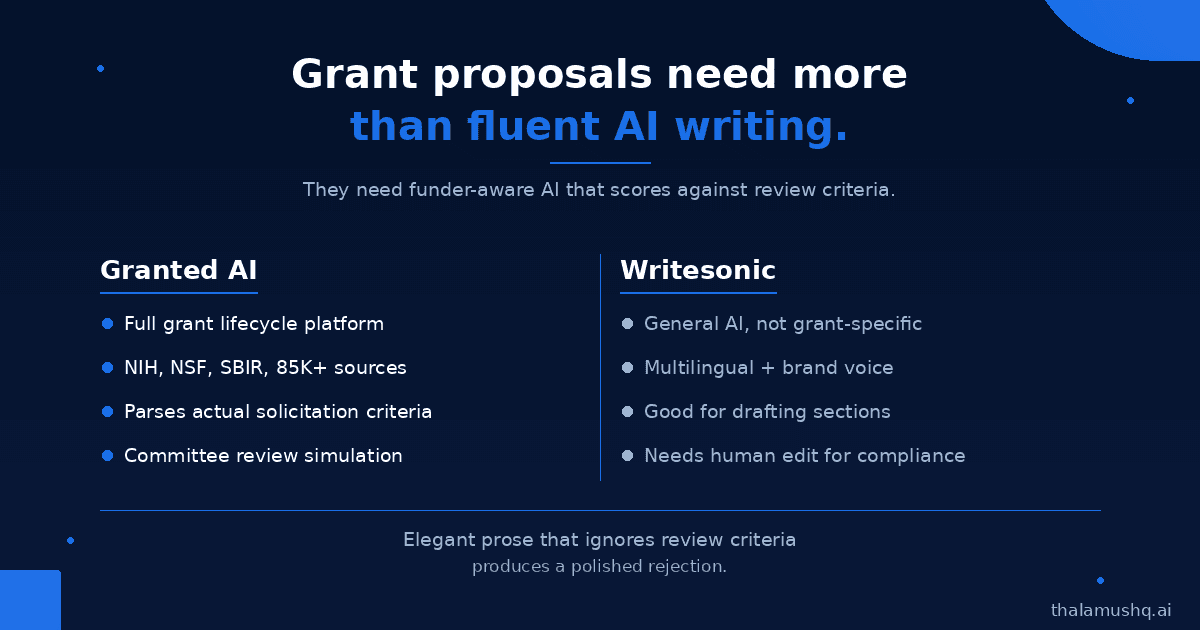
The purpose-built tools in this segment:

Granted AI - the most comprehensive grant writing platform in 2026, covering the full grant lifecycle from opportunity discovery through funder research, proposal drafting, committee review simulation, and compliance verification. The RFP analysis feature parses actual solicitations and structures proposals around their specific requirements rather than generic templates. Covers NIH, NSF, SBIR, and 85,000+ grant opportunities from 144 data sources.

Writesonic - a general AI writing platform useful for drafting individual grant sections quickly, with multilingual support and brand voice customization. Not grant-specific, but effective for academic teams that need flexible long-form content generation as a starting point for human editing.

For research teams, the critical evaluation question is not which tool writes the best prose; it is which tool understands the specific funder's review criteria and structures the proposal to score against them. A generic AI proposal generator that produces elegant text that does not address the Significance, Innovation, and Approach requirements of an NIH solicitation will produce a polished rejection.

How to Choose the Best AI Tool for Proposal Writing in 2026?

Match your tool to the actual problem, not the category name on the vendor's website.
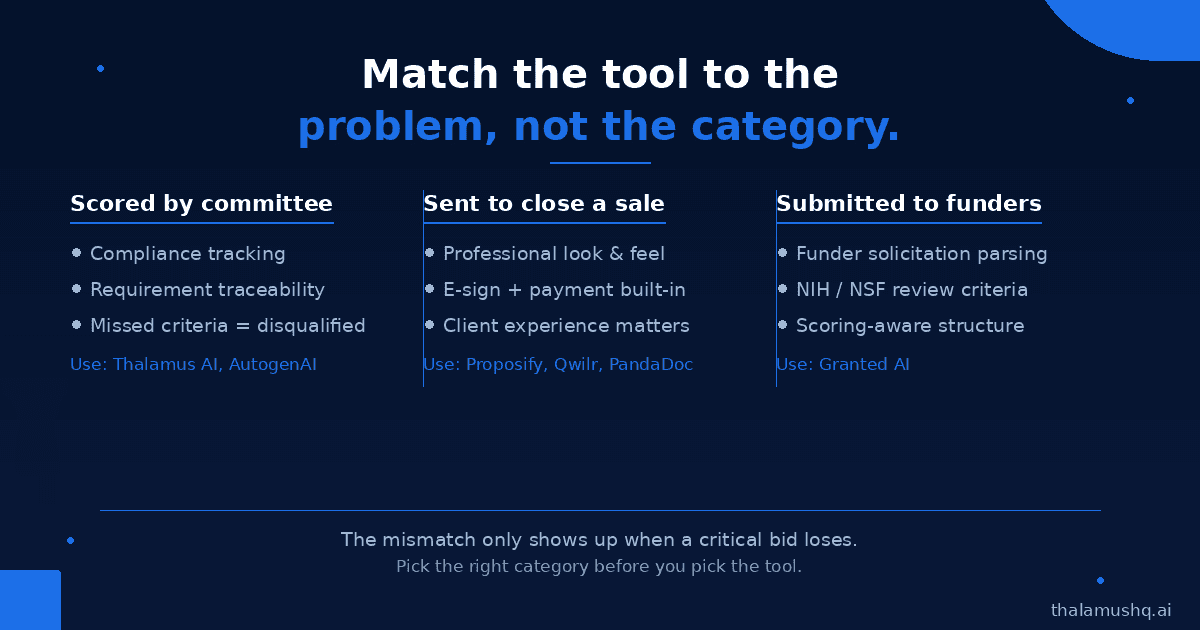
If your proposals are evaluated by a scoring committee against published criteria, you need a platform that understands compliance, requirement traceability, and the consequence of missing an evaluation criterion. Tools like Proposify and PandaDoc are not built for that. Thalamus AI and AutogenAI are.

If your proposals are sent to prospective clients to close a sale, you need a tool that makes them look professional, easy to sign, and easy to pay. RFP platforms with compliance matrices are not built for that. Proposify, Qwilr, and PandaDoc are.

If your proposals are submitted to funding agencies against specific solicitations, you need a tool that parses those solicitations and structures your narrative to score well against the specific review criteria. Neither an RFP platform nor a sales proposal tool does this. Granted, AI does.

The most expensive mistake in this category is not picking the wrong tool within a category. It is picking the right tool for the wrong category, because the features will look plausible, the platform will feel usable, and the mismatch will only become clear when a critical bid loses on a missed compliance requirement that a general proposal generator was never designed to catch.

For a full pricing model breakdown across the enterprise RFP category, see our RFP Software Pricing Guide for 2026.

If your team is in the enterprise bid category and you are still figuring out which platform fits your specific workflow, let's talk through it directly- no pitch, just a straight comparison on your actual situation. → Get a Personalized Recommendation

FAQ: What People Ask Most About AI for Proposal Writing

What is the best AI for proposal writing in 2026? 

For enterprise RFP and bid responses: Thalamus AI for full lifecycle coverage, or AutogenAI for government/defense teams requiring FedRAMP High security. For freelancer and SMB sales proposals: PandaDoc, Proposify, or Qwilr depending on whether you prioritize all-in-one functionality, AI-native generation, or visual design. For academic grant proposals: Granted AI. The most common mistake is using a sales proposal tool for a formal competitive bid, or an RFP platform for a client-facing sales proposal. They solve different problems.

Can ChatGPT write a proposal for me? 

ChatGPT can generate a useful first draft of a proposal section quickly and inexpensively. What it cannot do is maintain a persistent knowledge base of your past proposals, track compliance against specific RFP requirements, detect when an addendum changes a requirement mid-bid, route sections to the right reviewers, or learn from whether the proposal won or lost. For ad-hoc, low-stakes proposal sections, ChatGPT at $20 per month is a legitimate starting point. 

For formal, competitive bids where a missed requirement can disqualify an otherwise strong submission, the accuracy gap between general-purpose AI and purpose-built platforms is approximately 30 percentage points, roughly 65% first-pass accuracy for general LLMs versus 95% for specialist platforms, based on the ContraVault AI benchmark study (2026). Public claims from specialist RFP AI platforms often cite materially higher accuracy than general-purpose LLM workflows, but buyers should ask vendors for the underlying benchmark, dataset, and methodology before relying on a percentage claim. See our Thalamus AI vs General LLMs comparison for a full breakdown.

What is the difference between an AI proposal generator and RFP software?

An AI proposal generator, tools like Proposify, PandaDoc, Qwilr, and Bidara, helps teams create client-facing sales proposals faster through templates, AI content generation, e-signatures, and payment processing. 

RFP software, tools like Thalamus AI, AutogenAI, Loopio, and Responsive, helps teams respond to formal competitive procurement requests, which require compliance tracking, requirement mapping, multi-stakeholder coordination, and audit trails. 

The output format can look similar (a PDF or Word document), but the workflow, governance requirements, and consequences of errors are completely different. Submitting a sales proposal template in response to a formal government RFP is one of the fastest ways to get disqualified on technical grounds.

Is there a free AI tool for proposal writing? 

Yes, several. For sales proposals: Better Proposals and Proposify offer free trials; Venngage has a free AI proposal design tier. For general proposal drafting: ChatGPT and Claude both have free tiers that can generate proposal content from a prompt. For grant writing: Granted AI has free access to its opportunity discovery features. For enterprise RFP management: 1Up offers a genuine free plan for questionnaire and sales question automation. What does not exist is a free enterprise-grade RFP bid management platform with compliance matrix generation, addendum tracking, and institutional learning, because the computational and service cost of those capabilities precludes a free tier.

What AI do professional proposal writers use? 

Based on G2 review data and Loopio's 2026 RFP Trends Report, professional proposal writers in enterprise and government contracting most frequently use dedicated RFP platforms rather than general-purpose AI tools. Responsive (RFPIO) has the deepest review corpus (1,263 G2 reviews) and is the most commonly deployed platform in large enterprise proposal functions. Loopio is widely used in mid-market organizations. AutogenAI is used by government contracting and defense teams specifically for narrative writing quality. Thalamus AI is the platform of choice for enterprise teams that need the full bid lifecycle managed in one place without a content library to maintain. General-purpose AI tools like ChatGPT and Claude are used as supplementary tools for quick section drafts or competitive research rather than as primary proposal management platforms.

Can AI write an entire proposal from scratch? 

Technically, yes, every major AI proposal tool can generate a complete first-draft proposal from an uploaded RFP or brief. The more important question is whether that draft is submission-ready or draft-ready. 

For sales proposals, AI-generated first drafts are often 70-80% of the way there with good prompting and accurate source data. For formal competitive RFPs, the AI-generated first draft is the beginning of the work, not the end: it needs compliance verification, stakeholder review, expert input on technical sections, and a final check against the evaluation criteria. The value of AI in formal proposal writing is eliminating the blank-page problem and the content retrieval problem, not eliminating human judgment on the sections that determine whether the bid wins.

What is the best AI for government contract proposal writing? 

For US federal government contracting specifically, AutogenAI is the strongest dedicated platform; it is the only AI proposal tool in this category with FedRAMP High authority to operate, validated by the US Air Force, with CMMC 2.0 and DoD IL5 compliance. GovDash is the strongest platform for teams that need the full GovCon lifecycle, including opportunity discovery, capture management, and proposal drafting connected together. Thalamus AI covers the full bid lifecycle, including compliance matrix generation and addendum tracking, for government and regulated-sector teams whose procurement environment does not specifically require FedRAMP High certification. For a full evaluation, see our 12 Best AI RFP Software Tools in 2026.

How accurate is AI-generated proposal content? 

Accuracy varies significantly by tool and use case. General-purpose AI tools benchmark at approximately 65% accuracy on real-world RFP questions compared to approximately 95% for purpose-built platforms, based on the ContraVault AI benchmark study (2026). The accuracy gap is most pronounced on novel or complex questions outside the AI's training data or knowledge base coverage, and on technical compliance questions where a specific contractual or regulatory requirement must be precisely addressed. Purpose-built platforms using verified, source-linked knowledge entities or live-source document connections are measurably more accurate than tools generating answers from general training data. The editing requirement also scales inversely with accuracy: a 65%-accurate first draft requires significantly more human review time than a 95%-accurate one - which means the "time savings" claim of lower-quality tools is often overstated when total time including review and correction is measured.

What is the best AI for research proposal writing? 

For academic and scientific grant proposals, Granted AI is the strongest purpose-built option in 2026. It covers the full grant lifecycle: opportunity discovery across 85,000+ grants from 144 data sources, funder research using 133,000 foundation profiles, proposal drafting structured around the specific solicitation's requirements (not generic templates), a committee review simulation feature that evaluates the draft from the perspective of different review panel members, and compliance verification against organizational eligibility requirements. General-purpose AI tools can accelerate individual grant sections but do not have the funder-specific structural knowledge, page-limit compliance checking, or review simulation capability that specialist grant tools provide.

Which AI proposal writing tool has the most verified win rate impact? 

Several platforms publish win rate improvement claims, but verified independently sourced data is scarce. AutogenAI's impact is supported by an independent study from MH&A covering 511 proposal professionals, which found measurable revenue performance differences between AutogenAI users and non-users, though specific win rate percentage figures vary across different AutogenAI marketing materials (22% and 30% appear in different publications referencing different study parameters). Thalamus AI reports a 2.5x increase in bid win rates and 3x more bid shortlistings across enterprise customers, based on internal customer data. GovDash reports that its customers won more than $5 billion in government contracts in 2025. For any platform you evaluate, ask specifically which study underpins the win-rate claim, what the methodology was, and whether the figure represents a controlled comparison or a customer self-report.

The Honest Summary on AI for Proposal Writing in 2026

The category has fractured into tools that serve fundamentally different buyers, and most guides in this space have not caught up to that fracture. The result is freelancers being sold enterprise bid management platforms, and bid managers being directed to proposal generators designed to close a $3,000 website contract.

The right tool is not the one with the most impressive feature list or the boldest win-rate claim. It is the one built for the specific kind of proposal you write, the specific stage of the process where you are losing time, and the specific governance requirements your buyer expects you to meet.

If you are running enterprise RFPs and your bids are getting more complex, more contributors, more compliance requirements, more disqualification risk, the next step is not reading another comparison table. It is seeing what a purpose-built, agentic bid lifecycle platform looks like on your actual next bid.

Your next complex proposal does not have to start from a blank page or a stale content library. → Book Your Demo

Data Sources

Sources: G2 RFP Software category (Spring 2026), Gartner Peer Insights — RFP Software, Capterra verified reviews, Loopio 2026 RFP Trends Report, ContraVault AI benchmark study (2026), MH&A independent study (511 proposal professionals, 2025). Enterprise platform pricing estimates are based on industry analysis and verified G2 reviewer reports. Last updated: May 2026.