
Harpreet Singh, MBA
Founder, Thalamus AI

With 12+ years in AI and enterprise software, including GenAI product work at Travelers, Harpreet writes about AI RFP software, AI bid tools, proposal operations, RFP response automation, and the future of enterprise bid management.
10 Best AutogenAI Alternatives in 2026: Full Reviews
This list maps ten alternatives against those specific gaps, so you can match the tool to the actual reason you are looking.
1. Thalamus AI - Best AutogenAI Alternative for Full Bid Lifecycle Coverage
Best for: Enterprise proposal teams who need AutogenAI's narrative writing strength plus the format breadth, compliance tracking, and lifecycle coverage that AutogenAI does not currently offer.
G2 rating: 5.0 / 5 ↗ G2
Pricing: Unlimited users, unlimited projects, unlimited RFPs under one subscription. Three-month pilot pack available. Contact for enterprise pricing.
AI approach: Multi-agent agentic AI with a verified entity knowledge layer, decision graph, and closed-loop institutional learning.
What Thalamus AI Does Differently from AutogenAI?
Covers narrative proposals and structured formats in one platform - AutogenAI is purpose-built for long-form narrative writing. Thalamus AI handles narrative proposals, structured RFPs, DDQs, and online portal questionnaires through a single browser extension and platform, removing the need for a second tool to cover the formats AutogenAI does not.
No bespoke training period before the platform is usable -
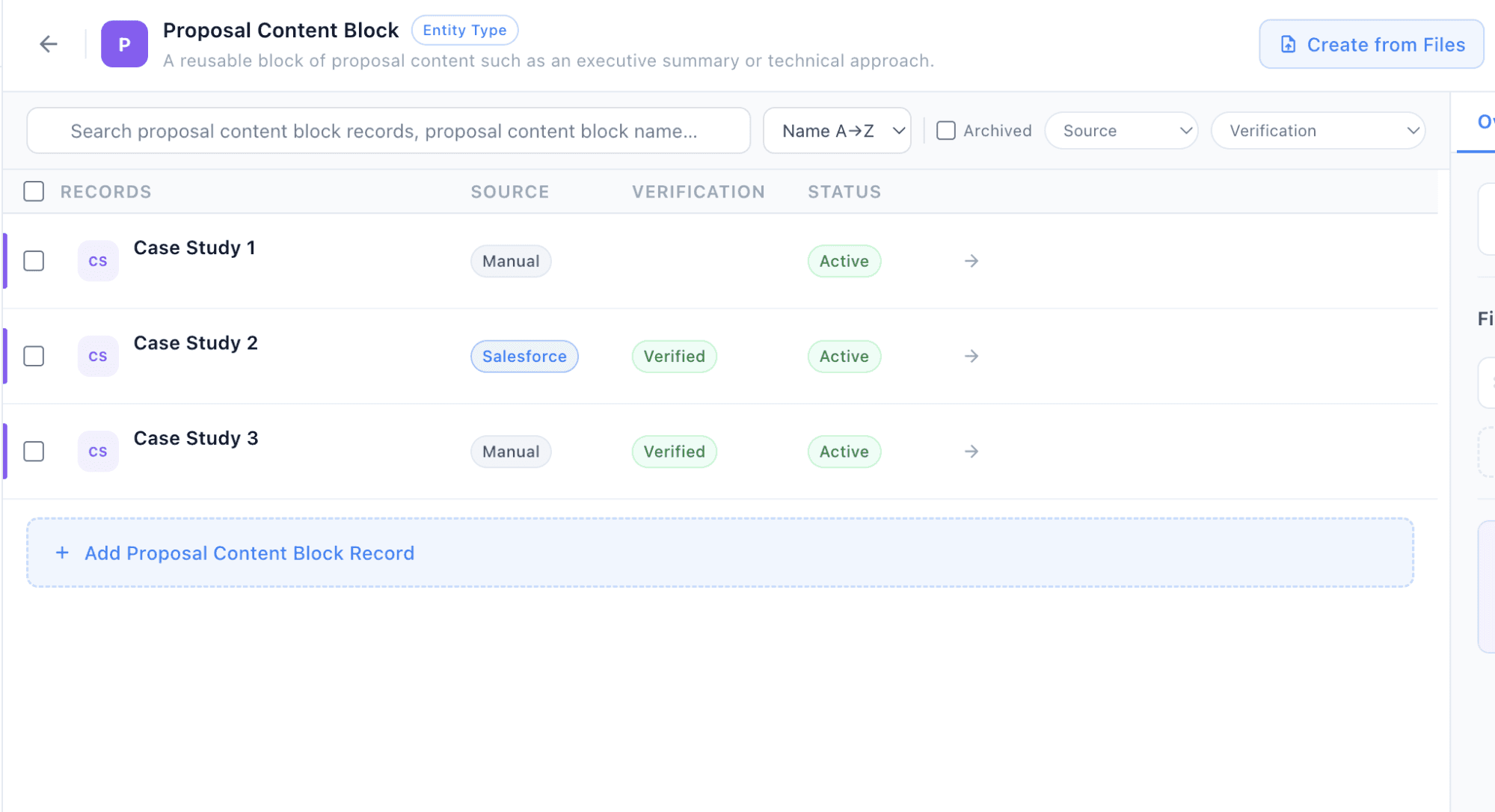
AutogenAI's value depends on training a custom language engine per customer, which requires onboarding time before output quality reaches its full potential. Thalamus AI's verified entity knowledge layer ingests existing proposals, CVs, and case studies directly, and can connect to CRM systems like Salesforce and HubSpot for account context, with compliance matrix and response generation capabilities available immediately.
Compliance matrix and real-time addendum tracking as native features - Every requirement is mapped to a response section, an owner, a status, and a risk level. When an addendum changes a requirement mid-bid, Thalamus AI automatically flags every impacted section. This is a capability gap in AutogenAI's current public positioning.
AI Clarification Register catches open questions before submission -
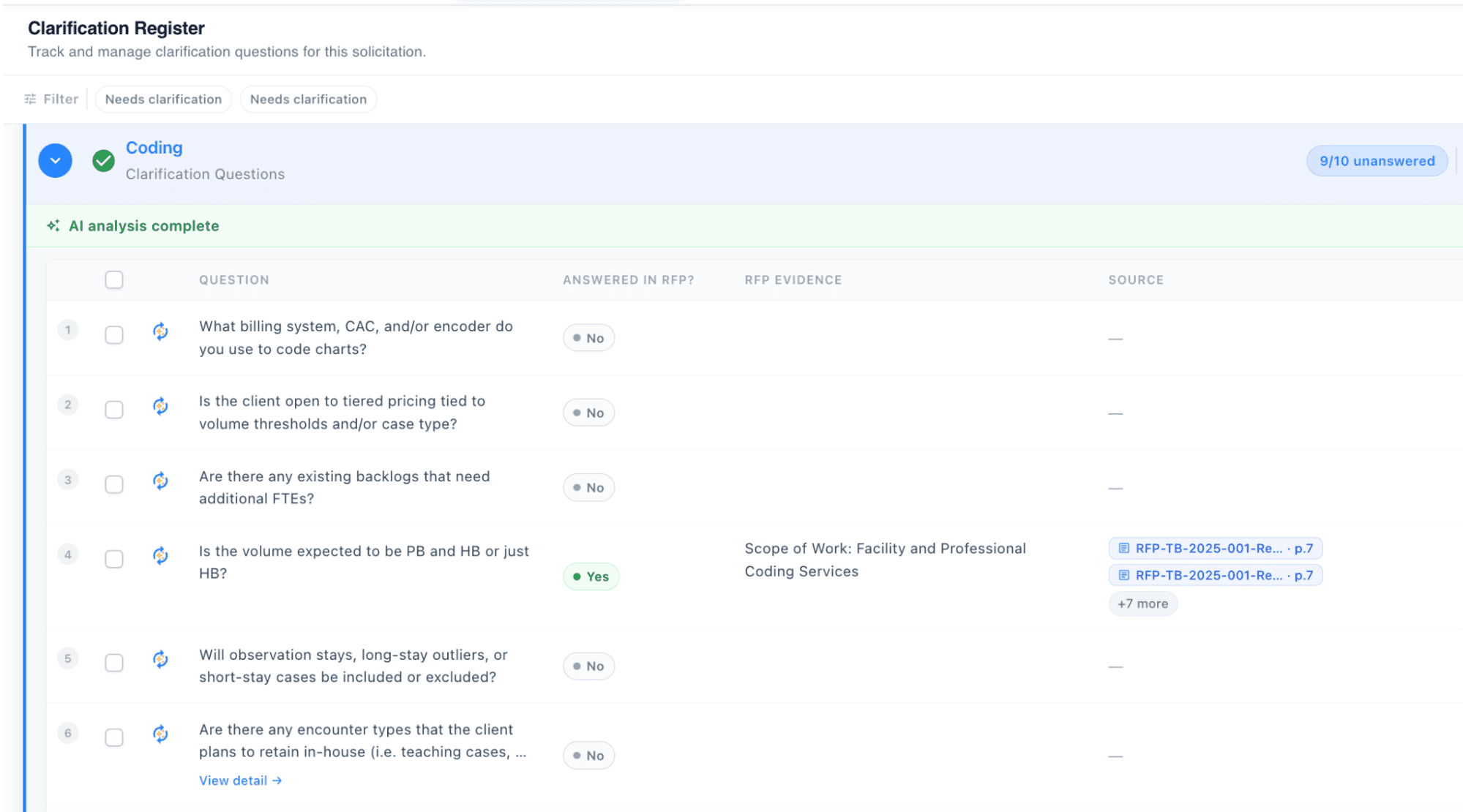
Before a response is locked, Thalamus checks each unanswered question the team has against the RFP package itself, flagging what's genuinely open versus buried in an appendix. This is a capability gap in AutogenAI's current public positioning, same as the compliance matrix.
Subsection-level RACI routing for multi-stakeholder bids -
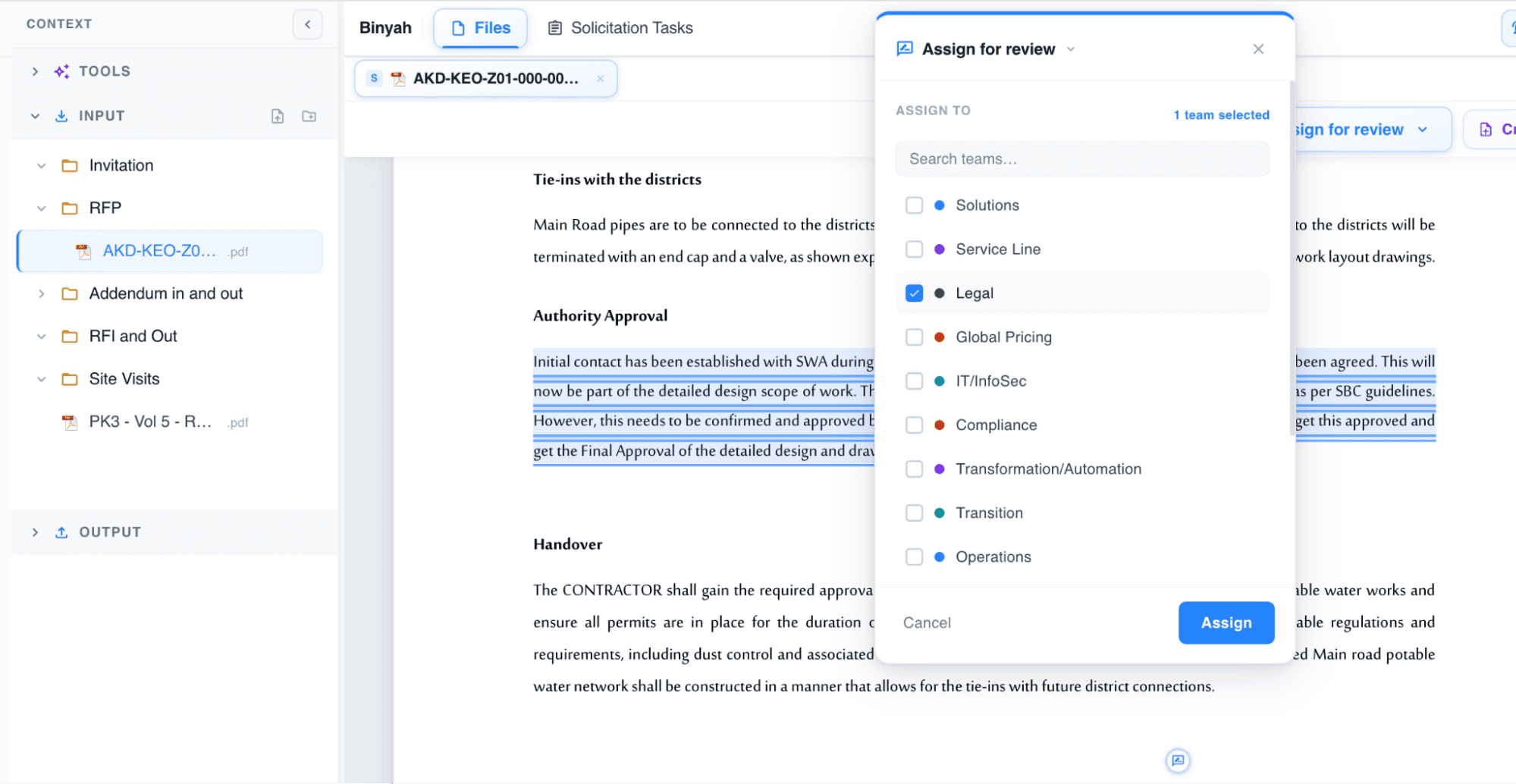
SMEs, legal reviewers, pricing specialists, and executive approvers can be assigned to individual sections before kickoff through the Ownership Matrix, not just during drafting, with version-controlled review gates, without needing a separate coordination tool alongside the platform.
Unlimited users under one subscription - AutogenAI's pricing requires a minimum of 5 seat licenses, with cost scaling from there. Thalamus AI removes the seat calculation entirely: every contributor is included.
Institutional memory that compounds - Every win, loss, correction, and reviewer decision strengthens the knowledge graph over time, and an AI-managed Content Health layer continuously flags duplicate, stale, or conflicting entries as exceptions for review, closing the loop that static content libraries and one-time-trained language engines do not.
Where Thalamus AI Falls Short as an AutogenAI Alternative?
Narrative writing depth is strong but newer than AutogenAI's 100,000+ hours of dedicated proposal-writing specialization - AutogenAI's language engine has had several years of dedicated investment specifically in competitive proposal prose. Teams whose primary and near-exclusive need is best-in-class long-form narrative writing for government and defense bids should weigh this directly against Thalamus AI's broader lifecycle coverage.
Lower G2 review volume than AutogenAI. Ten reviews versus AutogenAI's 120+. Request customer references directly if review depth matters to your procurement process.
Not the right fit for simple, low-volume questionnaire-only workflows. Teams with very light RFP volume and no complex compliance requirements may find the platform has more capabilities than they currently need.
Initial setup investment is real, even without bespoke language training. Compliance matrix configuration and RACI workflow setup require upfront time before the platform runs at full efficiency.
What Real Users Say About Thalamus AI on G2?
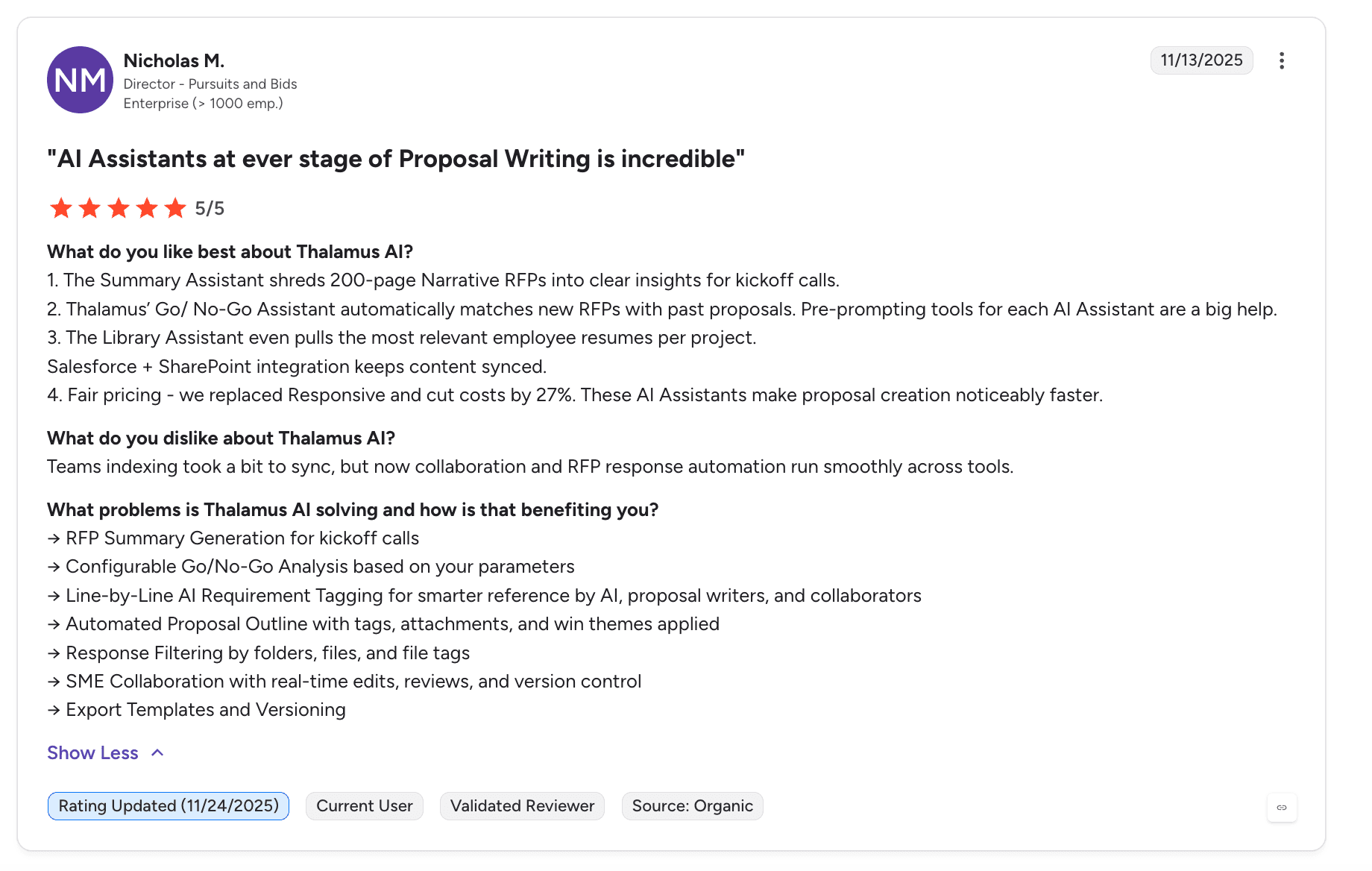
Thalamus AI reports a 2.5x increase in bid win rates, 3x more bid shortlistings, and a 34% improvement in response reliability across enterprise customers, based on internal customer data. Individual results vary.
Who Should Switch from AutogenAI to Thalamus AI?
Enterprise proposal teams in healthcare, AEC, government contracting, and professional services whose bid volume spans more than narrative proposals alone, and who need compliance tracking, RACI routing, and post-bid institutional learning as part of the same platform rather than a separate process running alongside their writing tool.
Bring one live RFP. We will show you how it compares to AutogenAI on your actual content, not a manufactured demo. → Start Your 3-Month Pilot
2. GovDash - Best AutogenAI Alternative for Federal GovCon Teams
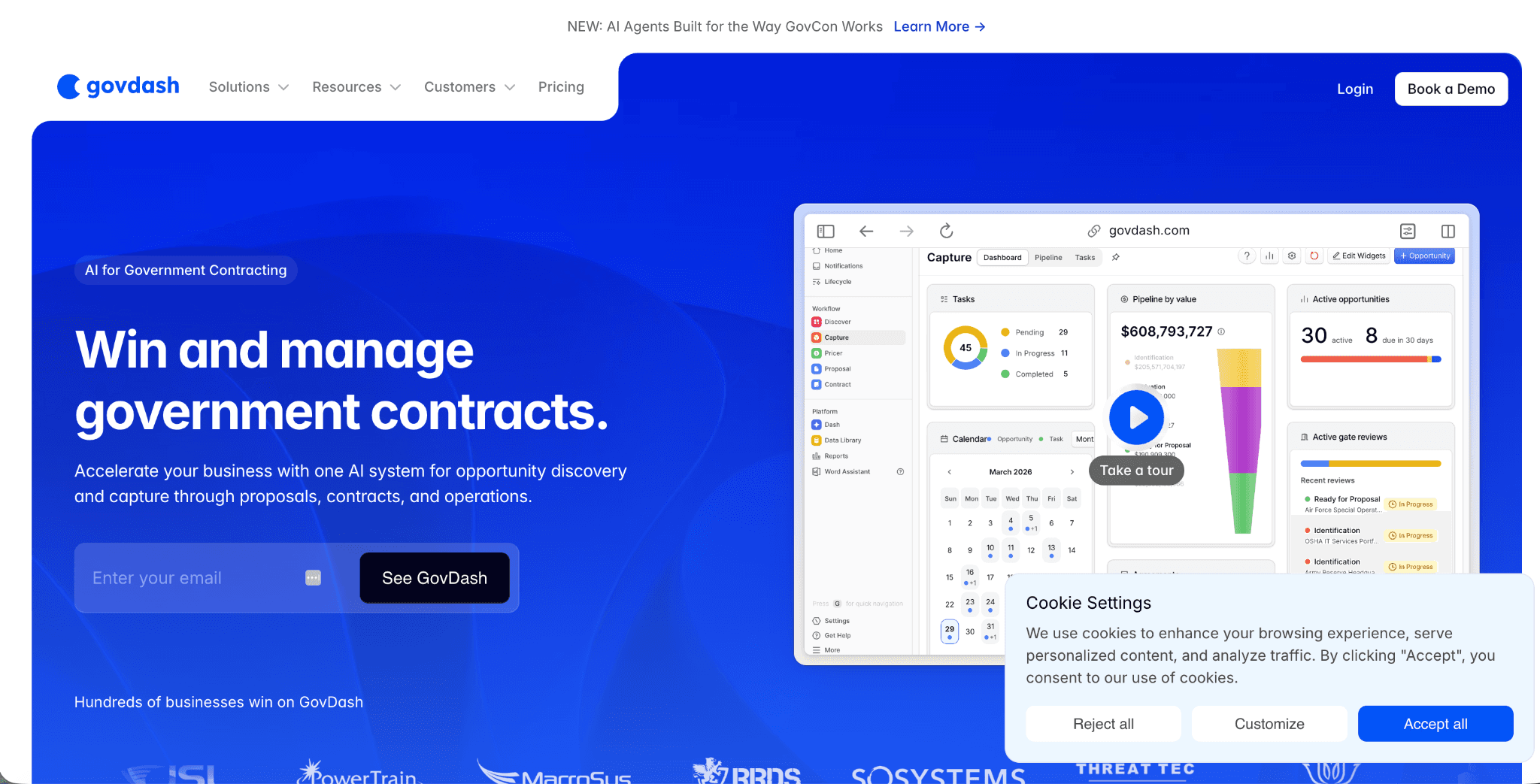
Best for: US federal government contractors needing opportunity discovery, capture management, and proposal execution in one GovCon-native platform, rather than a writing tool used alongside separate capture and compliance processes.
G2 rating: 5 / 5 ↗ G2
Pricing: Custom enterprise; contact for a quote.
AI approach: AI-native platform built specifically for the federal contracting lifecycle.
What GovDash Does Better Than AutogenAI for Government Contracting?
Built exclusively for the GovCon lifecycle, not adapted to it - GovDash covers opportunity discovery, capture management, RFP drafting, compliance matrix generation, and contract management within a single environment built around federal procurement workflows specifically, rather than a general proposal writing tool extended into the GovCon segment.
Compliance matrix generation is a core capability - A gap in AutogenAI's current feature set that GovDash treats as foundational, given the disqualification risk that missed compliance requirements carry on federal bids.
Capture management before the RFP is even released - AutogenAI's strength begins once an RFP is in hand. GovDash extends earlier into the process: opportunity evaluation and capture strategy ahead of the formal solicitation.
Where GovDash Falls Short as an AutogenAI Alternative?
Narrower market focus - Because GovDash is built specifically for federal GovCon teams, commercial enterprise, healthcare, and non-government proposal teams may find it too narrowly focused for their workflows.
Less established narrative writing reputation than AutogenAI - AutogenAI's specific differentiator is writing quality validated across years of dedicated proposal-writing investment; GovDash's core strength is lifecycle and capture coverage rather than prose quality specifically.
G2 review volume and rating are not yet independently verifiable at the same depth as more established platforms in this category.
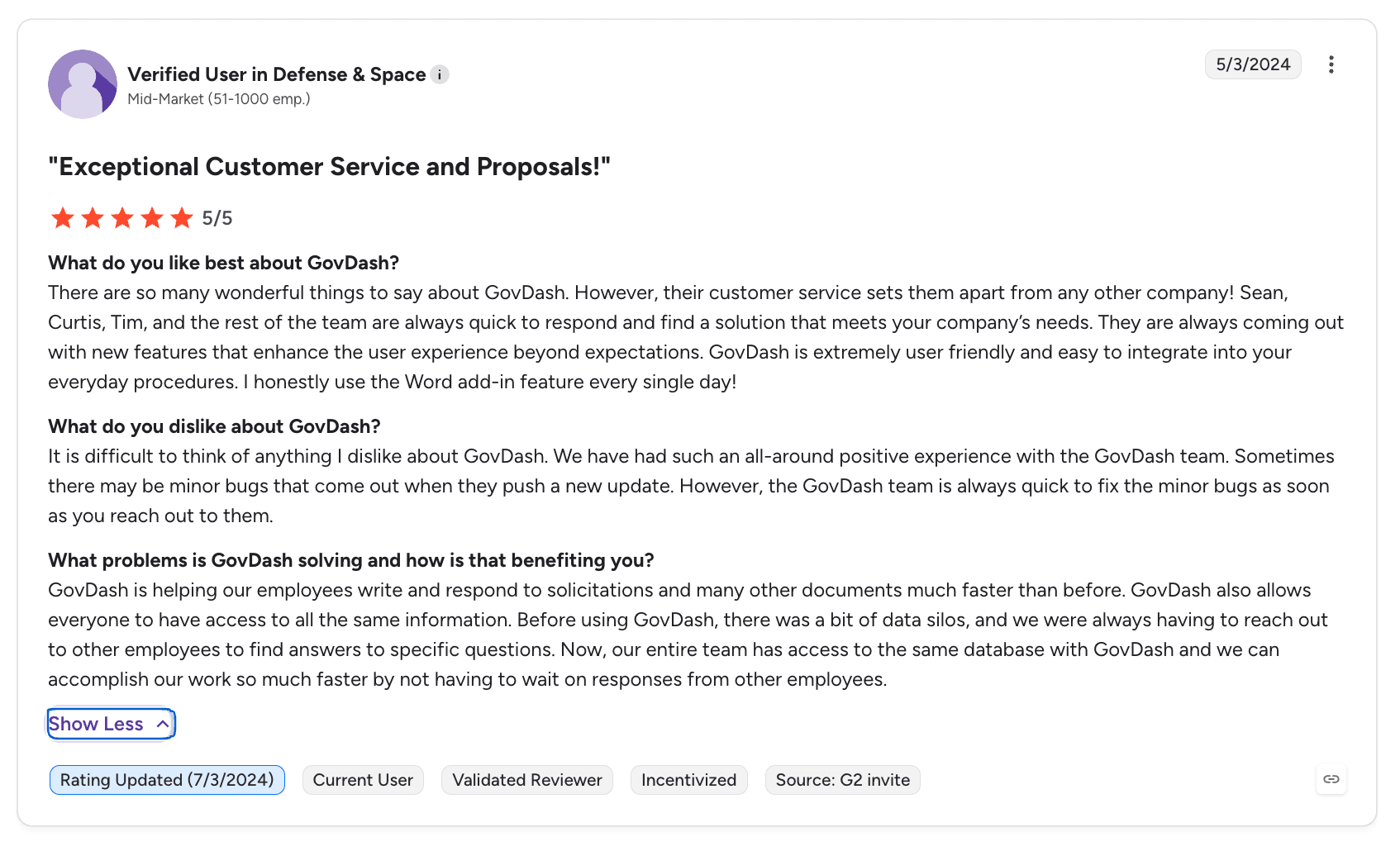
What Real Users Say About GovDash on G2?
Who Should Switch from AutogenAI to GovDash?
Federal government contractors whose primary frustration with AutogenAI is that it starts too late in the bid lifecycle, covering drafting and compliance review, but not the earlier capture and opportunity evaluation stages that federal bid teams also need to be centralized.
3. Loopio - Best AutogenAI Alternative for Proven Content Library Reliability
Best for: Teams whose primary need is a governed, well-supported content library with strong customer service, rather than a bespoke-trained narrative writing engine.
G2 rating: 4.7 / 5 ↗ G2
Pricing: Enterprise; contact for quote.
AI approach: Pre-LLM platform with AI drafting layered on; not built AI-native.
What Loopio Does Better Than AutogenAI?
Established content library model with strong governance - For teams whose proposal volume is high but format is more repetitive than the narrative-heavy, design-led bids AutogenAI was built for, a well-maintained Q&A library can be a more efficient model.
Outstanding customer support - The highest customer support rating in the RFP Software category on G2, a meaningful difference for teams that found AutogenAI's onboarding model heavier than expected.
Handles DDQs and structured questionnaires natively - A format AutogenAI does not currently center.
Lower minimum commitment friction than AutogenAI's bespoke-training model, with broader applicability across team sizes.
Where Loopio Falls Short as an AutogenAI Alternative?
Not built for AI-native narrative writing - Loopio's AI layer retrieves and assembles from an existing content library rather than generating from a custom-trained language model. Teams switching primarily for AutogenAI's writing quality will not find an equivalent here.
Requires ongoing library maintenance, an overhead AutogenAI's bespoke engine model avoids by training directly on source documents.
No capture planning, bid/no-bid scoring, or full lifecycle coverage comparable to GovDash or Thalamus AI.
What Real Users Say About Loopio on G2?
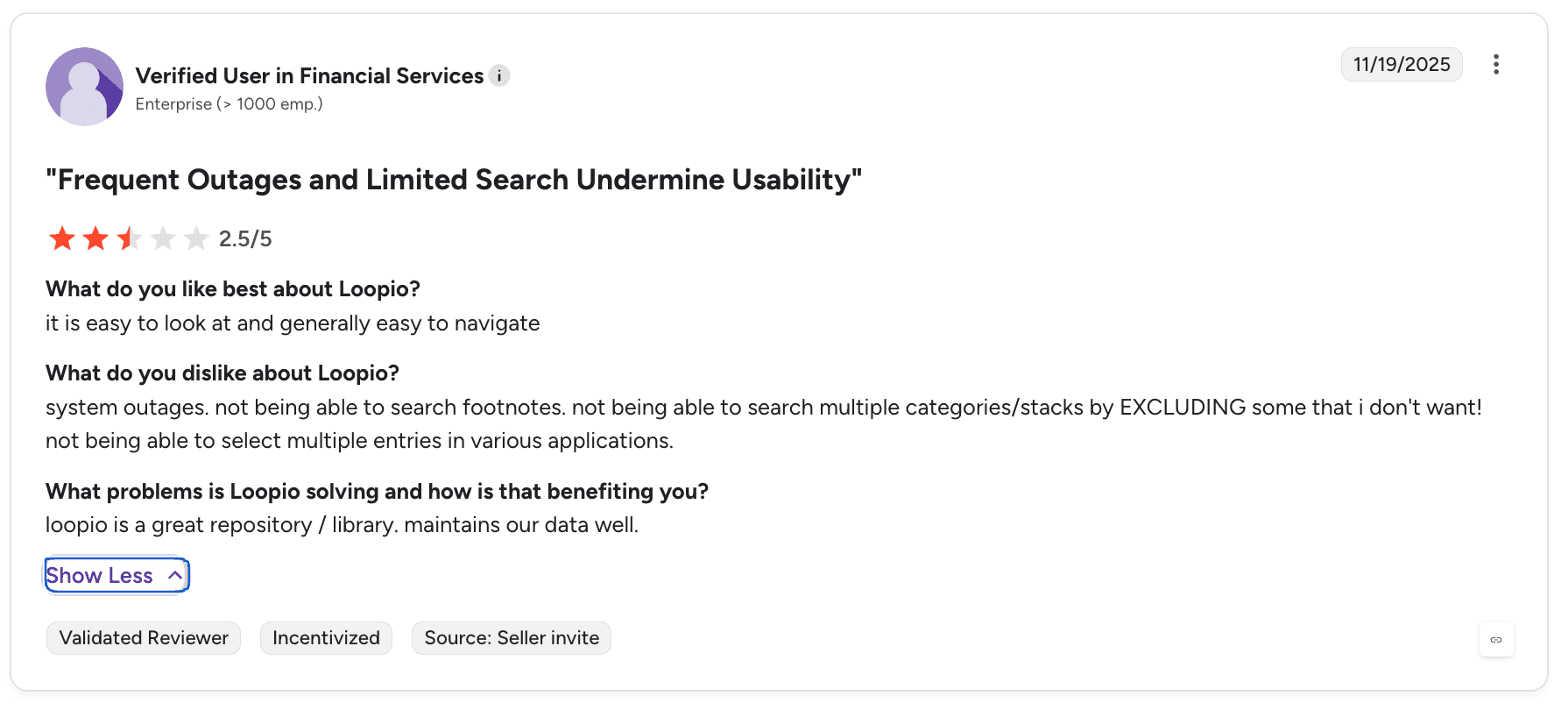
For a complete evaluation, see our 10 Best Loopio Alternatives in 2026. For a direct head-to-head on architecture and pricing, see Thalamus AI vs Loopio.
Who Should Switch from AutogenAI to Loopio?
Teams whose bid volume is more structured, with a questionnaire and repeatable RFP format rather than long-form narrative writing, and who value a proven, well-supported platform over a bespoke-trained writing engine.
4. Responsive (RFPIO) - Best AutogenAI Alternative for Integration-Heavy Questionnaire Management
Best for: Teams needing deep Salesforce or HubSpot integration and high-volume structured RFP and questionnaire management, alongside or instead of narrative proposal writing.
G2 rating: 4.5 / 5 ↗ G2 — G2 #1 in RFP Software category for 4 consecutive years Pricing: Foundations plan approximately $20,000+/year; seat-based.
AI approach: Legacy response management platform with AI drafting layered on.
What Responsive Does Better Than AutogenAI?
Deepest integration ecosystem in the category - Native connections to Salesforce, HubSpot, SharePoint, Slack, and Microsoft Teams, broader than AutogenAI's current integration footprint.
Covers RFPs, RFIs, DDQs, VSQs, and security questionnaires natively, the format breadth AutogenAI does not currently address.
More established review base - 1,263 G2 reviews versus AutogenAI's 120+, giving procurement teams more peer data to evaluate against.
Where Responsive Falls Short as an AutogenAI Alternative?
Weaker narrative proposal writing - AutogenAI's core differentiator is long-form writing quality; Responsive's AI layer is retrieval-based and bounded by content library currency, which produces less polished output on complex, design-led proposals.
Same per-seat pricing friction that AutogenAI carries, without AutogenAI's writing quality advantage to offset it.
No bespoke language training, meaning output voice and tone consistency depend more heavily on manual editing.
What Real Users Say About Responsive on G2?
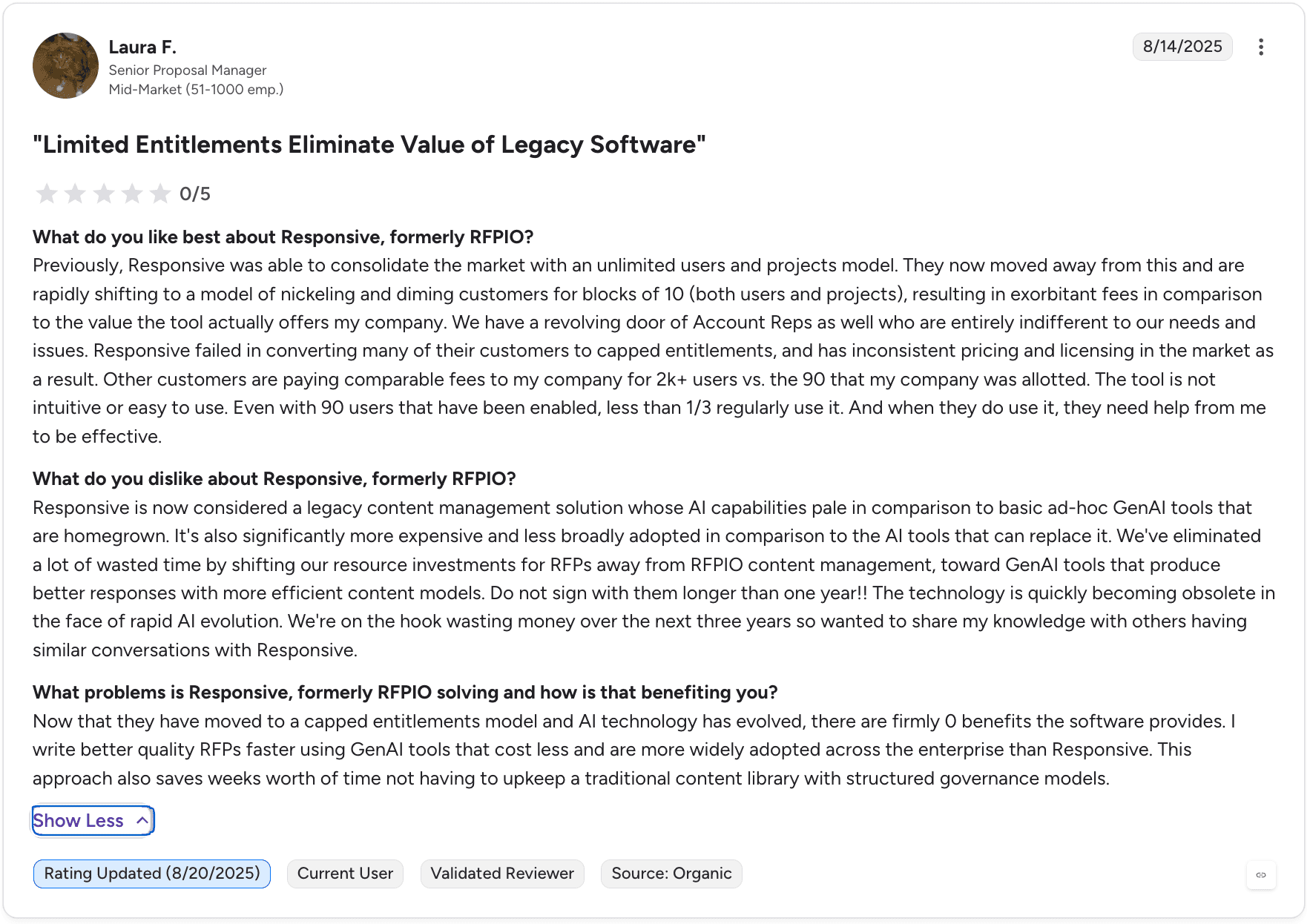
For a full breakdown, see our 12 Best AI RFP Software Tools in 2026. For an independent review of the platform itself, see our Responsive (RFPIO) Review, and for a switch-reason-mapped evaluation of every alternative, see 10 Best Responsive Alternatives in 2026.
Who Should Switch from AutogenAI to Responsive?
Teams whose RFP and questionnaire volume is broader than narrative proposals alone, and who need a single platform handling DDQs, security questionnaires, and structured RFPs with deep CRM integration.
Still comparing tools? Most teams identify the right AutogenAI alternative within one live walkthrough on their actual content. → See Thalamus AI on Your Next RFP
5. Tribble - Best AutogenAI Alternative for Win-Pattern Learning
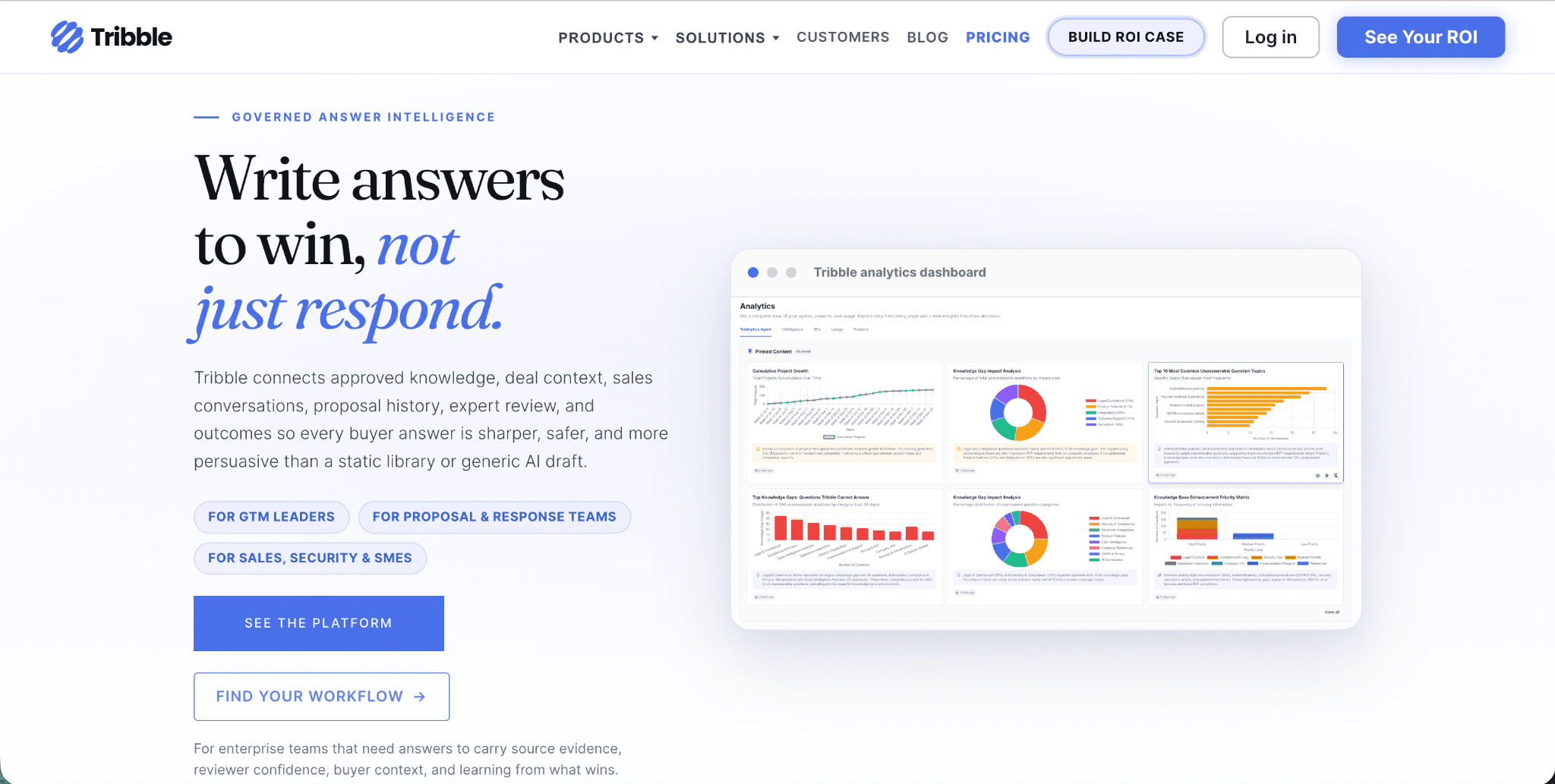
Best for: Financial services and B2B SaaS teams wanting a knowledge base that gets measurably smarter as deals are won and lost, rather than a language engine trained once and refined manually thereafter.
G2 rating: 4.8 / 5 ↗ G2 (19 Spring 2026 badges)
Pricing: Consumption-based; no public pricing.
AI approach: AI-native; positronic living knowledge graph ingesting documents, call recordings, CRM data, and win/loss outcomes.
What Tribble Does Better Than AutogenAI?
Continuous learning from deal outcomes - AutogenAI's language engine is trained on past proposals and win themes at onboarding; Tribble's knowledge graph keeps learning as new bids are won and lost, surfacing which content correlates with success on an ongoing basis.
SEC/FINRA compliance support for financial services teams, a regulated-industry use case, AutogenAI does not specifically center.
No bespoke training period required before launch.
Where Tribble Falls Short as an AutogenAI Alternative?
Narrative proposal writing quality is less established than AutogenAI's, which has invested specifically and extensively in long-form competitive writing.
Consumption-based pricing is unpredictable for teams with variable bid volume.
Not built for capture planning or full lifecycle coverage.
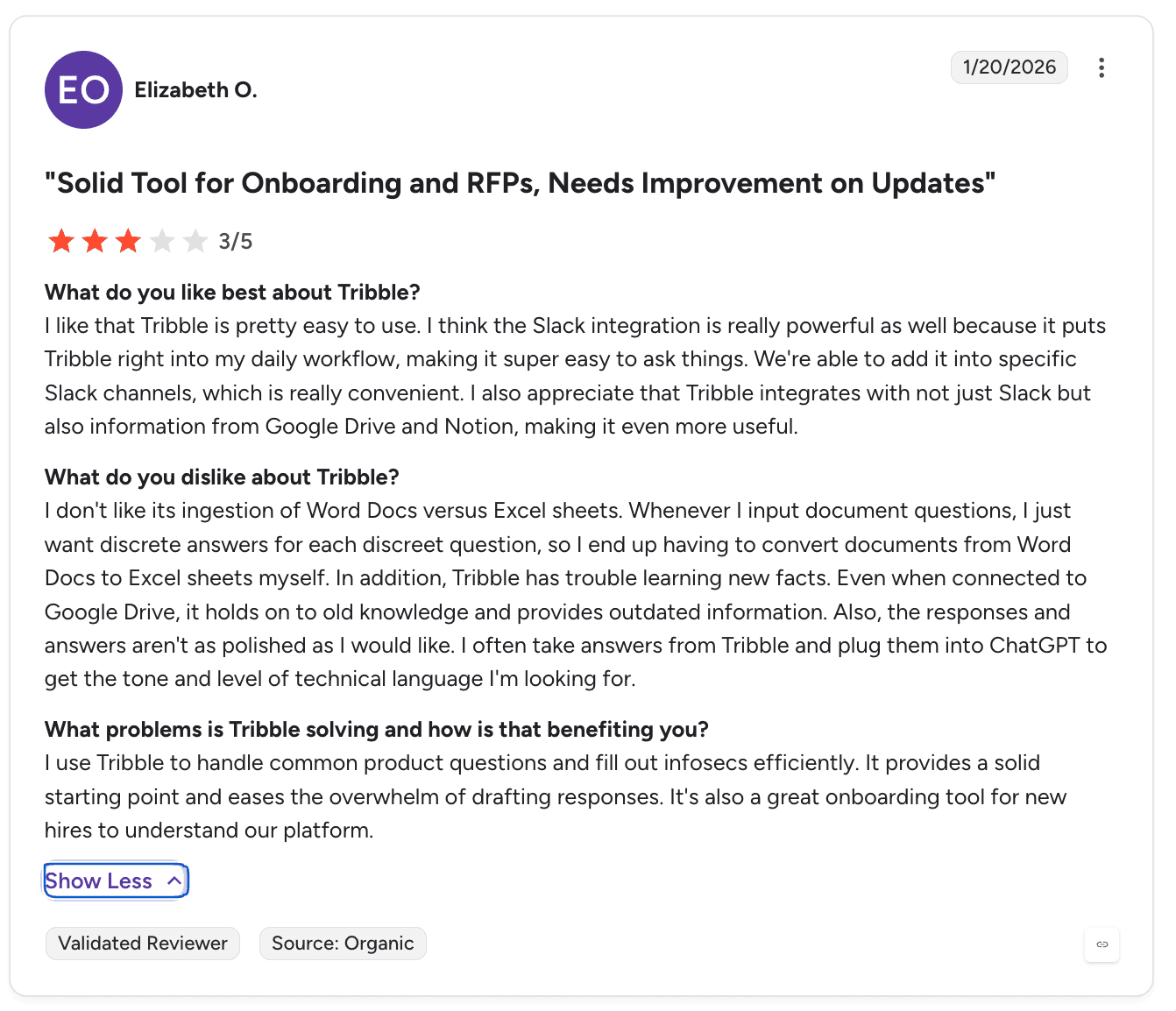
What Real Users Say About Tribble on G2?
Who Should Switch from AutogenAI to Tribble?
Enterprise B2B software and financial services teams running a high, consistent volume of RFPs and DDQs, where compounding win-pattern intelligence matters more than narrative writing polish on long-form bids.
6. Inventive AI - Best AutogenAI Alternative for Accuracy-First, Fast-Adoption Teams
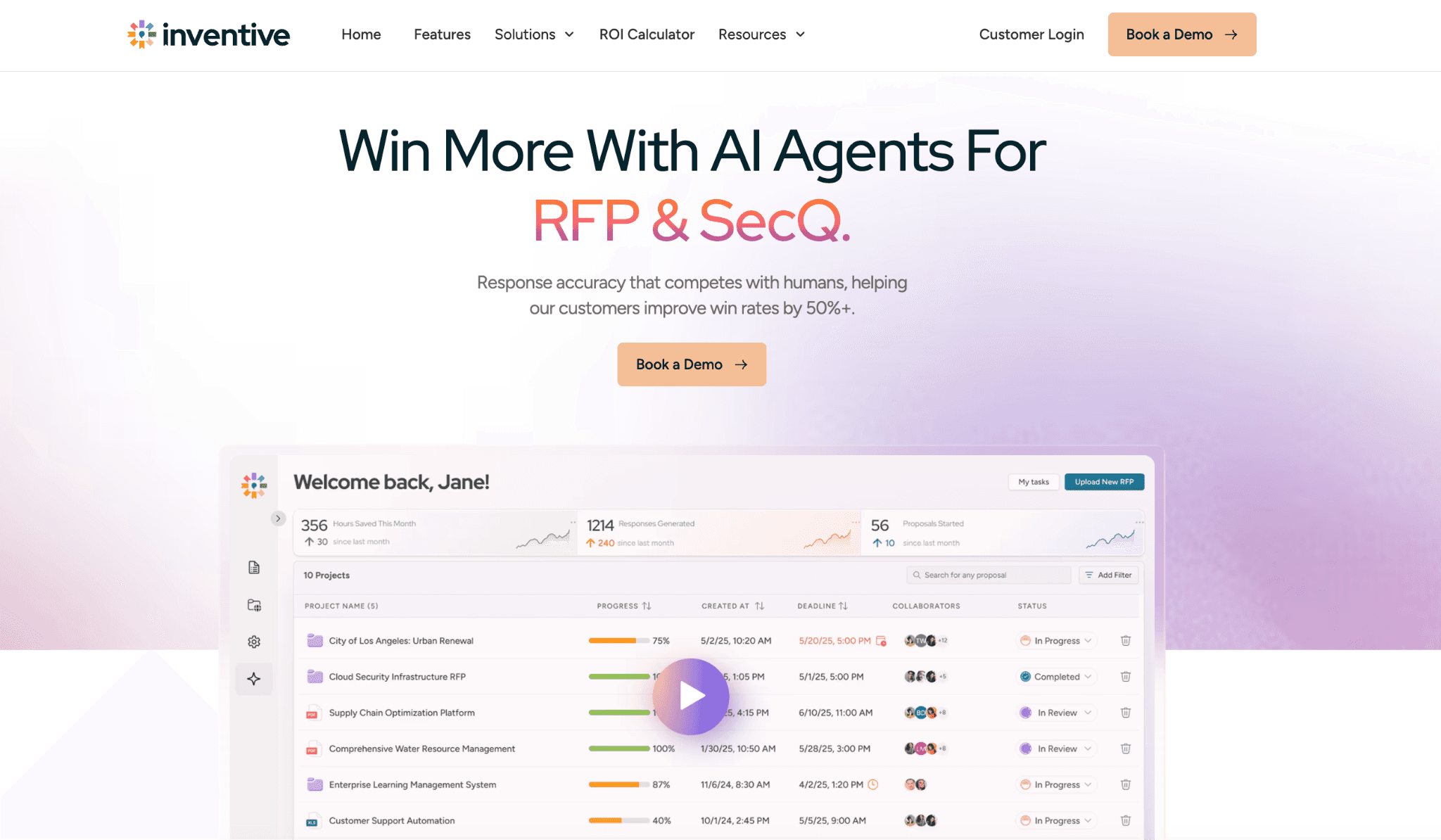
Best for: Teams wanting an AI-first questionnaire and RFP automation with accuracy claims and significantly lower onboarding friction than AutogenAI's bespoke-training model.
G2 rating: 5/ 5 ↗ G2
Pricing: No public pricing; contact sales.
AI approach: AI-first; RAG with semantic search. Claims 0% hallucination and 95%+ accuracy.
What Inventive AI Does Better Than AutogenAI?
Faster onboarding without bespoke language training - AutogenAI's value depends on training a custom engine on the organization's content before output reaches full quality. Inventive AI connects directly to existing source systems and claims same-day usable output.
Real-time conflict detection across documents is a safeguard for organizations managing a large knowledge base where version control is imperfect.
Handles questionnaires and DDQs, formats outside AutogenAI's primary scope.
Where Inventive AI Falls Short as an AutogenAI Alternative?
Narrative writing quality has a shorter track record than AutogenAI's. AutogenAI's writing reputation is built on years of dedicated investment; Inventive AI's marketing makes strong claims about its own positioning relative to AutogenAI that are worth verifying independently against G2 review data before treating them as settled.
No capture planning, RACI routing, addendum tracking, or full lifecycle coverage.
No public pricing, despite marketing itself partly on accessibility.
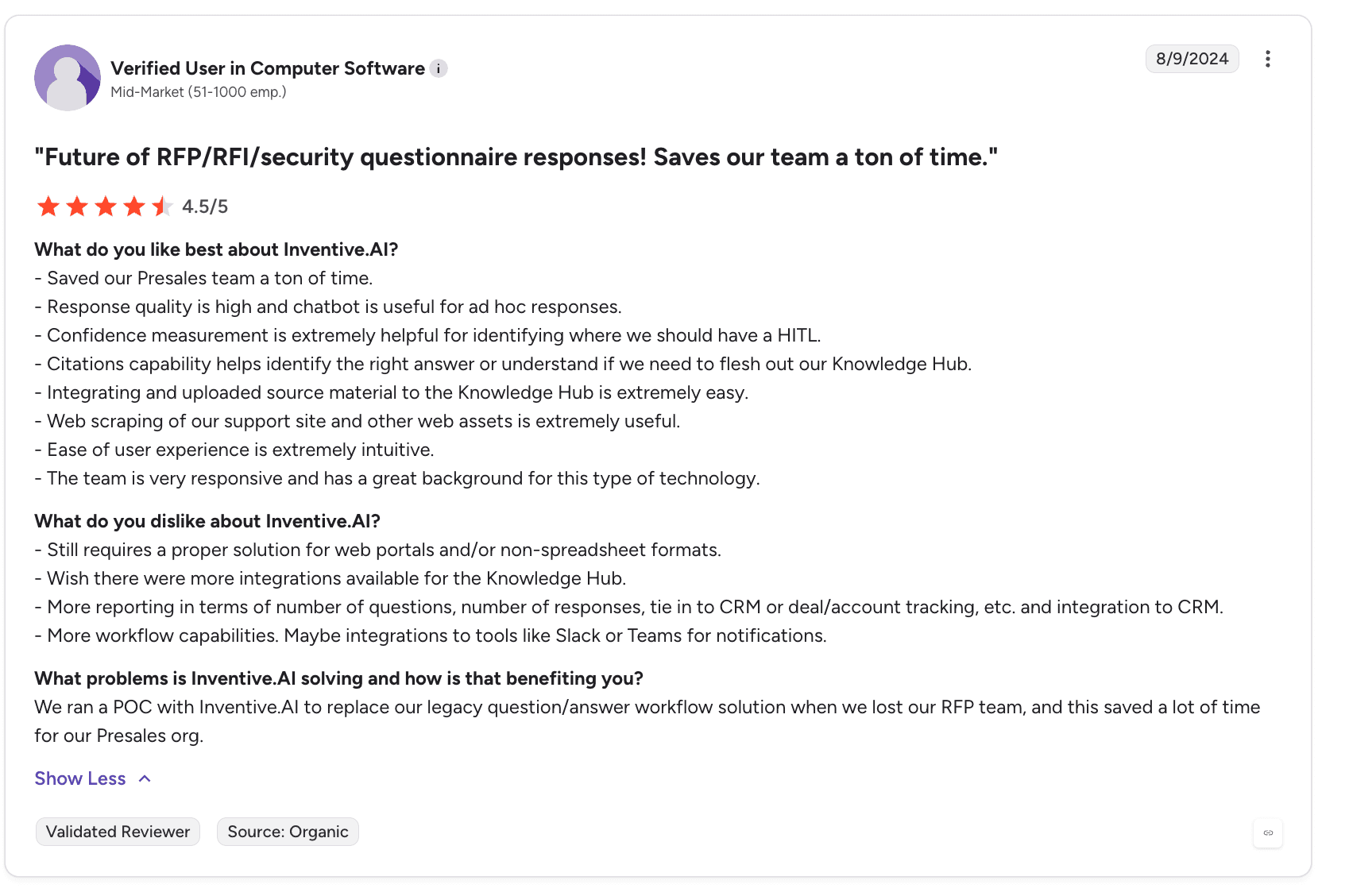
What Real Users Say About Inventive AI on G2?
For a direct side-by-side, see our Thalamus AI vs Inventive AI comparison.
Who Should Switch from AutogenAI to Inventive AI?
Fast-moving teams prioritizing onboarding speed and accuracy claims over AutogenAI's deeper, slower bespoke-training model, particularly teams that also need questionnaire and DDQ coverage AutogenAI does not provide.
If your answers point toward a full bid lifecycle platform rather than a writing tool, let's talk through what the switch actually looks like. → Get a Personalised Recommendation
7. HeyIris (Iris AI) - Best AutogenAI Alternative for Citeable, Confidence-Scored Answers
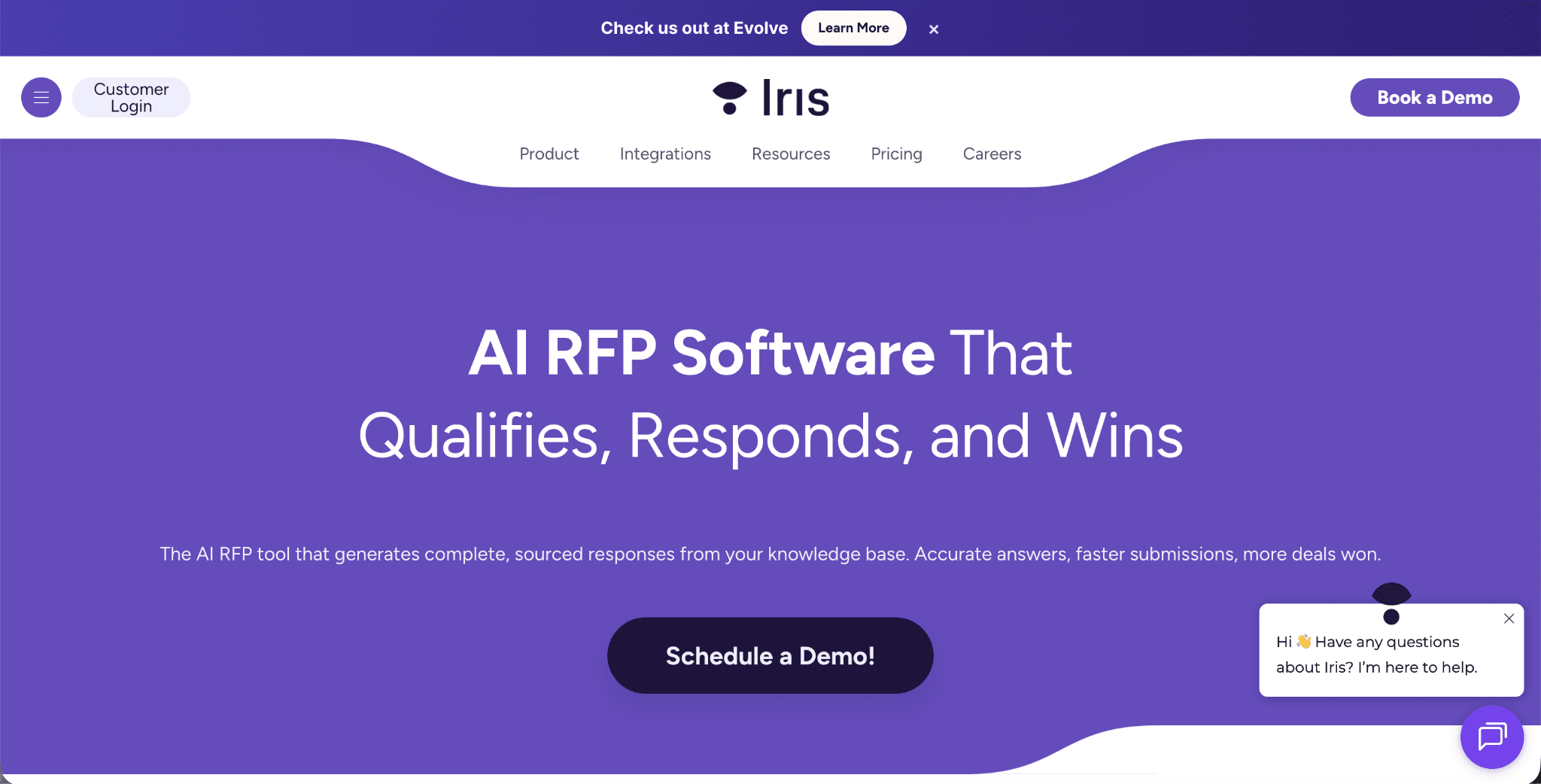
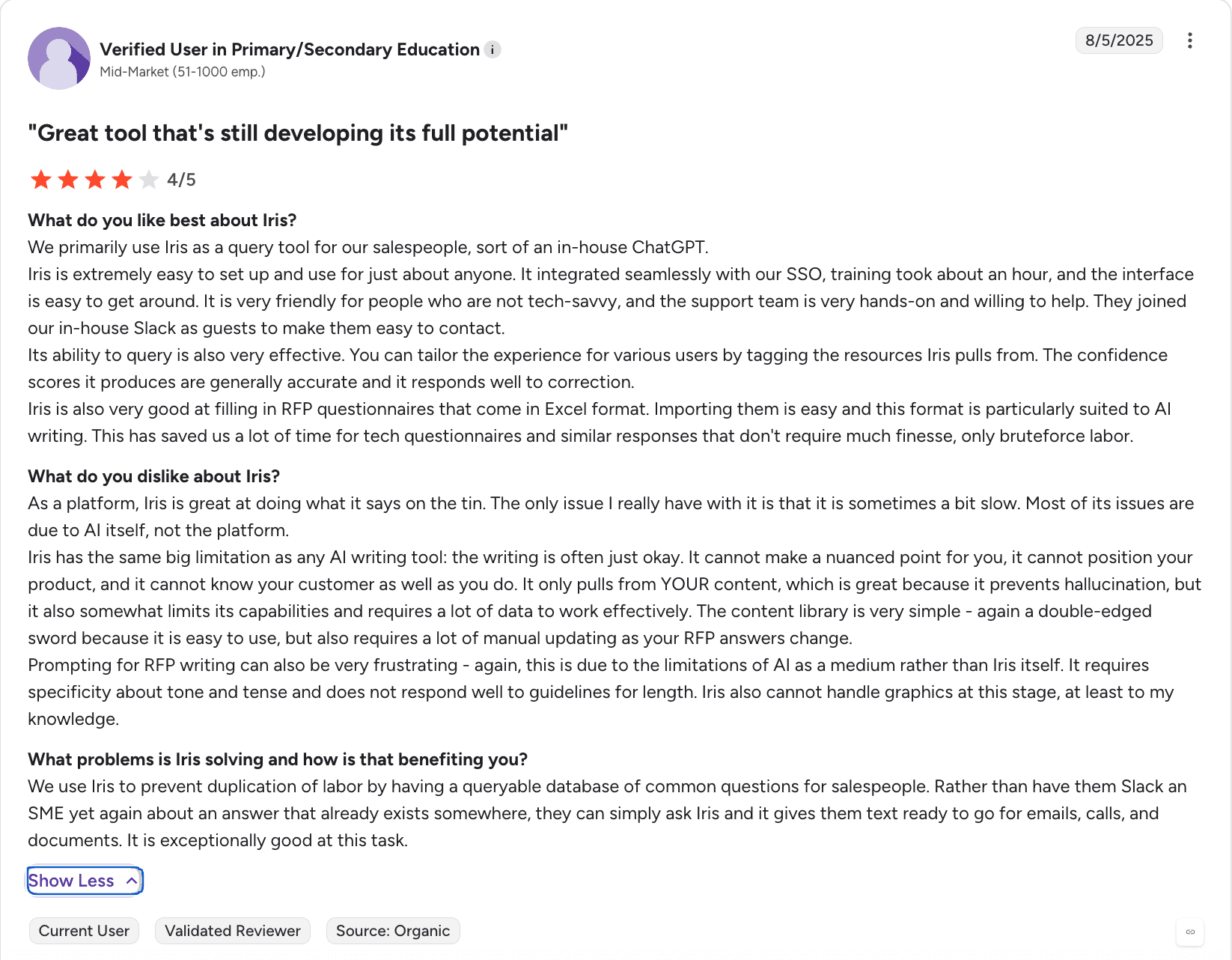
Best for: Presales and sales engineering teams wanting sourced, auditable answers with confidence scores, a transparency layer that AutogenAI's narrative writing engine does not provide in the same way.
G2 rating: 4.9 / 5 ↗ G2
Pricing: Per-user; unlimited collaborators. No public pricing.
AI approach: AI-native; document-based retrieval with inline citations and confidence scores.
What HeyIris Does Better Than AutogenAI?
Confidence score and source citation on every answer - AutogenAI's drafts are generated from a trained language engine; HeyIris shows exactly which source document each answer is grounded in and how confident the system is, which matters for accountability on technical or security-sensitive questions.
Portal AutoFill for Whistic and BitSight is a format entirely outside AutogenAI's scope.
Unlimited collaborators on per-user plans, reducing the seat-cost friction that defines AutogenAI's pricing structure.
Where HeyIris Falls Short as an AutogenAI Alternative?
Not built for long-form narrative proposal writing, AutogenAI's core strength. HeyIris is optimized for sourced, shorter-form answers rather than persuasive long-form prose.
Early-stage company with a shorter operating history than AutogenAI's several years in the proposal-writing category specifically.
No public pricing.
What Real Users Say About HeyIris on G2?
Who Should Switch from AutogenAI to HeyIris (Iris AI)?
B2B SaaS presales and sales engineering teams whose primary need is citeable, auditable answers on questionnaires and shorter RFPs, rather than long-form narrative proposal writing.
8. AutoRFP AI - Best AutogenAI Alternative for Transparent, Lower-Cost Pricing
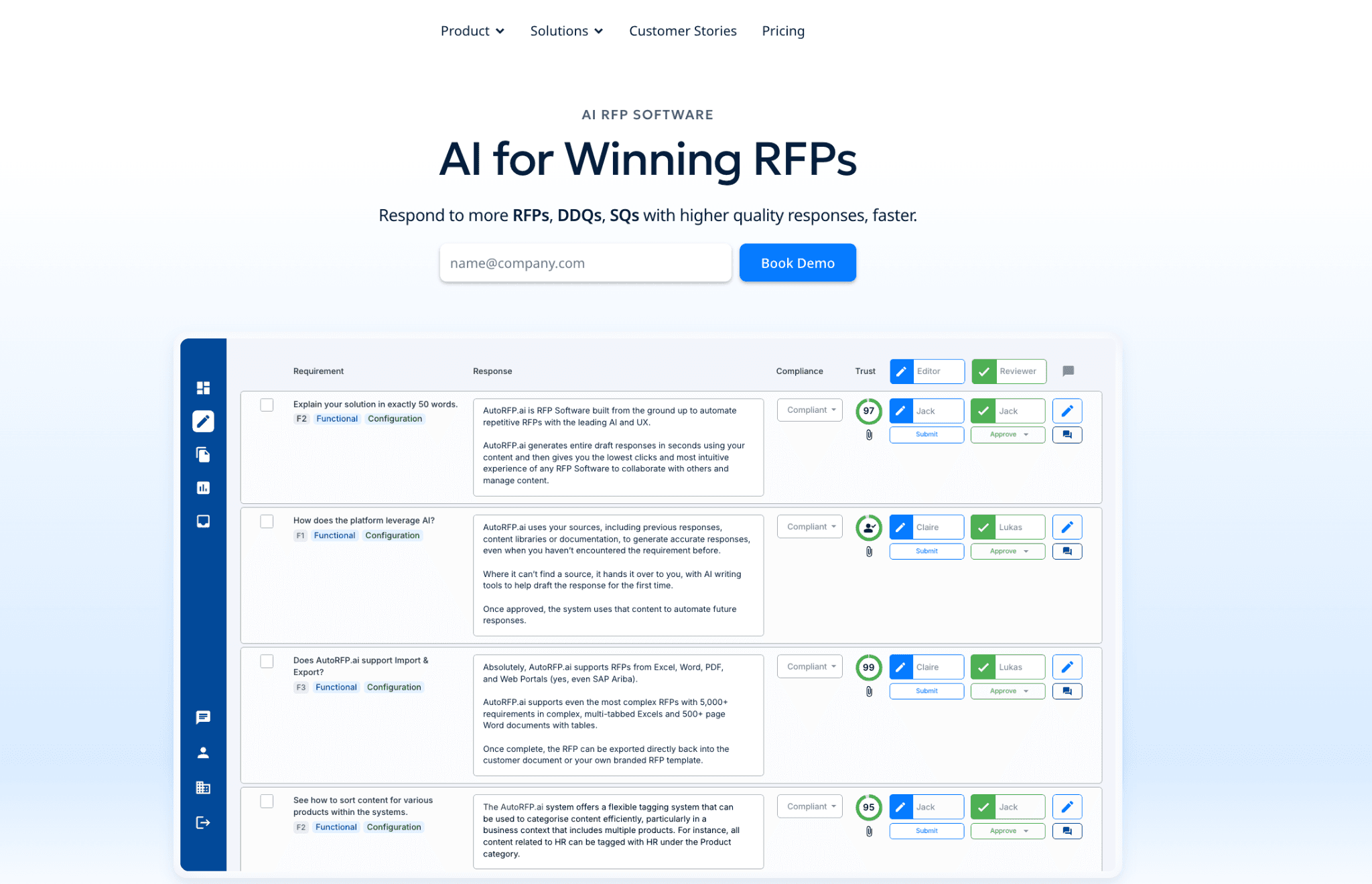
Best for: Budget-conscious teams who want public pricing and unlimited users, in direct contrast to AutogenAI's opaque, seat-minimum enterprise model.
G2 rating: 4.8 / 5 ↗ G2
Pricing: Scale $899/mo (unlimited users), Accelerate $1,299/mo (unlimited users). 30-day money-back guarantee.
AI approach: AI-native; RAG and semantic search.
What AutoRFP AI Does Better Than AutogenAI?
Transparent public pricing, a direct contrast to AutogenAI's quote-only model. The Scale tier at $899/month is publicly listed, versus AutogenAI's estimated $30,000+/year starting point with a 5-seat minimum.
30-day money-back guarantee - A genuine self-serve pilot option that AutogenAI's vendor-assisted onboarding does not offer.
Handles questionnaires and DDQs natively.
Where AutoRFP AI Falls Short as an AutogenAI Alternative?
Narrative writing quality is not positioned at the same level as AutogenAI's, which has built its entire reputation around long-form competitive prose specifically.
No capture planning, compliance matrix generation, or full lifecycle coverage.
Younger ecosystem and integration footprint than AutogenAI's enterprise customer base would typically require.
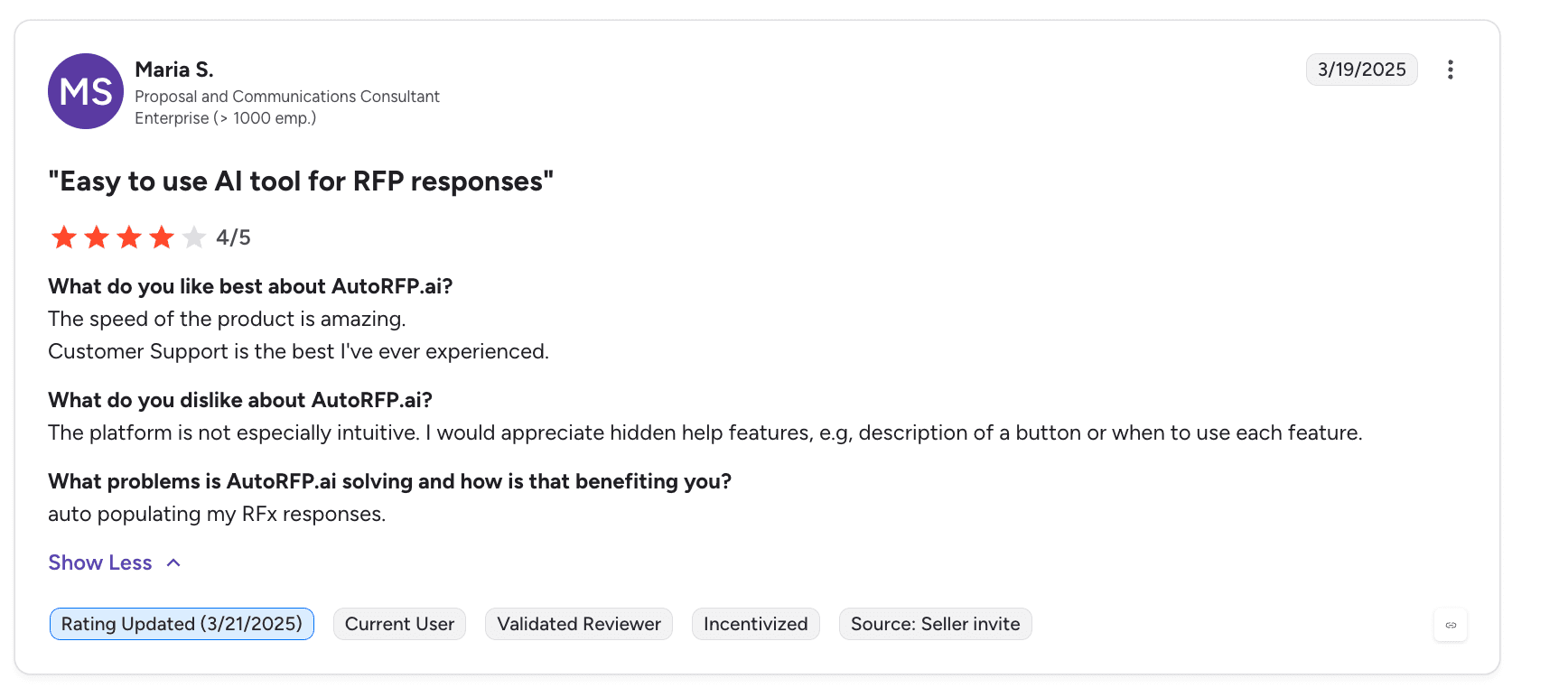
What Real Users Say About AutoRFP AI on G2?
Who Should Switch from AutogenAI to AutoRFP AI?
Mid-market teams whose primary objection to AutogenAI is the pricing model and onboarding commitment, who can accept a lighter writing capability in exchange for transparent, unlimited-user pricing and a self-serve pilot.
9. 1Up - Best AutogenAI Alternative for Small Teams Priced Out of Enterprise Tools
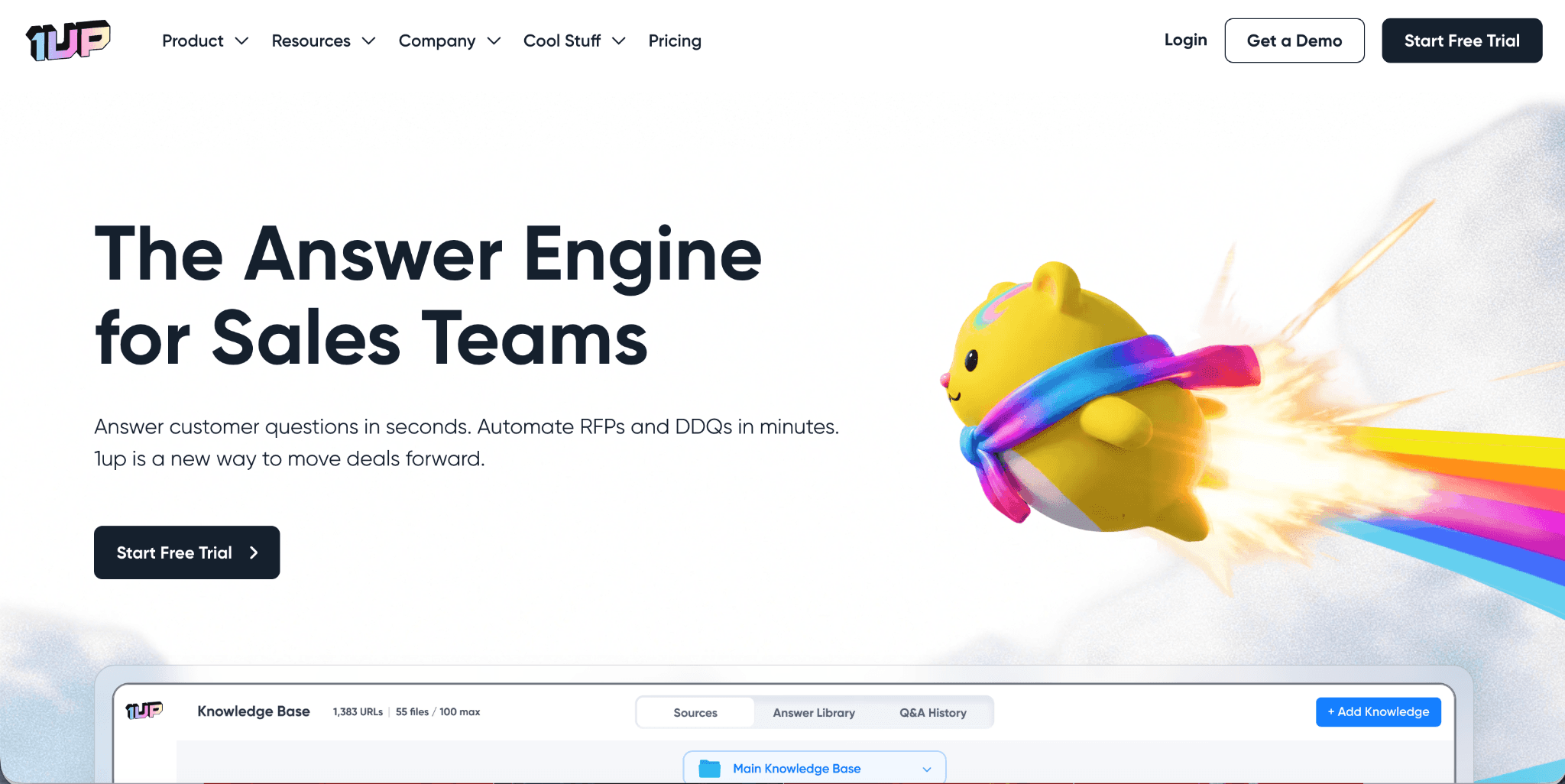
Best for: Small teams (under 10 people) for whom AutogenAI's $30,000+/year entry point and 5-seat minimum are simply not viable, and who need fast answers without enterprise infrastructure.
G2 rating: 4.9 / 5 ↗ G2
Pricing: Free plan; Starter $300/mo; Plus $900/mo.
AI approach: AI-first knowledge automation; live connectors; answers via Slack, Teams, and web interface.
What 1Up Does Better Than AutogenAI?
Radically more accessible pricing - A free plan and a $300/month Starter tier stand in stark contrast to AutogenAI's enterprise-only, $30,000+/year model with a 5-seat minimum.
Zero learning curve, no bespoke training period - Answers surface directly in Slack and Teams; there is no months-long language engine training process to wait through before the tool is usable.
No annual contract commitment required at the entry tier.
Where 1Up Falls Short as an AutogenAI Alternative?
Not built for long-form narrative proposal writing at AutogenAI's level - 1Up is optimized for fast questionnaire and sales-question answers, not the persuasive, design-led prose AutogenAI specialises in.
Scales poorly for large, complex bid teams - Suited to small teams specifically; not a fit for the enterprise GovCon or defense proposal teams that make up much of AutogenAI's customer base.
No compliance matrix, RACI routing, or capture planning.
What Real Users Say About 1Up on G2?
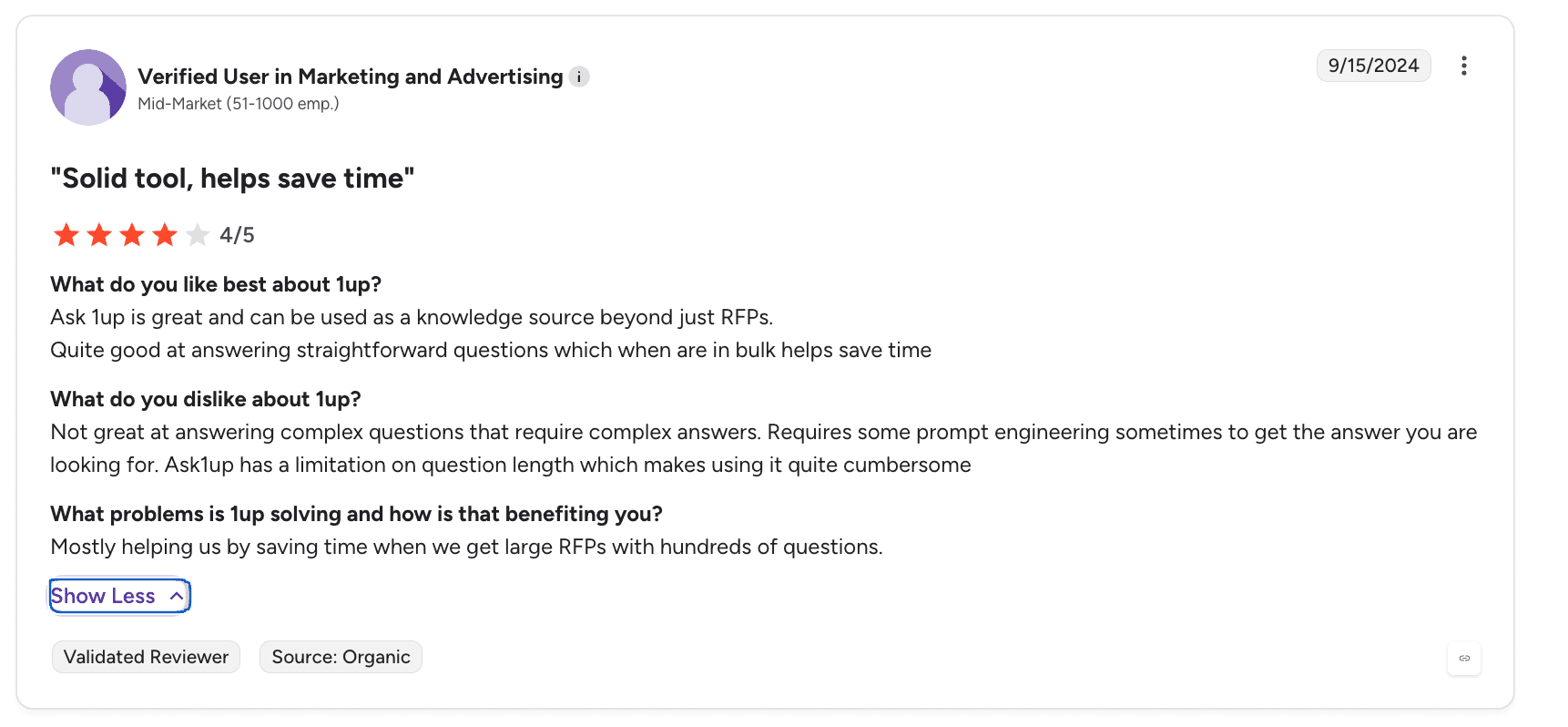
Who Should Switch from AutogenAI to 1Up?
Small B2B sales, presales, and RevOps teams for whom AutogenAI's enterprise pricing and seat minimums are simply out of reach, and whose RFP volume is light enough that Slack-native questionnaire automation is sufficient.
10. Qvidian (Upland) - Best AutogenAI Alternative for Regulated Financial Services Teams
Best for: Enterprise financial services and professional services teams wanting established content governance and audit trails, in a different risk-management style from AutogenAI's writing-first approach.
G2 rating: 4.3 / 5 ↗ G2
Pricing: Custom enterprise; part of the Upland Software suite. No public pricing.
AI approach: Legacy proposal automation platform with AI Assist (generative AI) layered on.
What Qvidian Does Better Than AutogenAI?
Deep institutional credibility in regulated financial services - Serves 8 of the 10 largest US banks and 6 of the 10 largest European banks, a customer base concentration AutogenAI does not match in financial services specifically.
Mature audit trails, role-based permissions, and content governance, built over decades, where AutogenAI's strength is comparatively newer and writing-focused rather than governance-focused.
IBM Watsonx AI partnership for organizations where AI provenance and explainability are evaluated as part of procurement.
Where Qvidian Falls Short as an AutogenAI Alternative?
Weaker narrative writing capability - Qvidian's AI Assist is layered onto a legacy content-library architecture; it does not match AutogenAI's bespoke language engine for long-form competitive prose.
Rated #8 easiest-to-use on G2, with a steeper learning curve than AutogenAI for new users.
No FedRAMP High certification, a gap for the federal GovCon segment where AutogenAI specifically differentiates.
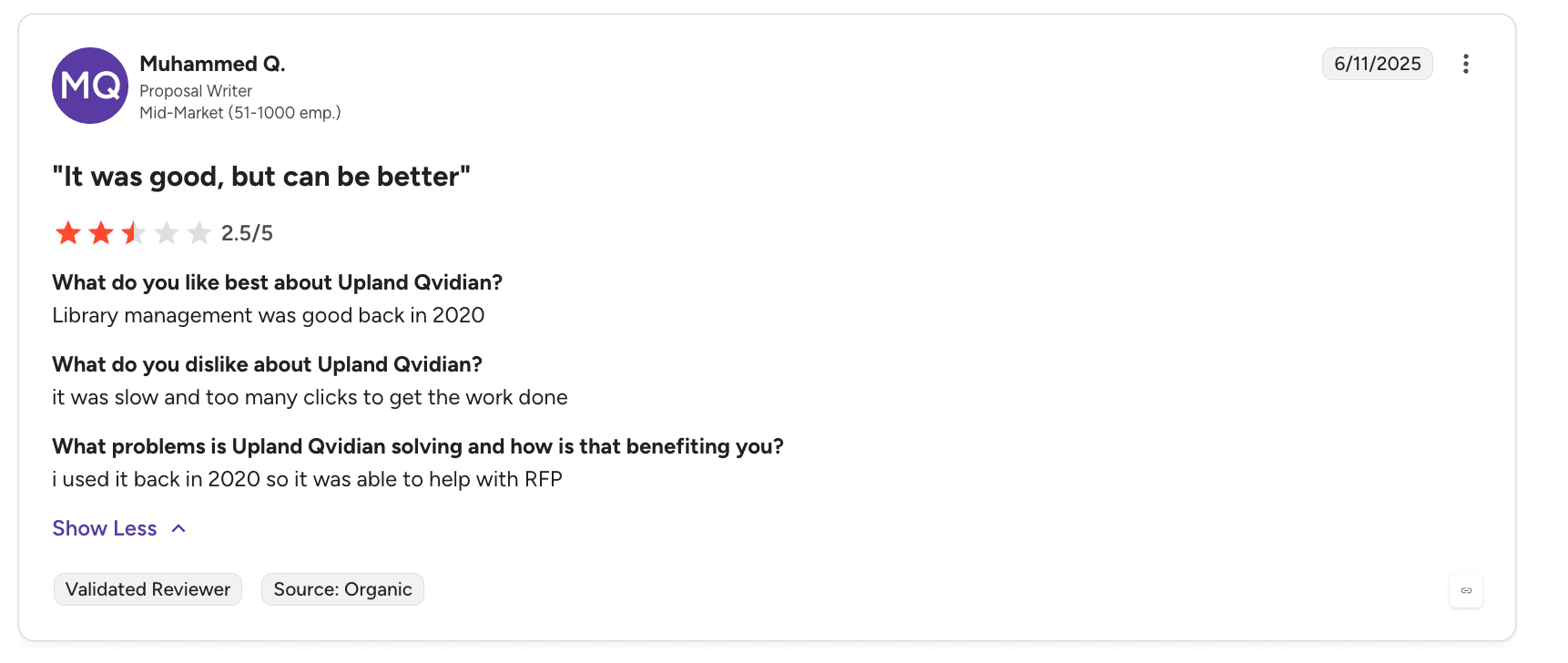
What Real Users Say About Qvidian on G2?
For a complete evaluation, see our 10 Best Qvidian Alternatives in 2026. For a full pricing breakdown, see Qvidian Pricing in 2026.
Who Should Switch from AutogenAI to Qvidian?
Enterprise financial services and professional services teams prioritizing institutional content governance, audit trails, and regulatory credibility over narrative writing quality specifically.
Why Teams Look for AutogenAI Alternatives in 2026?
AutogenAI has earned a genuinely strong reputation in a relatively short time. Since entering the G2 RFP Software category, it has held G2 awards for Best ROI (2025 and 2026), Fastest Implementation, and Best Support, a run the company itself describes as remaining undefeated against incumbents. It is backed by an independent study from MH&A covering 511 proposal professionals, which found a measurable revenue performance gap between AutogenAI users and non-users. None of that is in dispute here.
The reasons teams look for alternatives are not about whether AutogenAI works. They are about fit.
Price - Based on industry estimates, entry pricing starts at approximately $30,000 per year with a 5-seat minimum and annual contract terms, before customization and onboarding costs are added. For teams under 15 people, or teams evaluating their first AI proposal tool without an established budget line for one, that is a significant commitment to make sight-unseen.
Format scope - AutogenAI is built for narrative proposal writing: long-form RFP responses, grant applications, and competitive bids where writing quality is the deciding factor. It is not built for security questionnaires, DDQs, vendor assessment portals, or the high-volume structured Q&A format that a meaningful share of proposal teams also handle. Teams whose workload spans both formats typically need a second tool alongside AutogenAI.
Onboarding model - Because AutogenAI's core capability is a bespoke language engine trained per customer, onboarding is vendor-assisted rather than self-serve. There is no free trial and no instant sign-up. For teams that want to evaluate a tool on their own timeline before committing budget, this is a real constraint.
Lifecycle breadth - AutogenAI covers qualification, drafting, and compliance review well. Capabilities like real-time addendum detection, subsection-level RACI routing, and closed-loop institutional learning that tracks which content correlates with wins are not the platform's current core focus.
Evaluating AutogenAI and want to see what a full bid lifecycle platform looks like instead? → Book a Free Demo
Is AutogenAI Worth It in 2026? An Honest Assessment
AutogenAI is worth it for a specific buyer: enterprise and GovCon proposal teams whose primary competitive lever is narrative writing quality on long-form, complex bids, who have an established budget for premium proposal software, and who do not need security questionnaire or DDQ coverage in the same platform. The G2 award history (Best ROI, Fastest Implementation, Best Support, held consistently since entering the category) and the independent MH&A research on revenue performance are genuine, verifiable signals of impact for that buyer.
It is harder to justify for teams under 15 people, teams without a $30,000+/year line item already budgeted for proposal software, teams whose volume includes substantial questionnaire or DDQ work, or teams that want to evaluate a tool on their own timeline before committing to a sales-led, vendor-assisted onboarding process. For a full breakdown of how AutogenAI's pricing model compares to per-seat, project-based, and unlimited-user alternatives across the category, see our RFP Software Pricing Guide for 2026.
AutogenAI Alternatives FAQ: Direct Answers for 2026
What is the best alternative to AutogenAI in 2026?
The best alternative depends on why AutogenAI is not the right fit. For teams needing AutogenAI's writing strength plus full lifecycle coverage and questionnaire support: Thalamus AI. For federal GovCon teams needing capture management before the RFP stage: GovDash. For teams primarily objecting to price: AutoRFP AI or 1Up. For teams needing deep CRM integration alongside questionnaire volume: Responsive. There is no single "best" alternative independent of use case.
How much does AutogenAI cost?
AutogenAI does not publish pricing publicly. Based on industry estimates and verified G2 reviewer reports describing the platform's enterprise positioning, entry pricing starts at approximately $30,000 per year, with a minimum of 5-seat licenses and annual contract terms required, before onboarding and customization costs. Organizations must engage in a sales-led process to receive a specific quote.
Is AutogenAI worth it for small teams?
Generally, no. Verified G2 reviewers describe AutogenAI as positioned and priced as an enterprise tool, with minimum seat commitments and onboarding fees that are difficult for smaller teams to justify. Teams under 15 people, or teams without an established budget for premium proposal software, are typically better served by lower-cost, self-serve alternatives such as 1Up or AutoRFP.ai.
Is AutogenAI the same as Microsoft AutoGen?
No. These are entirely different products that happen to share a similar name. AutogenAI is a London-founded company building AI proposal and bid writing software for enterprise and government contracting teams. Microsoft's AutoGen (also known as AG2 after a community fork) is an open-source framework for developers building custom multi-agent AI applications, unrelated to proposal writing or RFP response. If your search intent is proposal software, you want AutogenAI; if your search intent is a developer framework for building AI agents, you want Microsoft's AutoGen.
Why are teams looking for AutogenAI alternatives?
The four most consistent reasons identified across verified G2 reviews and industry pricing analysis are: the enterprise pricing model and 5-seat minimum being difficult to justify for smaller teams; the lack of native security questionnaire and DDQ coverage requiring a second tool; the vendor-assisted, sales-led onboarding model not suiting teams that want self-serve evaluation; and the platform's current focus on drafting and compliance review rather than full bid lifecycle coverage including capture planning and post-bid learning.
Is there a free or low-cost alternative to AutogenAI?
Yes. 1Up offers a genuine free plan, and AutoRFP AI offers transparent published pricing starting at $899/month for unlimited users, both standing in direct contrast to AutogenAI's estimated $30,000+/year enterprise entry point. Neither matches AutogenAI's specific narrative writing depth, so the trade-off is real: lower cost in exchange for less specialized long-form writing capability.
What is the best Autogen AI alternative for RFP software?
Thalamus AI is a strong AutoGen AI alternative for enterprise proposal teams that need RFP software beyond narrative proposal writing. It supports CRM-connected requirement mapping, compliance matrices, an AI Clarification Register, addendum tracking, RACI routing, SME collaboration, DDQs, security questionnaires, portal responses, and post-bid learning.
What is the best lower-cost AutogenAI alternative?
For smaller teams, AutoRFP and 1Up are easier to evaluate because they have more accessible pricing models. They are better fits for structured RFPs and questionnaires, but they do not replace AutoGenAI’s narrative writing depth or Thalamus AI’s full bid lifecycle coverage.
What is the best AutogenAI alternative for DDQs and security questionnaires?
Loopio, Responsive, 1Up, Inventive AI, and Thalamus AI all support structured questionnaire workflows. Thalamus AI is the better fit when those questionnaires are part of a broader bid lifecycle that also needs compliance tracking, SME routing, and source-linked proposal drafting.
The Bottom Line on AutogenAI Alternatives in 2026
AutogenAI earned its G2 award history and its independent MH&A research validation for a real reason: narrative proposal writing quality is genuinely its strength, and for the enterprise GovCon and defense teams it was built for, that strength is well documented. The teams who outgrow it, or who never quite fit it, are the ones whose needs sit outside that specific lane: smaller budgets, broader format requirements spanning questionnaires and DDQs, or a need for full bid lifecycle coverage that goes beyond drafting and compliance review.
If your team needs AutogenAI's writing strength without the format gaps, the seat-minimum pricing, or the lifecycle ceiling, the next step is a direct comparison on your own content rather than a feature checklist.
Your next proposal does not have to choose between great writing and full lifecycle coverage. → Book Your Demo
Sources: G2 RFP Software category (Spring 2026), Gartner Peer Insights, Capterra verified reviews, TechCrunch and VentureBeat funding coverage, PitchBook company profile data. Pricing estimates for AutogenAI are based on industry analysis and verified G2 reviewer reports; AutogenAI does not publish official pricing. Contact AutogenAI directly for accurate pricing for your organization. Last updated: May 2026.