
Harpreet Singh, MBA
Founder, Thalamus AI

With 12+ years in AI and enterprise software, including GenAI product work at Travelers Group, Harpreet writes about AI RFP software, AI bid tools, proposal operations, RFP response automation, and the future of enterprise bid management.
10 Best Security Questionnaire Automation Software in 2026: Full Reviews
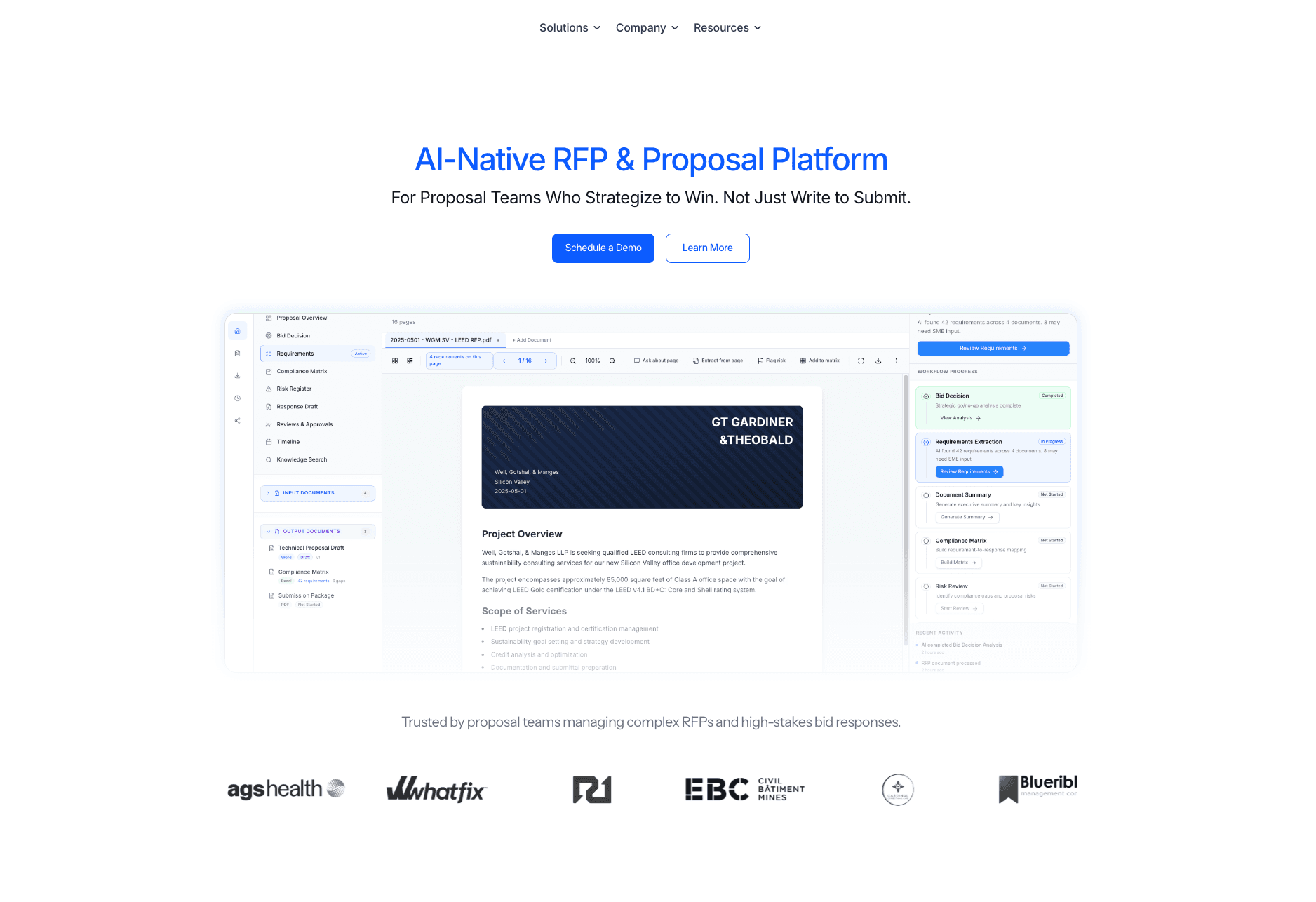
1. Thalamus AI - Best Security Questionnaire Automation Software for Enterprise RFP Teams
Best for: Enterprise teams whose inbound security questionnaires arrive alongside formal RFPs, DDQs, and vendor proposals, and who need one platform that handles all formats without requiring a separate tool for each.
G2 rating: 5.0 / 5 ↗ G2 (Spring 2026)
Pricing: Unlimited users, unlimited projects, one subscription. Three-month pilot pack available.
AI approach: Multi-agent agentic AI with a verified entity knowledge layer and closed-loop institutional learning.
What Thalamus AI Does Well for Security Questionnaire Automation?
Handles security questionnaires, DDQs, RFPs, and formal proposals in one platform - For teams whose workload spans multiple inbound assessment types, eliminating the tool-per-format problem is a meaningful ROI improvement beyond any single automation feature.
Q&A library with minimum maintenance - Most security questionnaire tools require teams to create and curate a knowledge base before AI output reaches useful quality. Thalamus AI's verified entity knowledge layer ingests existing policies, security documentation, and past responses directly, grounding every answer in source documents with full traceability, and can connect to CRM systems like Salesforce and HubSpot for account context. An AI-managed Content Health layer continuously flags duplicate, stale, or conflicting entries as exceptions for review, which is the mechanism behind why maintenance stays minimal even as security posture changes.
Browser extension for portal questionnaires. Handles online portal submissions without switching tabs or copy-pasting, covering the format that most security questionnaire tools still struggle with.
45+ language support - Relevant for multinational vendors receiving questionnaires in multiple languages from global customer security teams.
Source citation on every answer - Every response is traceable to its source document, with a completeness score and last-verified timestamp. Evaluators can verify claims without manual cross-referencing.
Subsection-level routing -
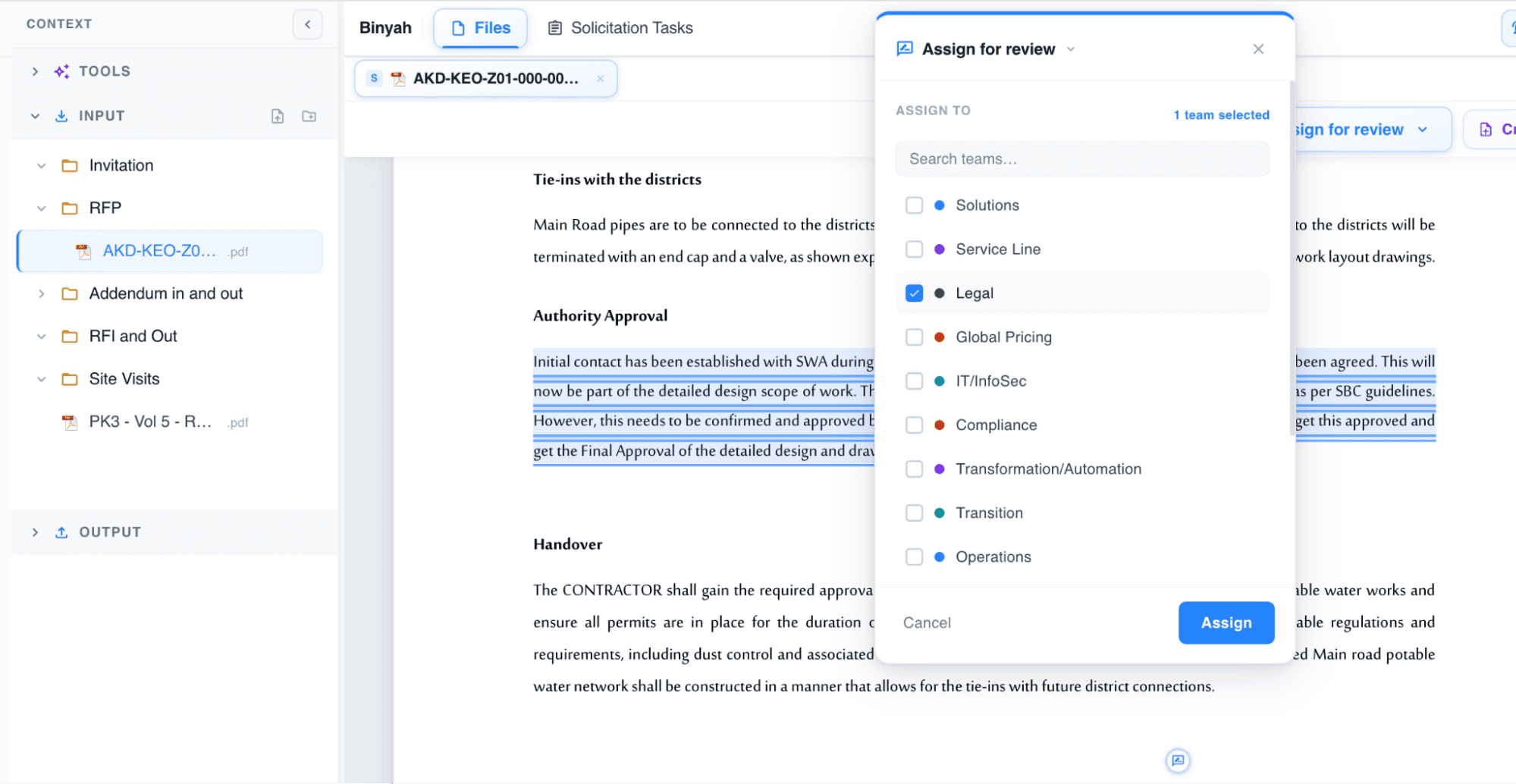
Security questions can be routed to the appropriate SME before a questionnaire even lands, through the Ownership Matrix, not just after intake: security engineering for technical controls, legal for data processing questions, and compliance for certification status, with structured approval chains and audit trails.
Post-submission institutional learning - Every correction, edit, and approval decision strengthens the knowledge layer for future questionnaires, improving answer quality automatically over time.
Where Thalamus AI Falls Short?
Not the right fit if security questionnaires are your only workload - For teams that exclusively handle vendor security assessments with no RFPs or DDQs alongside them, purpose-built tools like Conveyor or SafeBase are more narrowly optimized for exactly that format and typically faster to deploy.
Initial configuration is real - Workflow routing, entity ingestion, and approval chain setup require upfront time. Not a same-day self-serve platform.
Lower G2 review volume than specialist security questionnaire tools - Conveyor has 150+ G2 reviews specifically in this category; Thalamus AI's six reviews reflect broader proposal management use rather than security questionnaire-specific validation.
What Real Users Say About Thalamus AI on G2?
"The Content AutoFill accuracy is great. Something I loved most is that the Library doesn't need heavy maintenance, no Q&A-based library." - Verified G2 reviewer (View on G2 ↗)
That "doesn't need heavy maintenance" experience is Content Health working as intended, flagging what's changed rather than requiring a scheduled re-audit of every answer.
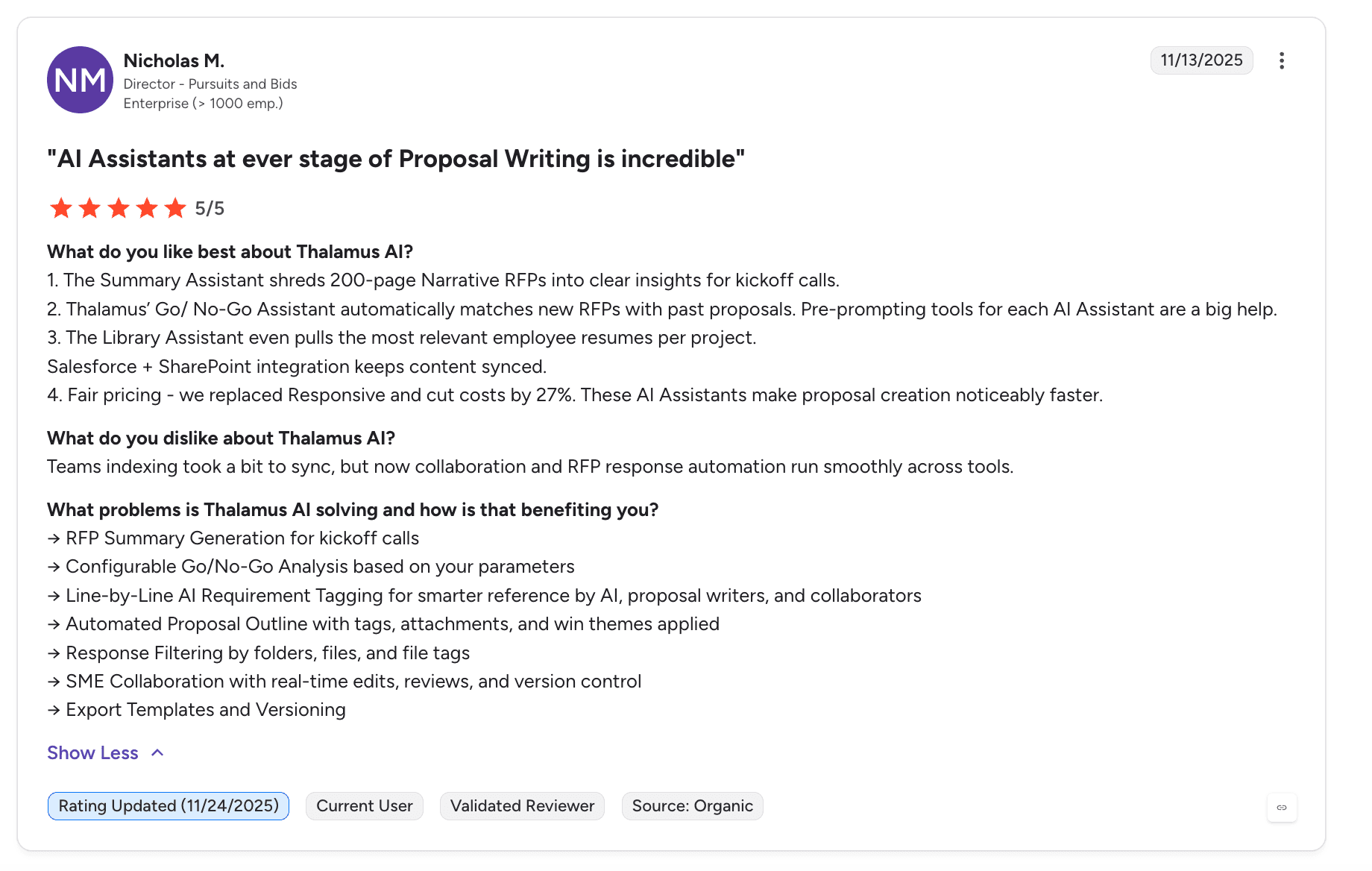
"Our team literally goes from RFP upload to the first draft in under 15 minutes." - Nicholas M., verified G2 reviewer
Who Should Choose Thalamus AI for Security Questionnaire Automation?
Enterprise presales, sales engineering, and proposal teams whose inbound volume spans security questionnaires alongside formal RFPs, DDQs, and vendor proposals, and who want one platform covering all formats with a verified, source-linked knowledge layer and no manual Q&A library to maintain.
Bring one live security questionnaire. We will show you how Thalamus AI handles it alongside your RFPs and DDQs in one workflow. → Start Your 3-Month Pilot
2. Conveyor - Best Security Questionnaire Automation Software for Revenue-First Teams
Best for: B2B SaaS vendors, scale-ups, and mid-market teams whose primary pain is the volume and turnaround time of inbound vendor security assessments, and who want the highest out-of-the-box accuracy without extensive knowledge-base setup.
G2 rating: 4.6 / 5 ↗ G2
Pricing: Always-free tier available. Credit-based professional plans. No seat-based pricing.
AI approach: AI-native; GPT-powered with cited sources and one-click portal auto-complete.
What Conveyor Does Well?
One of the strongest portal auto-complete workflows in the category - Conveyor's browser extension handles Whistic and BitSight portal questionnaires with one-click auto-complete, and claims 95%+ first-pass accuracy on security DDQs. Portal support is where most security questionnaire tools still fall short in practice.
Trust Center that proactively reduces inbound volume - A public-facing trust portal where vendors publish their security documentation, certifications, and pre-answered questionnaires, letting prospects answer their own questions before submitting a formal request. Teams that deploy the Trust Center consistently report a meaningful reduction in inbound questionnaire volume over 6 to 12 months.
Answers sourced from uploaded documents, not manual Q&A curation - Conveyor draws from your uploaded policies, SOC 2 report, and previous questionnaire responses, lowering ongoing maintenance overhead than platforms requiring a manually tagged Q&A library.
Always-free entry tier - Allows teams to start without a procurement process or budget approval, which matters for growing teams whose questionnaire volume is just beginning to become unmanageable.
150+ G2 reviews - the most validated peer review corpus for a purpose-built security questionnaire tool in this evaluation.
Where Conveyor Falls Short?
Not built for RFPs, formal proposals, or DDQs beyond security scope - Teams whose inbound volume includes procurement RFPs and formal vendor assessments alongside security questionnaires need a second tool for the broader formats.
Trust Center setup takes time to deliver ROI - The volume reduction benefit requires populating the Trust Center with current, comprehensive content before it meaningfully deflects inbound requests.
G2 reviewers note loading speed issues under tight deadlines - A frustration when a questionnaire has a 24-hour response window.
What Real Users Say About Conveyor on G2?
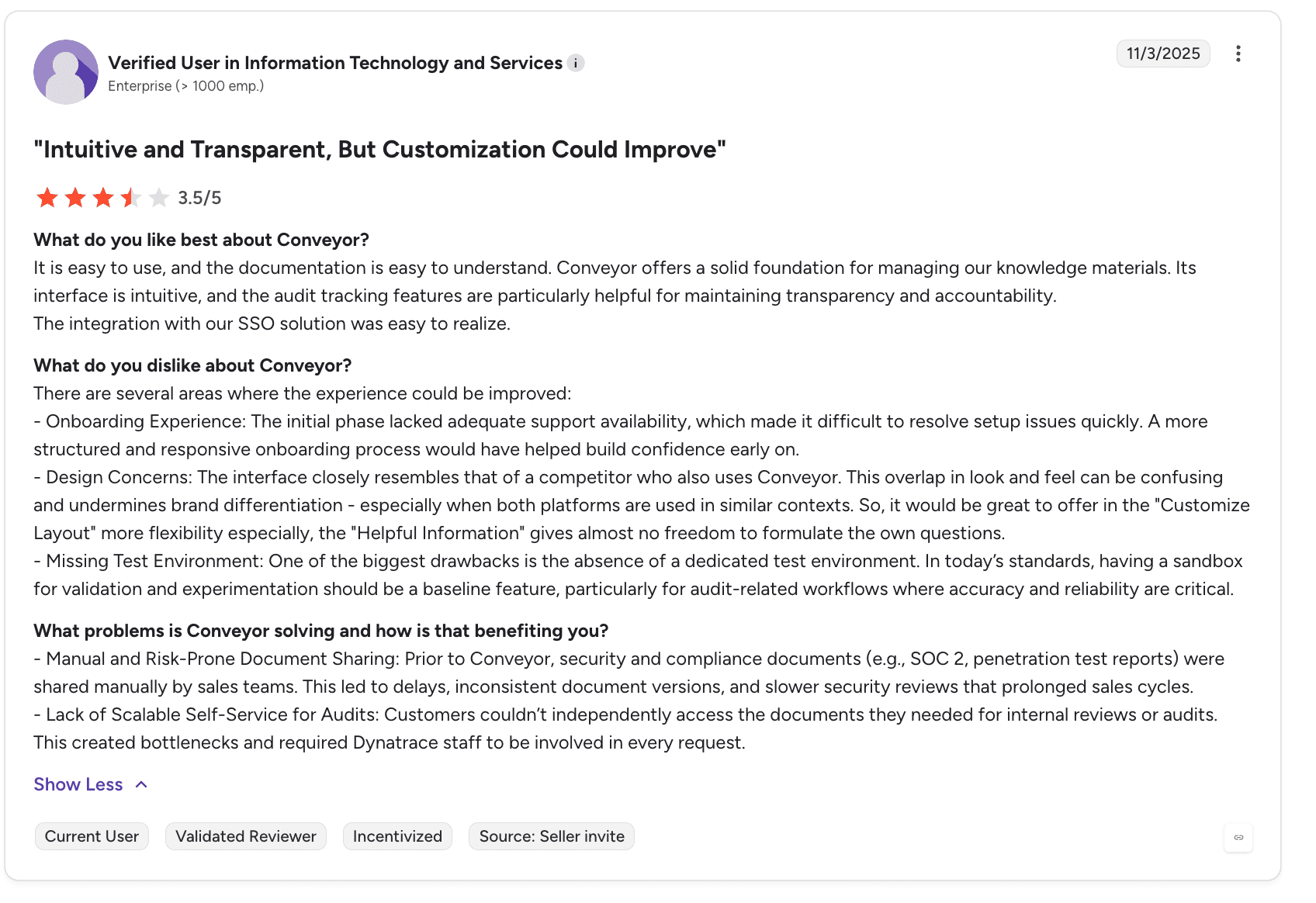
"Security engineers and pre-sales teams consistently praise Conveyor's first-pass accuracy and the Trust Center's ability to proactively reduce inbound review volume over time." - Paraphrased from G2 review sentiment (View on G2 ↗)
Who Should Choose Conveyor?
Revenue-first B2B SaaS and tech companies receiving a high and growing volume of inbound security questionnaires whose primary goal is faster turnaround and proactive volume reduction, not compliance program management.
3. Vanta - Best Security Questionnaire Automation for Compliance-First Teams
Best for: Growing SaaS companies, fintech, and healthtech teams that need SOC 2 or ISO 27001 certification and want questionnaire automation integrated with live compliance evidence rather than a separate tool.
G2 rating: 4.6 / 5 ↗ G2
Pricing: Custom enterprise; no public pricing.
AI approach: Compliance-evidence-grounded AI - answers are drawn from live security controls, not a separate Q&A database.
What Vanta Does Well for Security Questionnaire Software?
Questionnaire answers grounded in live compliance evidence - When Vanta's compliance monitoring detects that a control is in place and evidence-backed, questionnaire answers reflecting that control are automatically authoritative, sourced from the same evidence that would be reviewed in an audit. This is structurally different from tools that pull from a separately maintained Q&A database.
Agentic Trust Platform (launched January 2026) - Adds autonomous routing: questions that need human input are automatically assigned to the right SME, with reminders and final approval looped back to the security lead, without manual coordination overhead.
Trust Center integration - Like Conveyor, Vanta provides a public-facing Trust Center that lets prospects self-serve answers before submitting a formal questionnaire, reducing inbound volume over time.
Category leader in Security Compliance on G2 - Established, extensively reviewed platform with enterprise-proven stability.
IDC research indicates Vanta customers complete security reviews 81% faster, a third-party validated outcome figure that is more credible than vendor self-reporting.
Where Vanta Falls Short as Security Questionnaire Automation Software?
Compliance platform first, questionnaire tool second - If your only pain is inbound questionnaire volume and your certifications are already in place, Vanta's bundled pricing for the full compliance platform may be more than the questionnaire automation alone justifies.
Not built for RFPs, formal proposals, or procurement DDQs - Security questionnaires are one document type; Vanta is not designed for the broader vendor assessment and proposal management workload.
No public pricing - Requires a full sales process before any cost-benefit analysis is possible.
Portal support is improving but not the platform's primary strength compared to purpose-built portal automation tools like Conveyor.
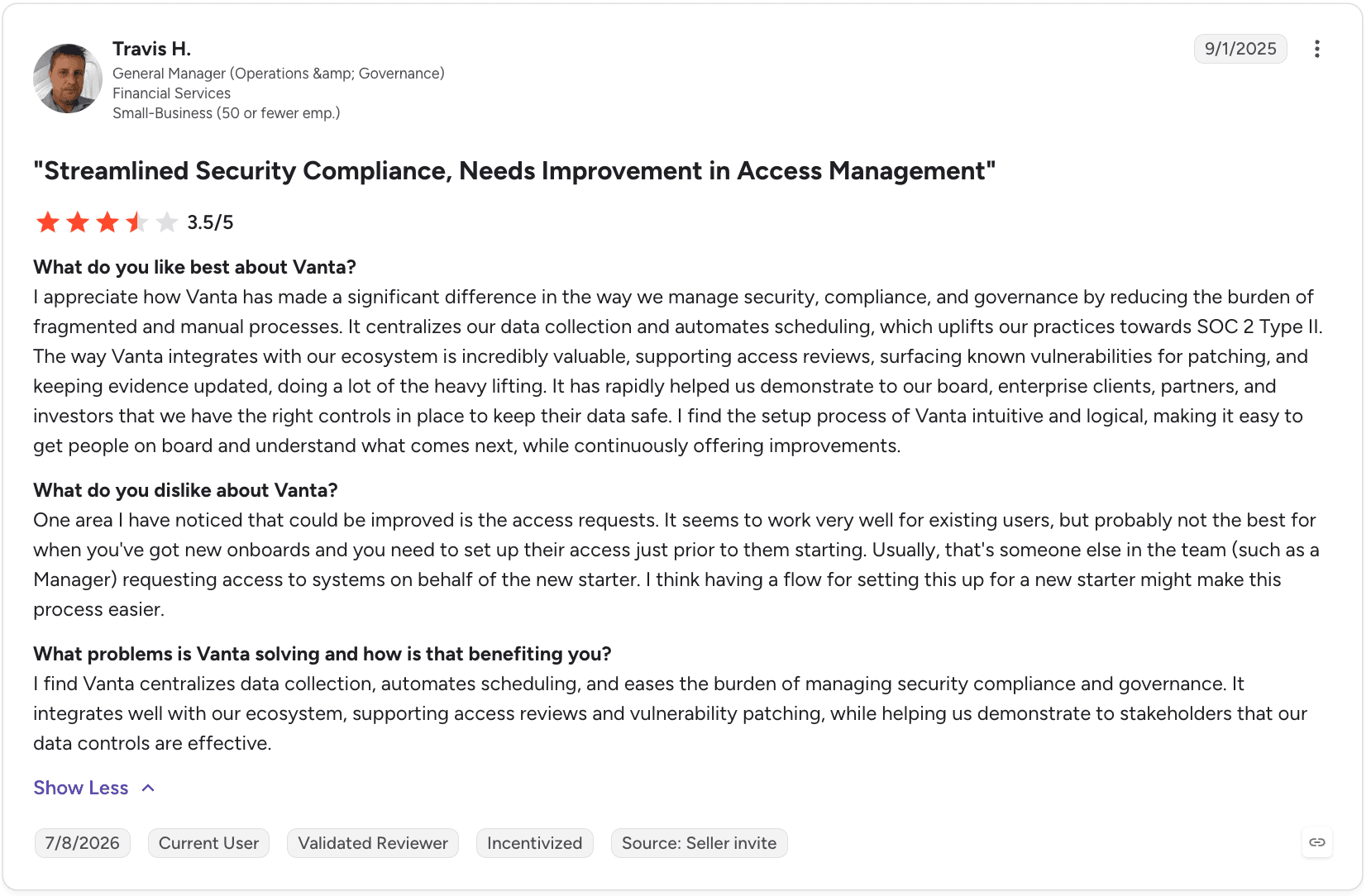
What Real Users Say About Vanta's Security Questionnaire Features on G2?
Who Should Choose Vanta?
Companies that are actively building or maintaining a formal compliance program (SOC 2, ISO 27001, HIPAA) and want questionnaire automation that draws directly from their live compliance evidence rather than a separately maintained knowledge base. Not the right choice if certifications are already complete and the only pain is questionnaire response volume.
4. HeyIris (Iris AI) - Best AI Security Questionnaire Tool for Confidence-Scored, Citeable Answers
Best for: B2B SaaS presales and sales engineering teams wanting every questionnaire answer to show its source and confidence level before submission - eliminating manual verification of AI-generated responses.
G2 rating: 4.9 / 5 ↗ G2
Pricing: Per-user; unlimited collaborators. No public pricing.
AI approach: Document-based retrieval with inline source citations and confidence scores on every answer.
What HeyIris Does Well?
Confidence score and source citation on every answer - Every AI-generated response includes a reference to the source document and a confidence percentage. For security teams where an incorrect answer creates legal or contractual exposure, this removes the need to manually verify every AI suggestion before submission.
Portal AutoFill for Whistic and BitSight natively - One of the strongest portal implementations in the category as it handles the questionnaire directly in the portal interface without switching tabs.
Unlimited collaborators on per-user plans - Security questions can be routed to security engineers, legal counsel, or compliance leads without triggering additional seat costs.
Deepest integration breadth in the presales segment - Salesforce, HubSpot, Slack, Google Drive, SharePoint, Confluence, Notion, Vanta, and more, which enables a connected workflow from CRM opportunity to completed questionnaire.
4.9/5 G2 rating across 66+ reviews - the strongest combination of rating and review volume for a modern AI-native tool in this evaluation.
Will not generate an answer when knowledge base coverage is incomplete - Returns "not enough info" rather than producing a plausible but ungrounded response, which is honest, but requires a well-populated knowledge base to reach full coverage.
Where HeyIris Falls Short?
"Not enough info" response creates friction when coverage has gaps - For teams with incomplete knowledge bases, the refusal to generate a plausible answer means more manual work on lower-coverage questions.
No full RFP or proposal management - covers questionnaires and shorter structured assessments but not complex narrative proposals.
No public pricing - Requires a full sales process before cost comparison is possible.
What Real Users Say About HeyIris on G2?
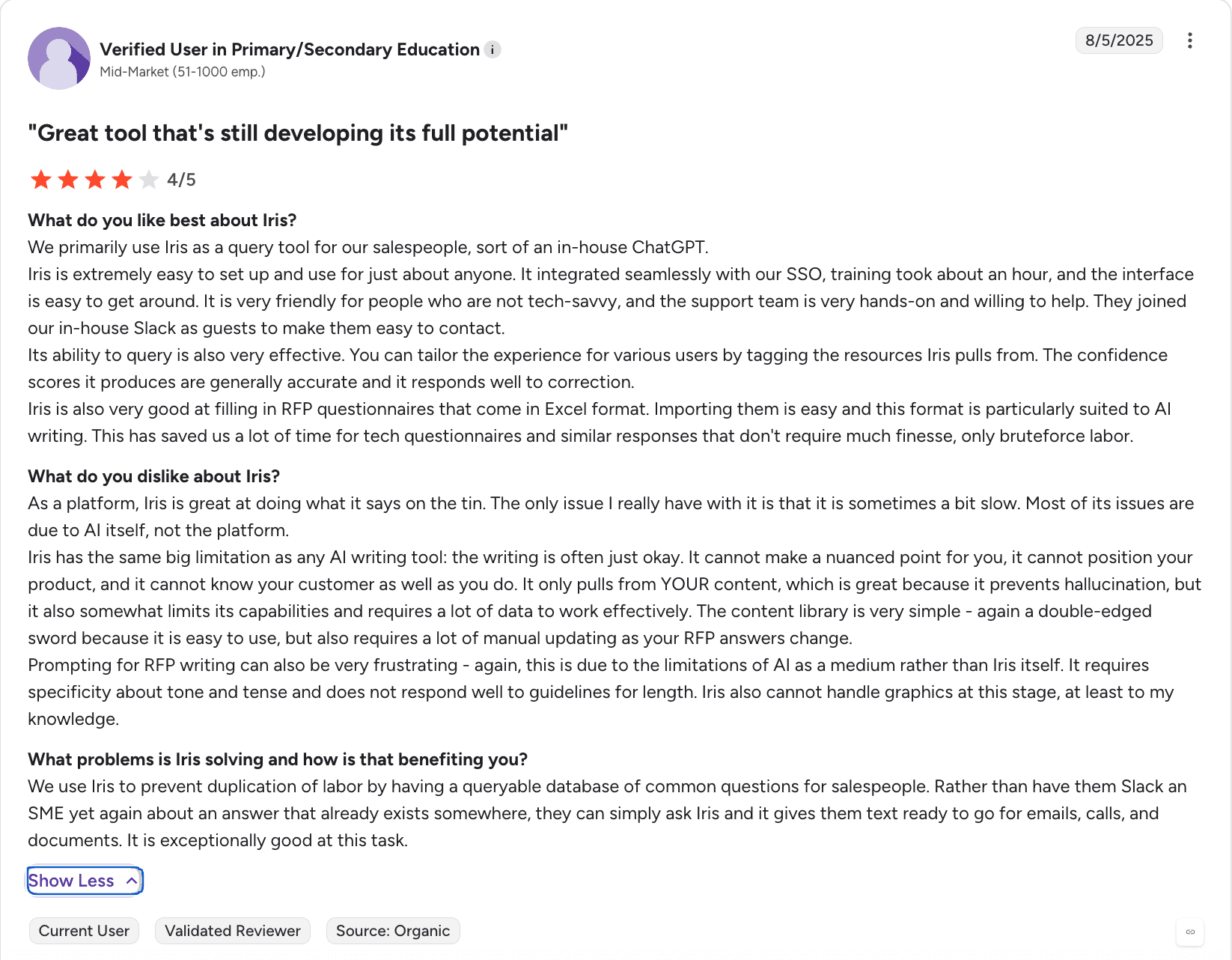
"I use Iris to automate RFP/RFI responses, saving time for my Solutions Engineers to focus on strategy. It also helps spot inconsistent and outdated data." — Verified G2 reviewer (View on G2 ↗)
Who Should Choose HeyIris (Iris AI)?
Presales and sales engineering teams at B2B SaaS companies who need every answer to be sourced and confidence-scored before it goes out, and whose portal-based questionnaire volume (Whistic, BitSight) is a significant share of the total inbound workload.
Still comparing options? Most teams identify the right security questionnaire automation platform within one live walkthrough on their actual content. → See Thalamus AI Handle a Live Questionnaire
5. SafeBase (by Drata) - Best Security Questionnaire Automation for Trust-Led Sales Teams
Best for: Revenue and security teams that want to proactively deflect inbound questionnaire volume by publishing a comprehensive public-facing Trust Center, reducing the number of questionnaires that need answering at all.
G2 rating: NA
Pricing: Custom; available as a Drata bundle or standalone product. No public pricing.
AI approach: Compliance-evidence-grounded; Trust Center + AI-assisted questionnaire response.
What SafeBase Does Well?
Public-facing Trust Center that deflects inbound volume proactively - Prospects visiting the Trust Center can self-serve answers to their standard security questions before formally submitting a questionnaire, reducing the volume of questionnaires that require human or AI review.
Integration with Drata's compliance monitoring - For teams already on Drata for SOC 2 or ISO 27001, SafeBase questionnaire answers draw from live compliance evidence rather than a separately maintained Q&A database.
AI-assisted questionnaire responses for assessments that do come in, with source-linked answers grounded in security documentation.
Customizable Trust Center with granular access control, public information visible to all prospects, sensitive documentation visible only to NDA-signed evaluators.
Where SafeBase Falls Short?
Trust Center ROI takes time to materialize - The volume reduction benefit requires prospects to discover and use the Trust Center - which takes time and active promotion.
Primarily a trust communication platform, not a pure questionnaire automation tool - Teams with high inbound volume that cannot be deflected via Trust Center will find the questionnaire automation features less deep than Conveyor or HeyIris.
Not built for RFPs, formal proposals, or procurement DDQs beyond security scope.
No public pricing - Typically acquired as part of the Drata compliance suite.
Who Should Choose SafeBase?
Teams already on the Drata compliance platform who want to extend their investment into inbound questionnaire management and proactive trust communication, particularly in B2B sales environments where a public Trust Center can meaningfully reduce the volume of formal security reviews required.
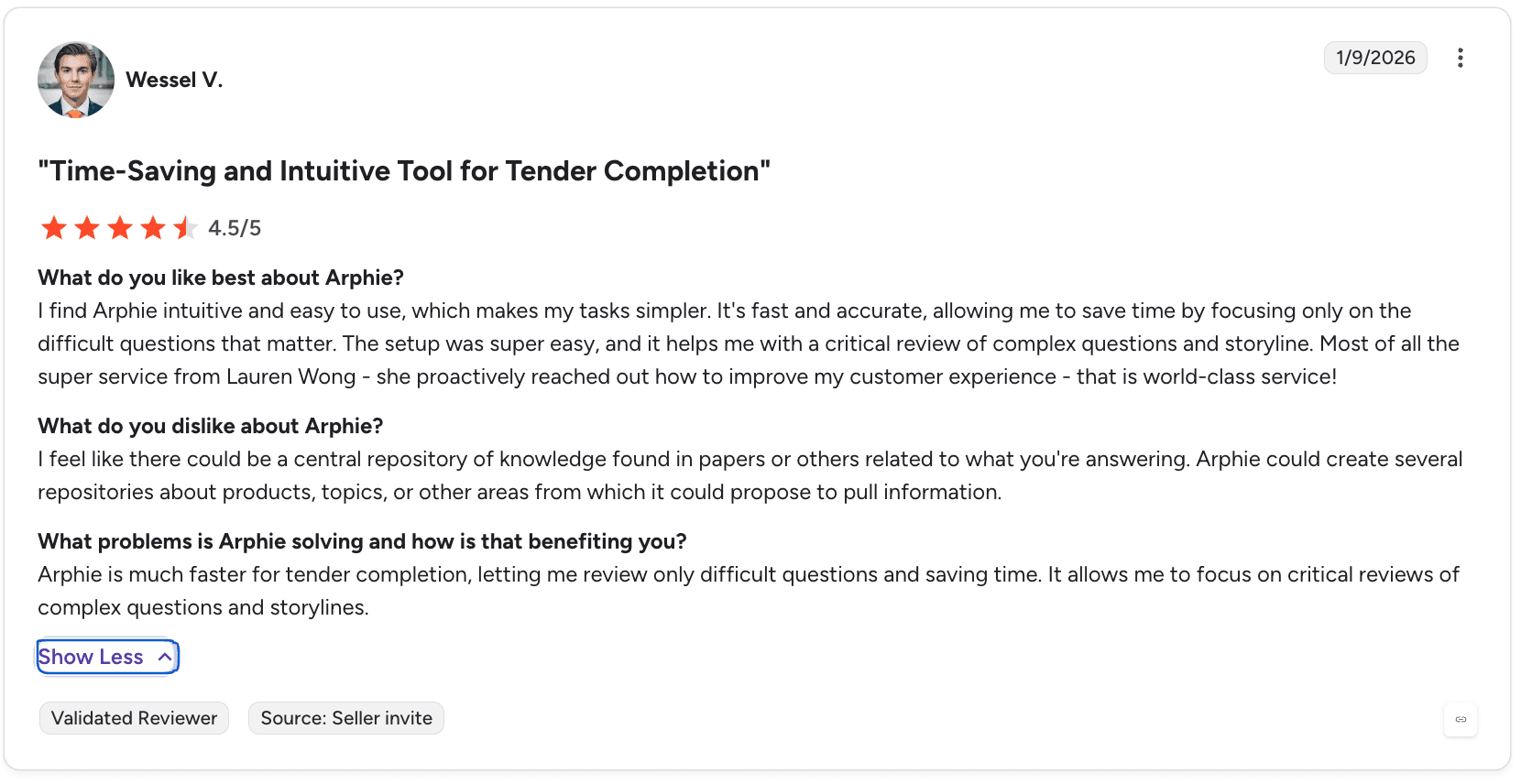
6. Arphie - Best Security Questionnaire Automation for Teams That Refuse to Maintain a Library
Best for: Security and presales teams whose content lives across Google Drive, SharePoint, Confluence, and Notion and who want AI-generated answers grounded in current source documents without building or migrating a Q&A database.
G2 rating: 5/ 5 ↗ G2
Pricing: Custom enterprise; zero data retention policy. No public pricing.
AI approach: AI agents with live integrations to Google Drive, SharePoint, Confluence, Notion, Seismic, Highspot, and web URLs.
What Arphie Does Well?
No Q&A library at all - Arphie's AI agents connect directly to live source systems and retrieve current content at generation time. Answers are only as stale as the source documents, not as stale as the last library curation cycle.
Proactive content update flagging - When connected source documents change, Arphie flags which questionnaire answers may be affected, preventing the scenario where a security policy changes and the automated answer still references the old policy.
Zero data retention policy and SOC 2 Type 2 certification - Critical security positioning for teams handling sensitive vendor security assessments.
Confidence scores and source citations on every answer - Full provenance on every generated response.
Browser extension for portal questionnaire support.
Where Arphie Falls Short?
"No library required" does not mean "no governance required." - Answer quality depends entirely on the organization and currency of connected source systems. Disorganized SharePoint or outdated Confluence pages produce disorganized, outdated answers.
Custom enterprise pricing - No self-serve evaluation path before engaging the sales team.
Not built for full RFP or proposal management beyond the answer-generation step.
What Real Users Say About Arphie on G2?
Who Should Choose Arphie?
Security and presales teams whose relevant content is already well-organized across live source systems - SharePoint, Confluence, Google Drive- and who want AI-generated answers grounded in current documents without the overhead of building, migrating, or curating a parallel Q&A database.
7. SecurityPal - Best Security Questionnaire Software for High-Value Deals Requiring Human Accountability
Best for: Enterprise teams where the deals attached to security questionnaires are high-value enough to justify certified human expert review behind every AI-generated answer, and where the risk of an inaccurate automated response is commercially unacceptable.
G2 rating: NA
Pricing: Custom; per-questionnaire pricing model. Contact for quote.
AI approach: AI-assisted responses reviewed and verified by a team of certified security analysts, with a 12-hour SLA.
What SecurityPal Does Well?
Certified human analyst behind every answer, not just AI - SecurityPal's model combines AI-generated first drafts with review and verification by a team of certified security analysts, producing answers that carry a level of human accountability that pure AI automation does not.
12-hour SLA for completed questionnaire delivery, meaningful for teams operating under tight deal timelines where a questionnaire response is the last blocker before contract signature.
Handles all standard questionnaire formats including SIG, CAIQ, HECVAT, custom Excel and Word DDQs, and portal-based submissions.
No internal knowledge base to build - SecurityPal's analysts work from your uploaded security documentation, eliminating the setup overhead that limits most self-serve platforms.
Where SecurityPal Falls Short?
Not self-serve; it is a managed service - Teams that want to build internal competency in questionnaire response, or who need to handle questionnaires at high-volume economics, will find the per-questionnaire model expensive at scale.
Not built for RFPs or formal proposals - the service is specific to security questionnaire formats.
Per-questionnaire pricing means cost scales with volume rather than staying fixed, meaningful for teams with unpredictable or growing inbound volume.
Limited transparency on G2 review count for independent validation at the time of writing.
Who Should Choose SecurityPal?
Enterprise teams at companies where individual deals are large enough that the cost of a certified analyst review per questionnaire is trivially justified by the deal value, and where the risk of an inaccurate automated answer creating a contractual or reputational problem outweighs the economics of pure self-serve automation.
If your answers point toward a full bid lifecycle platform that covers security questionnaires alongside RFPs and DDQs, let's talk. → Get a Personalized Recommendation
8. Loopio - Best for Enterprise Teams Managing Security Questionnaires Inside a Broader Proposal Library
Best for: Mid-to-enterprise proposal teams that already use Loopio for RFP and questionnaire management and want to extend that same governed content library to cover inbound security assessments.
G2 rating: 4.7 / 5 ↗ G2
Pricing: Enterprise; contact for quote.
AI approach: Pre-LLM platform with AI drafting layered on; content library-dependent.
What Loopio Does Well for Security Questionnaire Automation?
Governed content library with strong version history and role-based permissions - For teams managing security questionnaire answers alongside broader proposal content in one place, Loopio's library governance is mature and well-tested.
Handles Excel, Word, and online form formats - Covers the most common security questionnaire delivery methods.
Well-established, broadly reviewed platform with an enterprise-trusted track record.
Where Loopio Falls Short as Security Questionnaire Software?
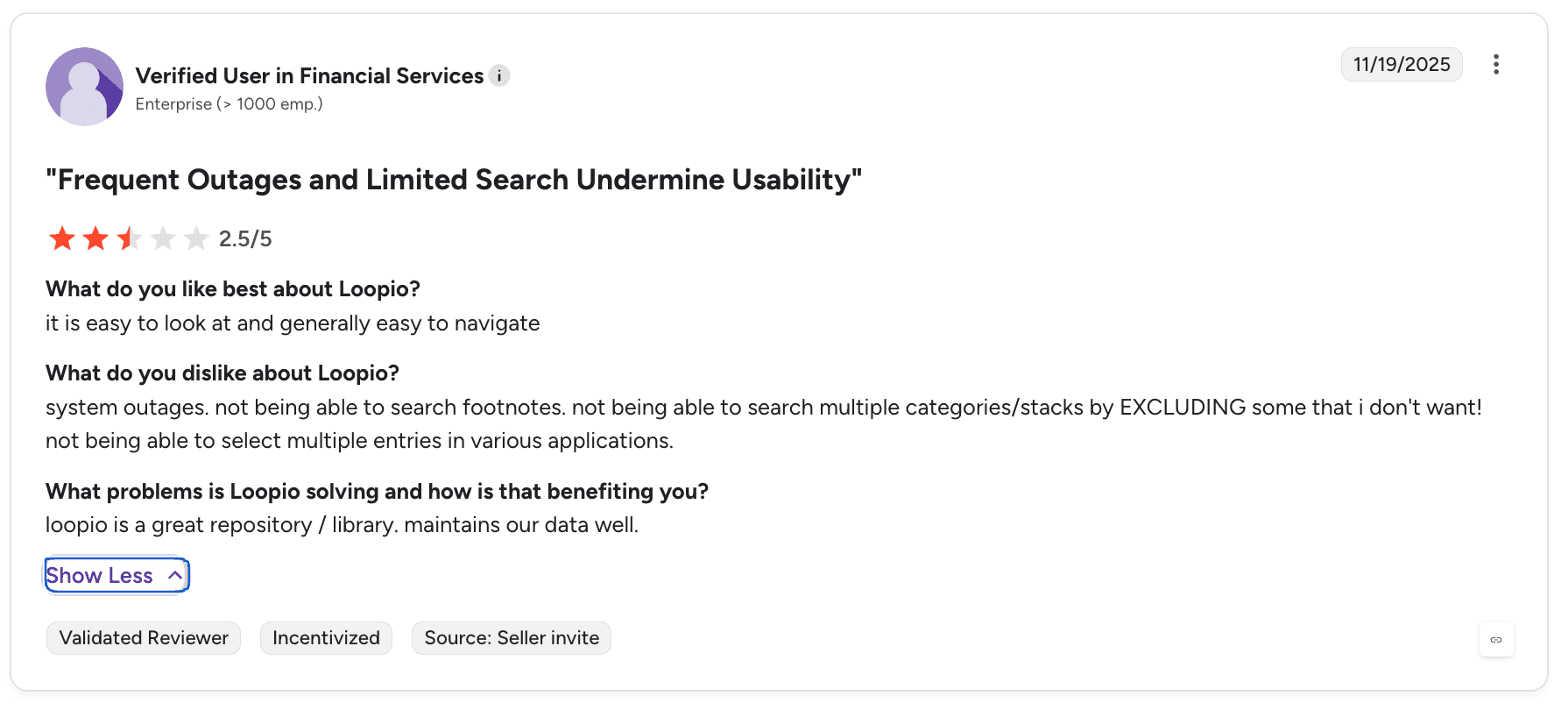
Portal support is limited - Whistic, BitSight, and OneTrust portal submissions are not Loopio's primary focus, teams with significant portal-based inbound volume will find copy-paste still required for portal submissions.
Requires a manually maintained content library - Security questionnaire answers need to be regularly reviewed, updated, and tagged to remain accurate as security posture changes. This is the same maintenance overhead that affects Loopio across all use cases.
AI output quality is bounded by library currency - If the library has not been updated since the last SOC 2 audit, the AI will suggest answers reflecting the old posture.
For a full evaluation of platforms beyond Loopio for this use case, see our 10 Best Loopio Alternatives in 2026.
Who Should Choose Loopio for Security Questionnaires?
Teams that already use Loopio for RFP and proposal management and want to extend that same library-governed workflow to cover security questionnaires, and who have a dedicated content owner who can keep the security answer library current.
9. Responsive (RFPIO) - Best for Enterprise Teams Needing Deepest CRM Integration Across Security and Proposal Workloads
Best for: Mid-to-enterprise teams managing security questionnaires alongside a high volume of structured RFPs and vendor assessments, who need deep Salesforce or HubSpot integration and mature analytics across all response types.
G2 rating: 4.5 / 5 ↗ G2
Pricing: Foundations plan approximately $20,000+/year; seat-based.
AI approach: Legacy response management platform with AI drafting layered on.
What Responsive Does Well?
One of the deepest integration ecosystems in the category - Native Salesforce, HubSpot, SharePoint, Slack, and Teams connections, meaning security questionnaire completion status can be tracked directly within the deal record.
Handles security questionnaires, DDQs, RFPs, and RFIs in one platform, the broadest format coverage of any library-based legacy platform in this evaluation.
1,263 G2 reviews - the most peer-validated platform in the broader RFP and questionnaire category, giving procurement teams the deepest independent evidence base to evaluate against.
Where Responsive Falls Short?
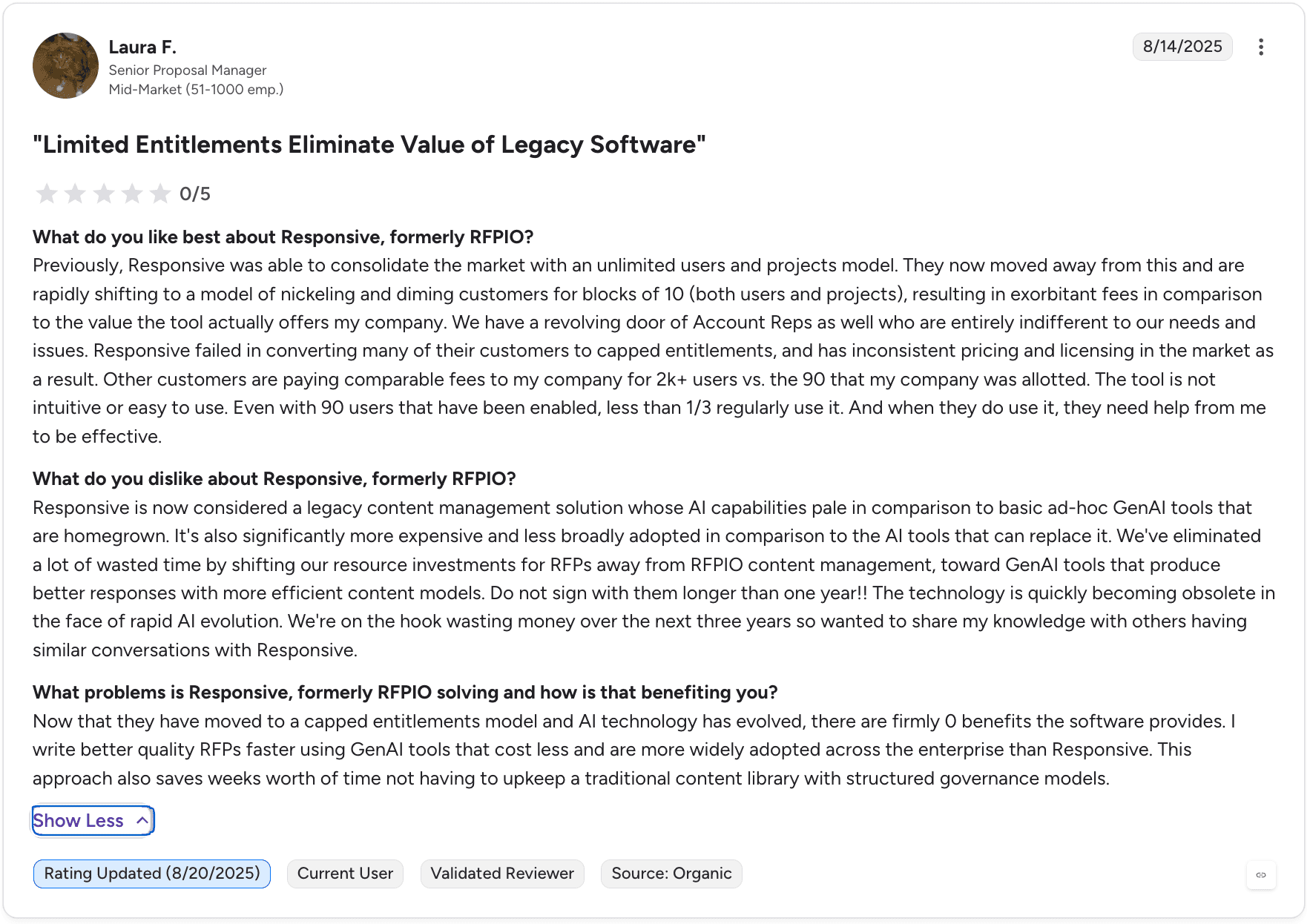
Portal support is limited compared to purpose-built security questionnaire tools. Whistic and BitSight portal auto-completion is not Responsive's primary strength.
Library-first AI - output quality is bounded by the currency of the manually maintained content library.
Seat-based pricing creates contributor access friction, relevant when multiple security engineers, legal leads, and compliance owners need access to review answers.
For a full comparison, see our 10 Best Responsive Alternatives in 2026.
Who Should Choose Responsive for Security Questionnaire Automation?
Enterprise teams that manage security questionnaires as one workload among many response types, including RFPs, DDQs, and vendor assessments, and where Salesforce or HubSpot integration is a core workflow requirement.
10. 1Up - Best Free Security Questionnaire Automation Tool for Small Teams
Best for: Small-to-mid-market B2B sales, presales, and IT teams wanting instant security questionnaire answers via Slack or Teams, without any knowledge library to build or budget to justify.
G2 rating: 4.9 / 5 ↗ G2
Pricing: Free plan; Starter $300/mo; Plus $900/mo; Enterprise custom.
AI approach: AI-first knowledge automation; live connectors to approved sources; answers surfaced via Slack and Teams.
What 1Up Does Well?
Genuinely free for getting started - No credit card, no procurement process, no knowledge base setup before first output. For small teams receiving their first wave of vendor security questionnaires, this is the fastest path to any automation at all.
Slack and Teams native - Security questions answered in the tools the team already uses, zero context-switching for contributors who are not daily proposal platform users.
Live connectors, no Q&A library required - 1Up connects to your website, Google Drive, Confluence, and past questionnaire responses in real time.
SOC 2 Type II certified; data not used to train AI models.
Where 1Up Falls Short?
Not designed for complex, compliance-grade security questionnaire workflows - No approval chains, audit trails, portal support, or confidence scoring, the features that enterprise security and legal teams typically require before approving automated responses for high-value deals.
Scales poorly for growing questionnaire volume - The Slack-first model creates coordination gaps as the questionnaire complexity or stakeholder count grows.
Not suited for portal-based submissions, the format where most teams find the greatest time savings.
Who Should Choose 1Up?
Small B2B SaaS and tech teams receiving their first wave of vendor security assessments who want to get started immediately at zero cost, and whose questionnaire volume and complexity have not yet grown to the point where approval workflows, audit trails, and portal support become necessary.
How to Choose the Right Security Questionnaire Automation Software?
Answer three questions before evaluating any tool.
Do your security questionnaires arrive alongside RFPs and DDQs, or are they your only inbound format?
If security questionnaires are your only format, purpose-built tools like Conveyor, SafeBase, or HeyIris will get you to value faster and at lower cost. If security questionnaires are one format among several, including formal RFPs, procurement DDQs, and vendor proposals, a platform that handles all formats in one place (Thalamus AI, Responsive) eliminates the tool-per-format overhead that drives hidden coordination cost.
Do you need questionnaire automation bundled with your compliance certification program?
If you are actively building a SOC 2 or ISO 27001 program and want your questionnaire answers grounded in live compliance evidence rather than a manually curated database, Vanta or SafeBase/Drata are structurally better fits than standalone questionnaire tools. If your certifications are already in place and the pain is purely response volume, a standalone questionnaire automation tool is more proportionate.
How critical is portal questionnaire support to your volume?
If a significant share of your inbound questionnaires arrive through Whistic, BitSight, OneTrust, or ServiceNow portals, make portal support a mandatory evaluation criterion, not an optional feature to demo later. Teams that buy a tool without reliable portal support fall back to copy-paste for portal submissions and lose most of the ROI they expected.
For a full breakdown of how these platforms are priced, see our RFP Software Pricing Guide for 2026.
Security Questionnaire Automation Software FAQ
What is security questionnaire automation software?
Security questionnaire automation software uses AI, typically large language models paired with retrieval-augmented generation (RAG) to draft, review, and submit responses to vendor security assessments.
These assessments arrive in multiple formats: custom Excel or Word DDQs, standardized forms like the SIG or CAIQ, compliance questionnaires for SOC 2 and ISO 27001 audits, and portal-based submissions through platforms like Whistic, BitSight, OneTrust, and ServiceNow.
The software centralizes approved security knowledge, generates sourced answers, routes questions requiring expert review to the right stakeholder, and tracks submissions through approval to completion.
What is the best security questionnaire automation software in 2026?
The best option depends on your workload and compliance status. For enterprise teams handling security questionnaires alongside RFPs and DDQs in a mixed workload: Thalamus AI.
For revenue-first teams focused purely on security questionnaire volume and turnaround speed: Conveyor for mid-market, SecurityPal for high-value enterprise deals.
For compliance-first teams building SOC 2 or ISO 27001 programs: Vanta or SafeBase/Drata. For presales teams needing confidence-scored, citeable answers: HeyIris (Iris AI). For teams that refuse to maintain any knowledge library: Arphie or 1Up.
How does AI automate security questionnaire responses?
Most platforms work in one of three ways. Library-based retrieval (Loopio, Responsive) matches incoming questions against a pre-built Q&A database and surfaces the closest match; output quality is bounded by library currency.
Document-grounded generation (Conveyor, Arphie, HeyIris) pulls answers from uploaded policy documents, past questionnaires, and compliance evidence at query time; no separate library required, but source documents must be current.
Compliance-evidence-grounded generation (Vanta, Drata/SafeBase) draws answers directly from live security controls and audit evidence, the most authoritative model for compliance-driven answers but requires an active compliance program to draw from.
Is Vanta good for security questionnaire automation?
Yes, with an important qualification. Vanta is an excellent security questionnaire automation tool for teams that are actively using Vanta for SOC 2, ISO 27001, or HIPAA compliance management because questionnaire answers are grounded in live compliance evidence from the same platform.
For teams whose certifications are already complete and whose only pain is inbound questionnaire volume, Vanta's full compliance platform pricing may be more than the questionnaire automation feature alone justifies. In that scenario, a purpose-built tool like Conveyor or HeyIris is a more proportionate choice.
Does Loopio do security questionnaire automation?
Yes. Loopio handles security questionnaires as part of its broader content library and RFP response workflow. The platform generates AI-assisted responses from a governed Q&A content library and supports Excel, Word, and online form formats.
The limitation is that Loopio's portal support for platforms like Whistic and BitSight is limited compared to purpose-built security questionnaire tools, and the library-first AI model means output quality degrades when the security content library is not regularly maintained.
For teams using Loopio primarily for RFP management who also receive security questionnaires, it is a workable single-platform solution. For teams whose primary use case is security questionnaire volume, more purpose-built alternatives typically deliver faster time-to-value.
What is the difference between a DDQ and a security questionnaire?
A DDQ (Due Diligence Questionnaire) is a broader category of vendor assessment covering financial stability, legal and contractual risk, data processing practices, business continuity, and operational processes, in addition to or instead of security controls specifically.
A security questionnaire (sometimes called a Vendor Security Assessment or VSA) focuses specifically on information security: data encryption, access controls, vulnerability management, incident response, and security certifications.
In practice, many enterprise procurement teams combine security questions into their broader DDQ, which is why the two terms are often used interchangeably in vendor automation tools.
How accurate is AI at answering security questionnaires?
Accuracy varies by tool and knowledge base quality. Vendors across this category advertise first-pass accuracy rates between 92% and 99.5%, but those figures are highly dependent on three factors: how complete and current the knowledge base or source documents are, how "accuracy" is defined (whether low-confidence questions are excluded from the denominator), and whether the questionnaire uses standard terminology or custom phrasing that may not match the knowledge base.
A reliable evaluation method is to bring a real or redacted questionnaire to a product demo and evaluate accuracy on your actual content rather than on vendor homepage claims.
What is a SIG questionnaire?
SIG stands for Standardized Information Gathering. A SIG questionnaire is a standardized third-party vendor risk assessment framework developed by Shared Assessments, covering 19 domains of security risk from cloud computing and application security to privacy and third-party management.
The current SIG questionnaire (SIG 2025/2026) runs to over 800 questions across those domains, making it one of the most comprehensive security assessment formats a vendor will encounter.
Most enterprise security questionnaire automation platforms support the SIG format; teams should verify that the specific SIG version they receive most frequently (SIG Core, SIG Lite, or full SIG) is supported by any platform they evaluate.
How much does security questionnaire automation software cost?
Pricing ranges widely. The most accessible entry point is 1Up's free plan and Conveyor's always-free tier, both available without a credit card. Mid-market tools like AutoRFPai offer published pricing starting around $899/month for unlimited users.
Enterprise platforms like Thalamus AI, Responsive, Vanta, and SafeBase are custom-priced and require a sales engagement before cost visibility.
The most accurate total cost comparison should factor in not just the subscription but the time saved per questionnaire at your team's loaded hourly rate and the revenue impact of faster deal closure on questionnaires that are currently blocking contract signatures.
For a full pricing model breakdown across the broader RFP and questionnaire management category, see our RFP Software Pricing Guide for 2026.
What formats do security questionnaire automation tools support?
The most common formats are Excel and CSV (the most prevalent custom DDQ format), Word documents, PDF forms, and inline portal submissions through platforms like Whistic, BitSight, OneTrust, ServiceNow, and SecurityScorecard.
Most tools in this evaluation support Excel and Word well; portal support is the critical differentiator. Teams that regularly receive questionnaires through Whistic or BitSight portals specifically should verify portal auto-complete capability in a live demo before purchasing; the gap between claimed portal support and actual portal performance in production is one of the most commonly cited sources of post-purchase disappointment in this category.
Start Your 3-Month Pilot of Security Questionnaire Automation Software With Thalamus AI
The category has matured significantly in two years. What was a novel capability in 2024 is now a competitive necessity: buyers expect faster turnaround on security assessments, and teams that are still completing 800-question SIG questionnaires manually are losing deals to teams that answer in an afternoon.
The choice of platform should start with your workload: questionnaire-only or mixed with RFPs and DDQs; compliance-program-building or already certified; portal-heavy or primarily Excel and Word format. The tool that maps most cleanly to your actual situation is more valuable than the tool with the longest feature list.
If your team handles security questionnaires as part of a broader portfolio of vendor assessments, RFPs, and formal proposals, and you want one platform that covers all of them without a Q&A library to maintain, the next step is a walkthrough of your actual content.
Your next security questionnaire does not have to take a week. → Book Your Demo
Related reading: 12 Best AI RFP Software Tools in 2026 | Thalamus AI vs General LLMs for Proposal Work | RFP Software Pricing in 2026