8 mins

8 mins

Responsive Review 2026: Honest Verdict on RFPIO from 1,200+ Users

Responsive Review 2026: Honest Verdict on RFPIO from 1,200+ Users

Responsive Review 2026: Honest Verdict on RFPIO from 1,200+ Users

Responsive Review 2026: Honest Verdict on RFPIO from 1,200+ Users

Harpreet Singh, MBA

Founder, Thalamus AI

With 12+ years in AI and enterprise software, including GenAI product work at Travelers, Harpreet writes about AI RFP software, AI bid tools, proposal operations, RFP response automation, and the future of enterprise bid management.

Summarize with ChatGpt

Summarize with ChatGpt

Key Takeaways

Responsive (formerly RFPIO) is an established RFP response platform in its category - 1,263 G2 reviews, 24 consecutive G2 leadership quarters, and $600B+ in managed opportunities make it the benchmark against which most alternatives are measured.

  • Its strongest capabilities are workflow automation across large distributed teams, a deep integration ecosystem (Salesforce, HubSpot, Slack, Teams, SharePoint, and more), and a content library that, when well maintained, delivers reliable first drafts for structured questionnaires and RFPs.

  • Its most consistent G2 and Capterra complaints are UI inconsistency between the old and new interfaces, slow bug resolution timelines (months, not days), Salesforce integration friction, and library maintenance overhead that requires ongoing dedicated staff time.

  • Responsive covers the response management step of the bid process. It does not cover capture planning, bid/no-bid qualification, compliance matrix generation, addendum tracking, RACI routing at the subsection level, or post-bid institutional learning.

  • Teams that need those capabilities, because their bids have grown more complex than a Q&A library can support, are typically the ones actively evaluating alternatives.

Quick Verdict: Responsive is the most reviewed RFP platform in its category and earns its G2 #1 ranking for enterprise workflow orchestration and integration depth. 

It is the right choice for mid-to-large teams managing high volumes of structured RFPs who already have a maintained content library and need deep CRM connectivity. It is a harder sell for teams whose bids have outgrown a Q&A-library model, who need full bid lifecycle coverage beyond the response step, or who find the per-seat pricing model a barrier to involving the full contributor circle.

G2 rating: 4.5 / 5 (1,263 reviews, Spring 2026) - 24 consecutive quarters as G2 category leader 

Capterra rating: 4.6 / 5 (170 verified reviews) 

Best for: Mid-to-enterprise proposal and presales teams managing high-volume structured RFPs with established content libraries and complex CRM integration needs 

Not suited for: Teams that need compliance matrix generation, addendum tracking, RACI routing, or full bid lifecycle management beyond response generation

Summarize with ChatGPT

Key Takeaways

Key Takeaways

Key Takeaways

Responsive (formerly RFPIO) is an established RFP response platform in its category - 1,263 G2 reviews, 24 consecutive G2 leadership quarters, and $600B+ in managed opportunities make it the benchmark against which most alternatives are measured.

  • Its strongest capabilities are workflow automation across large distributed teams, a deep integration ecosystem (Salesforce, HubSpot, Slack, Teams, SharePoint, and more), and a content library that, when well maintained, delivers reliable first drafts for structured questionnaires and RFPs.

  • Its most consistent G2 and Capterra complaints are UI inconsistency between the old and new interfaces, slow bug resolution timelines (months, not days), Salesforce integration friction, and library maintenance overhead that requires ongoing dedicated staff time.

  • Responsive covers the response management step of the bid process. It does not cover capture planning, bid/no-bid qualification, compliance matrix generation, addendum tracking, RACI routing at the subsection level, or post-bid institutional learning.

  • Teams that need those capabilities, because their bids have grown more complex than a Q&A library can support, are typically the ones actively evaluating alternatives.

Quick Verdict: Responsive is the most reviewed RFP platform in its category and earns its G2 #1 ranking for enterprise workflow orchestration and integration depth. 

It is the right choice for mid-to-large teams managing high volumes of structured RFPs who already have a maintained content library and need deep CRM connectivity. It is a harder sell for teams whose bids have outgrown a Q&A-library model, who need full bid lifecycle coverage beyond the response step, or who find the per-seat pricing model a barrier to involving the full contributor circle.

G2 rating: 4.5 / 5 (1,263 reviews, Spring 2026) - 24 consecutive quarters as G2 category leader 

Capterra rating: 4.6 / 5 (170 verified reviews) 

Best for: Mid-to-enterprise proposal and presales teams managing high-volume structured RFPs with established content libraries and complex CRM integration needs 

Not suited for: Teams that need compliance matrix generation, addendum tracking, RACI routing, or full bid lifecycle management beyond response generation

Responsive (formerly RFPIO) is an established RFP response platform in its category - 1,263 G2 reviews, 24 consecutive G2 leadership quarters, and $600B+ in managed opportunities make it the benchmark against which most alternatives are measured.

  • Its strongest capabilities are workflow automation across large distributed teams, a deep integration ecosystem (Salesforce, HubSpot, Slack, Teams, SharePoint, and more), and a content library that, when well maintained, delivers reliable first drafts for structured questionnaires and RFPs.

  • Its most consistent G2 and Capterra complaints are UI inconsistency between the old and new interfaces, slow bug resolution timelines (months, not days), Salesforce integration friction, and library maintenance overhead that requires ongoing dedicated staff time.

  • Responsive covers the response management step of the bid process. It does not cover capture planning, bid/no-bid qualification, compliance matrix generation, addendum tracking, RACI routing at the subsection level, or post-bid institutional learning.

  • Teams that need those capabilities, because their bids have grown more complex than a Q&A library can support, are typically the ones actively evaluating alternatives.

Quick Verdict: Responsive is the most reviewed RFP platform in its category and earns its G2 #1 ranking for enterprise workflow orchestration and integration depth. 

It is the right choice for mid-to-large teams managing high volumes of structured RFPs who already have a maintained content library and need deep CRM connectivity. It is a harder sell for teams whose bids have outgrown a Q&A-library model, who need full bid lifecycle coverage beyond the response step, or who find the per-seat pricing model a barrier to involving the full contributor circle.

G2 rating: 4.5 / 5 (1,263 reviews, Spring 2026) - 24 consecutive quarters as G2 category leader 

Capterra rating: 4.6 / 5 (170 verified reviews) 

Best for: Mid-to-enterprise proposal and presales teams managing high-volume structured RFPs with established content libraries and complex CRM integration needs 

Not suited for: Teams that need compliance matrix generation, addendum tracking, RACI routing, or full bid lifecycle management beyond response generation

Quick Answer: Is Responsive Worth It in 2026?

Quick Answer: Is Responsive Worth It in 2026?

Quick Answer: Is Responsive Worth It in 2026?

Responsive, formerly RFPIO, is worth it for mid-to-large proposal and presales teams that manage high volumes of structured RFPs, RFIs, DDQs, security questionnaires, and Q&A workflows. It is strongest when a team already has a maintained content library, dedicated proposal operations support, and deep CRM integration needs.

Responsive is harder to justify for teams that need more than response management. If your bids require bid/no-bid qualification, compliance matrix generation, addendum tracking, RACI routing, portal responses, or post-bid learning, a full bid lifecycle platform like Thalamus AI may be a better fit.

The short version: Responsive is strong for managing structured responses at scale. Thalamus AI is stronger when the problem is managing the full bid lifecycle.

Responsive, formerly RFPIO, is worth it for mid-to-large proposal and presales teams that manage high volumes of structured RFPs, RFIs, DDQs, security questionnaires, and Q&A workflows. It is strongest when a team already has a maintained content library, dedicated proposal operations support, and deep CRM integration needs.

Responsive is harder to justify for teams that need more than response management. If your bids require bid/no-bid qualification, compliance matrix generation, addendum tracking, RACI routing, portal responses, or post-bid learning, a full bid lifecycle platform like Thalamus AI may be a better fit.

The short version: Responsive is strong for managing structured responses at scale. Thalamus AI is stronger when the problem is managing the full bid lifecycle.

Responsive vs RFPIO: Are They the Same Platform?

Responsive vs RFPIO: Are They the Same Platform?

Yes. Responsive is the current name of RFPIO. RFPIO rebranded to Responsive in 2022 as the company expanded from RFP response automation into broader strategic response management. Many buyers still search for RFPIO review, RFPIO pricing, and RFPIO alternatives, but they are evaluating the same platform now known as Responsive.

Yes. Responsive is the current name of RFPIO. RFPIO rebranded to Responsive in 2022 as the company expanded from RFP response automation into broader strategic response management. Many buyers still search for RFPIO review, RFPIO pricing, and RFPIO alternatives, but they are evaluating the same platform now known as Responsive.

What Is Responsive RFP Software and Who Uses It?

What Is Responsive RFP Software and Who Uses It?

What Is Responsive RFP Software and Who Uses It?

Responsive is a Strategic Response Management platform used by mid-to-enterprise organizations to centralize content, automate RFP response workflows, and coordinate multi-stakeholder proposal teams. It was founded as RFPIO in 2015, rebranded to Responsive in 2022, and is headquartered in Portland, Oregon.

The platform's core architecture is built around a governed content library of Q&A pairs, verified, tagged answers to common RFP questions that the AI uses to suggest and auto-fill responses. Surrounding that library are workflow tools for task assignment, review gates, approval chains, and project tracking; integrations connecting the platform to CRM systems, cloud storage, and communication tools; and an AI layer that drafts and refines content based on library content and document context.

According to verified G2 and Capterra reviewer data, Responsive's primary users are proposal managers, presales engineers, sales operations leaders, and bid directors at mid-to-large organizations - primarily in technology, financial services, healthcare, and professional services. The platform handles RFPs, RFIs, DDQs, VSQs, security questionnaires, and proactive proposals.

Already using Responsive and wondering whether your workflow has outgrown response management? See how Thalamus AI compares. → Book a Free Demo

Responsive is a Strategic Response Management platform used by mid-to-enterprise organizations to centralize content, automate RFP response workflows, and coordinate multi-stakeholder proposal teams. It was founded as RFPIO in 2015, rebranded to Responsive in 2022, and is headquartered in Portland, Oregon.

The platform's core architecture is built around a governed content library of Q&A pairs, verified, tagged answers to common RFP questions that the AI uses to suggest and auto-fill responses. Surrounding that library are workflow tools for task assignment, review gates, approval chains, and project tracking; integrations connecting the platform to CRM systems, cloud storage, and communication tools; and an AI layer that drafts and refines content based on library content and document context.

According to verified G2 and Capterra reviewer data, Responsive's primary users are proposal managers, presales engineers, sales operations leaders, and bid directors at mid-to-large organizations - primarily in technology, financial services, healthcare, and professional services. The platform handles RFPs, RFIs, DDQs, VSQs, security questionnaires, and proactive proposals.

Already using Responsive and wondering whether your workflow has outgrown response management? See how Thalamus AI compares. → Book a Free Demo

Responsive RFPIO Pros and Cons: What 1,200+ verified G2 reviews Say?

Responsive RFPIO Pros and Cons: What 1,200+ verified G2 reviews Say?

Responsive RFPIO Pros and Cons: What 1,200+ verified G2 reviews Say?


What Users Consistently Praise About Responsive?

Based on 1,263 verified G2 reviews and 170 Capterra reviews (Spring 2026), the following strengths appear across more than 100 individual reviews each:

Workflow automation that genuinely reduces email overhead: 

The ability to assign sections and individual questions to named contributors, track completion status, and manage approval chains in one place is the most consistently praised capability. Verified Capterra reviewers describe it as having "made managing content and bids much more streamlined" and enabling teams to "include more SMEs in the RFP process with little to no training." More than 150 G2 reviewers specifically mention ease of collaboration as a key reason for using the platform.

Content library that saves hours on structured questionnaires: 

When the library is current and well-tagged, the auto-fill and smart search features significantly reduce the time spent on repetitive structured questionnaires. Verified G2 and Capterra reviewers report matching thousands of requirements to previous responses in an hour that previously required days of manual work.

Deep integration ecosystem: 

Native connections to Salesforce, HubSpot, Google Drive, SharePoint, Slack, Microsoft Teams, and a wide range of procurement portals. For enterprise organizations with proposal workflows distributed across multiple business systems, this integration breadth is the most differentiated capability in the category.

Broad RFx type coverage: 

RFPs, RFIs, DDQs, VSQs, security questionnaires, and proactive proposals, all handled within the same platform and the same content library.

AI-generated responses with source citations: 

The GenAI layer drafts complete first-pass responses using content from the library and connected documents. Multiple G2 reviewers note the AI has "significantly sped up complex RFPs," though the same reviews note responses "sometimes require manual refinement" before submission.

24 consecutive G2 quarters as category leader: 

No other platform in the RFP software category has maintained this level of consistent user recognition over this sustained period.

What Users Consistently Complain About Responsive RFPIO?

The following limitations appear consistently across Capterra, G2, Gartner Peer Insights, and TrustRadius review data:

UI inconsistency between the old and new interface: 

Responsive has been through a significant interface overhaul, and reviewers consistently note that the old and new UI experiences are inconsistent, features work differently, or are missing, depending on which part of the platform you are in. Multiple Capterra reviewers specifically flag this as a source of frustration for teams onboarding new contributors.

Slow bug resolution timelines: 

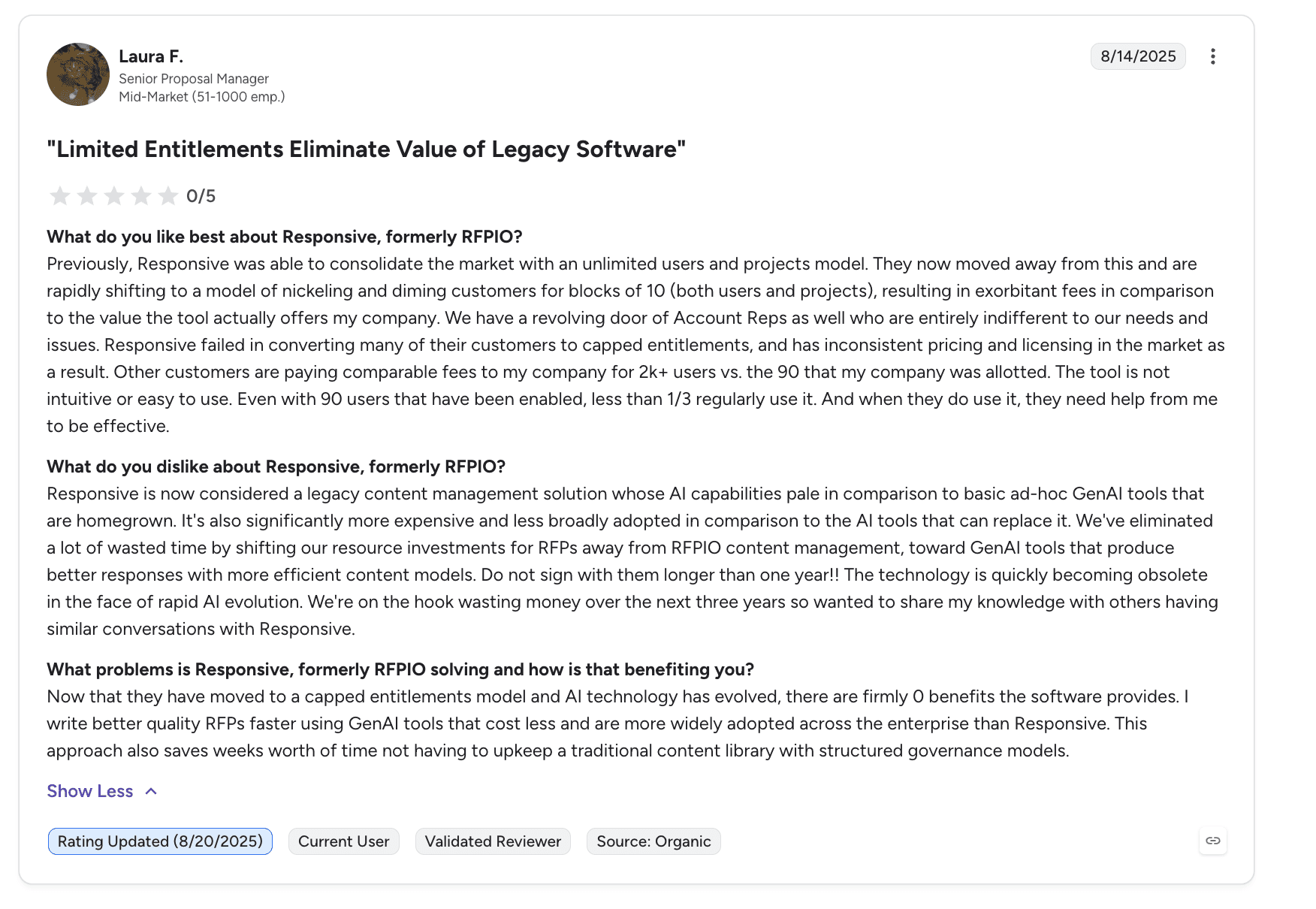
This is the most critically worded complaint in the verified review data. Capterra reviewers report bugs taking months to resolve, with "no real proactive communication" from account teams during the wait. One verified Capterra reviewer describes a production issue that prevented their team from completing RFPs for over four months, a significant operational risk for a platform that is supposed to be infrastructure.

Salesforce integration friction: 

Multiple Capterra and Gartner Peer Insights reviewers report difficulties with the Salesforce integration, including data sync issues, custom role limitations, and the inability to impersonate roles for training when using SSO.

Content library maintenance overhead: 

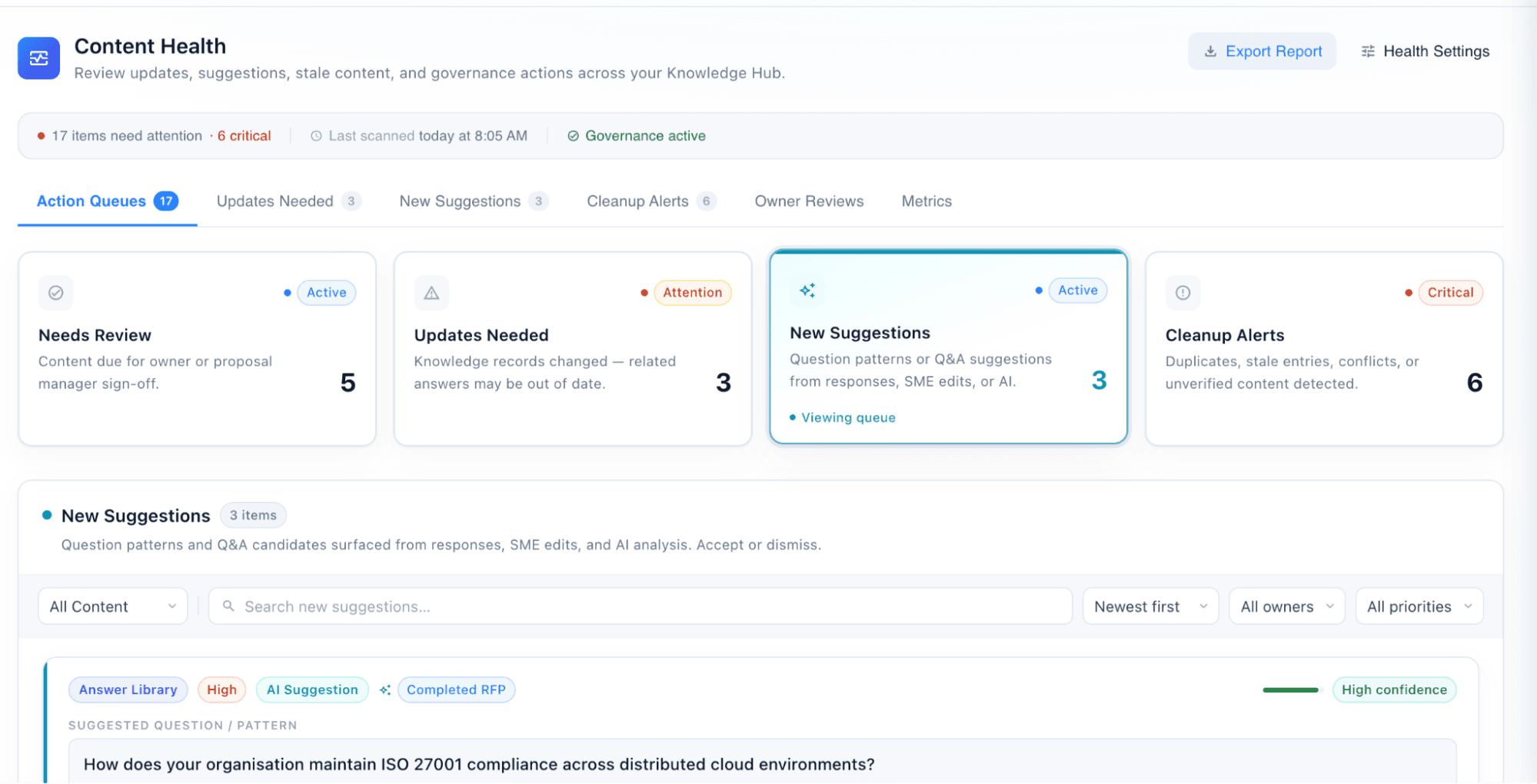
The library requires ongoing curation - tagging, deduplication, and regular updates - to remain accurate enough for the AI to use reliably. A Gartner Peer Insights reviewer describes spending significant time going through 1,200 existing library items that "hadn't been set up well," noting the process was "not as seamless" as expected. 

This is not unique to Responsive among legacy library-based platforms, but it is the structural constraint that most limits the platform's value for teams without a dedicated content owner.

Keyword-dependent search: 

Responsive's library search is primarily keyword-based, which means content is only surfaced when the search term matches the tags applied by whoever originally set up the library. If the question uses different terminology from the tag, relevant content is missed. This is a structural limitation of the Q&A library model rather than a Responsive-specific bug.

Export formatting friction: 

Verified Capterra reviewers note formatting issues when exporting responses to Word, specifically, text formatting from uploaded previous responses does not always carry through correctly, requiring manual correction post-export.

Reporting falls short of expectations: 

Multiple verified reviewers across G2 and Capterra describe the reporting and analytics as not meeting their requirements, flagging a lack of granular visibility into response performance, content usage, and win/loss data.


What Users Consistently Praise About Responsive?

Based on 1,263 verified G2 reviews and 170 Capterra reviews (Spring 2026), the following strengths appear across more than 100 individual reviews each:

Workflow automation that genuinely reduces email overhead: 

The ability to assign sections and individual questions to named contributors, track completion status, and manage approval chains in one place is the most consistently praised capability. Verified Capterra reviewers describe it as having "made managing content and bids much more streamlined" and enabling teams to "include more SMEs in the RFP process with little to no training." More than 150 G2 reviewers specifically mention ease of collaboration as a key reason for using the platform.

Content library that saves hours on structured questionnaires: 

When the library is current and well-tagged, the auto-fill and smart search features significantly reduce the time spent on repetitive structured questionnaires. Verified G2 and Capterra reviewers report matching thousands of requirements to previous responses in an hour that previously required days of manual work.

Deep integration ecosystem: 

Native connections to Salesforce, HubSpot, Google Drive, SharePoint, Slack, Microsoft Teams, and a wide range of procurement portals. For enterprise organizations with proposal workflows distributed across multiple business systems, this integration breadth is the most differentiated capability in the category.

Broad RFx type coverage: 

RFPs, RFIs, DDQs, VSQs, security questionnaires, and proactive proposals, all handled within the same platform and the same content library.

AI-generated responses with source citations: 

The GenAI layer drafts complete first-pass responses using content from the library and connected documents. Multiple G2 reviewers note the AI has "significantly sped up complex RFPs," though the same reviews note responses "sometimes require manual refinement" before submission.

24 consecutive G2 quarters as category leader: 

No other platform in the RFP software category has maintained this level of consistent user recognition over this sustained period.

What Users Consistently Complain About Responsive RFPIO?

The following limitations appear consistently across Capterra, G2, Gartner Peer Insights, and TrustRadius review data:

UI inconsistency between the old and new interface: 

Responsive has been through a significant interface overhaul, and reviewers consistently note that the old and new UI experiences are inconsistent, features work differently, or are missing, depending on which part of the platform you are in. Multiple Capterra reviewers specifically flag this as a source of frustration for teams onboarding new contributors.

Slow bug resolution timelines: 

This is the most critically worded complaint in the verified review data. Capterra reviewers report bugs taking months to resolve, with "no real proactive communication" from account teams during the wait. One verified Capterra reviewer describes a production issue that prevented their team from completing RFPs for over four months, a significant operational risk for a platform that is supposed to be infrastructure.

Salesforce integration friction: 

Multiple Capterra and Gartner Peer Insights reviewers report difficulties with the Salesforce integration, including data sync issues, custom role limitations, and the inability to impersonate roles for training when using SSO.

Content library maintenance overhead: 

The library requires ongoing curation - tagging, deduplication, and regular updates - to remain accurate enough for the AI to use reliably. A Gartner Peer Insights reviewer describes spending significant time going through 1,200 existing library items that "hadn't been set up well," noting the process was "not as seamless" as expected. 

This is not unique to Responsive among legacy library-based platforms, but it is the structural constraint that most limits the platform's value for teams without a dedicated content owner.

Keyword-dependent search: 

Responsive's library search is primarily keyword-based, which means content is only surfaced when the search term matches the tags applied by whoever originally set up the library. If the question uses different terminology from the tag, relevant content is missed. This is a structural limitation of the Q&A library model rather than a Responsive-specific bug.

Export formatting friction: 

Verified Capterra reviewers note formatting issues when exporting responses to Word, specifically, text formatting from uploaded previous responses does not always carry through correctly, requiring manual correction post-export.

Reporting falls short of expectations: 

Multiple verified reviewers across G2 and Capterra describe the reporting and analytics as not meeting their requirements, flagging a lack of granular visibility into response performance, content usage, and win/loss data.

Responsive RFP Software Review: Feature-by-Feature Breakdown
Content Library and Knowledge Management

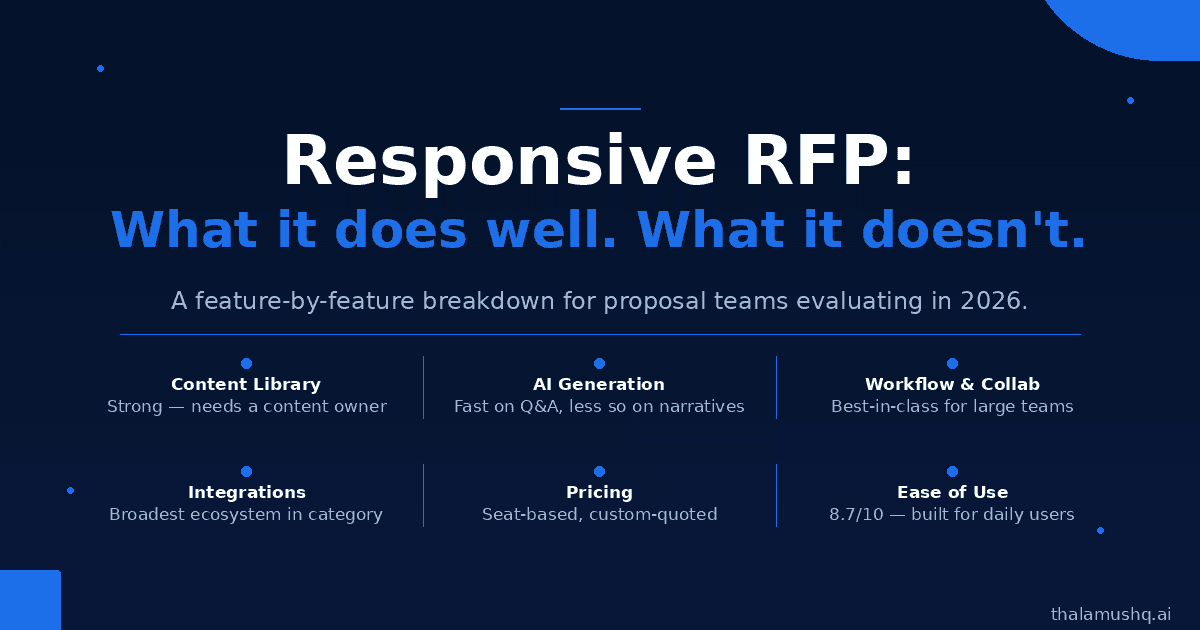
Verdict: Strong for teams with a dedicated content owner; a burden for teams without one.

Responsive's content library is the most mature in the category in terms of governance features - tagging, verification status, review cycles, and role-based permissions are all well-developed. When the library is current and properly structured, it is genuinely the fastest path to a first draft on a structured questionnaire.

The challenge is maintenance. The library does not self-update. When underlying business facts change, like new certifications, updated pricing, or changed compliance postures, the library reflects the old information until someone manually updates it. Multiple verified reviews on G2 and Gartner Peer Insights describe the library as a "critical asset that requires significant ongoing investment" to remain useful.

Teams that have a dedicated proposal operations function with at least one content owner typically get strong value from this capability. Teams without that dedicated role typically find the library degrading in quality over time, which directly degrades AI output quality.

AI and Content Generation Capabilities

Verdict: Meaningful time savings on structured questionnaires; requires human review on complex narratives.

Responsive's GenAI layer drafts first-pass responses by drawing on library content and connected documents. According to G2 review summaries, the AI has been cited as a significant productivity improvement; reviewers report it speeds up complex RFPs and reduces the time spent on initial drafting.

The consistent qualification in the same reviews: AI-generated responses "sometimes require manual refinement." This is expected behavior from a retrieval-based generative AI system; the quality of the output is bounded by the quality and currency of the library it retrieves from. The AI does not reason across multiple documents, learn from deal outcomes, or adapt to novel questions outside the library's coverage.

For structured, repetitive questionnaires where library coverage is complete and current, Responsive's AI performs reliably. For complex narrative proposals, where section-level coherence, cross-document reasoning, and adaptation to specific evaluation criteria matter, the manual editing step is more substantial.

Workflow and Collaboration Tools

Verdict: The platform's strongest differentiator for large, distributed teams.

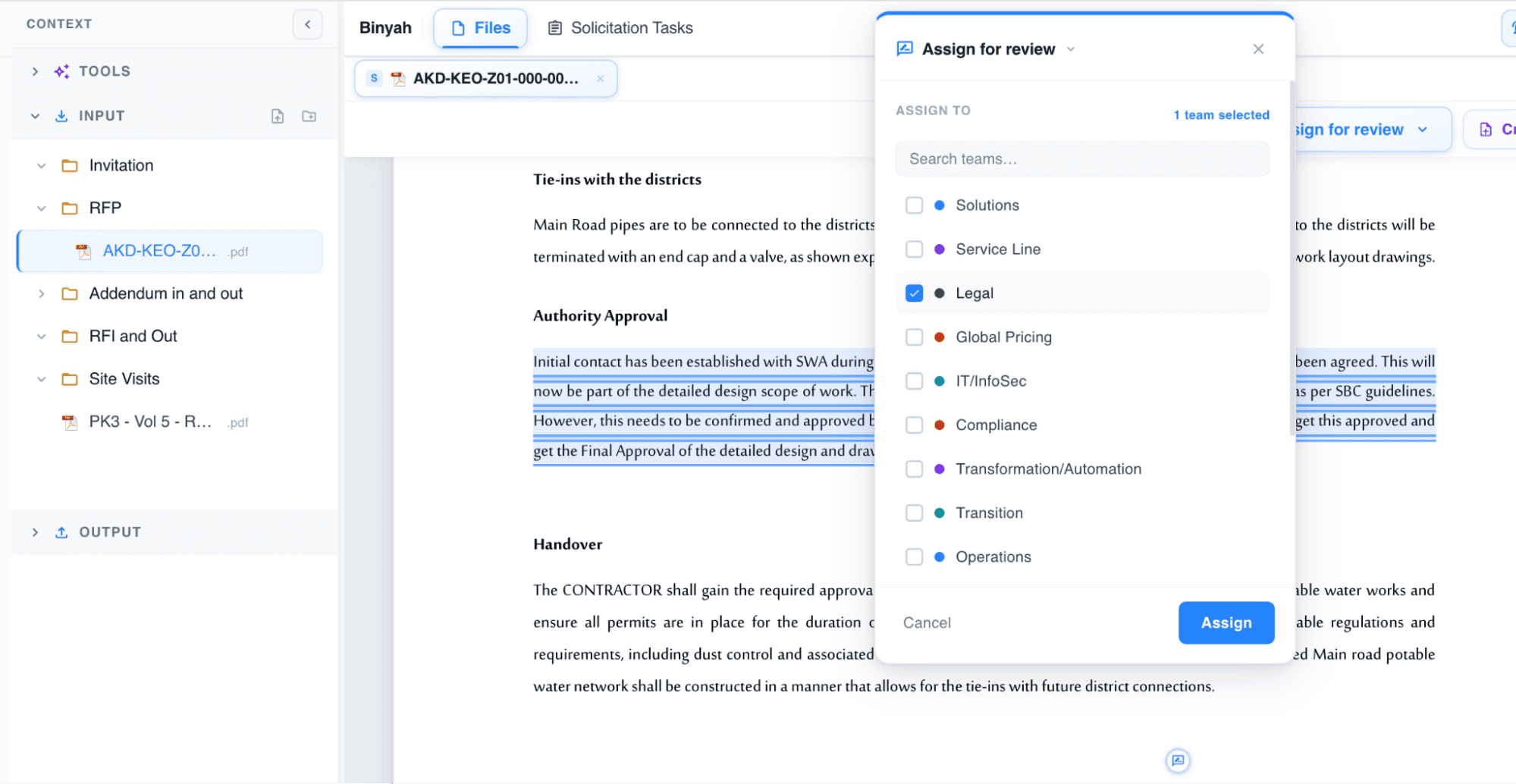
Responsive's workflow engine is the most configurable in the established platform category. Task assignment at the question level, section-level routing, completion tracking, approval chains, and audit trails are all well-developed. The ability to loop in SMEs on specific questions, without giving them full platform access, is a workflow capability that verified reviewers consistently praise as the primary reason for choosing Responsive over alternatives.

G2's AI-generated summary of 1,263 reviews notes that more than 117 reviewers specifically mention the platform's innovative workflow features. The collaboration and time-saving theme is the second most mentioned positive across the entire review corpus.

Integration Depth

Verdict: One of the strongest integration ecosystems in the RFP software category.

Salesforce, HubSpot, Google Drive, SharePoint, OneDrive, Slack, Microsoft Teams, Highspot, Seismic, and a range of procurement portals - Responsive's native integration footprint is the broadest in the established platform category. For enterprise organizations whose proposal workflow is deeply embedded in a CRM-centered revenue operations system, this is the most differentiated capability Responsive offers versus alternatives.

The asterisk: Salesforce integration quality is a noted pain point in verified reviews. Data sync issues, custom role limitations, and SSO-related access restrictions appear across multiple G2 and Capterra submissions. For teams where Salesforce integration is the primary reason for choosing Responsive, verifying the specific integration configuration against your Salesforce setup before committing is worth doing carefully.

Responsive Pricing Review

Verdict: Custom enterprise pricing across four tiers, with no public numbers. Seat-based model creates scaling costs.

Responsive offers four editions - Lite, Emerging, Growth, and Enterprise, but does not publish pricing for any of them. All pricing is custom-quoted through a sales process. Based on verified user community reports on G2 and Capterra, the Foundations-equivalent entry tier is estimated at approximately $20,000+/year, with real enterprise costs significantly higher when seat count, integration requirements, and AI tier are factored in.

The pricing model is seat-based - cost scales with the number of licensed users. This is the structural constraint that most limits Responsive's value for teams whose bid process requires input from 15-30 contributors: adding each reviewer, SME, and approver to the platform increases the annual license cost.

For a full breakdown of what drives Responsive's cost and how it compares to the pricing models used by other platforms, see our RFP software pricing guide.

Ease of Use and Onboarding for Responsive RFP Software

Verdict: Easier than Qvidian, harder than Loopio. Best suited for dedicated proposal professionals.

Responsive scores 8.7/10 on G2's ease of use metric, meaningful in absolute terms, but lower than Loopio's 9.1/10 on the same metric. The gap reflects a real difference: Responsive's broader feature set and more complex workflow configuration come with a steeper learning curve, particularly for users who are not daily proposal platform users.

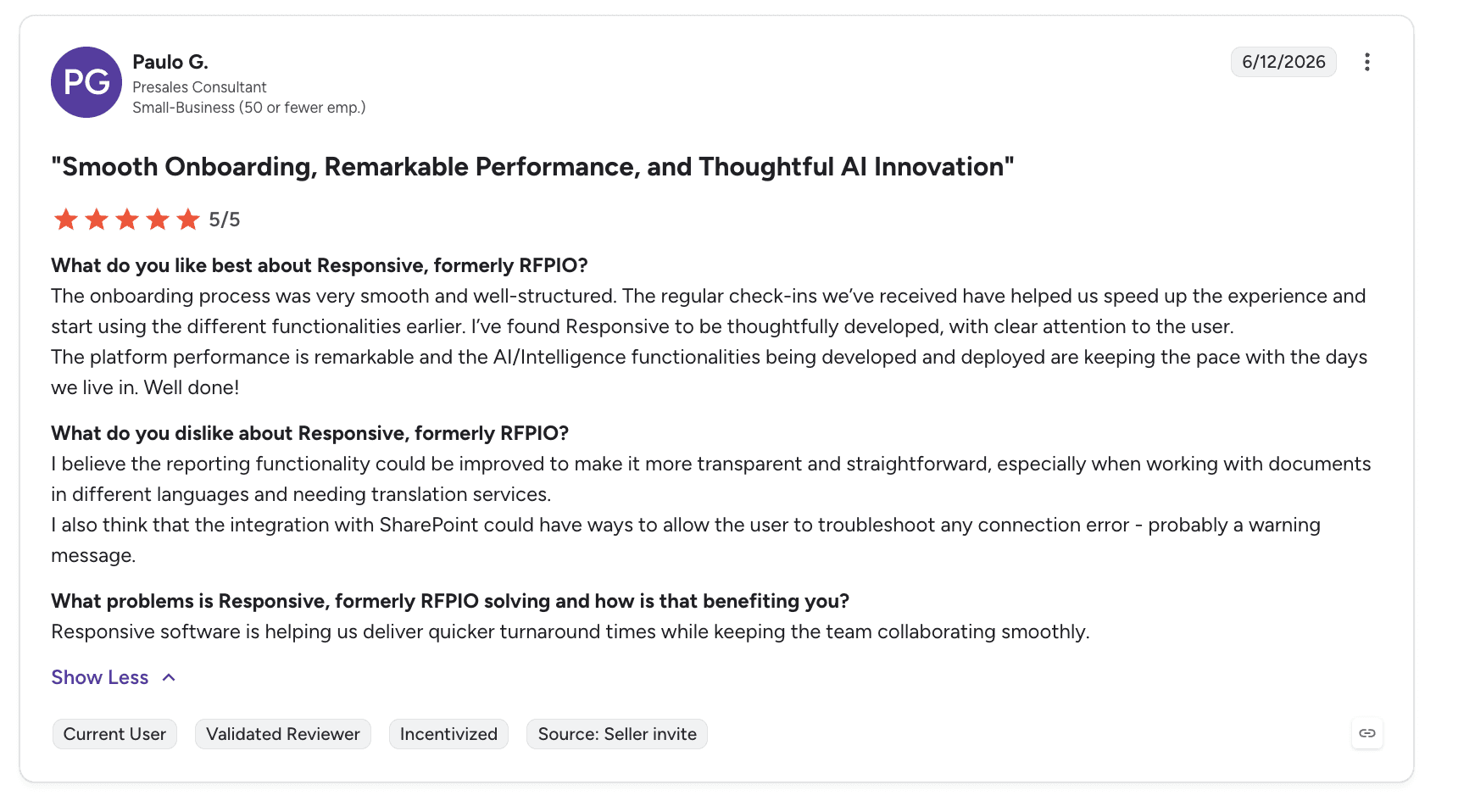
Verified Capterra reviewers describe the onboarding experience as well-supported. Responsive's implementation team is consistently praised as helpful and responsive to feedback. The challenge is not the implementation itself, but the ongoing adoption by occasional users, SMEs, legal reviewers, and executives who contribute to specific sections without using the platform daily, tend to find the interface less intuitive than daily users do.

Is Responsive Worth It in 2026? The Honest Verdict

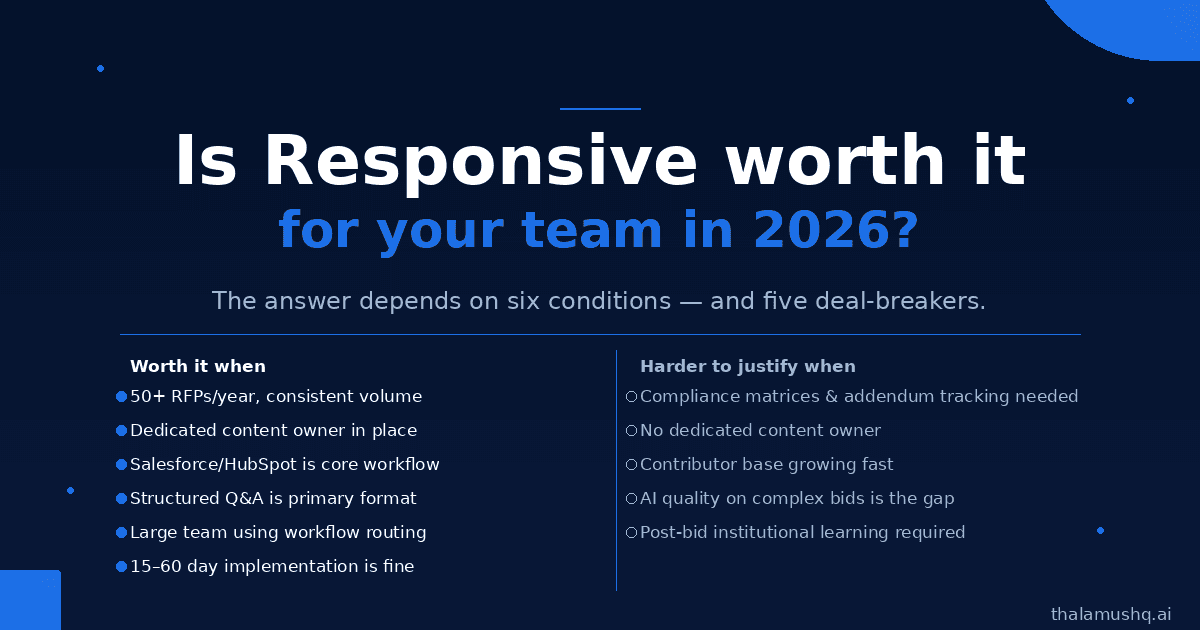
Responsive is worth it when all of the following are true:

  • Your team manages 50+ RFPs, DDQs, or questionnaires per year with a consistent and predictable volume

  • You have at least one dedicated proposal manager or content owner whose role includes ongoing library maintenance

  • Your CRM is Salesforce or HubSpot, and the integration is a core workflow requirement

  • Your primary RFP types are structured questionnaires and defined-format RFPs rather than complex narrative proposals requiring compliance tracking

  • Your team is large enough that the workflow orchestration features, task routing, approval chains, and section-level assignment are actively used rather than configured and then bypassed

  • You are willing to invest 15–60 days in implementation before the platform delivers full value
Responsive is harder to justify when:

  • Your bids have grown to the point where compliance matrices, addendum tracking, and RACI routing at the subsection level are required - these are not capabilities Responsive currently centres

  • You do not have a dedicated content owner, meaning library maintenance will fall to proposal managers who are already capacity-constrained

  • Your contributor base grows frequently, and per-seat pricing creates budget conversations every time you need to add a reviewer

  • Your primary frustration with your current tool is AI quality on complex or novel questions. Responsive's AI is bound by the same retrieval-from-library model that drives legacy platform limitations

  • Your team needs post-bid institutional learning, tracking which content correlates with wins, and using that signal to improve future responses, which is not a current Responsive capability

If Responsive's scope is limiting your team's bid quality, we can show you what a full bid lifecycle platform looks like on your actual content. See Thalamus AI in Action

Responsive Alternatives: When to Consider a Switch
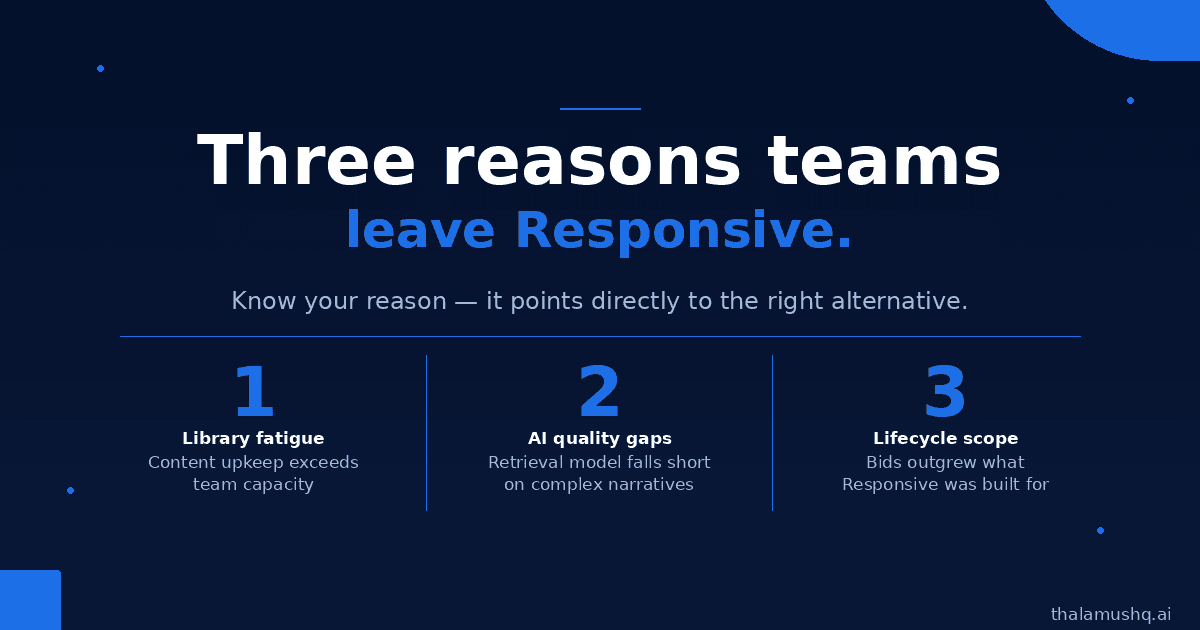
Teams typically evaluate Responsive alternatives for one of three reasons. Knowing which one applies to your situation points directly to the right alternative.

If the reason is library maintenance fatigue - the content library requires more ongoing curation than the team has capacity for, and AI output quality degrades when the library is not kept current, look at platforms that replace the library model with live source integrations or verified entity layers. 

See our 10 Best Loopio Alternatives in 2026 for a full evaluation of tools that solve this specific problem.

If the reason is AI quality on complex proposals, the GenAI layer produces usable first drafts on structured questionnaires but falls short on complex, multi-section narrative proposals where cross-document reasoning and compliance tracking matter. Look at platforms built on agentic AI architectures rather than retrieval-from-library models. 

See our 12 Best AI RFP Software Tools in 2026 for a full comparison.

If the reason is lifecycle scope - the team's bids have grown complex enough to require capture planning, compliance matrices, addendum tracking, RACI routing, and post-bid learning that Responsive was not built to cover. Two of the strongest platforms to evaluate for full bid lifecycle coverage are Thalamus AI and AutogenAI. Most other tools in the category are positioned more heavily around the response step. Everything else in the category, including Responsive, covers the response step.

For teams specifically looking at what comes after Responsive, see our full breakdown of Thalamus AI vs Inventive AI and Thalamus AI vs Loopio for a direct side-by-side evaluation of what the switch actually looks like.

How Thalamus AI Compares to Responsive as a Full Bid Lifecycle Platform?

Thalamus AI is not primarily an alternative to Responsive for teams whose core need is questionnaire automation and content library management, as Responsive does that well, and at scale. Thalamus AI is the right evaluation when the team's needs have grown beyond what a response management platform was designed to cover.

The structural differences are worth naming directly:

Capability

Responsive

Thalamus AI

Content architecture

Q&A library (manual maintenance required)

Verified entity knowledge layer (no Q&A curation)

AI architecture

Retrieval-from-library + GenAI drafting

Multi-agent agentic AI with decision graph

Compliance matrix generation

Not a current core feature

Native; maps every requirement to section, owner, and risk level

Addendum tracking

Not a current core feature

Automatic - flags impacted sections when addenda are issued

RACI routing

Section-level task assignment

Subsection-level RACI routing with version-controlled review gates

Bid/no-bid qualification

Not included

Native bid qualification workflow

Post-bid institutional learning

Not included

Closed-loop, every bid outcome strengthens the knowledge graph

User pricing model

Seat-based (cost scales with users)

Unlimited users, unlimited projects, one subscription

RFx type coverage

RFPs, RFIs, DDQs, VSQs, questionnaires

Full RFx range, including portal questionnaires (browser extension)

G2 rating

4.5/ 5

5.0/5 

The honest summary: Responsive is better at high-volume questionnaire management at scale with deep CRM integration. 

Thalamus AI covers the full bid lifecycle - the capture-to-learning workflow that Responsive does not position around. The right choice depends on whether the team's problem is response volume management or bid lifecycle orchestration.

Who should choose Responsive vs Thalamus AI

Choose Responsive if your main problem is high-volume structured questionnaire management, CRM-connected workflows, and content library governance. Choose Thalamus AI if your main problem is full bid lifecycle management: qualification, requirement mapping, compliance matrices, addenda, RACI routing, portal responses, and post-bid learning.

Not sure which platform fits your workflow? Bring one live RFP, and we will show you the difference in 30 minutes. → Get a Personalized Walkthrough

Responsive RFPIO Review FAQ: Direct Answers to What Buyers Ask Most

Is Responsive (RFPIO) worth it in 2026? 

Responsive is worth it for mid-to-enterprise teams managing 50+ structured RFPs and questionnaires per year with a dedicated content owner, a Salesforce or HubSpot-centered workflow, and a team large enough to justify the workflow orchestration features. 

It is harder to justify for teams without a dedicated library maintainer, teams whose bids require compliance tracking beyond what a Q&A library provides, or teams for whom per-seat pricing limits how broadly the tool can be deployed.

What are the pros and cons of Responsive RFPIO? 

Pros: deepest integration ecosystem in the category, workflow automation that genuinely reduces email overhead, strong content library governance when maintained, 24 consecutive G2 quarters as category leader, broad RFx type coverage. 

Cons: UI inconsistency between old and new interfaces, slow bug resolution timelines (months per verified Capterra reviews), Salesforce integration friction, library maintenance overhead requiring dedicated staff, keyword-based search that misses content when tags don't match query terminology, and seat-based pricing that limits contributor access.

How much does Responsive RFPIO cost? 

Responsive does not publish pricing. The platform offers four editions - Lite, Emerging, Growth, and Enterprise - all custom-quoted through a sales process. Based on verified user community reports on G2 and Capterra, the entry tier is estimated at approximately $20,000+/year. 

Real enterprise costs are typically higher when seat count, AI tier, integration complexity, and implementation are included. For a full pricing model breakdown, see our RFP software pricing guide.

How does Responsive compare to Loopio? 

Loopio wins on ease of use - G2 scores Loopio at 9.1/10 versus Responsive's 8.7/10, and customer support at 9.7/10 versus Responsive's lower support rating. 

Responsive wins on integration depth, workflow configurability for large distributed teams, and RFx type breadth. 

Both share the same core limitation: a Q&A library model that requires ongoing manual maintenance and bounds AI output quality by library quality. For a full side-by-side, see our 10 Best Loopio Alternatives in 2026, which covers both platforms in detail.

What is Responsive used for? 

Responsive is used to centralize RFP response content in a governed library, automate the assignment and tracking of questions across contributors, generate AI-assisted first drafts on RFPs, RFIs, DDQs, VSQs, and security questionnaires, and connect proposal workflows to CRM systems, cloud storage, and communication tools. It is a response management platform, designed to accelerate and coordinate the drafting and submission step of the proposal process.

What do users complain about most with Responsive RFPIO? 

The three most consistent complaints across G2, Capterra, and Gartner Peer Insights verified reviews are: UI inconsistency between the legacy and new interface, slow bug resolution with limited proactive communication during the wait, and Salesforce integration friction. Library maintenance overhead and keyword-dependent search are also recurring themes, though these are structural limitations shared by all Q&A library-based platforms.

Has RFPIO changed since rebranding to Responsive? 

Yes. The rebrand from RFPIO to Responsive in 2022 accompanied a broader product repositioning from RFP automation to "Strategic Response Management" - expanding the platform's stated scope to include proactive proposals, RFIs, DDQs, and security questionnaires beyond traditional competitive RFPs. 

A significant interface overhaul accompanied the rebrand, introducing a new UI that coexists with the legacy interface, a transition that G2 and Capterra reviewers note has created inconsistency. The AI capabilities have also been meaningfully expanded since the rebrand, with GenAI response generation added as a core feature.

Which industries use Responsive (RFPIO) the most? 

Based on G2 reviewer data, Responsive's primary user base is in technology and software (approximately 48.9% mid-market), financial services, healthcare, and professional services. The platform's strong Salesforce integration and broad RFx type coverage make it particularly well-suited to revenue-driven organizations where proposal volume is high, and the CRM is central to the sales workflow.

Is Responsive the best RFP software in 2026? 

Responsive is the most established and most reviewed platform in the RFP software category - 24 consecutive G2 quarters as the category leader is a meaningful credibility signal. Whether it is the best for a specific team depends on that team's use case. 

It is the strongest choice for high-volume structured questionnaire management with deep CRM integration. It is not the strongest choice for teams needing compliance matrix generation, addendum tracking, full bid lifecycle coverage, or post-bid institutional learning. See our 12 Best AI RFP Software Tools in 2026 for a full evaluation across all major platforms.

What are the best alternatives to Responsive in 2026? 

The right alternative depends on why Responsive is not meeting the team's needs. For library maintenance fatigue: Arphie (live source integrations) or Thalamus AI (verified entity layer). For AI quality on complex proposals: AutogenAI (bespoke language engines) or Thalamus AI (agentic AI). 

For full bid lifecycle coverage: Thalamus AI or AutogenAI - the only two platforms in the category that cover the complete workflow from capture planning through post-bid learning. 

For pricing model concerns: AutoRFP AI (unlimited users, $899/month published) or 1Up (free plan available). See our full 12 Best AI RFP Software Tools in 2026 and 10 Best Qvidian Alternatives in 2026 for complete evaluations.

The Bottom Line on Responsive in 2026

Responsive earned its G2 category leadership over 24 consecutive quarters for a real reason: it is the most mature, most integrated, and most thoroughly reviewed response management platform in the market. 

For the specific buyer it is designed for, a mid-to-large proposal team with a maintained content library, a Salesforce-centered workflow, and a dedicated content owner, it delivers genuine and defensible value.

The teams that outgrow it are typically those whose bids have become complex enough to expose the gaps in what a response management platform covers: the lifecycle before the response step, the compliance and addendum tracking during it, and the institutional learning after it.

If your team is in that second group, or heading there, the next step is a 30-minute walkthrough on your actual content, not on our demo data.

Your next complex bid deserves more than a smarter Q&A library. → Book Your Demo