
Harpreet Singh, MBA
Founder, Thalamus AI

With 12+ years in AI and enterprise software, including GenAI product work at Travelers, Harpreet writes about AI RFP software, AI bid tools, proposal operations, RFP response automation, and the future of enterprise bid management.
Responsive vs Loopio on Complex, Multi-Section Proposals
Imagine this. Your team receives a 120-page infrastructure tender. It includes a mandatory submission checklist, 60+ evaluation criteria across technical, commercial, and sustainability sections, team CVs and project references required for each lot, and a compliance statement that must map every requirement to a specific response section. The deadline is three weeks away, and your lead bid manager is splitting time across two other live bids.
What does Loopio do?
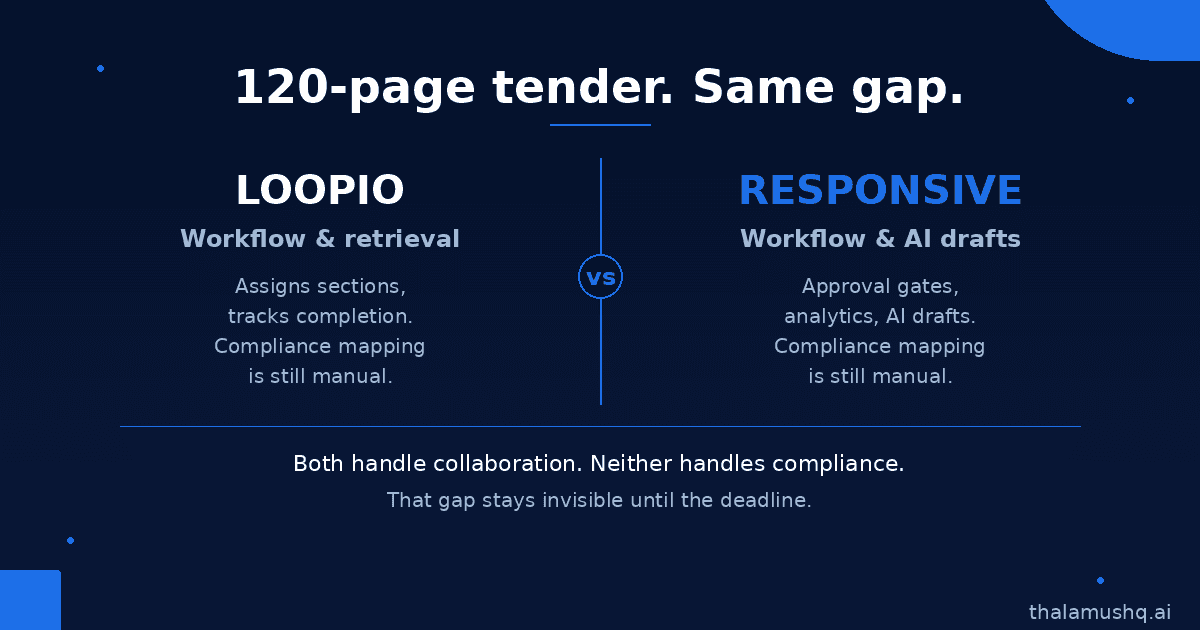
Loopio retrieves relevant content from your library, assigns sections to team members, and tracks completion through project milestones. Your team collaborates in the platform, SMEs receive task assignments, and can review drafts without full platform access.
For the compliance statement, your team manually maps each requirement against the draft response; there is no automated requirement extraction or compliance index. When a clarification notice arrives a week before the deadline, changing the evaluation weighting for the sustainability section, your team identifies the affected sections manually and updates them accordingly.
If Loopio’s limitations are a dealbreaker, our guide to the best Loopio alternatives is a good next step.
What does Responsive do?
Responsive provides more sophisticated workflow controls like custom review cycles, approval gates, detailed permissions, and advanced analytics on proposal progress. Its AI drafting helps with first drafts across sections. The compliance statement and requirement mapping remain manual processes. The clarification notice handling is the same: manual identification of affected sections, manual update, and no automated cross-referencing with what has already been drafted.
Both platforms handle the collaboration layer of a complex proposal. Neither handles the compliance layer, the systematic mapping of every requirement to a response section, an owner, a review gate, and a current status. For teams where compliance is the difference between a qualified bid and a disqualified one, that gap is consequential and invisible until the deadline.
Managing complex proposals where compliance tracking matters as much as drafting speed? See how Thalamus AI's compliance matrix and addendum tracking work on a live bid.
Where Responsive Genuinely Wins?
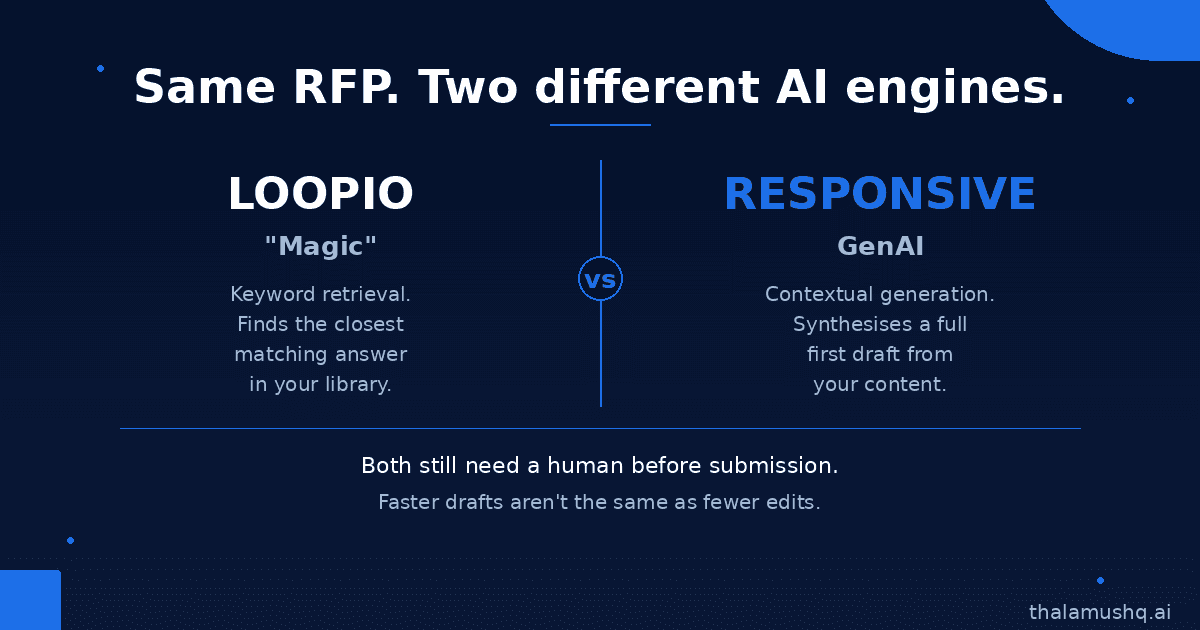
Responsive is the right platform for teams that need breadth and scale. Its 30+ native integrations and 75+ APIs make it the practical choice for large enterprises with complex tech stacks - Salesforce, Seismic, Google Drive, O365, and dozens more connect without custom development. Its GenAI drafting is measurably more advanced than Loopio's Magic feature for novel questions, and its multi-language support makes it workable for global teams managing responses across regions.
The 24-quarter G2 leadership record is not marketing. It reflects 1,200+ verified reviewers across industries who have found genuine value in the platform at scale. For high-volume enterprise teams managing RFPs, DDQs, security questionnaires, and sales quotes from a single platform, with the integration depth to connect into every tool in the stack, Responsive delivers.
The limitations are also real. The learning curve is steep, and users consistently flag the initial configuration requirement as significant. The text editing interface is basic, formatting tables is difficult, complex formatting requirements require workarounds, and import/export handling is a recurring complaint at the enterprise tier. And the per-seat pricing model makes Responsive expensive for teams that need broad SME participation without full licenses for every contributor.
For teams finding Responsive's per-seat pricing, learning curve, and above-mentioned limitations a poor fit, Responsive alternatives worth evaluating break down the field.
Where Loopio Genuinely Wins?
Loopio's 9.7/10 G2 support score is the highest in the RFP software category, and it reflects something real: the team is responsive, proactive, and proposal-domain fluent in a way that users consistently contrast with larger platforms. For a team adopting RFP software for the first time, the onboarding experience and the support quality during that period are not minor considerations; they determine whether the platform gets adopted or abandoned six months in.
Loopio's interface is cleaner and more intuitive than Responsive's, with a lower learning curve that makes it viable for teams that cannot dedicate implementation weeks to platform configuration. Its portal-based response management - including a Chrome extension for completing online questionnaires without tab-switching - is a genuine workflow differentiator for teams with high portal volumes.
For mid-market teams running a focused proposal function, with a dedicated content manager who can maintain the library, Loopio works as advertised, and its cost-to-value ratio at the entry level is competitive with Responsive.
Loopio vs Responsive: Who Should Choose Each?
The honest decision comes down to three questions: how large is your team, how complex are your bids, and who will maintain the platform once the contract is signed?
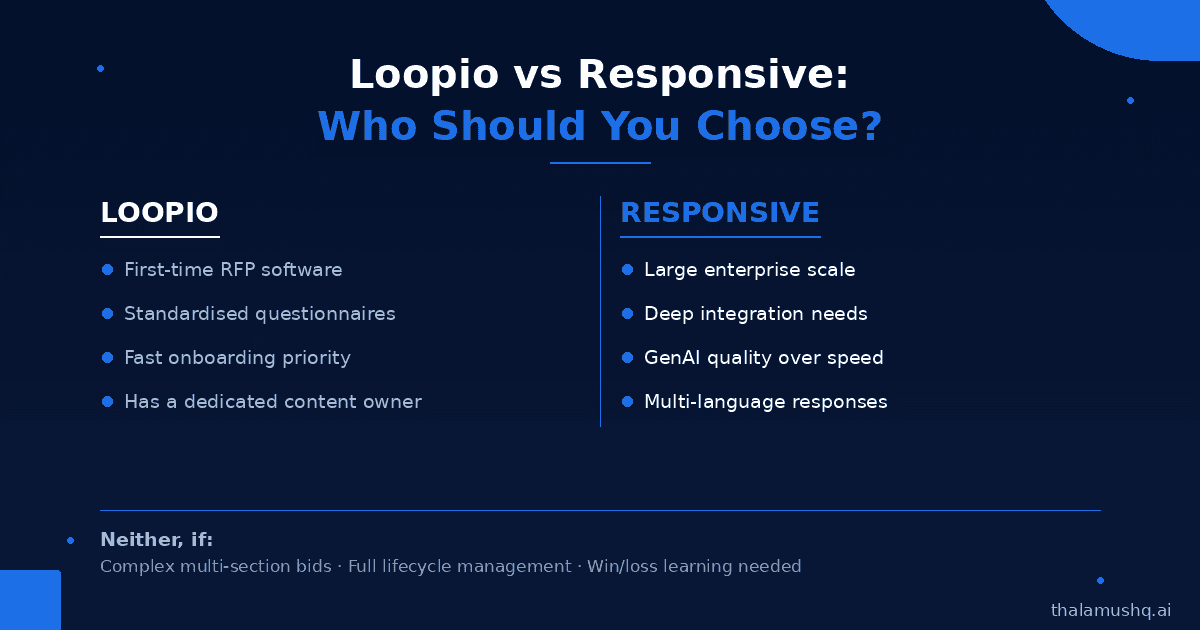
Choose Loopio if:
Your team is mid-market and adopting dedicated RFP software for the first time
Your primary workload is standardized questionnaires - DDQs, security reviews, RFIs - with repeatable answer patterns
Fast onboarding and best-in-class customer support are priorities
You have a dedicated content owner who will maintain the library consistently
Per-seat pricing at Responsive's scale would require restricting access for SMEs who contribute occasionally
Choose Responsive if:
Your team is a large enterprise, Fortune 500 scale, managing high volumes across multiple RFx types simultaneously
You need broad integration depth with your existing tech stack (Salesforce, Seismic, and similar)
GenAI drafting quality for novel questions matters more than onboarding speed
You can absorb the initial configuration investment and the steeper learning curve in exchange for long-term workflow sophistication
Multi-language response management is a regular requirement
Consider neither if:
Your bids are complex, multi-section proposals where requirement mapping, compliance tracking, and addendum management are as important as drafting speed. For a broader view of the RFP category beyond just these two, the full list of AI RFP software options for 2026 is worth a look before you commit.
Your knowledge is locked in unstructured documents - past proposals, CVs, case studies - that need to become reusable, verified assets without a manual conversion effort
You need a platform that learns from your win and loss outcomes and compounds that knowledge into future bids
Your team manages the full bid lifecycle, from go/no-bid scoring through SME coordination, addendum tracking, compliance review, and post-submission learning, not just the response stage
Think you might be in that third category? See how Thalamus AI manages the full bid lifecycle in a 20-minute demo - bring your next live RFP.
The Gap Both Platforms Leave and How Thalamus AI Fills It?
Responsive and Loopio were both built to solve the same problem: making it faster and more consistent to generate responses to RFPs and questionnaires. They solve that problem with different architectures and for different scales of teams. Both do it with reasonable effectiveness within that scope.
What neither was built to solve is the bid management problem - the set of challenges that exist before the response starts and after it ends.
Which opportunities should your team bid on, and which should you decline?
How do you map every requirement in a complex RFP to a specific section, owner, and review gate before drafting begins?
When an addendum arrives and changes eight requirements, which sections are affected, and who needs to know immediately?
What did your team learn from the last three losses that should change how this bid is positioned?
Which open questions still need a buyer's answer, and has anyone checked whether they're already answered somewhere in the 120-page pack?
These are not questions about how to generate a response faster. They are questions about how to run a bid function that improves over time. A content library, however well-maintained, however sophisticated the AI on top of it, cannot answer them.
Thalamus AI is built for that scope. It converts your unstructured documents into verified, editable knowledge entities that can connect to CRM systems like Salesforce and HubSpot for account context, and an AI-managed Content Health layer keeps that knowledge current without manual audits. It deploys AI agents across every stage of the bid lifecycle, requirement parsing, compliance matrix generation, bid/no-bid scoring, an AI Clarification Register, RACI routing, SME coordination, addendum tracking, and post-bid institutional learning. Every win, every loss, every reviewer correction makes the next bid sharper.
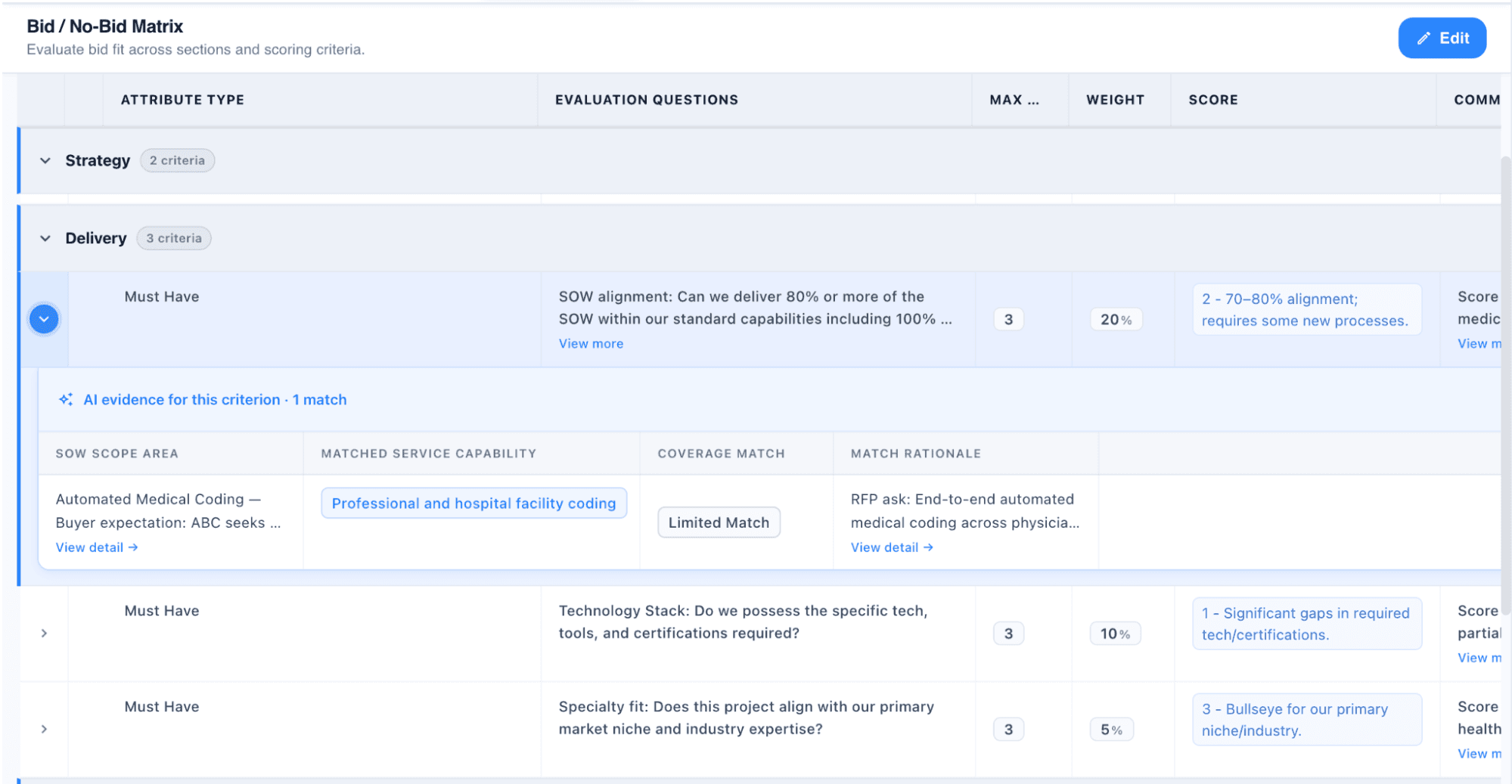
Enterprise customers using Thalamus AI across complex proposal environments have reported a +34% improvement in response reliability, 3x more bid shortlist appearances, and a 2.5x increase in bid win rates (Thalamus AI internal customer data, 2025–2026). Those are not response speed metrics. They are what happens when the full bid lifecycle is managed as a system rather than a drafting problem.
If Responsive or Loopio solves your problem - the drafting, the collaboration, the content governance - use them. Both are well-built platforms that do what they were designed to do. If your problem is bigger than drafting, the comparison to run is a different one.
Bring one RFP. We'll show you what the full bid management cycle looks like when an AI-native platform is built around it from the start. Book a Thalamus AI demo.
Pricing estimates for Loopio ($54k–$142k/year) are sourced from SiftHub independent pricing research (2026) and third-party market analysis. Responsive pricing estimate (~$299/user/month + platform fee) based on publicly referenced figures and user-reported data. Neither platform publishes official pricing. G2 ratings and review counts as of June 2026. Thalamus AI performance data sourced from internal customer outcomes, 2025–2026.
Responsive Vs Loopio FAQs
Is RFPIO the same as Responsive?
Yes. RFPIO rebranded to Responsive in 2022 after acquiring Realeyes AI. The platform, the company, and the customer base are the same, only the name has changed. If you see "RFPIO" referenced anywhere in 2026, it refers to the same product now sold as Responsive.
Do Loopio and Responsive offer a free trial?
No. Neither platform offers a self-serve free trial. Both require a sales conversation and a custom demo before you can evaluate the product hands-on, which means you cannot test drive either tool against a real RFP before signing a contract.
Can I migrate my content library from Loopio to Responsive, or vice versa?
Both platforms support content import, typically via CSV or spreadsheet upload, but neither offers a fully automated one-click migration between competitors. Switching teams should expect a manual content audit and re-tagging process, which is itself a meaningful hidden cost when evaluating a platform switch.
Which platform integrates better with Salesforce?
Both Responsive and Loopio offer native Salesforce integrations. Responsive's integration depth is broader overall, with 75+ APIs and 30+ native connectors covering tools like Seismic and Microsoft Copilot 365, while Loopio's integration set is more focused, covering core tools like Salesforce, Slack, and Microsoft Teams.
How long does it take to implement Responsive vs Loopio?
Loopio is generally faster to implement, with teams reporting a shorter learning curve and onboarding timeline suited to first-time RFP software buyers. Responsive's implementation typically takes longer due to its broader configuration options, deeper integrations, and more complex permission and workflow setup.
Is Loopio or Responsive better for government RFPs?
Neither platform is purpose-built for government or GovCon proposals. Both can handle government RFP content, but neither includes FAR/DFAR compliance checks, CUI-level security certifications, or AI trained specifically on government procurement language - capabilities found in specialist GovCon platforms.
Is there a more affordable alternative to both Responsive and Loopio?
Pricing for both platforms is quote-based and scales with seats, which makes costs climb quickly for teams needing broad SME access. Platforms with unlimited-user pricing models, like Thalamus AI, remove the per-seat cost structure that drives up Responsive and Loopio's total cost of ownership at scale.