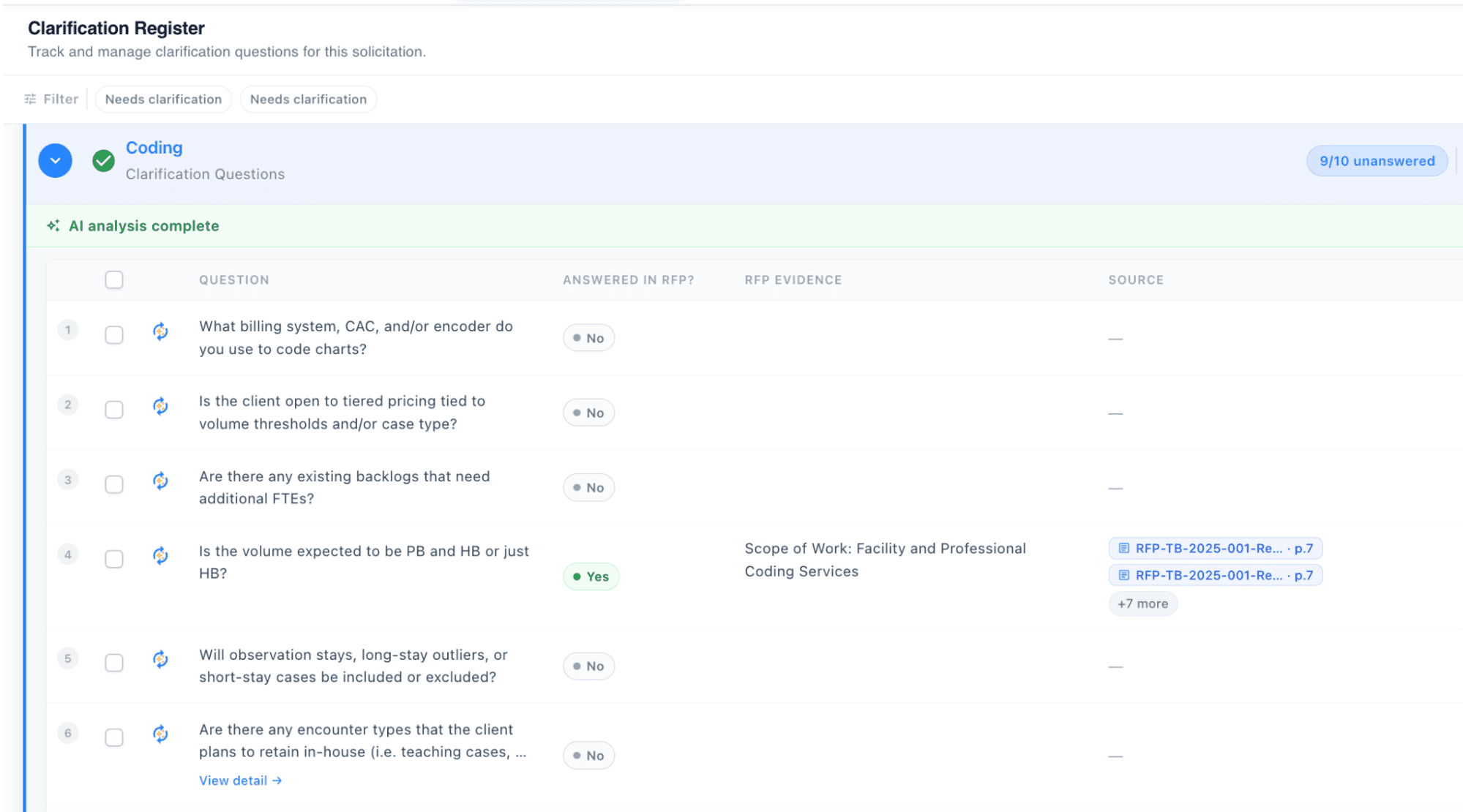
Compare

Compare

5 mins

5 mins

Thalamus AI vs Responsive: RFP Platform Comparison 2026

Thalamus AI vs Responsive: RFP Platform Comparison 2026

Thalamus AI vs Responsive: RFP Platform Comparison 2026

Thalamus AI vs Responsive: RFP Platform Comparison 2026

Harpreet Singh, MBA

Founder, Thalamus AI

With 12+ years in AI and enterprise software, including GenAI product work at Travelers, Harpreet writes about AI RFP software, AI bid tools, proposal operations, RFP response automation, and the future of enterprise bid management.

Summarize with ChatGPT

Summarize with ChatGPT

Key Takeaways

Responsive (formerly RFPIO) is a strong enterprise platform for high-volume questionnaire response, with deep integrations and GenAI drafting - but its compliance positioning is built on content governance, not requirement-level traceability.

  • Thalamus AI is built for the full bid lifecycle - qualification, compliance matrix generation, addendum tracking, RACI routing, and post-bid institutional learning, not just faster response drafting.

  • Responsive's per-seat pricing model becomes expensive fast for teams needing broad SME participation; Thalamus AI's unlimited-user pricing removes that constraint entirely.

  • For complex, multi-section proposals where a missed requirement can mean disqualification, Responsive's content library and analytics do not replace a true compliance matrix with addendum impact tracking.

  • Enterprise customers using Thalamus AI across complex proposal environments have reported a +34% improvement in response reliability, 3x more shortlist appearances, and a 2.5x increase in bid win rates.

  • Buyers also searching for Responsive vs Thalamus AI, RFPIO vs Thalamus AI, or an AI RFP software comparison are usually asking the same question: do they need response management, or full bid lifecycle management?

In nearly every prospect call I take, the same line comes up once a team has Responsive on their shortlist: "We already looked at Responsive - it's strong on compliance, isn't it?" It is a fair question, and Responsive has earned the right to be asked it. Twenty-four consecutive quarters as G2's category leader does not happen by accident.

I shared the stage with Responsive’s founder at BPC Nashville to discuss the future of RFPs, proposals, and AI in bid teams. Responsive has earned its place in the category. This comparison is not a takedown; it is about whether your team needs response management at scale or full bid lifecycle automation.

But "compliance-heavy" and "compliance-tracked" are not the same claim, and the gap between them is exactly where most evaluation conversations stall out. This is the comparison most teams need and the one nobody has written honestly.

Summarize with ChatGPT

Key Takeaways

Key Takeaways

Key Takeaways

Responsive (formerly RFPIO) is a strong enterprise platform for high-volume questionnaire response, with deep integrations and GenAI drafting - but its compliance positioning is built on content governance, not requirement-level traceability.

  • Thalamus AI is built for the full bid lifecycle - qualification, compliance matrix generation, addendum tracking, RACI routing, and post-bid institutional learning, not just faster response drafting.

  • Responsive's per-seat pricing model becomes expensive fast for teams needing broad SME participation; Thalamus AI's unlimited-user pricing removes that constraint entirely.

  • For complex, multi-section proposals where a missed requirement can mean disqualification, Responsive's content library and analytics do not replace a true compliance matrix with addendum impact tracking.

  • Enterprise customers using Thalamus AI across complex proposal environments have reported a +34% improvement in response reliability, 3x more shortlist appearances, and a 2.5x increase in bid win rates.

  • Buyers also searching for Responsive vs Thalamus AI, RFPIO vs Thalamus AI, or an AI RFP software comparison are usually asking the same question: do they need response management, or full bid lifecycle management?

In nearly every prospect call I take, the same line comes up once a team has Responsive on their shortlist: "We already looked at Responsive - it's strong on compliance, isn't it?" It is a fair question, and Responsive has earned the right to be asked it. Twenty-four consecutive quarters as G2's category leader does not happen by accident.

I shared the stage with Responsive’s founder at BPC Nashville to discuss the future of RFPs, proposals, and AI in bid teams. Responsive has earned its place in the category. This comparison is not a takedown; it is about whether your team needs response management at scale or full bid lifecycle automation.

But "compliance-heavy" and "compliance-tracked" are not the same claim, and the gap between them is exactly where most evaluation conversations stall out. This is the comparison most teams need and the one nobody has written honestly.

Responsive (formerly RFPIO) is a strong enterprise platform for high-volume questionnaire response, with deep integrations and GenAI drafting - but its compliance positioning is built on content governance, not requirement-level traceability.

  • Thalamus AI is built for the full bid lifecycle - qualification, compliance matrix generation, addendum tracking, RACI routing, and post-bid institutional learning, not just faster response drafting.

  • Responsive's per-seat pricing model becomes expensive fast for teams needing broad SME participation; Thalamus AI's unlimited-user pricing removes that constraint entirely.

  • For complex, multi-section proposals where a missed requirement can mean disqualification, Responsive's content library and analytics do not replace a true compliance matrix with addendum impact tracking.

  • Enterprise customers using Thalamus AI across complex proposal environments have reported a +34% improvement in response reliability, 3x more shortlist appearances, and a 2.5x increase in bid win rates.

  • Buyers also searching for Responsive vs Thalamus AI, RFPIO vs Thalamus AI, or an AI RFP software comparison are usually asking the same question: do they need response management, or full bid lifecycle management?

In nearly every prospect call I take, the same line comes up once a team has Responsive on their shortlist: "We already looked at Responsive - it's strong on compliance, isn't it?" It is a fair question, and Responsive has earned the right to be asked it. Twenty-four consecutive quarters as G2's category leader does not happen by accident.

I shared the stage with Responsive’s founder at BPC Nashville to discuss the future of RFPs, proposals, and AI in bid teams. Responsive has earned its place in the category. This comparison is not a takedown; it is about whether your team needs response management at scale or full bid lifecycle automation.

But "compliance-heavy" and "compliance-tracked" are not the same claim, and the gap between them is exactly where most evaluation conversations stall out. This is the comparison most teams need and the one nobody has written honestly.

Quick Answer: Thalamus AI vs Responsive - Which RFP Platform Is Better?

Quick Answer: Thalamus AI vs Responsive - Which RFP Platform Is Better?

Responsive, formerly RFPIO, is better for large enterprise teams that need high-volume RFP response management, security questionnaire workflows, governed content libraries, deep integrations, and GenAI-assisted drafting.

Thalamus AI is better for proposal and bid teams that need full bid lifecycle management, including bid/no-bid qualification, requirement mapping, compliance matrices, addendum impact tracking, RACI routing, SME collaboration, source-linked proposal drafting, online portal responses, and post-bid learning.

The short version: choose Responsive if your main problem is managing structured responses at scale. Choose Thalamus AI if your main problem is making sure complex bids are qualified, compliant, coordinated, traceable, and improved over time.

Responsive, formerly RFPIO, is better for large enterprise teams that need high-volume RFP response management, security questionnaire workflows, governed content libraries, deep integrations, and GenAI-assisted drafting.

Thalamus AI is better for proposal and bid teams that need full bid lifecycle management, including bid/no-bid qualification, requirement mapping, compliance matrices, addendum impact tracking, RACI routing, SME collaboration, source-linked proposal drafting, online portal responses, and post-bid learning.

The short version: choose Responsive if your main problem is managing structured responses at scale. Choose Thalamus AI if your main problem is making sure complex bids are qualified, compliant, coordinated, traceable, and improved over time.

Thalamus AI vs Responsive: What Each Platform Is Actually Built For

Thalamus AI vs Responsive: What Each Platform Is Actually Built For

Responsive, formerly RFPIO, rebranded in 2022, is an enterprise response management platform. It serves 2,000+ customers, including more than 20% of the Fortune 500, with 24 consecutive quarters as G2's category leader and 1,200+ verified reviews at 4.5/5.

For a deeper look at user feedback and real complaints beyond this comparison, our full standalone review of Responsive covers that ground.

Its core strength is breadth: RFPs, RFIs, RFQs, DDQs, security questionnaires, and sales quotes, all from a single governed content hub, with 30+ native integrations and 75+ APIs connecting into nearly any enterprise tech stack. Its GenAI engine drafts full responses with source citations, going beyond the keyword-matching approach of older platforms in the category.

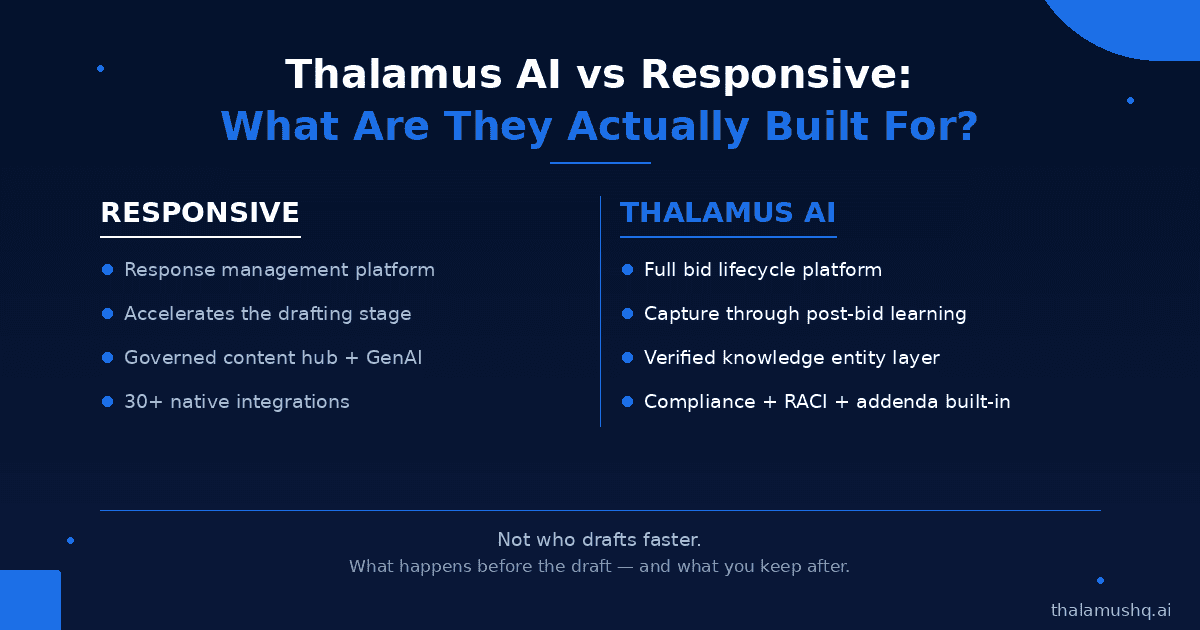
Thalamus AI is built for a different scope entirely. It is an AI-native bid management platform, not a response automation tool with AI layered on top. Where Responsive centralizes and accelerates the response stage, Thalamus AI converts your unstructured documents into verified, editable knowledge entities and deploys specialized AI agents across the full bid lifecycle: requirement parsing, compliance matrix generation, bid/no-bid scoring, RACI routing, SME coordination, addendum tracking, and post-bid institutional learning. 

The difference is not who drafts faster. It is what happens before the draft starts and what your team retains after the bid closes.

Already evaluating Responsive and want to see what a full bid lifecycle platform looks like? Bring one live RFP to a Thalamus AI demo — 20 minutes, no slides.

Responsive, formerly RFPIO, rebranded in 2022, is an enterprise response management platform. It serves 2,000+ customers, including more than 20% of the Fortune 500, with 24 consecutive quarters as G2's category leader and 1,200+ verified reviews at 4.5/5.

For a deeper look at user feedback and real complaints beyond this comparison, our full standalone review of Responsive covers that ground.

Its core strength is breadth: RFPs, RFIs, RFQs, DDQs, security questionnaires, and sales quotes, all from a single governed content hub, with 30+ native integrations and 75+ APIs connecting into nearly any enterprise tech stack. Its GenAI engine drafts full responses with source citations, going beyond the keyword-matching approach of older platforms in the category.

Thalamus AI is built for a different scope entirely. It is an AI-native bid management platform, not a response automation tool with AI layered on top. Where Responsive centralizes and accelerates the response stage, Thalamus AI converts your unstructured documents into verified, editable knowledge entities and deploys specialized AI agents across the full bid lifecycle: requirement parsing, compliance matrix generation, bid/no-bid scoring, RACI routing, SME coordination, addendum tracking, and post-bid institutional learning. 

The difference is not who drafts faster. It is what happens before the draft starts and what your team retains after the bid closes.

Already evaluating Responsive and want to see what a full bid lifecycle platform looks like? Bring one live RFP to a Thalamus AI demo — 20 minutes, no slides.

Thalamus AI vs Responsive: Side-by-Side Feature Comparison

Thalamus AI vs Responsive: Side-by-Side Feature Comparison

Thalamus AI vs Responsive: Side-by-Side Feature Comparison

What You're Actually Evaluating

Thalamus AI

Responsive (formerly RFPIO)

AI architecture

AI-native bid management platform; verified knowledge entity layer + agentic workflows

AI-first response platform; GenAI drafting with source citations; Smart Search

Full bid lifecycle coverage

✓ Capture → Qualify → Plan → Coordinate → Respond → Learn

Response generation and content governance; no qualification or learning stage

Knowledge structure

Verified, editable, auditable knowledge entities (CVs, projects, case studies, Q&A)

Governed content library with metadata, permissions, and analytics

Compliance matrix & requirement mapping

✓ Auto-generated living compliance index with full requirement-level traceability

Content governance and analytics; no requirement-to-section compliance index

Addendum & change impact tracking

✓ Automatically flags impacted sections in a live response when requirements change

Not publicly positioned as a core capability

Bid / No-Bid scoring

✓ AI-generated with win/loss outcome data

Not publicly positioned as a core capability

AI RACI & document routing

✓ Auto-classifies and routes to proposal, legal, security, and SME teams

Task assignment and collaboration; no automated RACI generation

Institutional memory & decision graph

✓ Every win, loss, correction, and reviewer comment improves future bids

Content usage analytics; no win/loss learning loop

Narrative proposal support

✓ 150-page multi-document proposals with structured assembly

Strong for questionnaires and structured RFx; narrative depth secondary

Online portal response

✓ Native part of the RFx workflow

Not a primary differentiator

Integrations

CRM, coordination tools, data hubs, SSO - broad enterprise stack coverage

30+ native integrations; 75+ APIs

Multilingual support

✓ 45+ languages

Multilingual support included

Pricing structure

Unlimited projects, users, and RFPs under one subscription

Public third-party estimates suggest per-seat pricing, often cited around ~$299/user/month + platform fee; per-seat scaling; confirm directly with vendor.

Onboarding

3-month pilot pack; live in days

Steep learning curve; significant initial configuration

Security certifications

SOC 2 Type II + ISO/IEC 27001:2022 + VAPT

SOC 2 Type II; GDPR

G2 rating

5.0/5 (growing review base)

4.5/5 (1,200+ reviews)

Want this comparison mapped against your specific RFx workflow? Book a 20-minute Thalamus AI session, bring your next RFP, and we'll run it through the platform live.

What You're Actually Evaluating

Thalamus AI

Responsive (formerly RFPIO)

AI architecture

AI-native bid management platform; verified knowledge entity layer + agentic workflows

AI-first response platform; GenAI drafting with source citations; Smart Search

Full bid lifecycle coverage

✓ Capture → Qualify → Plan → Coordinate → Respond → Learn

Response generation and content governance; no qualification or learning stage

Knowledge structure

Verified, editable, auditable knowledge entities (CVs, projects, case studies, Q&A)

Governed content library with metadata, permissions, and analytics

Compliance matrix & requirement mapping

✓ Auto-generated living compliance index with full requirement-level traceability

Content governance and analytics; no requirement-to-section compliance index

Addendum & change impact tracking

✓ Automatically flags impacted sections in a live response when requirements change

Not publicly positioned as a core capability

Bid / No-Bid scoring

✓ AI-generated with win/loss outcome data

Not publicly positioned as a core capability

AI RACI & document routing

✓ Auto-classifies and routes to proposal, legal, security, and SME teams

Task assignment and collaboration; no automated RACI generation

Institutional memory & decision graph

✓ Every win, loss, correction, and reviewer comment improves future bids

Content usage analytics; no win/loss learning loop

Narrative proposal support

✓ 150-page multi-document proposals with structured assembly

Strong for questionnaires and structured RFx; narrative depth secondary

Online portal response

✓ Native part of the RFx workflow

Not a primary differentiator

Integrations

CRM, coordination tools, data hubs, SSO - broad enterprise stack coverage

30+ native integrations; 75+ APIs

Multilingual support

✓ 45+ languages

Multilingual support included

Pricing structure

Unlimited projects, users, and RFPs under one subscription

Public third-party estimates suggest per-seat pricing, often cited around ~$299/user/month + platform fee; per-seat scaling; confirm directly with vendor.

Onboarding

3-month pilot pack; live in days

Steep learning curve; significant initial configuration

Security certifications

SOC 2 Type II + ISO/IEC 27001:2022 + VAPT

SOC 2 Type II; GDPR

G2 rating

5.0/5 (growing review base)

4.5/5 (1,200+ reviews)

Want this comparison mapped against your specific RFx workflow? Book a 20-minute Thalamus AI session, bring your next RFP, and we'll run it through the platform live.

Thalamus AI vs Responsive on What "Compliance-Heavy" Actually Means

Thalamus AI vs Responsive on What "Compliance-Heavy" Actually Means

Thalamus AI vs Responsive on What "Compliance-Heavy" Actually Means

I want to take Responsive's compliance positioning seriously, because it is the single biggest reason teams shortlist it. Responsive's content governance is genuinely strong with granular metadata, permissions, approval workflows, and analytics that track content usage and proposal effectiveness across the team. 

For a security questionnaire or DDQ where the goal is consistent, approved answers reused at scale, that governance layer does real work.

What it does not do is requirement-level compliance tracking - the specific discipline of mapping every clause in a 150-page RFP to a response section, an owner, and a verified status, with automatic detection when a requirement changes mid-bid. 

Responsive's own documentation describes "stronger content governance" and AI-supported library cleanup. That is content hygiene. It is not the same as a compliance matrix that tells you, in real time, which of the 80 mandatory requirements in your current bid are compliant, partial, or unaddressed.

Thalamus AI's RFx Analysis Agent generates that matrix automatically on upload - every requirement extracted, tagged by type, mapped to a section and an owner, with a live status and a forward trace to the source clause. When a clarification notice changes a requirement nine days before the deadline, Thalamus AI flags every impacted section immediately. Responsive requires your team to identify that manually. For teams responding to government tenders or complex enterprise RFPs where a missed mandatory requirement means automatic disqualification, that distinction is not a feature gap. It is the difference between submitting and being rejected on a technicality.

Thalamus AI compares to Loopio on the same lifecycle question; the underlying argument is the same: drafting speed isn't the whole job.

I want to take Responsive's compliance positioning seriously, because it is the single biggest reason teams shortlist it. Responsive's content governance is genuinely strong with granular metadata, permissions, approval workflows, and analytics that track content usage and proposal effectiveness across the team. 

For a security questionnaire or DDQ where the goal is consistent, approved answers reused at scale, that governance layer does real work.

What it does not do is requirement-level compliance tracking - the specific discipline of mapping every clause in a 150-page RFP to a response section, an owner, and a verified status, with automatic detection when a requirement changes mid-bid. 

Responsive's own documentation describes "stronger content governance" and AI-supported library cleanup. That is content hygiene. It is not the same as a compliance matrix that tells you, in real time, which of the 80 mandatory requirements in your current bid are compliant, partial, or unaddressed.

Thalamus AI's RFx Analysis Agent generates that matrix automatically on upload - every requirement extracted, tagged by type, mapped to a section and an owner, with a live status and a forward trace to the source clause. When a clarification notice changes a requirement nine days before the deadline, Thalamus AI flags every impacted section immediately. Responsive requires your team to identify that manually. For teams responding to government tenders or complex enterprise RFPs where a missed mandatory requirement means automatic disqualification, that distinction is not a feature gap. It is the difference between submitting and being rejected on a technicality.

Thalamus AI compares to Loopio on the same lifecycle question; the underlying argument is the same: drafting speed isn't the whole job.

I want to take Responsive's compliance positioning seriously, because it is the single biggest reason teams shortlist it. Responsive's content governance is genuinely strong with granular metadata, permissions, approval workflows, and analytics that track content usage and proposal effectiveness across the team. 

For a security questionnaire or DDQ where the goal is consistent, approved answers reused at scale, that governance layer does real work.

What it does not do is requirement-level compliance tracking - the specific discipline of mapping every clause in a 150-page RFP to a response section, an owner, and a verified status, with automatic detection when a requirement changes mid-bid. 

Responsive's own documentation describes "stronger content governance" and AI-supported library cleanup. That is content hygiene. It is not the same as a compliance matrix that tells you, in real time, which of the 80 mandatory requirements in your current bid are compliant, partial, or unaddressed.

Thalamus AI's RFx Analysis Agent generates that matrix automatically on upload - every requirement extracted, tagged by type, mapped to a section and an owner, with a live status and a forward trace to the source clause. When a clarification notice changes a requirement nine days before the deadline, Thalamus AI flags every impacted section immediately. Responsive requires your team to identify that manually. For teams responding to government tenders or complex enterprise RFPs where a missed mandatory requirement means automatic disqualification, that distinction is not a feature gap. It is the difference between submitting and being rejected on a technicality.

Thalamus AI compares to Loopio on the same lifecycle question; the underlying argument is the same: drafting speed isn't the whole job.

Thalamus AI vs Responsive on Complex, Multi-Section Proposals

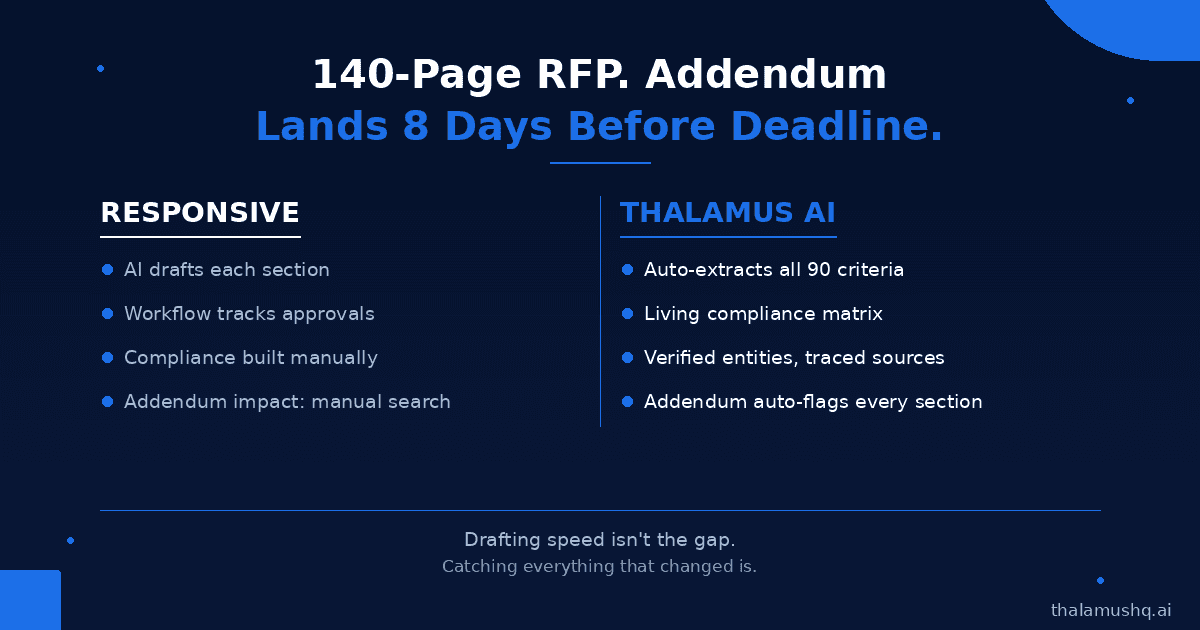
Imagine this. Your team receives a 140-page enterprise infrastructure RFP. It includes 90 evaluation criteria across technical, commercial, and sustainability sections, mandatory team CVs with certification dates, a compliance statement requiring every requirement to be explicitly addressed, and an addendum that lands eight days before the deadline, changing the technical scoring weighting.
What does Responsive do? 

Responsive's GenAI engine drafts strong first-pass content for each section, pulling from your governed library and citing sources. Your team uses the platform's workflow tools to assign sections, track review cycles, and manage approvals. The compliance statement is built manually; your bid manager works through the RFP requirement by requirement, cross-referencing against the draft. When the addendum arrives, identifying which sections the scoring change affects falls to whoever has bandwidth, competing against the platform's lack of automated impact detection.

What does Thalamus AI do? 

The RFx Analysis Agent shreds the RFP on upload, extracting all 90 evaluation criteria into a living compliance matrix with section, owner, and status. The technical, commercial, and sustainability narratives are drafted from verified knowledge entities - CVs confirmed current, project references traced to source documents. 

When the addendum lands, Thalamus AI automatically detects the scoring change and flags every section it affects, including ones already drafted, routing the update to the right SME via Slack or Teams for re-approval by the lead author.

The drafting quality gap between the two platforms is smaller than either vendor's marketing suggests. The coordination and compliance gap is not. A 140-page proposal with a late addendum is not won or lost on drafting speed. It is won or lost on whether the team caught everything that changed.

Managing complex, multi-section proposals with strict compliance requirements? See how Thalamus AI handles RFP shredding through final export in one connected workflow.

Where Responsive Genuinely Wins?

Responsive earned its 24-quarter G2 leadership streak honestly, and I think it is worth naming exactly where that strength comes from. For large enterprise teams managing extremely high volumes of structured RFx content like security questionnaires, DDQs, and vendor assessments across a broad tech stack, Responsive's integration depth (30+ native connectors, 75+ APIs) is difficult to match. Salesforce and Seismic integrations in particular are consistently praised by users for working well at scale.

Responsive's GenAI drafting is also a real step up from keyword-matching tools; it synthesizes rather than retrieves, and the source citations on generated answers give reviewers a starting point for verification. For a presales or sales engineering team that lives inside Salesforce and needs RFP response woven directly into that workflow, Responsive is a credible, well-built choice.

For the full 2026 ranking of AI RFP software, Responsive's full standing against 11 other platforms is covered there.

Where it shows real limits: the per-seat pricing model gets expensive quickly once SMEs across legal, security, and delivery need access, not just the core proposal team. The learning curve is steep enough that several reviewers flag a multi-week ramp before the platform pays off. Responsive’s compliance positioning is strongest around content governance, while this comparison focuses on requirement-level compliance tracking, addendum impact, and live compliance matrices.

For how RFP software pricing compares across the market, the full breakdown covers ten platforms side by side.

Thalamus AI vs Responsive: Who Should You Choose?

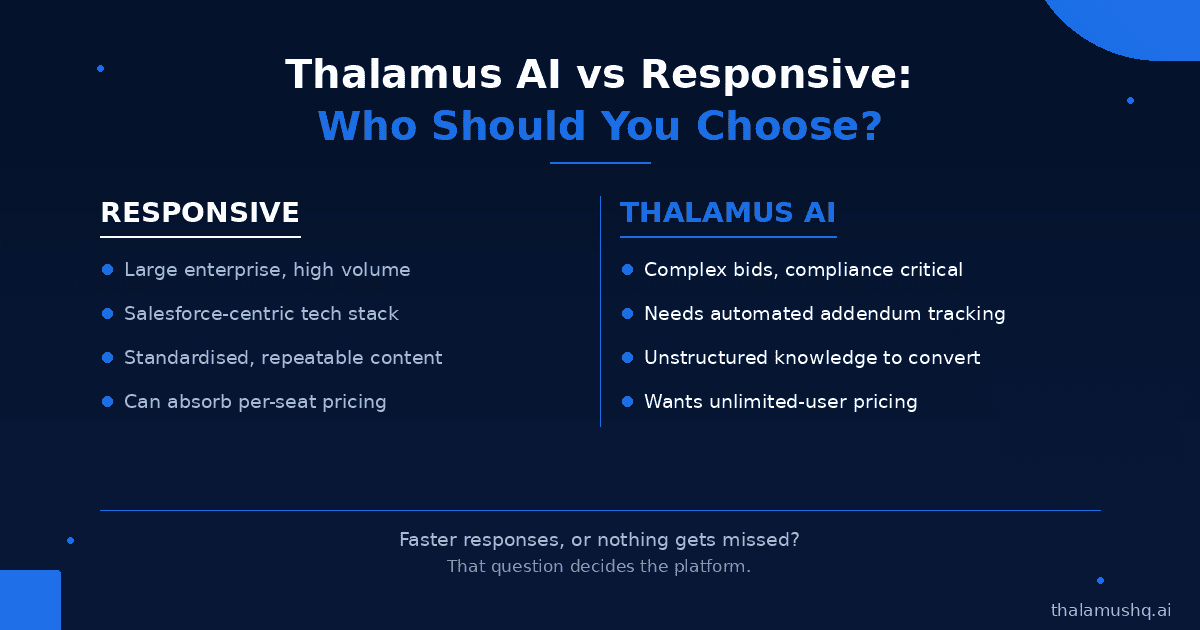
The decision usually comes down to a question most teams don't ask explicitly until it's too late: Is your hardest problem generating responses faster, or is it making sure nothing in a complex bid gets missed? Those are different jobs, and the platform that's right for one isn't automatically right for the other.

Choose Responsive if:

  • Your team is a large enterprise, managing high volumes of structured questionnaires, DDQs, and RFIs across a broad Salesforce-centric tech stack

  • Integration depth with 30+ existing tools matters more than full lifecycle coverage

  • Your bids are primarily standardized, repeatable content where content governance, not requirement-level compliance tracking, is the priority

  • You can absorb per-seat pricing at scale and a multi-week onboarding investment. 

If none of that describes your team, the broader field of Responsive alternatives is worth a look before narrowing to just Thalamus AI.

Choose Thalamus AI if:

  • You manage complex, multi-section proposals where a missed requirement risks disqualification, and a real compliance matrix is non-negotiable

  • You need addendum tracking that automatically flags impacted sections, not manual review under deadline pressure

  • Your knowledge is locked in unstructured documents that need to become verified, reusable entities without a manual conversion effort

  • You want unlimited-user pricing so SMEs across legal, technical, and delivery can contribute without license-driven access restrictions

  • You need the platform to compound institutional memory that gets your next bid sharper, not just your current draft faster

Thalamus AI is probably not the right fit if: your team's primary workload is short, standardized questionnaires with low complexity and minimal compliance risk, or you need a lightweight tool that plugs into an existing Salesforce-centric workflow without the depth of a full bid management platform.

Think Thalamus AI might be the right fit for your team? Start with a 3-month pilot, unlimited projects, unlimited RFPs, one team.

What Enterprise Customers Report After Moving to Thalamus AI?

Enterprise customers using Thalamus AI across complex proposal environments have reported measurable improvements at every stage of the bid cycle, not just faster drafts, but fewer missed requirements, stronger shortlists, and higher win rates.

Based on Thalamus AI internal customer performance data (2025–2026), across enterprise teams in healthcare, AEC, government contracting, and professional services:

  • +34% improvement in response reliability - attributed to the verified knowledge entity layer and the compliance matrix catching gaps before submission, not after

  • 3x more bid shortlist appearances - across customers managing complex, multi-section proposals where compliance tracking had previously been a manual, error-prone process

  • 2.5x increase in bid win rates - reported by enterprise teams using the full bid management platform, not just the drafting layer

Responsive is a strong, well-built platform that has earned its market position through genuine product investment and a decade of enterprise trust. For teams whose workload is response generation at scale, it performs. 

What it was not built to do, and does not claim to do beyond its content governance layer, is track compliance at the requirement level, flag the impact of a late addendum automatically, or learn from your win and loss history to make the next bid stronger.

If that is the gap your team is living with, the comparison becomes straightforward.

Bring one RFP. We'll show you what requirement-level compliance tracking and full bid lifecycle management look like in 30 minutes. Book a Thalamus AI demo.

Thalamus AI vs Responsive: FAQs

Does Thalamus AI integrate with Salesforce?

Yes. Thalamus AI connects to Salesforce as part of its CRM integration layer, alongside coordination tools like Slack and Microsoft Teams, and data hubs like Google Drive and SharePoint. It does not yet match Responsive's 75+ API count, but core CRM and collaboration workflows are covered natively.

Is Thalamus AI SOC 2 and ISO 27001 certified?

Yes. Thalamus AI currently lists SOC 2 Type II, GDPR, ISO/IEC 27001:2022, and VAPT. Responsive publicly lists SOC 2 Type II and GDPR-related controls. Buyers should confirm current security documentation with each vendor during procurement.

Does Thalamus AI support RFQs and sales quotes, the same RFx types as Responsive?

Thalamus AI is built primarily for RFPs, RFIs, DDQs, security questionnaires, and online portal responses. Sales quote generation is not a core focus area, the way it is for Responsive, which was built partly out of a sales-enablement use case.

Does Thalamus AI offer a free trial?

No. Like Responsive, Thalamus AI does not offer a self-serve free trial. Evaluation happens through a guided demo, typically followed by a 3-month pilot pack rather than an open trial period.

Is Thalamus AI more affordable than Responsive for teams with many SME contributors?

Generally, yes. Responsive's pricing is per-seat, which means costs climb as more SMEs across legal, security, and delivery need access. Thalamus AI's pricing covers unlimited users under one subscription, which removes that scaling cost for teams needing broad cross-functional participation.

Can I migrate my existing content library from Responsive to Thalamus AI?

Content can be imported via document upload, and Thalamus AI's parsing agents convert that content into structured knowledge entities automatically rather than requiring a manual field-by-field migration. This differs from a typical Q&A-library-to-Q&A-library import, since the underlying data structure is different.

Is Thalamus AI built for sales engineering teams, or only dedicated proposal teams?

Thalamus AI is built primarily for dedicated proposal, bid, and capture teams managing complex RFPs. Sales engineering teams handling lighter, more transactional questionnaires may find Responsive's sales-enablement integrations a closer fit out of the box.

Data source: Thalamus AI internal customer performance data, 2025–2026, based on enterprise customer outcomes across healthcare, AEC, government contracting, and professional services. Responsive (formerly RFPIO) data sourced from G2 (1,200+ reviews, 4.5/5), publicly referenced pricing, and Responsive's own published comparison materials, as of June 2026.