Blogs

Blogs

12 mins

12 mins

RFP Knowledge Base Software in 2026: The Architecture Decision That Determines Everything

RFP Knowledge Base Software in 2026: The Architecture Decision That Determines Everything

RFP Knowledge Base Software in 2026: The Architecture Decision That Determines Everything

RFP Knowledge Base Software in 2026: The Architecture Decision That Determines Everything

Harpreet Singh, MBA

Founder, Thalamus AI

With 12+ years in AI and enterprise software, including GenAI product work at Travelers Group, Harpreet writes about AI RFP software, AI bid tools, proposal operations, RFP response automation, and the future of enterprise bid management.

Summarize with ChatGPT

Summarize with ChatGPT

Key Takeaways

  • RFP knowledge base software is the system that stores, organizes, and retrieves institutional knowledge for proposal responses, but three fundamentally different architectures exist in 2026, and most teams choose based on brand name rather than architecture fit.

  • Q&A library model (Loopio, Responsive, Qvidian): manually curated answer pairs that deliver reliable output when maintained, and degraded, inaccurate output when they are not.

  • Live source model (Arphie, 1Up): AI agents retrieve answers from connected documents at query time, no library to maintain, but answer quality depends entirely on how well existing content is organized.

  • Verified entity layer (Thalamus AI): converts unstructured proposals, CVs, case studies, certifications, and compliance documents into auditable, source-linked knowledge entities with completeness scores. This is the strongest fit for enterprise teams that need knowledge governance without traditional Q&A library maintenance.

  • The hidden cost no RFP knowledge base comparison covers: the labor cost of maintaining a Q&A library over three years is frequently larger than the software subscription cost itself.

  • Buyers searching for “RFP knowledge base software,” “proposal knowledge base software,” “RFP answer library,” or “proposal content library” are often comparing very different architectures under the same category name.

Summarize with ChatGPT

Key Takeaways

Key Takeaways

Key Takeaways

  • RFP knowledge base software is the system that stores, organizes, and retrieves institutional knowledge for proposal responses, but three fundamentally different architectures exist in 2026, and most teams choose based on brand name rather than architecture fit.

  • Q&A library model (Loopio, Responsive, Qvidian): manually curated answer pairs that deliver reliable output when maintained, and degraded, inaccurate output when they are not.

  • Live source model (Arphie, 1Up): AI agents retrieve answers from connected documents at query time, no library to maintain, but answer quality depends entirely on how well existing content is organized.

  • Verified entity layer (Thalamus AI): converts unstructured proposals, CVs, case studies, certifications, and compliance documents into auditable, source-linked knowledge entities with completeness scores. This is the strongest fit for enterprise teams that need knowledge governance without traditional Q&A library maintenance.

  • The hidden cost no RFP knowledge base comparison covers: the labor cost of maintaining a Q&A library over three years is frequently larger than the software subscription cost itself.

  • Buyers searching for “RFP knowledge base software,” “proposal knowledge base software,” “RFP answer library,” or “proposal content library” are often comparing very different architectures under the same category name.

  • RFP knowledge base software is the system that stores, organizes, and retrieves institutional knowledge for proposal responses, but three fundamentally different architectures exist in 2026, and most teams choose based on brand name rather than architecture fit.

  • Q&A library model (Loopio, Responsive, Qvidian): manually curated answer pairs that deliver reliable output when maintained, and degraded, inaccurate output when they are not.

  • Live source model (Arphie, 1Up): AI agents retrieve answers from connected documents at query time, no library to maintain, but answer quality depends entirely on how well existing content is organized.

  • Verified entity layer (Thalamus AI): converts unstructured proposals, CVs, case studies, certifications, and compliance documents into auditable, source-linked knowledge entities with completeness scores. This is the strongest fit for enterprise teams that need knowledge governance without traditional Q&A library maintenance.

  • The hidden cost no RFP knowledge base comparison covers: the labor cost of maintaining a Q&A library over three years is frequently larger than the software subscription cost itself.

  • Buyers searching for “RFP knowledge base software,” “proposal knowledge base software,” “RFP answer library,” or “proposal content library” are often comparing very different architectures under the same category name.

Quick Answer: What Is the Best RFP Knowledge Base Software?

Quick Answer: What Is the Best RFP Knowledge Base Software?

The best RFP knowledge base software depends on the architecture your proposal team can maintain.

Q&A library platforms like Loopio, Responsive, and Qvidian work well when a team has a dedicated content owner who can curate approved answers, remove stale content, and maintain review cycles.

Live source platforms like Arphie and 1Up work well when knowledge already lives in clean, current systems like SharePoint, Google Drive, Confluence, or Notion.

Thalamus AI is best for enterprise proposal teams that need a verified RFP knowledge base without traditional Q&A library maintenance. Its verified entity layer converts proposals, case studies, CVs, certifications, compliance documents, and past performance into source-linked knowledge entities that can be reused across RFPs, DDQs, security questionnaires, and complex proposals.

The short version: Q&A libraries store answers. Live source tools search documents. Thalamus AI structures proposal knowledge so every answer can be traced back to approved sources.

The best RFP knowledge base software depends on the architecture your proposal team can maintain.

Q&A library platforms like Loopio, Responsive, and Qvidian work well when a team has a dedicated content owner who can curate approved answers, remove stale content, and maintain review cycles.

Live source platforms like Arphie and 1Up work well when knowledge already lives in clean, current systems like SharePoint, Google Drive, Confluence, or Notion.

Thalamus AI is best for enterprise proposal teams that need a verified RFP knowledge base without traditional Q&A library maintenance. Its verified entity layer converts proposals, case studies, CVs, certifications, compliance documents, and past performance into source-linked knowledge entities that can be reused across RFPs, DDQs, security questionnaires, and complex proposals.

The short version: Q&A libraries store answers. Live source tools search documents. Thalamus AI structures proposal knowledge so every answer can be traced back to approved sources.

What Is an RFP Knowledge Base?

What Is an RFP Knowledge Base?

An RFP knowledge base is the structured repository of institutional knowledge that an organization draws from when responding to RFPs, DDQs, security questionnaires, and vendor assessments. It contains approved answers, past performance evidence, team credentials, certifications, compliance documentation, and organizational boilerplate that proposal teams need to produce consistent, accurate responses at speed.

The RFP knowledge base is not the same as a file share, SharePoint folder, or company wiki. A file share stores documents. An RFP knowledge base structures knowledge into a form that AI can retrieve accurately, governance processes can maintain systematically, and audit trails can verify over time.

Every serious RFP response platform in 2026 has some form of knowledge base architecture beneath its AI layer. AI quality is a direct function of knowledge base quality. A platform with sophisticated generative AI but a poorly maintained knowledge base produces inaccurate, stale, or irrelevant first drafts. A platform with a well-structured, current knowledge base produces near-submission-ready output even from a moderately capable AI model. 

Choosing between RFP knowledge base software platforms is, more than anything else, choosing between knowledge architectures.

See how Thalamus AI's verified entity layer delivers compliance-grade knowledge governance without Q&A library maintenance. → Book a Free Demo

An RFP knowledge base is the structured repository of institutional knowledge that an organization draws from when responding to RFPs, DDQs, security questionnaires, and vendor assessments. It contains approved answers, past performance evidence, team credentials, certifications, compliance documentation, and organizational boilerplate that proposal teams need to produce consistent, accurate responses at speed.

The RFP knowledge base is not the same as a file share, SharePoint folder, or company wiki. A file share stores documents. An RFP knowledge base structures knowledge into a form that AI can retrieve accurately, governance processes can maintain systematically, and audit trails can verify over time.

Every serious RFP response platform in 2026 has some form of knowledge base architecture beneath its AI layer. AI quality is a direct function of knowledge base quality. A platform with sophisticated generative AI but a poorly maintained knowledge base produces inaccurate, stale, or irrelevant first drafts. A platform with a well-structured, current knowledge base produces near-submission-ready output even from a moderately capable AI model. 

Choosing between RFP knowledge base software platforms is, more than anything else, choosing between knowledge architectures.

See how Thalamus AI's verified entity layer delivers compliance-grade knowledge governance without Q&A library maintenance. → Book a Free Demo

Why the RFP Knowledge Base Architecture Is the Most Important Software Decision You Will Make

Why the RFP Knowledge Base Architecture Is the Most Important Software Decision You Will Make

Why the RFP Knowledge Base Architecture Is the Most Important Software Decision You Will Make

Most RFP software evaluations focus on the wrong things: interface quality, integration list, pricing tier, and G2 rating. These matter. But the most consequential long-term decision is the knowledge base architecture because it determines the ongoing maintenance burden, the output quality floor, and the scalability ceiling for every proposal the team will ever write on the platform.

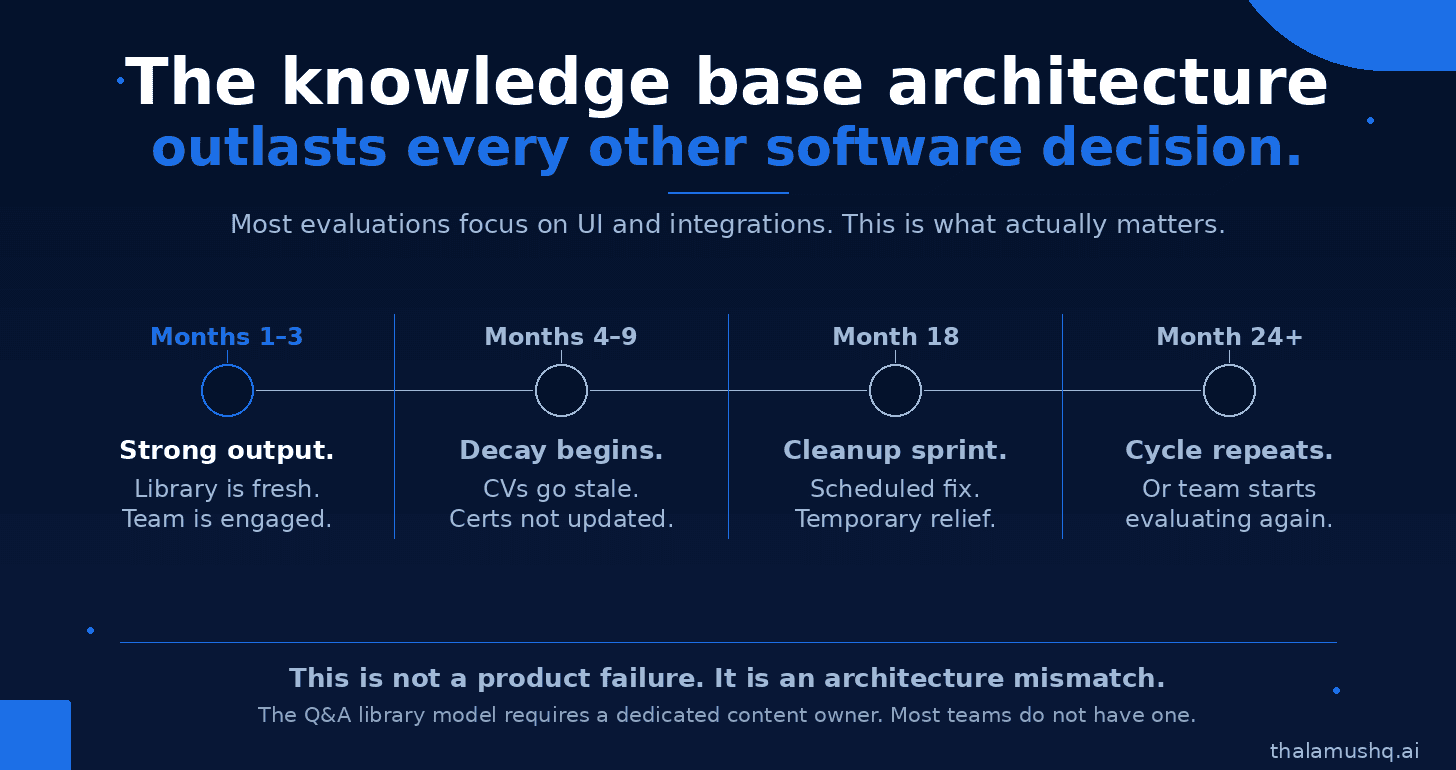
Teams that choose the wrong architecture for their capacity experience the same pattern. Months one to three: strong initial output. The knowledge base is new, and the team is engaged. 

Months four to nine: library decay begins. Certifications renew, but the library is not updated. Key personnel change, but their CVs still show old roles. 

Month 18: the maintenance overhead becomes a recurring agenda item. A library cleanup is scheduled and completed. Month 24 onwards: the cycle repeats, or the team starts evaluating alternatives.

This pattern is widely reported in G2 reviews across every Q&A library platform. It is not a product failure. It is an architecture mismatch. The Q&A library model requires a dedicated content owner. Teams that have one thrive on it. Teams that do not produce an increasingly unreliable knowledge base regardless of platform.

Understanding which knowledge base architecture your team can actually sustain, given headcount, RFP volume, and whether a dedicated proposal operations function exists, determines whether your software investment compounds or deteriorates over time.

Most RFP software evaluations focus on the wrong things: interface quality, integration list, pricing tier, and G2 rating. These matter. But the most consequential long-term decision is the knowledge base architecture because it determines the ongoing maintenance burden, the output quality floor, and the scalability ceiling for every proposal the team will ever write on the platform.

Teams that choose the wrong architecture for their capacity experience the same pattern. Months one to three: strong initial output. The knowledge base is new, and the team is engaged. 

Months four to nine: library decay begins. Certifications renew, but the library is not updated. Key personnel change, but their CVs still show old roles. 

Month 18: the maintenance overhead becomes a recurring agenda item. A library cleanup is scheduled and completed. Month 24 onwards: the cycle repeats, or the team starts evaluating alternatives.

This pattern is widely reported in G2 reviews across every Q&A library platform. It is not a product failure. It is an architecture mismatch. The Q&A library model requires a dedicated content owner. Teams that have one thrive on it. Teams that do not produce an increasingly unreliable knowledge base regardless of platform.

Understanding which knowledge base architecture your team can actually sustain, given headcount, RFP volume, and whether a dedicated proposal operations function exists, determines whether your software investment compounds or deteriorates over time.

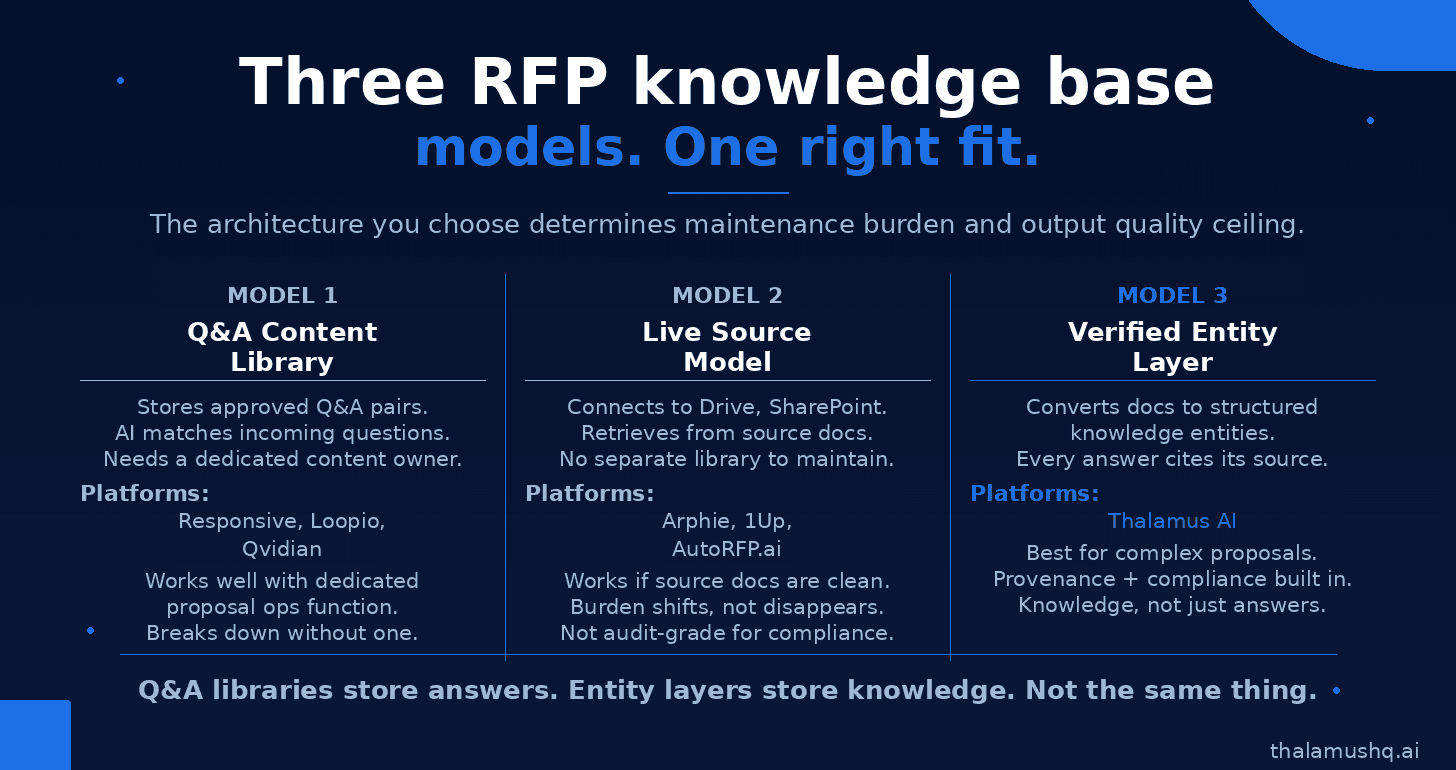
The Three RFP Knowledge Base Models in 2026

The Three RFP Knowledge Base Models in 2026

The Three RFP Knowledge Base Models in 2026

Model 1 - The RFP Content Library (Q&A Library)

The Q&A content library is the original RFP knowledge base architecture and still the most widely deployed. The organization builds a database of question-and-answer pairs, approved responses to common RFP questions, organized by category and tagged for retrieval. When a new RFP arrives, AI matches incoming questions against the library and surfaces the closest available answer.

Who it serves well? Teams with a dedicated proposal operations function, including at least one content owner whose role includes library maintenance. High-volume, repetitive questionnaire workflows where the same questions recur frequently. organizations that have already invested in building a mature, well-tagged library.

Where it breaks down? Teams without a dedicated content owner, the majority of proposal teams at organizations below $100M revenue. Any portfolio, team, or certification that changes frequently. Any team that assumes the platform will maintain itself.

Platforms: Responsive (RFPIO), Loopio, Qvidian (Upland).

Model 2 - The Live Source Model

The live source model replaces the separately maintained Q&A library with direct connections to the organization's existing documents like SharePoint, Google Drive, Confluence, Notion, Seismic. AI agents retrieve current answers from connected source documents at query time rather than from a pre-curated database. Answers are only as stale as the source documents, not as stale as the last time someone updated the library.

Who it serves well: Teams whose institutional knowledge already lives in well-organized, current repositories. organizations that want to eliminate library maintenance overhead. Presales and sales engineering teams whose primary format is questionnaires.

Where it breaks down: Teams with disorganized source documents. The maintenance burden shifts from the library to source systems; it does not disappear. Not well-suited for compliance-grade proposal work where answer provenance must be explicitly auditable.

Platforms: Arphie, 1Up, AutoRFP.ai

Model 3 - The Verified Entity Layer

The verified entity layer is the most recent architectural development in RFP knowledge management and the one with the most significant structural difference from the Q&A library model. Rather than storing knowledge as question-and-answer pairs, the platform converts unstructured source materials such as proposals, CVs, case studies, and certifications into structured, verified, auditable knowledge entities.

Each entity carries its source reference, a completeness score, and a last-verified timestamp. When a proposal question requires information about a specific past project, the AI retrieves the verified project entity rather than an answer from a Q&A database. Every generated answer cites the specific entity it was drawn from.

Why this differs structurally from Q&A libraries: Q&A libraries store answers. Verified entity layers store knowledge. Answers are only useful for the question they were written for. Knowledge can be assembled into answers for any relevant question. A verified project entity can simultaneously inform questions about experience, methodology, team qualifications, and timeline, without requiring a separate Q&A pair for each.

Who it serves well: Enterprise teams managing complex, multi-section proposals where answer provenance and compliance traceability matter. organizations where knowledge assets (CVs, case studies, past performance) are high-value and need to remain current and verifiable.

Platforms: Thalamus AI (the most fully realized implementation of this model in the enterprise RFP category at time of writing).

Model 1 - The RFP Content Library (Q&A Library)

The Q&A content library is the original RFP knowledge base architecture and still the most widely deployed. The organization builds a database of question-and-answer pairs, approved responses to common RFP questions, organized by category and tagged for retrieval. When a new RFP arrives, AI matches incoming questions against the library and surfaces the closest available answer.

Who it serves well? Teams with a dedicated proposal operations function, including at least one content owner whose role includes library maintenance. High-volume, repetitive questionnaire workflows where the same questions recur frequently. organizations that have already invested in building a mature, well-tagged library.

Where it breaks down? Teams without a dedicated content owner, the majority of proposal teams at organizations below $100M revenue. Any portfolio, team, or certification that changes frequently. Any team that assumes the platform will maintain itself.

Platforms: Responsive (RFPIO), Loopio, Qvidian (Upland).

Model 2 - The Live Source Model

The live source model replaces the separately maintained Q&A library with direct connections to the organization's existing documents like SharePoint, Google Drive, Confluence, Notion, Seismic. AI agents retrieve current answers from connected source documents at query time rather than from a pre-curated database. Answers are only as stale as the source documents, not as stale as the last time someone updated the library.

Who it serves well: Teams whose institutional knowledge already lives in well-organized, current repositories. organizations that want to eliminate library maintenance overhead. Presales and sales engineering teams whose primary format is questionnaires.

Where it breaks down: Teams with disorganized source documents. The maintenance burden shifts from the library to source systems; it does not disappear. Not well-suited for compliance-grade proposal work where answer provenance must be explicitly auditable.

Platforms: Arphie, 1Up, AutoRFP.ai

Model 3 - The Verified Entity Layer

The verified entity layer is the most recent architectural development in RFP knowledge management and the one with the most significant structural difference from the Q&A library model. Rather than storing knowledge as question-and-answer pairs, the platform converts unstructured source materials such as proposals, CVs, case studies, and certifications into structured, verified, auditable knowledge entities.

Each entity carries its source reference, a completeness score, and a last-verified timestamp. When a proposal question requires information about a specific past project, the AI retrieves the verified project entity rather than an answer from a Q&A database. Every generated answer cites the specific entity it was drawn from.

Why this differs structurally from Q&A libraries: Q&A libraries store answers. Verified entity layers store knowledge. Answers are only useful for the question they were written for. Knowledge can be assembled into answers for any relevant question. A verified project entity can simultaneously inform questions about experience, methodology, team qualifications, and timeline, without requiring a separate Q&A pair for each.

Who it serves well: Enterprise teams managing complex, multi-section proposals where answer provenance and compliance traceability matter. organizations where knowledge assets (CVs, case studies, past performance) are high-value and need to remain current and verifiable.

Platforms: Thalamus AI (the most fully realized implementation of this model in the enterprise RFP category at time of writing).

How We Evaluated RFP Knowledge Base Software

We evaluated each platform by knowledge architecture, source traceability, maintenance burden, answer freshness, completeness scoring, governance controls, multi-format coverage, AI retrieval model, and fit for enterprise proposal workflows. We also separated Q&A library platforms from live source platforms and verified entity-layer platforms because each model creates a different long-term maintenance cost and output quality ceiling.

Best RFP Knowledge Base Software in 2026

Platform

Knowledge base model

Best for

G2 rating

Maintenance burden

Thalamus AI

Verified entity layer

Enterprise teams needing compliance-grade governance without Q&A curation

5.0 / 5 ↗ G2

Minimal, entity ingestion replaces curation

Tribble

Living knowledge graph

B2B SaaS and financial services teams wanting win-pattern learning

4.8 / 5 ↗ G2

Low, graph self-updates from connected sources

HeyIris (Iris AI)

Document-based retrieval

Presales teams needing confidence-scored answers with inline source citations

4.9 / 5 ↗ G2

Medium, dependent on source document currency

Loopio

Q&A content library

Teams with a dedicated content owner and repetitive questionnaire volume

4.7 / 5 ↗ G2

High, requires ongoing curation and review cycles

Responsive (RFPIO)

Q&A content library

Enterprise teams with deep CRM integration needs and a mature existing library

4.5 / 5 ↗ G2

High, same Q&A library maintenance model

Arphie

Live source model

Teams who want answers from live source systems with zero separate library

5/ 5 ↗ G2

Low; source system quality determines answer quality

1Up

Live source model

Small teams wanting Slack-native answers from live connectors with a free entry tier

4.9 / 5 ↗ G2

Low; live connectors, no library required

Thalamus AI - Best RFP Knowledge Base Software for Enterprise Proposal Teams

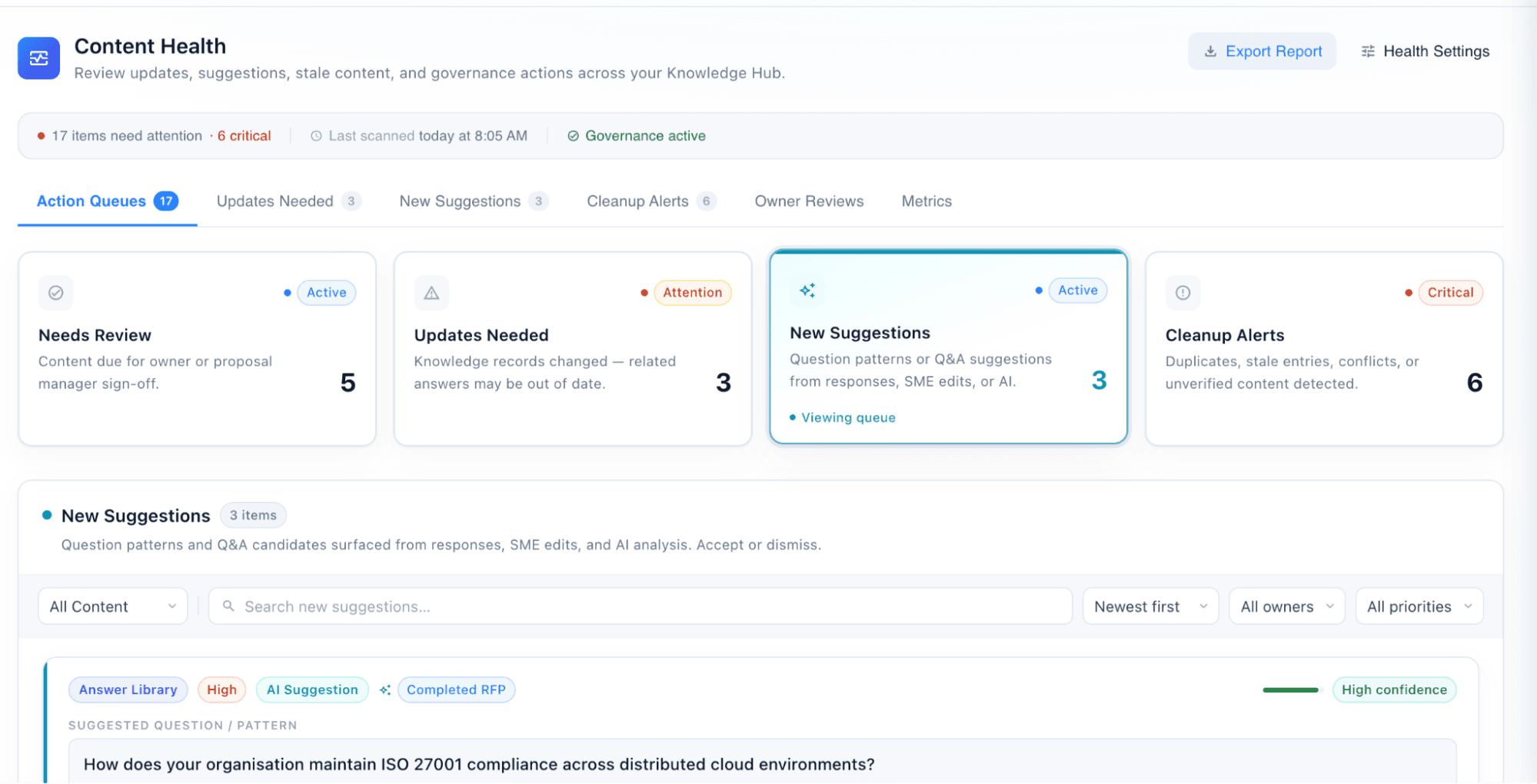
Thalamus AI's verified entity knowledge layer is the most structurally differentiated knowledge base architecture in the enterprise RFP category. Every answer is traceable to a named source document with a completeness score and last-verified timestamp, eliminating the two most common failure modes of Q&A library platforms: stale answers and untraceable claims.
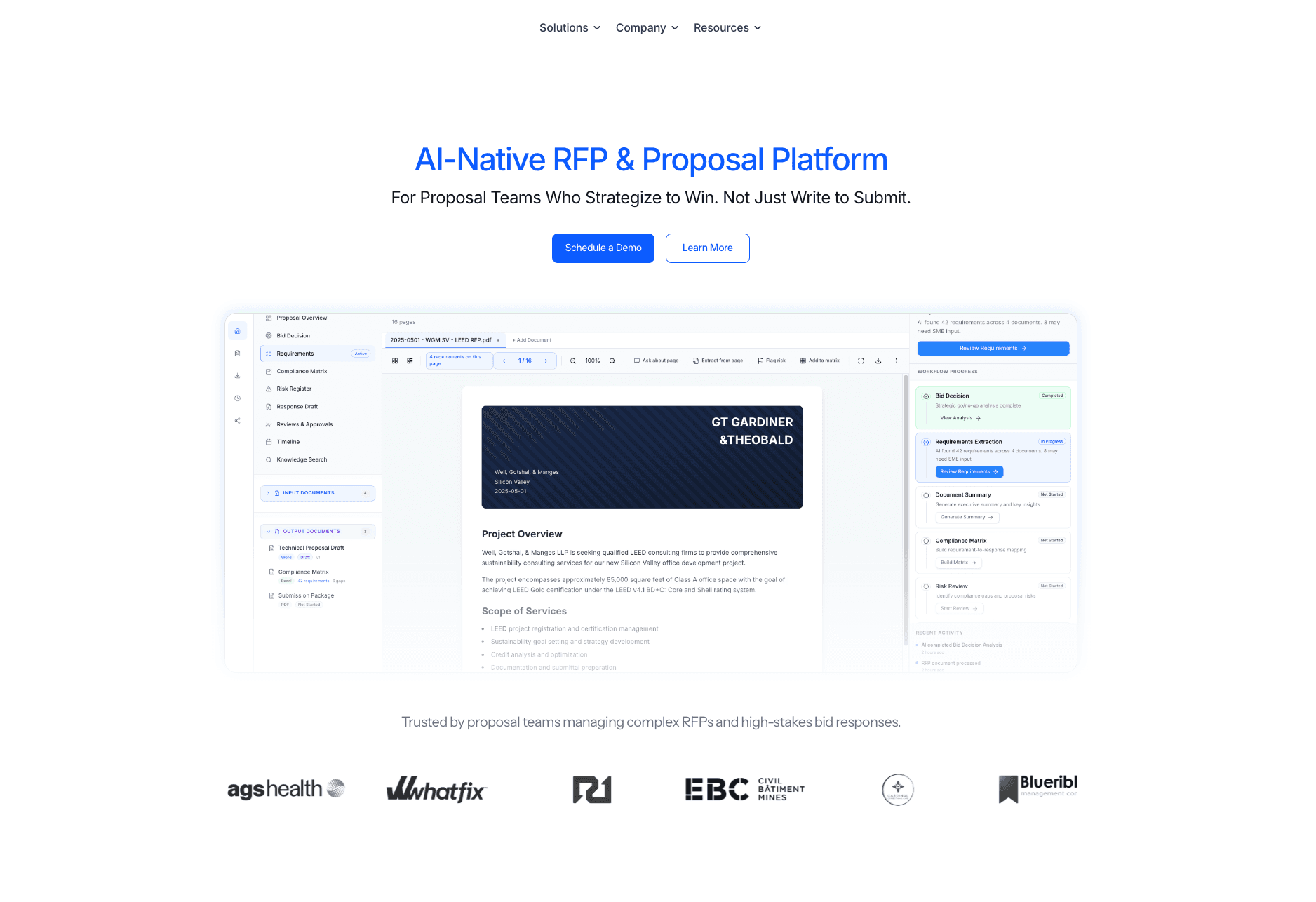
When an evaluator asks to verify a past performance claim in a Thalamus AI-generated proposal, the answer includes a direct link to the source document and the specific section it was drawn from. When a library-based platform is asked the same question, the answer comes from a Q&A pair that may have been written two years ago without any connection to the original source.

Thalamus AI is the strongest fit when compliance-grade answer provenance, no library maintenance overhead, and full bid lifecycle coverage, from capture planning through post-bid institutional learning, are all required in a single platform. 

For a direct side-by-side with Loopio, see our Thalamus AI vs Loopio comparison. For a comparison with general-purpose AI tools, see Thalamus AI vs General LLMs.

Tribble - RFP Knowledge Base That Learns from Deal Outcomes

Tribble's positronic living knowledge graph is the closest thing in the market to a self-improving RFP knowledge base. It ingests connected sources continuously, including CRM data and win/loss outcomes, and surfaces which knowledge correlates with deals won versus lost. 
Content that wins gets prioritized; content associated with losses gets flagged. For enterprise B2B and financial services teams running consistent, high-volume workflows, Tribble's architecture offers compounding returns that static Q&A libraries cannot match.

Loopio and Responsive - RFP Content Library Platforms for Teams With Dedicated Content Owners

Both serve the Q&A library model well when the team has content owner capacity. Loopio scores higher on G2 ease of use (9.1/10) and customer support (9.7/10). Responsive offers a deeper integration ecosystem like Salesforce, HubSpot, SharePoint, and broader procurement portal connectivity.

Both carry the same structural caveat: the library maintenance burden is real, ongoing, and frequently larger than teams anticipated at evaluation. For alternatives to both, see our 10 Best Loopio Alternatives in 2026 and 10 Best Responsive Alternatives in 2026.

Enterprise teams running 50+ RFPs per year on a manually maintained library: this is the conversation worth having before your next renewal. → See What No-Library Knowledge Management Looks Like

RFP Knowledge Base Maintenance: The Hidden Cost Nobody Quantifies

These figures are directional estimates based on user-community reports and typical senior proposal labor assumptions. Actual maintenance cost depends on RFP volume, library size, content complexity, review cadence, and whether the team has a dedicated proposal operations owner.
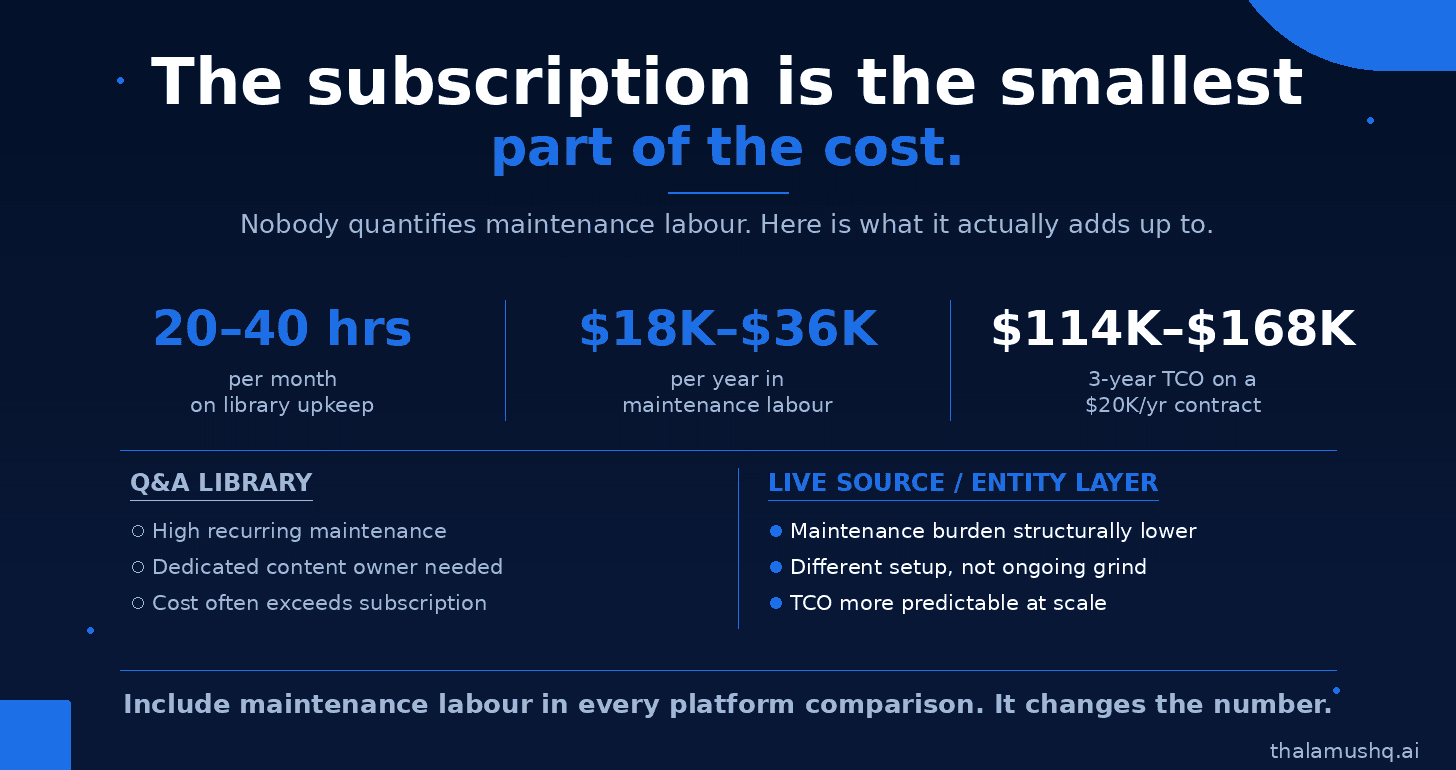
Every RFP software comparison compares subscription costs. Almost none compare total cost of ownership, which includes the labor cost of maintaining the knowledge base over the contract period.

For Q&A library platforms, that cost is high. Based on verified user community reports on G2 and Capterra, enterprise teams maintaining a mature Loopio or Responsive library spend a minimum of 20 to 40 hours per month on upkeep like tagging new content, removing duplicates, updating answers when certifications change, and reviewing stale entries. 

At a loaded labor cost of $75 per hour for a senior proposal professional, that is $1,500 to $3,000 per month in maintenance overhead or $18,000 to $36,000 per year, before the software subscription.

For a team on a $20,000 per year contract, the three-year total cost of ownership is not $60,000. It is $60,000 in subscription fees plus $54,000 to $108,000 in maintenance labor. The maintenance cost frequently exceeds the software cost.

The live source and verified entity models eliminate most of this overhead by shifting how knowledge is stored and retrieved. They introduce different requirements like source document organization for live source platforms and entity ingestion for entity layer platforms, but the recurring maintenance burden is structurally lower.

This is not an argument against Q&A library platforms. It is an argument for including the maintenance cost in the total cost of ownership when comparing platforms. For a full pricing model breakdown, see our RFP Software Pricing Guide for 2026.

What to Look for in RFP Knowledge Management Software?

Five capabilities determine whether the knowledge base delivers value at month 24, not just at the demo.
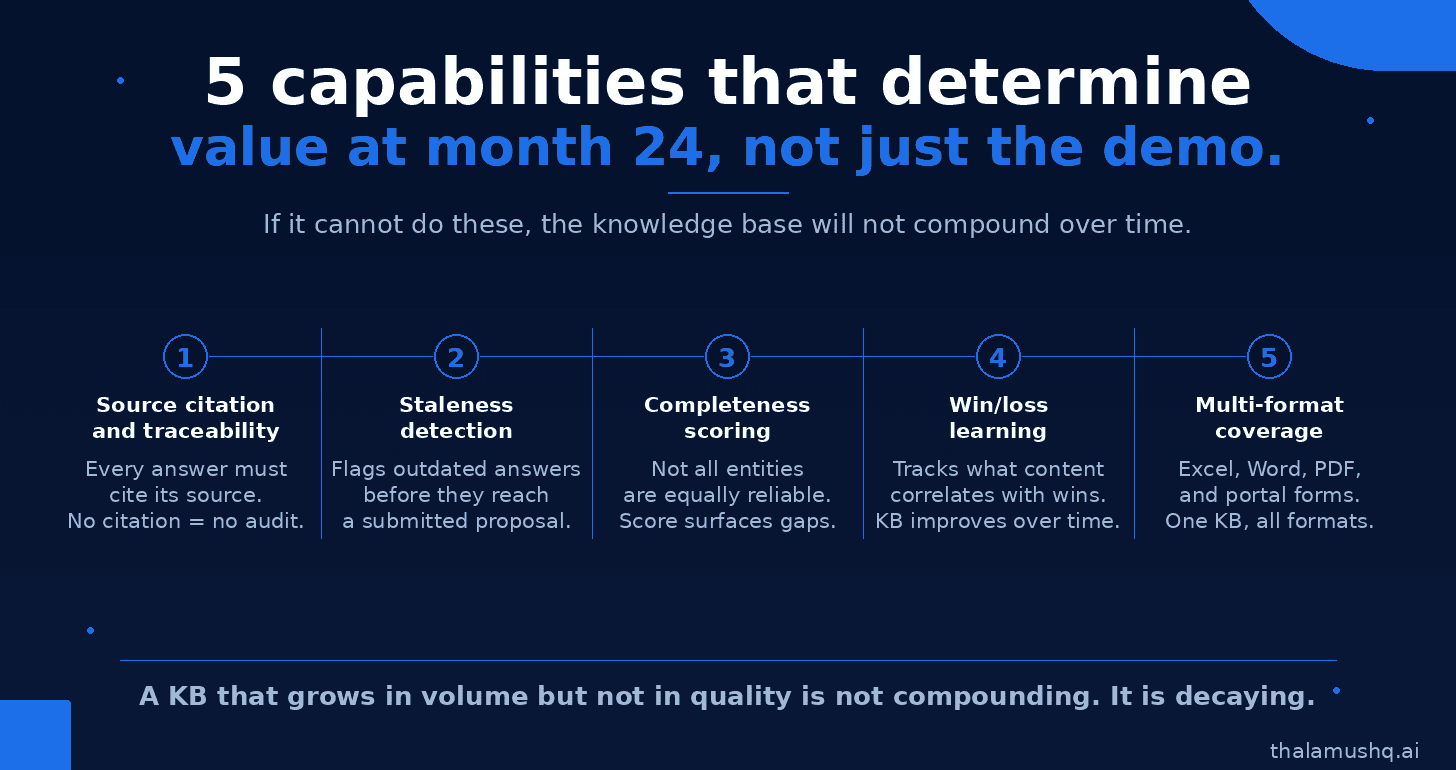
  • Source citation and answer traceability 

Every AI-generated answer should reference the specific source it was drawn from. Without this, proposal teams cannot verify claims during review, and there is no mechanism to identify when a source changes.

  • Staleness detection and governance

The knowledge base should proactively identify when answers may be outdated, either because a connected source changed or a review date has passed.

  • Completeness scoring

Not all knowledge entities are equally complete or reliable. A system that surfaces completeness scores lets proposal managers prioritize verification effort and prevents incomplete answers from reaching submitted proposals without review.

  • Win/loss learning integration

The strongest knowledge bases improve automatically by tracking which content correlates with wins. Without this feedback loop, a knowledge base grows in volume but not in quality.

  • Multi-format coverage

The knowledge base should serve the full range of formats the team receives - Excel, Word, PDF, and portal-based submissions. A knowledge base covering only one format requires separate tools for others, undermining knowledge consistency.

For a full comparison across all these dimensions, see our 12 Best AI RFP Software Tools in 2026.

How to Build an RFP Knowledge Base That Does Not Degrade Over Time?

Here are a few tips and best practices to follow to make sure that your library stays updated and fresh always: 
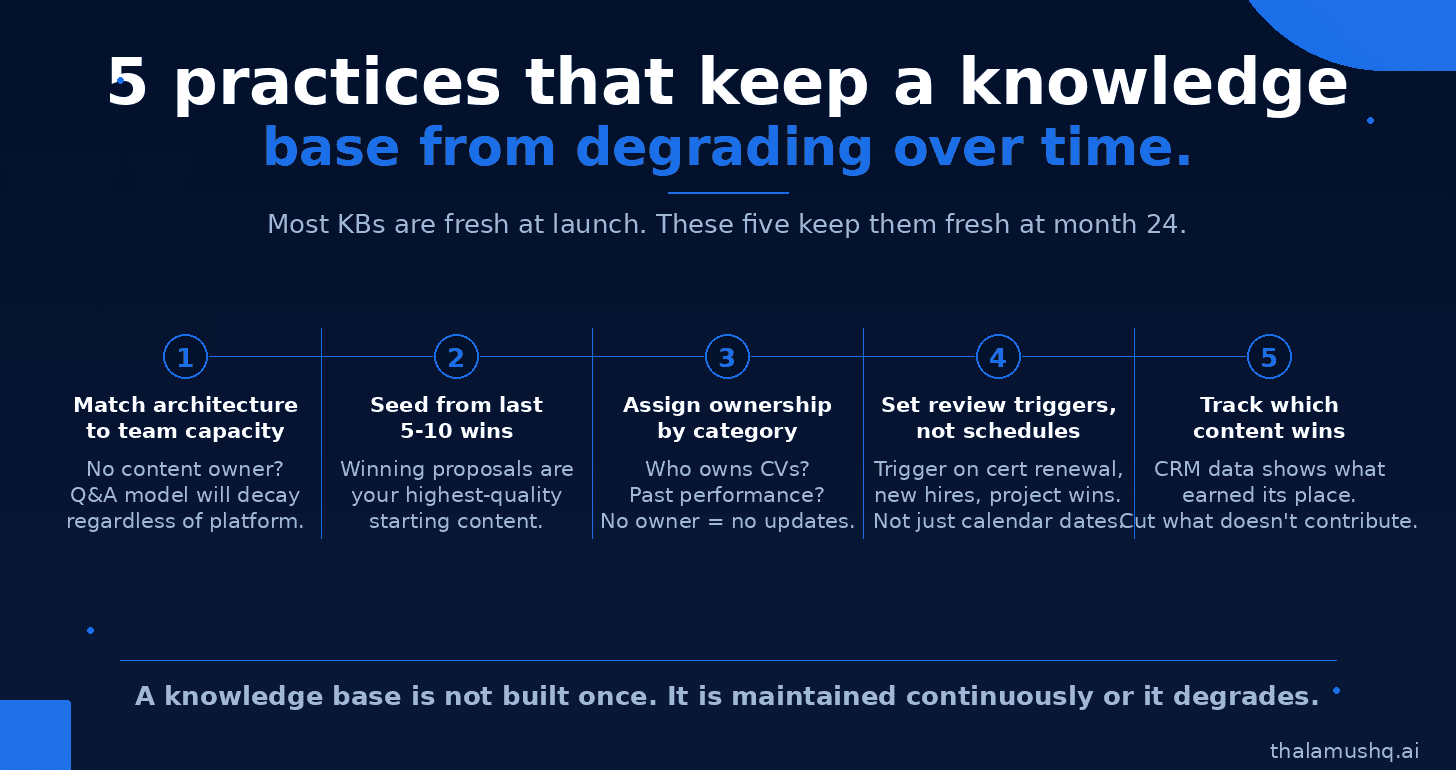
  1. Match the knowledge architecture to your team's actual maintenance capacity first - 

If the team does not have a dedicated content owner who will spend 20+ hours per month on library governance, the Q&A library model will degrade regardless of platform.

  1. Seed from your last five to ten winning proposals - 

The highest-quality initial content for any RFP knowledge base is past winning proposals, verified, approved, and demonstrably associated with positive outcomes.

  1. Assign content ownership by category before launch - 
Who owns technical capability claims? Past performance verification? Team CVs? Without pre-assigned ownership, content decays when circumstances change because no one feels accountable for updating it.

  1. Set review triggers, not just review schedules - 

Annual reviews are better than no schedule. Review triggers are better as they fire when something changes rather than on a calendar date. Set triggers for: certification renewal, key personnel changes, new project completions, portfolio changes, and win/loss notifications.

  1. Track which content wins - 

Platforms that integrate CRM data can show which knowledge base content was used in closed deals. After 12 to 18 months, this data reveals which parts of the knowledge base are earning their place and which are occupying space without contributing to outcomes.

RFP Knowledge Base Software FAQ

What is the difference between an RFP knowledge base and a general knowledge base like Confluence? 

A general knowledge base stores information for human retrieval, like someone searches and reads. 

An RFP knowledge base is structured specifically for AI retrieval and proposal assembly; knowledge is stored in a form that AI can match against incoming RFP questions, retrieve with source attribution, and assemble into structured responses. 

Confluence can store a product description document; an RFP knowledge base stores that same information as a verified, tagged, completeness-scored entity that an AI can cite in a proposal with a direct source link.

How do you migrate an RFP knowledge base when switching platforms? 

Most Q&A library platforms support export in CSV or Excel. The practical guidance: do not migrate everything. Audit the existing library first, identify the 20% of content generating 80% of reuse, retire outdated or duplicate entries, and migrate only current, verified, high-usage content. 

Migrating a stale library into a new platform reproduces the problem at a new address. For platforms using a live source or entity layer model, migration means connecting to live source systems rather than transferring a Q&A database, a configuration exercise, not a data migration.

Can one RFP knowledge base serve multiple business units or product lines? 

Yes, but governance becomes significantly more complex. The knowledge base must distinguish between universal content (company overview, security certifications, financial stability) and division-specific content (technical capabilities, past performance, team credentials). 

Most enterprise platforms support segmented library structures. The practical risk: content applicable to one division gets surfaced in proposals for another. Segmented governance with clear content ownership by division is essential before a shared knowledge base reaches meaningful scale.

What happens to the RFP knowledge base when key staff members leave? 

On Q&A library platforms, departures create two risks: knowledge gaps (answers that relied on the departed person's expertise become harder to update) and governance gaps (if the content owner for a category leaves, that category begins to degrade immediately). 

On verified entity layer platforms like Thalamus AI, the risk is lower as knowledge is grounded in source documents rather than individuals' curated answers. 

The practical mitigation on any platform: document content ownership in writing, cross-train at least one backup owner per content category, and include knowledge base governance in staff offboarding checklists.

Upgrade Your RFP Knowledge Base Software with Thalamus AI

The choice of RFP knowledge base architecture is a decision that compounds, positively or negatively, over the entire contract period. Teams that choose an architecture aligned with their actual maintenance capacity build institutional knowledge that grows more valuable over time. Teams that choose the wrong architecture spend that same period managing a degradation problem.

The Q&A library model is the right choice when a dedicated content owner is genuinely available and committed. The live source model is the right choice when content already lives in well-organized current systems. The verified entity layer is the right choice when compliance-grade answer provenance and minimal library maintenance are both required.

If your team is evaluating all three, or reconsidering a current platform that has not delivered the sustained output quality promised at demo, the clearest next step is a direct comparison on your actual content.

Your institutional knowledge is worth more than a degrading library. → Book Your Demo

Related reading: 12 Best AI RFP Software Tools in 2026 | Thalamus AI vs Loopio | RFP Software Pricing in 2026 

Table of Content