Compare

Compare

10 mins

10 mins

Thalamus AI vs Conveyor: RFP Platform Comparison 2026

Thalamus AI vs Conveyor: RFP Platform Comparison 2026

Thalamus AI vs Conveyor: RFP Platform Comparison 2026

Thalamus AI vs Conveyor: RFP Platform Comparison 2026

Harpreet Singh, MBA

Founder, Thalamus AI

With 12+ years in AI and enterprise software, including GenAI product work at Travelers Group, Harpreet writes about AI RFP software, AI bid tools, proposal operations, RFP response automation, and the future of enterprise bid management.

Summarize with ChatGPT

Summarize with ChatGPT

Key Takeaways

  • Conveyor is the only platform in this category with a Trust Center, a customer-facing portal where prospects self-serve security documentation without sending a questionnaire. This is a demand-side philosophy: reduce the questions you receive. Thalamus AI is a supply-side philosophy: make your organization faster and more reliable at answering every type of RFx.

  • Conveyor's AI agent "Sue" autonomously answers 90%+ of security questionnaire questions with 95%+ claimed first-pass accuracy, a genuine and impressive capability for its defined scope.

  • Conveyor's credit-based pricing model is its most common user complaint: the Professional tier starts at $9,600/year with a limited number of RFP project credits, and teams hit that ceiling quickly at scale.

  • Conveyor supports security questionnaires, Trust Centers, and RFP response workflows, but it is not publicly positioned as a full bid lifecycle platform. Thalamus AI is stronger when teams need complex narrative proposals, compliance matrices, addendum tracking, AI RACI routing, bid/no-bid scoring, SME coordination, and post-bid learning.

  • Enterprise customers using Thalamus AI across complex proposal environments have reported a +34% improvement in response reliability, 3x more shortlist appearances, and a 2.5x increase in bid win rates.

  • Buyers searching for “Thalamus AI vs Conveyor,” “Conveyor alternatives,” “Conveyor pricing,” or “AI RFP software comparison” are usually deciding whether their main problem is security questionnaire volume or full RFx and proposal workflow complexity.

Conveyor is the most philosophically distinct platform I have covered in this comparison series, and I want to name that upfront because it changes what the comparison is actually about.

Every other platform we've compared to Thalamus AI - Loopio, Responsive, Inventive AI, AutogenAI, Arphie, 1Up- approaches the same problem from the supply side: your organization receives RFPs and questionnaires, and the platform helps you answer them faster, more accurately, and more consistently. Conveyor does that, but it also does something none of the others do: it tries to reduce how many questionnaires you receive in the first place.

That is a different idea. And it is worth understanding before you decide which platform comparison is actually relevant to your team.

Summarize with ChatGPT

Key Takeaways

Key Takeaways

Key Takeaways

  • Conveyor is the only platform in this category with a Trust Center, a customer-facing portal where prospects self-serve security documentation without sending a questionnaire. This is a demand-side philosophy: reduce the questions you receive. Thalamus AI is a supply-side philosophy: make your organization faster and more reliable at answering every type of RFx.

  • Conveyor's AI agent "Sue" autonomously answers 90%+ of security questionnaire questions with 95%+ claimed first-pass accuracy, a genuine and impressive capability for its defined scope.

  • Conveyor's credit-based pricing model is its most common user complaint: the Professional tier starts at $9,600/year with a limited number of RFP project credits, and teams hit that ceiling quickly at scale.

  • Conveyor supports security questionnaires, Trust Centers, and RFP response workflows, but it is not publicly positioned as a full bid lifecycle platform. Thalamus AI is stronger when teams need complex narrative proposals, compliance matrices, addendum tracking, AI RACI routing, bid/no-bid scoring, SME coordination, and post-bid learning.

  • Enterprise customers using Thalamus AI across complex proposal environments have reported a +34% improvement in response reliability, 3x more shortlist appearances, and a 2.5x increase in bid win rates.

  • Buyers searching for “Thalamus AI vs Conveyor,” “Conveyor alternatives,” “Conveyor pricing,” or “AI RFP software comparison” are usually deciding whether their main problem is security questionnaire volume or full RFx and proposal workflow complexity.

Conveyor is the most philosophically distinct platform I have covered in this comparison series, and I want to name that upfront because it changes what the comparison is actually about.

Every other platform we've compared to Thalamus AI - Loopio, Responsive, Inventive AI, AutogenAI, Arphie, 1Up- approaches the same problem from the supply side: your organization receives RFPs and questionnaires, and the platform helps you answer them faster, more accurately, and more consistently. Conveyor does that, but it also does something none of the others do: it tries to reduce how many questionnaires you receive in the first place.

That is a different idea. And it is worth understanding before you decide which platform comparison is actually relevant to your team.

  • Conveyor is the only platform in this category with a Trust Center, a customer-facing portal where prospects self-serve security documentation without sending a questionnaire. This is a demand-side philosophy: reduce the questions you receive. Thalamus AI is a supply-side philosophy: make your organization faster and more reliable at answering every type of RFx.

  • Conveyor's AI agent "Sue" autonomously answers 90%+ of security questionnaire questions with 95%+ claimed first-pass accuracy, a genuine and impressive capability for its defined scope.

  • Conveyor's credit-based pricing model is its most common user complaint: the Professional tier starts at $9,600/year with a limited number of RFP project credits, and teams hit that ceiling quickly at scale.

  • Conveyor supports security questionnaires, Trust Centers, and RFP response workflows, but it is not publicly positioned as a full bid lifecycle platform. Thalamus AI is stronger when teams need complex narrative proposals, compliance matrices, addendum tracking, AI RACI routing, bid/no-bid scoring, SME coordination, and post-bid learning.

  • Enterprise customers using Thalamus AI across complex proposal environments have reported a +34% improvement in response reliability, 3x more shortlist appearances, and a 2.5x increase in bid win rates.

  • Buyers searching for “Thalamus AI vs Conveyor,” “Conveyor alternatives,” “Conveyor pricing,” or “AI RFP software comparison” are usually deciding whether their main problem is security questionnaire volume or full RFx and proposal workflow complexity.

Conveyor is the most philosophically distinct platform I have covered in this comparison series, and I want to name that upfront because it changes what the comparison is actually about.

Every other platform we've compared to Thalamus AI - Loopio, Responsive, Inventive AI, AutogenAI, Arphie, 1Up- approaches the same problem from the supply side: your organization receives RFPs and questionnaires, and the platform helps you answer them faster, more accurately, and more consistently. Conveyor does that, but it also does something none of the others do: it tries to reduce how many questionnaires you receive in the first place.

That is a different idea. And it is worth understanding before you decide which platform comparison is actually relevant to your team.

  • Conveyor is the only platform in this category with a Trust Center, a customer-facing portal where prospects self-serve security documentation without sending a questionnaire. This is a demand-side philosophy: reduce the questions you receive. Thalamus AI is a supply-side philosophy: make your organization faster and more reliable at answering every type of RFx.

  • Conveyor's AI agent "Sue" autonomously answers 90%+ of security questionnaire questions with 95%+ claimed first-pass accuracy, a genuine and impressive capability for its defined scope.

  • Conveyor's credit-based pricing model is its most common user complaint: the Professional tier starts at $9,600/year with a limited number of RFP project credits, and teams hit that ceiling quickly at scale.

  • Conveyor supports security questionnaires, Trust Centers, and RFP response workflows, but it is not publicly positioned as a full bid lifecycle platform. Thalamus AI is stronger when teams need complex narrative proposals, compliance matrices, addendum tracking, AI RACI routing, bid/no-bid scoring, SME coordination, and post-bid learning.

  • Enterprise customers using Thalamus AI across complex proposal environments have reported a +34% improvement in response reliability, 3x more shortlist appearances, and a 2.5x increase in bid win rates.

  • Buyers searching for “Thalamus AI vs Conveyor,” “Conveyor alternatives,” “Conveyor pricing,” or “AI RFP software comparison” are usually deciding whether their main problem is security questionnaire volume or full RFx and proposal workflow complexity.

Conveyor is the most philosophically distinct platform I have covered in this comparison series, and I want to name that upfront because it changes what the comparison is actually about.

Every other platform we've compared to Thalamus AI - Loopio, Responsive, Inventive AI, AutogenAI, Arphie, 1Up- approaches the same problem from the supply side: your organization receives RFPs and questionnaires, and the platform helps you answer them faster, more accurately, and more consistently. Conveyor does that, but it also does something none of the others do: it tries to reduce how many questionnaires you receive in the first place.

That is a different idea. And it is worth understanding before you decide which platform comparison is actually relevant to your team.

Quick Answer: Thalamus AI vs Conveyor - Which Platform Is Better?

Quick Answer: Thalamus AI vs Conveyor - Which Platform Is Better?

Conveyor is better for SaaS and technology teams whose main problem is security questionnaire volume. Its strongest differentiators are its customer-facing Trust Center, AI security questionnaire automation, browser extension for portal responses, source citations, and usage-based customer trust workflow.

Thalamus AI is better for enterprise proposal teams whose work extends beyond security questionnaires into full RFPs, DDQs, narrative proposals, compliance matrices, addendum tracking, AI RACI routing, SME collaboration, bid/no-bid scoring, portal responses, and post-bid learning.

Conveyor supports RFP response workflows, but its center of gravity is customer trust, security questionnaire automation, Trust Centers, browser-based questionnaire completion, and security-review volume reduction. Thalamus AI is broader bid lifecycle infrastructure for teams that need requirement mapping, compliance matrices, addenda tracking, bid/no-bid scoring, RACI routing, SME collaboration, narrative proposal drafting, portal responses, and post-bid learning in one platform.

The short version: choose Conveyor if your biggest problem is reducing and answering security questionnaires. Choose Thalamus AI if security questionnaires are only one part of a broader RFx and proposal workflow.

Conveyor is better for SaaS and technology teams whose main problem is security questionnaire volume. Its strongest differentiators are its customer-facing Trust Center, AI security questionnaire automation, browser extension for portal responses, source citations, and usage-based customer trust workflow.

Thalamus AI is better for enterprise proposal teams whose work extends beyond security questionnaires into full RFPs, DDQs, narrative proposals, compliance matrices, addendum tracking, AI RACI routing, SME collaboration, bid/no-bid scoring, portal responses, and post-bid learning.

Conveyor supports RFP response workflows, but its center of gravity is customer trust, security questionnaire automation, Trust Centers, browser-based questionnaire completion, and security-review volume reduction. Thalamus AI is broader bid lifecycle infrastructure for teams that need requirement mapping, compliance matrices, addenda tracking, bid/no-bid scoring, RACI routing, SME collaboration, narrative proposal drafting, portal responses, and post-bid learning in one platform.

The short version: choose Conveyor if your biggest problem is reducing and answering security questionnaires. Choose Thalamus AI if security questionnaires are only one part of a broader RFx and proposal workflow.

Thalamus AI vs Conveyor: What Each Platform Is Actually Built For?

Thalamus AI vs Conveyor: What Each Platform Is Actually Built For?

Across every sales team and proposal team conversation where Conveyor comes up, it surfaces the same two ways: either as the tool that handles the security questionnaire queue so the proposal team doesn't have to, or as the platform that prospects interact with before a questionnaire is even sent. Both of those are real, and both of them matter.

Conveyor was founded in 2021 and was one of the earliest platforms in this space to deploy generative AI in production workflows; by 2023, GPT-driven agents were already answering security questionnaires autonomously. Its flagship AI agent, "Sue," reads, interprets, and answers 90%+ of security questionnaire questions without human input, citing sources and flagging anything uncertain for review. Its Trust Center, a customer-facing portal, lets prospects ask natural-language security questions and download SOC 2 reports, ISO certifications, and compliance documentation behind a secure NDA gate, without ever sending a questionnaire to your team. For a SaaS company fielding dozens of security reviews per quarter from enterprise buyers, that combination of inbound volume reduction and autonomous response is genuinely powerful.

Thalamus AI operates at a different scope and with a different philosophy. Thalamus AI operates at a broader scope and with a different philosophy. Conveyor’s center of gravity is customer trust and security-review automation. Thalamus AI is built to manage the full bid lifecycle across RFPs, RFIs, DDQs, security questionnaires, portal responses, and complex narrative proposals. It converts your unstructured documents into verified, editable knowledge entities, deploys 20+ specialized AI agents across every stage like requirement parsing, compliance matrix generation, bid/no-bid scoring, RACI routing, SME coordination, addendum tracking, and post-bid institutional learning, and builds a decision graph that compounds with every submission your team makes.

One platform reduces the burden of one specific document type exceptionally well. The other manages the full burden of a bid function.

Already using Conveyor for security questionnaires but struggling with complex RFPs? Bring one live bid to a Thalamus AI demo, 20 minutes, no slides.

Across every sales team and proposal team conversation where Conveyor comes up, it surfaces the same two ways: either as the tool that handles the security questionnaire queue so the proposal team doesn't have to, or as the platform that prospects interact with before a questionnaire is even sent. Both of those are real, and both of them matter.

Conveyor was founded in 2021 and was one of the earliest platforms in this space to deploy generative AI in production workflows; by 2023, GPT-driven agents were already answering security questionnaires autonomously. Its flagship AI agent, "Sue," reads, interprets, and answers 90%+ of security questionnaire questions without human input, citing sources and flagging anything uncertain for review. Its Trust Center, a customer-facing portal, lets prospects ask natural-language security questions and download SOC 2 reports, ISO certifications, and compliance documentation behind a secure NDA gate, without ever sending a questionnaire to your team. For a SaaS company fielding dozens of security reviews per quarter from enterprise buyers, that combination of inbound volume reduction and autonomous response is genuinely powerful.

Thalamus AI operates at a different scope and with a different philosophy. Thalamus AI operates at a broader scope and with a different philosophy. Conveyor’s center of gravity is customer trust and security-review automation. Thalamus AI is built to manage the full bid lifecycle across RFPs, RFIs, DDQs, security questionnaires, portal responses, and complex narrative proposals. It converts your unstructured documents into verified, editable knowledge entities, deploys 20+ specialized AI agents across every stage like requirement parsing, compliance matrix generation, bid/no-bid scoring, RACI routing, SME coordination, addendum tracking, and post-bid institutional learning, and builds a decision graph that compounds with every submission your team makes.

One platform reduces the burden of one specific document type exceptionally well. The other manages the full burden of a bid function.

Already using Conveyor for security questionnaires but struggling with complex RFPs? Bring one live bid to a Thalamus AI demo, 20 minutes, no slides.

Thalamus AI vs Conveyor: Side-by-Side Feature Comparison

Thalamus AI vs Conveyor: Side-by-Side Feature Comparison

Thalamus AI vs Conveyor: Side-by-Side Feature Comparison

What You're Actually Evaluating

Thalamus AI

Conveyor

Core product philosophy

Supply-side: make your organization faster at responding to every RFx type

Demand-side + supply-side: reduce inbound questionnaire volume via Trust Center AND automate what remains

AI architecture

AI-native bid management platform; 20+ specialized agentic workflows

AI-native security questionnaire platform; "Sue" AI agent for autonomous questionnaire completion

Trust Center / self-serve portal

Not a core feature

✓ Customer-facing portal for self-serve security documentation, a unique differentiator

Primary use case

Complex, multi-section narrative proposals + all RFx types including security questionnaires

Security questionnaires, DDQs, and trust documentation

Full bid lifecycle coverage

✓ Capture → Qualify → Plan → Coordinate → Respond → Learn

Customer trust, security questionnaire automation, and RFP response support; not publicly positioned as a full bid lifecycle platform

Narrative proposal support

✓ 150-page multi-document proposals with structured assembly

Not publicly positioned as a core capability for complex, long-form narrative proposal assembly

Compliance matrix & requirement mapping

✓ Auto-generated living compliance index with requirement-level traceability

Not publicly positioned as a core capability

Addendum & change impact tracking

✓ Automatically flags impacted sections when requirements change

Not a capability

Bid / No-Bid scoring

✓ AI-generated with win/loss outcome data

Not a capability

RACI & multi-stakeholder routing

✓ Auto-classifies and routes to proposal, legal, security, SME teams at subsection level

Security-team-centric workflow; not designed for multi-team proposal coordination

Institutional memory & decision graph

✓ Every win, loss, correction, and reviewer comment improves future bids

Not a capability

AI first-pass accuracy

~99% on verified-entity-grounded responses (Thalamus AI)

95%+ on security questionnaires (Conveyor)

Browser extension for web portals

✓ Native part of the RFx workflow

✓ Browser extension for portal-based questionnaires

Source citations

✓ Every entity cited, traceable to source document

✓ Source citations on AI-generated answers

Pricing structure

Unlimited users and RFPs under one subscription; custom quote

Credit-based per project; Professional tier ~$9,600/year with limited project credits

Pricing constraint at scale

None, unlimited usage under one subscription

G2 reviewers flag hitting 10-project credit limit quickly; becomes expensive at volume

Free trial

Not available; 3-month pilot pack

Available

Security certifications

SOC 2 Type II + ISO/IEC 27001:2022 + VAPT

SOC 2 Type II; enterprise OpenAI APIs with no-data-training guarantee; data isolation per customer

G2 rating

5.0/5 (growing review base)

~4.7/5 (143+ reviews)

Want this comparison applied to your specific RFx workflow? Book a 20-minute Thalamus AI session, bring your next RFP, and we'll run it live.

What You're Actually Evaluating

Thalamus AI

Conveyor

Core product philosophy

Supply-side: make your organization faster at responding to every RFx type

Demand-side + supply-side: reduce inbound questionnaire volume via Trust Center AND automate what remains

AI architecture

AI-native bid management platform; 20+ specialized agentic workflows

AI-native security questionnaire platform; "Sue" AI agent for autonomous questionnaire completion

Trust Center / self-serve portal

Not a core feature

✓ Customer-facing portal for self-serve security documentation, a unique differentiator

Primary use case

Complex, multi-section narrative proposals + all RFx types including security questionnaires

Security questionnaires, DDQs, and trust documentation

Full bid lifecycle coverage

✓ Capture → Qualify → Plan → Coordinate → Respond → Learn

Customer trust, security questionnaire automation, and RFP response support; not publicly positioned as a full bid lifecycle platform

Narrative proposal support

✓ 150-page multi-document proposals with structured assembly

Not publicly positioned as a core capability for complex, long-form narrative proposal assembly

Compliance matrix & requirement mapping

✓ Auto-generated living compliance index with requirement-level traceability

Not publicly positioned as a core capability

Addendum & change impact tracking

✓ Automatically flags impacted sections when requirements change

Not a capability

Bid / No-Bid scoring

✓ AI-generated with win/loss outcome data

Not a capability

RACI & multi-stakeholder routing

✓ Auto-classifies and routes to proposal, legal, security, SME teams at subsection level

Security-team-centric workflow; not designed for multi-team proposal coordination

Institutional memory & decision graph

✓ Every win, loss, correction, and reviewer comment improves future bids

Not a capability

AI first-pass accuracy

~99% on verified-entity-grounded responses (Thalamus AI)

95%+ on security questionnaires (Conveyor)

Browser extension for web portals

✓ Native part of the RFx workflow

✓ Browser extension for portal-based questionnaires

Source citations

✓ Every entity cited, traceable to source document

✓ Source citations on AI-generated answers

Pricing structure

Unlimited users and RFPs under one subscription; custom quote

Credit-based per project; Professional tier ~$9,600/year with limited project credits

Pricing constraint at scale

None, unlimited usage under one subscription

G2 reviewers flag hitting 10-project credit limit quickly; becomes expensive at volume

Free trial

Not available; 3-month pilot pack

Available

Security certifications

SOC 2 Type II + ISO/IEC 27001:2022 + VAPT

SOC 2 Type II; enterprise OpenAI APIs with no-data-training guarantee; data isolation per customer

G2 rating

5.0/5 (growing review base)

~4.7/5 (143+ reviews)

Want this comparison applied to your specific RFx workflow? Book a 20-minute Thalamus AI session, bring your next RFP, and we'll run it live.

Thalamus AI vs Conveyor: The Trust Center Advantage, and Where It Ends?

Thalamus AI vs Conveyor: The Trust Center Advantage, and Where It Ends?

Thalamus AI vs Conveyor: The Trust Center Advantage, and Where It Ends?

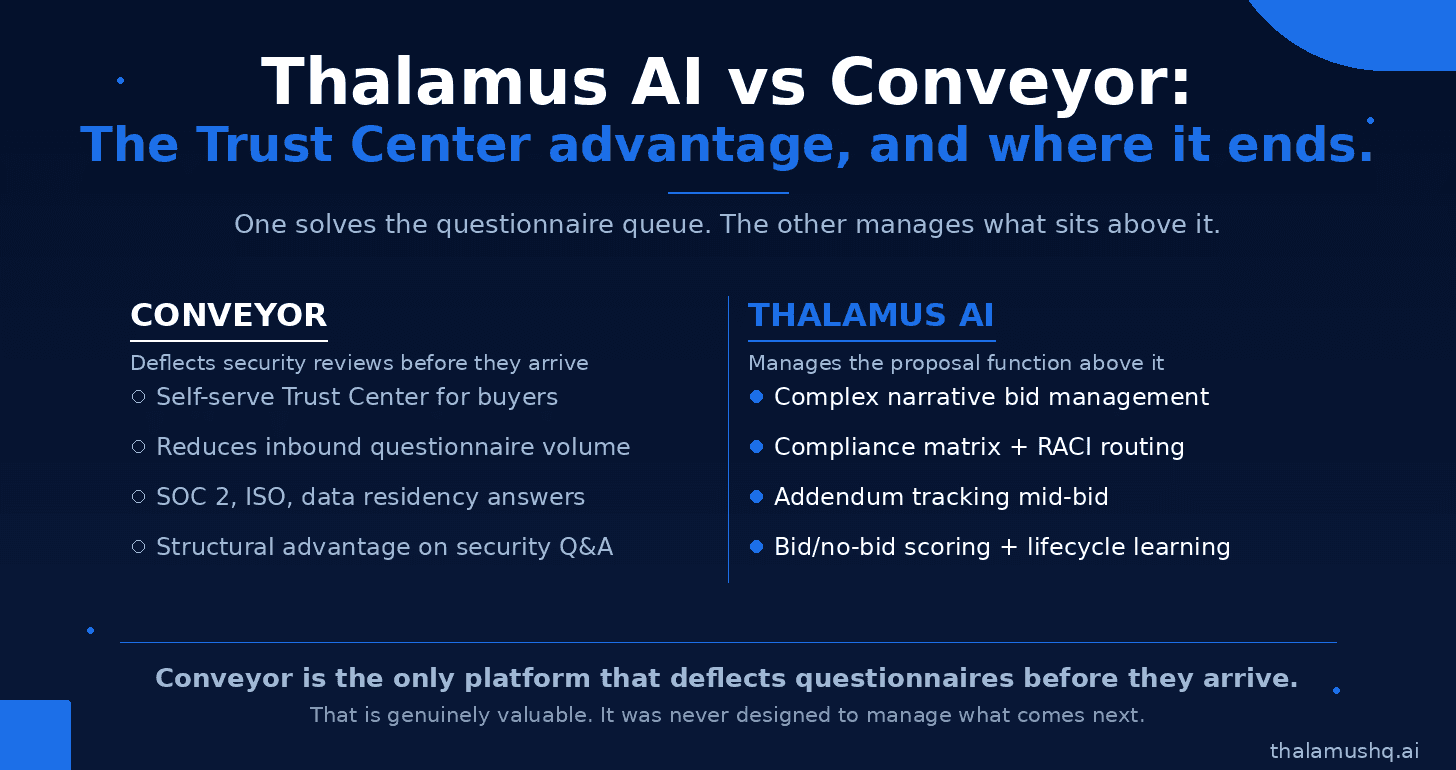
Conveyor's Trust Center deserves real attention because it is the only feature in this entire comparison series that addresses the problem before it arrives rather than after.

The logic is sound: if an enterprise buyer can self-serve your SOC 2 report, your ISO certification, and your data residency answers from a secure portal, without sending a questionnaire, your team never has to respond to that questionnaire at all. 

For a SaaS company with 200 active prospects in the funnel, each generating a 50-question security review, the reduction in inbound questionnaire volume that a well-deployed Trust Center produces is not a marginal efficiency gain. It is a structural change to how much response work your team has to do.

That is genuinely valuable, and no other platform in this category does it. Thalamus AI does not have a customer-facing Trust Center. If inbound questionnaire volume reduction is the primary goal, Conveyor has a structural advantage that Thalamus AI cannot match with a faster response engine.

Where the Trust Center ends is also important to name clearly. It deflects security reviews efficiently. It does not manage a 120-page public infrastructure bid with a mandatory compliance statement, six SME contributors, and an addendum. It does not generate a bid/no-bid score for an opportunity your team is evaluating. It does not route the technical approach section to the engineering lead and the commercial section to the pricing team. It does not flag that a clarification notice changed the evaluation weighting nine days before submission.

The Trust Center solves the security questionnaire queue. It does not,  and was never designed to, manage the proposal function that sits above it.

Finding that the questionnaire problem is solved but the complex bid problem isn't? See how Thalamus AI covers the full scope above the security questionnaire layer.

Conveyor's Trust Center deserves real attention because it is the only feature in this entire comparison series that addresses the problem before it arrives rather than after.

The logic is sound: if an enterprise buyer can self-serve your SOC 2 report, your ISO certification, and your data residency answers from a secure portal, without sending a questionnaire, your team never has to respond to that questionnaire at all. 

For a SaaS company with 200 active prospects in the funnel, each generating a 50-question security review, the reduction in inbound questionnaire volume that a well-deployed Trust Center produces is not a marginal efficiency gain. It is a structural change to how much response work your team has to do.

That is genuinely valuable, and no other platform in this category does it. Thalamus AI does not have a customer-facing Trust Center. If inbound questionnaire volume reduction is the primary goal, Conveyor has a structural advantage that Thalamus AI cannot match with a faster response engine.

Where the Trust Center ends is also important to name clearly. It deflects security reviews efficiently. It does not manage a 120-page public infrastructure bid with a mandatory compliance statement, six SME contributors, and an addendum. It does not generate a bid/no-bid score for an opportunity your team is evaluating. It does not route the technical approach section to the engineering lead and the commercial section to the pricing team. It does not flag that a clarification notice changed the evaluation weighting nine days before submission.

The Trust Center solves the security questionnaire queue. It does not,  and was never designed to, manage the proposal function that sits above it.

Finding that the questionnaire problem is solved but the complex bid problem isn't? See how Thalamus AI covers the full scope above the security questionnaire layer.

Conveyor's Trust Center deserves real attention because it is the only feature in this entire comparison series that addresses the problem before it arrives rather than after.

The logic is sound: if an enterprise buyer can self-serve your SOC 2 report, your ISO certification, and your data residency answers from a secure portal, without sending a questionnaire, your team never has to respond to that questionnaire at all. 

For a SaaS company with 200 active prospects in the funnel, each generating a 50-question security review, the reduction in inbound questionnaire volume that a well-deployed Trust Center produces is not a marginal efficiency gain. It is a structural change to how much response work your team has to do.

That is genuinely valuable, and no other platform in this category does it. Thalamus AI does not have a customer-facing Trust Center. If inbound questionnaire volume reduction is the primary goal, Conveyor has a structural advantage that Thalamus AI cannot match with a faster response engine.

Where the Trust Center ends is also important to name clearly. It deflects security reviews efficiently. It does not manage a 120-page public infrastructure bid with a mandatory compliance statement, six SME contributors, and an addendum. It does not generate a bid/no-bid score for an opportunity your team is evaluating. It does not route the technical approach section to the engineering lead and the commercial section to the pricing team. It does not flag that a clarification notice changed the evaluation weighting nine days before submission.

The Trust Center solves the security questionnaire queue. It does not,  and was never designed to, manage the proposal function that sits above it.

Finding that the questionnaire problem is solved but the complex bid problem isn't? See how Thalamus AI covers the full scope above the security questionnaire layer.

Thalamus AI vs Conveyor on Complex, Multi-Section Proposals

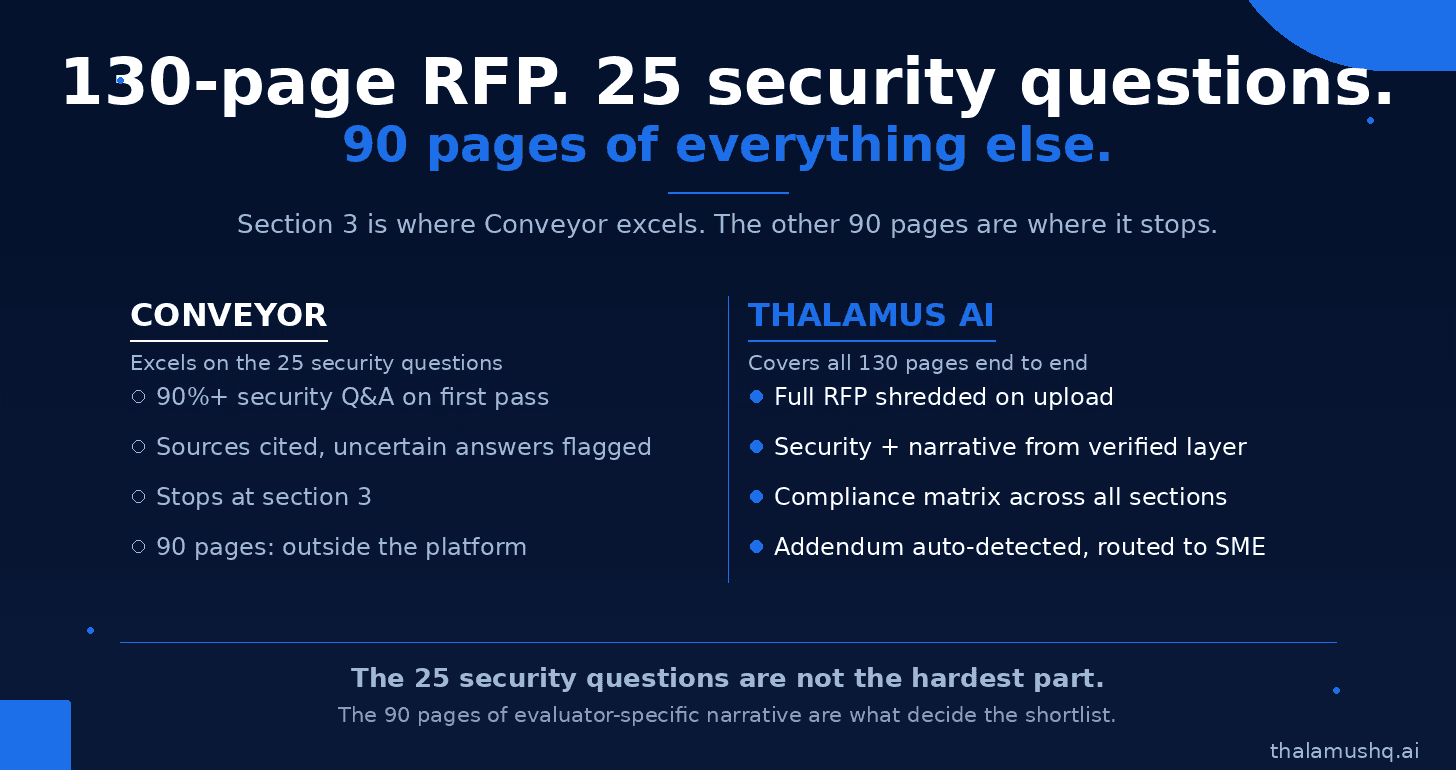
Imagine this. Your team is responding to a 130-page enterprise technology services RFP. Section 3 is a full technical security approach, 25 questions covering data residency, encryption standards, access controls, penetration testing, and incident response, plus 90 pages of commercial, delivery, and methodology content. Section 3 is exactly where Conveyor excels. The other 90 pages are exactly where Conveyor stops.
What does Conveyor do? 

Sue answers Section 3 autonomously with 90%+ of the security questions completed on first pass, sources cited, and uncertain answers flagged for review. For many teams, this genuinely eliminates the most time-consuming part of a security-heavy RFP. What happens to the remaining 90 pages falls outside the platform: no requirement extraction, no compliance matrix, no narrative drafting from verified knowledge entities, no RACI routing to the methodology team or the pricing lead, no addendum detection if requirements change mid-bid.

What does Thalamus AI do? 

The RFx Analysis Agent shreds the full 130-page RFP on upload, extracting every requirement across all sections into a living compliance matrix, mapping each to a section, owner, and status. Section 3's security questions are answered from verified knowledge entities: security policies, certifications, and compliance documentation attributed to source and confirmed current. 

The remaining 90 pages are drafted from the same verified layer, technical methodology from past proposal sections, delivery credentials from verified CVs, and commercial rationale from prior bid strategies. When an addendum arrives changing a security requirement in Section 3, Thalamus AI flags it automatically and routes the update to the right SME for re-approval, then updates the compliance matrix status.

The 25 security questions are not the hardest part of that RFP. They are often the most repetitive, the kind of structured, policy-backed questions that an autonomous AI agent handles well. The 90 pages of contextual, evaluator-specific narrative are harder, less repetitive, and consequential for whether you are shortlisted.

Does your team respond to RFPs where security questions are only part of the challenge? See how Thalamus AI handles the full scope in one connected workflow.

Where Conveyor Genuinely Wins?

I want to give Conveyor's strengths full credit, because for the right team it is not just a useful tool, it is a genuine competitive advantage.

The Trust Center is unlike anything else in this market. For a SaaS or technology company selling into enterprise buyers who run mandatory security reviews on every vendor, a well-deployed Trust Center changes the economics of the security review process permanently. Buyers self-serve. Questionnaire volume drops. The AI handles what remains. The 50% to 70% reduction in questionnaire completion time that Conveyor users consistently report is real, and the Trust Center means some of that time saving comes from questionnaires that simply never arrive.

Sue's autonomous completion rate is also a genuine differentiator. 90%+ of security questionnaire questions answered without human input, on first pass, at 95%+ accuracy, for a security team that currently spends a week per questionnaire coordinating answers across engineering, legal, and infosec, that is a transformative change to the workload. Conveyor's 9.5/10 G2 support score, the highest in its category, reflects a team that backs that capability up with responsive, domain-knowledgeable post-sale support.

The credit-based pricing model is Conveyor's honest limitation. The Professional tier at $9,600/year includes a limited number of RFP project credits, and multiple G2 reviewers note that their teams hit the starting allotment of ten projects quickly, making Conveyor expensive at scale for teams with high questionnaire volume. For teams that deploy it at low-to-moderate volume, the economics work. For teams with high inbound questionnaire frequency, the per-project credit model penalizes the teams that need it most.

Thalamus AI vs Conveyor: Who Should You Choose?

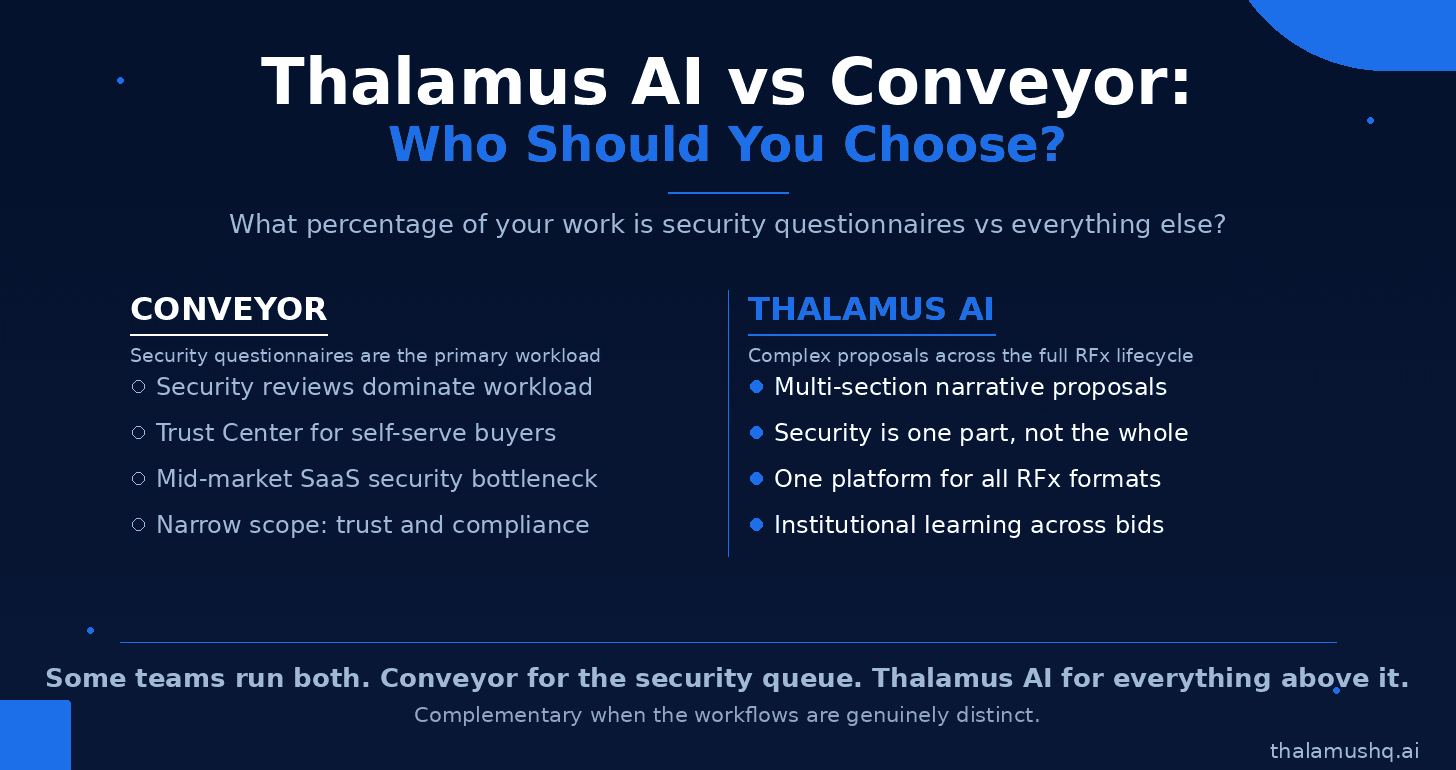
The clearest way to frame this decision: what percentage of your bid team's work is security questionnaires, and what percentage is everything else?
Choose Conveyor if:

  • Your team's primary workload is inbound security questionnaires and vendor trust reviews from enterprise buyers.

  • You want to reduce questionnaire volume before it reaches your team, not just answer it faster.

  • A customer-facing Trust Center for self-serve security documentation is a meaningful differentiator in your sales cycle.

  • Your proposal scope is narrow: security, compliance, and trust documentation rather than full RFPs.

  • You are a mid-market SaaS company where the security review bottleneck is the dominant proposal pain point. 

Choose Thalamus AI if:

  • Your bids include complex, multi-section narrative proposals where a compliance matrix, addendum tracking, and RACI coordination across multiple stakeholders determine whether you are shortlisted.

  • Security questionnaires are one component of your RFx workload, not the entirety of it.

  • You need a single platform for every RFx type, narrative proposals, online portal questionnaires, Excel and Word forms, security questionnaires, without multiple tools for different document categories.

  • You want institutional learning: every bid your team submits improves the next one, not just the one in front of you.

  • Credit-based pricing at scale is a cost concern; unlimited usage under one subscription removes that ceiling. 

Honestly, some teams run both. Conveyor's Trust Center and Sue agent for the security questionnaire queue. Thalamus AI for the complex, high-stakes proposals that sit above that layer. These are complementary when the workflows are genuinely distinct, not competing for the same budget when both problems exist at meaningful scale.

Think your bids have grown beyond what a security questionnaire tool covers? Start with a 3-month Thalamus AI pilot, unlimited projects, unlimited RFPs, one team.

What Enterprise Customers Report After Moving to Thalamus AI?

Enterprise customers using Thalamus AI across complex proposal environments have reported measurable improvements that compound across every bid type, not just the security questionnaire queue.
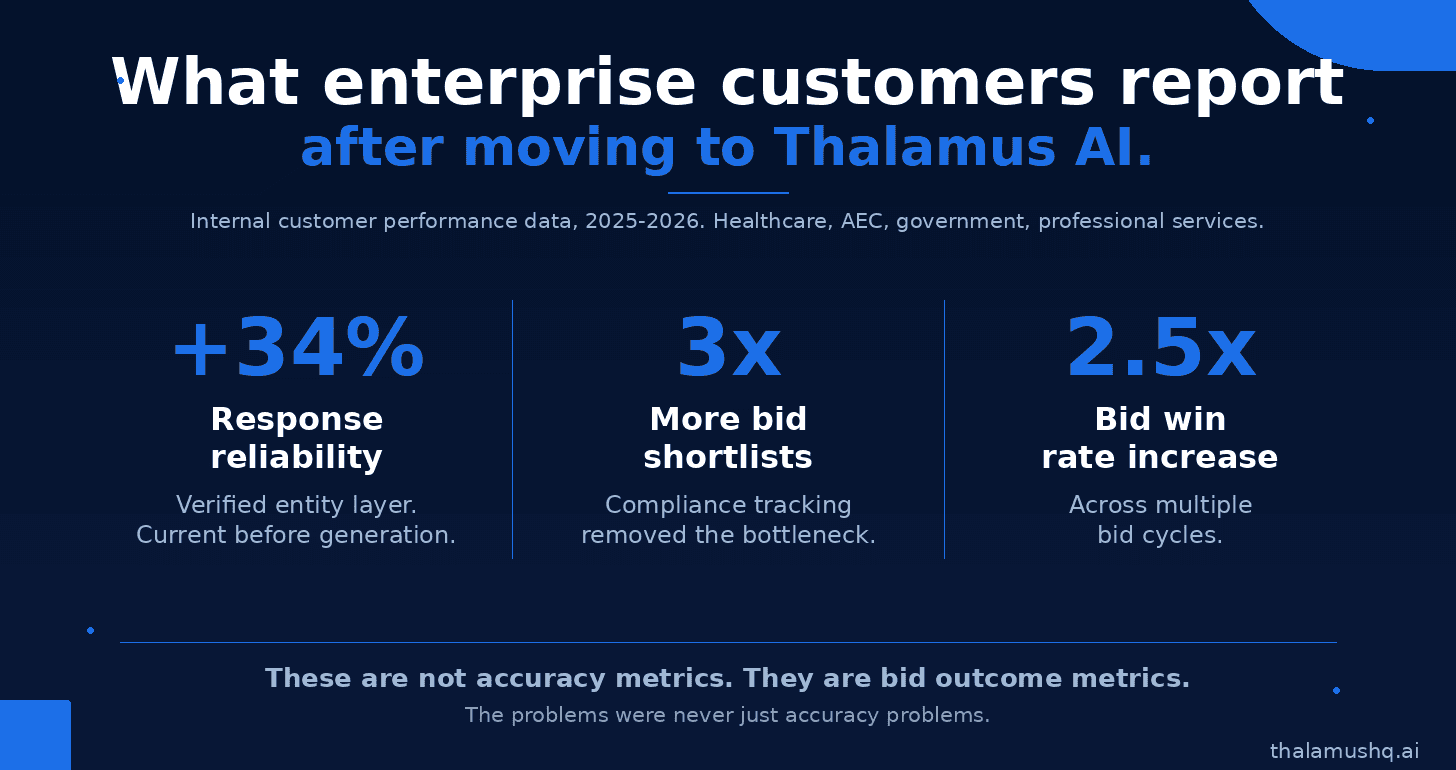
Based on Thalamus AI internal customer performance data (2025–2026), across enterprise teams in healthcare, AEC, government contracting, and professional services:

  • +34% improvement in response reliability - attributed to the verified knowledge entity layer ensuring that every claim in a bid is attributed to a current, verified source before it reaches the draft.

  • 3x more bid shortlist appearances - across customers managing complex, multi-section proposals where compliance tracking and multi-stakeholder coordination had previously been the bottleneck.

  • 2.5x increase in bid win rates - reported by enterprise teams using the full bid management platform across multiple bid cycles, not a single submission type. 

Conveyor is a well-designed, genuinely innovative platform and the Trust Center is a product idea that no other vendor in this category has matched. For the workload it was built for, it performs consistently and earns its user ratings. What it was never designed to manage is the full complexity of a bid: requirement parsing, compliance tracking, narrative synthesis, stakeholder coordination, and the institutional learning that makes the next bid stronger than the last.

If the security questionnaire queue is your hardest problem, Conveyor solves it well. If the 130-page proposal that contains those questionnaires is your hardest problem, the comparison runs the other way.

Bring one RFP. We'll show you what full bid lifecycle management looks like, security questionnaires included, in 20 minutes. Book a Thalamus AI demo.

Thalamus AI vs Conveyor - FAQs

Does Conveyor integrate with Salesforce or other CRMs?

Conveyor integrates with Salesforce for deal-stage triggering of security review workflows, and connects to Google Drive and SharePoint for knowledge ingestion. Its integration footprint is narrower than enterprise-wide platforms like Responsive, but covers the core stack a security and sales team typically needs.

Can Conveyor handle Excel and Word-based questionnaires, or only online portals?

Conveyor handles Excel and Word formats in addition to web-based portals via its browser extension. The browser extension is particularly well-regarded for completing portal-based questionnaires on platforms like OneTrust directly, without needing to export and re-import files.

Does Thalamus AI have a Trust Center or customer-facing security portal?

No. Thalamus AI does not include a customer-facing Trust Center where prospects can self-serve security documentation. Its security questionnaire capability is on the response side, answering incoming requests faster, not on the demand side of reducing how many requests arrive.

Is Conveyor suitable for regulated industries like healthcare or financial services?

Conveyor's SOC 2 Type II compliance and enterprise OpenAI API usage with a no-data-training guarantee make it appropriate for many regulated environments at the security questionnaire level. It does not hold HIPAA BAA documentation as a publicly stated certification, so teams in heavily regulated verticals should verify compliance scope directly with Conveyor before signing.